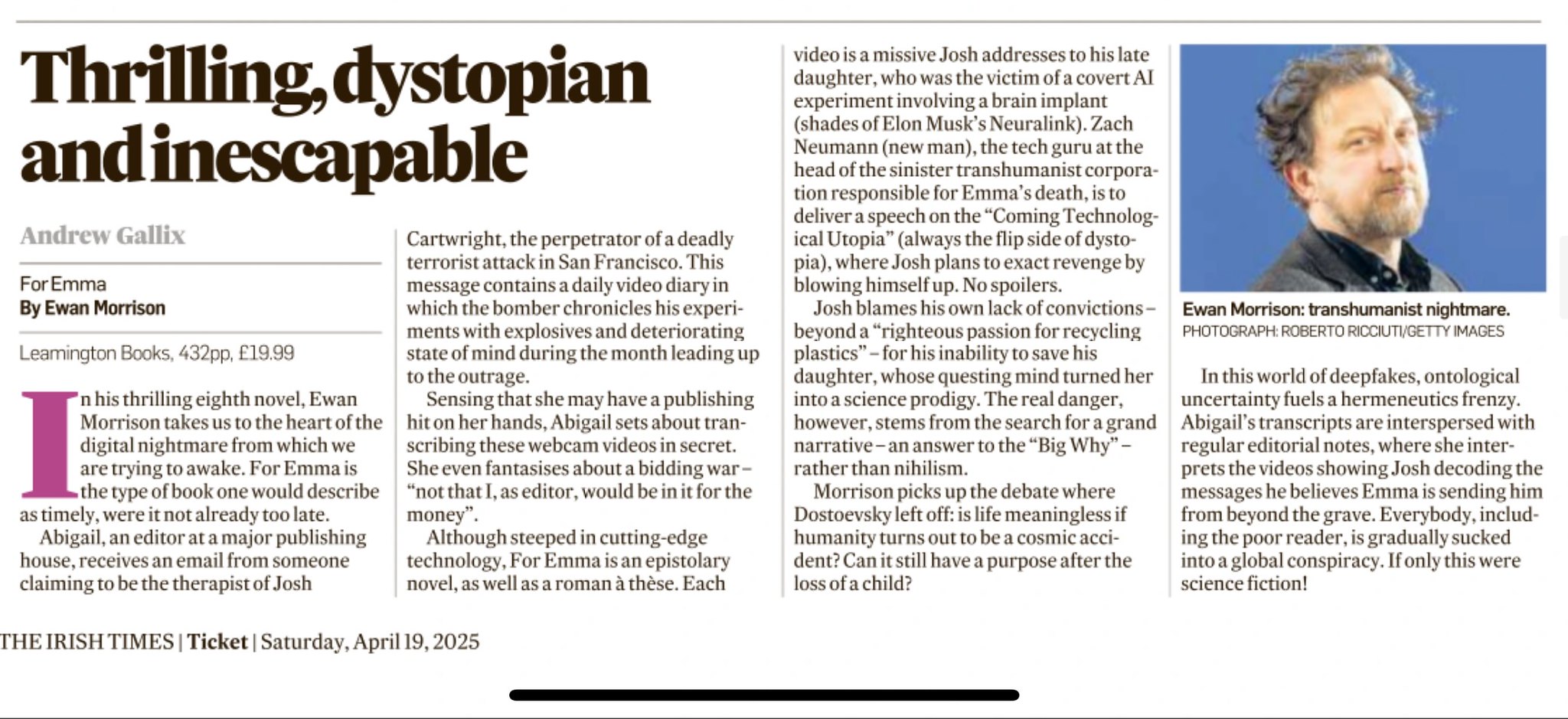
“Thrilling, Dystopian and Inescapable.” Review of For Emma by Ewan Morrison, The Irish Times, 19 April 2025, p. 22.
In his thrilling eighth novel, Ewan Morrison takes us to the heart of the digital nightmare from which we are trying to awake. For Emma is the type of book one would describe as timely, were it not already too late.
Abigail, an editor at a major publishing house, receives an email from someone claiming to be the therapist of Josh Cartwright, the perpetrator of a deadly terrorist attack in San Francisco. This message contains a daily video diary in which the bomber chronicles his experiments with explosives and deteriorating state of mind during the month leading up to the outrage.
Sensing that she may have a publishing hit on her hands, Abigail sets about transcribing these webcam videos in secret. She even fantasises about a bidding war — “not that I, as editor, would be in it for the money”.
Although steeped in cutting-edge technology, For Emma is an epistolary novel, as well as a roman à thèse. Each video is a missive Josh addresses to his late daughter, who was the victim of a covert AI experiment involving a brain implant (shades of Elon Musk’s Neuralink). Zach Neumann (new man), the tech guru at the head of the sinister transhumanist corporation responsible for Emma’s death, is to deliver a speech on the “Coming Technological Utopia” (always the flip side of dystopia), where Josh plans to exact revenge by blowing himself up. No spoilers.
Josh blames his own lack of convictions — beyond a “righteous passion for
recycling plastics” — for his inability to save his daughter, whose questing mind turned her into a science prodigy. The real danger, however, stems from the search for a grand narrative — an answer to the “Big Why” — rather than nihilism.
Morrison picks up the debate where Dostoevsky left off: is life meaningless if humanity turns out to be a cosmic accident? Can it still have a purpose after the loss of a child?
In this world of deepfakes, ontological uncertainty fuels a hermeneutics frenzy. Abigail’s transcripts are interspersed with regular editorial notes, where she interprets the videos showing Josh decoding the messages he believes Emma is sending him from beyond the grave. Everybody, including the poor reader, is gradually sucked into a global conspiracy. If only this were science fiction!
Macdonald, Rowena. “From Old Analogue to Nervily Digital.” Review of Unwords by Andrew Gallix and No Judgement by Lauren Oyler, The Irish Times, 23 March 2024
Andrew Gallix is an Anglo-French writer who lives in Paris and set up 3:AM Magazine, one of the first online literary magazines, in the year 2000. Unwords is a collection of essays but is also, as he explains, “not the book I wanted to write”.
The book he wanted to write was a work of criticism started in 1990, for which he got a publishing contract, but which remained unfinished because he couldn’t perfect the manuscript to his liking. “I wanted my book to contain not only multitudes, but everything.”
This “phantom book” haunts the pages of Unwords and the theme of unwritten books, unreadable books and books that attempt but fail to contain the whole of experience (as all books are doomed to do) is revisited throughout along with writers who stop writing, writers who “do not feel the need to publish in order to affirm … their status”, “writers who take their time; writers who take their lives … writers who vanish into their writing” or “who vanish into thin air”.
Unwords includes witty, accessible essays on French philosophers (Barthes, Sartre et al), French and English underground culture and the experimental authors that 3:AM has championed, alongside phenomena such as prank pie-throwing, hauntology and spam literature. Towards the end it includes personal pieces on Gallix’s time as a punk in New York, an elegy to lost childhood/Guy the Gorilla and a moving letter to his late mother.
Gallix is at heart a modernist and has little time for middlebrow, well-made novels by careerist “professional” authors. For me the most inspirational character in Unwords is Albert Cossery, the Egyptian-born writer, who died in 2008 aged 94, and who lived in the same Left Bank hotel for 63 years, did not bother to get a day job and instead subsisted on the royalties from his eight novels and followed the same radically lazy daily routine: “Every day, he got up at noon (like his characters), dressed up in his habitual dandified fashion and made his way to the Brasserie Lipp for a spot of lunch. From there, he usually repaired to the Flore or the Deux Magots where he would cast an Olympian eye over the drones passing by. Then it was time for his all-important siesta. Repeat ad infinitum”.
Neither London nor Paris allows writers to be so lackadaisical nowadays. Unwords may not be the Gesamtkunstwerk that Gallix wanted to write but the erudition contained within is remarkable, and yet it has a charming light touch.
So, to Lauren Oyler’s No Judgement. If I came to Gallix warm, as I’m familiar with 3:AM Magazine, I came to Oyler cold, having never heard of her. …
Gallix is a gentle melancholy guide, more analogue, older, European; Oyler is nervily digital, younger, very American in sensibility despite more than a decade in Europe. …
Unwords and No Judgement reveal the world views of two equally clever authors; are you in the mood for encouragement towards intellectual discourse, or confrontation?
“Haunted by the Music.” Review of August Blue by Deborah Levy, The Irish Times, 13 May 2023, p. 26.
A character in Swimming Home (2011), Deborah Levy’s breakthrough title, confides that she only enjoys biographies once the subjects have escaped “from their family, and spend the rest of their life getting over them”. In August Blue, her eighth novel, the author reprises this approach, but flips it round. The family Elsa is striving to get over is the one she never had, hence the question that haunts this book, lending it a spectral quality: how do you escape from the presence of absence?
Elsa M Anderson, the young protagonist, has quite a back story to contend with. Having been abandoned at birth by her mother, this piano prodigy was then “gifted” (authorial pun intended) by her foster parents to Arthur Goldstein, so that she could become a resident pupil at his prestigious music school. Goldstein, a diminutive but flamboyant aesthete, moulds his protégée into a virtuoso performer of international repute. He regards Elsa as his “child muse” rather than simply his child, encouraging her — through the cultivation of her talent — to dwell in a higher abode: “He meant a home in art”. The art of others is what he really meant. Although he cares for her deeply, as becomes apparent in his dying days, Goldstein discouraged Elsa’s “early attempts at composition”, threatened as he was by her ability to “hear something that he did not understand”.
Three weeks prior to the opening scene, this “something” — an “embryonic symphony” — had infiltrated the piano concerto Elsa was interpreting at Vienna’s Golden Hall. Her hands (insured for millions of dollars) “refused to play” the score despite the conductor’s baton-wielding histrionics: for a few minutes, Elsa “ceased to inhabit Rachmaninov’s sadness”, and dared to inhabit her own. She then walked off stage, sabotaging her career but reclaiming her life. As a prelude to this very public breakdown, she had dyed her hair blue, signalling a defiant “separation from [her] DNA”, but also from her mentor, whose “hostage” she had been since the age of six.
After rejecting the “old composition”, Elsa is free to dance to a new tune. An all-pervasive mood of “hyper-alert connections to everything” — not dissimilar to Levy’s adventurous free-associative prose — holds sway as she peregrinates through Athens, Paris, London and Sardinia. Her choice of creation (over interpretation) engenders a proliferation of duplications. Timelines overlap and locales collide in an intricate network of uncanny echoes exemplified by the ants that run along the rim of Elsa’s bath in both her London and Paris flats: “They had found a portal to all my worlds”. The non-binary teenager’s refusal to become their father’s “little me” likewise mirrors the heroine’s quest for identity and autonomy.
Elsa, however, is borne back into the past as she ventures into the future. The repressed returns in various guises, particularly in the shape of a pair of mechanical horses purchased by a young woman in an Athens flea market. These knick-knacks conjure up a recurring childhood memory — that of a piano being pulled by horses across a field — whose significance is slowly revealed to character and reader alike.
Not only does Elsa feel that the mechanical horses have somehow been stolen from her, but she is also convinced that the stranger at the market is in fact her doppelgänger. Although she is in her early 30s, like Elsa, and wears a very similar raincoat, the two women are in no way identical. Yet the protagonist seems to be in telepathic communication with this “psychic double” who, she believes, is stalking her across several countries. Elsa retrieves the hat the woman has forgotten, vowing to hand it back in exchange for the totemic horses.
The extent to which the doppelgänger is merely a figment of her lonely imagination, an idealised version of herself (“Perhaps she was a little more than I was”), or even her polar opposite in some parallel quantum universe remains open to interpretation. With her “attitude and confidence”, she certainly seems to embody the self-composure that the newly emancipated Elsa aspires to: “Perched between her lips was a fat cigar. Glowing at the end. It was a poke at life. A provocation”. At times, this “unlikely double” almost seems to merge with another phantom figure — that of the birth mother.
“My words were smaller than my feelings,” Elsa laments. The novelist’s achievement is to have found words equal to hers. Deborah Levy is now regarded as a grande dame of literature, but she remains as vital as ever, and August Blue is a mistresspiece.
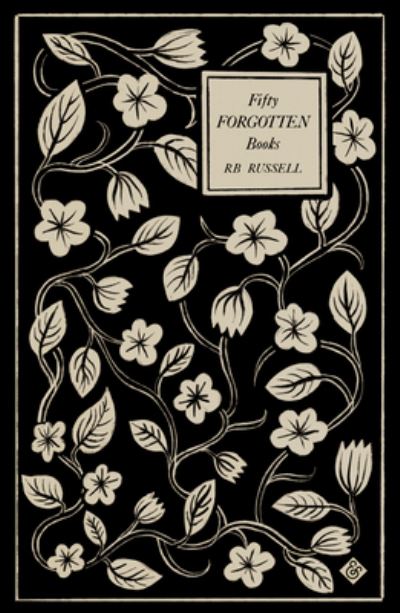
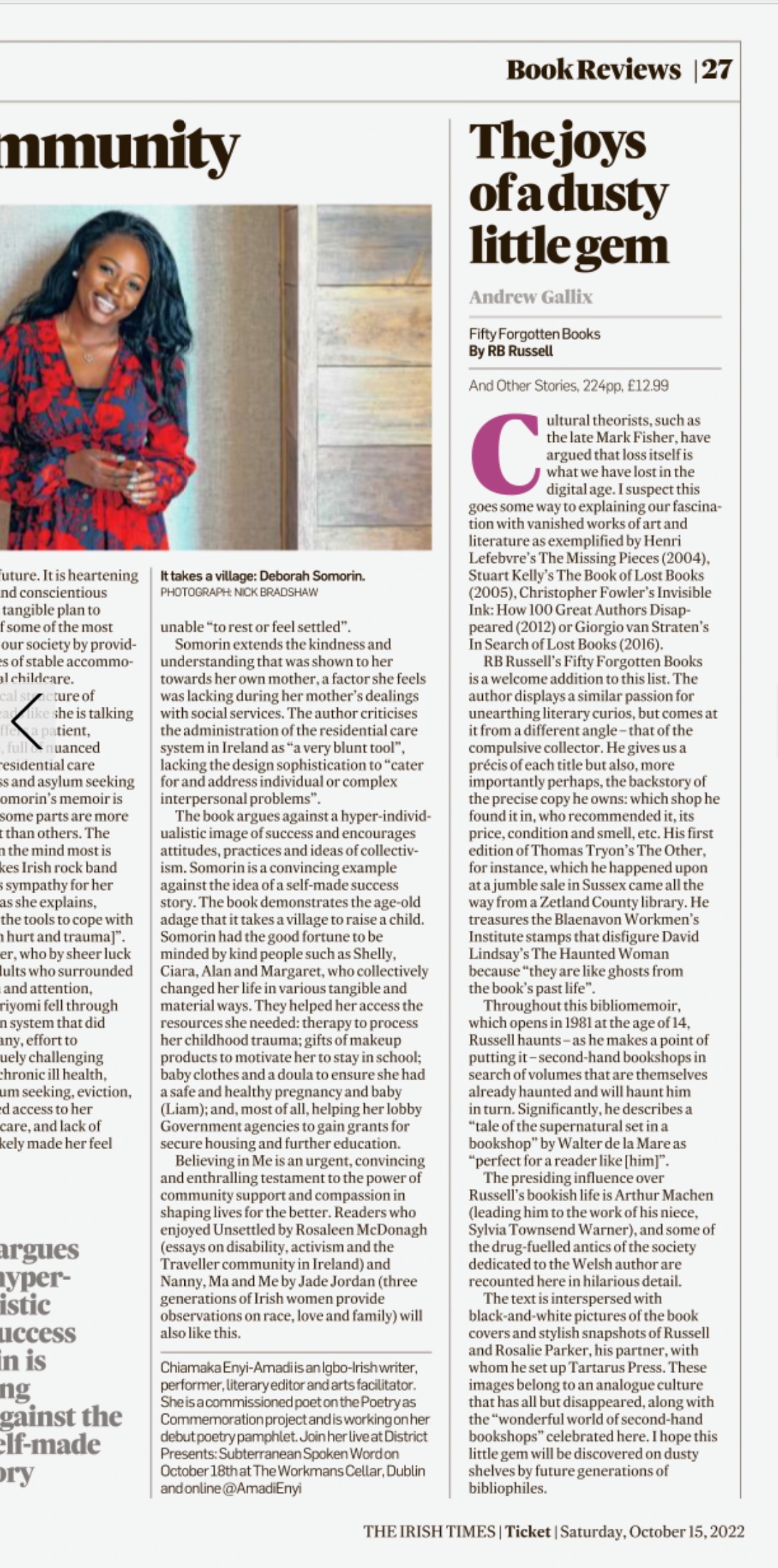
“The Joys of a Dusty Little Gem.” Review of Fifty Forgotten Books by R. B. Russell. The Irish Times, 15 October 2022, p. 27.
Cultural theorists, such as the late Mark Fisher, have argued that loss itself is what we have lost in the digital age. I suspect this goes some way to explaining our fascination with vanished works of art and literature as exemplified by Henri Lefebvre’s The Missing Pieces (2004), Stuart Kelly’s The Book of Lost Books (2005), Christopher Fowler’s Invisible Ink: How 100 Great Authors Disappeared (2012) or Giorgio van Straten’s In Search of Lost Books (2016).
R. B. Russell’s Fifty Forgotten Books is a welcome addition to this list. The author displays a similar passion for unearthing literary curios, but comes at it from a different angle — that of the compulsive collector. He gives us a précis of each title but also, more importantly perhaps, the backstory of the precise copy he owns: which shop he found it in, who recommended it, its price, condition and smell, etc. His first edition of Thomas Tryon’s The Other, for instance, which he happened upon at a jumble sale in Sussex came all the way from a Zetland County library. He treasures the Blaenavon Workmen’s Institute stamps that disfigure David Lindsay’s The Haunted Woman because “they are like ghosts from the book’s past life”.
Throughout this bibliomemoir, which opens in 1981 at the age of 14, Russell haunts — as he makes a point of putting it — second-hand bookshops in search of volumes that are themselves already haunted and will haunt him in turn. Significantly, he describes a “tale of the supernatural set in a bookshop” by Walter de la Mare as “perfect for a reader like [him]”.
The presiding influence over Russell’s bookish life is Arthur Machen (leading him to the work of his niece, Sylvia Townsend Warner), and some of the drug-fuelled antics of the society dedicated to the Welsh author are recounted here in hilarious detail.
The text is interspersed with black-and-white pictures of the book covers and stylish snapshots of Russell and Rosalie Parker, his partner, with whom he set up Tartarus Press. These images belong to an analogue culture that has all but disappeared, along with the “wonderful world of second-hand bookshops” celebrated here. I hope this little gem will be discovered on dusty shelves by future generations of bibliophiles.
“This Year’s Cult Classic.” Review of Bad Eminence by James Greer. The Irish Times, 16 July 2022, p. 16.
Bad Eminence, American author James Greer’s third novel, is the kind of book you open at your peril. The title alone (a reference to Milton’s Satan) should be warning aplenty, but it is my duty to report that a Latin phrase, planted in the opening pages, leads — once read — to instant possession by the devil. By the same token, I strongly advise you not to cut out and ingest the large dot containing a highly potent hallucinogenic, however much the narrator enjoins you to do so.
Things are already weird enough as it is with the regular intrusion of “sponsored content”, the small black-and-white photographs reminiscent of W.G. Sebald (who is name-checked several times), the recurrence of swans and characters called Temple, not to mention the growing sense of psychosis and gradual dissolution of all ontological certainty.
Vanessa Salomon — the wisecracking narratrix — is a young Franco-American translator, blessed with tremendous “genetic gifts” and a knack for nihilistic aphorisms. Thanks to her reputation for tackling works deemed untranslatable, she is hired by Not Michel Houellebecq to translate his new novel before it is even written. What France’s most famous author really covets, however, is another copy without an original: Vanessa’s celebrity “bitch twin sister”. Or is it?
The novel reaches a metatextual crescendo when the heroine parses a sentence she has just written: “I shut the lid of the laptop and headed back to bed”. She points out that this can only have been typed before or after the event, reflecting her dream of a book that would inhabit “the spaces between the binary code of our existence”. “Everything,” she declares, in what amounts to a manifesto, “is in the process either of becoming or unbecoming, and it is the task of the artist not to make something new but to make something present”.
Once the rollicking narrative has caught up with itself, the novel implodes in real-time. It becomes increasingly obvious that transgressive, S&M fantasies from the Robbe-Grillet book Vanessa was translating at the beginning have been contaminating the rest of her life, and that her world is now awash with simulacra and doppelgängers.
Hilarious, exhilarating and mind-blowing, Bad Eminence is this year’s cult classic.
Here is my review of The Making of Incarnation by Tom McCarthy. The Irish Times, 2 October 2021, p. 15:
Tom McCarthy’s fifth and arguably most ambitious novel brings to mind Theodor Adorno’s definition of art as “magic delivered from the lie of being truth”. The Making of Incarnation is about bodies in space — outer space in the case of the sci-fi blockbuster (Incarnation) that serves as both armature and mise en abyme. Here, the lie of being truth (which another character describes as “[n]aturalist bullshit”) must be perpetuated at all costs.
Ben Briar is flown in from the United States as part of a shadowy project called Degree Zero (a nod to Roland Barthes and his reality effect) to ensure that the film’s script, however fanciful, complies with the basic laws of physics. Herzberg, the art director, expends a great deal of energy convincing this “Realism Tsar” that the inclusion of mundane objects in the unlikeliest of set-ups can effectively “counteract the defamiliarisation”. Much is subsequently made of the CGI rendering of a fork (“your basic IKEA Livnära”) that recurs — comically as well as cosmically — throughout the climactic disintegration of the spacecraft.
Given that Briar works for a consultancy called Two Cultures (vide C. P. Snow), it is hardly surprising that he should view physics as a creative endeavour — “a plunge into the farthest-flung reaches of the imagination”. The unfolding of the plot, as the shoot progresses, is interspersed with complex descriptions of the wind tunnels and motion-capture techniques deployed behind the scenes. These are so meticulously detailed that they take on a hypnotic, almost hallucinatory, quality.
Kinesis moves in mysterious ways: at every corner, the scientific turns out to be underpinned by the poetic — or even the messianic. Pantaray Motion Systems is not only the slightly sinister corporate behemoth providing the cutting-edge technology without which there would be no movie; it also has “a heroic status tinged with traces of the mystical”.
Anthony Garnett, its founder, recalls once considering Norbert Wiener (the originator of cybernetics) as “prophet, messiah and apostle”. There was something in his vision that he thought “he’d left behind with Aeschylus, Catullus, Sappho: a condition best denoted by the old, unscientific label poetry”.
Garnett’s colleague Pilkington — referred to, behind his back, as the “Ancient Mariner” — senses that all machines are “stand-ins for some ultimate machine we’ll never build but nonetheless can’t stop ourselves from trying to”. Tasked with orchestrating an experimental plane crash, he goes looking for the “ur-disaster” — the “totality that hovers above every partial iteration”.
Monica Dean, who is conducting research into Lillian Gilbreth, discovers that the pioneer of factory-floor ergonomics had come to entertain “the possibility of some ‘higher’ or ‘absolute’ movement . . . derived from no source other than itself”. The novel is teeming with such intimations of preordained patterns or underlying algorithms.
In this quest for perfection, the human body is ultimately an obstacle. We are reminded that the French scientist Marey sought to infuse his compatriots with the “energy and dynamism of the locomotive” and that Taylorism was seen by some in the Soviet Union as an opportunity to liberate the worker from “the shackles of his very body”. This rejection of incarnation is (paradoxically) embodied by the film’s high romantic denouement: the two lovers, whose union is impossible, bow out in a blaze of glory, expecting to coincide with themselves — and everything — at the instant of their deaths.
The novel, however, does not end with the blinding light of revelation, but a “blackness neither rays nor traces penetrate”. Besides, there is an error in the code behind the film’s final frame — an invisible blemish only the technician is aware of. It recalls Pilkington’s secret that he alone was responsible for the failure of Project Albatross, a minute miscalculation having led the plane to vanish instead of crashing. He imagines the lost aircraft occupying “an aporia, blind alley, cubby-hole or nook”.
This instant of its disappearance, “cut out from the flow of time” — for ever suspended, deferred — is akin to the sense of dislocation that several characters experience: the feeling of being in two locations at once “without really being in either”; of experiencing the present and the past simultaneously while being at one remove from both.
Is not this liminality the very space of fiction, squatted by the two addicts, who reappear right at the end, lost in their pipe dreams and inevitably conjuring up Beckett’s Vladimir and Estragon?
The answer, no doubt, is to be found in Lillian Gilbreth’s Box 808 — the one that allegedly “changes everything”, that may “chisel a Northwest Passage through a stretch of the hitherto theoretical-physically impossible”. The one that is missing, of course, and that everyone — from the protagonist, Pantaray’s Dr Mark Phocan, to the secret services — is looking for.
The truth is out there: Tom McCarthy has worked his magic once again.
Here is my review of The Netanyahus by Joshua Cohen. The Irish Times, 5 June 2021, p. 17.
In a postface to his sixth novel, The Netanyahus, Joshua Cohen relates how he befriended Harold Bloom (to whom this book is dedicated) towards the close of his life. The venerable critic regaled Cohen with countless anecdotes — playing chess with Nabokov, skinny-dipping with Derrida — but the one that made the greatest impression was the time he supervised the campus visit of an “obscure Israeli historian” called Ben-Zion Netanyahu, who rocked up with his feral family, leaving a trail of destruction in his wake. Netanyahu’s second-born child went on to become the longest-serving, and most controversial, prime minister in Israeli history, thus endowing this farcical fait divers with a retrospective patina of world-historical importance: “An Account of a Minor and Ultimately Even Negligible Episode in the History of a Very Famous Family”.
The antique cast of this comically prolix, self-deprecating subtitle is redolent of early novels, which frequently masqueraded as authentic documents. The Netanyahus purports to be composed by a retired academic who, sensing the nighness of the end, is prompted to put pen to paper, as established in the opening sentences: “My name is Ruben Blum and I’m, yes, an historian. Soon enough, though, I guess I’ll be historical”. This transmutation of subject into subject matter is posited as a “more natural, rational incarnation” than the Christian version: “Goys believe in the Word becoming Flesh, but Jews believe in the Flesh becoming Word”. It could also be construed as the mission statement of an author at the top of his game who, like Flaubert, has alchemised a rather insignificant real-life incident into fictive gold. Cohen exploits his character’s professional rigour to sport with the conventions of memoir. Quotation marks are “holy to historians”, Ruben explains, vowing “to express only what was expressed to [him], as verbatim as [his] memory is able” — which is ironic given that both he and the dialogue are made up. Beyond his aversion to today’s “culture of grievance”, the character bears no resemblance to Harold Bloom. There is his surname, of course, but Ruben’s year of birth — 1922 — connects him to Joyce’s Leopold Bloom, and hence the world of fiction, rather than the waking nightmare of his discipline.
The struggle between history and myth provides the novel with its dialectical armature. History is associated with the onward march of progress, which would go on unimpeded “so long as every country kept trying to be more like America and America kept trying to be more like itself”. Even the revisionist zealot Ben-Zion is depicted, “lotused” on the floor in front of his hosts’ new colour television set, watching Bonanza with rapt attention. Significantly, when events spiral out of control, the tohubohu unleashed by the “Yahus” (as Ruben and his wife, Edith, call them) is likened to technological failure: “the snow was hissing down like static from a world signed-off, ash from the end of broadcast days”.
Ruben opted for “pagan” academia in a bid to flee his “Jewish past” (which returns in the shape of the Yahus), but remains torn between “the American condition of being able to choose and the Jewish condition of being chosen”. His teenage daughter Judy — whose agonistic relation to her elders provides a great deal of mirth — chooses rhinoplasty, which may be her own way of leaving behind the stereotypes affixed to her origins. Corbindale, where the Blums relocated from New York City, is so nondescript that their relatives keep calling it “Corbinton” or “Corbinville”. It is also a hotbed of petty anti-Semitism. The mechanic at the local garage pats Ruben’s head to feel his horns and, as the first Jew to be hired by Corbin College, he is expected to don a Santa Claus outfit at Christmas. It is for this very reason too that he is tasked, in 1960, with vetting Mr Netanyahu’s application and preparing his visit. Ben-Zion, whose idiosyncratic interpretation of the Iberian Inquisition I shall not disclose, argues that the Jewish people have been able to endure by abiding in myth, from whence he himself seems to have sprung. When he howls, it is “in the wind’s language, Hebrew” that he does so.
The Netanyahus demonstrates what can still be done within the relatively conventional yet capacious parameters of literary fiction. It veers from mid-century comedy of manners to campus caper by way of social, political and religious satire. Bravura displays — such as the hilarious scene where Edith’s mother harangues Ruben while her husband unburdens himself, most indiscreetly, in the adjoining toilet — are legion. Dialogue is deftly handled throughout: the banter between Ruben and Edith, in particular, is pitch perfect. Cohen’s style — inventive but elegantly understated — is a class act that few of his contemporaries can follow.
Here is my review of Chauvo-Feminism: On Sex, Power and #MeToo by Sam Mills. The Irish Times, 27 February 2021, p. 14:
A performative espousal of feminist principles may be a fig leaf for plain old misogyny. Many of the abusers exposed by the #MeToo movement — including Harvey Weinstein himself — were men of a woke persuasion. Sam Mills calls them chauvo-feminists, among other things. She even dated one, which gave rise to a textbook case of gaslighting. This provides the armature for a coruscating disquisition on the mind games of Jekylls who Hyde in plain sight. Mills corrals a vast array of material, blending poignant memoir and meticulous research to great effect. Bristling with righteous indignation, yet commendably nuanced, her essay is never less than entertaining, as when she remarks that map-reading is not a task she has to ‘strain against [her] vagina to accomplish’.
Here is my review of The Death of Francis Bacon by Max Porter. The Irish Times, 9 January 2021, p. 13:
Porter’s Portrait of the Artist is a Masterpiece in Miniature
Max Porter explores the inner workings of Francis Bacon’s mind as the artist deliriously recalls his life
If writing about music is like dancing about architecture, what of painting? As Francis Bacon once said, “If you can talk about it, why paint it?” Indeed. In his third novel, Max Porter explores what happens when you contemplate canvases to the point of being contemplated by them.
Rather than talk about Bacon’s paintings, he lets them speak — or mutely howl — and what they express is not what they represent, but how they feel: the sensation of their own brute facticity. “I can still feel it, right through me, like a shock,” Bacon says here, remembering the time when he “bit down on shot” while dining out on pheasant stew: “Metal drill in my fillings right down through my urethra. Buzzing in my underbladder.”
Possibly moonlighting as the critic David Sylvester, the author plants a sneaky mission statement at the beginning of the fourth chapter, where he confesses his longstanding “unfashionable fixation” with the painter as well as his aim “to get art history out of the way”. (Porter once obtained an MA in this very subject at London’s Courtauld.)
Bacon is lying on his deathbed in a Madrid clinic, where he is attended to by a sister whom he addresses as Hermana or Mercedes (she calls him “piggy”) and regularly mistakes for figures from his past, such as his lover and muse Peter Lacy or photographer and Soho habitué John Deakin. Through a series of delirious dreams, his life is depicted in the visceral style of his work.
Tales of turpentine and turpitude, fisting and feasting commingle with children’s stories and striking imagery, while the artist ponders his legacy: “Oh naff off you skag,” he says apropos of one famous critic. Dying itself is leavened with dark levity: “I wonder if I might have no pain. If you’d be so kind.”
The opening section — one page long, text laid out like a poem, copious amounts of blank space — is devoted to a “[N]on-existent” sketch, from which we may infer that all the other works conjured up thereafter are authentic and still extant. Every subsequent chapter proceeds from a different oil on canvas — seven in all — of varying dimensions (the smallest being 14 x 12 inches).
Of little import at first blush, these measurements highlight the art’s materiality, enabling us to track down, with a fair degree of accuracy, most of the pieces Porter has purposely left untitled. They also allow us to ascertain that the sequence in which the paintings are summoned is strictly chronological down to the penultimate chapter, which is in keeping with the narrative’s biographical tenor.
Porter spares us the tiresome ekphrases. Save for the aforementioned sketch, none of the artworks is described. The emphasis is placed firmly on the creative process and how the works “work”. The revelation of the models’ convulsive beauty, for instance, as soon as they twist and turn — a recurrent gesture that echoes Bacon’s retrospection. When the sister turns sitter she suddenly becomes a “handsome prospect”, her “crowded mouth” making the artist yearn to see her snarl: “that’s why she has to sit like that, as if sitting for me, lest those rows of teeth burp out”.
In one instance Bacon juxtaposes the boyish features of Don Carlos, seen on one painting, with Julius Caesar’s punctured body from another: “I folded the head over at the eyes and laid it on the injury.” This is portraiture as vivisection: “Yes, peeling a scab. Lifting the whole clotty lot of it and seeing the root. Verruca stippled. These are a few of my favourite things.”
The non-existent preparatory sketch, which Bacon cannot recall drafting, represents his own deathbed scene. It soon becomes apparent that with each new chapter and canvas, the sketch is being fleshed out. This impression is reinforced by the numerous repetitions: the sister’s incessant “Intenta descansar”, on which the book closes, produces a sort of litany; every chapter beginning with “Take a seat why don’t you” and containing questions pitting the painter against other figures (Edward the Martyr, Caesar, Mussolini, Caravaggio).
All the while, Bacon is painting his own departure until he absents himself through his work, resurfacing in canvases hanging in museums and galleries from whence he can spend an eternity mocking his critical foes. Self-portraiture as auto-autopsy.
The Death of Francis Bacon is a little masterpiece; a slim volume that packs a mean Peter Lacy-style punch. It is as though Porter had bit down on shot, taking the most adventurous passages from his two previous novels and letting rip — painting in words the “deeply ordered chaos” Bacon saw all about him.







 ANDREW GALLIX