Colossal Youth

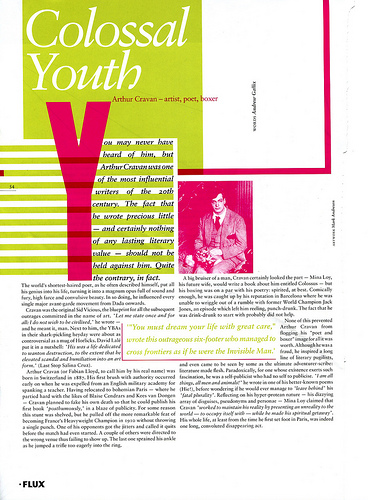
This appeared in the autumn 2009 issue of Flux magazine (issue 70, pp. 54-57):

Colossal Youth

Arthur Cravan — artist, poet, boxer

You may never have heard of him, but Arthur Cravan was one of the most influential writers of the 20th century. The fact that he wrote precious little — and certainly nothing of any lasting literary value — should not be held against him. Quite the contrary, in fact. The world’s shortest-haired poet, as he often described himself, put all his genius into his life, turning it into a magnum opus full of sound and fury, high farce and convulsive beauty. In so doing, he influenced every single major avant-garde movement from Dada onwards. Cravan was the original Sid Vicious, the blueprint for all the subsequent outrages committed in the name of art. “Let me state once and for all: I do not wish to be civilised,” he wrote — and he meant it, man. Next to him, the YBAs in their shark-pickling heyday were about as controversial as a mug of Horlicks. David Lalé put it in a nutshell: “His was a life dedicated to wanton destruction, to the extent that he elevated scandal and humiliation into an art form” (Last Stop Salina Cruz).

Arthur Cravan (or Fabian Lloyd, to call him by his real name) was born in Switzerland in 1887. His first brush with authority occurred early on when he was expelled from an English military academy for spanking a teacher. Having relocated to bohemian Paris — where he partied hard with the likes of Blaise Cendrars and Kees van Dongen — Cravan planned to fake his own death so that he could publish his first book “posthumously,” in a blaze of publicity. For some reason this stunt was shelved, but he pulled off the more remarkable feat of becoming France’s Heavyweight Champion in 1910 without throwing a single punch. One of his opponents got the jitters and called it quits before the match had even started. A couple of others were directed to the wrong venue thus failing to show up. The last one sprained his ankle as he jumped a trifle too eagerly into the ring.

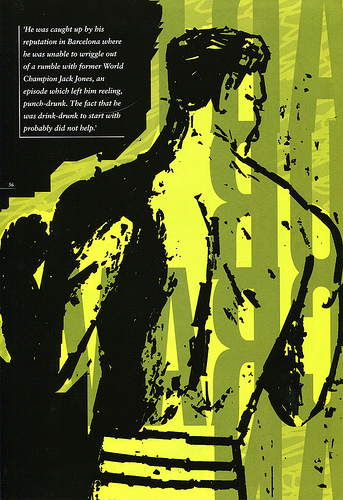
A big bruiser of a man, Cravan certainly looked the part — Mina Loy, his future wife, would write a book about him entitled Colossus — but his boxing was on a par with his poetry: spirited, at best. Comically enough, he was caught up by his reputation in Barcelona where he was unable to wriggle out of a rumble with former World Champion Jack Jones, an episode which left him reeling, punch-drunk. The fact that he was drink-drunk to start with probably did not help.

None of this prevented Arthur Cravan from flogging his “poet and boxer” image for all it was worth. Although he was a fraud, he inspired a long line of literary pugilists, and even came to be seen by some as the ultimate adventurer-scribe: literature made flesh. Paradoxically, for one whose existence exerts such fascination, he was a self-publicist who had no self to publicise. “I am all things, all men and animals!” he wrote in one of his better-known poems (“Hie!”), before wondering if he would ever manage to “leave behind” his “fatal plurality”. Reflecting on his hyper-protean nature — his dizzying array of disguises, pseudonyms and personae — Mina Loy claimed that Cravan “worked to maintain his reality by presenting an unreality to the world — to occupy itself with — while he made his spiritual getaway”. His whole life, at least from the time he first set foot in Paris, was indeed one long, convoluted disappearing act.

Cravan first gained the notoriety he so craved through Maintenant (“Now”), the literary journal in which he wrote everything under various noms de plume. It was partly a vanity outlet for his poems and essays, but primarily a means of courting controversy. Sourced from a butcher’s shop, the very paper it was printed on highlighted his utter contempt for belles-lettres. In the first issue, he ran a fake interview with Oscar Wilde — his late uncle — claiming that he was still alive. Cravan’s Bill Grundy moment occurred when he devoted an entire issue to gratuitous insults aimed at almost all the painters taking part in the 1914 Independents Exhibition. He opined, for instance, that only a good seeing-to would enable Marie Laurencin to fully grasp the true meaning of Art. As a result, her lover — the poet Guillaume Apollinaire — challenged Cravan to a duel which he narrowly avoided by apologising half-heartedly. He was also taken to court and almost lynched by a posse of avant-garde painters while selling copies of his journal from a wheelbarrow outside the exhibition room.

Maintenant proved that writing, for Cravan, was essentially boxing by another means, as did the infamous series of conferences he gave in Paris. During these happenings, he would take swigs from a bottle of absinthe (in lieu of the habitual bottle of water), shout abuse at the spectators and even fire gunshots over their heads. On one occasion, he wore nothing but a butcher’s apron and concluded proceedings by mooning the audience instead of bowing in the traditional fashion. On another, he sold rotten fruit and vegetables at the entrance so that people could pelt him during the performance should they feel so inclined (which they did). His final Parisian gig descended into pandemonium when he failed to commit suicide as advertised — a riot that forestalled his drunken inauguration of the 1917 Exhibition of the Society of Independent Artists in New York. Francis Picabia and Marcel Duchamp (whose legendary urinal was part of the show) had plied him with gallons of booze beforehand in the hope that his antics would put Dada on the map in the United States. Cravan rose to the occasion: he stumbled on stage looking the worse for wear and started to strip — knocking over a painting in the process — only to be pounced upon and carted away by security. Job done.

Arthur Cravan took Romantic hysteria to its logical conclusion: he was by turns histrionic, attention-seeking, uncontrollable, excessive, hilarious and, most importantly, the author of himself (hustera is Greek for womb). He was also a con artist with a cause. “The world has always exploited the Artist,” he once declared, “it is time for the Artist to exploit the world!” It was his fake-painting trafficking, rather than the First World War, that initially forced him to go on the run. He roamed the Continent, using several fake IDs, looking for “that something the poet always seems to have mislaid,” as Mina Loy elegantly put it. In Barcelona he became something of a living legend among Dadaists. When the war seemed about to catch up with him again, he relocated to New York (travelling aboard the same ship as Trotsky) and fled once more as soon as the Americans entered the conflict. Cravan stole the passport of an artist friend (who had conveniently conked out following a night on the razz) before crossing the Mexican border dressed — paradoxically enough — as a soldier. He was last seen in 1918, sailing away on a drunken boat of his own making (probably bound for neutral Argentina), leaving behind his “fatal plurality” for ever. “Whatever is said and done or even thought,” he had declared, “we are prisoners of this senseless world”. Perhaps he was trying to prove himself wrong.

Cravan was always larger than life and, in many ways, he was just too bad to be true. He was a self-unmade man whose biggest conjuring trick was to spirit himself away by taking elusiveness to the point of illusiveness. “You must dream your life with great care,” wrote this outrageous six-footer who managed to cross frontiers as if he were the Invisible Man. In the years following his disappearance, he would be sighted all over the world in a variety of guises. Several people, for instance, were convinced that he was the shadowy Dorian Hope who passed himself off as André Gide’s personal secretary and sold forged Wilde manuscripts to English and Irish booksellers from his Paris base. There is even a theory according to which he was none other than B. Traven, the mysterious author of The Treasure of the Sierra Madre. He inspired Gide’s Lafcadio, the infamous character who kills a man for no other reason but to exercise his free will, and became a symbol of ultimate transgression for the likes of Guy Debord. Dead or alive, Arthur Cravan is still at large.
In Theory: Mimetic Desire

This appeared in Guardian Books on 8 February 2010:

In Theory: Mimetic Desire

Nearly 50 years on, René Girard’s theory remains a powerfully illuminating insight into both literature and the world


Mediated desire … Amanda Drew as Emma and Simon Thorp as Rodolphe in Oxford Playhouse’s 2003 production of Madame Bovary. Photograph: PR

Many thanks for your insightful comments on “The Death of the Author” and interesting suggestions concerning future discussion topics — please keep them coming. All this feedback confirms the utility of a debate on the purpose of literary theory at a time when critics have all too often retreated into academia or become appendages of publishers’ marketing departments. Talented critics can do so much more than just test-drive the latest products for consumers. They can shape the zeitgeist, renew our perception of great literary works and even help authors make sense of their own worlds — a hat-trick René Girard pulled off with Deceit, Desire and the Novel.

Discovering Deceit, Desire and the Novel is like putting on a pair of glasses and seeing the world come into focus. At its heart is an idea so simple, and yet so fundamental, that it seems incredible that no one had articulated it before. Girard’s premise is the Romantic myth of “divine autonomy”, according to which our desires are freely chosen expressions of our individuality. Don Quixote, for instance, aspires to a chivalric lifestyle. Nothing seems more straightforward but, besides the subject (Don Quixote) and object (chivalry), Girard highlights the vital presence of a model he calls the mediator (Amadis of Gaul in this instance). Don Quixote wants to lead the life of a knight errant because he has read the romances of Amadis of Gaul: far from being spontaneous, his desire stems from, and is mediated through, a third party. Metaphysical desire — as opposed to simple needs or appetites — is triangular, not linear. You can always trust a Frenchman to view the world as a ménage à trois.

Mediation is said to be external when the distance between subject and mediator is so great that never the twain shall meet. This is the case of Don Quixote and Amadis, or Emma Bovary and the fashionable Parisian circles she dreams of. Here, the derivative nature of desire is clearly acknowledged. The hero of external mediation “worships his model openly and declares himself his disciple”. When mediation is internal, however, the distance between subject and mediator is small enough to give rise to rivalry between the two. The mediator, who aroused desire for the object in the first place, comes to be seen as an obstacle to the fulfilment of this very desire: “the model shows his disciple the gate of paradise and forbids him to enter with one and the same gesture”. Although now ostensibly a figure of hatred, the mediator continues to be idolised subterraneously or even subconsciously. In Proust‘s In Search of Lost Time, for instance, the Guermantes remain Mme Verdurin’s sworn enemies until the day when she marries into this family she had in fact secretly admired and envied all along.

Girard’s contention is that the need for transcendence has survived the decline of Christianity, resulting in the ersatz “inverted transcendence” of mimetic desire. The spread of this highly-contagious “ontological disease” gathers momentum in the works of Stendhal before reaching pandemic proportions in Proust and Dostoyevsky. Whereas Don Quixote is an “upside-down hero in a right-side-up world,” Julien Sorel (The Red and the Black) is a “right-side-up hero” in a topsy-turvy world. By the time we reach Dostoyevsky (Notes From the Underground, The Possessed), everything has gone awry. All these novels illustrate how internal mediation “triumphs in a universe where the differences between men are gradually erased”. The more egalitarian a society, the closer the mediator and the greater the rivalry.

In Stendhal’s worldview, there once was a golden age when the nobility’s social status was correlated with its nobility of spirit. Passion and spontaneity, which used to be the hallmarks of the true nobleman, have all but disappeared from The Red and the Black, giving way to abject vanity. After the French Revolution, it is no longer possible for the nobility to simply be: it must now justify its privileges in the eyes of “the Other”. In so doing, it becomes ignoble. The aristocrat mimics the bourgeois who mimics the aristocrat. At the level of individuals, this double mediation is a delicate balancing act in which the loser is the one who can no longer conceal his desire for the other, from the other. This revelation acts as an instant passion killer, since it shatters the illusion of “divine autonomy” that had proved so compelling. Open rejection, in turn, makes the heart of the spurned lover grow ever fonder.

Masochism — which features so prominently in both Proust and Dostoyevsky — is a by-product of the increasing proximity of the mediator; a means of enhancing his supposed divinity. The greater the obstacle he represents, the greater his divinity. Girard explains that we become masochists as soon as “we no longer choose our mediator because of the admiration which he inspires in us but because of the disgust we seem to inspire in him”. As the “ontological sickness” progresses, the desired object is increasingly forgotten — it virtually disappears in Dostoyevsky — to be replaced by the mediator. The masochist desires the obstacle which signals the divine presence of the mediator. In the same way, the Proustian snob puts up purely abstract barriers between himself and an object that is so ineffable it barely exists at all. This disappearance of the object is of no real consequence since it “loses its value in the very act of being possessed” anyway.

Writers themselves are not immune to mimetic desire. The release of a book is an “appeal to the public” which is frequently experienced as an affront to authorial pride. Aristocratic writers used to keep up appearances by claiming that they never intended their works to be printed. La Rochefoucauld even went as far as to claim that his manuscript had been stolen by a servant. The modern writer has no servants, so he makes “an anti-appeal to the public in the shape of anti-poetry, anti-novel, or anti-play. The main thing is to make the Other taste the rare, ineffable, and fresh quality of one’s scorn for him”. Sound familiar?

With Deceit, Desire and the Novel, René Girard wanted to demonstrate that the truly “great novelists reveal the imitative nature of desire” in their works. In the process, he reinterpreted some of the most important novels ever written, launched a devastating broadside against the inheritors of Romantic individualism and spawned a whole new sub-genre — mimetic theory — which has been applied to almost everything, from psychology to economics. Were it not for this brilliant debut, published in France back in 1961, incidentally, Facebook may have remained the plaything of a handful of Harvard geeks.

Peter Thiel — a venture capitalist whose mentor at Stanford was none other than Girard lui-même — soon spotted the commercial potential of a social networking site based on mimetic desire. In fact, the whole concept of viral, word-of-mouth marketing follows Girard’s principle according to which the strongest desires are those influenced by an admired third party. The gods haven’t withdrawn: they have gone online and their name is Legion. What the venerable Académicien makes of this exploitation of an “ontological disease” he has been denouncing for half a century is anyone’s guess.

One Thousand Cranes Can’t Be Wrong

This appeared in the winter 2009 issue of Flux magazine (issue 71, p. 14):

One Thousand Cranes Can’t Be Wrong

An introduction to Matthew Coleman’s “action painting of the heart”

Matthew Coleman had always been an artist — even when he saw himself as a writer or a filmmaker — but it took the mother of all depressions to open up his eyes. “The intensity, the violence of what I went through completely changed me,” he explains. Coleman’s work is the product of “heightened states of feelings”: the canvas is a “battleground” on which the artist squares up to his demons, wielding the palette knife like “a sword”.

The (noble) savage beauty of the Hand Bursts series — which culminates in a bloody mess that could incarnadine the multitudinous seas — conjures up the fleeting patterns Coleman creates on sundry beaches and then captures on camera. The Lines You Should Not Cross are vicious red pencil renditions of the artist’s bouts of self-harming, but they are also reminiscent of those lines literally drawn in the sand that will be, as it were, littorally washed away. The vibrancy of Coleman’s works often comes from this tension between the compulsion to freeze moments in time and the desire to dissolve into an eternal here and now.

The Cry of a Thousand Cranes — red, blue and yellow origami birds hanging in the Saatchi Gallery or from a tree in the artist’s back garden — was inspired by the old Japanese legend according to which whoever folds 1,000 paper cranes will be granted a wish. When I ask him if he believes in this legend, Matthew Coleman just smiles. Then he says, “I want yellows and blues and reds, I want to see them everywhere I walk, all exploding like fireworks”. We both stare in silence at the cranes gently swaying in the breeze.

Leaving Things Out

From Paul Morley, “On Gospel, Abba and the Death of the Record: an Audience with Brian Eno,” The Observer 17 January 2010 (Features section, p.10)

“A way to make new music is to imagine looking back at the past from a future and imagine music that could have existed but didn’t. […] One of the innovations of ambient music was leaving out the idea that there should be melody or words or a beat… so in a way that was music designed by leaving things out — that can be a form of innovation, knowing what to leave out.”

In Theory: The Death of the Author

This appeared on the Guardian Books Blog on 13 January 2010:

In Theory: The Death of the Author

Kicking off a new occasional series about the most influential literary theory, Andrew Gallix revisits a classic essay by Roland Barthes

Roland Barthes

Roland Barthes in 1979. Photograph: Fabian Cevallos/Corbis

Ecclesiastes famously warns us that “Of making many books there is no end” — the same, of course, applies to book commentaries. George Steiner has long denounced the “mandarin madness of secondary discourse” which increasingly interposes itself between readers and works of fiction. For better or worse, the internet — with its myriad book sites — has taken this phenomenon to a whole new level. Since Aristotle’s Poetics, literature has always given rise to its exegesis, but now that no scrap of literary gossip goes untweeted, it may be time to reflect a little on the activity of literary criticism.

I have chosen to inaugurate this series with a few considerations on “The Death of the Author” because of its truly iconic nature: it symbolises the rise of what would come to be known as “theory“. Even if he never names them, Roland Barthes (like Proust before him) launches an attack on the traditional biography-based criticism à la Sainte-Beuve or Lanson which still dominated French academia in the sixties. The paradox, of course, is that this essay — with its symbolic slaying of the paternal “Author-God” — could lend itself to a textbook psychological reading given that Barthes lost his own father before his first birthday. The “Death of the Author” theme itself takes on added meaning, in hindsight, when you consider that Barthes’s critical career was, at least in part, a displacement activity to avoid writing the novel he dreamed of. Does any of this invalidate his theories? I’ll let you be the judge of that…

In 2002, the prestigious Pompidou Centre in Paris devoted a major exhibition, not to an artist, philosopher, scientist or novelist, but a literary critic: Roland Barthes. Now that the “theory wars” — which had once torn apart literature departments on both sides of the Atlantic — were largely over, it served as a reminder of a time when a posse of structuralists and post-structuralists superseded the likes of Jean-Paul Sartre as France’s premier intellectual icons. Many of them were primarily philosophers, anthropologists, historians, linguists or psychoanalysts — Jacques Lacan, Michel Foucault, Gilles Deleuze, Julia Kristeva et al. — but the locus of this intellectual revolution was undoubtedly literary criticism.

La nouvelle critique was flavour of the month, much like its culinary counterpart, nouvelle cuisine, albeit more of a mouthful. Critics-cum-thinkers such as Barthes himself — who was equally at home at the lofty Collège de France or down the trendy Le Palace nightclub — achieved bona fide celebrity status. Their works often became bestsellers in spite of their demanding and iconoclastic nature. Soon, NME journalists were peppering their articles with arcane references to Baudrillard while Scritti Politti dedicated a postmodern ditty to Jacques Derrida. The whole movement seemed as provocative, and indeed exciting, as Brigitte Bardot in her slinky, sex kitten heyday. Its defining moment was the publication of a racy little number called “The Death of the Author“.

As if mimicking one of its central themes, Roland Barthes’s article first featured in an American journal in 1967: the original (an English translation of a French text) was thus, in effect, already a copy. With a nice sense of historical timing, it appeared in the critic’s homeland in the quasi-insurrectionary context of the 1968 student protests. As it was only anthologised much later (first in Image-Music-Text in 1977 and then in The Rustle of Language in 1984), the essay was photocopied and distributed samizdat-fashion on campuses all over the world, which enhanced its subversive appeal.

Subversive, it certainly was. In France, perhaps more than anywhere else, the secularisation of society (compounded by the Republic’s struggle against the Roman Catholic Church) had led to the adoption of art and literature as substitute religions. Nietzsche had announced the death of God only to see Him replaced by the “Author-God”. Enter Roland Barthes.

His starting-point is a sentence lifted from Sarrasine (1830), a little-known Balzac novella about an artist who falls in love with a young castrato he believes to be a woman. Barthes (who was gay) was so taken with this gender-bending tale of mistaken identity that he would study it at length in S/Z (1970). Here, he draws a parallel between the ambiguity of Sarrasine’s feelings and the ambiguous identity of the speaker who, ironically, describes the castrato as the essence of womanhood. Is it the deluded, love-struck protagonist? The narrator? Balzac the writer? Balzac the man?… Having exhausted all possibilities, the critic draws the conclusion that it is impossible to say for sure who the sentence should be attributed to. He goes on to describe literature as a space “where all identity is lost, beginning with the very identity of the body that writes”. The death of the author marks the birth of literature, defined, precisely, as “the invention of this voice, to which we cannot assign a specific origin”.

Indeed, the “modern writer” — or “scriptor” as Barthes calls him — can only mimic “a gesture forever anterior, never original” by recombining what has already been written. Whereas the “Author-God” maintained with his work “the same relation of antecedence a father maintains with his child,” the scriptor “is born simultaneously with his text”: for him, “there is no other time than that of the utterance, and every text is eternally written here and now”. As Barthes puts it, apropos of Mallarmé, “it is language which speaks, not the author” — or the scriptor for that matter. Works of fiction are palimpsests and as such are devoid of any “single ‘theological’ meaning (the ‘message’ of the Author-God)”. The key to a text is not to be found in its “origin” but in its “destination”: “the birth of the reader must be at the cost of the death of the Author”.

Next time, I’m planning to investigate the notion of mimetic desire — unless there’s anywhere else you’d rather visit first. Suggestions on future topics are most welcome…

All the Latest

I’m doing a series of blogs on literary criticism (called “In Theory”) for the Guardian‘s website. The first one, about “The Death of the Author,” was published today.

A short piece on Matthew Coleman‘s artwork appears in the Winter issue of the excellent Flux magazine.

On 30 December 2009, Susan Tomaselli devoted her first 3:AM Cult Hero feature to a piece I’d written about Arthur Cravan for the Guardian Books Blog. You’ll find the full text here.

Burn Baby Burn

Leo Benedictus, “Brian Duffy: ‘Photography was dead by 1972′” The Guardian 12 January 2010

One morning in 1979, Brian Duffy, then one of the most famous photographers in the world, came into work. One of his assistants told him they had run out of toilet paper. His memory is hazy, he admits, but what happened next became an ­episode of snapper folklore.

“I realised,” he recalls in a documentary that airs on BBC4 ­tonight, “that I was making decisions about toilet ­paper. And I thought, ‘This has got to end.’ Either by me murdering my staff, killing myself, or setting fire to the whole fucking thing.” So he gathered every negative and transparency he had ever shot and burned them on a fire in his back garden. After that, he never took another picture.

Except, as it turns out, negatives do not easily catch fire. And when they do, they produce an acrid black smoke: this bonfire ended when an official from Camden council peered over the fence and insisted Duffy put it out. Duffy packed what remained away in shoeboxes in his attic and turned to painting and furniture-restoring. It was only in 2007, when his son Chris went through the boxes, that he reluctantly agreed that they were worth another look. This led to a show in London last year – the first, anywhere, of his career.

To devotees of photography, these surviving pictures were like a salvaged stack from the library at Alexandria.

…So when did it cease to be interesting? Duffy offers some clues in the BBC’s documentary. Talking with Bailey, he says he feels the US photographers ­Irving Penn and Richard Avedon “fucked photography for us”. What does he mean? “They got there,” he says, ­referring to their revolutionary work, which pushed at the boundaries of photography. “You’re a bit annoyed when someone does something and you go, ‘Shit! I was just about to do that!'”

The result, says Duffy, was that “photography was dead by 1972”. He takes a rare pause, then explains: ­”Everything had been resolved between 1839 and 1972. Every picture after 72, I have seen pre-72. Nothing new. But it took me some time to detect its death. The first person who twigged was Henri Cartier-Bresson. He just stopped – and started painting and drawing. God, he was useless.”…

…So Duffy experimented, until he felt the scope for experimentation had ran out. By the 1970s, he was doing most of his work in advertising — with people he didn’t like, on briefs that bored him. “The more I got into it, the more I ­realised I was hanging out with things I was diametrically opposed to. And they wanted me to keep a civil tongue up their rectum.”

So he burned everything….