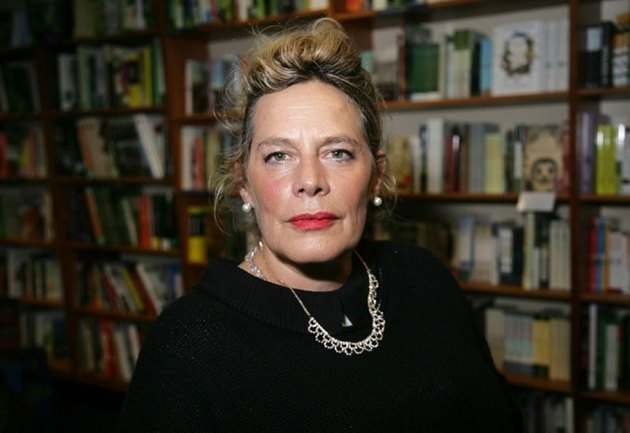
Portrait of Author Damon Young as a Reader

This appeared in the Irish Times on 30 December 2017, p. 24:

Portrait of Author Damon Young as a Reader

The vintage fingerprints and splashes of egg yolk adorning my Ladybird edition of The Three Little Pigs. The wild flowers pressed between the pages of a Danilo Kiš. We measure out our lives with books as well as coffee spoons. Those we have read, those we have not; above all, those that have read us. “To my right is a small stained pine bookcase,” writes Damon Young at the beginning of The Art of Reading. “It contains, among other things, my childhood.”

On the latter subject, and his subsequent development, he remains rather tight-lipped. Reading, we learn, was initially “a prop in [his] performance of superiority” and, crucially, a “liberation from school’s banality and home’s atmosphere of violence”. At the age of 11, he sought refuge from his father’s “morning screams” in ninja books and make-believe. As a teenager he was “Prufrock avoiding Prufrock”. Finally he alludes to his wife’s “grave illness” which rendered him incapable of finishing AS Byatt’s Still Life. There ends the confessional: this is a portrait of the author as a reader.

In the expository chapter Young navigates his way round the labyrinthine shelves of his own Library of Babel, travelling back and forth in time, both personal and historical. His early passion for Sherlock Holmes was shared by William Gibson, whose evocation leads — “[t]wo shelves under” him — to Orhan Pamuk’s reflections on childhood perusal and then on to Edith Wharton’s — “[t]wo rooms behind and one century before him” — and from thence to Rousseau, Sartre, de Beauvoir (close to the former “in [his] library as in life”) and so on. Taking in Batman as well as Heidegger, the breadth of reference is impressive, but never overbearing, thanks to the Australian philosopher’s lightness of touch, self-deprecating humour and endearing deployment of the word “bunkum”. Having traced a desire path through a lifetime of books, Young reflects upon six Aristotelian virtues (curiosity, patience, courage, pride, temperance and justice) that reading requires, exhibits or promotes.

The Art of Reading is not just another bibliomemoir; it is also a manifesto of sorts. The author shuns a utilitarian approach to his subject — regarded as “an end in itself” — summarily listing its ancillary benefits with a commendable degree of scepticism. After all, “bastards enjoy fiction too” and, as he cheekily points out, some of them are authors. His ambitious goal is to re-enchant an activity which, “cosmically speaking”, is very much “against the odds”. Reading, he laments, is grossly undervalued, its wonders all too soon forgotten.

It tends to be thought of as a rudimentary skill, acquired in early childhood, rather than a lifelong project to be honed from Miffy to Proust. It has the added disadvantage of being a largely invisible pursuit, incapable of competing with the social cachet conferred by authorship, or rather the “fantasy of publication”. A text, however, is “only ever half finished by the writer”; it is the reader who brings it to life. Should the human race be wiped out, books would be “lived in, eaten, buried, climbed upon, oxidised, but not read”.

Young contends that the reader’s demiurgic power is not only forgotten, but also repressed, because of the anxiety it generates in highlighting the contingency of our books and lives: “Giddiness arises as I become aware of my responsibility for affirming one world and not another, and the fragility of whatever is chosen. Every string of letters can be an existential challenge”. What Michel Foucault called the “author function” is thus “a way of making reading safe”. Words become “someone else’s job”: the book “just means this, end of story”.

If Young explores how Rousseau or Sartre became fully aware of their existence through reading, he also considers how fiction may provide an escape from the confines of the self — Dickens’s “hope of something beyond that place and time” — and the increasing encroachment of the actual upon the possible.

In order to truly appreciate a text we must also “overcome our egocentrism”, which Virginia Woolf signally failed to do vis-à-vis Joyce, whom she initially read through the prism of class snobbery and rivalry. The philosopher concedes, however, that Iris Murdoch’s notion of “unselfing” has its limits. We are “partial beings” whose “incompleteness varies” with age, so that some novels — Henry James’s in the case of Evelyn Waugh — need to be grown into.

Most importantly, perhaps, literature enables us “to stifle the little oligarch” within. Villains — in fiction as well as fact — “see all things as a means to an end”, which is always “some vision of perfection”. Reading teaches us to accept that things simply are, and that they may end without concluding: “Only the Library of Babel continues. It makes sense to restlessly move between artworks, never believing that any one is perfect.”
Haunting Hauntology

Frances King, Georgia and Paul Smalera. “Nostalgia is the Ultimate Privilege.” Quartzy, 17 December 2017 2017:

Philosopher Jacques Derrida coined the term Hauntology in 1993 to describe nostalgia for an impossible future — a possible future that has since been overtaken by the events of reality. A sort of “what if” reverie, it is also a wordplay on the philosophical term ontology, or the study of the nature of being.

Hauntology is probably the first major trend in critical theory to have flourished online,” Andrew Gallix writes in the Guardian. “Today, hauntology inspires many fields of investigation, from the visual arts to philosophy through electronic music, politics, fiction and literary criticism. At its most basic level, it ties in with the popularity of faux-vintage photography, abandoned spaces and TV series like Life on Mars.”

Pretty Vacant Or Spiky-Haired Situationists?

Empire, Kitty. “Pretty Vacant Or Spiky-Haired Situationists?” The Observer (The New Review section), 19 November 2017, p. 36.

. . . Were the art school games of canny old hippies behind punk? Sometimes, but perhaps more in theory than practice. An essay in Punk Is Dead: Modernity Killed Every Night by fanzine writer Tom Vague retraces McLaren’s appetite for destruction back through the situationists, the lettrists, psychogeography and a tiny late 60s Notting Hill faction called King Mob (a reference to the Gordon Riots of 1780).

Authors Richard Cabut and Andrew Gallix have skin in the game; Cabut is an ex-punk (“In the summer of 1977 I am 17 – perfect”) who became a playwright, while Gallix is at the Sorbonne and edits a free-ranging literary webzine called 3:AM (“whatever it is, we’re against it”). The book’s title (Modernity Killed Every Night) quotes Jacques Vaché, friend to the surrealist André Breton. But Punk Is Dead isn’t end-to-end cultural theory; there’s a lot on clothes. Three strands unfurl — papers, essays and first-person accounts. Cabut and Gallix have included historical documents — such as Penny Rimbaud’s 1977 essay, Banned from the Roxy, newly annotated by the Crass drummer — while Gallix argues that punk started ending when it acquired a name. Jon Savage is here, and Ted Polhemus and Vermorel (again).

As that list attests, punk can be a tiresomely Boy’s Own narrative, to which former Slit Viv Albertine’s 2014 memoir was a potent corrective. With the exception of Judy Nylon’s introduction and the reminiscences of go-go dancer turned drummer Dorothy Max Prior, however, this collection is let down by its dearth of female voices. Perhaps the notion to take away from both books — indeed from punk itself — is the one of endless possibility. As an interview with the punk turned philosopher Simon Critchley attests, punk unleashed ideas. It palpably changed suburban teenage futures, rather than ending them.

Book of the Year

Booker Prize-shortlisted novelist and playwright Deborah Levy has kindly chosen my Punk is Dead: Modernity Killed Every Night as one of her two books of the year.

Levy, Deborah. “Books of the Year.” New Statesman, 17-23 November 2017, p. 41:

I thoroughly enjoyed Punk Is Dead: Modernity Killed Every Night (Zero Books). Edited by Richard Cabut and Andrew Gallix, this anthology of essays, interviews and personal recollections reflects on the ways in which punk was lived and experienced at the time. Gallix flips his finger at those who see nostalgia as an affliction and rightly attempts to promote the fragmented and contested legend of punk to “a summation of all the avant-garde movements of the 20th century … a revolution for everyday life”.

Rebuked

O’Sullivan, James. “Electronic Literature’s Contemporary Moment: Brezze and Campbell’s ‘All the Delicates Duplicates’.” Los Angeles Review of Books, 7 November 2017:

Almost a decade has passed since 3:AM Magazine founder Andrew Gallix, writing in the Guardian, proclaimed the imminent death of electronic literature, that is, literature with an inherently computational aesthetic. There was some merit to Gallix’s argument, his concern being that the form’s emphasis on multi-modality was such that the word would eventually get lost. In many instances — say, where play is accentuated — this has indeed been the case. But today, for every work of e-lit that is more game than literary game, there are those pieces where language remains essential. All the Delicate Duplicates, the latest brainchild of Mez Breeze and Andy Campbell, is a superlative example of the latter, and thus a serious rebuke of Gallix’s assertion.

Electronic literature can be a lot of things — literary games, hypertexts, interactive fiction, generative poetry, bots — but it is always more than the product of digitization; ebooks, which merely mimic print on a screen, typically don’t count. E-lit relies on computational affordances for creative expression, privileging language within a constellation of modalities. Still, resistance to its charms endures.

Responding to Gallix’s provocation in a piece published in the Electronic Book Review, Dene Grigar*, current president of the Electronic Literature Organization, points to those barriers that have marginalized e-lit in classrooms and popular culture, arguing that resistance to the form emanates from “deeply-held views of the proper relationship between humans and machines, of what constitutes the good, the beautiful and the true, and of the nature of art.” (…)

(…) But the achievements of Duplicates are not just contextual. If Breeze and Campbell are to be commended for any aspect of their ambition, it should be for their efforts to juxtapose the literary and the digital in a manner that genuinely advances the field and forcefully responds to naysayers such as Gallix that, no, electronic literature is not dead, it is everywhere, it is thriving, and it is literary. Ten years ago, the future of electronic literature was legitimately being questioned. Ten years from now, I expect that we will be reflecting on the present moment as that which saw the form truly begin to build on the work of its pathfinders — to borrow from Grigar and Moulthrop — and progress toward its potential, both as an aesthetic experience and as an act of expression capable of permeating the public consciousness. There is little doubt that such reflection will place much focus on the work of Mez Breeze and Andy Campbell, the pathfinders of their day.

[* She accused me at the time of misquoting her in my Guardian piece, which is absolutely not true. I quoted her verbatim, and — sensing that what she had written might be misconstrued by some of her colleagues — had even gone to the trouble to double-check that I had permission to quote anything from the email in which she had answered my questions.]

Slow Writing Revisited

Tranter, Rhys. “Andrew Gallix on the Virtues of Writing Slowly.” RhysTranter.com, 28 October 2017:

Since interviewing Michelle Boulous Walker about “slow philosophy” earlier this month, I have been thinking about the way we approach writing within institutional or commercial settings. It seems I am not the only one. Lauren Elkin has posted a link to a piece by Andrew Gallix where he reflects on the benefits of writing at a slower pace:

[B]ack in February, I expressed concern at the accelerating pace of publishing and called (half-jokingly) for the creation of a Slow Writing Movement (SWM), modelled on the Slow Food phenomenon. Word processing probably enables people to write faster than ever, and the internet provides the sometimes dubious means of instant publication.

As a result, what often passes for fiction today would have been considered no more than an early draft only a few years ago. In truth, however, the digital age has simply compounded a problem caused by the increasing hegemony of one school of writing (the Ionic) over another (the Platonic).”

Andrew Gallix, The Guardian

Sketching a brief history of Ionic vs. Platonic writing, Gallix identifies a social/economic bias that sets the quick work of the “hack” against the slow, patient verse that privilege can afford. But his central point remains crucially relevant in a digital age of around-the-clock productivity: perhaps a Slow Writing Movement can make us stop for a moment to catch our breath?


Without the Book Before You

Virginia Woolf, “How Should One Read a Book?”, The Second Common Reader

To continue reading without the book before you…

Kate Briggs, This Little Art, 2017

‘Has it never happened, as you were reading a book,’ asks Barthes, in an essay from 1970, which I quote in Howard’s translation, ‘that you kept stopping as you read, not because you weren’t interested, but because you were: because of a flow of ideas, stimuli, associations? In a word, haven’t you ever happened to read while looking up from your book?’

Cultural Seeds Scattered

Myers, Ben. Review of Punk is Dead: Modernity Killed Every Night, edited by Richard Cabut and Andrew Gallix, Mojo, November 2017, p. 119.

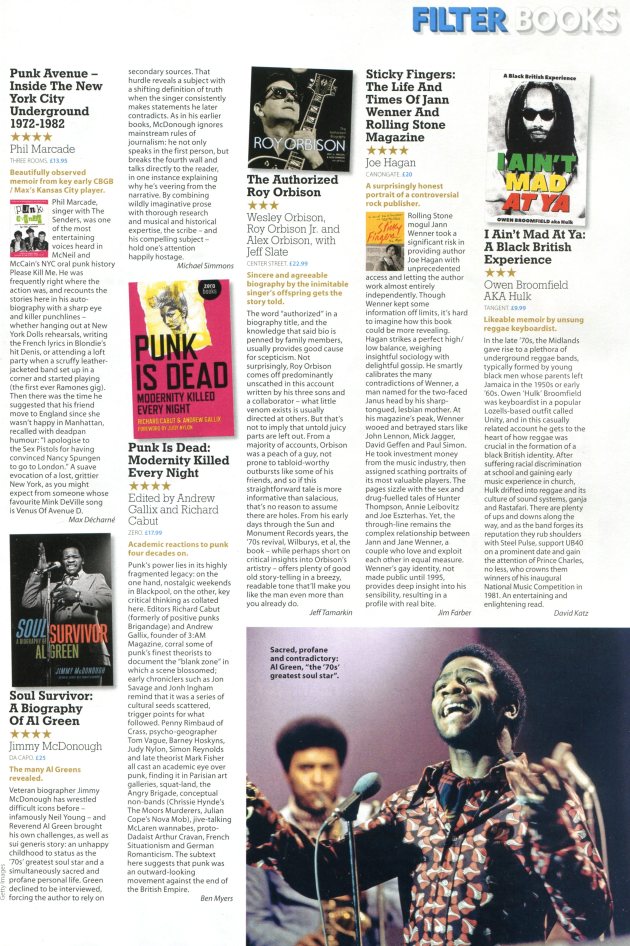
Academic reactions to punk four decades on

Punk‘s power lies in its highly fragmented legacy: on the one hand, nostalgic weekends in Blackpool, on the other, key critical thinking as collated here. Editors Richard Cabut (formerly of positive punks Brigandage) and Andrew Gallix, founder of 3:AM Magazine, corral some of punk’s finest theorists to document the “blank zone” in which a scene blossomed; early chroniclers such as Jon Savage and Jonh Ingham remind that it was a series of cultural seeds scattered, trigger points for what followed. Penny Rimbaud of Crass, psychogeographer Tom Vague, Barney Hoskins, Judy Nylon, Simon Reynolds and late theorist Mark Fisher all cast an academic eye over punk, finding it in Parisian art galleries, squat-land, the Angry Brigade, conceptual non-bands (Chrissie Hynde’s The Moors Murderers, Julian Cope’s Nova Mob), jive-talking McLaren wannabes, proto-Dadaist Arthur Cravan, French Situationism and German Romanticism. The subtext here suggests that punk was an outward-looking movement against the end of the British empire.

Ben Myers