
“Men dream of women. Women dream of themselves being dreamt of. Men Look at women. Women watch themselves being looked at.”
– John Berger, “Women in Art,” Ways of Seeing, BBC 1972
“Men dream of women. Women dream of themselves being dreamt of. Men Look at women. Women watch themselves being looked at.”
– John Berger, “Women in Art,” Ways of Seeing, BBC 1972
Carlos Magro, “Gallix,” fragmentos escritos 25 January 2014
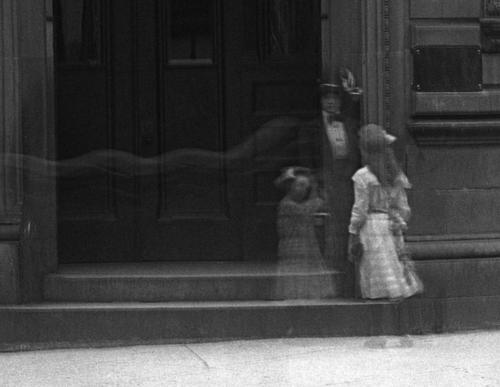
El “contenido” está “ahí fuera” -siempre ahí- toda la literatura es “paráfrasis”: “¿Quién estaría interesado en un discurso nuevo y no transmitido? Lo importante no es contar, sino volverlo a contar, y en esta repetición, contarlo de nuevo como si fuera la primera vez” (Maurice Blanchot. L’Entretien infini, 1969)
Andrew Gallix. “La influencia de la ansiedad”
[Foto: Fotografía tomada fuera del Royal Bank Branch. Notre Dame Street, Montreal, Canada. 1911]
Jeff Bursey, Rev. of [SIC], by Davis Schneiderman, The Quarterly Conversation 10 March 2014
In 2011 Andrew Gallix, in the Guardian, wrote a piece on unread difficult books, and he mentioned “an anthology of blank books [edited by Michael Gibbs] entitled All Or Nothing.” We can consider Blank as continuing that line. Kenneth Goldsmith’s prefatory essay “Why Conceptual Writing? Why Now?” in Against Expression: An Anthology of Conceptual Writing (2011) contains these useful lines: “What has happened in the past fifteen years has forced writers to conceive of language in ways unthinkable just a short time ago. With an unprecedented onslaught of the sheer quantity of language . . . , the writer faces the challenge of exactly how best to respond.” In volume one of his trilogy, Schneiderman edged near to muteness, but in [SIC] he has positioned himself, the work, and us in a new spot. His latest book is filled with words. None of them are his.
Karl Ove Knausgaard, “Completely Without Dignity: An Interview with Karl Ove Knausgaard” by Jesse Barron, The Paris Review Daily 26 December 2013
In the end, I want to write a book that is the thing itself. That is the ambition, of course.
Karl Ove Knausgaard, “Completely Without Dignity: An Interview with Karl Ove Knausgaard” by Jesse Barron, The Paris Review Daily 26 December 2013
Did you keep diaries when you were young?
Yes, I did, but I burned them when I was twenty-five or twenty-six.
Why?
I was so embarrassed, I couldn’t stand it. It’s the same with Min Kamp, I can’t stand it. If I could I would burn that, too, but there are too many prints, so it’s impossible.
Life develops, changes, is in motion. The forms of literature are not. So if you want the writing to be as close to life as possible — I do not mean this in any way as an apology for realism — but if you want to write close to life, you have to break the forms you’ve used, which means that you constantly have the feeling of writing the first novel, for the first time, which means that you do not know how to write. All good writers have that in common, they do not know how to write.
[See Roland Barthes and Thomas Mann.]
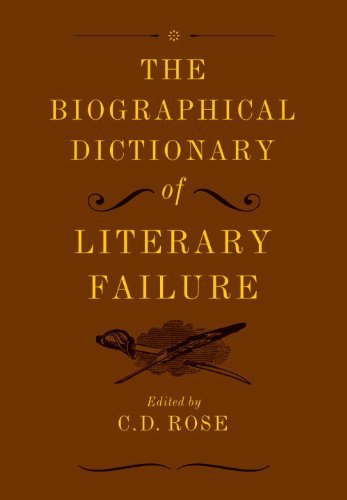
C. D. Rose‘s The Biographical Dictionary of Literary Literature (Melville House), with an introduction by yours truly, will be published on 4 November 2014.
“I reserve the right to leave everything a little ragged, as if it (“everything”) knows better than I do how to be a book. If I tuck in all the corners, make it too tidy, it strains for perfection without allowing for the real perfection of the irreducible. I’m not saying I achieved that. But one must have goals.”
– Rachel Kushner, “A Psychotic Pattern of No-Pattern: A Conversation with Rachel Kushner,” Interview by Dana Spiotta, Tin House 59 (2014)
Costica Bradatan, “In Praise of Failure,” The New York Times 15 December 2013
For, in a sense, the capacity to fail is much more important than any individual human achievements: It is that which makes them possible.
Maurice Blanchot, “The Disappearance of Literature,” The Book to Come
Whoever asserts literature in itself asserts nothing. Whoever looks for it looks for only what is concealed; whoever finds it finds only what is on this side of literature or, what is worse, beyond it. That is why, finally, it is non-literature that each book pursues as the essence of what it loves and wants passionately to discover.
 ANDREW GALLIX