Those Who Never Achieved Greatness

Stuart Kelly, “Stuart Kelly: Diversity Rules in Non-Fiction,” The Scotsman 13 December 2014

But my personal favourite in this genre [literary biography] has to be The Biographical Dictionary of Literary Failure, by CD Rose and Andrew Gallix, a glorious alphabetical compendium of those who never achieved greatness.

The Biographical Dictionary of Literary Failure 300dpi

Beautiful Losers

Julian Hanna, “Beautiful Losers,” Rev. of The Biographical Dictionary of Literary Failure by C. D. Rose, 3:AM Magazine 11 December 2014

The introduction, a brilliant extended meditation on ‘real’ failure by 3:AM’s own co-editor-in-chief Andrew Gallix, complements the fictional failures that follow.
The Biographical Dictionary of Literary Failure 300dpi

Glorious Failure

Keith Watson, Rev. of The Biographical Dictionary of Literary Failure by C. D. Rose, failure magazine November 2014

The BDLF is a clever put-on, a brisk stroll through Borges’s Library of Babel guided by Rose’s fastidious prose and copious literary references, but it is also a clarion for the infinite possibilities of literature. As Andrew Gallix observes in his introduction, “Writing about fictitious or lost works is a means of holding literature in abeyance, of preserving its potentiality.” Rose’s failures are also potential successes, each one a small recognition that the actuality of literature will never equal its potentiality. Reading Ulysses will never quite match the idea of reading Ulysses. And in that sense, all literature, no matter how great, is a glorious failure.

The Biographical Dictionary of Literary Failure 300dpi


Through a Rather Brief Unity of Time

I was interviewed by Linn Levy for her fine piece on Guy Debord, Situationism, and punk:

Linn Levy, “Debord j’adore,” Edelweiss December 2014: 52-53
Debord1
Debord2

. . . Et le punk? «Faut-il dire que le punk était situationniste?», s’interroge Andrew Gallix, écrivain, professeur à la Sorbonne, punk depuis l’âge de 12 ans et fondateur du premier blog littéraire «3:AM Magazine». «Non. Les idées de Debord ont été l’une des très nombreuses influences de ce mouvement éminemment postmoderne, au même titre que Dada, par exemple, ou le surréalisme. Il faut voir le punk comme un collage, ou comme une installation artistique : une conjonction d’influences diverses qui ont coexisté pendant “une assez courte unité de temps” (pour citer Debord) avant d’éclater en une myriade de mouvements. Entre 1976 et 1979, dans ce pays socialement à la dérive, l’esprit du situationnisme a été en quelque sorte mis en acte par le punk; il est réellement descendu dans la rue. Debord entendait mettre la révolution au service de la poésie, c’est-à-dire transformer la vie en art, et c’est précisément ce que le punk a réalisé. Il est évident que pour Malcolm McLaren, même s’il était avant tout un homme d’affaires, les Pistols étaient une situation au sens debordien.»

Photobooth

Paul Gorman, “What We Wore: An Intelligent and Egalitarian Celebration of Our Collective Visual Invention,” Paul Gorman Is 30 October 2014

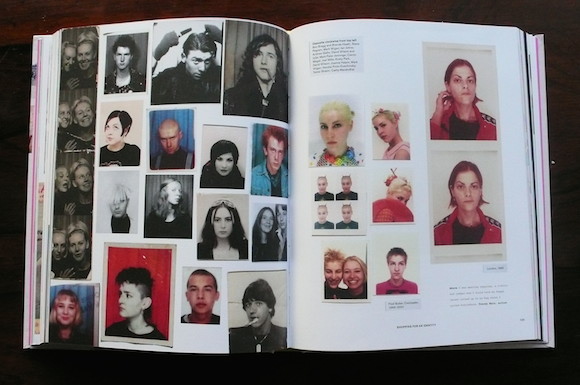
Paul Gorman has posted several pictures of Nina Manandhar’s What We Wore: A People’s History of British Style on his website. I appear in this one, across the page from Tracey Emin:

Towards Blankness

Thom Cuell, Rev. of The Biographical Dictionary of Literary Failure by C. D. Rose, The Workshy Fop 10 November 2014

In his introduction, 3:AM Magazine editor-in-chief Andrew Gallix notes a tendency in modern art towards blankness, exemplified by ‘the white paintings of Malevich…as well as John Cage’s mute music piece’. The literary apotheosis of this trend is Herman Melville’s Bartleby, the scrivener who stopped, er, scrivening. If we accept this theory, then we must accept that the writers Rose commemorates have inadvertently achieved greatness, ‘through their work being censored, lost, shredded, pulped or eaten by pigs’.
The Biographical Dictionary of Literary Failure 300dpi

Red and Black

Daisy Woodward, What We Wore: A People’s History of British Style, Another Magazine 5 November 2014.

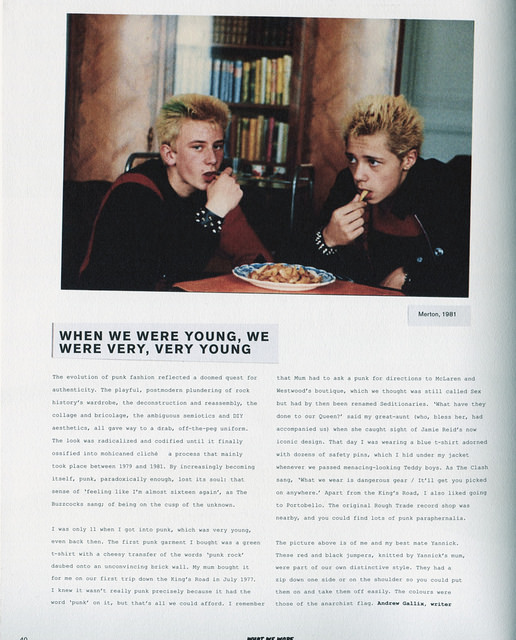
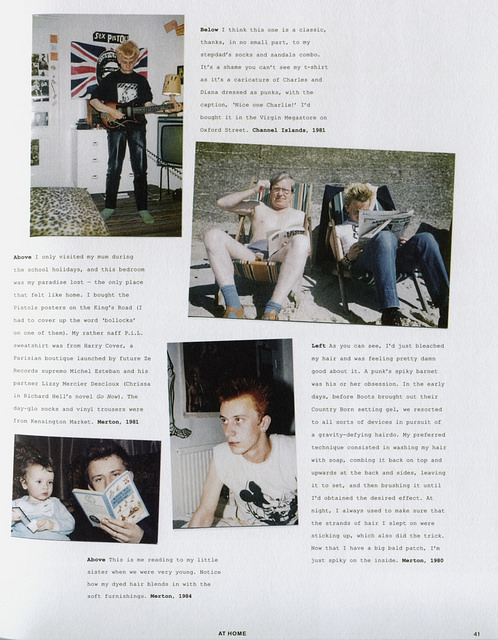
…Andrew Gallix, writer… “I was only 11 when I got into punk, which was very young, even back then. The first punk garment I bought was a green t-shirt with a cheesy transfer of the words ‘punk rock’ daubed onto an unconvincing brick wall… The picture above is of me and my best mate Yannick. These red and black jumpers, knitted by Yannick’s mum, were part of our own distinctive style. They had a zip down one side or on the shoulder so you could put them on and take them off easily. The colours were those of the anarchist flag.”

The same picture appeared in Clash on 7 November 2014.

Scholarly Introduction

Michael Dirda, Rev. of The Biographical Dictionary of Literary Failure by C. D. Rose, The Washington Post 5 November 2014

After a scholarly introduction that touches on such topics as blankness, the whiteness of the page and the ontology of fiction, Rose opens The Biographical Dictionary of Literary Failure with an account of the life of Casimir Adamowitz-Kostrowicki.
The Biographical Dictionary of Literary Failure 300dpi