
Paul Willetts, from an interview by Andrew Stevens, published in 3:AM Magazine on 30 August 2010:
Finished books can never compete with their unwritten, blemish-free counterparts.
Paul Willetts, from an interview by Andrew Stevens, published in 3:AM Magazine on 30 August 2010:
Finished books can never compete with their unwritten, blemish-free counterparts.
This appeared in the summer 2010 issue of Nude Magazine (issue 16, pp. 40-43):
The Young Parisians
‘Why don’t you come to Paris with me?
And see the young Parisians’
– “Young Parisians” by Adam and the Ants
‘There’s something very un-British about electronic music,’ says Daniel Miller — founder of Mute Records — in BBC Four’s excellent Synth Britannia documentary. By ‘very un-British’ he means très European — German, of course, but also French. Lest we forget, musique concrète composers like Pierre Schaeffer began their sonic experiments before Stockhausen. Most Continentals in the late 70s were first introduced to synthesizers via Jean-Michel Jarre not Kraftwerk. Métal Urbain — France’s answer to the Sex Pistols — produced their scuzzy rabble-rousing pogobeat on custom-made imitation Moogs at a time when electronic instruments were still usually associated with prog rock dinosaurs. The strong French presence on Angular Records’ recent Cold Waves and Minimal Electronics compilation was generally met with dismay by British music journalists who were blissfully unaware of the existence of a thriving post-punk scene across the Channel (Indochine, a synthpop outfit in the Depeche mode, even became France’s biggest band at one point). Whereas Gallic guitar combos have always been viewed — rightly or wrongly — as derivative vis-à-vis their Anglo-American counterparts, the synth-driven ‘French Touch’ sound was successfully exported ‘around the world’ at the turn of the century. The missing link between the early 80s and late 90s was Denis Quillard, better known as Jacno, who died in November last year at the age of 52 having cemented his country’s love affair with electronic minimalism.
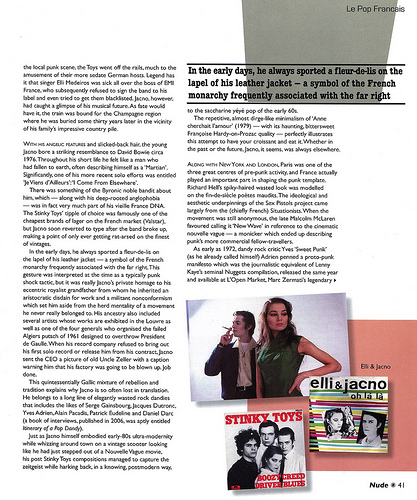
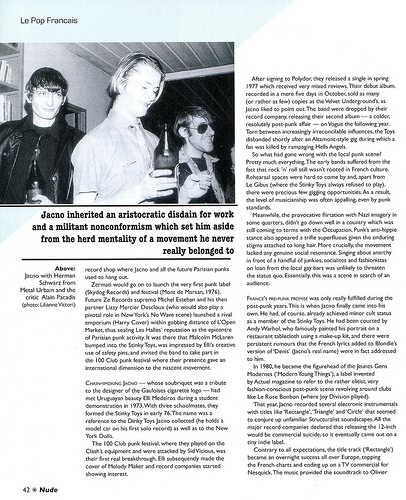
There are times when the past, present and future seem to collide, and one such occasion occurred on 9 February 1977 when Jacno’s band, the Stinky Toys, were invited to a music press junket aboard the eponymous Trans Europe Express coinciding with the release of Kraftwerk’s album. Having a reputation to maintain as the enfants terribles of the local punk scene, the Toys went off the rails, much to the amusement of their more sedate German hosts. Legend has it that singer Elli Medeiros was sick all over the boss of EMI France, who subsequently refused to sign the band to his label and even tried to get them blacklisted. Jacno, however, had caught a glimpse of his musical future. As fate would have it, the train was bound for the Champagne region where he was buried some thirty years later in the vicinity of his family’s impressive country pile.
With his angelic features and slicked-back hair, the young Jacno bore a striking resemblance to David Bowie circa 1976. Throughout his short life he felt like a man who had fallen to earth, often describing himself as a ‘Martian’. Significantly, one of his more recent solo efforts was entitled ‘Je viens d’ailleurs’: ‘I Come From Elsewhere’. There was something of the Byronic noble bandit about him, which — along with a deep-rooted anglophobia — was in fact very much part of his vieille France DNA. The Stinky Toys’ tipple of choice was famously one of the cheapest brands of lager on the French market (Valstar), but Jacno soon reverted to type after the band broke up, making a point of only ever getting rat-arsed on the finest of vintages. In the early days, he always sported a fleur-de-lis on the lapel of his leather jacket — a symbol of the French monarchy frequently associated with the far right. This gesture was interpreted at the time as a typically punk shock tactic, but it was really Jacno’s private homage to his eccentric royalist grandfather from whom he inherited an aristocratic disdain for work and a militant nonconformism which set him aside from the herd mentality of a movement he never really belonged to. His ancestry also included several artists whose works are exhibited in the Louvre as well as one of the four generals who organised the failed Algiers putsch of 1961 designed to overthrow President de Gaulle. When his record company refused to bring out his first solo record or release him from his contract, Jacno sent the CEO a picture of old Uncle Zeller with a caption warning him that his factory was going to be blown up. Job done.
This quintessentially Gallic mixture of rebellion and tradition explains why Jacno is so often lost in translation. He belongs to a long line of elegantly wasted rock dandies that includes the likes of Serge Gainsbourg, Jacques Dutronc, Yves Adrien, Alain Pacadis, Patrick Eudeline and Daniel Darc (a book of interviews, published in 2006, was aptly entitled Itinerary of a Pop Dandy). Just as Jacno himself embodied early-80s ultra-modernity while whizzing around town on a vintage scooter looking like he had just stepped out of a Nouvelle Vague movie, his post-Stinky Toys compositions managed to capture the zeitgeist while harking back, in a knowing, postmodern way, to the saccharine yéyé pop of the early 60s. The repetitive, almost dirge-like minimalism of ‘Anne cherchait l’amour’ (1979) — with its haunting, bittersweet Françoise Hardy-on-Prozac quality — perfectly illustrates this attempt to have your croissant and eat it. Whether in the past or the future, Jacno, it seems, was always elsewhere.
Along with New York and London, Paris was one of the three great centres of pre-punk activity, and France played an important part in shaping the punk template. Richard Hell’s spiky-haired wasted look was modelled on the fin-de-siècle poètes maudits. The ideological and aesthetic underpinnings of the Sex Pistols project came largely from the (chiefly French) Situationists. When the movement was still anonymous, the late Malcolm McLaren favoured calling it ‘New Wave’ in reference to the cinematic Nouvelle Vague — a monicker which ended up describing punk’s more commercial fellow-travellers. As early as 1972, dandy rock critic Yves ‘Sweet Punk’ Adrien (as he already called himself) penned a proto-punk manifesto which was the journalistic equivalent of Lenny Kaye’s seminal Nuggets compilation, released the same year and available at L’Open Market, Marc Zermati’s legendary record shop where Jacno and all the future Parisian punks used to hang out. Zermati would go on to launch the very first punk label (Skydog Records) and festival (Mont-de-Marsan, 1976). Future Ze Records supremo Michel Esteban and his then partner Lizzy Mercier Descloux (who would also play a pivotal role in New York’s No Wave scene) launched a rival emporium (Harry Cover) within gobbing distance of L’Open Market, thus sealing Les Halles’ reputation as the epicentre of Parisian punk activity. It was there that Malcolm McLaren bumped into the Stinky Toys, was impressed by Elli’s creative use of safety pins, and invited the band to take part in the 100 Club punk festival where their presence gave an international dimension to the nascent movement.
Chain-smoking Jacno — whose soubriquet was a tribute to the designer of the Gauloises cigarettes logo — had met Uruguayan beauty Elli Medeiros during a student demonstration in 1973. With three schoolmates, they formed the Stinky Toys in early 76. The name was a reference to the Dinky Toys Jacno collected (he holds a model car on his first solo record) as well as to the New York Dolls. The 100 Club punk festival, where they played on the Clash’s equipment and were attacked by Sid Vicious, was their first real breakthrough. Elli subsequently made the cover of Melody Maker and record companies started showing interest. After signing to Polydor, they released a single in spring 1977 which received very mixed reviews. Their debut album, recorded in a mere five days in October, sold as many (or rather as few) copies as the Velvet Underground’s, as Jacno liked to point out. The band were dropped by their record company, releasing their second album — a colder, resolutely post-punk affair — on Vogue the following year. Torn between increasingly irreconcilable influences, the Toys disbanded shortly after an Altamont-style gig during which a fan was killed by rampaging Hell’s Angels.
So what had gone wrong with the local punk scene? Pretty much everything. The early bands suffered from the fact that rock’n’roll still wasn’t rooted in French culture. Rehearsal spaces were hard to come by and, apart from Le Gibus (where the Stinky Toys always refused to play), there were precious few gigging opportunities. As a result, the level of musicianship was often appalling, even by punk standards. Meanwhile, the provocative flirtation with Nazi imagery in some quarters didn’t go down well in a country which was still coming to terms with the Occupation. Punk’s anti-hippie stance also appeared a trifle superfluous given the enduring stigma attached to long hair. More crucially, the movement lacked any genuine social resonance. Singing about anarchy in front of a handful of junkies, socialites and fashionistas on loan from the local gay bars was unlikely to threaten the status quo. Essentially, this was a scene in search of an audience.
France’s pre-punk promise was only really fulfilled during the post-punk years. This is when Jacno finally came into his own. He had, of course, already achieved minor cult status as a member of the Stinky Toys. He had been courted by Andy Warhol, who famously painted his portrait on a restaurant tablecloth using a make-up kit, and there were persistent rumours that the French lyrics added to Blondie’s version of ‘Denis’ (Jacno’s real name) were in fact addressed to him. In 1980, he became the figurehead of the Jeunes Gens Modernes (‘Modern Young Things’), a label invented by Actuel magazine to refer to the rather elitist, very fashion-conscious post-punk scene revolving around clubs like Le Rose Bonbon (where Joy Division played). That year, Jacno recorded several electronic instrumentals with titles like ‘Rectangle,’ ‘Triangle’ and ‘Circle’ that seemed to conjure up unfamiliar Structuralist soundscapes. All the major record companies declared that releasing the 12-inch would be commercial suicide, so it eventually came out on a tiny indie label. Contrary to all expectations, the title track (‘Rectangle’) became an overnight success all over Europe, topping the French charts and ending up on a TV commercial for Nesquick. The music provided the soundtrack to Olivier Assayas’s first short film (Copyright) in which Elli Medeiros made her debut performance as an actress. Assayas also shot a video for ‘Rectangle’ which shows Jacno playing against the suitably angular, brutalist background of the La Défense area of Paris. The only track on the record that wasn’t an instrumental — the aforementioned ‘Anne cherchait l’amour’ — was sung by Elli. It marked the beginning of Elli & Jacno who provided a blueprint for countless other synth-based duos like Soft Cell and Yazoo, and sold millions of records until they split up in 1984 having written the soundtrack to Eric Rohmer’s Les Nuits de la pleine lune.
Elli would go on to have a couple of massive solo hits in 86-87 before concentrating on her acting career and family life. She made a musical comeback in 2006. Jacno, meanwhile, released six solo albums and produced work by some of France’s greatest stars like Jacques Higelin or Etienne Daho, an early fan of the Stinky Toys. He will always be remembered, however, as the New Wave Erik Satie whose elegant electronic minuets (as Rohmer once described them) seemed to capture the essence of our adolescence. ‘True life,’ as Rimbaud once put it, ‘is elsewhere.’ That is, as ever, where Jacno is to be found.
****
Ten of the best first wave punk bands from over the Channel
Métal Urbain
Think Sex Pistols crossed with Suicide or Throbbing Gristle — or both. Hardcore political lyrics. Their second single was Rough Trade’s first release. Best track: ‘Panik’.
Asphalt Jungle
Fronted by dandy rock critic-cum-novelist Patrick Eudeline. Talked the talk but seldom walked the walk except on their third single, ‘Polly Magoo,’ which sounds like a gang of inebriated football hooligans rutting with Phil Spector. In a good way.
Starshooter
They hailed from Lyon, played a mean live set, had a sense of humour and were solidly working class unlike most of their bourgeois contemporaries. Good mates with the Damned. Listen to: ‘Macho’.
Marie et les Garçons
Also from Lyon. Heavily influenced by the NYC scene at first, then experimented with a disco crossover thang. Second single produced by John Cale. They had a female drummer (the eponymous Marie) who died in the 90s. Top track: ‘Re-Bop’.
Guilty Razors
Famous for singing in pigeon English (‘Provocate,’ ‘I Don’t Wanna Be a Rich’!). Two of their members were of Spanish origin. They were very close to the Slits. Check out: ‘I Don’t Wanna Be a Rich’.
Gazoline
Having been a failed teenybop heartthrob in the 60s, a failed glam rock star in the early 70s and a successful gay cabaret artist, Alain Kan reinvented himself as a punk rocker. His band was named after a group of militant drag queens from the early gay liberation days. Kan disappeared in 1990; no one has seen or heard from him since. Gazoline’s second single is arguably one of the most convincing punk records to ever come out of France. Best track: ‘Radio flic’.
Les Olivensteins
Started later than most of the others and paved the way for the hardcore of the early 80s (Oberkampf, Bérurier Noir et al.). One of their most provocative lyrics described the Vichy regime as the good old days. Their name came from a psychiatrist famous for his anti-drugs crusade. Like Sham 69, they ended up attracting the wrong element and split up. Top track: ‘Fier de ne rien faire’.
1984
On paper, a kind of dystopian Clash but never fulfilled their promise. Listen to: ‘Salted City’.
Les Lou’s
All-girl band managed at one stage by Bernie Rhodes. Highlight: ‘Back on the Street’.
Electric Callas
A flamboyant Bowie/Iggy fanatic from Lyon backed by a dizzying array of line-up changes. Check out: ‘Kill Me Two Times’.



Jon Savage, “Jon Savage on Song: The Screamers – 122 Hours of Fear,” Guardian Music Blog 27 July 2010
Thanks to YouTube, this 70s synth-punk band who never released a record have finally found an audience
The clip begins with a frontal shot of a helicopter: the sound of its take-off bleeds into descending synthesiser notes. A caption comes up: “Screamers.” The second image to be seen is out of focus, a pink/brown blur against a sea green background. The ominous notes continue, with an abrasive synthesiser counter melody. Live drums come in, upping the tempo to manic punk.
The blur comes into focus: it’s the back of a spiky-haired head, jerking to the manic tempo then resting stock-still. The camera pans out while the music churns. Suddenly, it stops and the figure turns round: “Be quiet or be killed,” it screams, and you see the close up of a face contorted with fury and frustration. Ninety seconds in, the tension is broken and the song starts.
Taken from a headline in the Los Angeles Herald-Examiner about the hijacking of Luftansa flight 181 in 1977, 122 Hours of Fear is sung from the point of view of a hostage; a similar theme to R.A.F by Brian Eno and Snatch. This was, after all, the era of the famous shoot-outs at Entebbe and Mogadishu, where the hi-jackings of an Air France and a Lufthansa flight respectively made global news.
The Screamers’ singer, Tomata du Plenty, takes you right into the chilling scenario. His background in performance art gives him total control: his sculpted, swept-up 50s psycho hustler face keeps firmly within the camera position, lapsing from anger into stillness in the space of seconds. He is simultaneously within and outside the song: this is not arch, but conversely even more involving.
At 2:15 minutes, the camera pans out further, and you see the band. KK Barrett, a blond-haired drummer in a striped T-shirt, provides the visceral element, while two synthesiser players — Paul Roessler and Tommy Gear — encompass the stage moves that lie between willingness to please and total hostility. The camera pans back as du Plenty jack-knifes on to one knee.
There are several seconds of silence: “You’d better shut up and listen,” du Plenty yells and the furore starts again. The rest of the clip is more like a standard live run-through, with the musicians bobbing along with the rhythm, but at the end the camera returns to the singer, who stares at the lens with a gaze that runs from gurning speed psychosis to a certain, pained vulnerability.
This remarkable promo was shot at San Francisco’s Target Video in September 1978. Although they were inner circle members of the Los Angeles punk scene, the Screamers — like all of their peers — did not have a record deal. In fact, they never would, despite a heavily defined image, the vaunting ambition that they exhibited in interviews and the acres of press they attracted.
The Screamers were at the absolute cutting-edge of their time and place. There were other synth-punk groups, such as Suicide, Throbbing Gristle and the Normal, but they were based in New York and Europe, and were moving towards making slightly smoother, electro-pop records. Their nearest equivalent were the fabulously abrasive Metal Urbain from Paris.
There were other reasons for the lack of music industry interest. The era of mass synth success, of Soft Cell and the Human League, was at least three years away, and the confrontational nature of 122 Hours of Fear, (If I Can’t Have What I Want, I Don’t Want) Anything and Punish Or Be Damned was not likely to get punk-hostile record companies flocking.
Plenty of other Californian punk groups, such as the Germs, the Avengers and the Dils, were in the same boat, and they released classic independent 45s. But when I talked to the Screamers right after the Target video shoot, Tommy Gear summarily dismissed the whole idea: “What’s having a record? If I had a couple of thousand I could go out and make a record, what’s that? It’s nothing.”
The interview was strange. Consumed with the power of his concepts, Gear was extremely sarcastic, before deciding to relent just enough to show flickers of charm. Tomata du Plenty was dreamy and light, prone to gnomic epithets such as: “I think advertising is more exciting than the product most of the time.” KK Barrett was the voice of reason; well, somebody had to be.
I didn’t mind the barrage too much, having gone through far worse with Devo. It was expected then. But I thought that they were getting a little over-determined, especially when Gear started talking about the group in terms of the Monkees: “One thing we might want to do is to project ourselves as a video-projection instead of doing a performance. So we can get the money without having to be there.”
The Screamers kept on talking, having these fabulous ideas, while the world passed them by. As the first wave of the Los Angeles punk scene disintegrated around them, they held out for that perfect deal that never came. They never released a record, and disappeared into yellowing fanzine pages, decaying handbills and old VHS copies, an example of what might have been.
Until the advent of YouTube, that is. Type “the Screamers” into the search option and you’ll find an array of live and studio footage, including 122 Hours of Fear. The total hits for the clips add up to more than 100,000, which is probably 95,000 people more than ever saw or heard the group throughout their career. In the 21st century, the Screamers have finally found their audience.
Simon Critchley,”Being and Time, Part 7: Conscience,” The Guardian 20 July 2009
“…What gets said in the call of conscience? Heidegger is crystal clear: like Cordelia in King Lear, nothing is said. The call of conscience is silent. It contains no instructions or advice. In order to understand this, it is important to grasp that, for Heidegger, inauthentic life is characterised by chatter — for example, the ever-ambiguous hubbub of the blogosphere. Conscience calls Dasein back from this chatter silently. It has the character of what Heidegger calls “reticence” (Verschwiegenheit), which is the privileged mode of language in Heidegger. So, the call of conscience is a silent call that silences the chatter of the world and brings me back to myself….”
Tom McCarthy, Calling All Agents (London: Vargas Organisation, 2003). 4-5.
“…And yet the Hearings left us with the impression that if (as Gil Scott Heron says) the Revolution will not be televised, then perhaps its nucleus will not be caught on audio tape or broadcast on the airwaves either — or if it will, then it will take the form of silence. For Heidegger, everything stems from the Unspoken: Being calls us, but it does so ‘in the uncanny mode of keeping silent.’ Burroughs’s revolutionary drive extends to a transformation of language that will help cast off the ‘IS’ of identity: this language, he tells us, will be a hieroglyphic one that ‘will give one the option of silence.’ Hollings, discussing Burroughs in an article, writes: ‘Recorded silence only becomes a political act once it is played back.’ There are echoes of Cégeste’s first message here. Hollings was a contributor to Violent Silence (a book about Bataille), a collaborator with John Cage and at the time of the Hearings was conducting research into the erased passages in Nixon’s Watergate tapes. What did he mean ‘recorded silence only becomes a political act once it is played back,’ we asked him. ‘Playing a blank tape,’ he told us, ‘breaking the seal on something and sticking it in a machine and listening to it, is an act of refusal.’ ‘So there is a kind of inalienable silence that is encrypted somehow?’ Anthony Auerbach asked; ‘And this potentially contains the revolutionary moment?’ ‘Exactly so,’ said Hollings. This is the violent silence of Shakespeare’s Cordelia, who tells her father ‘Nothing’ — a single word which leads to general annihilation, wars and madness; or of Stephen Daedalus, self-styled ‘Cordoglio’ who, as he brings about ‘the ruin of all space, shattered glass and toppling masonry, and time one livid final flame,’ says ‘Nothing!’ ‘Maybe,’ I suggested, ‘our radio project should be a quest for that silence’ — a suggestion to which Hollings answered, in what turned out to be the Hearings’ final exchange: ‘I would strongly recommend it.’…”
On p. 12, McCarthy mentions Burroughs’s “putative hushed-up language”.
On p. 16: “This silent word is so charged and so seductive, Abraham and Torok conclude [in Cryptonomy: the Wolf Man’s Magic Word], that it and it alone becomes the object of the Wolf Man’s love. To keep it safe he buries it inside the crypt ‘like a chrysalis in its cocoon’ and carries it around for all his life, showing and hiding it, saying it without saying it, ‘repeating tirelessly to one and all, especially to his analyst: ‘Here is nothing, hold it tight’.”
“‘Poetry,’ in the words of Auden, ‘makes nothing happen’ — an active construct in which ‘nothing’ designates an event, perhaps even a momentous one. In looking into the abyssal ground, reading its source code and transmitting this nothing outwards, maybe we will find that our culture also [like Freud’s Wolf Man] has a secret, silent word.”
The summer 2010 issue of the brilliant Nude Magazine (issue 16) is out now, and it contains an article by yours truly about Jacno, the founder of the Stinky Toys who went on to become a pioneer of French electropop:
“A look back at the too short life of Denis Quillard (aka Jacno), the artistocratic pop dandy, former Stinky Toy and pioneer of French electronic music.”
An extract from Robert Collins’s interview with Tom McCarthy:
Robert Collins, “The Novel: Rewound and Remixed,” The Sunday Times 4 July 2010
Less than a century ago, James Joyce and Virginia Woolf took the 19th-century realist novel and forged it into the blinding experimental thunderbolt of high modernism. Ninety years later, with more novels being published than ever, and most of them uniformly aiming for the same realist goal, it’s as if Ulysses, Finnegans Wake and Mrs Dalloway had never happened. Where did the zeal for unfettered innovation go? Even in the brilliantly able hands of David Mitchell, Zadie Smith or Ian McEwan, the novel has regressed almost completely to its realist origins. With commercial expectations in publishing more desperate and unforgiving than ever, the room for experimentation has shrunk to virtually nil.
A recent book, Reality Hunger, by the American author David Shields, has generated febrile literary chatter about the novel’s future. Shields argues that the form, tied to phoney invention and creaky artifice, is no longer a viable medium for the tastes of the hyperconnected age, with its urge towards hybridisation and cross-pollination. Nonfiction — memoir, the lyric essay, rap, all freed from fiction’s dusty strictures — is where it’s at.
You can see novelists showing chronic signs of fiction fatigue. The twice Booker-winner and Nobel laureate JM Coetzee has strayed ever deeper into autobiography in his novels, and has rallied to Shields’s cry: “I, too, am sick of the well-made novel with its plot and its characters and its settings.” He was joined by Smith, who recently swore off writing another novel and, “out of exactly the kind of novel-nausea Shields describes”, decided to produce a collection of essays, Changing My Mind. “Novels,” she writes, “are idiosyncratic, uneven, embarrassing, and quite frequently nausea-inducing — especially if you happen to have written one.”
Novelists, catching the mood of despair, are falling like flies, turning to what now appears as the verdant, promising land of nonfiction. This year alone, Chinua Achebe, Jonathan Safran Foer, Siri Hustvedt and Rupert Thomson have published nonfiction debuts. There are, of course, fiction writers of astounding virtuosity out there, such as Mitchell, McEwan or Hilary Mantel. But these novelists are, it is no disparagement to say, going through the motions. Where’s the novelty, the newness, that the novel promised in Joyce and Woolf’s hands? The contemporary novel’s not dead. It’s sleepwalking.
Then along comes Tom McCarthy. Forty-one, and born in London, McCarthy has stood until recently at the outer edges of the literary world. With his third novel, C, a supercharged, fizzingly written Bildungsroman about a morphine-addicted radio operator in the early decades of the 20th century, he is arguably about to take his place at its centre. …
This appeared in Guardian Books on 13 May 2010:
In Theory: Towards a New Novel
Alain Robbe-Grillet’s provocative essays on creating new literature outside the ‘dead rules’ of the past resonate now

A novel ‘expresses nothing but itself’ … Alain Robbe-Grillet. Photograph: Daniel Janin/AFP/Getty Images
David Shields recently dismissed most contemporary novels as “antediluvian texts” that “could have been written by Flaubert 150 years ago”. “In no way,” claimed the author of Reality Hunger, “do they convey what it feels like to live in the 21st century.”
He has a point — albeit one that Alain Robbe-Grillet had already made in 1965 when he deplored the fact that young French novelists were praised for writing “like Stendhal” but castigated as soon as they refused to abide by the “dead rules” of a bygone age. Along with Michel Butor, Nathalie Sarraute and Claude Simon — the main proponents of the new novel (nouveau roman) — Robbe-Grillet stood resolutely in the second camp. In his essays, he returns time and again to the notion that the novel, from Stendhal to Joyce, has constantly evolved — hence the absurdity of using “the norms of the past” to judge the fiction of today. Far from representing a rejection of the past, the quest for a new novel was thus very much in keeping with the history of a genre which, by definition, must always be renewed.
Feeling that his work was too often misrepresented by the critical establishment (with a few notable exceptions including Barthes, Blanchot and Nabokov), Robbe-Grillet published a series of articles to set the record straight. In 1963 they were collected in Towards a New Novel — for my money, one of the most important works of postwar literary criticism. However, these “critical reflections” were never meant to constitute a manifesto. Every novel, according to Robbe-Grillet, is a self-sufficient work of art which cannot be reduced to some external meaning or truth that is “known in advance”. “The New Novel,” as he put it, “is not a theory, it is an exploration.” Why bother writing a book that illustrates a rule when “the statement of the rule would suffice”?
Quoting Heidegger at the beginning of an essay on Waiting For Godot, Robbe-Grillet writes that the human condition is “to be there”. In another essay, he states that it is “chiefly in its presence that the world’s reality resides”. So there you have it. Man is here, the world is there and the distance between the two lies at the heart of the new novel project. We endow the world with meaning (or meaninglessness) in order to control it. From this point of view, the writer’s traditional role was to excavate nature in order to unearth the “hidden soul of things”. Robbe-Grillet calls for the creation of a new form of fiction that reflects the “more modest, less anthropomorphic world” we live in today — one which is “neither significant nor absurd,” but simply is.
This seemingly anodyne observation has serious literary ramifications. Gone is the traditional hero of yore who believed the world was there to be conquered and whose hour of glory coincided with the triumph of individualism. Gone is the humanist “communion” between people and things: “Things are things, and man is only man”. Gone is the notion of tragedy, which Robbe-Grillet sees as a twisted ploy to reaffirm this solidarity: “I call out. No one answers. Instead of concluding that there is no one there (…) I decide to act as if someone were there, but someone who, for some reason or other, will not answer”. In the new novel, “Man looks at the world” but “the world does not look back,” which precludes any symbolism or transcendence. The novelist’s task now is to describe the material world, not to appropriate it or project himself onto it; to record the distance between human beings and things without interpreting this distance as a painful division. All this implies that the “entire literary language” be reformed. Similes and metaphors, which are often used gratuitously to confer literary status upon a text, are seldom innocent since they tend to anthropomorphise the world.
The new novel is routinely attacked for being inhuman and coldly descriptive. Robbe-Grillet responds that his work is in fact far less objective than the godlike, omniscient narrator who presides over so many traditional novels. Description here is purely subjective and takes centre stage, whereas in Balzac, for instance, it simply sets the scene by lending the plot an air of authenticity. Instead of referring to an external, pre-existing reality, Robbe-Grillet’s descriptions seem to create their own objects, their own hallucinatory reality. “Nothing,” he explains, “is more fantastic, ultimately, than precision.”
The reality of any work of art is its form, and to separate style from substance is to “remove the novel from the realm of art”. Art, Robbe-Grillet reminds us, is not just a pretty way of presenting a message: it is the message. Like the world out there, a novel is self-sufficient and “expresses nothing but itself”. Its “necessity” has nothing to do with its “utility”. Whenever an author envisages a future book, “it is always a way of writing which first of all occupies his mind,” which leads Robbe-Grillet to state — provocatively — that “the genuine writer has nothing to say. He has only a way of speaking”. Creative writing classes should always start and end on that note.
****
Here is a slightly longer version of the same piece:
David Shields recently dismissed most contemporary novels as “antediluvian texts” that “could have been written by Flaubert 150 years ago”. “In no way,” claimed the author of Reality Hunger, “do they convey what it feels like to live in the 21st century.” He has a point — one that Alain Robbe-Grillet had already made, back in 1965, when he deplored the fact that young French novelists were praised for writing “like Stendhal” but castigated as soon as they refused to abide by the “dead rules” of a bygone age. Along with Michel Butor, Nathalie Sarraute and Claude Simon — the main proponents of the so-called New Novel (Nouveau Roman) — Robbe-Grillet stood resolutely in the second camp. Throughout his essays, he returns time and again to the notion that the novel, from Stendhal to Joyce, has constantly evolved, hence the absurdity of using “the norms of the past” (and specifically those of the 19th century) to judge the fiction of today. He defends the nouveaux romanciers from accusations of formalism by arguing that the true “formalists” are in fact those who write formulaically, as if “the ‘true novel'” had been cast “once and for all” in the Balzacian mould: “But we, on the contrary, who are accused of being theoreticians, we do not know what a novel, a true novel, should be; we know only that the novel today will be what we make it, today, and that it is not our job to cultivate a resemblance to what it was yesterday, but to go forward”. Far from representing a rejection of the past, the quest for a new novel was thus very much in keeping with the history of a genre which, by definition, must always be renewed. “Flaubert wrote the new novel of 1860, Proust the new novel of 1910”: it was up to the nouveaux romanciers to bring the novel kicking and screaming into the 1950s.
Feeling that his work was too often misrepresented by the critical establishment (with a few notable exceptions like Barthes, Blanchot or Nabokov) and misunderstood by large sections of the reading public, Robbe-Grillet started publishing a series of articles in order to set the record straight. In 1963, they were collected in Towards a New Novel (For a New Novel in the American version; Pour un nouveau roman in the original) which, for my money, remains one of the most important works of post-war criticism. Not surprisingly, these essays cover the period during which Robbe-Grillet was also producing some of his greatest works of fiction: The Voyeur (1955), Jealousy (1957) and the screenplay for Last Year at Marienbad (1961).
In retrospect, some of the author’s predictions may seem wide of the mark: the New Novel did not, for instance, bring about “a revolution more complete” than “romanticism or naturalism”. Robbe-Grillet’s Pascalian “wager” that “man, some day, will free himself” of the concept of tragedy, strikes me as impossibly naive. The claim that calling upon the reader to play an active part in the creation of the world of a novel will also enable him “to learn to invent his own life” probably sounds a tad too ambitious — or even pretentious — for us today. But all this is just nitpicking when set against the radical renewal of fiction that is heralded within these pages. Whereas Finnegans Wake feels like a one-off or a dead end, Towards a New Novel still reads like a blueprint for a truly novel novel.
Robbe-Grillet’s forays into criticism were frowned upon by those who clung to the old cliché of the great writer in the throes of creation as “a kind of unconscious monster” emitting “‘messages’ which only the reader may decipher”. Not only did the author claim that there was no “antinomy between creation and consciousness,” but he was also convinced that literature had entered an age of self-conscious creation in which “critical preoccupations” would prove a “driving force”. However, his “critical reflections” were in no way intended to constitute “a theory, a pre-existing mould into which to pour the books of the future”. Every novel, according to Robbe-Grillet, is a self-sufficient work of art which cannot be reduced to some external meaning or truth that is “known in advance”: “The New Novel is not a theory, it is an exploration”. Why bother writing a book that illustrates a rule when “the statement of the rule would suffice”?
Towards a New Novel is neither a theory of the novel nor the manifesto of a new literary movement. Robbe-Grillet speaks of “a possible novel of the future,” “this literature still in progress” and the search for “a realistic style of an unknown genre beyond Flaubert and Kafka”. It is all very modest and tentative. There are few references to the “New Novel” as such — a term coined by a journalist in 1957 — and none to “L’Ecole du regard” (literally the School of Sight) or “L’Ecole de Minuit” (many of the nouveaux romanciers were published by Les Editions de Minuit where Robbe-Grillet was a literary advisor for 30 years). The New Novel, we are told, is simply a “convenient label for writers seeking new forms to express new relations between Man and the world”. This is as close to a programme that we get.
Quoting Heidegger at the beginning of an essay on Waiting For Godot, Robbe-Grillet writes that the human condition is “to be there”. In another essay, he states that it is “chiefly in its presence that the world’s reality resides”. So there you have it. Man is here, the world is there and the distance between the two lies at the heart of the New Novel project. We endow the world with meaning (or meaninglessness) in order to control it. From this point of view, the writer’s traditional role was to excavate nature in order to unearth the “hidden soul of things”. Words were traps “in which the writer captured the universe” before handing it over to society. Robbe-Grillet calls for the creation of a new form of fiction that reflects the “more modest, less anthropomorphic world” we live in today — one which is “neither significant nor absurd,” but simply is. This seemingly anodyne observation has huge literary ramifications.
Gone is the traditional hero of yore who considered the world was only there to be conquered and whose hour of glory coincided with the triumph of individualism. Gone is the humanist “communion” or “solidarity” between people and things: “Things are things, and man is only man”. Gone is the notion of tragedy, which Robbe-Grillet sees as a twisted ploy to reaffirm this “solidarity”: “I call out. No one answers. Instead of concluding that there is no one there (…) I decide to act as if someone were there, but someone who, for some reason or other, will not answer”. In the New Novel, “Man looks at the world” but “the world does not look back,” which precludes any symbolism or transcendence. The novelist’s task now is to describe the material world (not to appropriate it or project himself onto it); to record the distance between human beings and things (without interpreting this distance as a painful division). All this implies that the “entire literary language” be reformed. Similes and metaphors, which are often used gratuitously to confer literary status upon a text, are seldom innocent since they tend to anthropomorphize the world.
The New Novel is routinely attacked for being inhuman and coldly descriptive. Robbe-Grillet responds that his work is in fact far less objective than the godlike omniscient narrator who presides over so many traditional novels. Description here is purely subjective and takes centre stage whereas in Balzac, for instance, it simply sets the scene by lending the plot an air of authenticity. Instead of referring to an external, pre-existing reality, Robbe-Grillet’s descriptions seem to create their own objects, their own hallucinatory reality. “Nothing,” he explains, “is more fantastic, ultimately, than precision.”
The reality of any work of art is its form, and to separate style from substance is to “remove the novel from the realm of art”. Art, Robbe-Grillet reminds us, is not just a pretty way of presenting a message: it is the message. Like the world out there, a novel is self-sufficient and “expresses nothing but itself”. Its “necessity” has nothing to do with its “utility”. Whenever an author envisages a future book, “it is always a way of writing which first of all occupies his mind,” which leads Robbe-Grillet to state — somewhat provocatively — that “The genuine writer has nothing to say. He has only a way of speaking”. Creative writing classes should always start and end on that note.
On the Official Catalog of the Library of Potential Literature by Ben Segal and Erinrose Mager:
We are very excited to announce the coming existence of The Official Catalog of the Library of Potential Literature. The Catalog is to consist of a series of blurbs/short descriptions of books that do not exist. In order to compile that Catalog, we have asked many of the writers, theorists, and text-makers we most admire to imagine that they’ve just read the most amazing book they’ve ever encountered and then write a brief blurb about the imagined text.
As many of you know, The phrase ‘potential literature’ is highly associated with the Oulipo group. We choose to use the phrase here because, as the Oulipo says, their project, properly, is to conceptualize forms and potential works: not necessarily to bring them into being. Literature is potential literature when it is that shimmering non-work of total possibility. Though Official only by way of titular hyperbole (itself, like the blurbs contained within, a kind of unfulfilled and unfulfillable promise), the Catalog will evoke a library of wonderful — maybe even impossible — books; books that, in spite or even because of their non-existence, excite and fascinate. Each paragraph will be the promise of the unopened book in the moment before reading. […]
My piece on Alain Robbe-Grillet‘s Towards a New Novel appeared in Guardian Books today.

