Art is the Gap

Marcel Duchamp, “The Creative Act” (1957)

In the creative act, the artist goes from intention to realization through a chain of totally subjective reactions. His struggle toward the realization is a series of efforts, pains, satisfaction, refusals, decisions, which also cannot and must not be fully self-conscious, at least on the esthetic plane.

The result of this struggle is a difference between the intention and its realization, a difference which the artist is not aware of.

Consequently, in the chain of reactions accompanying the creative act, a link is missing. This gap, representing the inability of the artist to express fully his intention, this difference between what he intended to realize and did realize, is the personal ‘art coefficient’ contained in the work.

In other words, the personal ‘art coefficient’ is like a arithmetical relation between the unexpressed but intended and the unintentionally expressed.

****

What art is in reality is this missing link [between intention and realization], not the links which exist. It’s not what you see that is art, art is the gap. I like this idea and even if it’s not true, I accept it for the truth.

The Reality Effect

This appeared in FT Weekend on 13 May 2017:

The Reality Effect

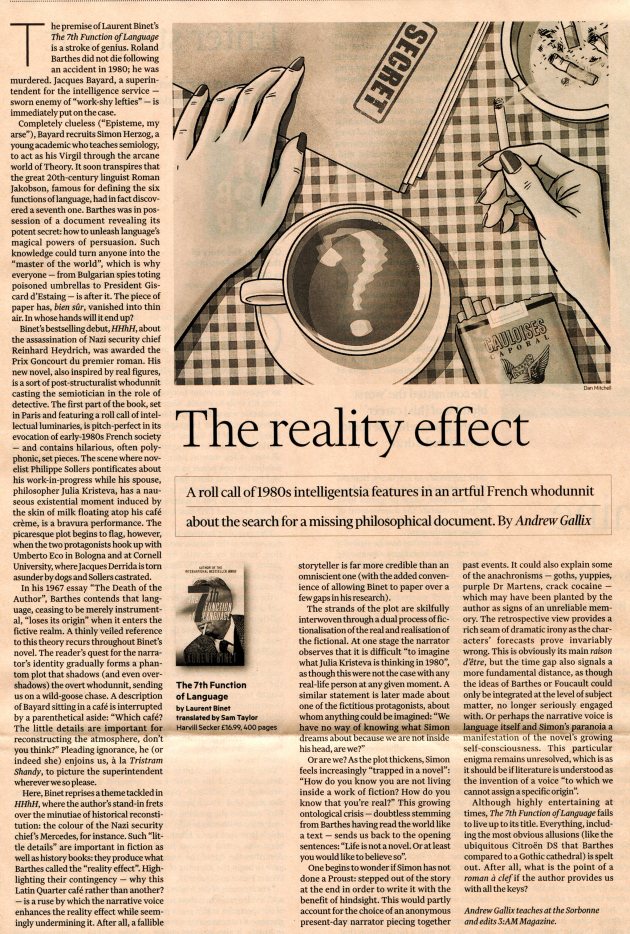
The premise of Laurent Binet’s The 7th Function of Language is a stroke of genius. Roland Barthes did not die following an accident in 1980; he was murdered. Jacques Bayard, a superintendent for the intelligence service — sworn enemy of “work-shy lefties” — is immediately put on the case.

Completely clueless (“Episteme, my arse”), Bayard recruits Simon Herzog, a young academic who teaches semiology, to act as his Virgil through the arcane world of Theory. It soon transpires that the great 20th-century linguist Roman Jakobson, famous for defining the six functions of language, had in fact discovered a seventh one. Barthes was in possession of a document revealing its potent secret: how to unleash language’s magical powers of persuasion. Such knowledge could turn anyone into the “master of the world”, which is why everyone — from Bulgarian spies toting poisoned umbrellas to President Giscard d’Estaing — is after it. The piece of paper has, bien sûr, vanished into thin air. In whose hands will it end up?

Binet’s bestselling debut, HHhH, about the assassination of Nazi security chief Reinhard Heydrich, was awarded the Prix Goncourt du premier roman. His new novel, also inspired by real figures, is a sort of post-structuralist whodunnit casting the semiotician in the role of detective. The first part of the book, set in Paris and featuring a roll call of intellectual luminaries, is pitch-perfect in its evocation of early-1980s French society — and contains hilarious, often polyphonic, set pieces. The scene where novelist Philippe Sollers pontificates about his work-in-progress while his spouse, philosopher Julia Kristeva, has a nauseous existential moment induced by the skin of milk floating atop his café crème, is a bravura performance. The picaresque plot begins to flag, however, when the two protagonists hook up with Umberto Eco in Bologna and at Cornell University, where Jacques Derrida is torn asunder by dogs and Sollers castrated.

In his 1967 essay “The Death of the Author”, Barthes contends that lang­uage, ceasing to be merely instrument­al, “loses its origin” when it enters the fictive realm. A thinly veiled reference to this theory recurs throughout Binet’s novel. The reader’s quest for the narrator’s identity gradually forms a phantom plot that shadows (and even overshadows) the overt whodunnit, sending us on a wild-goose chase. A description of Bayard sitting in a café is interrupted by a parenthetical aside: “Which café? The little details are important for reconstructing the atmosphere, don’t you think?” Pleading ignorance, he (or indeed she) enjoins us, à la Tristram Shandy, to picture the superintendent wherever we so please.

Here, Binet reprises a theme tackled in HHhH, where the author’s stand-in frets over the minutiae of historical reconstitution: the colour of the Nazi security chief’s Mercedes, for instance. Such “little details” are important in fiction as well as history books: they produce what Barthes called the “reality effect”. Highlighting their contingency — why this Latin Quarter café rather than another? — is a ruse by which the narrative voice enhances the reality effect while seemingly undermining it. After all, a fallible storyteller is far more credible than an omniscient one (with the added convenience of allowing Binet to paper over a few gaps in his research).

The strands of the plot are skilfully interwoven through a dual process of fictionalisation of the real and realisation of the fictional. At one stage the narrator observes that it is difficult “to imagine what Julia Kristeva is thinking in 1980”, as though this were not the case with any real-life person at any given moment. A similar statement is later made about one of the fictitious protagonists, about whom anything could be imagined: “We have no way of knowing what Simon dreams about because we are not inside his head, are we?”

Or are we? As the plot thickens, Simon feels increasingly “trapped in a novel”: “How do you know you are not living inside a work of fiction? How do you know that you’re real?” This growing ontological crisis — doubtless stemming from Barthes having read the world like a text — sends us back to the opening sentences: “Life is not a novel. Or at least you would like to believe so”.

One begins to wonder if Simon has not done a Proust: stepped out of the story at the end in order to write it with the benefit of hindsight. This would partly account for the choice of an anonymous present-day narrator piecing together past events. It could also explain some of the anachronisms — goths, yuppies, purple Dr Martens, crack cocaine — which may have been planted by the author as signs of an unreliable memory. The retrospective view provides a rich seam of dramatic irony as the characters’ forecasts prove invariably wrong. This is obviously its main raison d’être, but the time gap also signals a more fundamental distance, as though the ideas of Barthes or Foucault could only be integrated at the level of subject matter, no longer seriously engaged with. Or perhaps the narrative voice is language itself and Simon’s paranoia a manifestation of the novel’s growing self-consciousness. This particular enigma remains unresolved, which is as it should be if literature is understood as the invention of a voice “to which we cannot assign a specific origin”.

Although highly entertaining at times, The 7th Function of Language fails to live up to its title. Everything, including the most obvious allusions (like the ubiquitous Citroën DS that Barthes compared to a Gothic cathedral) is spelt out. After all, what is the point of a roman à clef if the author provides us with all the keys?

Retrotopia

This appeared in The Irish Times on 13 May 2017:

A Heavyweight’s Flawed but Important Last Work

Zygmunt Bauman, who died in January at the age of 91, was one of the last intellectual heavyweights of the 20th century. He belonged to a generation that derived its aura and wisdom from the second World War, even winning a medal for gallantry in combat. He was a Polish Jew, and so his life and work were shaped by both Nazi and communist persecution, the latter forcing him to relinquish his citizenship as a prerequisite for exile.

Although he became professor of sociology at the University of Leeds in 1971 — residing in England, with his family, for the rest of his life — he always retained a strong accent, not dissimilar to a comedy impression of Sigmund Freud. You can hear it in his numerous books, ostensibly written in English but frequently reading like literal translations from sundry continental tongues. This deterritorialised voice, poised somewhere between Yorkshire and Mitteleuropa, never tries to conceal its cosmopolitan origins. It speaks the language of liquid modernity, the era-defining concept that will doubtless serve as his epitaph.

Composed in the shadow of Brexit and Trump, Retrotopia — Bauman’s last, posthumously published work — revisits this rapidly evolving phenomenon. The sociologist had long argued that a loss of faith in society’s perfectibility was one of the main distinctions between the “solid” and “liquid” phases of modernity, a theme that he reprises and expands on here.

His argument hinges on the “emancipation of power from territory”, as a result of which nation states, with increasingly “porous” borders, are no longer able to fulfil their traditional functions. This political impotence, compounded by the stupefying pace of change, has redirected the utopian impulse towards the “space of collective memory”. We take refuge in the past because it can be “remodelled at will”, thus providing the “blissful omnipotence lost in the present”.

The future is now associated not with progress but with stasis or regression. At best it seems to offer more of the same; at worst it holds out the prospect of “social degradation” and “impending catastrophe”. Hence the privatisation of happiness, sought no longer through collective endeavours but through self-improvement and personal “wellness”.

Today’s dominant “managerial philosophy” appeals to our contradictory aspirations to autonomy and belonging. Idiosyncrasies, which would once have been ironed out on the Fordist conveyor belt, are now encouraged in the name of ever more diversity. In exchange, however, corporations feel free to exploit the “sum total” of their employees’ “personality assets” while guaranteeing them little or no loyalty.

Social in name only, our online networks offer another ersatz brand of communality, acting as they do as filter bubbles, providing insulation from any views likely to challenge our easily bruised egos. Such comfort zones are “as close to the nirvana of the womb” as we can get. Indeed, a return to the safety of the womb is the logical conclusion of a series of reactionary trends taking us back to a world of “weakening human bonds”, tribalism and growing inequalities — a Hobbesian “war of all against all”.

Despite the bleakness of the picture he paints, Bauman elicits none of the pessimism he has sometimes been accused of. He suggests that retrotopianism is largely due to our failure to develop a cosmopolitan consciousness, despite living in a cosmopolitan world. Human groups continue, as they have always done, to define themselves by exclusion. The challenge of our times, he asserts, with an enthusiasm that almost makes it sound feasible, is to achieve “integration without separation”.

Crudely reductive
Retrotopia is an important work but one that is deeply flawed. The sociologist’s rationale, for instance, can be crudely reductive: he too seems holed up in his comfort zone, from whence all ills are ultimately ascribed to globalisation. He appears surprisingly naive at times, presenting some of the pontiff’s pious platitudes as a blueprint for the future of mankind, or universal basic income as a foolproof panacea for inequality.

Bauman’s methodology is equally questionable. Sweeping statements (“today’s growth of violence”) alternate with detailed references to studies whose validity is premised exclusively on their authors’ academic credentials. The recourse to Homeric epithets — “the remarkable Belgian psychoanalyst”, “the great Norwegian anthropologist”, “the formidable Estonian student of culture”, “the foremost researcher” — is unlikely to hold sway in the current populist climate and may even prove counterproductive.

Another weakness is the author’s failure to engage with popular culture, which theorists such as Mark Fisher (who took his life four days after Bauman’s death) and Simon Reynolds have identified as the locus where the major symptoms of our nostalgic times may be observed.

Overlooking a few recurring linguistic mistakes and the odd cliche masquerading as reference, Bauman has a propensity to repeat himself twice, or even thrice, like a one-man Thomson and Thompson, which should have been reined in: “correctness and veracity”, “porosity and permeability”, “trenchant and incisive”, “budding, aspiring and up-and-coming”, “insecurity, uncertainty and un-safety”, “cautious, circumspect and prudent”. The cumulative effect is ludicrous, laughable and risible.

The keen interest this nonagenarian showed in the world and its future is a source of hope and even joy. His enduring intellectual vigour should come as no great surprise, considering that he published most of his works after retiring. Some of the references here are so up to the minute that reading Retrotopia is like stumbling across the number of a recently departed loved one on your mobile.

In those moments it is difficult not to give in to feelings of nostalgia.

Resemblance in the Work of Jochen Gerz

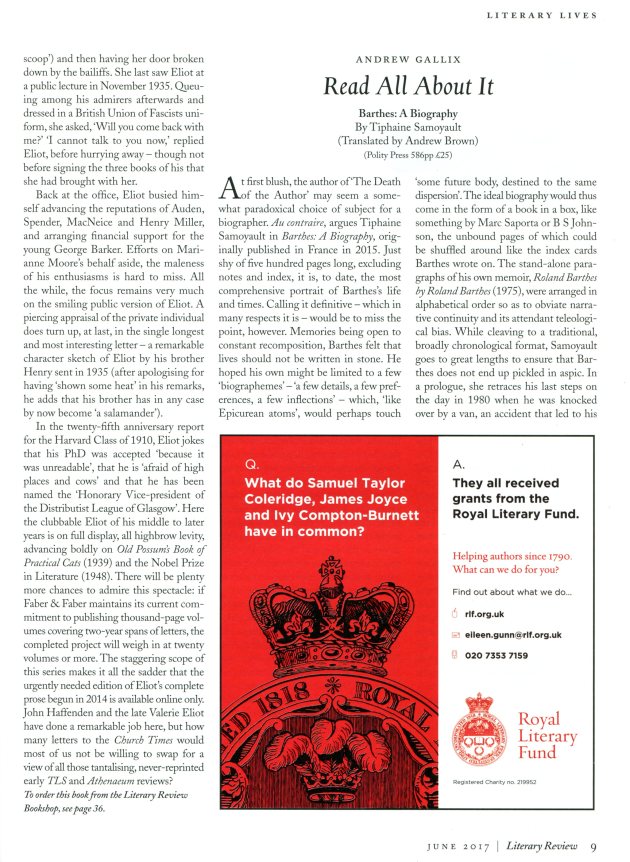
I have translated Octave Debary‘s Resemblance in the Work of Jochen Gerz (French title: La ressemblance dans l’oeuvre de Jochen Gerz) published by Créaphis éditions on 1 June 2017. It is a bilingual edition, with my English translation appearing on each page beside the original French text.

My aim here is to go on a journey down this road with Jochen Gerz. To strike up a conversation, not so much about his work as one that winds its way through his works. I wish to chart the trajectory I have been following as an anthropologist studying remains and the remains of history, which has led to a decade-long dialogue with Gerz’s oeuvre. Those artworks that he often abandons, once created, offering them up to the city and passers-by. Gerz is one of the foremost contemporary artists of memory and public space.

A Deterritorialised Voice

My review of Zygmunt Bauman‘s Retrotopia appears in today’s Irish Times. Here is an extract:

Zygmunt Bauman, who died in January at the age of 91, was one of the last intellectual heavyweights of the 20th century. He belonged to a generation that derived its aura and wisdom from the second World War, even winning a medal for gallantry in combat. He was a Polish Jew, and so his life and work were shaped by both Nazi and communist persecution, the latter forcing him to relinquish his citizenship as a prerequisite for exile.

Although he became professor of sociology at the University of Leeds in 1971 – residing in England, with his family, for the rest of his life – he always retained a strong accent, not dissimilar to a comedy impression of Sigmund Freud. You can hear it in his numerous books, ostensibly written in English but frequently reading like literal translations from sundry continental tongues. This deterritorialised voice, poised somewhere between Yorkshire and Mitteleuropa, never tries to conceal its cosmopolitan origins. It speaks the language of liquid modernity, the era-defining concept that will doubtless serve as his epitaph.

Composed in the shadow of Brexit and Trump, Retrotopia — Bauman’s last, posthumously published work — revisits this rapidly evolving phenomenon. The sociologist had long argued that a loss of faith in society’s perfectibility was one of the main distinctions between the “solid” and “liquid” phases of modernity, a theme that he reprises and expands on here.

His argument hinges on the “emancipation of power from territory”, as a result of which nation states, with increasingly “porous” borders, are no longer able to fulfil their traditional functions. This political impotence, compounded by the stupefying pace of change, has redirected the utopian impulse towards the “space of collective memory”. We take refuge in the past because it can be “remodelled at will”, thus providing the “blissful omnipotence lost in the present”.

The future is now associated not with progress but with stasis or regression. At best it seems to offer more of the same; at worst it holds out the prospect of “social degradation” and “impending catastrophe”. Hence the privatisation of happiness, sought no longer through collective endeavours but through self-improvement and personal “wellness”….

Phantom Plot

My review of Laurent Binet’s The Seventh Function of Language will appear in the FT tomorrow. It was posted on their website today. Here is an extract:

In his 1967 essay “The Death of the Author”, Barthes contends that lang­uage, ceasing to be merely instrument­al, “loses its origin” when it enters the fictive realm. A thinly veiled reference to this theory recurs throughout Binet’s novel. The reader’s quest for the narrator’s identity gradually forms a phantom plot that shadows (and even overshadows) the overt whodunnit, sending us on a wild-goose chase. A description of Bayard sitting in a café is interrupted by a parenthetical aside: “Which café? The little details are important for reconstructing the atmosphere, don’t you think?” Pleading ignorance, he (or indeed she) enjoins us, à la Tristram Shandy, to picture the superintendent wherever we so please.

Here, Binet reprises a theme tackled in HHhH, where the author’s stand-in frets over the minutiae of historical reconstitution: the colour of the Nazi security chief’s Mercedes, for instance. Such “little details” are important in fiction as well as history books: they produce what Barthes called the “reality effect”. Highlighting their contingency — why this Latin Quarter café rather than another? — is a ruse by which the narrative voice enhances the reality effect while seemingly undermining it. After all, a fallible storyteller is far more credible than an omniscient one (with the added convenience of allowing Binet to paper over a few gaps in his research).

The strands of the plot are skilfully interwoven through a dual process of fictionalisation of the real and realisation of the fictional. At one stage the narrator observes that it is difficult “to imagine what Julia Kristeva is thinking in 1980”, as though this were not the case with any real-life person at any given moment. A similar statement is later made about one of the fictitious protagonists, about whom anything could be imagined: “We have no way of knowing what Simon dreams about because we are not inside his head, are we?”

Or are we? As the plot thickens, Simon feels increasingly “trapped in a novel”: “How do you know you are not living inside a work of fiction? How do you know that you’re real?” This growing ontological crisis — doubtless stemming from Barthes having read the world like a text — sends us back to the opening sentences: “Life is not a novel. Or at least you would like to believe so”.