
This appeared in The Irish Times on 13 May 2017:
A Heavyweight’s Flawed but Important Last Work
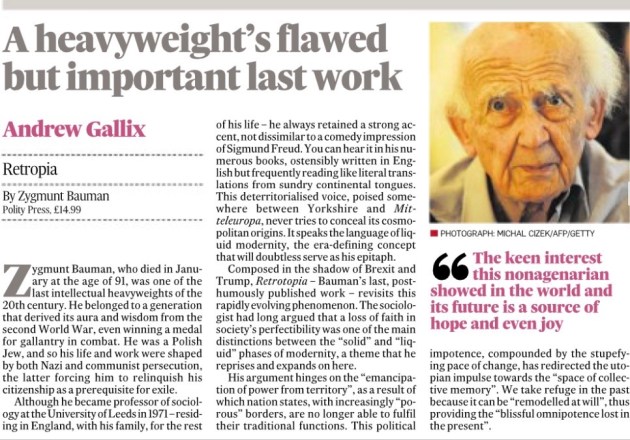
Zygmunt Bauman, who died in January at the age of 91, was one of the last intellectual heavyweights of the 20th century. He belonged to a generation that derived its aura and wisdom from the second World War, even winning a medal for gallantry in combat. He was a Polish Jew, and so his life and work were shaped by both Nazi and communist persecution, the latter forcing him to relinquish his citizenship as a prerequisite for exile.
Although he became professor of sociology at the University of Leeds in 1971 — residing in England, with his family, for the rest of his life — he always retained a strong accent, not dissimilar to a comedy impression of Sigmund Freud. You can hear it in his numerous books, ostensibly written in English but frequently reading like literal translations from sundry continental tongues. This deterritorialised voice, poised somewhere between Yorkshire and Mitteleuropa, never tries to conceal its cosmopolitan origins. It speaks the language of liquid modernity, the era-defining concept that will doubtless serve as his epitaph.
Composed in the shadow of Brexit and Trump, Retrotopia — Bauman’s last, posthumously published work — revisits this rapidly evolving phenomenon. The sociologist had long argued that a loss of faith in society’s perfectibility was one of the main distinctions between the “solid” and “liquid” phases of modernity, a theme that he reprises and expands on here.
His argument hinges on the “emancipation of power from territory”, as a result of which nation states, with increasingly “porous” borders, are no longer able to fulfil their traditional functions. This political impotence, compounded by the stupefying pace of change, has redirected the utopian impulse towards the “space of collective memory”. We take refuge in the past because it can be “remodelled at will”, thus providing the “blissful omnipotence lost in the present”.
The future is now associated not with progress but with stasis or regression. At best it seems to offer more of the same; at worst it holds out the prospect of “social degradation” and “impending catastrophe”. Hence the privatisation of happiness, sought no longer through collective endeavours but through self-improvement and personal “wellness”.
Today’s dominant “managerial philosophy” appeals to our contradictory aspirations to autonomy and belonging. Idiosyncrasies, which would once have been ironed out on the Fordist conveyor belt, are now encouraged in the name of ever more diversity. In exchange, however, corporations feel free to exploit the “sum total” of their employees’ “personality assets” while guaranteeing them little or no loyalty.
Social in name only, our online networks offer another ersatz brand of communality, acting as they do as filter bubbles, providing insulation from any views likely to challenge our easily bruised egos. Such comfort zones are “as close to the nirvana of the womb” as we can get. Indeed, a return to the safety of the womb is the logical conclusion of a series of reactionary trends taking us back to a world of “weakening human bonds”, tribalism and growing inequalities — a Hobbesian “war of all against all”.
Despite the bleakness of the picture he paints, Bauman elicits none of the pessimism he has sometimes been accused of. He suggests that retrotopianism is largely due to our failure to develop a cosmopolitan consciousness, despite living in a cosmopolitan world. Human groups continue, as they have always done, to define themselves by exclusion. The challenge of our times, he asserts, with an enthusiasm that almost makes it sound feasible, is to achieve “integration without separation”.
Crudely reductive
Retrotopia is an important work but one that is deeply flawed. The sociologist’s rationale, for instance, can be crudely reductive: he too seems holed up in his comfort zone, from whence all ills are ultimately ascribed to globalisation. He appears surprisingly naive at times, presenting some of the pontiff’s pious platitudes as a blueprint for the future of mankind, or universal basic income as a foolproof panacea for inequality.
Bauman’s methodology is equally questionable. Sweeping statements (“today’s growth of violence”) alternate with detailed references to studies whose validity is premised exclusively on their authors’ academic credentials. The recourse to Homeric epithets — “the remarkable Belgian psychoanalyst”, “the great Norwegian anthropologist”, “the formidable Estonian student of culture”, “the foremost researcher” — is unlikely to hold sway in the current populist climate and may even prove counterproductive.
Another weakness is the author’s failure to engage with popular culture, which theorists such as Mark Fisher (who took his life four days after Bauman’s death) and Simon Reynolds have identified as the locus where the major symptoms of our nostalgic times may be observed.
Overlooking a few recurring linguistic mistakes and the odd cliche masquerading as reference, Bauman has a propensity to repeat himself twice, or even thrice, like a one-man Thomson and Thompson, which should have been reined in: “correctness and veracity”, “porosity and permeability”, “trenchant and incisive”, “budding, aspiring and up-and-coming”, “insecurity, uncertainty and un-safety”, “cautious, circumspect and prudent”. The cumulative effect is ludicrous, laughable and risible.
The keen interest this nonagenarian showed in the world and its future is a source of hope and even joy. His enduring intellectual vigour should come as no great surprise, considering that he published most of his works after retiring. Some of the references here are so up to the minute that reading Retrotopia is like stumbling across the number of a recently departed loved one on your mobile.
In those moments it is difficult not to give in to feelings of nostalgia.


 ANDREW GALLIX