This appeared in the New European, 27 July-2 August 2017, pp. 38-40:

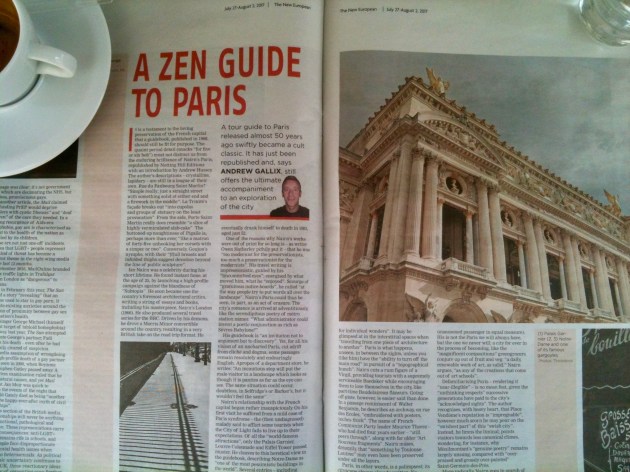
A Zen Guide to Paris
It is a testament to the loving preservation of the French capital that a guidebook, published in 1968, should still be fit for purpose. The quaint period detail (snacks “for five or six bob”) must not distract us from the enduring brilliance of Nairn’s Paris, republished by Notting Hill Editions with an introduction by Andrew Hussey. The author’s descriptions — crystalline, lapidary — are still in a league of their own. Rue du Faubourg Saint-Martin? “Simple really; just a straight street with something solid at either end and a firework in the middle”. La Trinité’s façade breaks out “into cupolas and groups of statuary on the least provocation”. From the side, Porte Saint-Martin really does resemble “a slice of highly vermiculated slab-cake”. The buttoned-up naughtiness of Pigalle is, perhaps more than ever, “like a matron of forty-five unhooking her corsets with a simper or two”. Conversely, Goujon’s nymphs, with their “[f]ull breasts and infolded thighs suggest devotion beyond the line of public sculpture”.
Ian Nairn was a celebrity during his short lifetime. He found instant fame, at the age of 25, by launching a high-profile campaign against the blandness of “Subtopia”. He soon became one the country’s foremost architectural critics, writing a string of essays and books, including his masterpiece, Nairn’s London (1966). He also produced several travel series for the BBC. Driven by his demons, he drove a Morris Minor convertible around the country, resulting in a very British take on the road trip format. He eventually drank himself to death in 1983, aged just 52.
One of the reasons why Nairn’s works were out of print for so long is — as writer Owen Hatherley pithily put it — that he was “too modernist for the preservationists, too much a preservationist for the modernists”. His travel writing is impressionistic, guided by his “uncommitted eyes”; energised by what moved him, what he “enjoyed”. Scourge of “gratuitous notice-boards”, he railed “at the way people try to put words all over the landscape”. Nairn’s Paris could thus be seen, in part, as an act of erasure. The city’s romance is arrived at adventitiously, like the serendipitous poetry of métro station names: “What administrator could invent a poetic conjunction as rich as Sèvres-Babylone?”
His guidebook is “an invitation not to argument but to discovery”. Yet, for all his vision of an uncharted Paris, cut adrift from cliché and dogma, some passages remain resolutely and endearingly English. Apropos of a department store, he writes: “An incautious step will put the male visitor in a landscape which looks as though it is panties as far as the eye can see. The same situation could occur, doubtless, in Selfridge’s or Barker’s, but it wouldn’t feel the same”.
Nairn’s relationship with the French capital began rather inauspiciously. On his first visit he suffered from a mild case of Paris syndrome — the (then undiagnosed) malady said to afflict some tourists when the City of Light fails to live up to their expectations. Of all the “world-famous attractions”, only the Palais Garnier, Louvre Colonnade and Eiffel Tower passed muster. He cleaves to this heretical view in the guidebook, describing Notre-Dame as “one of the most pessimistic buildings in the world”. Several entries — including such crowd-pleasers as the Sacré-Coeur — are cordoned off within sanitary square brackets, making it perfectly plain that these landmarks did not “appeal” to the author, although it would have been remiss of him not to cover them. Nairn’s Paris — for that, after all, is the title of the book — is a “collective masterpiece”, not “a place for individual wonders”. It may be glimpsed at in the interstitial spaces when “travelling from one piece of architecture to another”. Paris is what happens, unseen, in between the sights, unless you (like him) have the “ability to turn off the main road” in pursuit of a “topographical hunch”. Nairn cuts a rum figure of a Virgil, providing tourists with a supremely serviceable Baedeker while encouraging them to lose themselves in the city, like part-time Baudelairean flâneurs. Going off-piste, however, is easier said than done. In a passage reminiscent of Walter Benjamin, he describes an archway, on rue des Ecoles, “embroidered with posters, inches thick”. The name of French Communist Party leader Maurice Thorez — who had died four years earlier — “still peers through”, along with far older “Art Nouveau fragments”. Nairn muses, dreamily, that “something by Toulouse-Lautrec” may even have been preserved under all the layers.
Paris, in other words, is a palimpsest; its cityscape always already written. No wonder, then, that the travel writer should long for a blank slate, or, failing that, one that resists easy decipherment. Something akin to the restaurant menu boards he was so fond of, “written up daily in near-illegible purple ink”, or the “inscrutable lettering” adorning bus stops (designed, presumably, to delight and wrong-foot the unseasoned passenger in equal measure). His is not the Paris we will always have, but the one we never will; a city for ever in the process of becoming, like the “magnificent compositions” greengrocers conjure up out of fruit and veg: “a daily, renewable work of art, as valid,” Nairn argues, “as any of the creations that come out of art schools”.
Defamiliarising Paris — rendering it “near-illegible” — is no mean feat, given the “unthinking respects” successive generations have paid to the city’s “acknowledged sights”. The author recognises, with heavy heart, that Place Vendôme’s reputation is “impregnable”, however much scorn he may pour on the “swishest part” of this “swish city”. Instead, he limns the liminal; points visitors towards less canonical climes, wondering, for instance, why Ménilmontant’s “genuine poetry” remains largely unsung, compared with “over-praised and grossly over-painted” Saint-Germain-des-Prés.
More radically, Nairn goes in search of Paris’s genius loci, which, owing to the city’s “homogenous” and “monolithic” nature, is not rooted in any specific locale. “Specific buildings and specific views” are the “least part” of l’Île-Saint-Louis, he declares, “as they are of Paris as a whole”. Promoting the joys of the river Seine, he reaffirms this notion of a moveable feast: “The actual place is unimportant: there will always be a view of something. What counts is water, the gleaming stone kerbs, the angle of a tree, the look of someone else’s upturned feet, their view of your own, the perspective of buildings on the other side”. Likewise, the author’s elegant black-and-white photographs tend to focus on the aura of a site in lieu of the site itself. The Jardin des Tuileries, for instance, is adumbrated by a couple of empty chairs facing each other, like a Ionesco play on a budget.
Nairn has a penchant for undistinguished locations, where “there is almost nothing to look at in the usual sense”; where space spaces out and place can take place. In an entry not included in the present edition, he praises Quevauvillers’ features, “all lying around waiting for nothing to happen”. Nothing happened with a vengeance, when he and his wife, high on hiatus, spent a “very wet day” near a suburban station “not going to the Air Museum”: “In London it would have been a misery; in Paris it became The Day the Rain Came, luminous and isolated”. Numinous too. There is a Zen-like quality to these mini epiphanies — these lulls in the topographer’s relentless perambulations — which signals a fleeting sense of arrival: “the moment you give up and relax, the city will accept you. All you have to do is put your arse on a café seat, park bench, or low wall, and look”.
Transmuting the infra-ordinary into the extraordinary is Paris’s party trick, hence the “magic-city” sobriquet. It is “a memorable experience,” Nairn enthuses, “to have banality transform itself into ideal as you sit and look, hear, smell, and taste — the whole city is urging you to greater depth of feeling, the opposite effect of a Birmingham”. The humdrum is magicked, by dint of “atmosphere”, into the everyday sublime, a transformative experience that leaves visitors feeling “more alive”: “You and the city, together, have built an event which is neither personal nor impersonal”. Once tuned into, Paris achieves a flow state, where everything is “plugged in” while remaining a “vehicle for the expression of millions of disparate desires”. This version of the French capital is resolutely “on the side of life” unlike many of the fusty, musty national monuments — “desexed” and “stone-cold dead” — which Nairn inveighs against. It provides “pure urban freedom”; a framework within which “life can take what shape it likes”, allowing “full space for your private world”. It is perhaps best exemplified by the Tuileries, where I am writing this, sipping a cheeky rosé: “These are enchanted groves for world-citizens, where each gesture has its own weight and space: absolute, unimpeded by any outside influence: assessed by its own nature and no other — whether it is a kiss or a system of philosophy. (…) Not bad for a thick copse and some gravel; but that’s Paris”. I think we can all drink to that.