[SIC]

Jeff Bursey, Rev. of [SIC], by Davis Schneiderman, The Quarterly Conversation 10 March 2014

In 2011 Andrew Gallix, in the Guardian, wrote a piece on unread difficult books, and he mentioned “an anthology of blank books [edited by Michael Gibbs] entitled All Or Nothing.” We can consider Blank as continuing that line. Kenneth Goldsmith’s prefatory essay “Why Conceptual Writing? Why Now?” in Against Expression: An Anthology of Conceptual Writing (2011) contains these useful lines: “What has happened in the past fifteen years has forced writers to conceive of language in ways unthinkable just a short time ago. With an unprecedented onslaught of the sheer quantity of language . . . , the writer faces the challenge of exactly how best to respond.” In volume one of his trilogy, Schneiderman edged near to muteness, but in [SIC] he has positioned himself, the work, and us in a new spot. His latest book is filled with words. None of them are his.

Not Knowing How to Write

Karl Ove Knausgaard, “Completely Without Dignity: An Interview with Karl Ove Knausgaard” by Jesse Barron, The Paris Review Daily 26 December 2013

Did you keep diaries when you were young?

Yes, I did, but I burned them when I was twenty-five or twenty-six.

Why?

I was so embarrassed, I couldn’t stand it. It’s the same with Min Kamp, I can’t stand it. If I could I would burn that, too, but there are too many prints, so it’s impossible.

Life develops, changes, is in motion. The forms of literature are not. So if you want the writing to be as close to life as possible — I do not mean this in any way as an apology for realism — but if you want to write close to life, you have to break the forms you’ve used, which means that you constantly have the feeling of writing the first novel, for the first time, which means that you do not know how to write. All good writers have that in common, they do not know how to write.

[See Roland Barthes and Thomas Mann.]

The Radiance of the Future

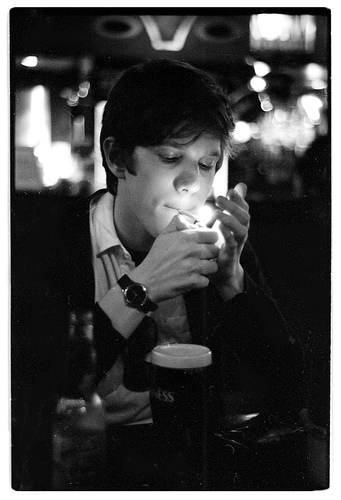
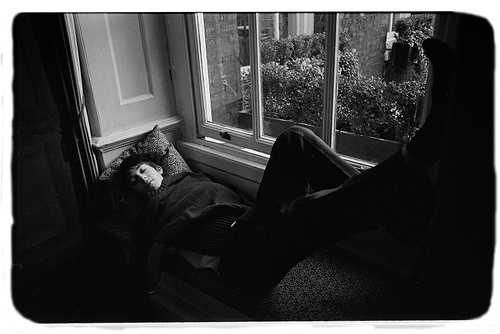
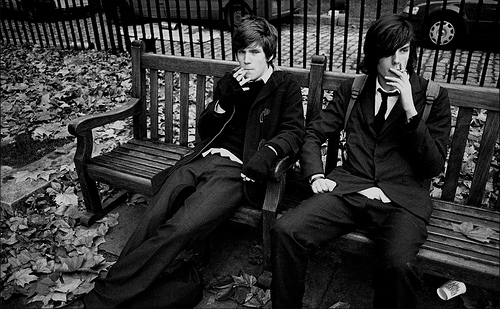
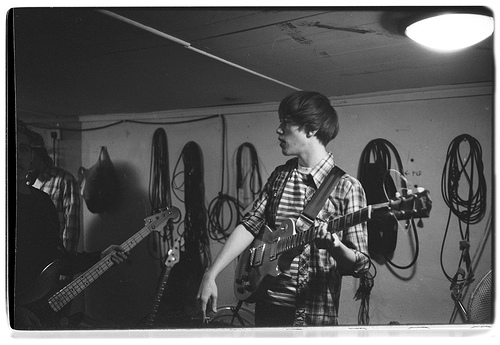
This interview with photographer Jamie Stoker appeared in 3:AM Magazine on 23 March 2007:

The Radiance of the Future: An Interview with Jamie Stoker
jamiestoker

3:AM: Your pictures are both out of time and of the moment. As a result, they seem to capture the very essence of youth: the living for the moment, but also the fleetingness of that moment. Is this deliberate? And to what extent is this effect due to your use of old-school materials and methods?

JS: Photography first became important to me because I realised that with a camera I could document my social surroundings, record the memories, the faces, all of that. Eighteen is an age, for me at least, where I feel like I’m finally living my life for real. My earlier teen years were mainly hanging around with nowhere to go or nothing worthwhile to do. So yeah, I guess it is deliberate, I didn’t like the idea of letting the best years of my life slip by unnoticed — so I picked up a camera. Shooting analogue is a long drawn-out process, and I like that. You spend your time engaging with the world and people around you, rather than the tiny LCD on the back of your camera. Having to spend time and work towards an image you can’t even see yet will always beat the instant gratification of digital. Getting prints back or developing a roll in the sink and seeing my images at the end feels like getting presents at Christmas (or something like that.)
stoker2
stoker3
stoker4
stoker5
stoker6
stoker73:AM: This meeting of the old and the new also reflects recent trends in photography: digital cameras and the Internet have led to a paradoxical revival of interest in film and analogue cameras. You choose to shoot film but post scans of your pictures on your blog and on Flickr (where they are viewed by hundreds of people). Do you agree that the two media seem to complement each other?

JS: Definitely. Photography is a social art. My photos reflect the life I lead and the people I know, and I like being able to share that with people. I shoot film because the cameras and the process are fun and satisfying as hell, and the end results look amazing. Combining it with the Internet and its limitless possibilities is that perfect blend of old and new.

3:AM: Your favourite camera at the moment is a Bessa R2a. Could you explain what’s so great about it?

JS: Rangefinder. The viewfinder. Small, quiet, black (looks badass, like a ninja!). Great lenses. Well built, expensive but not to the extent where I’m afraid to use it and fuck it up. I named mine Beowulf. Nice.
stoker8

3:AM: The colours in your colour Bessa pictures are beautifully passé as in ‘faded’, which lends them the wistful, nostalgic quality I mentioned previously. Where does that come from? Have you ever tried using a Holga or a Lomo L-CA which can produce similar effects? Where do you stand on the whole Lomo/toy camera phenomenon?

JS: I have film to thank for my colours (and tonality for black and white shots.) It’s really hard for me to pin down, but film just has these colours where they are both desaturated but at the same time incredibly rich. Digital looks fake. Film looks real. Haven’t tried any of those cameras although I was looking into Holgas the other day and was tempted to pick one up. I’m all for anything that can liberate your shooting style. Personally, I love Polaroids and the little cluster of photographers that still shoot with them. The old land cameras that take pack film and Sx-70s are beautiful feats of engineering, and great fun to shoot with too. A little shitty camera that you can have with you 24/7 is in my opinion worth more than a Leica that sits in your dad’s study. The other day I bought a Yashica Samurai for ten quid. It’s a half frame SLR, you get 72 shots on one roll of film and to make things better (or worse) it looks like a weapon from Star Trek. It’s great for when I’m too drunk to worry about an expensive rangefinder.
stoker9
stoker10
stoker11
stoker12

3:AM: Which do you prefer: colour or black and white? (Most of your pictures seem to be black and white.)

JS: It’s an eternal struggle within me. I don’t know. Black and white features more because it’s cheap to develop at home. It can be great for removing the distraction of colour and creating this amazing relationship with the viewer. That being said, if you nail a decent colour shot, it can be amazing. I really don’t know, both for the moment, they have their time and place, maybe I will favour one in the future — who knows.

3:AM: How did you come to photography in the first place? Tell us about your career plans…

JS: JS: I went on a trip to Africa and wanted to take some photos to remember it (I always wanted go to there when I was younger.) So I stole my brother’s Canon Av-1 and a bunch of prime lenses even though I didn’t know what SLR stood for or how the hell to use it. 10 rolls of blurred shots later and I was hooked – I needed to know how to take decent photos. Like I said earlier, I realised that with a camera I could document me and my friends and the city around us. That was two years ago.

I used books, the Internet, friends, teachers — anything really — to teach myself all there is to know from the techniques to the execution of photography. I think I did pretty well if I can say so myself. One thing I will say was that digital was a great platform to learn on, and very forgiving with trial and error. But now that I know what I’m doing, it’s film all the way.

My plans? I’m in the process of applying to do some sort of photography course or degree at the London College of Communication. We’ll see what happens and how it goes. When I’m older I would love to be a photojournalist. To travel and meet people, try and make a difference. I know it’s over romanticised and the industry is very tough, but I could see myself happy doing it. Plus documentary photography is essentially what I do now with my friends, it is the kind of photography that I want to spend my life doing. In the summer I’m going to be assisting Nick Danziger in Monaco for a month, so I’m really excited about that. He’s a pretty big deal and a great photojournalist, so I feel very luck for the opportunity. He’s got an exhibition on at the National Portrait Gallery of shots taken behind the scenes with Tony Blair which I would definitely recommend.
stoker13

3:AM: In your blog, you mention Winogrand: are you interested in the history of photography? Are you influenced by any of The Greats?

JS: Yes, yes and yes. I study History of Art at school and, aside from far too many essays, it’s great. It’s definitely taught me to appreciate what came before. At the moment we are studying Renaissance art in Florence and the thinker Plutarch talked about “moving forward in the radiance of the past”. That’s an idea that stuck with me.

As far as influences go, I don’t have singular devastating ones, but rather a melting pot of ideas. At the moment I’m reading this huge tome on Robert Capa I bought the other day, and it’s amazing from seeing his contact sheets and method of working to reading about his personal life. A great man indeed. I have a lot of respect and admiration for war photographers, and it’s definitely something which interests me with an eye to the future. Larry Burrows, McCullin and the rest. In a week or so I’m going to a talk by Philip Jones Griffiths on his amazing book Vietnam Inc and I really can’t wait.
stoker14

3:AM: Many of the artists (Larry Clark, Gus Van Sant etc.) who document the lifestyles of young people do so from the outside. You are in the privileged position of being able to do so from the inside, which is why your pictures are revealing without being prurient. Are you afraid people will find your pictures less interesting when you grow older and move on to other subjects?

JS: Not at all. I shoot my friends because they are what I have access to, but as I get older and things change, so hopefully shall I. There’s so much going on in this world that it’s more a case of pure excitement for what the future will yield.
stoker15

3:AM: Your pictures document your life and that of your friends, so tell us a bit about that. Let’s start with where you live: Hampstead…

JS: Hampstead. It’s nice. That’s about it. It’s not very exciting, but it’s a comfortable place to live. And the heath is lovely in the summer. There are far too many mobile phone shops and estate agents which makes no sense, however there’s an awesome private old camera shop called Photocraft where the old folks who work there all know their shit and are really helpful. With uni and whatnot, I am planning to move out and elsewhere in the next couple of years.

3:AM: Westminster School
JS: It’s the most fantastic location, and the history of the school really pervades through. That being said, they are very focused on academics and Oxbridge and so I’ve become very bored with it all. I’m studying A-levels in History, English, History of art and Art — far too many essays. The art department is like this little bastion of sanity for me.
ws1
ws2
ws3
ws4

3:AM: Many of your pictures depict your nightlife in trendy East London (333, 93 Feet East)…

JS: Well, my other main hobby aside from photography is partying. But I take a camera with me (of varying expense depending on how much I’m planning to party) so I kinda combine the two. The maddest shit happens on night buses and in the early hours of the morning in London, so I like to be prepared. Lots of interesting people and places in that area of London. London itself is another main element of my photos. I’ve travelled a lot, but nowhere compares to London. It really is the most fantastic, diverse city. I think it’s also the most visited city in the world now, and so it should be. I’m proud to live in it.
trafalgar

3:AM: You are also the drummer in a band called Trafalgar. How does that fit into the grand scheme of things?
coach

JS: Well, things are really about to take off with Trafalgar. We played an all-expenses-paid gig in Barcelona at this huge club called Razmatazz the other week, and it was pretty much the greatest 24 hours of my life. I shot it all on Polaroid taken on an old Sx-70. Our single’s out around June followed by a 2-week-long UK tour, so we shall see what happens. It also provides me with interesting situations from a photographical point of view. I keep a scrapbook of our shows and flyers and press clippings and photos I’ve taken and whatnot so I can reminisce about it all when I’m a crusty old man.

3:AM: Where does your Tintin fetish come from?

JS: Growing up, I loved reading the books. He went on the most amazing journeys and adventures. I have original French posters on the wall of my room, and every one of the books. Plus he’s really inspirational, because if you think about it, he’s pretty much the greatest journalist ever. Plus in Tintin in Tibet he uses some sort of Leica to take photos of the Yeti. Sweet.
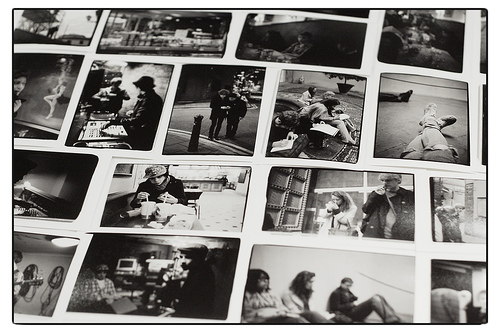
contactsheet

3:AM: Finally, is your family related to Bram Stoker?

JS: Ahahaha, I get asked this a lot, from random old men working in the Tube to excited English teachers. The truth is I’m not sure. I know my dad looked into it. Our family (well the British side, I’m also half American) is originally up near Manchester, so not that far from Ireland where Bram was from. It’s likely there is some sort of vague link. Dracula is an amazing book and so the idea excites me a lot!
jamiestoker

La faim du livre

Along with Gérard Berréby, Augustin Trapenard, and Hervé Laurent, I was interviewed by Linn Levy for a piece entitled “La faim du livre” which appeared in the December 2013 issue of Swiss magazine Edelweiss. The article features on pp. 44-47; my interview is on p. 46.

La faim du livre

Edelweiss part en quête de la littérature contemporaine, des mots qui dérangent et se demande si être écrivain veut encore dire quelque chose par les temps qui courent. Quatre intellectuels se penchent sur ces questions et nous éclairent.

«Nous sommes les visages de notre temps», clamaient les futuristes russes, le poète Maïakosvki en tête, il y a exactement un siècle, pétris de la conviction que l’art qu’ils inventaient allait renverser l’ordre des choses, qu’en récrivant le monde ils façonneraient le futur. Et aujourd’hui? A qui appartiennent les visages de l’époque contemporaine? Peut-on encore écrire? Et quels sont, parmi le demi-millier d’ouvrages publiés cette rentrée en Suisse et en France, ceux qui tordent la littérature, l’éprouvent, l’inventent? Oui, dans quels livres trouve-t-on les questions que nous ne nous sommes pas encore posées? Difficile pour le lecteur de se retrouver dans le magma de fictions qui ornent les étals des librairies comme les marchandises envahissent les hypermarchés. Le divertissement, devenu la norme au risque d’endormir insidieusement les esprits, laisse peu de place au doute, la tension semble diluée, presque rien ne dérange, pas grand-chose ne dépasse. Alors, pour celui qui a faim d’autre chose que de spectacle et qui ne déteste pas être dérangé – «Etre scandalisé, un plaisir», assurait Pasolini –, il s’agit de résister en cherchant les lignes qui dévient, la littérature, la vraie, ce souffle qui a «la faculté d’empêcher la folie du monde de s’emparer totalement de nous», comme l’écrit Alberto Manguel. Quatre experts nous éclairent sur les mots d’aujourd’hui, l’influence du web, la mort imminente du droit d’auteur, celle de la figure de l’écrivain, sur le remix aussi, et l’irrévérence anglo-saxonne ou helvétique… L’éditeur Gérard Berréby, l’écrivain et professeur Andrew Gallix, le journaliste Augustin Trapenard et le critique d’art Hervé Laurent ont accepté de surcroît de dévoiler leurs titres préférés de la rentrée.

Andrew Gallix
Ecrivain, éditeur, professeur à la Sorbonne

L’écriture a cinquante ans de retard sur la peinture – triste constat de l’artiste Brion Gysin dans les années 60… «Et, pour le philosophe et romancier anglais Lars Iyer, la situation n’a fait qu’empirer. Le roman, censé échapper au monde des genres, est lui-même devenu un genre. Pour lui, la littérature est morte (comme la musique classique avant elle) et les livres que l’on peut encore écrire doivent exprimer la distance qui nous sépare de la grande littérature du passé. Cette «postlittérature» s’inscrit d’ailleurs dans un contexte politique et culturel plus général: pour Mark Fisher ou Simon Reynolds, par exemple, la modernité est derrière nous. Cette nouvelle crise du roman, symbolisée par Reality Hunger, le manifeste de David Shields, se traduit souvent par un rejet de la fiction.» Les idées se bousculent dans l’esprit brillant d’Andrew Gallix. L’écrivain britannique, professeur à la Sorbonne, collaborateur du quotidien The Guardian, punk depuis l’âge de 12 ans, a lancé en 2000 le premier blog littéraire en anglais, «3:AM Magazine»1, dont le mot d’ordre est le très groucho-marxesque: «De quoi qu’il s’agisse, nous sommes contre». Un webzine si avant-gardiste qu’il a donné naissance à un véritable mouvement littéraire, The Offbeat Generation, regroupant des plumes anglophones non conformistes (Tony O’Neill, Ben Myers, Tom McCarthy notamment), rejetant la culture dominante et le monde traditionnel de l’édition. «La littérature est quelque chose qui résiste, analyse-t-il. Même s’il n’existe plus vraiment d’avant-garde – le web l’a diluée en quelque sorte –, je remarque que l’écriture conceptuelle, expérimentale prend de plus en plus d’importance. Il y a toute une génération d’auteurs qui reste très influencée par la théorie poststructuraliste de Derrida, je pense notamment à Rachel Kushner. Il y a un autre courant d’écrivains, américains pour la plupart, qui s’inscrit dans la directe lignée de l’éditeur Gordon Lish – celui qui a en quelque sorte fait Raymond Carver. Pour eux, tout se passe au niveau de la phrase. Et, pour finir, je trouve passionnante et à suivre la scène littéraire qui s’est formée autour de la revue new-yorkaise n+1 (nplusonemag.com).»
1 http://www.andrewgallix.com / http://www.3ammagazine.com

Il lit:
Au départ d’Atocha, Ben Lerner (à paraître)
C, Tom McCarthy, L’Olivier
Nue, Jean-Philippe Toussaint, Editions de Minuit

Detour in the Orthodoxy

This interview with Clémentine Deliss was published in 3:AM Magazine in December 2005:

Detour in the Orthodoxy: Andrew Gallix Interviews Clémentine Deliss

3:AM: I gather that Metronome was primarily an arts magazine. Why did you decide, after nine years, to launch into fiction with a new publishing house called Metronome Press?

CD: Metronome has always worked with fiction. The very first issues included texts of fiction rather than criticism or theoretical texts written by art critics. The intention has been to create a detour in the orthodoxy of a person’s work whether they are an artist, critic, or writer. There is no point in replicating the same identity that one carries as a professional within the context of Metronome. Metronome is there to create a short-circuit between professionals working in different fields of aesthetic practice, and in many cases, in different urban locations (spanning Africa to Europe). The spark or trigger that awakens professional curiosity is potent when a moment of differentiation or otherness is recognised by the participating interlocutors (there can be no complacency with regard to the intersection of different theoretical discourses within art). So fiction in the context of contemporary art practice sets up a certain field of expression in contrast to the more standardised forms of writing we find in art magazines. Metronome is an organ, not an art magazine as such. To set up Metronome Press is to build on the ongoing interest in fiction and translation, nothing more. There is no exception to the rule.

London launch of Metronome Press at the Arts Club: Tom McCarthy & Louise Stern

London launch of Metronome Press at the Arts Club: Tom McCarthy & Louise Stern

3:AM: Metronome Press is “dedicated to developing fiction and new styles of writing in relation to contemporary art practice”. Why are you so interested in the art/writing interface? Is the distinction between the two worlds disappearing?

CD: I am interested in experiments related to interpretation. Metronome is an interpretational tool rather than a vehicle for the promotion of artists’ works. Metronome Press has a similar attitude. It has not been set up within a literary field, but within the context of writing produced in relation to art production. Our challenge is the art world, and its discourse, not the literary world. We do not deny that visual artists can produce good literature, nor do we exclude the input of writers within our framework, but our main area of investigation is research and experimentation in art practice.

3:AM: Three of the first four novels in the collection are by writers (Tom Gidley, Tom McCarthy and Phyllis Kiehl) who also have artistic activities. Are they primarily artists who write on the side, or is writing integral to their artistic vision? Did you encourage any of them to take up the pen for the first time, or were all three already writers as well as artists?

CD: Phyllis Kiehl and Tom Gidley are primarily visual artists. Both have written in the past, and have now produced novels. They were writers before I knew them. I had published Phyllis Kiehl’s short stories in several earlier issues of Metronome (4, 5, 6, 7), and Tom Gidley had written a lot for Frieze in the past. I knew that Gidley had withdrawn for a while in order to write a book, and so I contacted him when we set up Metronome Press to see if he was interested. Phyllis was working on Fat Mountain Scenes whilst she and I were living in Paris. By publishing Fat Mountain Scenes, she was able to place her novel within the art context prior to the literary world of publishing.

3:AM: How did you come across Tom Gidley, Phyllis Kiehl and Tom McCarthy’s works?

CD: As I said above, I knew Tom Gidley and Tom McCarthy had both finished novels and whilst I had not read them, I was curious to follow up the hunch that fiction within art practice might be the way forward. And Phyllis as I said earlier, was in the process of writing her first novel as we both moved to Paris. It all made sense and their inclusion in the first collection of fiction produced by Metronome Press is a sign that perhaps there is a further interest out there. We are keen to receive manuscripts, scenarios, novels, etc., from artists.

London launch: Phyllis Kiehl & Tom Gidley

London launch: Phyllis Kiehl & Tom Gidley

3:AM: In the US, it is quite acceptable for writers to play music and do art (or vice versa), but not so much in Europe. Is this something that should be encouraged?

CD: It’s always interesting to enter different territories. Today there is an important shift in the way we view art as an aesthetic field or set of practices, rather than as differentiated compartmentalised art productions (theatre/dance/visual arts/literature/film, etc). But you have to be lucid about whatever crossover you are ready to experiment with, and the context in which you are doing it. For Metronome Press to take on the airs of a literary publishing house in Paris, with all the history this city has, would be suicide! However, for us to work within art practice using fiction as a means of expression, and encouraging artists to experiment with other styles of communication, seems a logical step to take in today’s world.

3:AM: Do you see Metronome Press as a French, English or Anglo-French venture? It is based in Paris, but the first four novels are in English and one of your web addresses is a UK address…

CD: Metronome Press is based in Paris. It has no nationalist identity. It relates to those locations where we live (and that is necessarily subjective) and to those locations where we have worked.

3:AM: You are republishing Charles Henri Ford and Parker Tyler’s The Young and Evil which had originally been published by Obelisk Press in 1933. How did this come about?

CD: Thomas Boutoux and I loved the book. It is languid and tight at the same time. A perfect combination of erotic thinking and scenic or episodic action with a touch of historical information on the art scene of the early twentieth century. We were fortunate to be able to secure the rights and reprint an edition that is laid out exactly as the first edition was. There are cheap versions from other publishers, but the graphics that Charles Henri Ford had developed are rarely respected.

3:AM: The latest issue of Metronome mixes fiction and erotica as a homage to Maurice Girodias‘s Olympia Press. Do you see Metronome Press as the heir of the Olympia Press?

CD: Metronome Press is inspired by the system that Girodias had developed. If we could have a hotel too and a bar like Girodias we’d be happy! Let’s hope, however, that we don’t enjoy the multiple bankruptcies that characterised Girodias’ professional career!

3:AM: Do you think the anglophone literary scene in Paris is about to enjoy a revival?

CD: I don’t think that is the issue. Everyone and everywhere is anglophone these days. But we do hope that Paris will open up even more to the international situation it has always nurtured.

Full Stop

Full Stop magazine interviewed me as part of their “Pathos” series, examining “the consequences of pursuing writing as a vocation”.
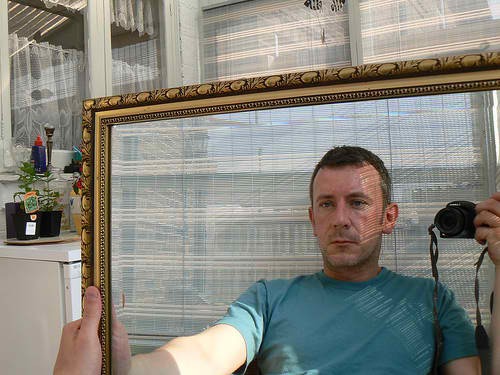
andrewgallix

“Pathos: Andrew Gallix,” Full Stop 16 January 2013

Last winter, Full Stop introduced “The Situation in American Writing,” a questionnaire adapted from The Partisan Review that asked questions about literature’s responsibility to address seismic changes in culture, the publishing industry, and the political and geopolitical landscape. That questionnaire, which featured responses from Marilynne Robinson, George Saunders, Victor LaValle, T.C. Boyle, Dana Spiotta, and dozens of other writers was illustrative of the concerns and preoccupations that writers carry with them when practicing their craft.

This year we are interested in the situation of writers, rather than writing, in the subjective experience of writing fiction (or in this case, memoir), rather than fiction’s responsibilities to respond to a rapidly changing world. To this end we are interested in examining the trying intellectual, creative, and emotional labor that is often unacknowledged or effaced in the public presentation of writing. What we’re interested in, to put it another way, is pathos.

This year, we’ve crafted a questionnaire asking writers about the effect writing has had on their physical, emotional, and economic health; on the idea of poverty being a precondition for writing well; on what makes writing truthful to one’s self and to readers. Ultimately, we are interested in the consequences of pursuing writing as a vocation.

Andrew Gallix is the Editor-in-Chief of the consistently great 3:AM Magazine which features a motto that is the envy of Full Stop: ”Whatever it is, we’re against it.” He also teaches at the Sorbonne, writes for The Guardian, and is currently working on a novel, as well as a collection of reviews of impossible books in collaboration with David Winters.

How has your decision to write affected your health? Has it had negative effects on your personal life?

The great Polish writer Witold Gombrowicz said, “One cannot be nothingness all week and then suddenly expect to exist on Sunday.” It’s equally difficult to have a day job and be “nothingness” in the evening — especially if you’re trying to juggle a family life at the same time. Things must be much easier when you can write for a living. I’m pretty sure writing contributed to my divorce, for instance!

There is long tradition that links the craft of writing with poverty. Do you think that’s appropriate? Does poverty feel like the most appropriate condition for your practice as a writer?

No. The authors I know who insist upon writing for a living, although their work is resolutely uncommercial, end up, paradoxically, being obsessed with financial matters. Every single word they write must be counted, and accounted for; turned into money to pay the bills. Don’t get me wrong: writers should be paid, but you can’t force people to buy books, let alone read them. Those lucky, or cunning enough, to find a wide audience don’t usually stop writing, all of a sudden, because they’re raking it in. Some of the most interesting writers today come from very privileged backgrounds. Others don’t, and if their books fail to sell in sufficient quantities, they usually have to supplement their incomes through grants, teaching, journalism, or jobs in publishing. The creative writing industry is, in part, a means of subsidising writers’ careers.

The question of the cost of letters (to refer to the title of a book on this subject published by Waterstone’s in 1998) is an important one, because it reflects the evolution of literature itself. When literature was essentially an aristocratic pursuit — for people who had both time and money — this question was immaterial. It only really arises with the spread of literacy and the emergence of writers who didn’t hail from the ranks of the idle rich. The Waterstone’s book I mentioned — How Much Do You Think a Writer Needs to Live on?: The Cost of Letters (edited by Andrew Holgate and Honor Wilson-Fletcher) — was inspired by a survey of literary living standards carried out by Cyril Connolly fifty years earlier. When it was published by Horizon, in 1948, British society was being radically transformed through mass education and the Welfare State. Connolly’s survey contained the following questions:

How much do you think a writer needs to live on?
Do you think a serious writer can earn this sum by his writing and if so, how?
If not, what do you think is a suitable second occupation for him?
Do you think literature suffers from the diversion of a writer’s energy into other employments or is enriched by it?
Do you think the state or any other institution should do more for writers?
Are you satisfied with your own solution of the problem and have you any specific advice to give young people who wish to earn their living by writing?

The main question (which wasn’t addressed because it went without saying at the time) is, of course, that of the definition of a “serious writer” — one who may be worthy of being subsidised in the absence of commercial success. Who decides who is a “serious writer” in the first place? Is it the writer him/herself? His/her peers? Academia? The media? The reading public? The state? I’ve always been a little dubious about the romantic image of the impoverished, tortured genius scribbling away in his, or indeed her, dingy garret, but it does reflect a very real process of privatisation of the writing profession.

Walter Benjamin famously described the “birthplace of the novel” — and hence that of modern literature — as “the solitary individual”: an individual cut off from tradition, who, unlike the writers of antiquity, could no longer claim to be the mouthpiece of religion or society. The writer’s legitimacy, in a “destitute time” (Hölderlin) of absent gods and silent sirens (Kafka) — a disenchanted world (Schiller) which is still ours — becomes highly arbitrary.

Personally, financial difficulties have always diverted me away from my writing. Having said that, the necessity to write often stems (at least in part) from a feeling of dissatisfaction — a sense that something is missing — so, from that point of view, not being rich and contented is probably an asset.

In a rare 1983 interview the enigmatic and often dour Romanian writer Emil Cioran speaks about only reading Nietzsche’s letters because he became concerned with how untruthful Nietzsche’s published works seemed when read against the miserable condition of his day to day existence (isolated, weak, sickly, certainly not characterized by any sense of vigor). Is there any sense in which the truth of one’s condition should be related to the truth of one’s writing, even if in an oblique sense?

In an oblique sense, yes; otherwise, not necessarily. As I was saying, literature is often a compensatory activity; an elaborate form of wish-fulfilment. I am absolutely fascinated by the impact that someone’s physical and psychological life can have on his/her thinking and writing — how apparently rational choices are due, for instance, to a tiny todger, short stature, child abuse, or the absence of a parent. Sartre claimed that he began writing to make up for his ugliness and impress women. We all want to be loved, and writing is always a love letter of sorts. As Richard Brautigan put it, “Just because people love your mind, doesn’t mean they have to have your body” — but one lives in hope, of course.

Perhaps Cioran’s remark makes more sense in the context of philosophy, but literature is the space of contradiction and ambiguity, and that’s what interests me.

Incidentally, I once lived in the same street as Cioran, in Paris.

Are you envious of other people’s success? If so, are you more envious of people’s success in your field or outside of it? Why?

I am, especially if I think they don’t deserve it. I’m more envious of people in my own field, of course, because I feel closer to them. It’s a phenomenon that René Girard skillfully analyses in Deceit, Desire & the Novel.

Give one example in which you had high hopes for success (artistic, commercial, or otherwise) but had those hopes dashed.

When I was really young, and still a student, I got a contract with an American publisher for a short work of criticism. I’d sent them the manuscript, on the off-chance, and it turns out that they wanted to publish it as it was. I was really proud: I didn’t know anyone my age who had published a book — but, of course, I wasn’t satisfied. The manuscript, in my eyes, wasn’t good enough. I asked the publisher to give me a little time to work on it. They granted me a one-year deadline, on the understanding that I’d send in the revised manuscript after six months. Six months, that’s all you need, they said, six months. Almost five years later, I was still working away on the manuscript, wracked by guilt, and I had to draw the conclusion, eventually, that the project I’d embarked upon was unfinishable. As Blanchot said of Joubert, I preferred failure to “the compromise of success” — or at least, that’s my excuse.

Do you feel like the world owes you a chance to make a living as a writer?

Absolutely not, but I hate the world for it!

What is the strongest emotional reaction you have ever elicited from a reader, either in your written work or during a reading? What is the strongest emotional reaction you have ever elicited from yourself during the writing process?

When people I respect have told me that they wished they’d written a story of mine.

When I’ve managed to write something so painful that I thought I’d never see it through.

When, on the rare occasion and in the distant past, women have wanted my body, just because they loved my mind.

When are you at your most truthful as a writer?

When I’m not writing.
Fleeting

The wonderful Deborah Levy was kind enough to mention me in an interview with Matt Shoard for Fleeting Magazine (“8 Questions for Deborah Levy”) published on 22 December 2012. Here’s the relevant extract:

Are you comforted by the assertion that there are yet People on Earth who know what they are doing? Or, like me, do you subscribe to the notion that people who knew what they were doing began to die off about 1945 and are now on the brink of extinction?

Yes, Benjamin Eastham and Jacques Testard, editors of the stunning new Art Literature and Politics journal The White Review know what they are doing and they also know who they do not want to do business with. Andrew Gallix, writer and editor of 3:AM Magazine knows what he’s doing and I am so pleased he’s doing it. Uber publisher and translator Stefan Tobler at And Other Stories is a man of vision and steel; he knows what he’s doing in any number of languages. So does Matt Shoard of Fleeting and so does John Self, an incredibly astute reader and critic. Every generation throws up its new thinkers and they tend to make a cultural revolution. They have energy and purpose and sometimes wear really nice shoes. They make everyone else look exhausted and clapped out. That is how it should be.