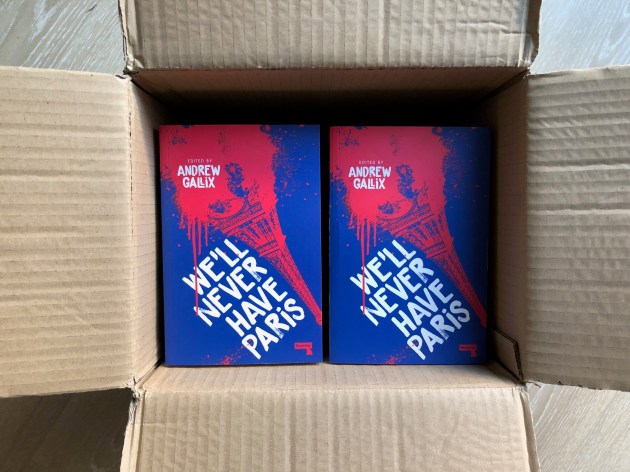
Copies of We’ll Never Have Paris have landed…in Paris. It’s out in May on Repeater Books.


My review of Owen Booth‘s wonderful debut novel, What We’re Teaching Our Sons, appears in the December issue of Literary Review.

To misquote Simone de Beauvoir, one is not born but rather becomes a man. This is the premise of What We’re Teaching Our Sons, a satire, alternately hilarious and heartbreaking, of all those earnest treatises on fatherhood.
Although very accessible, Owen Booth’s debut is as difficult to pin down as the notion of masculinity in an age of female empowerment and gender fluidity. It is a novel with an emotional arc, but one you may also dip into, each chapter being a story unto itself. In fact, it is essentially the same story — sixty-seven variations on dadsplaining — springing from the same template. …

My review of Steven Connor‘s Dream Machines appears in this week’s Times Literary Supplement.

Here’s a little teaser:
Dream Machines is an exercise in technography — an exercise, that is, in what Steven Connor defines as any kind of writing about technology that draws attention to the workings of its own machinery. Writing itself may be thought of as a kind of technology — a “mechanisation of speech”, as Connor puts it — and technology in turn may be thought of, perhaps less obviously, as writing. Demonstrating the latter, more counterintuitive proposition is the main purpose of this ground-breaking book.
For Connor, a professor of English at the University of Cambridge, all machines could stand as “preliminary sketches” towards an absolute machine: one that would align perfectly with the process of thinking itself. Examples abound, in both fact or fiction, of schemes for machines whose nuts and bolts evanesce into sheer fancy. Marie Corelli conjures up contraptions in her Romance of Two Worlds (1886) that are really…

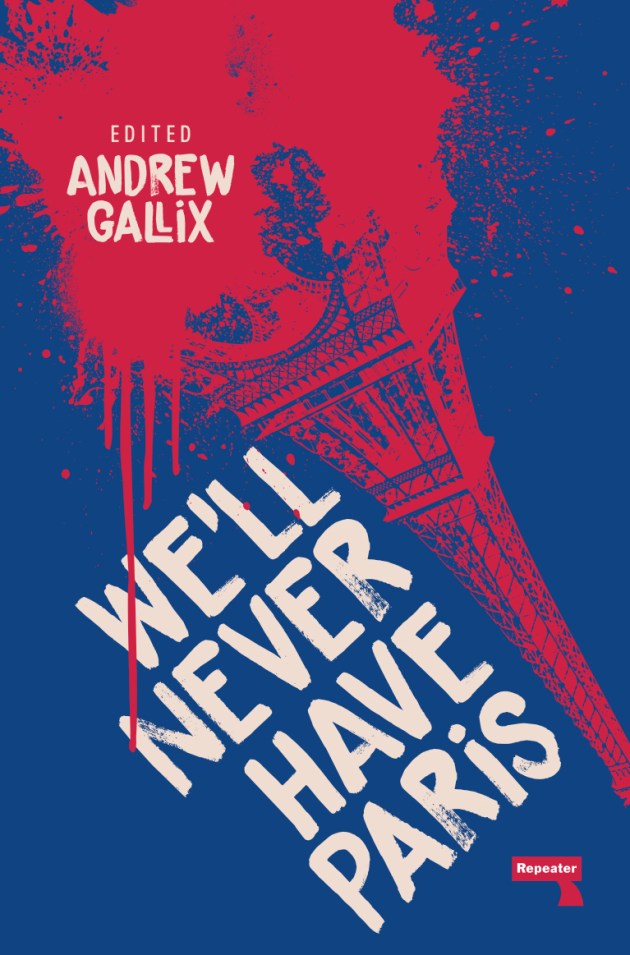
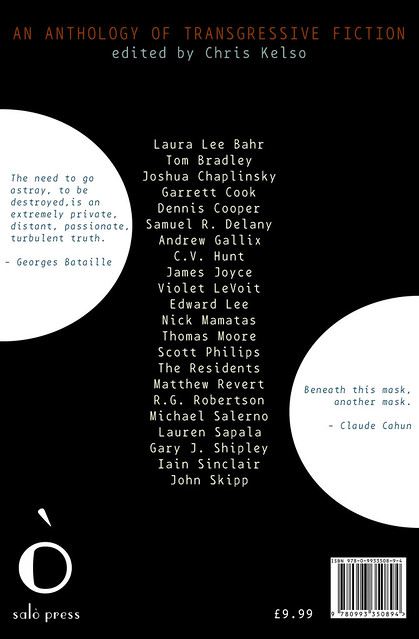
The book I’m editing, We’ll Never Have Paris, published by Repeater Books early next year, will include more than 70 of the best, most adventurous writers in the English language. It now has a cover. More soon.


Volpert, Megan. “Punk is Dead is Very Alive.” Popmatters, 16 April 2018
… If you want to learn a tremendous quantity of information about punk that has been obscured by a lack of reputable first-hand accounts, look no further than Punk Is Dead: Modernity Killed Every Night. It’s a collection of weird histories and poetic fragments of recollection strung together by two editors: Richard Cabut, who was 17 in the summer of 1977, and Andrew Gallix, who is best known as chief of 3:AM Magazine. The focal point of the book is London in late 1976, during the 15-minutes where pretty much everybody agrees that “punk” was a genuinely existing thing. …


Marshall, Richard. “A Personal Golgotha.” 3:AM Magazine, 19 May 2018:


Richard Marshall writes: “A bit of fun… Stuff I’ve done over the years here at 3:AM thanks to legends Andy Gallix and Andrew Stevens… It’s all DIY — hardly proofread and done too fast in between day jobs to be anything but jump-start writing. So forget about the writing. What matters is what its about. It adds up to a boss reading list and a cranked up gang of characters smoking up the haunted back bars of the eerie early morning. 3:AM’s been around since 2000 and I joined Gallix’s punkstorm early on. It’s one of the oldest literary sites on the web. And back in the early days there was hardly anything out there so we were literally making it up as we went along. We still are. Lots of things have changed since the start and people have come and gone of course. There’s a new crew now. Still, I like that Andy’s still throttling the helm and Andrew keeps lighting fires. …”


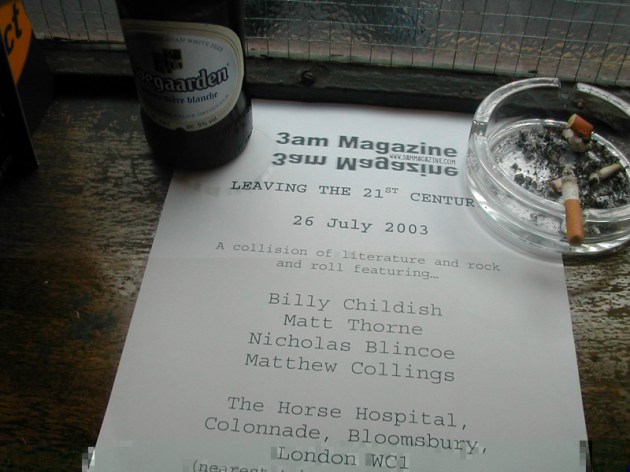
[Pictures from top:
Flyer advertising 3:AM Magazine‘s ‘Leaving the 21st Century‘ gig at London’s Horse Hospital, 26 July 2003.
‘Leaving the 21st Century’, 26 July 2003.
Richard Marshall, London, 2003.
Me sporting a 3:AM T-shirt, London, 2003.
Andrew Stevens at Death Disco, London, 2003.]

Gallix, Andrew, translator. “Trash, Or Tainted Culture” by Octave Debary. Hidden by the Surface: Works About Marine Debris. By Swaantje Güntzel, Herausgeber, 2017, pp. 6-11.

“. . . When Swaantje Güntzel offers us the incongruous spectacle of a cleaning lady diligently vacuuming a field (Staubsauger 2004), she is reminding us that nature produces no waste. This impurity is culture’s privilege, culture’s dirty “sin”, which is that of existence itself. The objective is to express one’s finitude and fear of loss — a loss culture wishes to lose: we seek to get rid of what we produce as it is also the source of our finitude. At the heart of this logic, waste enables us to express the passing of time and the end looming on the horizon; decay and dirt as depletions of life. This is where our contemporary eschatology, linked to environmental disasters, fits in. The more we live, producing ever more waste, the more we pollute the world (an immaculate nature?) where the danger to the environment always comes from culture. It is the border between waste and non-waste that makes our social and cultural condition possible. Waste’s exclusion from culture signals the end of a story that can no longer take place within a cultural context. It must be sacrificed (sacrum) because it is through this process of relinquishment that culture traces the boundary between what is pure and impure. Culture produces waste, which it then excludes. . . .” (original French text by Octave Debary)

Haven, Cynthia. “’The Genius to Glue Them Together: On René Girard and His Ideas.” Los Angeles Review of Books, 25 March 2018.

Deceit, Desire, and the Novel already bears Girard’s signature writing style — formal yet engaging and approachable, erudite, incisive, and masterful — it’s the book that would make his reputation. I found the book rather addictive, though Library Journal called it “a highly complex critique of the structure of the novel,” and added a warning: “As may be expected, the interpretations are highly psychological, the argument philosophical, and the intellectual footwork, dazzling; but for the reader, the going is slow, and conviction, grudging.”
For many, however, it was a revelation. “You can always trust a Frenchman to view the world as a ménage à trois,” wrote Andrew Gallix in the Guardian, describing Girard’s theory of mediated desire. “Discovering Deceit, Desire and the Novel is like putting on a pair of glasses and seeing the world come into focus. At its heart is an idea so simple, and yet so fundamental, that it seems incredible that no one had articulated it before.”
La Mont III, Alfredo. “Sin maquillaje” Excelsior, 25 December 2017.
. . . Sí, y el filósofo Jacques Derrida acuñó el término hauntología en 1993 para describir la nostalgia de un futuro imposible: un posible futuro que desde entonces ha sido superado por los acontecimientos de la realidad. Una especie de ensueño “qué pasa si…”, es también un juego de palabras sobre el término filosófico ontológico o el estudio de la naturaleza del ser.
“La hauntología es probablemente la primera tendencia importante en teoría crítica que floreció en línea”, escribe Andrew Gallix, en The Guardian. “Hoy, la hauntología inspira muchos campos de investigación, desde las artes visuales a la filosofía a través de la música electrónica, la política, la ficción y la crítica literaria. En su nivel más básico, se relaciona con la popularidad de la fotografía de faux vintage, espacios abandonados y series de televisión como Life on Mars”.

Kraus, Chris. “Howl – Punk: the Twentieth Century’s Last Avant-Garde.” Times Literary Supplement, 12 January 2018 , p. 33
Composed of essays, interviews, memoirs and manifestos by veterans of London’s punk scene, Richard Cabut and Andrew Gallix’s Punk is Dead is a nostalgic, intelligent homage to the brief, hazy era of “pure” London punk, before it was named, over-described and turned into another subcultural phenomenon. This golden age lasted somewhere between four and eighteen months, depending on who’s recollecting, although most agree that by 1978, it was over. Since punk began as a rebellion against boredom, the dead space of commercial music production and the empty hedonism born of the hippie era’s “great sexual revolution”, it was only a matter of time until it, too, would become corrupted. A yearning for its own prelapsarian state was built into punk’s ethos. As the punk musician-turned-philosopher Simon Critchley tells Gallix, “Because of the acute awareness of the fact that punk . . . would become a creature of the very music industry whose codes it subverted, we knew that it was going to be shortlived. And that was fine”. To Critchley, punk was most of all, lucid: a Protestant reformation without God: “We wanted to see reality for what it was in all its ugliness . . . and tear away the decadence and fallenness of the culture industry that surrounded us”.
. . . “Bands are necessarily approximations of the dreams that conjured them up”, Gallix writes in his essay “Unheard Melodies”. Punk is Dead shows the transmission of culture as a kind of lucid group dreaming. The accounts of its contributors capture the role that coincidence plays in history. Ideas can rarely be traced back to one person; they accrete and recur. . . .
Gallix is eloquent in his defence of nostalgia against the cult of an amnesiac future. Punk might be not only the last great subculture in the rock and roll mode, but the most analysed and documented. Nevertheless, art and cultural histories are always reductive, and, as he writes, “the past is subtly rewritten, every nuance gradually airbrushed out of the picture”. . . .