Umbilical Words

Dear Mum,

I hope you have read my letter. The other one. The proper one. The one I could not write, because it cannot be written. Couched in an idiom only you and I understand. A mother tongue. Umbilical words that bind us for ever and ever. You alone can hear me mouth them.

Of the pain of being parted from you as a child, it says nothing, not least because that always went without saying. Being separated made us inseparable. In the other letter, this unspeakable pain speaks, though not in so many words. You alone can hear its mute howl. Mum’s the word.

For years, I could not sleep facing a wall. I had to face the door, through which I would be reunited with you. Returning for the holidays was always a homecoming. Even as an adult. I once spent my lunch break at Gare du Nord, simply to feel a little closer to you. Watching all those people boarding trains bound for my mother’s land.

You are my motherland. The only time I tried to tell you, on that warm summer night, you said I was drunk. That was by the potted olive tree.

As soon as I heard you were going, I caught the first train, but did not make it on time. I hope you sensed that I was on my way. That I was coming home to you.

You were already so cold when I kissed your forehead. Stone cold.

We always fail to talk about what we love. Someone else wrote that.

You dwell in me, just as I once dwelt in you. Someone else wrote that too.

Perhaps they were drunk.

Your son, who always loved you more than you could ever know,

Andrew

The Abode of Fancy

This appeared in The Guardian (Guardian Review) on 24 December 2016: 10.

samcoll

We have all met him: the precocious Irish student who can talk the hind legs off a donkey and would be a shoo-in for the next Joyce if only he deigned to put pen to paper. Sam Coll did put pen to paper, and then some. And then some more, until he had completed 69 chapters spanning almost 500 pages. Born in 1989, he was still an undergraduate at Trinity College Dublin when the first draft was produced. The Abode of Fancy, his all-embracing debut, is fiendishly difficult to summarise: it is episodic and digressive, yet everything is skilfully connected.

There are two main plot lines. The first revolves around Simeon Collins, a young student who shares his initials with the author, and the washed-up, world-weary older friends in whose company he seeks solace. The second concerns a godlike figure, the Mad Monk, who returns to Ireland to herald the advent of the “new lusty age” along with other fantastical creatures: the Pooka, the Puck, the White Dog, the Clunge Monkey, Banshee Megan Devlin. The book is also about one man’s unrequited love for his bull, a pair of garrulous hares who are accidentally killed by golf-playing university lecturers, and countless other twisted tales.

There are shades of Rabelais in this gargantuan feast of lingual felicity, peopled with giants and morbidly obese alcoholic grotesques. The long-winded sentences seem to have been secreted rather than accreted (which is apt since the novel is awash with jizz, piss, puke, shit and snot). A single sentence describing a young woman walking towards her boyfriend under the anguished eye of a third character, who secretly pines for her, is agonisingly and hilariously drawn out over the best part of three pages.

Not surprisingly for a book whose heft exposes the reader to the risk of carpal tunnel syndrome, The Abode of Fancy draws boastful attention to its endowment. A doggerel epic, which appears in several instalments, prompts the following critique: “It’s a bloody gardener you need to edit that behemoth, mate!” Beautiful Saruko, whose essay is “5,000 words over the limit”, cajoles the protagonist into whittling down her “unwieldy word count”. Simeon composes a short story that becomes a book that mutates into a “gargantuan behemoth of a book”: “There would be room for infinity in the grandiose cathedral he dimly foresaw.”

The Abode of Fancy contains multitudes. All great Irish writers are here in name or spirit, from Swift and Sterne to Flann O’Brien and beyond. The novel even contains itself. The four-page-long inventory, in the prologue, of the “vast collection of assembled objects” found on a table, provides a preemptive index to all the ensuing narrative strands: “A fragment, contained in a jar, of the surviving bones of Peadar Lamb’s Bull”, for instance, or “A postcard for a Connemara golf-course, with two hares in the foreground”. Reminiscent of Joyce’s “Sirens” overture, this framing device is completed by the revelation, in the epilogue, that the first character to appear has been reading a lengthy comic book all along. No sooner has he put it down, however, than its fanciful cast come knocking at his door.

The Abode of Fancy actually evolved out of an epic comic strip, in which the speech bubbles gradually took over. The dialogue is often pitch-perfect and Coll (pictured) displays an emotional intelligence beyond his years: the unflinching, compassionate depiction of loneliness and ageing provides a melancholy undertow to the lusty comedy. There are shifts in tone, but the default mode is mock-heroic, with the quixotic cast out of place in a hastily delineated contemporary Ireland: the bored Polish blonde at the till, the “surly youths in hoodies and trainers”, Tesco’s “four euro red” and the 2008 recession.

In one of the frequent self-referential passages, a would-be bohemian poet contends that novels “can never be perfect” because they are “just too long”. The Abode of Fancy’s main flaw is neither its length nor its sophomoric quality, but the almost exclusive focus on masculine concerns. Nearly all the characters are male and women only feature as objects of affection and attraction.

According to Witold Gombrowicz, it is no longer possible for a serious novelist to go back to the “good old days” when one could write “as a child might pee against a tree”. Coll seems to have proved him wrong with this tour de force. Some may call it postmodern, but pre-modern is probably nearer the mark: the novel is returned to its picaresque roots, when everything was up for grabs. What fanciful abode will he build next to house his poetic impulse?

samcoll2

Here is a longer, slightly different version:

We have all met him: the precocious Irish student who can talk the hind legs off a donkey and would be a shoe-in for the next Joyce if only he deigned to put pen to paper. Sam Coll did put pen to paper, and then some. And then some more, until he had completed 69 chapters spanning almost 500 pages of scatological high jinks and coruscating wit. Born in 1989, he was still an undergraduate at Trinity College — a mere 20 years old — when the first draft was produced. The Abode of Fancy, his all-embracing debut, is fiendishly difficult to synopsize: it is episodic and digressive, yet everything is skilfully connected. For what it is worth, there are two main plot lines. The first one revolves around a young student, Simeon Collins, his sentimental travails, and his father’s washed-up, world-weary friends in whose company he seeks solace. The second concerns a godlike figure, the Mad Monk, who returns to Ireland to herald the advent of the “new lusty age” along with other fantastical creatures: the Pooka, the Puck, the White Dog, the Clunge Monkey, Banshee Megan Devlin, and Elijah, who, like one of the author’s nested narratives, takes up abode in a deceased character’s body from which it emits gnomic utterances. But the book is also about one man’s unrequited love for his bull, a pair of garrulous hares (most of the animals can speak) who are accidentally killed by golf-playing university lecturers, and countless other twisted tales. It even includes a donkey called Balthazar (as in Bresson’s classic) who — “or so he claimed” — was a film star in a previous life.

There are shades of Rabelais in this gargantuan feast of lingual felicity, peopled with giants and morbidly obese alcoholic grotesques. The long-winded sentences seem to have been secreted rather than accreted (which is quite apt since the novel is awash with jizz, piss, puke, shit, snot and whatnot). A single sentence describing a young woman walking towards her boyfriend under the anguished eye of a third character, who secretly pines for her, is agonisingly and hilariously drawn out over the best part of three pages. Not surprisingly for a book whose heft exposes the reader to the risk of carpal tunnel syndrome, The Abode of Fancy draws boastful attention to its endowment. A doggerel epic, which appears in several instalments, prompts the following critique from the aforementioned wisecracking ass: “It’s a bloody gardener you need to edit that behemoth, mate!” Beautiful Saruko, whose essay is “5000 words over the limit”, cajoles the protagonist into whittling down her “unwieldy word count”. A bookmark on page 390 in Arsene O’Colla’s copy of Swann in Love proves “how far he got” in Proust’s oeuvre and, crucially, “from whence he never proceeded”. Simeon Collins (whose initials are also the author’s) starts off composing a short story that becomes a book that mutates into a “gargantuan behemoth of a book”: “There would be room for infinity in the grandiose cathedral he dimly foresaw”.

The Abode of Fancy contains multitudes. All great Irish writers, from Swift and Sterne to Flann O’Brien and beyond, are here, in name or spirit. One thinks of Albert Potter’s dingy subterranean flat, in the novel, where books “copulate and fecundate, book begetting book”. Detailed descriptions of photographs open up new vistas; worlds within worlds. The novel even contains itself. The four-page-long inventory, in the prologue, of the “vast collection of assembled objects” found on a table, provides a preemptive index to all the ensuing narrative strands: “A fragment, contained in a jar, of the surviving bones of Peadar Lamb’s Bull”, for instance, or “A postcard for a Connemara golf-course, with two hares in the foreground”. Reminiscent of Joyce’s “Sirens” overture, this framing device is completed by the revelation, in the epilogue, that Martin Graves (the first character to appear) has been reading a lengthy comic book all along. No sooner has he put it down, however, than the fanciful characters come knocking at his door.

The Abode of Fancy actually evolved out of an epic comic strip, in which the speech bubbles gradually took over. The dialogue — “You’re not, no, are you not, yeah” — is often pitch-perfect. Despite his youth, Sam Coll displays an emotional intelligence far beyond his years. His unflinching, albeit compassionate, depiction of loneliness and ageing provides a melancholy undertow to the lusty comedy. There are shifts in tone (as well as point of view) but the default mode is mock-heroic. When the Mad Monk asks for directions, bemused passersby fail to comprehend the “antique cast in which he couched his query”. The Irish-American Tadgh O’Mara spurns his “own accursed tongue” in favour of bookish Gaelic gibberish. As a result, the poetry he produces is “like reading a dictionary of the most obscure Irishness that had been spliced all out of order”. The implicit critique of the “impoverished idiom” of our age is part of the characters’ quixotic cast. For various reasons, they feel out of place in contemporary Ireland, which is hastily delineated: the bored Polish blonde at the till, the “surly youths in hoodies and trainers”, Tesco’s “four euro red” (that “can’t be beat”) and the 2008 recession.

Like most great works, The Abode of Fancy comes equipped with its own critical apparatus. The description of the Mad Monk’s doggerel as a “happy fusion of Sterne and Yeats, two names one would not have suspected of ever being conducive to successful welding” provides a fitting definition of the novel itself. A mock-Yeatsian mythology runs parallel to, and gradually merges with, the disenchanted world of piss artistry and unrequited love embodied by Simeon and his entourage.

In one of the frequent self-referential passages, a would-be bohemian poet contends that novels “can never be perfect” because they are “just too long”. The Abode of Fancy’s main flaw is neither its length nor its sophomoric quality, but the almost exclusive focus on masculine concerns. Barring a couple of exceptions, the characters are all male to a man and women only feature as objects of affection and attraction.

According to Witold Gombrowicz, it is no longer possible for a serious novelist to go back to the “good old days” when one could write “as a child might pee against a tree”. Sam Coll seems to have proved him wrong with this tour de force. Some may call it postmodern, but pre-modern is probably nearer the mark: the novel is returned to its picaresque roots, when everything was up for grabs. What fanciful abode will he build next to house his poetic impulse? And will he micturate against the wall whilst whistling a jaunty Celtic ditty?

The Making of Meursault

This appeared in Literary Review November 2016: 30-31.
camus

The Making of Meursault

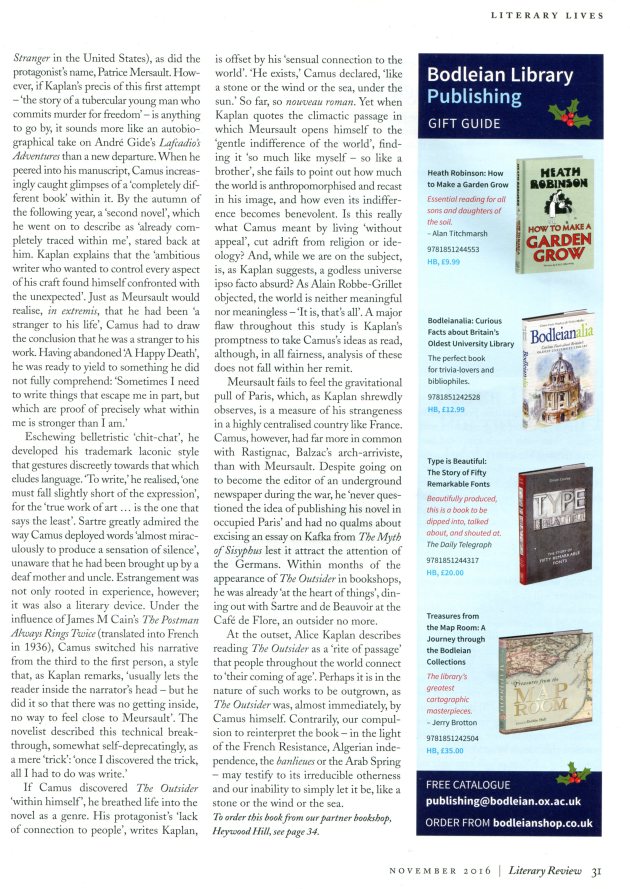
In July 1944 Albert Camus produced a counterfeit manuscript of his debut novel, The Outsider, published two years earlier. Josette Clotis, André Malraux’s partner, read the text aloud while Camus took it down in longhand, introducing the odd crossed-out variant to lend it the air of an early draft. In Looking for ‘The Outsider’, Alice Kaplan outlines this ingenious scam, born of wartime austerity, but does not say whether it proved successful or not. All the same, it speaks volumes about the book it sought to cash in on. The Outsider had already outgrown its title, acquiring the aura of a canonical work. Camus was now in a position to turn Bouvard and Pécuchet’s lowly profession — that of the copy clerk — into gold. All he had to do was replicate his near-indecipherable microscript, originally developed in response to an acute paper shortage.

Looking for ‘The Outsider’ is the biography of a book rather than of its author. Kaplan chronicles the story of The Outsider from the germ of an idea in Camus’s notebooks to the novel’s re-evaluation in the light of gender and postcolonial studies, taking in, chemin faisant, its wider impact on popular culture. She even identifies the individual who inspired the anonymous Arab. Her research really comes into its own when she pieces together the strange circumstances in which the novel saw the light of day. Retracing the various manuscripts’ convoluted journey between Algiers and occupied Paris — charted on four different maps — is likened to ‘chasing several Minotaurs in a maze’. Even Raymond Queneau, at publishers Gallimard, was baffled, ending up with two different versions before going to press.

In 1937, with two collections of essays under his belt, Camus set about writing fiction. The provisional title of his work-in-progress, ‘A Happy Death’, clearly anticipated The Outsider (published as The Stranger in the United States), as did the protagonist’s name, Patrice Mersault. However, if Kaplan’s precis of this first attempt — ‘the story of a tubercular young man who commits murder for freedom’ — is anything to go by, it sounds more like an autobiographical take on André Gide’s Lafcadio’s Adventures than a new departure. When he peered into his manuscript, Camus increasingly caught glimpses of a ‘completely different book’ within it. By the autumn of the following year, a ‘second novel’, which he went on to describe as ‘already completely traced within me’, stared back at him. Kaplan explains that the ‘ambitious writer who wanted to control every aspect of his craft found himself confronted with the unexpected’. Just as Meursault would realise, in extremis, that he had been ‘a stranger to his life’, Camus had to draw the conclusion that he was a stranger to his work. Having abandoned ‘A Happy Death’, he was ready to yield to something he did not fully comprehend: ‘Sometimes I need to write things that escape me in part, but which are proof of precisely what within me is stronger than I am.’

Eschewing belletristic ‘chit-chat’, he developed his trademark laconic style that gestures discreetly towards that which eludes language. ‘To write,’ he realised, ‘one must fall slightly short of the expression’, for the ‘true work of art … is the one that says the least’. Sartre greatly admired the way Camus deployed words ‘almost miraculously to produce a sensation of silence’, unaware that he had been brought up by a deaf mother and uncle. Estrangement was not only rooted in experience, however; it was also a literary device. Under the influence of James M Cain’s The Postman Always Rings Twice (translated into French in 1936), Camus switched his narrative from the third to the first person, a style that, as Kaplan remarks, ‘usually lets the reader inside the narrator’s head — but he did it so that there was no getting inside, no way to feel close to Meursault’. The novelist described this technical breakthrough, somewhat self-deprecatingly, as a mere ‘trick’: ‘once I discovered the trick, all I had to do was write.’

If Camus discovered The Outsider ‘within himself’, he breathed life into the novel as a genre. His protagonist’s ‘lack of connection to people’, writes Kaplan, is offset by his ‘sensual connection to the world’. ‘He exists,’ Camus declared, ‘like a stone or the wind or the sea, under the sun.’ So far, so nouveau roman. Yet when Kaplan quotes the climactic passage in which Meursault opens himself to the ‘gentle indifference of the world’, finding it ‘so much like myself — so like a brother’, she fails to point out how much the world is anthropomorphised and recast in his image, and how even its indifference becomes benevolent. Is this really what Camus meant by living ‘without appeal’; cut adrift from religion or ideology? And, while we are on the subject, is a godless universe ipso facto absurd? As Alain Robbe-Grillet objected, the world is neither meaningful nor meaningless: ‘It is, that’s all’. A major flaw throughout this study is Kaplan’s promptness to take Camus’s ideas as read although, in all fairness, analysis does not fall within her remit.

Meursault fails to feel the gravitational pull of Paris, which, as Kaplan shrewdly observes, is a measure of his strangeness in a highly centralised country like France. Camus, however, had far more in common with Rastignac, Balzac’s arch-arriviste, than with Meursault. Despite going on to become the editor of an underground newspaper during the war, he ‘never questioned the idea of publishing his novel in occupied Paris’ and had no qualms about excising an essay on Kafka from The Myth of Sisyphus lest it attract the attention of the Germans. Within months of the appearance of The Outsider in bookshops, he was already ‘at the heart of things’, dining out with Sartre and de Beauvoir at the Café de Flore, an outsider no more.

At the outset, Alice Kaplan describes reading The Outsider as a ‘rite of passage’ that people throughout the world connect to ‘their coming of age’. Perhaps it is in the nature of such works to be outgrown, as The Outsider was, almost immediately, by Camus himself. Contrarily, our compulsion to reinterpret the book — in the light of the French Resistance, Algerian independence, the banlieues or the Arab Spring — may testify to its irreducible otherness and our inability to simply let it be, like a stone or the wind or the sea.
camus
literaryreview

A Towering Work of Staggering Scholarship

This appeared in The Irish Times (Weekend Review) 8 October 2016: 10.

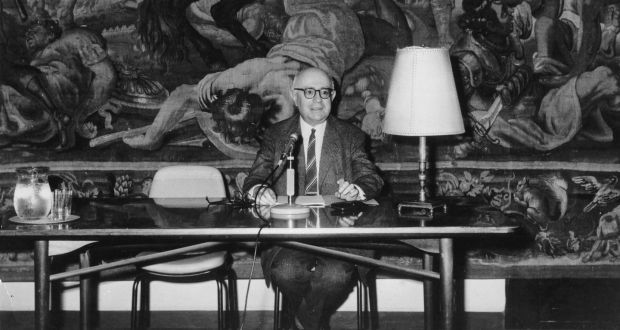
Frankfurt School lecture: Theodor Adorno in Rome. Photograph: Ullstein Bild via Getty

Frankfurt School lecture: Theodor Adorno in Rome. Photograph: Ullstein Bild via Getty

A Towering Work of Staggering Scholarship

Grand Hotel Abyss is a towering work of staggering scholarship. It is so comprehensive that even its own existence falls within its purview. Stuart Jeffries, a former Guardian arts editor, reflects, in the closing pages, on the “mini-boom in popularising critical theory books” — a “perverse consequence of the global capitalist crisis” — comprising “graphic guides, dictionaries, perhaps even this book”.

It is as if his magnum opus were enacting one of the Frankfurt School’s central tenets: the absence of any external perspective from which to critique the system. “There is,” lamented Theodor Adorno, “no exit from the entanglement” — a maxim that also applies to these thinkers’ pervasive influence and, dare I say, aura. Those whom Bertolt Brecht dismissed as the “Frankfurturists” are now an integral part of our theoretical make-up, whether we agree with them or not.

Jeffries should be applauded for sticking to a broadly chronological narrative rather than experimenting with Walter Benjamin’s rather baffling “dialectical image”. His engagement with these thinkers’ ideas is, contrarily, very much in keeping with the Frankfurt School ethos.

He counters Benjamin’s technological utopianism by stating that “one could also argue the opposite” and reminds Adorno, beyond the grave, that Germany was first defeated by “Soviet totalitarianism”, not by a “more advanced form of capitalism”.

Jeffries is unafraid of giving voice to common sense — “isn’t it ludicrous to compare the Third Reich to Hollywood?” — or being didactic when needs be: apropos of Adorno’s constellation theory of knowledge he writes, “This is all quite tough stuff and, even for adepts of critical theory, hard to swallow.”

Unexpected humour
Humour (“to get dialectical for a moment”) is one of the most unexpected facets of this book devoted to hard-core German intellectuals. Benjamin’s somewhat ludicrous resemblance to Groucho Marx or Charlie Chaplin is remarked on, and a quotation from his Neapolitan peregrinations elicits the following gloss: “It’s hard to tell in this passage whether Walter Benjamin is being given directions or being propositioned. Either way, he seems to like it.” And Herbert Marcuse’s meeting with Jean-Paul Sartre (above) at La Coupole is recounted in hilarious detail.

His “group biography” is an intellectual saga. Readers looking for upskirt pictures of Hannah Arendt will be sorely disappointed: titillation in these rarefied climes is of a purely cerebral nature. The infamous Busenaktion of 1969, when Adorno was surrounded by three female students who “bared their breasts and scattered rose and tulip petals over him”, barely raises an eyebrow. A benign, possibly enviable form of protest to be faced with, in theory, but one that proved profoundly hurtful in praxis.

Commendably, Jeffries only ever adduces private matters to highlight glaring discrepancies between rhetoric and reality. A prime example is the highly conventional lifestyle led by Marcuse, despite publishing works “indicting bourgeois repression”.

The New Left darling’s fondness for a stuffed hippo is as close as we get to tittle-tattle. Yet even this cuddly-toy fetish proves significant, highlighting how some of the last century’s finest minds were also overgrown children. Incapable of making himself a cup of coffee, Benjamin was bankrolled by his parents until “well into his thirties”. Marcuse could neither cook nor drive. Adorno is described as a “child prodigy who never grew up (because he didn’t have to)”. Few of them did, given their wealthy backgrounds and the women — conspicuous by their absence at the Institute for Social Research, to give the Frankfurt School its proper name — who waited on them at home. Practice was never the school’s forte; nor, to be fair, was it ever meant to be.

Although ostensibly Marxist, the institute was founded, at Goethe University in 1924, not to promote revolution but to analyse its failure. Focus on the ill-fated Spartacist uprising soon shifted to understanding the triumph of Nazism — which led the scholars into exile — and Germany’s postwar “psychopathology of denial”.

Capitalism had moved on since Marx. It was no longer a mere mode of production but an entire superstructure, encompassing the mass media and show business, geared towards concealing its exploitative nature. As Marcuse astutely observed, anticipating today’s ludic work environment, “the pleasure principle had absorbed the reality principle”.

Under the aegis of Max Horkheimer, who became its director in 1931, the institute took a “multidisciplinary turn” so as to embrace all aspects of this complex system, thus giving birth to critical theory. Such hybrid studies conducted “at the trough of mass culture” would indicate, contra Marx, that the proletarian revolution was not inevitable. As a result the Frankfurt School became “modern-day monks working in retreat from a world they could not change”.

Adorno and Horkheimer jettisoned the Enlightenment’s legacy, arguing that reason had become an instrument of oppression rather than emancipation (Dialectic of Enlightenment, 1944). They did so, in brilliantly paradoxical style, by taking “the corpse of reason” and making it “speak of the circumstances of its own death”.

In Negative Dialectics (1966) Adorno went on, quite logically, to reject Hegel and Marx’s “conception of history as moving dialectically towards a happy ending”. If the Holocaust had produced a “new categorical imperative” — that is, ensuring it never repeated itself — revolution was perhaps no longer even desirable. He sought utopia through art that was at odds with the affirmative culture that had done “little more than supply a soundtrack to mass murder”: art that could express “the truth of suffering ‘in an age of indescribable horror'” by daring to be radically negative.

It is this embrace of negativity that is so bracing to some and frustrating to others, even within the school.

During the 1960s student protests, change was deemed possible by Marcuse, who embodied a sunnier, Californian take on critical theory. The institute’s “late ethos” is likewise predicated on the feasibility of “ameliorating the conditions of capitalism and liberal democracy”.

Yet Café Marx, as it used to be called derisively, remains tainted by Georg Lukács’s quip that these representatives of the chattering classes — branded traitors by Brecht — had holed themselves up in a beautiful hotel “equipped with every comfort, on the edge of an abyss, of nothingness, of absurdity”.

There is a great deal of wisdom, however, in Adorno’s suspicion of revolutionary students’ “aversion to introspection”, which he had already observed in the dark days of Nazism. “I established a theoretical model of thought,” he told an interviewer in 1969. “How could I have suspected that people would want to implement it with Molotov cocktails!”

There is also a great deal of hope in his belief that “whoever thinks offers resistance”.

At its best the Frankfurt School was always a think tank — in the armoured-fighting-vehicle sense of the word.

irishtimes
grandhotelabyss

Goal-Line Philosophy

This appeared in the Life & Arts section of the Financial Times (FT Weekend) 14-15 May 2016: 9.

Goal-Line Philosophy

football

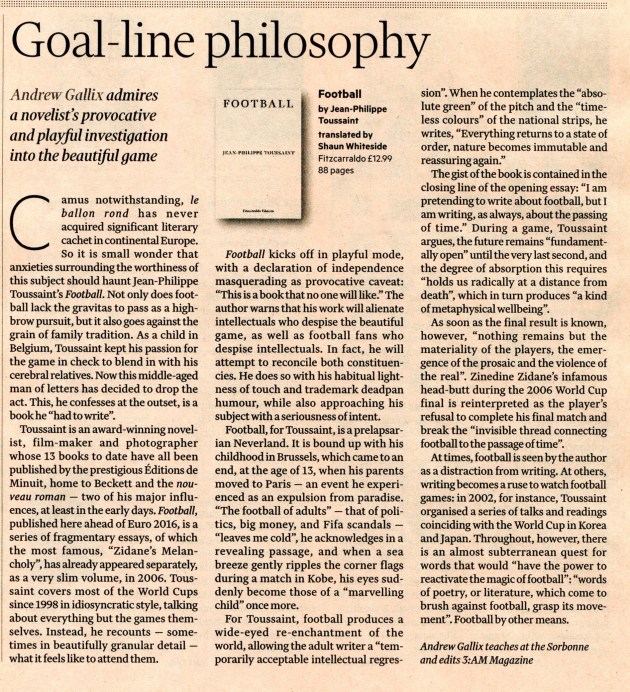
Andrew Gallix admires a novelist’s provocative and playful investigation into the beautiful game

Camus notwithstanding, le ballon rond has never acquired significant literary cachet in continental Europe. So it is small wonder that anxieties surrounding the worthiness of this subject should haunt Jean-Philippe Toussaint’s Football. Not only does football lack the gravitas to pass as a highbrow pursuit, but it also goes against the grain of family tradition. As a child in Belgium, Toussaint kept his passion for the game in check to blend in with his cerebral relatives. Now this middle-aged man of letters has decided to drop the act. This, he confesses at the outset, is a book he “had to write”.

Toussaint is an award-winning novelist, film-maker and photographer whose 13 books to date have all been published by the prestigious Éditions de Minuit, home to Beckett and the nouveau roman — two of his major influences, at least in the early days. Football, published here ahead of Euro 2016, is a series of fragmentary essays, of which the most famous, “Zidane’s Melancholy”, has already appeared separately, as a very slim volume, in 2006. Toussaint covers most of the World Cups since 1998 in idiosyncratic style, talking about everything but the games themselves. Instead, he recounts — sometimes in beautifully granular detail — what it feels like to attend them.

Football kicks off in playful mode, with a declaration of independence masquerading as provocative caveat: “This is a book that no one will like.” The author warns that his work will alienate intellectuals who despise the beautiful game, as well as football fans who despise intellectuals. In fact, he will attempt to reconcile both constituencies. He does so with his habitual lightness of touch and trademark deadpan humour, while also approaching his subject with a seriousness of intent.

Football, for Toussaint, is a prelapsarian Neverland. It is bound up with his childhood in Brussels, which came to an end, at the age of 13, when his parents moved to Paris — an event he experienced as an expulsion from paradise. “The football of adults” — that of politics, big money, and Fifa scandals — “leaves me cold”, he acknowledges in a revealing passage, and when a sea breeze gently ripples the corner flags during a match in Kobe, his eyes suddenly become those of a “marvelling child” once more.

For Toussaint, football produces a wide-eyed re-enchantment of the world, allowing the adult writer a “temporarily acceptable intellectual regression”. When he contemplates the “absolute green” of the pitch and the “timeless colours” of the national strips, he writes, “Everything returns to a state of order, nature becomes immutable and reassuring again.”

The gist of the book is contained in the closing line of the opening essay: “I am pretending to write about football, but I am writing, as always, about the passing of time.” During a game, Toussaint argues, the future remains “fundamentally open” until the very last second, and the degree of absorption this requires “holds us radically at a distance from death”, which in turn produces “a kind of metaphysical wellbeing”.

As soon as the final result is known, however, “nothing remains but the materiality of the players, the emergence of the prosaic and the violence of the real”. Zinedine Zidane’s infamous headbutt during the 2006 World Cup final is reinterpreted as the player’s refusal to complete his final match and break the “invisible thread connecting football to the passage of time”.

At times, football is seen by the author as a distraction from writing. At others, writing becomes a ruse to watch football games: in 2002, for instance, Toussaint organised a series of talks and readings coinciding with the World Cup in Korea and Japan. Throughout, however, there is an almost subterranean quest for words that would “have the power to reactivate the magic of football”: “words of poetry, or literature, which come to brush against football, grasp its movement”. Football by other means.

ft

Here is an earlier, unpublished version:

Camus notwithstanding, le ballon rond has never acquired the literary cachet afforded to cycling in the heyday of Le Tour. Small wonder that anxieties surrounding the worthiness of this subject should haunt Jean-Philippe Toussaint’s Football. Not only does it lack the necessary gravitas to pass muster as a highbrow pursuit, but it also goes against the grain of family tradition. He describes his four-year-old likeness as “anticipating, by more than fifty years, the austere and taciturn appearance bestowed on writers” in solidarity with his Lithuanian grandfather, pictured standing next to him, who failed to take him to a single match. Now that he is no longer simply bald at heart, the middle-aged man of letters may have decided that it was high time to drop the act in solidarity with his younger self. This, he confesses at the outset, is a book he “had to write” lest he “break the fine thread that still connects [him] to the world”. The world of childhood and the seriousness of its games, no doubt, that he opposes to the trivial childishness of adults at play: “I can’t dissociate football from dreams and childhood”. The few sentences from his first novel he has lovingly woven into the text testify to the importance of this endeavour, which could be construed as a summation of his entire work.

Jean-Philippe Toussaint is an award-winning novelist, filmmaker and photographer, whose fifteen books to date have all been published by the iconic Editions de Minuit, home to Beckett and the nouveau roman — two of his major influences, at least in the early days. Football, released here ahead of Euro 2016, is a series of fragmentary essays (the most famous one — “Zidane’s Melancholy” — had already appeared separately, as a very slim volume, in 2006). Toussaint covers most of the World Cups since 1998 in his idiosyncratic style, which consists in talking about everything but the games themselves. Instead, he recounts — sometimes in beautifully granular detail — what it feels like to attend them.

Football kicks off in playful mode with a declaration of independence masquerading as provocative caveat: “This is a book no one will like”. The author warns that his work will alienate intellectuals who despise the beautiful game, as well as football fans who despise intellectuals. In fact, he will attempt to reconcile both constituencies which reflect Descartes’ mind-body dichotomy as well as the two facets of his divided self. Toussaint — whose name is French for All Saints’ Day — seemed predestined to tackle such a weighty issue, and does so with his habitual lightness of touch and trademark deadpan humour. Religious imagery runs through these essays like Gareth Bale across a pitch. Early on, he recalls how the two teams in his primary school were picked with “biblical simplicity” according to whether pupils attended civic education or religious classes: “we played Moral versus Religion football matches”. The children run after the ball “amidst a halo of dust” that, with time, morphs into a “halo of memory”. Toussaint was on the side of Religion, but he is torn between mind, soul, and body. He describes himself watching the 1970 World Cup through a shop window and smiling at the way players left their “physical envelope” behind — “like a halo of themselves” — due to imperfect colour technology. Holed up in his Corsican retreat, hell-bent on writing another novel, he chronicles, several decades later, the intrusion of “sacrilegious”, “profane images” — “images of football” — upon his sacred work. Soon he is glued to a live stream of the 2014 World Cup, having raised his laptop “like an offering on a profane little altar consisting of two or three volumes of the Encyclopédie Universalis (a paradoxical homage of virtue to vice)”.

Football, for Toussaint, is a prelapsarian Neverland. It is bound up with his childhood in Brussels, which came to an end, at the age of thirteen, when his parents moved to Paris — an event he experienced as an expulsion from Paradise. “The football of adults” (that of politics, big money, and FIFA scandals) “leaves me cold,” he acknowledges in a revealing passage, and when a sea breeze gently ripples the corner flags during a match in Kobe, his eyes suddenly become those of a “marvelling child” once more. Football produces a wide-eyed re-enchantment of the world. It allows the adult writer a “temporarily acceptable intellectual regression”: “Everything returns to a state of order, nature becomes immutable and reassuring again” when he contemplates the “absolute green” of the pitch or the “timeless colours” of the national strips.

The gist of the book is contained in the closing line of the opening essay: “I am pretending to write about football, but I am writing, as always, about the passing of time”. During a game, Toussaint argues, the future remains “fundamentally open” until the very last second, and the degree of absorption this requires “holds us radically at a distance from death”, which in turn produces “a kind of metaphysical wellbeing”. When the “invisible thread connecting football to the passage of time is broken” — as soon as the final result is known —“nothing remains but the materiality of the players, the emergence of the prosaic and the violence of the real”. The infamous headbutt during the 2006 World Cup final is reinterpreted as Zidane’s refusal to complete his final match and break this “invisible thread”.

At times, football is seen by the author as a distraction from writing, or even its very antithesis. At others, writing becomes a ruse to watch football games: in 2002, for instance, he organised a series of talks, readings, and journalistic assignments coinciding with the World Cup in Korea and Japan. Throughout, however, there is an almost subterranean quest for words which would “have the power to reactivate the magic of football” once the “invisible thread” is broken — “words of poetry, or literature, which come to brush against football, grasp its movement”. Football by other means.

Beckett with a Smiley Face

This appeared in the New Statesman 4-10 March 2016: 16.

Beckett with a Smiley Face

danfoxpretentiousness

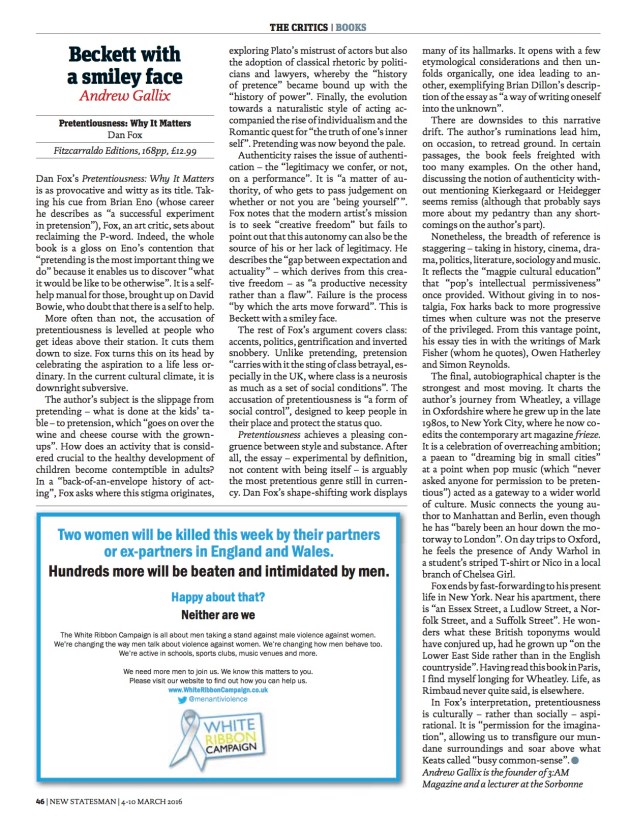
Dan Fox’s Pretentiousness: Why It Matters is as provocative and witty as its title. Taking his cue from Brian Eno (whose career he describes as “a successful experiment in pretension”), Fox, an art critic, sets about reclaiming the P-word. Indeed, the whole book is a gloss on Eno’s contention that “pretending is the most important thing we do” because it enables us to discover “what it would be like to be otherwise”. It is a self-help manual for those, brought up on David Bowie, who doubt that there is a self to help.

More often than not, the accusation of pretentiousness is levelled at people who get ideas above their station. It cuts them down to size. Fox turns this on its head by celebrating the aspiration to a life less ordinary. In the current cultural climate, it is downright subversive.

The author’s subject is the slippage from pretending — what is done at the kids’ table – to pretension, which “goes on over the wine and cheese course with the grown-ups”. How does an activity that is considered crucial to the healthy development of children become contemptible in adults? In a “back-of-an-envelope history of acting”, Fox asks where this stigma originates, exploring Plato’s mistrust of actors but also the adoption of classical rhetoric by politicians and lawyers, whereby the “history of pretence” became bound up with the “history of power”. Finally, the evolution towards a naturalistic style of acting accompanied the rise of individualism and the Romantic quest for “the truth of one’s inner self”. Pretending was now beyond the pale.

Authenticity raises the issue of authentication — the “legitimacy we confer, or not, on a performance”. It is “a matter of authority, of who gets to pass judgement on whether or not you are ‘being yourself'”. Fox notes that the modern artist’s mission is to seek “creative freedom” but fails to point out that this autonomy can also be the source of his or her lack of legitimacy. He describes the “gap between expectation and actuality” – which derives from this creative freedom — as “a productive necessity rather than a flaw”. Failure is the process “by which the arts move forward”. This is Beckett with a smiley face.

The rest of Fox’s argument covers class: accents, politics, gentrification and inverted snobbery. Unlike pretending, pretension “carries with it the sting of class betrayal, especially in the UK, where class is a neurosis as much as a set of social conditions”. The accusation of pretentiousness is “a form of social control”, designed to keep people in their place and protect the status quo.

Pretentiousness achieves a pleasing congruence between style and substance. After all, the essay – experimental by definition, not content with being itself – is arguably the most pretentious genre still in currency. Dan Fox’s shape-shifting work displays many of its hallmarks. It opens with a few etymological considerations and then unfolds organically, one idea leading to another, exemplifying Brian Dillon’s description of the essay as “a way of writing oneself into the unknown”.

There are downsides to this narrative drift. The author’s ruminations lead him, on occasion, to retread ground. In certain passages, the book feels freighted with too many examples. On the other hand, discussing the notion of authenticity without mentioning Kierkegaard or Heidegger seems remiss (although that probably says more about my pedantry than any shortcomings on the author’s part).

Nonetheless, the breadth of reference is staggering — taking in history, cinema, drama, politics, literature, sociology and music. It reflects the “magpie cultural education” that “pop’s intellectual permissiveness” once provided. Without giving in to nostalgia, Fox harks back to more progressive times when culture was not the preserve of the privileged. From this vantage point, his essay ties in with the writings of Mark Fisher (whom he quotes), Owen Hatherley and Simon Reynolds.

The final, autobiographical chapter is the strongest and most moving. It charts the author’s journey from Wheatley, a village in Oxfordshire where he grew up in the late 1980s, to New York City, where he now co-edits the contemporary art magazine frieze. It is a celebration of overreaching ambition; a paean to “dreaming big in small cities” at a point when pop music (which “never asked anyone for permission to be pretentious”) acted as a gateway to a wider world of culture. Music connects the young author to Manhattan and Berlin, even though he has “barely been an hour down the motorway to London”. On day trips to Oxford, he feels the presence of Andy Warhol in a student’s striped T-shirt or Nico in a local branch of Chelsea Girl.

Fox ends by fast-forwarding to his present life in New York. Near his apartment, there is “an Essex Street, a Ludlow Street, a Norfolk Street, and a Suffolk Street”. He wonders what these British toponyms would have conjured up, had he grown up “on the Lower East Side rather than in the English countryside”. Having read this book in Paris, I find myself longing for Wheatley. Life, as Rimbaud never quite said, is elsewhere.

In Fox’s interpretation, pretentiousness is culturally — rather than socially — aspirational. It is “permission for the imagination”, allowing us to transfigure our mundane surroundings and soar above what Keats called “busy common-sense”.
danfox

On 8 March 2016, this review was posted on the New Statesman‘s website under the title “When Did Pretentiousness Become Such a Dirty Word?”

It was prefaced thus: Dan Fox’s new book sets out to reclaim the P-word with an impressively broad-ranging study of art, literature and culture.

Strange Beauty of the Nada in Nevada

This appeared in The Independent on 21 December 2015 (Section 2, page 38):

Strange Beauty of the Nada in Nevada

Mallo can spot a mermaid’s tail in a neutron monitor; estrange theorems into pure poetry

nocilladream

Modernism’s last stand, according to the great art critic Robert Hughes, was a retreat to the American desert. This is the terrain Agustín Fernández Mallo explores in his debut novel, Nocilla Dream, set against the barren backdrop of the “loneliest highway in North America”. Bookended by two forlorn brothels, US Route 50 is the non-place — the nada in Nevada — where “precisely nothing” can be found, if you look hard enough.

The horizon, here, is an event; a vanishing point, reminiscent of one of the characters’ de Chirico-style paintings, rather than the magnet that fuels narrative drive. No longer manifest, destiny can only be glimpsed obliquely, as illustrated by the haunting, Fitzgeraldian image of “the last casino glimmering on the horizon in the rearview mirror”. This retrospective vision soon infects the reading process itself.

First published in Spain in 2006, Nocilla Dream is the opening gambit in a trilogy that spawned a generation of like-minded writers. It is composed of 113 brief chapters — one of them is less than two lines long — which appear like shards of a shattered globe, or fragments of an unfinishable whole. Jorge Rodolfo Fernández is obsessed with Borges’s tale of an empire where cartography becomes so sophisticated that a map as large as the territory it represents is produced. He comes to believe that he inhabits the ruins of this mythical map, which seems to hark back to a time when a work of art could coincide with life itself. In another vignette, a Mexican stowaway who suffocates in a truck trying to cross the border, leaves a “broken map” of himself on the black beans serving as his deathbed.

Linear narrative is ill-equipped to respond to globalisation, hence Mallo’s picaresque twist on the road trip trope. Objects and characters migrate from one chapter to another, prompting the reader to constantly flick backwards to check if the biscuit tin produced in a Danish factory had already appeared in a supermarket in Carson City.

Nocilla Dream is a world seen in a grain of Nevada sand. Its arborescent structure stems from a solitary poplar tree, decorated with hundreds of pairs of shoes, growing alongside US Route 50. By juxtaposing fiction with non-fiction — more than 20 chapters are lifted verbatim from extraneous works — the author has created a hybrid genre that mirrors our networked lives, allowing us to inhabit its interstitial spaces. A physician as well as an artist, Mallo can spot a mermaid’s tail in a neutron monitor; estrange theorems into pure poetry.

Signs and Mythologies

I was asked to write and read an essay on Roland Barthes as part of a series entitled ‘Signs and Mythologies – The Significance of Roland Barthes’ for BBC Radio 3‘s The Essay programme. It first aired on 26 November 2015 at 10:45 pm and was repeated on 11 May 2017 at 10:45 pm. The other essays were written by Andrew Hussey, Nick James, Penny Sparke, and Michael Wood.

Here is the presentation from the BBC Radio 3 website:

An encounter as a teenager with Roland Barthes and an orange moped inspired the magazine editor Andrew Gallix, who now teaches at the Sorbonne, with a fascination for the ideas of the great French theorist. In this week of essays celebrating the 100th anniversary of his birth, Andrew reflects on what Barthes meant by ‘The Death of the Author’.

Across the week five authors write about Barthes’ significance to them and discuss the influence the maverick cultural philosopher has had upon their own work. Over the week they create a picture of a literary figure whose writing was fun, accessible and is still deeply influential on the way we look at the world. Barthes’s literary output was not only prolific, but also eclectic. During the course of his life his thinking influenced the development of theories of structuralism, semiotics, social theory, design, anthropology and post structuralism. A powerful blast of fresh air in post war cultural thought, his carefully argued, accessible and sometimes mischievous examinations of philosophical, cultural and social ideas continue to influence contemporary writers and thinkers.

An eclectic group of essayists celebrate the range of influence his writing has had. Andrew Hussey examines Barthes’ impact in Europe in the 1960s. Other essayists over the week include design historian Penny Sparke, film journalist Nick James, the editor of 3 A.M. Magazine and teacher at the Sorbonne in Paris, Andrew Gallix, and cultural historian Michael Wood.

****

Here is the text. The passages that were cut are in square brackets:

I never met Roland Barthes, but I did spot him once, walking down the street[, at what I recall to be a brisk pace]. It was in the Latin Quarter, where he lived most of his life and seldom strayed from. I must have been fourteen at the time, fifteen at a push. The day before this sighting, I had chanced upon a Barthes profile in a weekly news magazine. Despite skimming it in a most cursory fashion, I gathered that he was a prominent intellectual. It was the accompanying picture — in colour, if memory serves — that allowed me to recognise him. The thing that struck me — and almost struck him — was that orange moped he narrowly avoided when crossing the road. In hindsight, it is difficult not to view this near escape as a dress rehearsal for his iconic (but also ironic, in light of his deconstruction of detergent commercials) encounter with a laundry van — an accident that would eventually lead to his demise in 1980. The feeling that I had conjured him up simply by reading about him was nonsense, of course, but also quite fitting given that Barthes — unbeknown to me — had extolled the creative powers of the reader, whose symbolic birth was the flip side of the death of the author.

‘The Death of the Author’ is not only Barthes’ most famous essay (at least in the Anglophone world) but also the most misunderstood. As though enacting one of its central themes — literature as palimpsest and collage — it first appeared in an American journal: the 1967 original was thus, in effect, already a copy; an English translation of a French text that would remain unpublished until the following year. As it was only anthologised a decade later, the essay was photocopied and distributed samizdat-fashion on campuses the world over, which no doubt enhanced its subversive appeal. For many, on either side of the barricades, it symbolised the emergence of what came to be known as Theory. Malcolm Bradbury’s satire of post-structuralism, Mensonge, is an extended joke on the death-of-the-author trope. The eponymous character — whose name means ‘lie’ in French — is a shadowy intellectual, a former student and collaborator of Barthes, who takes elusiveness to the point of illusiveness, so that the reader, and indeed the narrator, are never even quite sure whether he is meant to exist or not. Much comic capital is derived from the misconception — deliberate, I presume — that Barthes believed books wrote themselves, or that he was denying the very existence of writers, when in fact what he was challenging was the notion of authorship. Take a love letter someone sent you years ago, when people still sent letters and loved you. [An epistle you had mislaid perhaps.] You read it again. The content remains the same, although the person who penned it now hates you with a passion or, worse still, has forgotten about your very existence. The author is dead — detached from his or her work, which endures independently. Let me reassure you: Barthes’ essay, however brief, is far more subtle and interesting than that.

Barthes’ premiss is a sentence lifted from a novella by Balzac[, which cannot be attributed to anyone with any degree of certainty]. He argues that as soon as writing becomes ‘intransitive’ — as soon as language is no longer an instrument, but the very texture of a text — ‘the voice loses its origin’. [In literature, as Mallarmé, Heidegger, and Blanchot had already claimed, it is essentially language that speaks.] The ‘scriptor’ — whose existence coincides with the composition of a text — replaces the ‘Author-God,’ whose absence implies that a work can no longer be assigned a single, ultimate[, ‘theological’] meaning. Barthes also undermines the authority of the critic, whose traditional remit was precisely to decipher the Author-God’s message; to explain a work of fiction through the life (frequently the private life) of its progenitor. Every text, he concludes, is always ‘written here and now’ — by the reader.

Roland Barthes took reading out of the library and into the world, which, he believed, was structured like discourse. In Mythologies, his 1957 bestseller, he exposed the ideological underpinning of what usually goes without saying in everyday life, from the world of wrestling to the art of striptease [through steak and chips], thus demonstrating that the world is always already written. Language — as he put it, somewhat provocatively, [during his inaugural lecture at the Collège de France in 1977] — is ‘fascist’: it [speaks us,] compels us to think and talk along certain lines. In one of his numerous television appearances, he ventures that death is the only true event — in that it escapes language — while all the rest is words, words, words.

If reading was a means of engaging with the world, it could also be a personal, even intimate, activity. For Barthes [reading literature involves ‘rewriting the text of the work within the text of our lives’.] Textual pleasure climaxes when a book ‘succeeds in writing fragments of our daily lives’ — when it reads us. Life and text even become synonymous in what he called ‘life writing’: writing as a way of life, whereby life becomes the text of the work [— a text to be produced, not deciphered]. Barthes, who, for better or worse, popularised the use of the word ‘text’ instead of essay, novel or book, went back to the etymology of the word, which, in Latin, refers to a textile. [This fabric, he argued, is traditionally regarded as a ‘ready-made veil’ concealing meaning (which can only be unveiled through interpretation).] He suggests we consider text as a piece of material that is constantly in the process of being woven, prompting him to compare Proust’s work to that of a seamstress. As early as ‘The Death of the Author,’ he had pinpointed the ‘radical reversal’ operated by Proust. Barthes said of Proust, ‘instead of putting his life into his novel, as is so often maintained, he made of his very life a work for which his own book was the model’. In his last series of lectures, entitled The Preparation of the Novel, he reaffirmed his assessment of Proust: ‘the positioning of the life as work,’ he declared, ‘is now slowly emerging as a veritable shift in values’. In Search of Lost Time, he went on, is ‘entirely woven out of him, out of his places, his friends, his family; that’s literally all there is in his novel’ — and yet it is not an autobiography.

Barthes had little time for the sanctity of books. What interested him was the interaction between life and writing. He claimed, for instance, that he derived more enjoyment from the ‘abrasions’ that his distracted reading imposed upon ‘the fine surface’ of a text than from the narrative itself: ‘I read on, I skip, I look up, I dip in again’. He established a famous distinction between the Book (capital B) and the Album (capital A). The former is a total artwork[: the Absolute in codex form]. The latter — aphorisms, scrapbooks, journals, collages, and so on — remains resolutely fragmentary in nature. According to Barthes, ‘the future of the Book is the Album, just as the ruin is the future of the monument’: ‘What lives in us of the Book’ — a quotation, for instance — ‘is the Album’. Similarly, what lives in us of the biography is, what he called, the biographeme, akin to a textual snapshot: ‘Photography,’ he writes in Camera Lucida, ‘has the same relation to History that the biographeme has to biography’. If someone were to write his life, he once remarked, anticipating his own memoir, he hoped it would be limited to a few ‘biographemes’ — ‘a few details, a few preferences, a few inflections’ [— which, ‘like Epicurean atoms,’ would perhaps touch ‘some future body, destined to the same dispersion’]. Barthes felt that lives should not be written in stone since the past never stands still and identity is open to constant recomposition. His oeuvre is punctuated with [prefigurations or] echoes of the biographeme, which, I think, attests to the centrality of this concept. One finds ‘the Surprise, the Incident, the Haiku’ — presented as near synonyms — or the punctum, the accidental detail in a photograph (as opposed to its ostensible subject), which moves the observer to the extent that his or her involvement becomes deeply personal.

Surprising though it may seem, Roland Barthes had nothing against biography per se, and even toyed with the idea of composing one himself. Susan Sontag observed that he started his career by writing about André Gide’s journal and ended up reflecting upon his own. Barthes was always fascinated by the moment when authors like Stendhal or Proust switched from diary to novel, and seemed to be about to follow suit. His work took a decidedly autobiographical — and indeed literary — turn with the publication of Empire of Signs in 1970. This was followed by a memoir in fragments (Roland Barthes by Roland Barthes) and what he described as an ‘almost novel,’ a novel ‘without proper names’ (A Lover’s Discourse). The subject (himself, his life) is real, but the narrative voice belongs[, of necessity,] to the realm of fiction. This is why it is prefaced with the following caveat, which, significantly, appears in the author’s own elegant script: ‘It must all be considered as if spoken by a character in a novel’. Readers often suspect novels of being thinly disguised biographies; Barthes sensed, contrarily, that biographies were novels that dare not speak their name. The appeal of authors’ diaries is that they are repositories of what he described as the ‘fantasy’ of the writer figure, that is to say ‘the writer minus his work’. In truth, though, a writer cannot dissociate him or herself from the act of writing, just as it is impossible to discuss language in nonlinguistic terms. Barthes, I suspect, felt that he somehow produced himself through his work.

In the wake of the death of his mother, with whom he lived most of his life, the French theorist famously declared: ‘It is the intimate which seeks utterance in me, seeks to make its cry heard, confronting generality, confronting science’. During a lecture delivered a mere two months before his death, he even disavowed ‘The Death of the Author,’ dismissing it as modish structuralist excess. He goes on to confess that he has ‘sometimes come to prefer reading about the lives of certain writers to reading their works’. Barthes had seemingly forgotten to reread his own essay, just like his numerous detractors who never bothered to read it in the first place. Let it be said once and for all, then: the death of the author is that of the ‘Author-God’. Barthes never denies the very existence of the writer, which would be patently absurd. [When he states that, from a linguistic standpoint, ‘the author is never more than a man who writes,’ he recognises that he or she is never anything less either.] When he speaks of literature being an experience of identity loss ‘beginning with the very identity of the body that writes,’ he acknowledges that a body is doing the writing. [It is the presence of this body that he would increasingly seek out in his work.] The author [‘who leaves his [or her] text and comes into our life,’ as Barthes put it,] is primarily a physical presence devoid of psychological [or chronological] unity (a body, not a person). The text dispossesses the writer of his or her ‘narrative continuity’: ‘it takes my body elsewhere,’ he says. [The subject unmakes him or herself in the making of the text, ‘like a spider dissolving in the constructive secretions of its web’. However, it is also through these very secretions that the subject resurfaces, in disseminated form, ‘like the ashes we strew into the wind after death’. These ashes are ‘biographemes’].

Roland Barthes never considered himself as a visual artist, but he derived a great deal of pleasure — ‘a kind of innocence,’ he said — from the sheer physicality of drawing or painting. His most interesting artworks are multicoloured squiggles that resemble a preliterate child’s impression of writing[: writing as ludic abstraction]. What he found most attractive about Japanese calligraphy was that it allowed writing to take flight into painting. Barthes devoted several essays to the tradition of ‘illegible writing’ in the works of artists like Cy Twombly. He even produced some elegant doodles of his own, which we would now describe as asemic writing — a purely gestural form of writing with no semantic content whatsoever. The care with which he fashioned the file boxes for his famous index cards indicates that he also considered writing as a handicraft, as do the corrected proofs of his manuscripts, with their lovingly redacted lines in blue felt-tip that look like erasure poetry. His beautiful handwriting is as distinctive as the legendary grain of his voice. Barthes, it is often said, wrote from the body. He sought to inscribe ‘the hand as it writes’ — his very desire for writing, rather than his psychological subjectivity — into the body of his texts. Given the fascist nature of language, the utopian mission of literature is ‘to unexpress the expressible,’ to take the intransitivity of writing to its logical conclusion by relinquishing meaning altogether: ‘For writing to be manifest in its truth (and not in its instrumentality) it must be illegible’. Roland Barthes, the arch-interpreter dreamed, paradoxically, of a world ‘exempt from meaning’ — an unwritten world, that simply is.

Claire-Louise Bennett’s Pond

This appeared in Guardian Review on 21 November 2015 (Page 10). It was posted on the Guardian‘s website on 18 November 2015:

Pond by Claire-Louise Bennett

A woman meditates on her rural seclusion in a stunning debut that ‘re-enchants the world’

‘Bennett aims at nothing short of a re-enchantment of the world.’ Photograph: Tim Graham/Getty Images

‘Bennett aims at nothing short of a re-enchantment of the world.’ Photograph: Tim Graham/Getty Images

Claire-Louise Bennett’s highly acclaimed debut, initially published in Ireland earlier this year, is a collection of 20 stories — the shortest of which runs to a couple of sentences. They are all told, it seems, by the same female character, whose semi-reclusive existence the tales revolve around. Reading them is an immersive experience. We come to share the “savage swarming magic” the narrator feels under her skin by focusing at length on her “mind in motion” (the only exception being the final story, told in the third person). For all this propinquity, we would be hard-pressed to recognise her, should she suddenly emerge from her rural retreat. One of the most striking aspects of this extraordinary book is how well we get to know the narrator — whose brain and body we inhabit — yet how little we know about her. We don’t even learn her name.

Her soliloquies are peppered with asides to an implied reader — “if you want to know” — cheekily drawing attention to the amount of information being withheld. The young woman discloses, in typically obfuscating fashion, that “it wouldn’t be entirely unwarranted to suggest that she might, overall, have the appearance and occasionally emanate the demeanour of someone who grows things”, despite having actually “propagated very little”. So much for what she looks like. We learn that she expended “many thousands of words” on an aborted doctoral thesis before relocating to the countryside, whence she chronicles the minutiae of her reduced circumstances with professorial pedantry and a mock-heroic style. Ireland, where the stories are set, is never even mentioned: “I live on the most westerly point of Europe, right next to the Atlantic ocean” is as close as we get and as much as we need.

The narrator’s largely solitary lifestyle enables her to eschew what Bennett (pictured) has called “anthropocentric parochialism”. “In solitude you don’t need to make an impression on the world,” the author explained to the Irish Times, “so the world has some opportunity to make an impression on you.” When that impression fails to materialise, in “A Little Before Seven”, the protagonist presses down on the worktop to give herself “a little more density”. In “Morning, Noon & Night” she lies in bed next to her boyfriend, thinking of the vegetables “out there in the dark”: “I’d splay my fingers towards the ceiling and feel such yearning!”

A rich seam of nostalgie de la boue runs through the collection, from the primeval earth that smells “as if it had never before been opened up” in the aforementioned story, to the mud — “feudal and rich, almost igneous” — in “The Big Day”, and the Dostoevskian close of “Words Escape Me”: “I was beneath the ground.” In “Control Knobs”, the narrator seems to envy a character in a novel she is reading, who becomes “more like an element” than a human being, “in the same way that rocks and trees are physiological manifestations. Material. Matter. Stuff.” Having recently moved into her cottage, she reclines on the lawn, and lets nature take her over: “I would listen to a small beetle skirting the hairline across my forehead. I would listen to a spider coming through the grass towards the blanket.”

In the opening story, the narrator is still a little girl, and she climbs over a wall into an ornamental garden and falls asleep on the “unfeasible lawn”, clutching a lilac seashell. This could imply that the rest of the book is an Alice-style dream, or series of daydreams. As she puts it in “The Deepest Sea”, “daydreams return me to my original sense of things” — one thinks here of Wallace Stevens’s “plain sense of things” — “and I luxuriate in these fervid primary visions until I am entirely my unalloyed self again”. The cottage, first glimpsed through a thick hedgerow, and the inaccessible secret garden that she stumbles upon in the process of chasing away a cat, are echoes of this paradise lost.

What Bennett aims at is nothing short of a re-enchantment of the world. Everyday objects take on a luminous, almost numinous, quality through the examination of what Emerson called “the low, the common, the near” or the exploration of Georges Perec’s “infra-ordinary” — a quest for the quotidian. Unlike Perec, however, the narrator does not set out to exhaust circumscribed fragments of reality; quite the contrary. “I don’t want to be in the business of turning things into other things”, which only ends up “making the world smaller”.

Besides being a nod to Walden Pond, where Thoreau went to “live deliberately”, Bennett’s title refers to a sign next to a pond “saying pond” — the kind of literal message that breaks the spell of place, preventing us from “moving about in deep and direct accordance with things”. On brief occasions, the narrator starts speaking in tongues, drawing on a private inner language that can never be “written down at all”. A language beyond meaning, conversant with “the earth’s embedded logos”, it remains “simmering in the elastic gloom betwixt our flickering organs”. This is a truly stunning debut, beautifully written and profoundly witty.

The Writer Postponed

This appeared in The Los Angeles Review of Books on 23 August 2015:

The Writer Postponed: Barthes at the BnF
roland-barthes

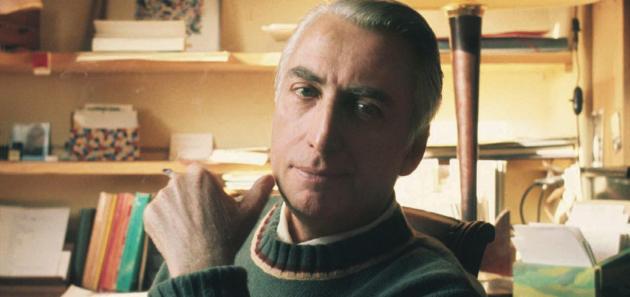
The BnF (Bibliothèque nationale de France) exhibition is one of numerous events commemorating the centenary of the birth of the author of “The Death of the Author” (1967). The exhibition is a rather modest affair compared with the grand 2002–03 retrospective at the Centre Pompidou — one that is far more in keeping with its subject’s endearing reticence. Curated by Éric Marty (who edited the complete works) Les écritures de Roland Barthes, Panorama is divided into two distinct parts. The first one consists of a series of white canvas wall panels, like the Chinese posters called dazibao, teeming with quotations, reproduced manuscript pages, and outsize photographs — including an inevitable Paris Match cover shot of the iconic Citroën DS, which the author of Mythologies famously likened to a Gothic cathedral. These dazibao conjure up Barthes’s 1974 trip to China (Carnets du voyage en Chine, 2009), his Zen inclinations, and his fondness for a partly fantasized Japan — a country he visited three times and wrote about, most famously, in Empire of Signs (1970). The use of fabric in lieu of paper could be construed as a nod to The Fashion System (1967) and, beyond that, to the semiologist’s dapper drapery metaphors. Stage curtains also spring to mind, of course. Barthes was deeply influenced by Bertolt Brecht in the 1950s, a period when his criticism revolved around drama: mostly avant-garde plays at first (until alternative theater was co-opted by Malraux and the Gaullist regime), but soon extending to canonical works. On Racine (1963) even became a cause célèbre, pitting the youngish bucks of la nouvelle critique against the academic establishment. Barthes would later reflect that theater — the personae of “life writing” and the performance of performativity — stood at the crossroads of his entire work. As a student, he dabbled in amateur dramatics, and he was always mesmerized by the manner in which the tragedian’s voice seceded into autonomous acting. Those who visited Barthes frequently fell under the spell of his voice. Chantal Thomas recalls that his speech rendered the silence it sprang from audible (Pour Roland Barthes, 2015). Philippe Roger mentions a sentence that still rings so distinctly in his ears that he could turn it into sheet music — despite having no recollection of what was actually said (Roland Barthes, roman, 1986). Barthes, who cherished “The Grain of the Voice” (1972) — “the body in the voice as it sings” — would no doubt have approved of his words time-lapsing into pure sound.

I walked the length of these gauzy panels, repeatedly, to ensure I had not missed the entrance to some occult gallery room. En route, I spotted several other mildly bemused visitors doing likewise, l’air de rien. Just as the art of striptease conceals nudity (Mythologies, 1957), everything here is hidden in plain sight. The author is ubiquitous, but atomized; splintered into myriad shards of text. In her monumental new biography, Tiphaine Samoyault demonstrates how his fragmentary, aphoristic, and self-referential style resists analysis, often leaving commentators no other option but to paraphrase or quote. This, she says, is how he inhabits his texts. Barthes himself goes back to the etymology of the word “text,” which, in Latin, refers — precisely — to tissue. This tissue, he avers, has traditionally been regarded as a “ready-made veil” concealing meaning (which can only be unveiled through interpretation). Instead of prêt-à-porter, he suggests we consider text as a piece of material that is constantly in the process of being woven — he compares Proust’s work to that of a seamstress. In this “making” of the text, “the subject unmakes himself, like a spider dissolving in the constructive secretions of its web” (The Pleasure of the Text, 1973). However, it is also through these very secretions that the subject resurfaces, albeit in disseminated form, “like the ashes we strew into the wind after death” (Sade, Fourier, Loyola, 1971).

Roland Barthes was not averse to biography per se. In fact, he even toyed with the idea of writing one himself (on his beloved Schumann). Besides, the intersection between life and literature was arguably his central concern throughout his career. Samoyault traces his penchant for self-portraiture back to his sanatorium days, the diseased body being his first object of investigation. She goes on to claim that his main achievement was to take reading out of the book and into the world: to decipher, as it is now, post-Barthes, common to say, the world like a text. For Barthes, however, reading literature was a highly personal pursuit: it meant “rewriting the text of the work within the text of our lives” (Le Nouvel Observateur, 1979). Textual pleasure reaches its climax when a book “transmigrates into our life, whenever another writing (the Other’s writing) succeeds in writing fragments of our daily lives” (Sade, Fourier, Loyola). As Susan Sontag shrewdly observed, Barthes started off discussing Gide’s journal (which, in his view, turned the life and work into “a creative whole”) and ended up reflecting upon his own. During one of his last lectures, he even confessed (citing Kafka’s Diaries and Tolstoy’s Notebooks) that he had “sometimes come to prefer reading about the lives of certain writers to reading their works” — an admission that would have been anathema in the days of high post-structuralism. Indeed, diaries are repositories of what he had previously described as the “fantasy” of the writer figure, that is to say “the writer minus his work”. Readers often suspect novels of being thinly disguised biographies; Barthes believed, contrarily, that biographies were novels that dare not speak their name. Put bluntly, a writer cannot dissociate him or herself from the act of writing, just as it is impossible to discuss language in nonlinguistic terms. Roland Barthes by Roland Barthes (1975) is thus prefaced with the following caveat, which, significantly, appears in the author’s own elegant script: “It must all be considered as if spoken by a character in a novel”. The fragmentary memoir that ensues is narrated in the first and third (he, R.B.) persons singular: Barthes, in effect, becomes a character — several characters — in what he describes as “almost a novel: a novel without proper names”. The subject (himself, his life) is real, but the narrative voice belongs (of necessity) to the realm of fiction. A clear line is drawn between the “unproductive” time of childhood — depicted in the first pages through a series of captioned snapshots — and the “productive” time of writing that endures in textual form, rather than as memory. Since the text dispossesses the writer of his “narrative continuity” — “it takes my body elsewhere” — only the “unproductive life” can be presented in chronological (albeit pictorial) fashion. Much of the author’s work, from Empire of Signs onward, can be read as a quest for a biography of the productive life.

Barthes felt that lives should not be written in stone. After all, the past never stands still: memories are always being reimagined and reshuffled; identity is open to constant recomposition. If someone were to write his life, Barthes remarked, anticipating his own memoir, he hoped it would be limited to a few “biographemes” — “a few details, a few preferences, a few inflections” — which, “like Epicurean atoms,” would perhaps touch “some future body, destined to the same dispersion” (Sade, Fourier, Loyola). As Paul Valéry put it, in a letter he quotes, “It is strange how the passage of time turns every work — and so every man — into fragments. Nothing whole survives — just as a recollection is never anything more than debris, and only becomes sharper through false memories”. In his lectures on The Preparation of the Novel (1978–1980; published in 2003), Barthes establishes a distinction between two literary Platonic ideals: the Book and the Album. The former is the ultimate Gesamtkunstwerk — an instantiation of the Absolute in codex form. The latter (aphorisms, pensées, fragments, collages, journals, scrapbooks) stands at the other, resolutely immanent end of the spectrum. Given that nothing whole ever survives, Barthes draws the conclusion that “the future of the Book is the Album, just as the ruin is the future of the monument”: “What lives in us of the Book” — a quotation, for instance — “is the Album”. (Éric Marty recently edited a collection of the author’s miscellanea under that very title.) Similarly, what lives in us of the biography is the biographeme, that textual snapshot: “Photography has the same relation to History that the biographeme has to biography” (Camera Lucida: Reflections on Photography, 1980). Barthes’s oeuvre is dotted — punctuated — with prefigurations or echoes of the biographeme, which attests to the centrality of this concept. There is the gaping garment, for instance, pinpointed in The Pleasure of the Text as the scintillating locus of eroticism. There is “the Surprise, the Incident, the Haiku” — presented as near synonyms — which Mao’s China famously failed to deliver (Travels in China). And then there is the punctum: the accidental detail in a photograph (as opposed to the studium, its ostensible subject), which moves the observer to the poignant point where his or her involvement becomes intensely personal. One thinks of that passage in Empire of Signs where the author recalls that he never took any pictures of Japan. Quite the contrary, he explains: it is Japan that constellated him with flashes, as though from a camera not loaded with film. In her biography, Samoyault insists that, even at its most theoretical, Barthes’s criticism is never solely (soullessly) analytical. We always perceive the flash of the author’s desiring gaze.

The first part of the BnF exhibition illustrates Barthes’s definition of the “Album”. As its title indicates, it provides us with a panoramic view of the polymath’s multifaceted career. This dizzying, kaleidoscopic portrait of Roland Barthes — dissolved in the constructive secretions of his web — highlights his engagement with the world. The second part, tucked away in a room at the far end of the busy wall panels, is far more intimate. The dimmed lights instantly instill a quasi-religious ambience. The only audible sound comes, muffled, from headphones resting on black seats at the back. Enshrined in glass display cases, the manuscript of A Lover’s Discourse: Fragments (1977) and related relics (letters, index cards, artworks) take center stage. “So it is a lover who speaks and says:” — the magic Open Sesame formula — is inscribed on a blue wall, reminiscent of an Yves Klein monochrome or a manuscript illumination by the Limbourg brothers. Everything here represents the autobiographical, and indeed literary, turn in Barthes’s career: “It is the intimate which seeks utterance in me, seeks to make its cry heard, confronting generality, confronting science” (“Longtemps, je me suis couché de bonne heure …,” 1978).

One of the major lessons of Mythologies is that the world is always already written. Language — as Barthes put it, somewhat provocatively, during his inaugural lecture at the Collège de France in 1977 — is “fascist”. It speaks us, compels us to think and talk along certain lines. The task of literature is thus “to unexpress the expressible,” to take the intransitivity of writing to its logical conclusion by relinquishing meaning altogether: “For writing to be manifest in its truth (and not in its instrumentality) it must be illegible” (Critical Essays, 1964). In his memoir, Barthes writes that “he dreams of a world which would be exempt from meaning“. On several occasions, he praises the haiku for managing to “achieve exemption from meaning” whilst remaining perfectly intelligible. The arch-interpreter dreamt, paradoxically, of signifiers without signifieds. What attracted him to Japanese calligraphy was the interface between writing and painting. He was fascinated by the artistic tradition of “illegible writing” (linked to Chinese characters in the case of André Masson’s semiograms) that he studied in essays devoted to the likes of Bernard Réquichot or Cy Twombly. He even produced some elegant doodles of his own: an instance of what we would now call asemic writing is reproduced on one of the wall panels. The BnF exhibition also showcases several artworks (although that is perhaps too grand a word). The most interesting are multicolored squiggles that resemble a preliterate child’s impression of writing: writing as ludic abstraction.

Barthes never considered himself as a visual artist, and rightly so, but he derived a great deal of pleasure — “a kind of innocence” — from the sheer physicality of drawing or painting. The care with which he fashioned the file boxes for his famous index cards indicates that he also considered writing as a handicraft, as do the corrected proofs of A Lover’s Discourse, with their neatly redacted lines in blue felt-tip that look like erasure poetry. The author’s beautiful handwriting is as distinctive as the grain of the voice, where sound and meaning merge. Barthes, it is often said, wrote from the body. He sought to inscribe “the hand as it writes” — his very desire for writing, rather than his psychological subjectivity — into the body of his texts, thus substituting an erotics for hermeneutics. There is indeed a “return of the author” in Barthes’s work, but the author who returns is not the “Author-God” of realist fiction: “The author who leaves his text and comes into our life has no unity […] he is not a (civil, moral) person, he is a body”. It is through the body that the intimate makes its cry heard on the page.

Writing as pure gesture was, of course, only a fantasy. On this side of “the Utopia of language,” Barthes came to identify what he called “life writing” as a viable way of voicing the intimate. Simply put, life writing is writing as a way of life, whereby life becomes the text of the work — a text to be produced, not deciphered. In “The Death of the Author,” of all places, Barthes had already highlighted the “radical reversal” operated by Proust: “instead of putting his life into his novel, as is so often maintained, he made of his very life a work for which his own book was the model”. Despite disavowing that polemical essay in The Preparation of the Novel — as though he could hear time’s winged laundry van hurrying near — he reprised his assessment of Proust, going as far as to claim that: “the positioning of the life as work is now slowly emerging as a veritable historical shift in values”. In Search of Lost Time is “entirely woven out of him [Proust], out of his places, his friends, his family; that’s literally all there is in his novel” — and yet it is not an autobiography.

Whether Barthes would have written a novel — had he not been knocked over by that van in 1980, dying a month later at the age of 64 — remains a moot point. In an interview, given in 1977, he announced his intention to write a “real novel”. However, he then went on to explain that he was looking for a form that would enable him to detach the “novelistic” (le romanesque) from the novel — which no longer really sounds like a “real novel”. The following year, in his conference on Proust, he mentioned his “fantasized and probably impossible” book. The lectures on The Preparation of the Novel did nothing to clear up the ambiguity; au contraire: “Will I really write a Novel? I’ll answer this and only this. I’ll proceed as if I were going to write one”. Samoyault argues, in her biography, that he probably would have done so. Although he only left an eight-page outline for his projected “Vita Nova,” she believes that much of the material that has been published posthumously (Incidents, Mourning Diary, et cetera) along with vast swaths of the unpublished archives, would eventually have been integrated into some grand magnum opus.

There are numerous counterarguments. Even though he had his ear to the ground and finger on the pulse — championing some of the most cutting-edge artists of his day — Barthes considered himself as a man of the 19th century: the rearguard of the avant-garde, as he once put it. Samoyault highlights the fact that he felt far more at home with Schumann or Chateaubriand than Messiaen or Robbe-Grillet, hence his deep-rooted fear of being an impostor. Proust — whose innovative work also retained a strong traditional Human Comedy dimension — probably represented his beau idéal of literary modernity. For Barthes, however, being modern also meant knowing “what cannot be started over again,” and that kind of monumental novel belonged to the past. At the beginning of The Preparation of the Novel, he suggests that “The Impossible Novel” could have been a good alternative title for these lectures, echoing one of the central themes of Writing Degree Zero: “Modernism begins with the search for a Literature which is no longer possible”. This general cultural crisis was echoed by his own abandonment of novel-writing as a teenager. In a letter to a friend, explaining why he had given up his bildungsroman — a satire of social conventions in provincial France — he described the novel as an “anti-artistic genre” in which aesthetics is stifled by psychology, and form a mere accessory. He then spoke of his conception of an “artistic form of literature,” which he would go on to seek out through his criticism in later years. When he died, he was preparing a conference on Stendhal’s switch from diary to fiction, which had finally allowed him to express his love of Italy. Evidently, Barthes was hoping that “Vita Nova” would likewise enable him to express his love of his mother, with whom he had lived almost all his life, and whose death in 1977 had left him devastated. The title — a quote — was “One Always Fails to Speak of What One Loves”. He may have sensed that his novel would never get as close to the “impossible science of the unique being” as he wished.

In fact, Barthes had already written a fitting, at times heart-rending, tribute to his late mother in the shape of the second part of Camera Lucida. He was too modest and racked by doubts — “I am not fully a writer” — to gauge the importance of his own work. As Philippe Sollers noted, his reading of Balzac’s “Sarrasine” in S/Z (1970) had rewritten a competent story into a veritable masterpiece. Michel Foucault pointed out that his criticism had a prophetic quality: it actually shaped the course of contemporary literature, rather than merely reflecting it. Alain Robbe-Grillet, whom Barthes had championed in his early days, claimed that A Lover’s Discourse may come to be regarded as the nouveau nouveau roman. He believed that the future of the novel lay in the hands of someone, like Barthes, who was not a professional novelist. A Lover’s Discourse was published in 1977, the year Serge Doubrovsky coined the term “autofiction”: it is now obvious that Barthes was one of the originators of this genre. It is equally obvious that most of his books, starting with Empire of Signs (when he began speaking in his own name), could now be labeled novels. Unknowingly, he had redefined what fiction could be.

In his Critical Essays, Barthes describes the critic as a writer, “but a writer postponed,” whose goal — to write a novel — remains tantalizingly on the horizon, like abstract squiggles: “the critic is the man who is going to write and who, like the Proustian narrator, satisfies this expectation with a supplementary work, who creates himself by seeking himself and whose function is to accomplish his project of writing even while eluding it”. While dreaming of the Book, Barthes produced the Album.