“As long as nothing happens anything is possible, you agree?”
– Graham Greene, Our Man in Havana, 1958

“As long as nothing happens anything is possible, you agree?”
– Graham Greene, Our Man in Havana, 1958
![]()
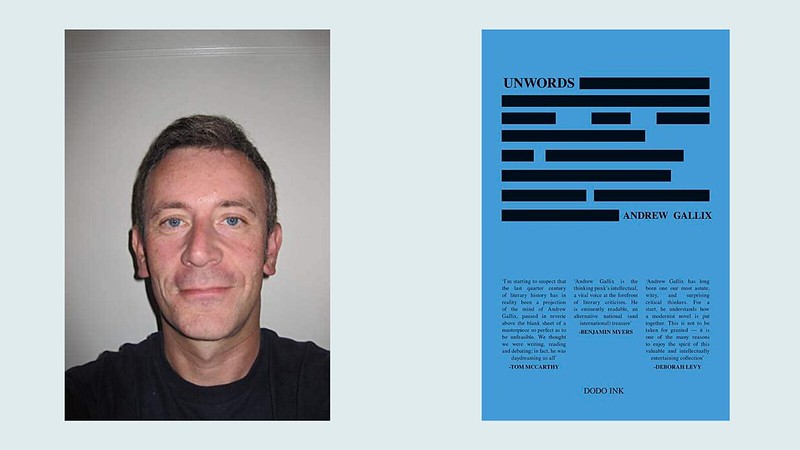
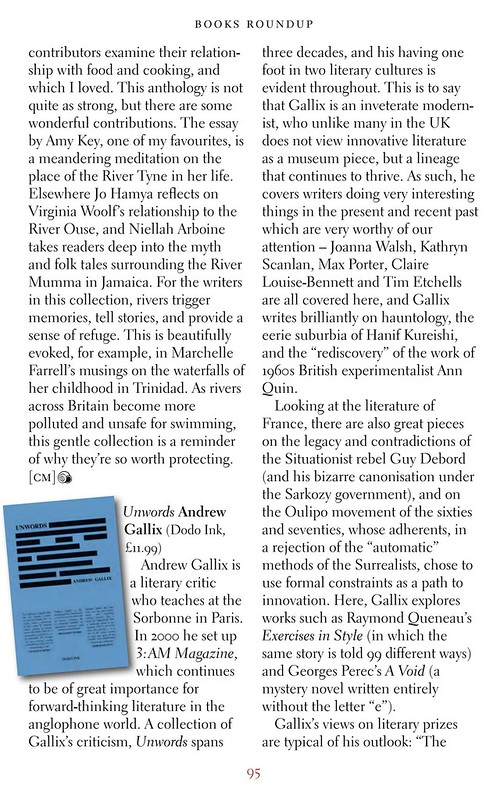
Greer, Rob. “Changing the Narrative.” Review of Unwords by Andrew Gallix, The Idler, July-August 2024, pp. 95-96
![]()
I have an essay, entitled “The Deader the Better: On Writing the Murder” in this fine collection devoted to the craft of crime fiction. Writing the Murder (Dead Ink Books), edited by Dan Coxon and Richard V. Hirst, comes out on 26th September, but you can pre-order it as of today.

Here’s a short extract:
…It is difficult to overstate the thematic importance of murder for any writer, let alone a crime writer — it is bound up with the mysteries of being and not being, inscription and erasure. Jasper Johns famously described Robert Rauschenberg’s Erased de Kooning Drawing (1953) as an ‘additive subtraction’, but could not this be said of all works of art and literature? A painting, according to Picasso, is ‘a sum of destructions’. All books are the result of elimination and omission, revision and redaction — killing your darlings (the original phrase, coined by Sir Arthur Quiller-Couch in 1914, was actually ‘[m]urder your darlings’). Lavinia Greenlaw recounts how her writing is ‘shaped by the stories [she] will not tell’ (Some Answers Without Questions, 2021). ‘Destruction was my Beatrice,’ declared the poet Stéphane Mallarmé apropos of his writing method.
![]()
Nesbitt, Huw. “Reading and Writing: Thirty Years of Textual Snapshots.” Review of Unwords by Andrew Gallix, Times Literary Supplement, 14 June 2024, p. 25

Masquerading as a wide-ranging collection of literary essays, Unwords is in fact a hybrid work of critical theory and biography. A reader might object that literature is already brimming with such experiments. Yet few are delivered with Andrew Gallix’s charm.
Originally published in the TLS, the Guardian, the Irish Times and 3:AM Magazine, the literary website Gallix founded in 2000, the essays in this collection are written in crisp newspaper prose, avoiding the preponderant “I” and paragraph-long sentences frequently found in creative non-fiction. At the book’s heart sits the story of Gallix’s writing career. In 1990, he landed a deal with a publisher for a book about a “middling English novelist and playwright (dead)”. Then Gallix blew it, writing an unwieldy, unfinishable Gesamtkunstwerk instead. Undeterred, he took to criticism, opting to sketch a treatise on literature via freelance commissions.
“The best authors … are wary of the consolations of fiction”, Gallix writes in an article on literary realism. “They sense that the hocus-pocus spell cast by storytelling threatens to transform their works into bedtime stories.” He prefers — and draws this collection’s title from — what Samuel Beckett described as the literature of the “unword”: fiction that isn’t just about something but is the thing itself. “The reality of any work of art is its form, and to separate style from substance is to ‘remove the novel from the realm of art'”, he notes in another essay, quoting the nouveau romancier Alain Robbe-Grillet.
To elaborate this thesis, he explores the work of authors often classed as stylists. Naturally there are big names: Jonathan Franzen, Joyce Carol Oates, Deborah Levy, Joshua Cohen. But, Gallix is equally at home with the obscure. “The book’s apparent lack of direction is part of a strategy … to ensure that it does not become another bogus piece of literary fiction”, he remarks of Lars Iyer’s Dogma (2012), a plotless novel about two bungling philosophy professors. “Perhaps what Tunnel Vision really aspires to be is a self-portrait without a self”, he observes of the Irish writer Kevin Breathnach’s autofictional debut (2019).
A sense of provocation permeates Unwords. This is reinforced by tributes to the Parisian punk icon Jacno (“He belongs to a long line of elegantly wasted rock dandies”) and the French-Egyptian postwar novelist Albert Cossery, who wrote only one sentence a day. For Gallix, literature doesn’t exist to be binged, to delight or comfort: novels are real objects requiring reflection, whose language and syntax very often lead us back to the world itself.
Unwords brings together thirty years of reading and literary contemplation. It offers what Roland Barthes termed biographemes, textual snapshots where life and literature are indistinguishable. “Simply put, life writing is writing as a way of life”, Gallix notes. From the disappointment of the book he never published, Unwords’ author has produced something rare: a work of criticism that aspires to the condition of art.
![]()
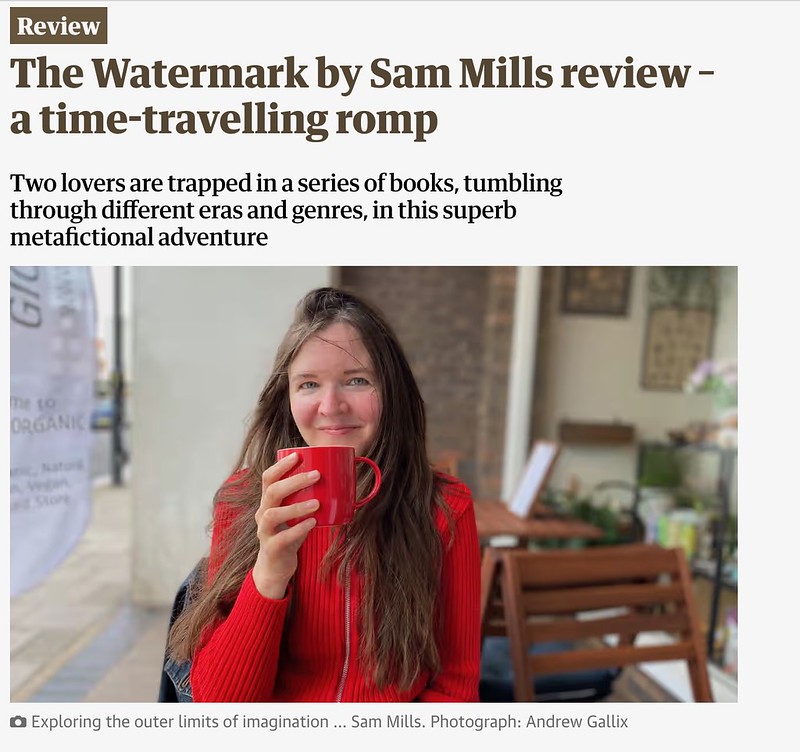
Me on the Offbeat Generation, Paris, April 2008
![]()
Aldridge, Jonny. “Haunting and Being Haunted.” Review of Unwords by Andrew Gallix, Writing Stories, 21 May 2024

Most of what I write never lives up to my expectations artistically or commercially and I spent a lot of time (my twenties) haunted by the feeling this was a problem.
But some books change you and Unwords by Andrew Gallix was one of them. It is a litany of reimaginings, reframings of what the novel is. It’s 600 pages of “essays and reviews haunted by a phantom book the author never completed when he was in his twenties”. It’s — a paean to writers who do not feel the need to publish in order to affirm or reaffirm their status qua writers. Writers for whom literature is ‘the locus of a secret that should be preferred to the glory of making books’ (Maurice Blanchot). Writers of works whose potentiality never completely translates into actuality. Writers who believe in the existence of books they have imagined but never composed. Writers whose books keep on writing themselves after completion.
This list (about a third the length of Andrew Gallix’s in full) seems to me far truer than the narrow notion of a book as the discrete thing bought from shelves in shops or shoved hastily through letterboxes by harassed couriers. If not truer, then more palatable, digestible, and easier on the gut. Proper writers bear this out: the 90,000 words binned during drafting (Bernardine Evaristo), the 40-something full rewrites (Claire Keegan), the seven novels written before the ‘debut’ (Richard Milward)… To say writing is a mess is to say: creativity is creative. The problem isn’t my writing, it’s my expectations. My shallow idea of what the novel can be.
Reinventing the novel
Perhaps this is obvious: Unwords is unapologetically esoteric. But its punk intellectual aesthetic is playful, endearing, and thought-provoking. A collection of 20 years of words, it’s also unsettlingly repetitious. Gallix not only circles the same ideas but reuses the exact same quotes, rehashes the same phrases and sentence structures, plagiarises his own opinions. Haunts his own writing. This is the point. It’s the text he should have completed in his twenties. We are, all of us, writing our ur-novel, seeking the ideal of literature that made us want to wade among words in the first place. …

![]()
Greco, Nicolas. “Roland Barthes’ Album: Unpublished Correspondence and Texts.” ASAP Journal, 19 July 2018

Writing for The Los Angeles Review of Books, Andrew Gallix points out the distinction Roland Barthes makes between a book and an album in his lectures on The Preparation of the Novel (from that late 1970s): the book can be considered a “complete work,” a monument which will ultimately be destroyed, whereas an album is “what lives in us.” Describing his visit to the BnF (Bibliothèque nationale de France) exhibition on Barthes in 2015 — called “Panorama” — Gallix suggests that it “provides us with a panoramic view of the polymath’s multifaceted career. This dizzying, kaleidoscopic portrait of Roland Barthes — dissolved in the constructive secretions of his web — highlights his engagement with the world.”