Through a Rather Brief Unity of Time

I was interviewed by Linn Levy for her fine piece on Guy Debord, Situationism, and punk:

Linn Levy, “Debord j’adore,” Edelweiss December 2014: 52-53
Debord1
Debord2

. . . Et le punk? «Faut-il dire que le punk était situationniste?», s’interroge Andrew Gallix, écrivain, professeur à la Sorbonne, punk depuis l’âge de 12 ans et fondateur du premier blog littéraire «3:AM Magazine». «Non. Les idées de Debord ont été l’une des très nombreuses influences de ce mouvement éminemment postmoderne, au même titre que Dada, par exemple, ou le surréalisme. Il faut voir le punk comme un collage, ou comme une installation artistique : une conjonction d’influences diverses qui ont coexisté pendant “une assez courte unité de temps” (pour citer Debord) avant d’éclater en une myriade de mouvements. Entre 1976 et 1979, dans ce pays socialement à la dérive, l’esprit du situationnisme a été en quelque sorte mis en acte par le punk; il est réellement descendu dans la rue. Debord entendait mettre la révolution au service de la poésie, c’est-à-dire transformer la vie en art, et c’est précisément ce que le punk a réalisé. Il est évident que pour Malcolm McLaren, même s’il était avant tout un homme d’affaires, les Pistols étaient une situation au sens debordien.»

Photobooth

Paul Gorman, “What We Wore: An Intelligent and Egalitarian Celebration of Our Collective Visual Invention,” Paul Gorman Is 30 October 2014

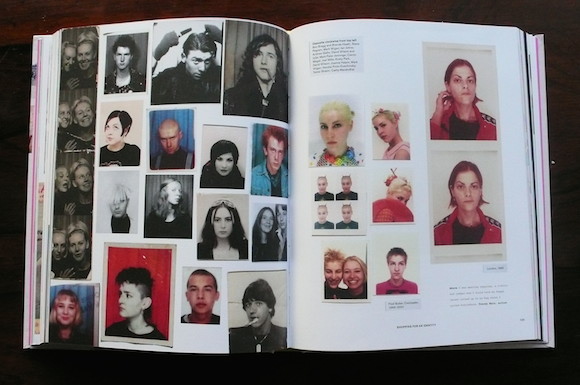
Paul Gorman has posted several pictures of Nina Manandhar’s What We Wore: A People’s History of British Style on his website. I appear in this one, across the page from Tracey Emin:

Towards Blankness

Thom Cuell, Rev. of The Biographical Dictionary of Literary Failure by C. D. Rose, The Workshy Fop 10 November 2014

In his introduction, 3:AM Magazine editor-in-chief Andrew Gallix notes a tendency in modern art towards blankness, exemplified by ‘the white paintings of Malevich…as well as John Cage’s mute music piece’. The literary apotheosis of this trend is Herman Melville’s Bartleby, the scrivener who stopped, er, scrivening. If we accept this theory, then we must accept that the writers Rose commemorates have inadvertently achieved greatness, ‘through their work being censored, lost, shredded, pulped or eaten by pigs’.
The Biographical Dictionary of Literary Failure 300dpi

Red and Black

Daisy Woodward, What We Wore: A People’s History of British Style, Another Magazine 5 November 2014.

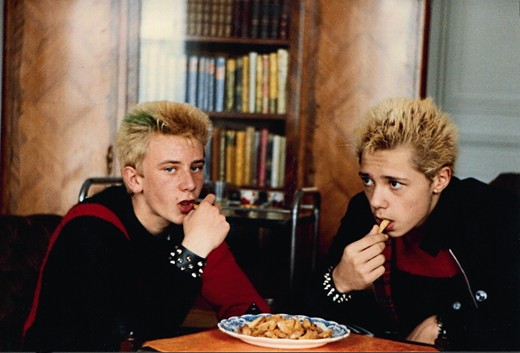
…Andrew Gallix, writer… “I was only 11 when I got into punk, which was very young, even back then. The first punk garment I bought was a green t-shirt with a cheesy transfer of the words ‘punk rock’ daubed onto an unconvincing brick wall… The picture above is of me and my best mate Yannick. These red and black jumpers, knitted by Yannick’s mum, were part of our own distinctive style. They had a zip down one side or on the shoulder so you could put them on and take them off easily. The colours were those of the anarchist flag.”

The same picture appeared in Clash on 7 November 2014.

Heading For the Final Shore

“Just as the man who is hanging himself, after kicking away the stool on which he stood, heading for the final shore, rather than feeling the leap which he is making into the void feels only the rope which holds him, held to the end, held more than ever, bound as he had never been before to the existence he would like to leave.”
Maurice Blanchot, Thomas the Obscure

Unaltered By Perception

Nicholas Rombes, The Absolution of Roberto Acestes Laing

For I’ve come to see, in retrospect, that there was a void at the heart of the films that Laing destroyed, and that through his description of those films he was attempting to fill, somehow, that void, as if talking about the films might fill in the meaning that they themselves lacked. I also came to understand that Laingn didn’t think of the destroyed films as “lost treasures” at all, but instead as something more dangerous, as expressions of pure nothingness. A nothingness that goes beyond nihilism, beyond philosophy, a sort of absence that’s so seductive and so powerful that to look upon it is to corrupt a part of your soul (p. 67).

“…I’d watched them, all right, and seen something in them that should never be seen, and I’m not talking about a real-life killing on camera or a dangerous, evil idea convincingly expressed by an otherwise sympathetic character or anything like that. What I mean is that there was something there, in between the frames, something that wasn’t quite an image and wasn’t quite a sound. It was both and neither of those things at the same time. In other words, an impossibility that, because it expressed or represented a new way of being, had to be destroyed. An extreme, undiluted truth, that’s what I’m talking about” (p. 69).

As Laing looks down at the picture I think about the missing children, the ones in the news, and that Laing’s reasons for destroying the films only made sense if you believed there was such a thing, as he had called it, as undiluted truth because in fact, well let’s face it, we’re luckless when it comes to truth because there’s just no way to grasp it without polluting it or mucking it up with ourselves, as if the observer effect didn’t only apply just in physics, but in metaphysics as well because, sure, you can coax it out, the truth, but the moment it shows or reveals itself to you it’s changed in response to being detected, and maybe that’s what Laing meant, after all, that somehow, against all reason, the films in question had actually managed to capture the truth unaltered by perception and that’s why they had to be destroyed… (pp. 60-70).

The shoebox seemed to vibrate there on my lap, like a dying wasp, and I imagined opening it right there and unleashing a terrible fury and blaze that was meant for some apocalyptic future, like some carefully erased sentence slowly re-appearing across the page (p. 76).

See also Guillaume Apollinaire, Yves Bonnefoy (here and here), Stan Brakhage, Karl Ove Knausgaard (here and here), Steven Millhauser (here and here), and Simone Weil.

Scholarly Introduction

Michael Dirda, Rev. of The Biographical Dictionary of Literary Failure by C. D. Rose, The Washington Post 5 November 2014

After a scholarly introduction that touches on such topics as blankness, the whiteness of the page and the ontology of fiction, Rose opens The Biographical Dictionary of Literary Failure with an account of the life of Casimir Adamowitz-Kostrowicki.
The Biographical Dictionary of Literary Failure 300dpi

A Kind of Other-ing

Simon Critchley, “Cult of Memory: Simon Critchley Interviewed” by Daniel Fraser, The Quietus 2 November 2014

One moral of Memory Theatre is that it is a kind of parable of writing. Here is someone who writes and then goes crazy and then that writing becomes a sort of monumentalisation of death in this fantasy of total recall where everything would become meaningful at the moment of the extinction of one’s life in death. Which is a very reassuring picture of writing, writing helps us to remember but in many ways writing should be pushing us towards that which we can’t remember, that which escapes memory, that which really haunts us. Or again to push us towards something which actually involves other people rather than this masturbatory activity of writing which can lead to catastrophe.

I think there is a way of writing, a kind of Derridean theme: you can try to write in a way which encourages a certain otherness in the self, a certain self-distancing, and Memory Theatre therefore is a negative example, something to be avoided. However, Memory Theatre is also importantly a universe without love, this is what an existence without love looks like and love is also a kind of other-ing. It engenders a disposition in you which is orientated towards something which you cannot control or recollect. It is the same way I see psychoanalysis which again is not premised on a fantasy of total recall, it’s about an orientation towards something which is in you that is maybe not in your conscious memory, and is not really memorialisable in any way.

Does It Mean Stopping Writing?

Simon Critchley, “Cult of Memory: Simon Critchley Interviewed” by Daniel Fraser, The Quietus 2 November 2014

Bataille is of particular interest to me because you could see Bataille condemning the memory theatre and in particular the memory theatre that is Hegel’s fantasy of absolute knowledge, the closed economy of the theatrical space in the book, and opposing that in the name of what he calls throughout his work ‘sovereignty’. Sovereignty is an odd word to use in many ways, because what Bataille was interested in wasn’t sovereignty as the capacity to make a decision or act in a certain way but rather to engage in an experience where you give up who you were and be free of that fantasy of a closed economy.

So in Bataille you’ve got this cultivation of a series of experiences: eroticism, squandering, sacrifice and so on and so forth which are about staging something which would let that memory theatre go in a way; would let go of the delusion of absolute knowledge.

In many ways you can read the book as a negative moral: the point of the book is what’s not in it in many ways. I wrote the book in order to try to correct that tendency in myself which of course you fail to do but nonetheless you have to try.

To write at all is to construct some kind of delusional memory theatre which so often leads to you becoming like some machine which just produces words, like Zizek, just saying the same things over and over again. How do you stop doing that? Does it mean stopping writing? Maybe. Maybe it means writing in a different way such as writing collaboratively, something I’ve tried to do over the years to try and give up the authority of the voice.