
Nina Manandhar, What We Wore: A People’s History of British Style (London: Prestel, 2014)
There’s a small photobooth picture of me on the cover. I also appear on pp. 24, 40-41 (with some text), and 104.

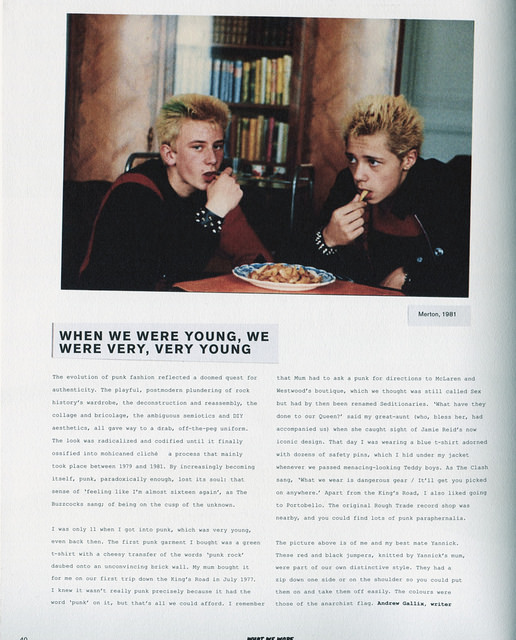
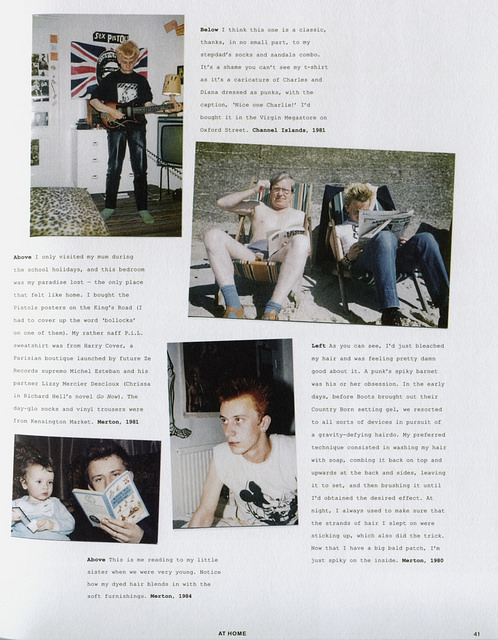
Nina Manandhar, What We Wore: A People’s History of British Style (London: Prestel, 2014)
There’s a small photobooth picture of me on the cover. I also appear on pp. 24, 40-41 (with some text), and 104.
“Just as the man who is hanging himself, after kicking away the stool on which he stood, heading for the final shore, rather than feeling the leap which he is making into the void feels only the rope which holds him, held to the end, held more than ever, bound as he had never been before to the existence he would like to leave.”
– Maurice Blanchot, Thomas the Obscure
Nicholas Rombes, The Absolution of Roberto Acestes Laing
For I’ve come to see, in retrospect, that there was a void at the heart of the films that Laing destroyed, and that through his description of those films he was attempting to fill, somehow, that void, as if talking about the films might fill in the meaning that they themselves lacked. I also came to understand that Laingn didn’t think of the destroyed films as “lost treasures” at all, but instead as something more dangerous, as expressions of pure nothingness. A nothingness that goes beyond nihilism, beyond philosophy, a sort of absence that’s so seductive and so powerful that to look upon it is to corrupt a part of your soul (p. 67).
“…I’d watched them, all right, and seen something in them that should never be seen, and I’m not talking about a real-life killing on camera or a dangerous, evil idea convincingly expressed by an otherwise sympathetic character or anything like that. What I mean is that there was something there, in between the frames, something that wasn’t quite an image and wasn’t quite a sound. It was both and neither of those things at the same time. In other words, an impossibility that, because it expressed or represented a new way of being, had to be destroyed. An extreme, undiluted truth, that’s what I’m talking about” (p. 69).
As Laing looks down at the picture I think about the missing children, the ones in the news, and that Laing’s reasons for destroying the films only made sense if you believed there was such a thing, as he had called it, as undiluted truth because in fact, well let’s face it, we’re luckless when it comes to truth because there’s just no way to grasp it without polluting it or mucking it up with ourselves, as if the observer effect didn’t only apply just in physics, but in metaphysics as well because, sure, you can coax it out, the truth, but the moment it shows or reveals itself to you it’s changed in response to being detected, and maybe that’s what Laing meant, after all, that somehow, against all reason, the films in question had actually managed to capture the truth unaltered by perception and that’s why they had to be destroyed… (pp. 60-70).
The shoebox seemed to vibrate there on my lap, like a dying wasp, and I imagined opening it right there and unleashing a terrible fury and blaze that was meant for some apocalyptic future, like some carefully erased sentence slowly re-appearing across the page (p. 76).
See also Guillaume Apollinaire, Yves Bonnefoy (here and here), Stan Brakhage, Karl Ove Knausgaard (here and here), Steven Millhauser (here and here), and Simone Weil.
Michael Dirda, Rev. of The Biographical Dictionary of Literary Failure by C. D. Rose, The Washington Post 5 November 2014
After a scholarly introduction that touches on such topics as blankness, the whiteness of the page and the ontology of fiction, Rose opens The Biographical Dictionary of Literary Failure with an account of the life of Casimir Adamowitz-Kostrowicki.

Simon Critchley, “Cult of Memory: Simon Critchley Interviewed” by Daniel Fraser, The Quietus 2 November 2014
One moral of Memory Theatre is that it is a kind of parable of writing. Here is someone who writes and then goes crazy and then that writing becomes a sort of monumentalisation of death in this fantasy of total recall where everything would become meaningful at the moment of the extinction of one’s life in death. Which is a very reassuring picture of writing, writing helps us to remember but in many ways writing should be pushing us towards that which we can’t remember, that which escapes memory, that which really haunts us. Or again to push us towards something which actually involves other people rather than this masturbatory activity of writing which can lead to catastrophe.
I think there is a way of writing, a kind of Derridean theme: you can try to write in a way which encourages a certain otherness in the self, a certain self-distancing, and Memory Theatre therefore is a negative example, something to be avoided. However, Memory Theatre is also importantly a universe without love, this is what an existence without love looks like and love is also a kind of other-ing. It engenders a disposition in you which is orientated towards something which you cannot control or recollect. It is the same way I see psychoanalysis which again is not premised on a fantasy of total recall, it’s about an orientation towards something which is in you that is maybe not in your conscious memory, and is not really memorialisable in any way.
Simon Critchley, “Cult of Memory: Simon Critchley Interviewed” by Daniel Fraser, The Quietus 2 November 2014
Bataille is of particular interest to me because you could see Bataille condemning the memory theatre and in particular the memory theatre that is Hegel’s fantasy of absolute knowledge, the closed economy of the theatrical space in the book, and opposing that in the name of what he calls throughout his work ‘sovereignty’. Sovereignty is an odd word to use in many ways, because what Bataille was interested in wasn’t sovereignty as the capacity to make a decision or act in a certain way but rather to engage in an experience where you give up who you were and be free of that fantasy of a closed economy.
So in Bataille you’ve got this cultivation of a series of experiences: eroticism, squandering, sacrifice and so on and so forth which are about staging something which would let that memory theatre go in a way; would let go of the delusion of absolute knowledge.
In many ways you can read the book as a negative moral: the point of the book is what’s not in it in many ways. I wrote the book in order to try to correct that tendency in myself which of course you fail to do but nonetheless you have to try.
To write at all is to construct some kind of delusional memory theatre which so often leads to you becoming like some machine which just produces words, like Zizek, just saying the same things over and over again. How do you stop doing that? Does it mean stopping writing? Maybe. Maybe it means writing in a different way such as writing collaboratively, something I’ve tried to do over the years to try and give up the authority of the voice.
Clare Margetson, “The Hay Relay: The End-less Wait is Over,” The Guardian 4 July 2007
I blame Andrew Gallix’s slow writing movement. David Hockney, too. Sparked by his concerns about our non-visual age I’ve taken a leaf out of his book and taken to gazing out of the window a great deal recently. But all these fantastic clouds in the sky are a huge distraction. So, we’re late, we’re late in putting up this post.
Jonathon Sturgeon, “In Praise of Literary Failure,” Flavorwire 30 October 2014
The book’s introduction, too, is one of the finer pieces of literary criticism to be released this year. Written by Andrew Gallix, editor-in-chief of 3:AM Magazine, which purports to be “the first literary blog,” the intro deftly surveys the gamut of literary failure. Especially good and poetic is Gallix’s take on the scourge of the writer, the blank page:
Blankness is the sine qua non for inclusion in the BDLF, but it is seldom sought after directly. Manuscripts and books remain blank to us through being censored, lost, drowned, shredded, pulped, burned, used as cigarette paper or wrapped around kebabs, fed to pigs or even ingested by their own authors…These brief biographies are sketches that merely gesture towards the possibility of narrative development; stories that are cut short or fall silent. Stories that would prefer not to.
Douglas Lord, Rev. of The Biographical Dictionary of Literary Failure by CD Rose, Library Journal 16 October 2014
Don’t be taken in, as I first was, by Sorbonne instructor Andrew Gallix’s Very Serious Introduction in which he notes all sorts of high-level details, such as that most of the writers “…devoted their lives to the pursuit of some Gesammtkunstwerk…”.
David Winters, “An Interview with David Winters” by Matthew Jakubowski, truce 21 October 2014
My first book review was of Barthes’ The Preparation of the Novel. I sent it to Andrew Gallix at 3:AM. He published it, and made me an editor shortly afterwards. I’m grateful to Andrew for that. And to Barthes!
… As for “guiding” the magazine, for me the most attractive aspect of 3:AM is its refusal to “stand for” anything! As Andrew often puts it, the site has “no party line”. It was always supposed to be a broad church — or an anarchic ship of fools, to mix the metaphor. The most amusing attacks on us have come from bloggers who treat book reviewing as if it were some sort of moral crusade; who want to divide readers’ tastes into “right” and “wrong”. We find factionalism quite infantile, and upsetting these dogmatists is as good a reason as any to keep publishing.
 ANDREW GALLIX