The Nothing-Something of Loren Ipsum

Albert Rolls. “The Nothing-Something of Loren Ipsum.” Review of Loren Ipsum by Andrew Gallix, 3:AM Magazine, 24 October 2025.

As Shakespeare’s Hamlet and Claudius’s reign progress toward their denouement, Ophelia, now mad, presses her way into the royal presence. A gentleman, advising Queen Gertrude to give her an audience, observes,

Her speech is nothing, Yet the unshaped use of it doth move The hearers to collection. They aim at it And botch the words up fit to their own thoughts; Which, as her winks and nods and gestures yield them, Indeed would make one think there might be thought…

The nothing-something described here emerges elsewhere in Shakespeare, for example, in Richard II, where it is portrayed as the anamorphic presence out of which Bolingbroke forms a political body in opposition to Richard II’s and becomes Henry IV. Laertes, who, the people cry, “shall be king,” seems to assume Bolingbroke’s structural position in Act IV of Hamlet but does not yield to the amorphous body of the people (1) and reshape it, thereby failing to become its head. He is instead re-absorbed into King Claudius’s graces and taken into the plot that will leave the stage scattered with royal corpses, the head of the political body reduced to the nothing-something that Fortinbras will be left to reshape so that he can become, in the parlance of Shakespeare’s day, Denmark, while Horatio is left to tell Hamlet’s story, to fashion a narrative analogue to the ordered state that we are likely meant to assume will rise in Claudius’s wake.

An ordered condition, the narrative variety in any case, has proven not to be the principal interest of the state that emerges after the intervention of King Hamlet, the ghost of the prince’s father and Shakespeare’s spirit, to borrow, if unfashionably and only metaphorically, from Harold Bloom’s Hamlet: Poem Unlimited with a wink at the grander titled Shakespeare: The Invention of the Human (2). We might call this state modernity, noting it’s not likely the one Shakespeare and his contemporaries sought to produce (3), and posit that Ophelia’s nothing-something, involving as it does the interaction between speech and listeners (text and readers), provides the most significant point of fascination for those of us stranded in modernity’s most recent iteration, an iteration in which “we locate modernity in the past,” as Loren Ipsum, the eponymous character of Andrew Gallix’s debut novel, observes.

Gallix’s novel explores a nothing-something analogous to the one Ophelia’s utterings become, asking in its first chapter, “what is lost when nothing is lost? When it becomes something?” The question here, posed by the novelist Sostène Zanzibar, refers to a note that reads “NOTHING IS LOST” and is found on the corpse of the murdered, we learn later, “Solange de la Turlute, the controversial boss of one of France’s largest family-owned publishing houses,” the first in series of murders, mostly of authors. But the question resonates beyond this context and seems to serve as the grounding question of the entire novel, “the book you are currently reading, which . . . is not the book I wanted to write,” the author, Adam Wandle — whom Ipsum is in Paris researching for a book and whose works provide slogans for the group behind the murders — asserts, but in such a way as to make ”the porous borders” between character — here Wandle — and author —Gallix (4) — “almost indistinguishable,” to appropriate phrases of a passage from Loren Ipsum that blurs, in a different manner, the distinction between fictional and nonfictional worlds.

The book he wanted to write was to “contain not only multitudes but everything,” a description of his desire that suggests “the book you are currently reading” is associated with a nothing-something in a classical sense, for Plato equated a term meaning “all” or “everything” with cosmos, as T. McAlindon notes in Shakespeare’s Tragic Cosmos, so that its opposite, “the word ‘nothing’ or ‘nought’ became another word for ‘chaos,’” the primordial nothing-something from which the cosmos was created and the liminal state in the metamorphic process in the post-creation world, or, as Gallix describes it in reference to a site of logical contradiction the “negation of the world that leads to the rise of a new one,” an end that is aligned with the figure of Zanzibar, who emerges as a supplement to Ipsum, another character who seems to blur into Gallix, for example, when Ipsum, on page 289, ends an interruption of a discussion about her debut novel and returns to her conversation with “‘Where were we? Ah yes, that passage on page 289…,’” a joke that seems to assume that the pagination won’t be changed in future printings. The number, of course, could be altered to match any page on which the passage appears, a maneuver that would provide a fitting element of instability to the text and perhaps oblige the original to supplement the repetition (and vice versa) to tease out its significance (5).

The dynamic I am here positing between the original and its supplemental repetition finds clearer expression when Ipsum attends the exhibit titled L’appel du vide (The Call of the Void), an exhibit in which Zanzibar participates, falling asleep and dreaming Ipsum, the dream version of whom dreams him. Gallix here provides a set of framing devices, one inside the other: the critic’s dream of the novelist is framed by the novelist’s dream of the critic, which is framed by the exhibit watched by the critic within the novel, Loren Ipsum. Author and critic even merge within the episode, for Ipsum briefly assumes the perception of an omniscient narrator — an authorial doppelgänger, if ever there were one — who, as she watches Zanzibar dream, thinks, “there is nothing more tiresome than other people’s dreams, especially in bloody books. I mean, how much pointless made-up pseudo-surreal slash absurdist shit can you stomach, for fuck’s sake?”

The concerns over the significance of the dream are wrong, serving rather as an anticipatory misreading that is meant to deter the reader from regarding the episode as a repetition of a tired trope, tired repetition being among the novel’s anxieties, the one that compels it to strive to situate itself in the liminal state of nothing-somethingness. The issue is played out in the trajectory that Zanzibar’s career takes, his successful debut, Je suis la Femme Bigorneau (1986) having been followed with four novels that “resembled an increasingly faded photocopy of the original blueprint [that is, Bigorneau], giving rise to …‘a sense of perpetual déjà vu on a dimmer switch,’” a sign of stagnation that Zanzibar seeks to escape through writing a “prequel to Genesis,” literally the story of primordial nothingness — something that can only be described by way of negation. The project comes to nothing, all drafts being destroyed.

Interestingly, the stagnation Zanzibar experiences has its analogue in a more ideal version of the creative process, the one that Wandle finds himself following, that is, writing stories “while looking for the story” (emphasis added), the profound tale that came to him one night — making him feel as if he “had been singled out, in the grand tradition of Plato’s Ion” — but that he had forgotten. “This may be the very source of all literature,” he muses. Zanzibar, in the absence of the “epiphany” that visited Wandle and intent on producing something like his Genesis prequel, arrives at “the concept of a novel printed in disappearing ink. Once read, each word would vanish forever, the full text living on in people’s minds — retold, reinterpreted, reinvented” in the tradition, perhaps, of Ophelia and those hearing her. This concept would situate the reader in the position of Wandle’s idea of a writer trying to find the perfect story, the details of which have been forgotten. The idea of a novel printed with disappearing ink is, of course, abandoned due to its impracticality but is published as a facsimile of a novel that had been written in longhand with such ink. The object, commercially successful, comes to serve as a “handy memo pad,” the imagined retelling, reinterpreting, reinventing being replaced by text that records the momentarily needed but discardable ephemera of people’s days, the creative dialogue between text and its readers being abandoned in the name of commercial necessity.

Zanzibar’s creative difficulty is one that Loren Ipsum, the novel, overcomes by pushing its apparent stories — the one about terrorists’ murdering writers and the one about the attempt to “make it to the mythical Blue Island,” both of which are described on the back cover of the paperback — into the background. The reader, it is true, is provided with firsthand accounts of some of the murders, one of which is narrated in the second person, and may catch a glimpse of the Blue Island, but the experience of the murder plot and the quest plot remains secondhand, comparable to the story of a serial killer in another country or of a vaguely interesting voyage of discovery that one half attends to in media accounts while going about one’s daily life. The novel, for example, never lingers on the scenes of the murders so that a narrative related to them can emerge. A negative stand-in for Horatio, in fact, shows up in the guise of Horatia, the apparent daughter of Jonathan Titterington-Jones, the writer whose murder is narrated in the second person. She remains disinterested, and her father is left to wonder, “At what point, if any, would [she] look up from her mobile and interrupt Cosimo’s [her brother’s] video game to enquire where you are?” Her focus is not “you,” so she can’t be relied on to fashion a story analogous to the one Hamlet asks Horatio to tell.

Loren Ipsum is a-not-quite lorem ipsum, a dummy text used to design pages. The novel’s pages have comprehensible text, but the story it purports to be about remains in a liminal state, waiting to be “retold, reinterpreted, reinvented.” Readers are to become, in short, Lorens, that is, critics whom the novelist dreams and who in turn dream the novelist.

Notes

(1) I am alluding here to Laertes’ warning to Ophelia to be careful about getting involved with Hamlet: He may not, as unvalued persons do, Carve for himself, for on his choice depends The safety and the health of this whole state. And therefore must his choice be circumscribed Unto the voice and yielding of that body Whereof he is the head.

(2) Shakespeare, it is believed, played the ghost of Hamlet’s father, the figure who gives birth to the plot and who serves, in Bloom’s reading, as Shakespeare’s spirit. Bloom’s assertion that “Hamlet has become the center of a secular scripture” — a text related to the secular world as the Bible, for example, is related to Christendom — thereby suggests that Hamlet and its spirit gave birth to our secular world, inventing us so to say.

(3) For example, in the Novum Organum, Francis Bacon explains, “there is a great difference between the idols of the human mind and the ideas of the divine mind; that is to say, between certain empty opinions and the genuine signatures and marks impressed on created things.” Bacon’s development of the scientific method, this observation suggests, was an effort to fill the gap that separated the hermeneutics and semiology of the sixteenth-century episteme, the purpose, as Foucault describes it in The Order of Things, of learning during the age we have come to call early modern.

(4) Gallix has a novel in his past that he wanted to write but did not. His last book, Unwords, is described on the publisher’s website as “essays and reviews haunted by a phantom book the author never completed when he was in his twenties.”

(5) If, for example, the chapter appeared as the last excerpt in an anthology of twenty-first century fiction with text that read “on page 956” to match the page on which the passage appears in the anthology, the text would almost certainly be accompanied by a supplemental note that observed “in the original printing of the novel, the text read ‘on page 289,’ the page number on which it appeared in that text.”

Interview with James Greer

Greer, James. “More Parody Than Satire.” Interview by Andrew Gallix. 3:AM Magazine, 16 July 2022.

3:AM: In Bad Eminence, France’s most famous author, Not Michel Houellebecq (or at least one of them, as there may be two!) asks the narrator-protagonist, Vanessa Salomon, to translate his new novel before he’s even written it. In other words, he wants her to produce a copy without an original. To what extent did Baudrillard’s take on the simulacrum shape your book, and when did you hit upon the idea of the twin (Vanessa claims to have a “bitch twin sister”) as simulacrum?

JG: A Parisian friend once told me that she went to high school with the (now famous) actor Eva Green, and that Eva had a twin sister. Everyone at her school assumed that the twin sister was much more likely to become a famous actor, because she was outgoing and dramatic, whereas Eva was bookish and shy. No idea if that story’s true, but I thought it might make a promising start to . . . something. One of these days I’ll have to read some Baudrillard.

3:AM: Which goes to prove, once again, that you don’t need to have read Baudrillard to be influenced by him!

Not Michel Houellebecq’s impossible demand reflects the primacy of translation — the recurring idea, in the book, that all writing is already a form of translation (of ideas, feelings, the world, into words). As Kafka puts it (in translation!) in The Zürau Aphorisms, “All language is but a poor translation”. Do you share this view to a certain extent?

JG: I don’t know about “poor” — I might substitute the word “failed” or “inadequate” — but I do share his view, and would go further and say that all lived experience is a translation of sense perceptions into stories we tell (ourselves) about ourselves. There are good translations and bad translations, but you always want to read the original when possible. It’s just that it’s almost always not possible.

3:AM: The novel reaches a metatextual crescendo, when Vanessa parses a sentence she has just written: “I shut the lid of the laptop and headed back to bed”. She goes on to point out that this can only have been typed before or after the event. Does this remark reflect her dream of writing a book that would inhabit “the spaces between the binary code of our existence”? Are you also trying to occupy this liminal space?

JG: I don’t think Vanessa is that self-aware, honestly. She strikes me as someone who’s trying to pretend that she’s smarter than she actually is, and throws up a wall of superficial erudition to prevent anyone getting too close. But speaking for myself, yes, that’s exactly what I’m trying to do.

3:AM: Once the narrative has caught up with itself, the novel seems to implode in real time as it becomes increasingly clear that Vanessa’s translations have been contaminating the rest of her life: everything and everyone seems to be a copy — her world is awash with doppelgängers and simulacra. It is, in particular, the Robbe-Grillet novel she is translating at the beginning, which is seeping through, so I was wondering what relationship you had with the nouveau romancier’s work?

JG: An uneasy one. I’ve always been a fan of the way Robbe-Grillet and some of the other writers lumped under that clumsy but useful self-designation tried to expand the possibilities of the novel — not always successfully, but still. They tried. When I write films, for example, I have no choice but to adhere to a specific format, which can also be quite liberating in its own way (like trying to write a sonnet, or build a car); but when I set out to write a novel I can’t seem to help plunging ahead like I’ve just been freed from Making Sense jail, which is a real place that exists. I’m less enamored of some of Robbe-Grillet’s specific obsessions (for example, degrading sexual violence), but a book like Dans le labyrinthe was formative for me, almost comically so. I love a good maze. Of the nouveau roman writers, I tend to prefer Nathalie Sarraute. How I came to hit on Souvenirs du triangle d’or as the urtext for Bad Eminence is a thing no longer accessible by my brain. It just felt right at the time, I guess.

L to R James Greer, Vanessa Salomon. Copyright Thomas Early.

3:AM: Please tell us about the black-and-white photographs. They are obviously reminiscent of W. G. Sebald, who is namechecked several times, but is there also a link with Francesca Woodman, whom Vanessa is obsessed with (to the point of living in her former apartment)?

JG: In an ideal world, i.e. one in which money did not exist, the photos would have been in colour. The nod to Sebald is, as you say obvious, and as with the “sponsored content” both parodic and serious, depending on context. If I could compose pictures half as beautifully as Francesca Woodman did, I would absolutely claim a link there, but I can’t, so I won’t. Nonetheless, her work, which seems to exist in the liminal space you referred to earlier, very much resonates with me, and I hope that resonance is to some degree reflected in the text.

3:AM: Even though the novel is hilarious and very playful, it is also the study of a divided self, isn’t it?

JG: One of my selves emphatically agrees with you. Another thinks you’re crazy. Still another wants to sue, for some reason, but don’t worry, I never listen to any of them.

3:AM: In an age of earnest autofiction and misery memoirs, your novel seems audaciously — almost procatively — ludic and self-referential. Did you have the feeling, when writing Bad Eminence, that you were going against the grain?

JG: I knew as it developed tentacles and tangents that Bad Eminence would likely be swimming against what no one ever calls (but should?) the literary tide. That’s always been the case with me, a person who is not particularly good at swimming. Having said that, I do read more or less everything w/r/t contemporary literature, and enjoy quite a bit of what I read. I didn’t set out to write something in opposition to anything else. My brain doesn’t work that way. I wish I could just write something that people enjoy on a large and commercially successful scale, but — this could be my 90s indierock roots showing — I have an unfortunate tendency to sabotage anything that comes across as overly earnest. I think it’s because I am by nature a sentimental fool and I’m scared that people will find that out and make fun of me. As a result, I often end up writing novels that amuse only me, which is the kind of narrowcasting publishers live for.

3:AM: Why is Bad Eminence being released in the UK before the US?

JG: It’s not, in fact, unless something changed and I’m in the dark (not for the first time). The publication date is the same in the US and the UK, it’s just that And Other Stories, who is publishing the book in both countries, is based in the UK. Because I was writing in the voice of a French/British woman who’d been living in NYC for five years, I was very careful to mix in a confusing array of Anglicisms, Americanisms, clunky literal translations from her French brain into English, and a mishmash of different spellings and made-up words. The overall effect, if I’ve done my job, is to make you think the book was published in the UK before the US.

3:AM: Finally, could you please tell us about the “sponsored content”? At first, I thought it was merely satire, but now I’m not so sure!

JG: Singani 63 is a real brand of liquor imported by a real film director named Steven Soderbergh, with whom I have had a long and fruitful working relationship. Any suggestion that I included his brand in my “sponsored content” in exchange for a better deal on my next project with him is a fabrication. Also, not to pick nits, but I think it’s more parody than satire.

Where You Can Be a Writer Without Writing

Mardell, Oscar. “Style Wars: The Conquest of Gall.” 3:AM Magazine, 21 December 2019:


[…] Here, Paris is both “transformed” into a symbol, and “taken away” from its inhabitants: a “dumb show” for “the world” but not, it seems, for Parisians. And when Sartre wonders “if we too hadn’t become symbols”, he is essentially positing that the citizen body might be “guarding carefully the object within [it]self” — that it might, like Genet’s criminal child, have become the “image” of a Paris to which it has been denied access.Did this “artificial existence” end after Liberation? Did Paris — and, moreover its public — simply cease to be a symbol once its “practical purpose” was restored? To these questions, We’ll Never Have Paris offers a defiant “no”. If one thing is made clear by this paradigm-shifting collection, it is that Paris has been routinely plundered by another occupier, one which predates the German invasion by at least a decade, and which has hung around long after Liberation. As Andrew Gallix phrases it in his stunning introduction: “our vision of literary Paris has been shaped by anglophone writers”:

By “literary Paris” I do not mean the city’s depiction in works of literature (Hugo, Balzac and Proust will always trump foreign competitors on that front) or even Saint-Germain-des-Prés’ café society, but rather the more nebulous notion of Paris as the very space of literature. A place, crucially, that you have to go to in order to become, be recognised as, and lead the life of a writer…Paris is a city where literature can actually be lived out — where you can be a writer without writing…

The idea here is that Paris signifies literariness, is so infallible a marker of writerly authenticity that if writers can brandish Parisian postcodes then they don’t need to put pen to paper at all. But what is crucial about this sign, about “the bohemian Paris people think of most readily outside of France”, is that it, as Gallix explains, “is anglophone”: a symbol whose exchange rate is best outside of France, whose power to signify rests chiefly in a foreign language — a sign which has been “confiscated”, in other words, from its rightful owners.

Throttling the Helm

Marshall, Richard. “A Personal Golgotha.” 3:AM Magazine, 19 May 2018:


Richard Marshall writes: “A bit of fun… Stuff I’ve done over the years here at 3:AM thanks to legends Andy Gallix and Andrew Stevens… It’s all DIY — hardly proofread and done too fast in between day jobs to be anything but jump-start writing. So forget about the writing. What matters is what its about. It adds up to a boss reading list and a cranked up gang of characters smoking up the haunted back bars of the eerie early morning. 3:AM’s been around since 2000 and I joined Gallix’s punkstorm early on. It’s one of the oldest literary sites on the web. And back in the early days there was hardly anything out there so we were literally making it up as we went along. We still are. Lots of things have changed since the start and people have come and gone of course. There’s a new crew now. Still, I like that Andy’s still throttling the helm and Andrew keeps lighting fires. …”


[Pictures from top:
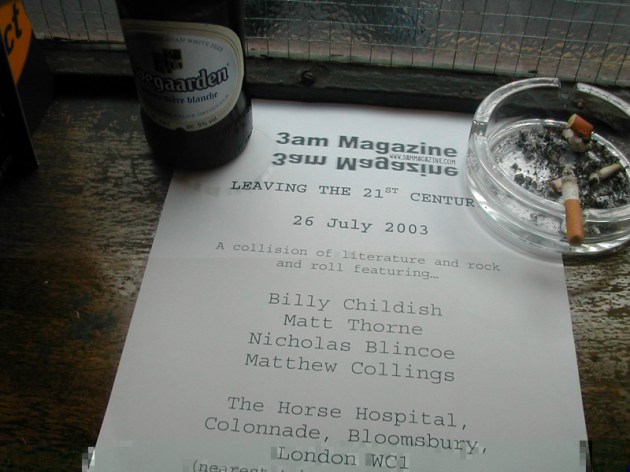
Flyer advertising 3:AM Magazine‘s ‘Leaving the 21st Century‘ gig at London’s Horse Hospital, 26 July 2003.
‘Leaving the 21st Century’, 26 July 2003.
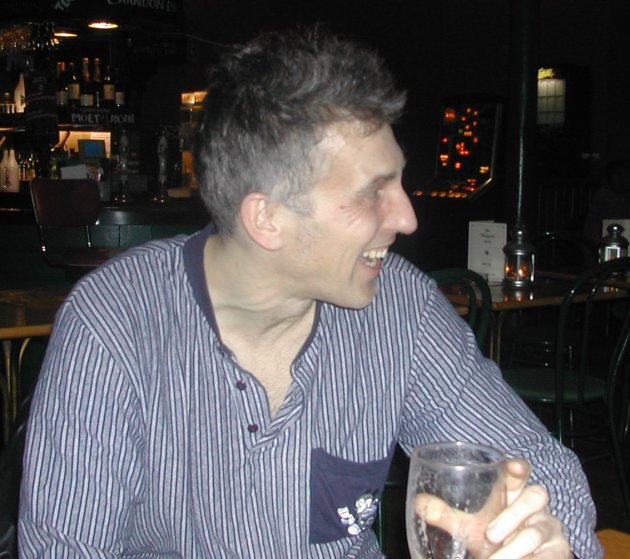
Richard Marshall, London, 2003.
Me sporting a 3:AM T-shirt, London, 2003.
Andrew Stevens at Death Disco, London, 2003.]


Pretty Vacant Or Spiky-Haired Situationists?

Empire, Kitty. “Pretty Vacant Or Spiky-Haired Situationists?” The Observer (The New Review section), 19 November 2017, p. 36.

. . . Were the art school games of canny old hippies behind punk? Sometimes, but perhaps more in theory than practice. An essay in Punk Is Dead: Modernity Killed Every Night by fanzine writer Tom Vague retraces McLaren’s appetite for destruction back through the situationists, the lettrists, psychogeography and a tiny late 60s Notting Hill faction called King Mob (a reference to the Gordon Riots of 1780).

Authors Richard Cabut and Andrew Gallix have skin in the game; Cabut is an ex-punk (“In the summer of 1977 I am 17 – perfect”) who became a playwright, while Gallix is at the Sorbonne and edits a free-ranging literary webzine called 3:AM (“whatever it is, we’re against it”). The book’s title (Modernity Killed Every Night) quotes Jacques Vaché, friend to the surrealist André Breton. But Punk Is Dead isn’t end-to-end cultural theory; there’s a lot on clothes. Three strands unfurl — papers, essays and first-person accounts. Cabut and Gallix have included historical documents — such as Penny Rimbaud’s 1977 essay, Banned from the Roxy, newly annotated by the Crass drummer — while Gallix argues that punk started ending when it acquired a name. Jon Savage is here, and Ted Polhemus and Vermorel (again).

As that list attests, punk can be a tiresomely Boy’s Own narrative, to which former Slit Viv Albertine’s 2014 memoir was a potent corrective. With the exception of Judy Nylon’s introduction and the reminiscences of go-go dancer turned drummer Dorothy Max Prior, however, this collection is let down by its dearth of female voices. Perhaps the notion to take away from both books — indeed from punk itself — is the one of endless possibility. As an interview with the punk turned philosopher Simon Critchley attests, punk unleashed ideas. It palpably changed suburban teenage futures, rather than ending them.

Punk Bashing Time

Andrew Stevens interviewed me for Creases Like Knives, 16 September 2017:

Punk Bashing Time: An Interview with Andrew Gallix

It was no less than Garry Bushell himself who wrote of ‘dreading well-meaning graduates with crops and tailor-made crombies’ in Sounds when he met with the teenaged members of ‘Skins Against the Nazis’ in 1978. Stevo had a few less hang-ups about meeting a fully-fledged Professor at the Sorbonne in Paris to go over his new book Punk Is Dead (Zero Books), which in part deals with aspects of skinhead’s troubled history among punk.

But then Andrew Gallix, who also edits the eclectic and punked-up webzine 3:AM, was a little more gracious and even-handed than some of the book’s other contributors when it came to recounting his own experiences.

You begin by taking issue with claims in “certain punk memoirs, [that] the streets of London, in 1977, were thronging with skinheads”?

Well, I was thinking specifically of Viv Albertine’s memoir — possibly the best punk memoir ever published and a truly excellent book in its own right. The dates, however, are not always totally accurate, which, to be fair, is hardly surprising given the breakneck speed of change in those days. Besides, it’s a personal memoir not a history book. I’ve just spotted an anecdote that supposedly took place in 1976 although Johnny Rotten is said to be listening to Iggy Pop’s The Idiot — an album that only came out the following year. Either the date is wrong or he was listening to another record.

In a chapter devoted to the Roxy club circa 77, Viv mentions night buses being ‘full of skinheads and drunks’, which is highly unlikely. Sham 69 started getting a strong following at the fag-end of the summer of 1977 — they were on the cover of the August-September issue of Sniffin’ Glue following the release of their first single. There was indeed already a smattering of skinheads in their midst, but it was so small they had no real visibility at the time. Teddy boys, definitely — they were all over the place. As I write in the book, I can’t recall ever seeing a skinhead in the flesh before 1978, save for intriguing pictures of Skrewdriver in the music press.

In 78-79 there were also quite a few punks with skinhead-style crops, so there was a lot of overlapping and ambiguity. The guttersnipe hanging out of the open platform at the back of a double-decker in the ads for ‘Clash City Rockers’ (1978) is clearly meant to be a punky urchin, with ‘CLASH’ stencilled on his trousers, but he also has a very short haircut that makes him look a bit like a skinhead. He’s a good example of this hybrid style that reflected a radicalisation of punk in the face of commercialisation and was due to an influx of working-class punters on the scene. Paul Simonon himself sported braces and a proper skinhead crop, complete with a shaved parting, at some point in 78.

One of the ideas I develop in Punk is Dead: Modernity Killed Every Night is that punk was haunted by its lost beginning. If I may quote myself quoting the Cockney Rejects, ‘Punk’s year-zero mentality (like all other attempts to start again from scratch) was haunted by a yearning to return to some original, prelapsarian state — back in the garage, when the cult still had no name, before they killed the fucking thing. Being born again is just that: being born again. Being borne back’. The radicalisation of the movement that led to the skinhead revival is, in my opinion, part of this quest for authenticity. Steve Jones, Paul Cook, Simonon and Weller had all been little skinheads or suedeheads.

I believe there’s another passage in Viv Albertine’s book where she talks about Mick Jones and herself being attacked by a gang of skinheads after a gig on the White Riot tour. I’ve just flicked through the book to check, but alas couldn’t find it. Once more, however, I suspect the date is wrong.

All this is very anal, of course, but I can’t help thinking historical accuracy is important; that the devil is in the (lack of) detail. Maybe it’s because it’s also my own past we’re dealing with here. Yesterday, on Soho Radio, someone was talking about seeing mohicaned punks on the King’s Road in 1977 — another common anachronism which annoys me no end.

But there’s plenty of accounts which claim that skinhead ‘came back’ at the Roxy in 1977?

It’s extremely difficult to say for sure when punk started and ended, but one possible cut-off point is the closure of the original Roxy club in April 1977. I believe Sham only played the real Roxy once, supporting Generation X — that is, Andy Czezowski, Susan Carrington and Barry Jones’ Roxy. I may be wrong, but in any event, they were totally unknown at the time and the whole skinhead thing only really started taking off at the Vortex and at the Roxy Mark 2, when the club reopened under new management, immediately becoming a parody of its previous incarnation.

The atmosphere on the punk scene grew much darker following the ‘summer of hate’, as the NME called it at the time, which had been the movement’s high-water mark. Things started going awry over the autumn and winter, culminating in the Pistols’ acrimonious split in January 1978. These are the bad days when the streets were ‘paved with blood,’ as Paul Weller sang: ‘I’m stranded on the Vortex floor / My head’s been kicked in and blood’s started to pour’.

How old were you when all this was happening? You make reference to boys around your way kitted out in skinhead clobber and the ‘prepubescent, second-generation skinheads in a black-and-white photo spread — doubtless compiled by Garry Bushell — from around 1979’.

Yes, there were little skinheads everywhere! That was in 1979, and I was 14. Skinheads were ubiquitous for a while, and not only in London, of course. Up and down the country. It was absolutely massive, not a fringe thing. Weetabix even had commercials with cartoon skinhead characters: ‘If you know what’s good for you, ok’.

What about in Paris? Who were the ‘once dodgy skinheads’ you mention in your chapter?

I’ve written two chapters somewhat tangentially linked to the Parisian punk scene. One of them is devoted to L.U.V., a fascinating all-girl phantom band; the other focuses on the Bazooka art collective. I wish I could have covered more aspects of French punk. Hopefully in a future book.

The whole skinhead phenomenon was largely lost in translation abroad. What, in an English context, referred back to London working-class culture immediately took on a more sinister, neo-Nazi complexion on the Continent. To be honest, the French skinhead scene had no redeeming features whatsoever. It produced very few bands and they were all beyond crap — initially, Parisian skins followed La Souris Déglinguée, who were not themselves skinheads.

The very first French skins may not have been racist, but they were only interested in fighting. Many of them went on to become drug addicts. The following wave, however, was almost exclusively made up of glue-sniffing fascist nutters. There were also far-left skinheads, calling themselves redskins, whose sole purpose in life was to beat up far-right skinheads. To all intents and purposes, they were the mirror image of their enemies, on whose existence their righteous identity as anti-fascists was entirely predicated.

Those I refer to in that quote are Farid and his gang: la bande à Farid. They were the most interesting on account of being the first and having, paradoxically enough, an Arab leader. As French skinheads, they had a kind of exotic cachet. There hadn’t been any in France the first time round — I understand Australia was the only foreign country to have had an indigenous scene in those days. Most of the members of Farid’s gang hailed from Colombes, a nondescript Parisian suburb. Hanging out in and around Les Halles, they thrived on gratuitous violence, relishing the fear they generated throughout the capital. I remember travelling around Paris, in 1980-81, and wherever we went fellow punks would tell us to watch out because Farid was about. He seemed to be everywhere at the same time!

When the Specials played a gig at the Pavillon Baltard, on 14 March 1980, the French skins were all wearing Onion Johnny black berets to distinguish themselves from their English counterparts. Before the gig, they beat up a mate of mine and stole the white tie I had lent him. During the Specials’ set there was a massive brawl, like in a western, between the French and English skins. You can guess who started the trouble.

Violence is something of a motif throughout the book, for instance both Bob Short and Tony Drayton cite regular skinhead violence against punk squatters (‘gangs of skinheads who would rape and beat at will’). Tony even went so far as to include a manifesto against Oi! and skins in Kill Your Pet Puppy! Did that surprise you?

It didn’t surprise me at all, because violence on the streets was a fact of life back then. If you were a punk, you attracted random abuse and aggression all the time. In 1977, it was teddy boys, football hooligans or outraged members of the general public. I remember seeing blokes stepping off Routemasters on the King’s Road to punch a passing punk, then jumping back on. One of the most famous incidents, of course, was when Rotten was razored by vigilantes. That was part of a widespread anti-punk backlash in the wake of ‘God Save the Queen’. Before that punk violence had been largely symbolic: from the Silver Jubilee onwards, it became literal.

Thereafter, it was usually members of some rival youth cult you had to worry about. The early 80s were very tribal, and there was trouble on all fronts, but skinheads were obviously the worst of the lot. After 1982, almost all the gigs you went to involved some degree of violence at some stage — it just went with the territory. On one occasion, I was walking down Putney Hill with my then girlfriend, when we noticed hordes of skinheads ahead of us on the other side of the road. We were on our way to a gig by anarcho-punk band Conflict — and so were they. Sensibly, we decided to beat a hasty retreat as it would have been a bloodbath. I actually stopped going to gigs for a number of years because it just was not worth the hassle any more.

In all fairness, that adrenalin rush that kicked in as soon as you left home was intoxicating. Boredom may have been a buzzword, but there was never a dull moment: punk really was a revolution of everyday life. After a few years, of course, it started taking its toll.

Around 1985, and still with the same girlfriend, I came face to face with another large gang of menacing-looking skinheads, this time in Brighton. The only way to avoid them would have been to turn round and flee, but I feared they would come running after us, so we walked on petrified. As we got closer I noticed that some of them were holding hands. Nobody had told me that the skinhead look had been subsumed into gay subculture.


Indeed, I noticed David Wilkinson levered in a mention of Nicky Crane’s double life in his chapter on ambivalence of queer in punk. Richard Cabut, who co-edited the book, suggests in his ‘Punk Positive’ chapter’s many dismissals of ‘glue-swamped’ Oi! by ‘lobots’ that by the early 80s skinhead (as one of three ‘tribes’) had become ‘mindlessness wrapped in a dull, grey, lazy uniform of bitterness’. You yourself give the Cockney Rejects more credit, though, i.e. splinter groups capturing original unity.

Yes, I liked Sham 69 and then some of the early Oi bands — Cockney Rejects in particular. The first Oi compilation was really great. The musical boundaries were actually very porous in spite of all the tribalism: mods would listen to punk bands, for instance, and vice-versa. By 1980-81 I was more into the Ants and the anarcho side of things, but I was interested in everything that came in the wake of the initial punk explosion. As I said earlier, the skinhead revival was essentially a response to punk’s commercialisation, as was the mod revival. If I may quote another extract from the book:

Every splinter group that joined the ranks of the punk diaspora (Oi!, the mod revival, 2-Tone, no wave, cold wave, post-punk, goth, early new romanticism, anarcho-punk, positive punk, psychobilly, hardcore etc.) was a renewed attempt to recapture an original unity, which the emergence of these very splinter groups made impossible. As Paul Gorman put it in a recent documentary, ‘People began to play with, and tease out, the strands which were therein, and it was so rich, and so full of content, that one strand could lead to a whole movement.’ When Garry Bushell claims that the Rejects were ‘the reality of punk mythology’ — which is precisely what Mark Perry had previously said apropos of Sham 69 — he is referring to a very restrictive, lumpen version of punk that excludes most of the early bands bar the Clash. (Even within the Clash, only Joe ‘Citizen Smith’ Strummer ever really subscribed to this view.) Many Blitz Kids felt that it was their scene — which was not only contemporaneous with Oi! but also its inverted mirror image — that captured the true spirit of the early movement. Each new wave of bands sought out this point of origin: punk prior to its negation by language, when it was still in the process of becoming. The moment when memory’s exile would come to an end and literally take place.

Finally, is punk really dead? And did modernity kill every night?

The original title we wanted was Modernity Killed Every Night, but the publisher probably found it a little obscure, so I suggested a series of alternatives. Eventually we settled on Punk is Dead, with the original as subtitle.

Punk is Dead works on several levels. It’s a reference to the early Crass song, which is fitting as Penny Rimbaud has contributed a piece to the book, and an oblique response to the Exploited’s ‘Punk’s Not Dead’ — which, of course, was a response to Crass in the first place. I remember Jordan, around 1980-81, pointing out that the ‘Punk’s Not Dead’ slogan was an admission of defeat. I believe this was in The Face magazine.

In fact, when punk was alive and kicking, no one used the word ‘punk’ apart from journalists who had to call it something. Using it was very uncool. In the book I argue that ‘punk died (or at least that something started dying or was lost) as soon as it ceased being a cult with no name — or with several possible names, which comes to the same thing’:

Punk — in its initial, pre-linguistic incarnation, when the blank in ‘Blank Generation’ had not yet been filled in by that ‘bloody word’ [Jonh Ingham] — was the potentiality of punk. It escaped definition, could never be pinned down, as it was constantly in the process of becoming. Punk was a movement towards itself, made up of people who disliked movements and kept pulling in opposite directions.

So the whole question of onomastics is an important one, in my view. It is related to the controversial issue of punk’s birth and death. Borges claimed that writers create their own precursors. In the same way, there is a punk spirit that people now recognise in individuals or movements that predates (and indeed postdates) punk. In this book, we wanted to highlight the socio-historical specificity of the British punk scene of the late 70s and early 80s. Punk’s influence is everywhere today, but for a whole variety of reasons it’s not the same thing as the real thing.

In 1974 Malcolm McLaren contemplated using ‘Modernity Killed Every Night’ as the name of his boutique. In the end he opted for SEX, but the slogan was sprayed on one of the walls inside the shop. It came from a letter Jacques Vaché sent to André Breton during the First World War:

Despite his bovine-sounding name, Vaché (1895-1919) was a dandified anglophile, who enjoyed walking the streets dressed as a loose woman or a Napoleonic soldier. Choosing to be an actor rather than a puppet, he subverted army life, by — as he put it — deserting within himself. There, in that Switzerland of the mind, he would pretend that his superiors were under his orders, or that he was fighting for the other side. It was gun in hand, sporting an English pilot’s uniform, and threatening to shoot at random, that Vaché interrupted the premiere of Guillaume Apollinaire’s The Breasts of Tirésias (1917) on account of its arty-farty production. Apollinaire had coined the word ‘surrealist’ to describe his play, but it was Vaché’s radical brand of criticism that embodied the true spirit of the forthcoming movement. A couple of years later, he died of an opium overdose, which may have been an accident, but is commonly regarded as a defiant parting shot to everyone and everything — the ultimate artistic statement. For André Breton — who befriended him during the war and always claimed that he was the true originator of Surrealism — Vaché was poetry incarnate. After listing his early literary influences — Rimbaud, Jarry, Apollinaire, Nouveau, Lautréamont — he added, ‘but it is Jacques Vaché to whom I owe the most.’ His stroke of genius, Breton maintained, was ‘to have produced nothing.’

Peter Rabbit is to be Found in Everything

Interview with Andrew Gallix, “The Brief: 3:AM Magazine,” Silent Frame 1 April 2017:

3:AM Magazine is a literary webzine that comprises reviews, critical essays, prose fiction, poetry, and interviews with prominent writers and philosophers. The interview responses below are given by the site’s Editor-in-Chief, Andrew Gallix. Alongside editing 3:AM, Gallix works as a freelance journalist, translator, and lecturer at the Sorbonne in Paris. He has written for various publications, including the Financial Times, The Guardian, and the Times Literary Supplement. With Richard Cabut, he co-edited and contributed to Punk is Dead: Modernity Killed Every Night (Zero Books, October 2017).

Which book would you recommend to our readers?
Remainder by Tom McCarthy. The best French novel ever written in English. It has a special place in 3:AM Magazine’s history, as we were the very first to champion it. This is where twenty-first-century literature began.

Which film would you recommend to our readers?
Berberian Sound Studio, directed by Peter Strickland, which revolves around a particularly gruesome giallo, evoked only through sound effects and snatches of overdubbed dialogue and howls — because films should be heard and not seen.

Which architectural work would you recommend to our readers?
The Serpentine Gallery Pavilion in Kensington Gardens, where Peter Pan poetically dwells — a new pavilion is built from scratch each year.

Which television episode would you recommend to our readers?

‘Episode 8’ from Series 1 of Life on Mars, directed by John Alexander — the episode where time-travelling protagonist Sam Tyler comes face to face with his young parents, and even catches a glimpse of himself as a child.

Which Mexican artwork would you recommend to our readers?
Under the Volcano, a novel by Malcolm Lowry. What I most admire about this most admirable novel is the line, ‘Everything is to be found in Peter Rabbit’.

[NB: Though an English author, Lowry briefly lived in Mexico, where Under the Volcano is also set.]

Which Serbian artwork would you recommend to our readers?
Complete Poems by Danilo Kupus, some of which were inspired by Beatrix Potter — because Peter Rabbit is to be found in everything.

Can art erase history?
No, but history can erase art. If art is a de Kooning drawing, history is Robert Rauschenberg’s rubber.

Can children make art?
Yes, but can adults?

Could art end civilisation?
No, but I suspect all great art aspires to do just that.

Is the alphabet a system of oppression?
Absolutely. Language, as Roland Barthes once remarked, is ‘fascist’. It speaks us; compels us to see things in a certain way.

Why discover?
Because the temptation to peek underneath is too great?

What question would you like to ask other Silent Frame interviewees?
What question would you fail to answer?

More to discover: You can read 3:AM Magazine here, visit Andrew Gallix’s website here, view his contributions to The Guardian here, and follow them on Twitter @3ammagazine and @andrewgallix.

Click on any of the following links to find out more about today’s recommended artists and artworks: Remainder (excerpt), Berberian Sound Studio (trailer), The Serpentine Gallery Pavilion (information), Life on Mars (trailer), Under the Volcano (excerpt).

What the Whole Thing is About

Caleb Crain. Rev. of Memory Theater, by Simon Critchley. The New York Times 16 December 2015

… In “The Phenomenology of Spirit,” Hegel imagined history as a long, bloody drama acted out by the spirit of history, which played all the characters. Critchley cleverly describes (or rather, claims that his late teacher cleverly described) Hegel’s idea of history as a moving memory theater — “a kind of proto-­cinema.” The narrator concludes that his own experiments have failed because his memory theater didn’t move, and he looks forward to a posthuman upgrade: “an endlessly recreating, re-enacting memory mechanism.” This sounds awfully like the Internet, to which it is so tempting nowadays to offload one’s more tedious tasks of remembering — and indeed, in a recent interview with Andrew Gallix of 3:AM Magazine, Critchley has admitted that the Internet is “what the whole thing is about.” Maybe it makes more sense to think of “Memory Theater” as an allegory.

Down the Tubes

Boyd Tonkin, “The Week in Books,” The Independent 14 July 2012

When a dodgy server pulls the literary plug

A couple of weeks ago, I wrote about Andrew Blum’s eye-opening book Tubes, which asks the question: where is the internet? Andrew Gallix, editor of the smart and sparky literary webzine 3:AM, has had reason to find out. His server went down and 3:AM, with its 12 years of archived articles, vanished. Who ran the server, and from where? Gallix’s quest led to Dallas, to Missouri, and to some bloke called Florin in Bucharest, Romania — the zine’s unwitting host. Florin seems to have switched it on again. O, brave new world…
[Full title: “The Week in Books: Welcome back, Ovid — for English poets, you always were the champion
Plus — in search of the internet and the true colour of fiction”]

Those Who Never Achieved Greatness

Stuart Kelly, “Stuart Kelly: Diversity Rules in Non-Fiction,” The Scotsman 13 December 2014

But my personal favourite in this genre [literary biography] has to be The Biographical Dictionary of Literary Failure, by CD Rose and Andrew Gallix, a glorious alphabetical compendium of those who never achieved greatness.

The Biographical Dictionary of Literary Failure 300dpi