
Yesterday, I was interviewed by Serena Dana for a piece on 3:AM Magazine‘s recent blackout. It features in today’s Corriere della Sera:
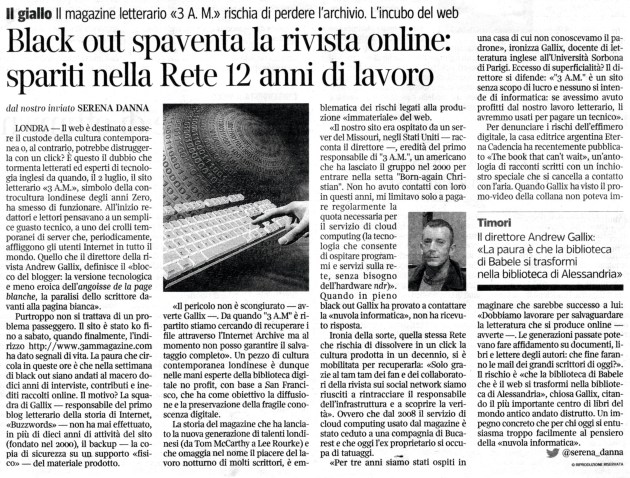
Yesterday, I was interviewed by Serena Dana for a piece on 3:AM Magazine‘s recent blackout. It features in today’s Corriere della Sera:
The Guardian‘s Richard Lea kindly asked me to write a piece about 3:AM Magazine‘s recent vanishing act. You can read it here.
Edward Champion, “3:AM Magazine — How Twelve Years of Literary Content Disappeared in an Instant,” Reluctant Habits 6 July 2012

3:AM Magazine, the first literary magazine to champion Tom McCarthy’s work and a pioneering avant vanguard that had published the early work of Tao Lin, Tony O’Neill, and Ben Myers, had vanished in an instant, with the hosting company seemingly disappearing along with it. While a substantial chunk of the magazine’s content was still available through the Internet Archive’s Wayback Machine, there was no backup. And according to editor-in-chief Andrew Gallix, the site was held together by little more than “a doctored WordPress system”.
“It never occurred to me that our server could just be switched off without a word of warning and that the owner would do a runner!” wrote Gallix to me by email. Gallix’s efforts earlier in the week to reach the host were unsuccessful. Emails bounced. The phone had been disconnected. Gallix hadn’t received so much as a notice that his valiant magazine was disconnected and no longer in service.
While Gallix had used another host for a site dedicated to McCarthy’s work, he never switched 3:AM over during the twelve years he ran the site. He had a full-time day job. He wanted to read and he wanted to write. If the server crapped out, it would find a way to resurface after a time. “I kept postponing the move in the hope that things would improve,” said Gallix.
There was no reason for Gallix to worry. Because he had experienced very few problems. “The site was down on some occasions,” said Gallix, “sometimes just for a couple of hours; at worst for a whole day: there didn’t seem to be any real cause for concern”.
* * *
3:AM began, as many literary magazines begin, with a short story. Gallix started corresponding with an American named Kent Wilson, and a website was born. 3:AM Magazine, initially a static site comprised of a handful of stories, was founded in 1999. But Wilson had an unanticipated spiritual awakening. And 3:AM, which abided by the motto “Whatever it is, we’re against it,” didn’t fit into these mysterious ways. Wilson asked Gallix to take over 3:AM in April 2000.
“We were the first to really make use of the global dimension of the web,” said Gallix. “All the editors and contributors met online, and it was only after that some of us became friends in real life”.
This commitment to friendship and passion sustained a literary magazine with a distinct and inimical tone. “While in the middle of a feverish pawing at the back-clip of her bra,” begins one typically edgy and entertaining story around this time, “I did not think much of her whispering in my ear that she could not stay for the night because she had to go home feed Satan”.
But as long as the website continued to work, Gallix didn’t rue over the technical logistics. Wilson had given Gallix the name of a host: RMIhost.com, which was run by Reece Marketing Inc. Reece Marketing Inc. was a one man operation run by Brandon Reece. And when I tracked Reece down by telephone on Friday afternoon, he told me that he was stunned that someone was still using it.
“We haven’t done hosting for four or five years,” said Reece, who sounded somewhat surprised at the news that 3:AM had vanished. “I haven’t hosted anybody’s site since 2008.”
Gallix informed me later in the afternoon that he had paid an annual hosting fee, but it was unclear whether someone had taken over from Reece. He received an email every year asking to pay for the next year. So what was RMIhost.com?
“That’s all still up there,” replied Reece. “It’s not doing any business.”
Reece claimed to not know anything about 3:AM Magazine. He said his company had once specialized in website design and had operated out of Dallas. “It was never a successful side company,” said Reece.
Reece recalled a guy named Kent when I asked him. He identified a “born again Christian,” and confirmed that this was Kent Wilson when I provided the surname. But Reece didn’t appear to know what Wilson had given him. Was it possible that he wasn’t even paying attention to RMIHost?
“I don’t ever remember hosting 3:AM Magazine,” said Reece. “I think I would know.”
Reece referred to “a server admin in Bucharest” — a gentleman named Florin — who he promised to email tonight. When I asked Reece if RMIhost had leased any particular server, he seemed baffled.
“DNS,” said Reece. “I haven’t done anything like this in a while.”
Reece was busy “looking for something new right now”. He intimated that he was in a transition period and that the hosting company had been more of an unprofitable sideline. These days, he was living on savings.
“I don’t trust my personal expertise,” said Reece when I asked him about his technical chops. “I don’t even know how to do that myself. You forget everything you do.” But he did promise to get on the case by Monday. He also allowed me to pass along his contact information to Gallix.
As for Gallix, he informed me that he had tech people retrieving what they could off the Internet Archive. But even if 3:AM manages to extract the content, he’s unsure about what “more reliable and reputable host” he’ll offload his content onto. The experience revealed to Gallix “the fragility of online content”.
It remains unclear whether Reece was playing dumb or acting in good faith. But he was willing to pass along his contact info to Gallix, even after I informed him of the significant online outcry that had followed 3:AM‘s server outage. And these efforts do represent a step in the right direction to preserve 3:AM‘s vast archive.
No matter how the 3:AM predicament works out — and there are positive signs that it will — preserving online work may very well be as dangerous as other historical precedents. Or as Tom McCarthy, reached on holiday, declared to me upon learning the news, “My first reaction is: ALEXANDRIA!”
[7/6/2012 6:45 PM UPDATE: As of 6:45 PM EST, 3:AM Magzine has been restored. Many thanks to all who helped out with this story and to Mr. Reece for following through with his promise.]
Nick Clark, “Web Hits Delete on Magazine’s 12-Year Archive,” The Independent 6 July 2012
When avant-garde literary website 3:AM Magazine went down a week ago, staff hoped it would be up and running within the day.
But they now fear that 12 years of archived material — every article they have published — may be lost for ever after it emerged those responsible for the site’s servers have vanished.
Andrew Gallix, editor-in-chief, told The Independent that the events of the past week have been “traumatic” and highlighted the “the fragility of online content”.
He added: “I never expected those who were meant to host and back up our content to just switch us off without even telling us.”
Messages of support flooded in from Facebook and Twitter for one of the original book blogs. One reader wrote: “Twelve years of writing, vanished. Here’s hoping it’s able to continue somehow.”
Mr Gallix has run the site since 2000, with the literary webzine attracting acclaimed writers including Lee Rourke, Tony O’Neill and Booker Prize nominee Tom McCarthy.
[…] As for 3:AM, Mr Gallix is trying to track down the person responsible for the servers. After a few false leads, as well as a disconnected phone and emails bouncing back, he believes he has tracked him down.
“At this stage, we do not know if we’ll ever be able to speak to him and if he can switch his server back on long enough to allow us to move 12 years’ worth of content to another, more reliable host,” Mr Gallix said. “I should have backed it up somewhere else, but it never occurred to me.”
Here is my first interview with Jon Savage. It appeared in 3:AM Magazine in June 2002:
London’s Outrage Andrew Gallix interviews Jon Savage 
3:AM: You were about 23 when punk came along. When did you first hear about it and why did it appeal to you so much?
JS: Being a pop fan from the year dot: I was a teenager at the height of the mid-60s pop explosion. Wanting to rock and there being no rock. The countdown to punk was very simple: Nuggets (1972) and Hard Up Heroes (1973) rekindled interest in the hard, mutated sixties pop that you could buy in Rock On [Ted Carroll’s record shop] in 73-75 (ie Yardbirds, Kinks, Who, Them etc). Patti Smith’s Horses. Charles Shaar Murray’s article about the Ramones (November 75). The Ramones’ first album (April 76). Television’s “Little Johnny Jewel”.
3:AM: I believe you were training to become a solicitor in 1975: did punk save you from a life of tedium like bank clerk Mark Perry, for instance?
JS: Yes. It enabled me ultimately to quit the law and enter the media — another kind of hell but not that particular kind of hell.
3:AM: Unlike Mark Perry, you graduated from Cambridge University. Did your social/intellectual background prevent you from feeling totally integrated within the new scene or, on the contrary, did it help you better understand its numerous influences and appreciate it even more?
JS: Um, I would have to say that despite the influence that those three years of University might well have had on me, you would have to place 13 years of growing in Ealing, and another 8 of being a teenager in Kensington and wandering around central London. I’m a West Londoner and was acutely aware of my pop-saturated environment. So for me not to be fascinated by punk would have been stranger. Plus there is the emotional element (oh sorry, because I have a brain I’m not supposed to have any emotions) and I was totally pissed off, isolated and alienated, in 1976.
3:AM: Why did you pick up a pen rather than a guitar? Did you ever consider forming a band?
JS: No, because to be in a band, in 1977, was to go up and down the country in a van getting spat at. I don’t think so. Plus, I was working in the lawyers’ office at the time and so was unable. Steven Lavers and I had a concept band called Para — I was Para Noia and he was Para Normal — but that’s all it was. If I had been in the same situation 12 years later (like Bob Stanley of Saint Etienne) then I would have no doubt started tinkering around with samplers. 
3:AM: When did you start your fanzine London’s Outrage? Were you directly influenced by Sniffin’ Glue? What were your favourite fanzines?
JS: London’s Outrage was done at the end of November 1976: went to see The Clash, saw The Sex Pistols, and did it in two days. I was highly influenced by Sniffin’ Glue, Who Put The Bomp, Bam Balam, and, on the visual side, Claude Pélieu and John Heartfield.
3:AM: Could you tell us about how you produced London’s Outrage, how it was distributed and how many copies you sold?
JS: 50 copies xeroxed. 1000 copies printed. Distributed through Rough Trade — the first one, I might add. All sold. London’s Outrage 2 (all photos and montage set in Notting Hill, Ladbroke Grave and Notting Dale) — only 50 copies xeroxed and sold.
3:AM: I was surprised to discover that Sniffin’ Glue actually had an office: did you also have a professional approach to your zine? Did you ever consider turning London’s Outrage into a more commercial proposition like Jamming, for instance?
JS: No. I always disliked Jamming because I hated The Jam and the whole point of fanzines was to construct a new verbal / visual language, not to ape the existing music media. I also thought Sniffin’ Glue lost its edge when it got ‘professional’. Plus I thought Danny Baker was an idiot, unlike Mark Perry for whom I have great respect.
3:AM: “Outrage” was a punk buzzword like “boredom” or “anarchy”, but why exactly did you call your fanzine London’s Outrage?
JS: It was already on the Sex Pistols’ flyer (for the Notre Dame Hall gig) that I converted for the front cover. Easy. 
3:AM: In a TV programme a few years ago, you spoke of the influence of Sheperd’s Bush on the Sex Pistols and of Notting Hill / Ladbroke Grove on The Clash: what impact did London have on the punk scene?
JS: Well, it started in London, didn’t it? This is too wide a question. The answers are in England’s Dreaming. The one thing I would say was that London was so decrepit that 15-25 year olds could leave home and squat or find cheap flats. Obviously, this is no longer possible.
3:AM: What were the punk years like for you on a day-to-day basis? Did you hang out at Louise’s [where the Pistols and the Bromley Contingent used to hang out] in the early days?
JS: No.
3:AM: Were you a regular at The Roxy [London’s first exclusively punk club]?
JS: Yes.
3:AM: Did you shop in Sex, Seditionaries, Acme Attractions, Boy or Beaufort Market [all on London’s King’s Road]?
JS: Yes. In a way that was my introduction because I shopped in Acme and must have been to Sex before I heard the British punk groups. I didn’t shop in Boy because I thought it was naff. My friend Poly Styrene had a stall in Beaufort Market, so I used to hang out there.
3:AM: Who were your favourite bands? Do you still listen to some of them today?
JS: Ramones, Sex Pistols, early Television, early Clash, The Adverts, The Buzzcocks, The Saints, Wire, Penetration, The Slits, Siouxsie, Subway Sect, The Prefects, X-Ray Spex — the distaff side. Still listen to them today, not all the time, but I still like the energy, the humour and the strong emotions. I hated The Jam and The Stranglers: ghastly retro rubbish, old information. The point about punk was that everything should be new.
3:AM: In England’s Dreaming, you claim that punk’s gay roots were hidden as soon as the movement went overground: how important were those roots?
JS: As important as they are throughout the history of popular culture and artistic movements: damn near central. Many of punk’s original participants were gay, and much of the original aesthetic was also. There is much about this in England’s Dreaming. Gay involvement in pop culture is always downplayed, if not ignored, by scared and insecure het boys who can’t admit that much of what they love comes from queers. Well it does, so get used to it.
3:AM: How did you graduate from the world of fanzines to the weekly music press, Sounds, Melody Maker and later The Face?
JS: Quick pick up of anyone on the scene who had a brain in early 1977: in my case, thanks to Dave Fudger and Vivien Goldman. For the rest of it, read Paul Gorman’s In Their Own Write.
3:AM: How did you get on with other young, hip gunslinging punk rock critics like Tony Parsons, Julie Burchill, Caroline Coon, John Ingham or Jane Suck?
JS: This is the bitching question, right? Pass.
3:AM: Much of what you have written (on Joy Division, for instance, or the intro to The Manual) is punk-related: is it still very much an influence for you?
JS: Well, obviously. It’s not like I’m sitting here with spiked up hair or bondage strides, but I do not regret any aspect of my involvement with punk at all and despise those who, in order to achieve some illusory ‘adulthood’, deride their adolescent ideals. I think that successful adulthood depends on the integration of youthful ideals with mature experience of the world.
3:AM: Where does your obsession with pop culture (from Picture Post Idols to house music through The Kinks) come from?
JS: Being a sentient being with quivering antennae in early sixties suburbia. The Beatles hit hard, and then I saw the Kinks on the telly in summer 1964 and couldn’t believe that boys could look like girls and make such an unholy racket. Compared to the other great option, sport, this mix of glamour and perceptual subversion was so much more attractive. Football: just a bunch of people in bad clothes running round in the rain, getting shouted at. I still loathe sport culture, not the sport. I was 10 in 1963, so the whole parade of sixties pop was unfurled before my greedy eyes. I couldn’t get enough of it.
3:AM: How did you come to write The Faber Book of Pop with Hanif Kureishi?
JS: His idea. A good one, as it happens.
3:AM: Did you like him as a writer?
JS: I liked Buddha, didn’t like Intimacy at all. Ultimately, we both want quite different things.
3:AM: Why do you think it took so long for punk to have an impact on British fiction?
JS: Because fiction always lags behind music. And because the literary ‘scene’ in England is SO vile. Example: when in 1975, I left university for the world, my guides were not Martin Amis or Ian McEwan, but Patti Smith and The Ramones. They told me all I needed to know, not the overhyped products of an incredibly small, and inward-looking clique.
3:AM: Who are your favourite contemporary British writers?
JS: I don’t think in these terms. All my reading is concentrated on my work which is at present located in the 1930s.
3:AM: How did the British Film Institute’s Never Mind the Jubilee punk season come about?
JS: I was asked by Hilary Smith (National Film Theatre Head) and I said yes. I knew most of the footage because of the research I’d done for England’s Dreaming and Arena’s Punk and the Pistols programme.
3:AM: What impact do you hope it will have? Punk is often seen retrospectively through the black and white photos of the music press: maybe these films will show how colourful it really was? It might also prove once and for all that there were no mohicans back in 77…
JS: Well that’s a start! I think seeing beyond the clichés presented by lame thirty/fortysomethings (example: Never Mind the Buzzcocks — a total travesty; another example, the super-straight Nick Hornby) is extremely important: punk was wild, outcast, vicious and protective at the same time. It wasn’t boring, and it wasn’t straight (I don’t mean this just in terms of sexuality, but in a perceptual sense). It did not, initially, reinforce the dominant values. So if you’re pissed off, you might pick up some tips. You might find a bunch of outcasts coming together curiously uplifting. There is, also, some great music there (and that’s where I came into all of this). Otherwise: punk is dead. It was 25 years ago: half an adult lifetime. Bye bye.
This appeared in 3:AM Magazine on 11 July 2011:

L’Homme qui arrêta d’écrire, Marc-Edouard Nabe, 2010
Marc-Edouard Nabe has always relished playing with fire, but never more so than when he burned what would have been the fifth volume of his journal. His main motivation was to avoid being trapped in a Shandyesque race with time, ending up pigeonholed as a diarist. Nevertheless, he went on to describe this event in Alain Zannini (2002), a novel so blatantly autobiographical that it even bore his real name as its title (Nabe, short for “nabot” — midget — is a nom de plume). The implication was clear: having lived his life in order to narrate it, Zannini had gradually become Nabe’s creation. What, then, would happen if the writer were to stop writing?
This ontological question is raised in L’Homme qui arrêta d’écrire (“The Man Who Stopped Writing”), which begins with the author-narrator’s paradoxical assertion — given the length of the book, let alone its very existence — that he has forsaken literature after being dropped by his publisher. “A publisher paying me to write books nobody reads,” he deadpans, “I thought this would go on for ever.”
For the best part of two decades, the real-life Nabe had received a monthly wage from Les Editions du Rocher, but this stipend was suddenly withdrawn when they were bought out in 2005. The novelist responded by taking legal action. Throughout the lengthy lawsuit, he expressed himself by means of posters, which his hardcore supporters pasted all over the walls of France’s major cities. He also maintained the fiction that his authorial days were over, so as to remain in character while secretly writing his novel about writing no more.
The appearance of L’Homme qui arrêta d’écrire thus came as quite a surprise, not least because Nabe chose to go down the self-publishing, or rather “anti-publishing”, route. The minimalist jet-black cover has a whiff of piracy about it: no barcode, no ISBN, no publisher’s name or logo; the spine remains bare. On the front, the author’s name is reduced to “Nabe” as if it had become a brand, and on the back you only find a number, indicating that it is the author’s twenty-eighth published work (and seventh novel). The book is only available through an official website and a handful of highly unlikely retailers (a butcher’s, a florist’s, a hairdresser’s and three restaurants at the last count). By cutting out the middleman, Nabe claims to be able to make a 70% profit, instead of the usual 10%, on each copy sold. The initial print run — funded by the sale of paintings (Nabe is also an artist and jazz guitarist) — sold out within a month; there have been three more since. Last year, the novel was shortlisted for the prestigious Renaudot prize — a first for a self-published volume in France — and last month, the online platform morphed into a full-blown company.
This declaration of war on the publishing industry is in keeping with Nabe’s image as an écrivain maudit. “Great artists,” says the protagonist, as Baudelaire’s Flowers of Evil manuscript is auctioned off at Sotheby’s, “have but one purpose: to become moral alibis for the bastards of posterity”. Initially accused of being a crypto-fascist (partly because of his predilection for Céline and Lucien Rebatet), Nabe is now frequently depicted as a pro-Palestinian leftist (whose anti-Americanism, it must be said, borders on the pathological). His first television appearance, in 1985, proved so incendiary that he was beaten up by a leading anti-racist campaigner. Every day, he declared — looking every inch the provocative young fogey, complete with centre parting, bow tie and retro spectacles — I shoot up with a Montblanc pen full of “utter hatred of humanity”. A great admirer of Jacques Mesrine, Nabe famously befriended the flamboyant bankrobber Albert Spaggiari as well as the Venezuelan terrorist Carlos the Jackal. Following 9/11, he produced a pamphlet entitled Une Lueur d’espoir (“A Glimmer of Hope”) and argued repeatedly that bin Laden was only acting in self-defence. In 2003, he even travelled to Baghdad, where he protested against the invasion of Iraq in typically Gallic fashion: by writing a novel. These antics may have earned him a large cult following, but Mazarine Pingeot summed up the views of many when she declared that Nabe was “unfortunately” a great writer.
Despite running to almost 700 pages, L’Homme qui arrêta d’écrire has no chapters or even paragraphs, as though it were shot in real time, like 24, the American TV series the narrator watches. If the dialogue is a little didactic — even Socratic — at times, there are far fewer purple passages than usual. This is the affectless, almost pedestrian, prose of someone who will not even allow himself to sign an autograph or compose a letter any more. The novel is meant to read as if it were unwritten. This tonal blankness (often reminiscent of Houellebecq’s) is marred on occasion by poor punning, but it can also be shot through with flashes of sheer poetry: a vintage sewing machine is likened to a “giant bee in mourning”; a brunette’s hair looks like it has been “soaked in liquid night”.
Structurally, L’Homme qui arrêta d’écrire is a 21st-century reworking of Dante’s Divine Comedy, taking us all the way from Inferno to Paradiso via Purgatorio. The picaresque plot begins when the protagonist abandons his calling, and spans seven days during which events that really took place over several years are skilfully conflated. At a loose end, the “post-writer” wanders around town and meets Jean-Phi, a young celebrity blogger who acts as his Virgil, guiding him through his post-literary vita nuova. Nabe’s mouthpiece dreams of a “literary lobotomy” that would rid him of all the bookish references preventing him from living fully in the here and now. Try as he may, Jean-Phi is unable to wean him off his old ways, and each new stroll through the streets of Paris gives rise to a digression about Raymond Roussel‘s birthplace or Proust‘s childhood haunts. However, as the days go by, and his life becomes increasingly bound up with Jean-Phi’s youthful entourage, the narrator rediscovers the pleasure of living gratuitously, without having to worry about transmuting his experiences into words. In the final pages, Mallarmé‘s famous dictum that “The world was made in order to result in a beautiful book” appears on a poster but, crucially, it has been misquoted, so that it is now the book which results in a beautiful world.
The protagonist inhabits this inverted world. Early on, he wonders if his new condition does not necessarily imply that he has himself become a character, as if a writer and his creation were but two sides of the same coin. The names of all the famous living people who appear in the novel have been slightly doctored (Depardieu, for instance, becomes Depardieux). This is no doubt to avoid lawsuits, but it also seems to indicate that they too have stepped through the looking-glass, on the other side of which they are exposed as grotesque parodies of themselves. As one of Jean-Phi’s friends remarks, a mere typo can suddenly plunge you into another universe.
One of the key scenes is a chance meeting with Alain Delons (Delon), on the seventh day. The narrator explains that he is his favourite actor because in all his major films Delon/s goes on a quest for a doppelgänger he could replace or who could replace him. The same, of course, can be said about the novelist’s entire oeuvre, which is haunted by the figure of the double. Narrator and author are as indistinguishable as ever, here, although the former is clearly an anti-Nabe, inhabiting a parallel universe where he has been defeated by his detractors. L’Homme qui arrêta d’écrire, proof of the real-life author’s triumph, is an affirmation of the truth of fiction, as well as of the virtues of unmediated life: after all, he wrote his novel by pretending not to. Give Nabe a mask, and he will tell you the truth. Just don’t ask him — or me, for that matter — who the doppelgänger is.
Zannini/Nabe once quipped that Alain Zannini — in which Zannini meets Nabe — was told in the “double person singular”. Sometimes, however, I really is another, rather than just the other half of a divided self. Although no oil painting, Michel Houellebecq is Dorian Gray to Nabe’s picture — the acceptable face of controversy. Or at least this is Nabe’s spin on events. In the early 90s, both men lived at the same address (103 Rue de la Convention in the fifteenth arrondissement of Paris) facing each other, like bookends, across a cobbled courtyard. Both belong to the same generation, come from similar lower middle-class backgrounds, had domineering Corsican mothers they rebelled against, established their reputations by courting controversy and chronicled the demise of French joie de vivre. Nabe was, in fact, the senior partner in this relationship, up until the success of Atomised in 1998.
In The Map and the Territory, which finally earned him the Goncourt prize last year, Houellebecq depicted his own murder. Nabe immediately outed himself as the culprit in the course of an interview. What he really meant is that Houellebecq had committed literary suicide, by selling out and writing a Goncourt novel. Losing the Renaudot prize, on the other hand, reaffirmed Nabe’s outsider status. Like his master, Céline, he remains untainted by recognition, alone against the world; beyond the pale. With an eye on posterity, Marc-Edouard Nabe is biding his time.
“Literary Melancholy: Lars Iyer Interviewed by David Winters,” 3:AM Magazine 15 November 2011
… For me, the truth about Montano’s sickness is that literature, what is called ‘literature’, has very little to do with our world. Something has happened. Something has come between us and the world of literature we admire. And that ‘something’ has to be acknowledged if literature is to avoid becoming a kind of repertoire routine, like The Nutcracker at Christmas.
… Much supposedly ambitious literary fiction seems to have similar characteristics. In attempting to distance itself from our marketized, neoliberalized, liberal-democratized world, it has become as stylized as bad high-fantasy. I want to read books that are commensurable with this world, in content and form, books that have abandoned a whole repertoire of literary gestures but which still, in some way, respond to what literature once was. I want to read books that make a problem of their inheritance, a problem of coming somehow after literature. I want to read books that register a sense of their own belatedness. … [F]or whatever reason, and we can speculate about this, it is not only a certain literary style, but literature itself, that is no longer believable.
… Montano’s Malady is not a lament. It is not heavy-handed, like Austerlitz. It isn’t Solemn or Serious in a kitschy way. It is swift and light. It is funny. It belongs on our side of the great divide that separates us from figures like Kafka. But, for all that, Montano’s Malady does acknowledge this divide. It does negotiate its relationship with Modernism, with the past. It does situate itself with respect to Old Europe and the ‘narrative voice’ of Old Europe’s great writers. And it does all of this in the present, in our present.
… But, for me, Robbe-Grillet’s and Sarraute’s polemics are remarkable not only for their particular prescriptions for the novel, which remain exhilarating, but also for the very fact that they felt able to prescribe a future for the novel at all. For me, their prescriptions for a new novel can only, in the end, be so many more exhibits in the museum of literature. Their essays belong to an almost-unimaginable past in which such ideas mattered, a past which had a real stake in the future of the novel.
Sometimes, I wonder whether my making claims of this kind is a result of my literary melancholy! Shouldn’t it be possible, if one only tried hard enough, to dream of a fabulously new novel to come, of a nouveau roman newer than the nouveaux romans of Robbe-Grillet and Sarraute, of an eternally nouveau nouveau roman which would always belong to the future? Mightn’t there be some fiery rebirth of the Modern in some faraway place, among writers who write new manifestos in the dream of restoring a revolutionary purity to their endeavours? But I can only say that it seems to me that literature has, in some fundamental way, run its course.
… But for me, for whom literary melancholy is not a merely personal issue but a condition of writing in our time (and this is why I admire what I have read of David Markson, who thoroughly understands this point), no novel, least of all Spurious, could be a nouveau roman, and much less a nouveau nouveau roman! My novel, like all novels published today, is a roman after the roman, a novel that comes after the novel and after literature.
“Literary Melancholy: Lars Iyer Interviewed by David Winters,” 3:AM Magazine 15 November 2011
…Perhaps W.’s and Lars’s awareness of their failure does give them a kind of ethical wisdom. On the other hand, W.’s and Lars’s awareness of failure consists in very little more than an endless acknowledgement of their failure. They do not act, like, say, Mascolo or the Italian philosophers they admire. They might know that they have fallen short of their constitutive messianism, but they have done very little about it. If they are, considered from the perspective of the tradition of the thinkers they admire, at the beginning of wisdom, ethical and philosophical, then they do their best to ruin this beginning. W. and Lars have failed — they know that. But they will only ever fail, over and over again. Every beginning is a false beginning. This is why Spurious never settles into what we would normally understand to be a plot, instead revolving over and again around the same concerns. The novel can only take the form of an endless circling around failure. It can only take the form of spuriousness…
But that might be its success. If the characters fail, Spurious, I hope, succeeds in remaining with that failure, preserving a distance between W. and Lars, and the traditions of thought they admire. ‘Since the destruction of the Temple, the divine inspiration has been withdrawn from the prophets, and given to madmen and children’, it says in the Talmud. W. and Lars are these madmen, which is to say, fallen prophets (though not false ones, perhaps). And Spurious is a fallen book of prophecy — the only kind of such book there can now be. …

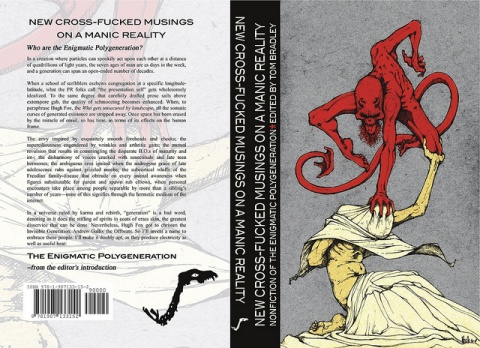
Darran Anderson briefly mentions “Dr Martens’ Bouncing Souls” in his review of the New Cross-Fucked Musings on a Manic Reality anthology (edited by Tom Bradley). He describes the story as “a bruising but graceful play on language, violence and cocksmanship,” which just about sums it up. (The review appeared in 3:AM Magazine on 27 October 2011.)
I’ve written a piece about custard-pie activism for the Guardian‘s Comment is Free section. You can read it here. An expanded version of my review of Marc-Edouard Nabe‘s latest novel appeared in 3:AM Magazine. Also in 3:AM, I talk about my summer reading list.
 ANDREW GALLIX