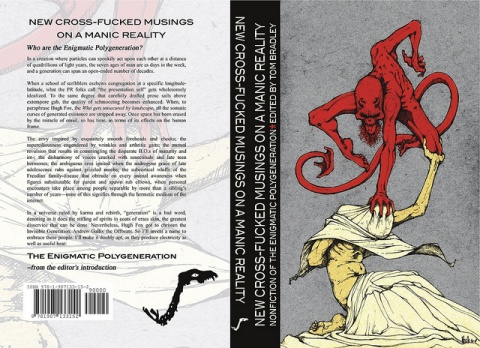
Darran Anderson briefly mentions “Dr Martens’ Bouncing Souls” in his review of the New Cross-Fucked Musings on a Manic Reality anthology (edited by Tom Bradley). He describes the story as “a bruising but graceful play on language, violence and cocksmanship,” which just about sums it up. (The review appeared in 3:AM Magazine on 27 October 2011.)
Tag Archives: 3:AM Magazine
All the Latest

I’ve written a piece about custard-pie activism for the Guardian‘s Comment is Free section. You can read it here. An expanded version of my review of Marc-Edouard Nabe‘s latest novel appeared in 3:AM Magazine. Also in 3:AM, I talk about my summer reading list.
Illicit Frequencies, or All Literature is Pirated

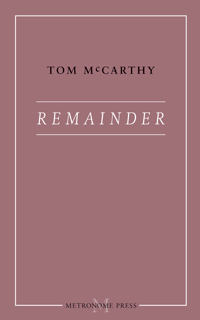
Here is my interview with Tom McCarthy that appeared in 3:AM Magazine on 13 July 2006.
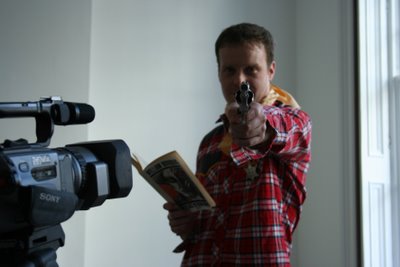
3:AM: It’s very rare, these days, to see a work of literary criticism being given such prominence. Do you agree that this is probably largely due to the fact that the main subject is not Balzac or Baudelaire — two key references here — but a comic-strip hero?
TMcC: First of all, I’m not sure I’d describe Tintin and the Secret of Literature as ‘criticism’. More as an essay. I like the idea of the essay as a primary literary form. You can trace it from David Foster Wallace through Blanchot all the way back to people like Hazlitt. But yes, the fact that it revolves around Tintin and not just Balzac and Baudelaire has certainly helped it get attention — although it wasn’t strategic to do this. I genuinely rate Hergé’s work, and wanted to read it alongside Balzac, Baudelaire, Bergson, Bachelard and all the rest, hopping from one to the other in a set of playful, serendipitous detours — which is exactly what the essay format allows.
3:AM: Your book is very much in the tradition of Barthes‘s Mythologies (an anthology which you fail to mention). I can’t remember if Barthes actually mentions Tintin anywhere, but he certainly could have done. In a way, the two figures go curiously well together: Tintin’s heyday corresponds roughly to that of Barthes and both, today, appear a little quaint. Was it Barthes who inspired this book? After all, your Tintin is primarily a semiologist who “can navigate [a key word in the McCarthy canon] the world of signs” (Tintin and the Secret of Literature p. 22), a deciphering cipher who embodies (along with Snowy?) the presence of absence — the Melvillian “whiteness of the whale” (p. 161) — but also, of course, Barthes’s “écriture blanche”.
TMcC: I do kind of mention Mythologies when I refer to wrestling and tomato tins early on in the book. I love Barthes: he’s a beautiful, generous writer. He never mentions Tintin directly as far as I know, although Derrida, another big presence (or present absence or whatever) in my book, does, glancingly, in The Post Card. Hergé read Barthes; you can see his influence very directly in the final book, Tintin and Alph-Art, in which language becomes a set of physical signs, giant letters which are held up and scrutinised by his characters.
ODETTE’S BITS
3:AM: Are you the first to draw a parallel between Sarrasine and the Tintin corpus? I haven’t read Balzac’s novel, but, from what you write, La Zambinella seems to bear a resemblance to Proust’s Odette de Crécy. Am I mistaken?
TMcC: As far as I know I am the first to draw a parallel between Tintin and Sarrasine. I re-read Barthes’s S/Z, which turns around that particular novella, initially because I wanted to write about Hergé’s total mastery of plot: the way he misdirects, doubles, occludes, jams and so on, all these devices Barthes describes so well in his take on Balzac. But as I did I realised that there were loads of points of correspondence between Sarrasine and the Tintin books. Balzac’s eponymous artist becomes obsessed by the opera singer la Zambinella, like Captain Haddock does with Bianca Castafiore; he copies her, like the sculptor Balthazar does the fetish in The Broken Ear; he’s murdered, as is Balthazar; the copy is copied and these copies are themselves copied, in both. Fundamentally, it’s about entering the realm of denatured simulation that is art. La Zambinella’s voice draws Sarrasine backstage, into a world of artifice, just as la Castafiore’s voice draws Haddock backstage and on into a world of inauthenticity. And these worlds prove fatal: the castrato la Zambinella effectively kills Sarrasine, and ultimately the not-really-pubescent Tintin effectively kills Hergé.
With Proust, I’ve got to admit I’ve never got as far as the Odette bits in the Remembrance. There are passages I find completely compelling, like the bit about how you can construct a composite memory of a house from various other houses you’ve known or read about or seen in pictures (which is more or less what my hero does in Remainder, but other bits lose me, and I put it down again for two years, then re-read as far as the house bit, then same again: a kind of incomplete repetition loop. Perhaps that’s what Old Marcel would have wanted.
ILLICIT FREQUENCIES
3:AM: Given that the literary status of the Tintin books is uncertain/debatable, isn’t it a little perverse to analyse them in order to uncover the “secret of literature”?
TMcC: Yes — and that’s why I wanted to do it. It would be easy to identify literary motifs in Faulkner or Dickens or someone. But what does it tell us when a corpus that makes no claims to being ‘literature’ displays a symbolic register as developed as Faulkner’s and characters as deep and rich as Dickens’s, not to mention themes and plots more or less identical to Sophocles’s and Shakespeare’s: the fall of the noble house, family secrets coming out into the open, the relation between host and guest gone disastrously wrong and so on? So much of the very best literature opens up illicit frequencies so that meaning can travel along channels other than the obvious or rational. The Tintin books are full of these frequencies, these channels; they even dramatise their setting up, hunting down, rumbling and relocating. And then it struck me that literature as a whole might hide its most intimate secrets in the most illicit of all zones, one tucked away ‘off-stage’, ‘aside’, below the radar of literature proper, which is of course the kind of zone that cartoons lurk in.
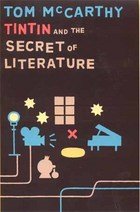
3:AM: Could you tell us about the cover of the book and Tintin’s absence from the illustrations inside?
TMcC: The cover is by Jochen Gerner, a French artist. I saw a book he’d done called TNT en Amérique, in which he buried the whole of Tintin in America under black ink but left a few symbols, mainly of money, divinity and violence (i.e. dollar signs, crosses and guns, all done in cartoony style) as markers for what he’d erased — all on the correct pages, corresponding to frames in the original book. So I contacted him and asked him to do the cover, and he was really into it. We looked at the main motifs in The Castafiore Emerald — the window, the piano, the cameras and spotlights that, ultimately, occlude more than they reveal — and he applied his technique (which, after Bataille, he calls ‘déformation’) to these. And in the foreground, as on Hergé’s, the tufted figure with his finger to his lips, saying ‘Shhhh!’ — what in the book I call “the condition of the secret become visible”.
To answer the second part of your question: I didn’t want images directly from the Tintin books inside my book. I was more interested in showing how these images (which I’m assuming most people who read my book will be at least slightly familiar with) mutate into and out of other ones: eighteenth-century portraits of castrato singers, stills from Buster Keaton films and, not least, ‘detourned’ versions of the Tintin books themselves. These last images break down into political activist ones, pornographic ones and ‘art’ ones: an interesting triangle.
THE BOY HAIRDRESSER
3:AM: Given your chapter devoted to “Castafiore’s Clit” (if you ever form a band, promise me that you’ll use that name) and your comments about Tintin’s androgyny, I was surprised you didn’t devote at least a few lines to the once-ubiquitous gay Tintin haircut…
TMcC: A band called Castafiore’s Clit is a great idea. Kind of Jane’s Addiction meets The Thompson Twins. Yes, it’s funny that Tintin has lent his haircut to gay culture. I found out recently that the Rocker quiff of the Fifties was taken directly from Jean Marais’s haircut in Cocteau’s Orphée, another big presence in my book.
THE SINS OF THE FATHER
3:AM: During the Second World War, Hergé had no qualms about publishing his comic strips in Le Soir, a newspaper that was under Nazi control and had clear Nazi sympathies. Interestingly enough, as you point out, Paul de Man also wrote for Le Soir. However, I was surprised that you did not make more of this coincidence. Paul de Man’s undermining of meaning and values having been reinterpreted (and partly discredited) in the light of the posthumous discovery of his youthful far-right views, should not we also be somewhat wary of Hergé’s “retroactive wiping-out of history” (p. 41), the erosion of Rastapopoulos’s “Semitic status” (pp. 44-45) or his reinvention as a “liberal leftist” (p. 46)? After all, anti-capitalism and anti-consumerism which, in your view, testify to the author’s “right-to-left trajectory” (p. 47) are common tenets on the far right as well as the far left…
TMcC: I never went with the argument that Paul de Man’s shameful youthful secret undermines all of deconstruction (is Derrida, a Jew, a secret anti-Semite too?), not least because when I was at university one of this argument’s main advocates serially harassed his female students while simultaneously espousing feminism, which for me kind of discredited anything he had to say. Yes, the anti-consumerist thing can serve a right-wing position as much as a left-wing one, and I point out in the book that Hergé kept the same villains in place throughout his career (secret cabals, men in hoods). But I think his right-to-left trajectory was a genuine one, as was Paul de Man’s. Things are connected. Fascism is a moment that the twentieth century goes through, in the arts as much as anywhere else. Think of Yeats, Spengler, Hamsun, Pound, Céline — brilliant and hugely influential writers who were fascists. Do we discount anything that’s come after them? Of course not: you trace the fallout of the disaster, how it mutates and develops. Think of Heidegger, a one-time Nazi out of whose thought the incredibly compelling ethical vision of Levinas (another Jew) has emerged. Anyway, it would be naive and liberal to want all our artists to be nice Guardian readers. Some people are arseholes. And another thing: Paul de Man doesn’t undermine meaning and value — just certain tired and reactionary notions of both.
[Just for the record: I didn’t mean to imply that Hergé’s, Céline’s or Yeats’s works should be rejected because of their political views, although I clearly gave that impression. Like Tom, I subscribe to a resolutely politically-incorrect conception of literature. My point simply concerned anti-capitalism and anti-consumerism (which the far left certainly has no monopoly over) along with the fact that certain thinkers’ seemingly-rational ideas are so obviously linked to individual history (Maurras’s deafness or Foucault’s masochism, for instance) that one should sometimes approach them with a little caution. Another issue we could have raised here is the Arendt-Heidegger relationship, but that would probably have been one serendipitous detour — to quote McCarthy — too many!]
FOUND IN TRANSLATION
3:AM: Remainder — the best novel of 2005 which, due to its republication by Alma Books, looks set to be the novel of 2006 (ironically enough, given the theme of the book) — could be described as the best French novel ever written in English by an Englishman. With Tintin and the Secret of Literature, your approach is once again resolutely French. Almost all of your major references are French (Balzac, Baudelaire, Barthes, Derrida…), and even the vocabulary you use is Gallicized (“fictive,” for instance, which is far closer to the French “fictif” than “fictional”). Where does your familiarity with French culture and the French language come from? Was it deliberate on your part to largely avoid references to British or American literature? Wouldn’t it have been interesting to give a more English perspective on Tintin since Tintinologists have a habit of being Belgian or French?
TMcC: First of all, thanks for your kind words about Remainder, and I’ll try to persuade my French publisher, Hachette Littératures, to use your “best French novel in English” line as a blurb for their edition that’s coming out next September — I couldn’t think of better praise! Yes, most of the points of reference in Tintin and the Secret of Literature are French, although Defoe, Bunyan, Behn and other Anglo early novelists get a look in — plus there’s a big digression through Shakespeare’s Sonnets. I guess I just really like French literature. The English were going really well from the sixteenth to the nineteenth centuries, producing poets like Donne and Marvell and novels like Clarissa and Tristram Shandy, but it all went horribly wrong somewhere in the late nineteenth/early twentieth and, while the French (and Americans) embarked on the wildest adventures with thought and form — Mallarmé, Breton, Cendrars, Faulkner etc etc — we got Thomas fucking Hardy and DH fucking Lawrence. The only top-class twentieth century English writers are the ones we claim spuriously: Americans like Eliot and James, Poles like Conrad, Irishmen like Joyce and Beckett…
3:AM: At the same time, there is a sense of humour and earthiness which are very un-French, as it were. After the publication of a strange review in The Economist which presented your book as a send-up of French theory, you spoke to me of the astounding “idiocy of English empirical culture”: do you think Tintin and the Secret of Literature is going to reignite the critical Querelle des Anciens et des Modernes of the 80s and 90s?
TMcC: I think to ignite any thought at The Economist you’d need to stick a ton of semtex up their arses. That review was quite funny, though: it perfectly captured the red-faced, vein-popping fury of Little England once the values on which it bases its entire identity are ever-so-slightly “solicited”, as Derrida would say. English takes on Tintin always present Hergé as a ’satirist’ and only that: a self-sufficient, rational subject who uses words and images as tools to tell us something he knows because he’s worked it out, rationally, you see. That’s the empirical line on literature tout court: the rational expression of a self-sufficient subject — as though we weren’t constantly made and unmade within language, desire, history, symbolic networks and so on. It’s as moronic as crediting a surfer with creating the wave which carries him and allows him to ply his craft — and back into which he’s eventually going to sink.
McCARTHYISM
3:AM: You say that you were introduced to Tintin by your mother at the age of seven. That, in itself, probably says a lot about your social background — that and your early encounter with Hugo Williams (mentioned by the poet in an article he wrote in the TLS about your International Necronautical Society). In France, in the 70s, Le Journal de Tintin tended to be read in Catholic and conservative circles whereas kids from Communist families usually read a comic called Pif. What sort of social and cultural milieu were you raised in, Tom?
TMcC: I come from a liberal arts-steeped middle-class family. My mum would tell us the stories of The Odyssey and The Merchant of Venice on car journeys. My parents were left-ish but not radical. They voted Labour but I went to a private day-school from the age of twelve.
3:AM: You write that “Everybody wants to be Tintin,” but I get the feeling that that everybody applies, first and foremost, to you. You even bear a slight physical resemblance to Hergé’s hero…
TMcC: I went to a fancy dress party dressed as Tintin once…
3:AM: Susan Tomaselli rounds off her review with the claim that Tintin and the Secret of Literature made her feel like re-reading Remainder (your debut novel) rather than the Tintin books themselves. Do you see this as a success or a failure?
TMcC: Success — although she should read the Tintin books too. In a way, I used Tintin and the Secret of Literature to work through some of the themes in Remainder in a more conscious way: the relationship between trauma and repetition, for example, or the idea of inauthenticity which emerged from the de Man essay “The Rhetoric of Temporality”, which I hadn’t read when I wrote Remainder even though it could almost be describing that book. It’s great to be able to switch modes, and come at the same territory from a different angle.
WE WANTED TO BLOW UP TIME ITSELF
3:AM: Your whole oeuvre seems to be contained within this critical essay: Tintin and the Secret of Literature could thus be read as a work of internal intertextuality. First of all, there’s the importance of meridians which points to Greenwich Degree Zero, your recent artistic collaboration with Rod Dickinson…
TMcC: …when we blew up the Greenwich Observatory, or at least produced the documentation of having blown up the Observatory, completing the task of Martial Bourdin, model for Conrad’s Stevie in The Secret Agent. We wanted to blow up time itself. Funnily enough, there’s a scene in The Broken Ear where a secret agent like Stevie carries a time-bomb around and gets blown up by it because he doesn’t realise the town clocks have broken. I love the sequence in The Sound and the Fury where Quentin carries a broken clock around and rides trams in different directions in a sub-Einsteinian attempt to escape time — then dies…
WE WANTED TO BLOW UP BRIDGES
3:AM: Then you’ve got the references to Cocteau’s Orphée and, more generally, your fascination with the “transmission-reception figure” (as you put it elsewhere): “[Tintin] will also be aware, as a radio operator, that the waves which carry his transmissions will travel outwards endlessly through space. Who knows where the signals will end up, or what they will end up meaning?” (p. 91).
TMcC: If I had to select five things to put in a space capsule to show aliens what we were capable of, Orphée would be one of them. It’s the most perfect piece of art, which lays out our existence as being in relation to death, technology, transmission-reception and desire — not to mention repetition. Death, a beautiful princess (and arts patron) falls in love with Orphée so she has another poet snatched to the underworld so he can send illicit, looping radio messages to Orphée which draw him towards her, through a mirror. Cocteau based his radio messages on the ones sent to occupied France during World War Two: these short lines of poetry. Most of them meant nothing, but one in every two hundred meant — only to those who knew — ‘blow up the bridge’. A man or woman in London reads a line of poetry into a microphone and in France a bridge blows up — or not. Poetry — real poetry — should harbour that potentiality somehow.
3:AM: You talk about Alph-Art, the eponymous avant-garde movement of Hergé’s posthumous book, which is “a cover for a giant forgery operation” (p. 158). Couldn’t this also be a fitting definition of your own “semi-fictitious” avant-garde movement, the International Necronautical Society?
TMcC: The INS had its own radio transmission network, operating out of the ICA two years ago, generating messages like Cocteau’s and actually transmitting them over the radio London-wide (and, via collaborating radio stations, world-wide). It looked like a giant factory floor, with workers running everywhere carrying lines of text — lines which, having been plucked from other media sources, were kind of second-hand if not fake. The INS is itself semi-fake, as you point out. Although the fake can hide the real.
THE UNNAMEABLE
3:AM: On page 84, you explain that, according to Freud, trauma produces “a desire for repetition mixed with a need to disguise the scene being repeated”. Could you comment on this sentence with reference to your novel Remainder?
TMcC: It’s not just Freud who says this: even his most positivist counterparts concur. Under ultra-extreme stress, the part of the mind that processes raw data into the narrative thread we call ‘memory’ simply goes on strike and refuses to process. It’s called ‘dissociation’. So the data’s present, but not dealt with, and therefore keeps bobbing up and demanding to be incorporated somehow. As it can’t form part of normal memory, it plays itself out in weird ways — ones that contain elements of the original event but are also scrambled, disguised. And it will keep repeating, albeit in modulated form, until it is accommodated properly. Well, in Remainder the hero has undergone a traumatic event which he hasn’t retained as straight memory but rather as fragments of data: the sense of being about to be hit, blue lights, railings, being held above a tray or bed and so on. These induce a propensity to repeat stuff in him. Another interesting thing about post-trauma is that (to return to a motif we touched on a moment ago) it makes people feel inauthentic, fake, because everything is of a lesser magnitude of experience than the trauma-moment itself, the only ‘real’ thing. And then the subject back-projects for himself a time when he wasn’t fake, and longs for that time. That’s what my guy is doing with his re-enactments: repeating backwards to an imagined era of authenticity — but repeating, more accurately, towards the trauma-moment itself, the true, unnameable moment, the moment of truth and unnameability itself.
THE CHINK ON THE CARPET
3:AM: The re-enactments in Remainder or in your artistic work: mimesis or simulacrum?
TMcC: Aha: very good question, bang on the money. In Remainder, he wants the authentic, so he sets up a zone of mimesis, paying architects and designers to recreate his ‘remembered’ building and re-enactors to ‘be’ the lady he remembers frying liver on the floor below him, the pianist he remembers practising Rachmaninoff and so on. He wants to accede through these re-enactments to a mode of authenticity, of simply ‘being’ rather than simulating. But of course it doesn’t work: the re-enactments tend more towards the status of simulacra, what Plato defines as ‘a copy without an original’. But then, paradoxically, the most jarring and obviously inconsistent things, the ‘extra’ bits, the ones with no originals of any type at all, are what catapult him into ultra-authenticity — which, not coincidentally, is also pure violence. It’s the little chink on the carpet of his re-enacted bank heist that flips the whole re-enactment over into all-too-real-ness, when the re-enactor trips on it, or rather on its absence, and his gun goes off…
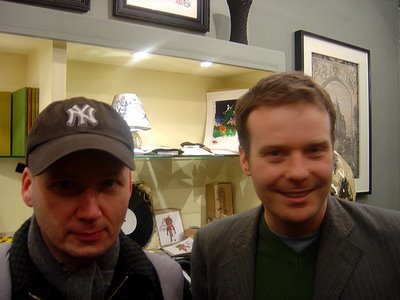
[Stewart Home and Tom McCarthy at 3:AM Magazine‘s Xmas Bash, London 2005]
THE CRACK IN THE WALL
3:AM: Barthes writes that “…the ‘realistic’ artist never places reality at the origin of his discourse, but only and always, as far back as can be traced, an already written real, a prospective code, along which we discern, as far as the eye can see, only a succession of copies” (quoted on p. 55): this is also, unwittingly, what the protagonist of Remainder does, right?
TMcC: Remainder has been read by some critics as an allegory of realism and of the realist mode of art, and this isn’t an entirely wrong reading — although if the hero had actually been an artist rather than an Everyman, some bloke, it would have been an entirely different, and inferior, book. But yes, it definitely turns around his copying, and even (as he sets about getting his re-enactors to re-enact the moments when they prepared for the previous re-enactment) his copying his moments of copying, endlessly regressive. We can try to work it out together, but ultimately I can’t give the definitive schematic meta-reading of the book any more than you — perhaps less. It was intuitive: I was looking at a crack in a wall and had a moment of dejà-vu and wished I had loads of money to re-enact this moment and there was the novel.
EVERYTHING LITERATURE SHOULD BE
3:AM: When discussing tobacco throughout the Tintin books, you explain (following Derrida) that it “goes up in smoke” but “also leaves remains, ashes, which maintain symbolic links to memory, death and inheritance. Baudelaire’s story takes off from the change left over from the two friends’ luxury expenditure: like the coin itself, it proceeds from the remainder” (p. 135). Why are remnants so important in your work?
TMcC: It’s what’s left. After the disaster, after thought, interpretation, writing itself. It’s like when Wallace Stevens says “The plum survives its poems”. Writing has to deal with this remainder, and good writing has to deal with the fact that it can never fully deal with it. Francis Ponge knows this. He writes brilliant prose poems about, for example, oranges: the texture of their cells, the way they leave goop on your hands so that even when you’ve ‘expressed’ them there’s a residue that’s not contained. If Susan Tomaselli or anyone else really want to do themselves a favour, they should re-read neither Remainder nor the Tintin books but rather Ponge’s Le Parti pris des choses (you can get it in dual text). It’s everything writing should be.
[This interview was initially posted here.]

Spank for England

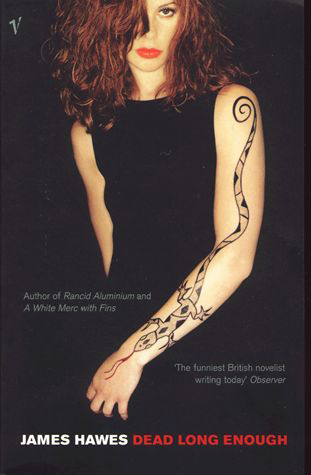
Here is my interview with novelist James Hawes, published in 3:AM Magazine in April 2005:
3:AM: When you burst onto the literary scene in 96, you already seemed to be a fully-formed, fully-fledged novelist. Tell us about your writing apprenticeship.
JH: I wanted to be an actor and playwright, but I was useless at both and thus managed to end up totally lost, broke and CV-less at 27, living among smackheads, crims and slumming-it trustafarians just as the Loadsamoney late 80s were starting. I knew I couldn’t last in that world, so I went back and did a PhD, which meant I got a grant to live on (ah, lost days) and a name-tag for my life. For the next seven years I quietly close-read Kafka, Nietzsche, Mann, Musil, Hesse and suchlike. I did it seriously and straight: by 1993 I was quite a respected Young Academic, but I was also trying to write again, this time a novel. In hindsight I suppose it looks as though I half-consciously made myself a bubble where I could be paid to dissect serious writers and see how they did it. But then we all have PhDs in Hindsight.
3:AM: A White Merc with Fins was part of that whole finger-on-the-pulse-of-the-zeitgeist post-Trainspotting chemical generation/lad lit wave. Were you influenced, or at least inspired, by Irvine Welsh or any of those writers?
JH: I didn’t know anything about them. I was still working full-time as a teacher of German lit. I knew almost nothing about Eng. Lit in general (I had never read anything by Martin Amis except Money or by Ian McEwan except his first story-collection, and still haven’t). When my younger, cooler Manchester brother heard I was trying seriously to write, he sent me Trainspotting, but by the time I read it White Merc was finished and sent off to my agent. When I read it I loved it and was jealous as hell. You could tell straight away that unlike most so-called “young gunslinger” Brit writers (see next question(s)!) Welsh was not a posh North London day-school/olde grammar-school/Eton boy slumming it.

3:AM: The consensus at the moment is that Speak for England is your first truly serious work (Alfred Hickling wrote in The Guardian that you have “filled out into a comic novelist of considerable stature”) after starting off as a hip young gunslinger in the Bret Easton Ellis/Welsh mode. I think it’s becoming increasingly clear that you’ve been sending up the zeitgeist all along à la Kingsley Amis or Evelyn Waugh (who you recently described as the “only English writer” you “read and re-read for sheer pleasure”). Is the angry young man turning into a middle-aged fogy? Are you in the process of doing a John Osborne?
JH: I don’t think my writing was ever “angry” in that way. Or “young”, come to think of it. The hero of White Merc was quite explicitly a middle-class boy knocking on 30 who really only wanted “a flat with tall windows” but had gone adrift. The book took the piss out of “alternative” IRA groupies, smackheads, hippies and suchlike. I love Waugh for the LACK of foregrounded psychology in his writing — a satirical tactic which (bizarre though it probably sounds to Anglo-Saxon ears) he shares with Kafka. As for Waugh’s snobbery, see later answers…
3:AM: As Toby Clements points out in The Telegraph, the narrator’s allegiances seem to be divided in your new book, Speak for England. To what extent were you — the author — seduced by the reactionary lost world Brian Marley encounters? I mean, even if your intent is clearly satirical, it must have been quite intoxicating — liberating, even — to write the unwriteable by envisioning the Empire literally striking back, Britain withdrawing from the EU, the public humiliation of the PM’s “Best Friend” etc.
JH: Writing satire is a way of having your cake and eating it. For example, anyone who reads Brecht can hardly miss that the supposedly Bad Guys, the wicked capitalists and chancers, get all the best lines and laughs. And the more you know about Brecht himself the more clear it is that these characters are far closer to his (concealed) heart than the Good Persons. Then again (cf Waugh, too), as Nietzsche says: “What do we care about the ORIGIN of a work? The artist is only the soil and the earth — sometimes the dung and shit — from which the WORK grows!” (fx: insane cackling).
3:AM: Your analysis of the psycho-sexual roots of power is fascinating. If we “are all forever small children”, as Carl Jung surmises in the epigraph to Chapter Three (Speak for England, 95), the past is “the only real home we shall have” (ibid 335) and, consequently, we all want to go back in order to go back home. In Speak for England, the past literally comes home. The protagonist Brian Marley — who is stranded in Papua New Guinea after taking part in a Survivor-type reality game show called Brit Pluck, Green Hell, Two Million — stumbles upon a corner of a foreign jungle that is forever England, created by the passengers of a plane crash which happened in 1958. The Colonists eventually return to Britain where they reintroduce no-nonsense Fifties values. Your academic work on Nietzsche must have had some bearing on this hankering after authority (“the ultimate perversion is repression,” 315) which drives the National Government’s counter-revolution.
JH: Yes, Nietzsche is fascinating on the psychology of power and I did a lot of work on Kafka/Nietszche in that light, so no doubt it filtered in. But even more so (and more importantly for Speak for England), he’s a master of insight about our crippling need for structures of belief and certainties — as he famously says “man would rather will nothingness than not will” — meaning that we tend to embrace (any old) system of thought that can deliver “Certainties”, at almost any price, rather than face the uncharted oceans of modernity. Today that insight is more serious than ever — it exactly explains the triumph of Muslim Fundamentalism in Iran, for example.

3:AM: You get a lot of mileage out of the past/present dichotomy. The scene in which the Prime Minister’s “Best Friend” is “seen live on TV, by about half a billion people, being caned thoroughly on his naked backside by an elderly gentleman while handsome, bronzed youths with ancient rifles and big shorts stood about and laughed at him” (254) could be innocent enough in a Boy’s Own story, but has strong S&M/homoerotic connations for us. Likewise the depiction of the PM’s Press Secretary being tossed, stark naked, in the Union Jack by sixth formers while a beautiful young lady looks on “holding her hips and shaking with laughter” (249). Could you tell us a bit about that?
JH: The bizarre thing about the 50’s was that in certain circles (i.e. ex-public school, theatrical, cinematic) people were openly gay in a way that has only become more generally possible in the last ten or fifteen years. To be honest, my conscious intentions in the above passages were simply Broad Comedy — but what do our intentions matter when it’s a question of subconcious enactments…
3:AM: If we are “all forever small children”, the childhood we long for only ever really existed in books — the kind of books which created our notion of childhood in the first place. Brian Marley (whose name advertises its own literary nature) has a Proustian moment when he rediscovers his 1965 Eagle Annual which strikes him as more real than reality itself. Speak for England often resembles one of those Disney films which mix flesh-and-blood actors with animated figures. The Colonists, for instance, seem to have stepped out of a typical Boy’s Own story: significantly, they use a toy Dan Dare radio station to make contact with the modern world. There are even two references to the Famous Five, one of which is made by a female character called George! So when people like Clemency Burton-Hill (whose name could come straight out of your book!) criticise the “dismal cliche” of the dialogue, they overlook the whole metatextual aspect, don’t they?
JH: Couldn’t out it better myself. How else would these characters talk? The whole point is that our Hero free-falls easily into that clipped, anti-emotional, impersonal, oh-so “English” mode — as a grateful escape from the pressures of Individuality.
3:AM: This childhood nostalgia can be likened to “a warm homecoming to something we have never truly known but yet missed all our lives” (28), first of all because it is fictitious, but also because the childhood depicted in most children’s books is an upper-class or at least very middle-class one. The same can be said about notions of Englishness which are also class-based. Do you think there is a link between these two notions of childhood and Englishness?
JH: Absolutely. There’s a striking difference between England and America here that goes all through cinema, especially U.S. depictions of “the golden times of youth” or whatever are always (right from Citizen Kane) small-town, close-to-the-soil, classless. Ours are Edwardian upper-middle. And in every U.S. film, the Hero has to prove his blue-collar cred (even if he’s a bigshot lawyer or the President himself) by e.g. smacking a baseball out of sight. Whereas in the UK we seem happy to accept Hugh Grant’s dithering shtick as “normal everyday Englishman”. Pinter marries into the nobility, Scruton goes hunting: to a middle-class Englishman there simply IS no other model of success than a mad sub-Austen Georgians At Home fairytale.
3:AM: Speak for England — which is partly a robinsonnade — is often reminiscent of Robinson Crusoe. Like Robinson Crusoe, the Colonists have recreated the society they came from in the middle of nowhere. Like Robinson Crusoe, Brian Marley’s problems stem from his relationship with his father (Robinson disobeys his father; fatherless Brian is in thrall to the Führer-type Headmaster, the ultimate father figure). Robinson Crusoe’s inability to accept the “middle Station of Life” is mirrored by Brian’s desire to become a “real Englishman”, ie a member of the upper-classes. The difference between the two novels is that Robinson Crusoe marks the triumph of middle-class social climbing whereas in Speak For England there is a constant distinction between becoming and being.
When Brian Marley thinks he is dying in the jungle and wishes to record a last message for his son, he cannot find his own voice. As a member of the lower middle-classes, he has no voice, no identity: being lower middle-class is a transitional state. But as you show in several of your works, the upward-mobility associated with the post-war consensus has disappeared leaving only frustration in its wake. People like Brian Marley struggle through their mediocre, ersatz lives (fake mail-order Agas!) with the nagging feeling that they are “below their imagined station” (80) and are denied “the unreflective joy of unthinking union” (222) which is shared by the working and upper classes. Tell us more about this opposition between becoming (the aspirational lower middle-classes) and being (“A caveman, that would be real”, 21).
JH: I have honestly not seen this “being” vs “belonging” business before (as an ex-academic I think I have to almost consciously repress the awareness of intellectual substructures in order to preserve any life and freedom in my writing) but you are quite right. Hmm. Yes, the salient facts of the middle-class are its very MIDDLE-ness (i.e. its lack of any “authentic” aspects) and (as Marx pointed out) its dynamism. Its relations with the Working Classes are a mixture of disdain, fear and envy, while the Upper Classes are objects of secret outrage mixed with public fawning. To my Hero’s mother’s generation the vision of “oak trees growing out of the ruins of Buckingham Palace” still implied a sort of Good Old Uncle Joe All Them Cornfields And Ballet In the Evenings left-wing project: but that Lower-Middle Radicalism is, in the saloon-bars of today, more often part of something very different: “get rid of the Posh Wasters (the Queen herself alone excepted), dismantle social security, do-gooding and multiculturalism, smash the unions, kick out the asylum seekers…”. And never underestimate the dynamism Marx spotted: we are facing what Brecht said we should dread — interesting times.

3:AM: As befits any novel about Englishness, class plays a central part. Your characters often sleepwalk through life, forgetting that “this is not a rehearsal” (Rancid Aluminium, 29), prolonging the “long vacation of extended adolescence” (A White Merc with Fins, 19), in order to maintain “the helpful fantasy that their true lives still lay in the future” (Speak for England, 80) until they make a last-ditch attempt at saving themselves by doing “something radical” (A White Merc with Fins, 22): robbing a bank, say, or taking part in an extreme reality TV show. Before reaching the end of his tether, the protagonist of Speak for England, Brian Marley, teaches English as a foreign language and flees “to some new foreign country” whenever “things get too tough or too real” (Speak for England, 41) because “moving about lets you kid yourself you are moving on” (A White Merc with Fins, 70). Countless authors of your generation have depicted the nihilistic slackerdom of the idle rich or its lumpen variety, but nobody else has dissected the “pre-emptive strike on living” of the lower middle-classes with such deadly accuracy. Would you agree that this is your great theme, and do you see it as a particularly English phenomenon?
JH: I think it’s my great theme because I’m English. Nietzsche again: “We are all just organ-grinders with only one tune, but eternity itself turns the handle”. I went to Oxford in 1978 from a rural comp like some mad innocent with a straw in his mouth, four years behind the fashion and quite literally having never met a boarding-school boy in my life. I found that the world (Oxford was then still largely a men-only-colleges place) was full of incredibly sophisticated, shamingly cool and impossibly well-connected young chaps who were used to partying in publishers’ holiday homes, skiing every Xmas vac and using mummy’s debenture at the Royal Court. They seemed two or three years older than me, never mind infinitely richer. And they (step forward in particular a certain person whom I learned ten years ago was none other than Will Self) naturally got the Posh Birds I wanted but hadn’t the faintest notion how to approach. You may detect a chip on ye olde Hawes shoulder. A sack of spuds, more like, my dear. I shudder to remember, never mind relate, the wretched idiocies I got into. And all based on class.
3:AM: You seem to imply that the linguistic class war goes far beyond the “Garridge”/”garaaj” dichotomy (256), that it is not merely a question of pronunciation.
JH: My own theory is that this can be traced right back to the Conquest. Show me a name like Percy Beaufort in the phone-book and I will call someone posh for you. I invented an Irish archaeological book from which to supposedly lift an epigraph on this subject in order to avoid forcing my views into the mouth of some hapless “character”…
3:AM: I thought the controversial end of the book (which could be described as the ultimate cliffhanger) was really effective. Did you know how it would (or would not) end right from the start, or did you come up with this — hum — aporetic non-dénouement precisely because you had no idea?
JH: No, I really didn’t know what to do with the Hero at the end, and the last thing I wanted was to manufacture a ghastly film-syle “upbeat” ending. I wish I’d ended it like A Good Man in Africa in retrospect, but I’m glad you think it worked.
3:AM: Did the Comet IV accident really happen?
JH: No, that was made up. Delighted you even have to ask.
3:AM: Many novelists of your generation like Jonathan Coe (The Rotters’ Club) or Toby Litt (Deadkidsongs) seem to be writing about their childhood. Is this a generational thing? Were you in any way inspired by these books?
JH: I haven’t read either of these. As you get older you realise that what you thought, when you were 20, was pure freedom to create your own, new, form of living is in fact tugged at by hidden (apron-)strings that go back even beyond your birth. By 40 — or maybe with parenthood? — you see that you will never know who you really are and what you could really do until you know what you actually were, and were being formed for. If anyone under 25 is reading this, my motto to them would be: “No, you don’t believe this, of course you don’t, you’re not MEANT to. But you will”.
3:AM: So what’s next?
JH: I’m putting the final touches to my first original screenplay so a Producer can take it to Cannes. It’s a screwball rom-com called Dr Kafka’s Love-Letter. I adore it and it’s had great initial come-back. I’m thinking of a novel version, but the next one will be a black-comic story about a cheated lower-middle-class man (hey, what else?) who is digging his little South London garden while wishing he’d had the guts to completely desert his ex-wife and kids by buying a bar in Valparaiso for $15,000 instead of paying £300K for this shitheap, when he comes across a long-buried, perfectly oiled and preserved AK-47…
Indie Literary Sites Start Coming of Age

Katie Allen, “Indie Literary Sites Start Coming of Age,” The Bookseller 8 October 2010:
For the time being, print still rules. There is no denying the cachet of Granta, the London Review of Books and the Times Literary Supplement, plus a number of smaller publications such as Litro and print-and-online publications such as Pen Pusher and Notes from the Underground.
Yet alongside Hamish Hamilton’s own project, Five Dials, the recent recruitment of publishing names including Scott Pack, Simon Trewin and Alma Books m.d. Alessandro Gallenzi as columnists for The View from Here is an example of how seriously the trade is taking independent literary websites.
Gallenzi became involved out of interest in “promoting new talent, new voices, new writers”. However, he is wary of the proliferation of online books content. “There is a certain hierarchy of critics and reviews. I respect the opinion of certain critics because of who he or she is and what they have done before . . . You have to take it on a blog-by-blog basis,” he said.
Sandra Taylor — Pan Mac publicity and digital communications manager — is a keen advocate of online literary magazines.“It’s hard to identify a spike in sales, as you can with a book being mentioned on Radio 4. But we definitely see it as part of a fully integrated campaign because if a reader wants to Google one of our authors, we want there to be richer content available. It’s interesting and important for Google rankings. It’s also important in terms of supporting new writers.”
Viola Fort, editor of untitledbooks.com, said: “Publishers are getting more web-savvy. From the beginning, they saw us as credible. We’ve got a much younger audience than traditional literary magazines. I wanted to do something on a par, but with a new way of access.”
Andrew Gallix, editor of 3:AM, said: “It’s easier today than [when we launched] in 2000, because online publications are taken far more seriously. Then again, it’s far more difficult for us as there are now hundreds of similar webzines.
“When we started out, webzines were looked down upon in Britain as being second-rate. [But] we’re now assiduously courted by publishers, big and small, especially since the credit crunch (which led them to look for cheaper ways to promote their books).
“The majors, in particular, know that we can give authors credibility, which is something that’s difficult to manufacture,” he added.
Jane Bradbury of For Books’ Sake said that publisher attention had been more noticeable since the site chose to focus exclusively on female writers five months ago.
“Independent and smaller presses have been so much more proactive and supportive,” she said, citing Serpent’s Tail and Pulp Press. “More mainstream publishing houses have mostly ignored us so far (with a couple of exceptions such as Virago).
She added: “Maybe that’s to do with them being much more rambling operations. With smaller publishers, they are usually much more on the ball in terms of monitoring online media, such as Twitter etc, and making mutually valuable connections.”
All the Latest

I’m quoted in an article by Katie Allen (“Indie Literary Sites Start Coming of Age”) that appeared in The Bookseller on 8 October 2010.
On 13 August 2010, Slow Travel Berlin republished a piece I wrote on “The Virtues of Slow Writing“.
On 5 August 2010, IKE published an article on the Offbeat Generation in which they quote Jim Ruland saying this about me, back in 2007: “Andrew Gallix writes as if he invented Warhol on Monday, punk rock on Tuesday and then took the rest of the week off after declaring the project a sodding mess. In this day and age when laundry detergent is bold and automobiles are innovative, Gallix’s prose is like a fresh breath of mercurochrome: sharp and acrid with truths that are hideous to behold even though it’s good for us. Never mind Gallix? Bollocks!”
On 3 August 2010, Susan Tomaselli devoted her “3:AM Cult Hero” column in 3:AM Magazine to a piece I’d written for the Guardian about fictitious non-author Félicien Marboeuf, “the greatest writer never to have written”.
Blemish-Free Counterparts

Paul Willetts, from an interview by Andrew Stevens, published in 3:AM Magazine on 30 August 2010:
Finished books can never compete with their unwritten, blemish-free counterparts.
All the Latest

I’m doing a series of blogs on literary criticism (called “In Theory”) for the Guardian‘s website. The first one, about “The Death of the Author,” was published today.
A short piece on Matthew Coleman‘s artwork appears in the Winter issue of the excellent Flux magazine.

On 30 December 2009, Susan Tomaselli devoted her first 3:AM Cult Hero feature to a piece I’d written about Arthur Cravan for the Guardian Books Blog. You’ll find the full text here.

Disappear Here

Here is Darran Anderson‘s recent article about writers’ disappearing acts:
Darran Anderson, “The Indian Rope Trick,” 3:AM Magazine 9 August 2009
October 1849. A dishevelled and incoherent bedlamite was found in some distress outside Ryan’s Tavern, a Baltimore drinking hole popular with corrupt canvassers and men of idle personage. He was wearing a variety of clothes seemingly assembled with scant regard to fitting or style; a palm leaf hat, a soiled silk coat and a battered pair of shoes. His hair was standing on end and his face smeared with dirt. Though presumed half-demented with drink, no traces of alcohol could be smelt or discerned on his person. This was no standard vagabond or panhandler. Instead, he was soon identified as no less than Edgar Allan Poe, poet, essayist and master of the macabre. His previous whereabouts were unknown. He’d simply vanished and reappeared, mysteriously afflicted and wearing the clothes of a stranger.
Whisked away to a sanatorium by friends, the writer’s condition deteriorated rapidly. Though he had been depressed and had taken to the drink following the death of his young wife (and cousin) Virginia Clemm, he had since cleaned himself up, joined an abstinence society and was working extensively on plans to launch his own periodical. The week previous, he had routinely left Virginia to travel back to New York City. What happened in those intervening days has never been revealed. In the hospital, the bedridden writer ranted and raved, slipping in and out of consciousness. He called out to his dead wife and an unknown “Reynolds” and begged those by his bedside to let him die. Finally in the early hours of the morning, without revealing what had happened to him, he gasped, “Lord, help my poor soul” and passed away. Faced with a vacuum that no rational explanation could fill, his close associates turned to fiction. His last panic-stricken words were altered to something more suitably lofty and erudite, in this case the following abomination; “He who arched the heavens and upholds the universe, has His decrees legibly written upon the frontlet of every human being and upon demons incarnate.” His death certificate was soon mislaid leading to speculation as to his cause of death, running the full spectrum of diseases and syndromes; epilepsy, diabetes, stroke, cholera, syphilis. When they ran out of genuine medical maladies, the gossip-mongers invented some of their own (“brain congestion” being chief among them). Soon speculation took a darker turn with tales of poisoning, laudanum overdose (Poe was a known opiate user) and the DTs vying with reports he’d been kidnapped, robbed and drugged (two shadowy figures had been spotted following him in the vicinity of a train station). Given the ghoulish nature of his writing, there’s the constant hint of something diabolical at work. Poe had stared into the abyss for too long perhaps and one day the abyss had noticed him.
Disappearing is an act with its own bewildering history (or anti-history considering it is a litany of what we do not know and perhaps never will). In 1587, the New World pilgrims of the Roanoke Colony (over 100 souls in all), in what would later be named North Carolina, vanished into thin air leaving only the word “Croatoan” carved onto a tree. In 1872, the Mary Celeste was discovered drifting in the Atlantic, a month after the brigantine had set off from New York for Genoa. Below decks, the ship’s cargo and cabins were relatively undisturbed but for the absence of her crew who were never seen again. In 1971, the bourbon-drinking hijacker D. B. Cooper leapt out of a Boeing 727 and into infamy with a parachute and a briefcase with $200,000 in ransom money. Entire regions of the planet have become feared for the prevalence of disappearances, as if some devilry were involved. Collectively known as the Vile Vortices, the Bermuda triangle in the Caribbean and the Devil’s Sea near Japan are the most notorious examples of the phenomenon. Some fates are more decipherable than others; the sailor Donald Crowhurst forging a circumnavigation around the planet descended into madness, writing hundreds of pages about time travel, God and the nature of being before stepping off his boat and into the sea whilst Amelia Earhart’s Electra vanished in the South Pacific with a final radio communication to their Howland Island destination, “We must be on you, but cannot see you — but gas is running low. Have been unable to reach you by radio. We are flying at 1,000 feet.”
Whilst it’s an occupational hazard for explorers to go missing, it’s surprising how many writers have gone forth to the great unknown. These days we’re largely used to writers as bourgeois academics writing stories about English teachers having affairs with students or the existential crisis of marriages set in second homes in Tuscany with deceptively enigmatic titles (The Bible of Forgetting, The Ironsmith’s Daughter ad nauseum). But what of the fuck-ups, those who struck out and never returned or simply had enough? The destructive impulse is passé, the stuff of adolescent folly and voyeurism goes the supposed consensus. And yet the literary past is littered with them, these missing in action. It’s not to gloat over nor celebrate nor condemn such lives in freefall rather it’s crucial to haul back their works and lives from the void. And while the mythology of self-destruction may seem old hat, it still exerts its magnetism; there is still always a voice in your head that cannot resist wondering where they went and why and maybe there by the grace of god…
At the heart of every writer lies a paradox. Whereas the other art-forms (music, theatre and film in particular) have a natural communal element, writing necessitates a monkish solitude but also a desperate clawing desire for recognition. The turbulence between these two states is the stuff that can make or break a person. Added to this are life’s natural disasters and the neuroses/bohemianism of creative types which have blazed a trail of glory and destruction from John Clare through Sylvia Plath and d.a. levy to David Foster Wallace. Whereas every successful writer’s path is more or less the same, every doomed one has a unique tale to tell.
Take Hart Crane for example; an American poet still ludicrously underrated, who in hindsight stands as a kind of bridge between Walt Whitman’s world and that of the Beats, who rhapsodised about the fledgling New York cityscape the way the Romantics had about the Lake District, a man who for all his troubles (and there were few more troubled than Crane, wracked by drink and sexual guilt) was perhaps the very first to decipher the magic in the streets and skyscrapers and technology of the new age of modernity and describe it in a unique veiled even arcane language all of his own (elevators that “drop us from our day,” cinemas that were “panoramic sleights,” traffic lights “that skim thy swift / unfractioned idiom, immaculate sigh of stars,” a city with its “fiery parcels all undone, Already snow submerges an iron year”). Yet none of these factors were to save him when, wearing his pyjamas, he clambered over the railings of the SS Orizaba, midway between Cuba and Florida, having been spurned in his amorous drink-sodden advances to the sailors below decks and then robbed for his troubles, and leapt into the ocean. He was last seen swimming for the horizon.
Whereas Crane’s end, for all its sadness, had an anger and near-defiance to it (after all he swam away rather than sank), the last act of Lew Welch was a more resigned even contemplative affair. A member of the Beat Generation, the Arizona-born poet was enraptured with nature, in contrast to Crane, viewing the city as a monstrous thing. Embracing rural life, he gave up his advertising career, after spells travelling with Jack Kerouac (appearing in Big Sur as the hard-drinking Dave Wain) and working as a taxi driver in San Francisco. He sought to make a living as a fisherman, spent time on communes and wrote elegiac Thoreau-influenced naturalist verse (Ring of Bone being the most definitive collection). On the 23rd of May 1971, struggling with alcoholism and despondent over a failed relationship (he had had several nervous breakdowns in the preceding decades), he took his rifle, walked into the mountains of the Sierra Nevada and out of existence, leaving a note to his friend the poet Gary Snyder that reads in part, “I never could make anything work out right and now I’m betraying my friends. I can’t make anything out of it — never could. I had great visions but never could bring them together with reality. I used it all up. It’s all gone… I went Southwest. Goodbye. Lew Welch.” Today, when he is remembered it’s as the most mysterious of all the Beats, giving his works the vital resonance of a rare and cherished relic in contrast to the over-exposed works of his comrades.
Similarly neglected but just as gifted, the poet Weldon Kees parked his car by the mist-shrouded Golden Gate Bridge in the summer of 1955 and exited history. The dapper Nebraskan had wowed New York’s literary circles with his gentile poetry of the suburbs (his Robinson series of poems being his most acclaimed) in which devastating everyday encounters tap into the dark undercurrents of life; murder victims, decaying animals, moral corruption, all fuelled by the sense that no matter how respectable and refined a life, death still casts its inescapable shadow. A sense that the American Dream was but a delusion, the achievement of its goals a Pyrrhic victory. Gradually like some self-fulfilling prophecy, his life fell apart. He split up from his wife after she descended into drink-fuelled paranoid delusions and he struggled to find willing publishers. He disappeared with a sleeping bag, a watch and his wallet. Rumour has it, he resurfaced in Mexico. Given the Golden Gate Bridge’s notorious history as a suicide spot, reports of his reappearance seem like wishful thinking.
One character who did make it to Mexico was the writer Ambrose Bierce, creator of the glorious Devil’s Dictionary. A Civil War veteran, journalist and scourge of big business, Bierce chose at the sprightly age of 71 to enjoy his retirement not by gardening or playing bowls but by crossing the border, gun in hand, and joining the rebel army of Pancho Villa. He sent one final letter to his niece which read in part, “Goodbye. If you hear of my being stood up against a Mexican stone wall and shot to rags please know that I think that a pretty good way to depart this life. It beats old age, disease, or falling down the cellar stairs. To be a gringo in Mexico ah, that is euthanasia… I shall not be here long enough to hear from you, and don’t know where I shall be next. Guess it doesn’t matter much. Adios, Ambrose.” Bierce’s life and subsequent vanishing in the tumult of the Mexican revolution makes a fantastic story in the true sense of the word yet it also points out the danger in romanticising the fates of those who disappear. In absence of facts and explanations, their fates become infinite, subject to limitless speculation which may seem irresistible for the fan or casual observer but is unimaginably horrifying for the loved ones they leave behind. Whilst we envisage all manner of fantastical stories, they are left with untold horrors.
Sometimes the riddle of disappearance is solved. When her husband abruptly left her for his mistress in the winter of 1926, Agatha Christie went AWOL, provoking a nationwide twitching of curtains amongst Hercule Poirot and Miss Marple fans across Middle England. She was discovered 11 days later, lodging at a hotel in Harrogate, under an assumed South African identity, suffering from amnesia and a suspected nervous breakdown (an episode she hastened to discuss).
Within the last ten years, the fate of the masterful French aviator and writer Antoine de Saint-Exupéry (author of The Little Prince and Wind, Sand and Stars), who vanished flying a reconnaissance mission for the Free French airforce over the Mediterranean, has become slightly clearer with a fisherman discovering his ID bracelet and a diver locating his P-38 Lightning plane off the coast of Marseilles. Just last year, a former Luftwaffe fighter (and fan of the writer) Horst Rippert claimed he’d inadvertently shot down his hero in a dog-fight during the Second World War.
Rather than the traditional binary view of existence and identity, it’s clear there are vast shifting grey areas. Consider Arthur Rimbaud, “the savage of the Latin Quarter” and poetry’s great enfant terrible, who famously disappeared at least from Western eyes but in doing so appeared to African ones and whose later life became the stuff of rumour and myth (slavetrading, gunrunning, going Kurtz) to the extent it’s almost impossible to decipher the truth from the fiction. Or B Traven (of The Treasure of the Sierra Madre renown) who didn’t disappear but didn’t ever fully appear, remaining a curious cipher of a man whose true identity has never been established. Or M. Ageyev the Istanbul-based Russian emigre whose Novel with Cocaine became a literary sensation before he chose (or was forced) to disappear into obscurity (over sixty years later, his book was found in the abandoned hotel room of Manic Street Preacher Richey Edwards after he’d gone missing). Or Oscar Acosta, the drug-crazed “300-pound Samoan” Dr Gonzo from Fear and Loathing in Las Vegas who was last seen boarding a coke-filled Mexican yacht with a number of extremely shady undesirables. Or Franz Kafka who on his deathbed instructed his friend Max Brod to incinerate his papers in an attempt to posthumously fade away (an instruction that thankfully Brod ignored, barely escaping Prague and the Nazi invasion with a suitcase filled with the writer’s then-unpublished works). J.D. Salinger and Thomas Pynchon have so far successfully evaded the cynical all seeing eye of the modern world and it could be said that they just wish to be known (and unknown) on their own terms. It’s ironic that dodging the spotlight can make such writers all the more intriguing, the curious double bluff of fame; the more you hide, the more they (or we) want to uncover.
Of course the writers mentioned so far chose to disappear. There were many who had no choice in the matter. In totalitarian regimes, the first to go are nearly always the writers, being the conscience/trouble-makers of society (Lenin prophesised this murderous philistinism in a missive to the writer and Bolshevik Maxim Gorky when he castigated “the educated classes… who consider themselves the brains of the nation. In fact they are not its brains but its shit” and eerily warned him not to “waste yourself on the whining of decaying intellectuals”). It’s such a customary factor to dictatorships, this terrible need to silence, to make those who question disappear, that it becomes a noun: Zhen Fan in Maoist China, the Yezhovschina (“Yezhov’s Era”) in Stalinist Russia, the Nacht under Nebel (Night and Fog) of Nazi Germany, los desaparecidos under the right-wing juntas of South America. Some of the greatest cultural figures of theirs or any time (Osip Mandelstam, Robert Desnos, Bruno Schulz, Victor Jara, Sarah Powell, Jakob van Hoddis and on and on) were simply made to evaporate. “No man, no problem” in the words of Uncle Joe.
These are merely a few examples from the ones that we know. Then there are the writers whose names and works have been so deftly excised from history by their killers that we know nothing of them or their work. They die the first physical death but also a second death; that of forgetting which causes them to never have existed in the first place. The act of remembering thus becomes a revolutionary act, an act of defiance against the forces of death.
There is another more mundane but just as perilous a route to oblivion; that of sheer disinterest. Whether due to public taste (or lack of) or the woeful lack of vision of mainstream publishing houses, many writer’s legacies fall into disrepair or ebb away completely. Some are rescued by the admirable work of far-sighted publishers (Rebel Inc’s resurrection of Richard Brautigan and Sadegh Hedayat in the nineties for example or the recent Richard Yates revival) or by near acts of God (Janet Frame the great New Zealand novelist was only saved from a lobotomy by winning a literary prize). The question arises, who’s to save long neglected writers (say Delmore Schwartz, Chester Himes, Clarence Cooper Junior, Lola Ridge, Nathaniel West) from the death that is amnesia if not us? And to paraphrase that great architect of remembering the writer Primo Levi, if not now, when?
Meet the New Barbarians

This interview with the late Steven Wells appeared in 3:AM Magazine in 2001:

Attack Books!: Meet the New Barbarians
Steven Wells interviewed by Andrew Gallix.
3:AM: When did you launch Attack! Books and, more importantly, why?
SW: I was hacking away at a Stewart Home-influenced psycho-novel titled Tits-Out Teenage Terror Totty, about what would happen if everybody who has ever taken ecstasy suddenly went totally INfuckingSANE and started hacking up their nearest and dearest with garden tools and safety scissors.
Tommy Udo then invited me along to his “extreme spoken word” club The Shining Path where these mad scribblings went down a storm. It was the start of a brutally beautiful sado-masochistic sexual relationship. Tommy had some cash left over from his disastrously brief career as a Channel 4 TV presenter and wanted to start a publishing company.
Soon we had a name — Attack! Books. And a shitload of titles: Pagan Bastards!, Fat Goth Chick, Legalise Cannibalism, Apes of Wrath, Vatican Bloodbath, Prince Bastard (followed by King Bastard and Intergalactic Emperor Bastard) etc.
And a manifesto:
“ATTACK! WHERE THE NOVEL HAS A NERVOUS BREAKDOWN!
This generation needs a NEW literature—writing that apes, matches, parodies and supersedes the flickeringly fast 900 MPH ATTACK! ATTACK ATTACK! velocity of early 21st century popular culture at its most mEnTaL!
HARD-CORE ANARCHO-COMMIE SEX PULP
We will publish writers who think they’re rock stars, rock stars who think they’re writers and we will make supernovas of the stuttering, wild-eyed, slack-jawed drooling idiot-geek geniuses who lurk in the fanzine/internet shadows.
HORROR! SEX! WAR! DRUGS! VIOLENCE!
“Subtlety” is found in the dictionary between “shit” and “syphilis”. The self-perpetuating ponce-mafia oligarchy of effete bourgeois wankers who run the literary scene must be swept aside by a tidal wave of screaming urchin tits-out teenage terror totty and DESTROYED! ATTACK! ATTACK! ATTACK! Hail the Social Surrealist revolution! Death to Brit Lit! Meet the New Barbarians!”
And a concept:
“Attack is punk rock—but for books! We are the Tamla Motown of publishing! In your face, down your trousers and up your arse like a shit-eating rabbit on speed! Written by psychopaths! For psychopaths! Gratuitously violent, stomach churning two-fisted avant-pulp rock’n’roll fuck-fiction! Attack! is the literary equivalent of being spit-roasted by two horse-cocked muscle studs! (On crack, obviously.)
Our novels will be hacked out by ranks of glassy eyed author-serfs, the skeletal fingers of these mindless minions tip-tapping away at 200 words per minute for 24 hours of every day of every week of every year churning out an endless stream of pulp fiction classics with titles like: HUGETITTED SPUNKSUCKING NAZISNAKE SLUTNUNS IN CYBERSPACE!, FISTFUCK TO FREEDOM! , JOYRIDING INTELLECTUAL CRACKBABY BLOODFIENDS!, GASHCRAZED MEDICAL STUDENT CANNIBAL PARTY PAEDOPHILE CRACK-MASSACRE!, SUBMISSIVE BOOTBOY SMACK ADDICT SEXTOY!, I KILL FOR LAGER!, SKINHEAD TAKES IT UP THE SHITTER!, MENTAL SELF-MUTILATION FRENZIED KUNG FU GLUESNIFFER SPUNK RIOT!, I SHAT THE HOT-CUM OF A BILLION NEW LABOUR SPIN-DOCTOR SCUM IN A CRACK-WRAP LITTERED AND BADLY-LIT BACKSTREET, BOMBAY BUMBOY BROTHEL FOR BASTARD YONKS!, MY LIFE AS THE DRUG-DERANGED AND SAVAGELY UNDERPAID MAD MONKEY WAGE SLAVE OF CUTTING EDGE ENFANT TERRIBLE BAD BOY NOVELIST MARTIN AMIS FOR PEANUTS AND LOVED EVERY FUCKING MINUTE OF EVERY CUNTING DAY! And:
SHITSURFINGFISHNETS TOCKINGEDI NTELLIGENTJUNGLECRAZEDMUTANTFERRET SEXSLAVECANNIBALSPUNKADD ICTS INGLEMOTHERDRUGALIEN CRACKSMUGGLINGCOPKILLERAND ROIDRIOT GRRLWHORENUNS FROMREABCLINICCOLDTURKEY HELLVERSUSTHECOCKSU CKERMER CENARYSKULLFUCKEDPSYCHODRUG KOPSPACEFASCI STRANGERSFA NSFROMSPEED GABBAKEBAB PUKESMEAREDMINICAB HELLPLANET 9ONSMACK! 2—THE SCREENPLAY which will sell in their millions.
The stinking ranks of pulpspewing semi-android hacks’ hideously swollen heads will all sport heavy steel headphones which blast cutting-edge extreme pop sounds straight into their shaking skulls whilst banks of video machines spew looptapes packed with horrific images of slaughter, torture, kids’ cartoons and triple-X rated hardcore-europorn straight into each slackjawed slave’s visual cortex through a complicated spaghetti of multi-coloured wiring. Using these revolutionary production methods we aim to flood the English reading world with thousands of utterly psychotic surefire smash-hit but shudderingly subliterate teensploitation novels mindlessly churned out in a few hours by the utterly drugboggled brain of an anonymous kidnapped rock hack whose finer sensibilities have been mercilessly crushed by a relentless and totally desensitising non-stop barrage of gratuitously-violent, overtly sexual and utterly tasteless cultural effluent and then smashed into atoms by the computer generated super-orgasms that thrash their emaciated body as a reward each time they concoct a savage sentence, sordid sex scene or sickeningly violent pig-getting-his-ear-sliced-off-in-Res Dogs style scenario that leaps clean over the boundaries of civilised good taste and falls screaming into the abyss of barbarity, perversion and dangerously demented decadence beyond.”
And a press release:
“Attack! Books are gaudily painted ruffian whores blatantly flourishing the rouged lips of their distended genitalia and giving you the come on. You are aroused to passion. Feverishly fingering the cheap pages, you speed-read the sordid contents, your mind reeling under the savage mental carpet bombing of the fuck-frenzied prose. At last, satiated and weeping, you collapse in a heaving heap. Then you sit down at your computer and start to write. The world must hear of the glory, the frenzy, the dementia and — yes — the love that IS Attack! Books. The pulsating glory that you once thought could only be found in the screaming amplifiers of beautiful and tragically thin young proletarian sex-rock gods thrashing machine-gun fuck rock out of cock-level held and crude-slogan plastered electric guitars has now found its literary equivalent!
The doors of perception are ripped off their rusting hinges and smashed into worm-ridden matchwood by a barbarian horde of Viking berzerker skum who stomp into the darkest corners of the human soul, howling like crazed wolves, roaring like priapic mastodons, screaming like blood crazed bull-chimps and shitting in your spanking new trainers like naughty puppies. Did someone say punk rock? Fuck punk rock! Did someone say Acid House? Fuck Acid House! All cultural references are redundant. Attack! is like The Battle of Stalingrad experienced by a five-year-old psychopath on Jacob’s Ladder style CIA experimental combat acid! It’s like being butt-fucked to a bloody pulp by a detective chief constable with a hammer head shark for a cock. It’s like wading knee deep through a sea of used condoms casually tossed aside by the Ghaddafi trained lesbian terror squads whose mission it is to inject infected semen into the arteries of the common mind. But basically, chum, it’s about love. Let’s not forget that, OK?”
But unfortunately Tommy had no money left after having to pay for a series of operations following a disastrous move to America where he tried (and failed spectacularly in front of 7.8 million TV viewers) to make it big on the WWF pro-wrestling circuit.
So we hawked it around:
MAJOR PUBLISHER: So who’s the target audience for Attack!?
US: Um, working-class and lower-middle class males. Probably.
MAJOR PUBLISHER: Do they go into bookshops?
US: AAAAAAAAAARGH!
So eventually we fell in with Creation books (nothing to do with Creation records) and put six books out. Tits-Out Teenage Terror Totty by Steven Wells, Raiders Of The Low Forehead by Stanley Manly, Satan! Satan! Satan! by Tony White, Get Your Cock Out by Mark Manning (AKA Zodiac Mindwarp), Vatican Bloodbath by Tommy Udo and Whips & Furs — My Life As A Bon-Vivant, Gambler And Love Rat by Jesus H. Christ (edited by Stewart Home). But that relationship is coming to an end and we are currently looking to go solo and are in negotiation with some RICH PEOPLE to make this happen because we got TONS OF SHIT-HOT MANUSCRIPTS screaming to be born.

3:AM: I believe you used to work for the NME. Is this still the case? What sort of music are you into today? Do you think there is a generation gap in British fiction today between writers influenced by pop music (from punk onwards) and the rest?
SW: Yes, I still freelance for the NME. I am into loud, fast, violent rock’n’roll music and mindless bubblegum pop that makes me smile. I think everybody over 40 should be allowed to carry a large wooden stick (with a knobbly bit at the end) with which they should be allowed to beat all teenagers sporting long hair, goatee beards, ridiculously baggy trousers and pierced genitalia.
3:AM: Your manifesto attacks the Britlit establishment. What about the Chemical Generation writers or the New Puritans?
SW: The Chemical Generation are BORING! What the fuck have they got to say? I put on some ridiculously baggy trousers and a tea cosey and went to a disco and took some drugs that made me want to twitch to music designed to be twitched to by people who’ve taken drugs that make them want to twitch to music designed to be twitched to by people who’ve taken drugs that make them want to twitch to music etc etc etc. And then we went back to someone’s house and took some more drugs and talked shit and then crashed out for 48 hours and woke up maniacally depressed having contracted Parkinson’s disease. It was great. BORING!
And what the fuck is up with the New Puritans? It’s all so minimalist! Good luck to anybody out to sir up the stagnant, class-ridden cesspit of “serious literature” but the New Puritans seem to be reformists and, as it says on the tattoo on Tommy Udo’s horse-sized cock: ONE SOLUTION! REVOLUTION!
3:AM: What do you think of other alternative publishers/imprints like Pulp Faction, or Canongate in Scotland?
SW: Good luck to them. But I don’t think that any of them have Attack!’s evangelical zeal or clarity of vision.
3:AM: You want a “NEW literature” for “this generation”. How would you define this new type of literature?
SW: That slogan: Punk rock for books! It’s a tad crude (hem hem). Especially when we’re talking about a medium which, in musical terms, hasn’t even had its bebop yet. We want literature that is the literary equivalent of “No Limits” by Two Unlimited, Gabba, Hardcore, Grindcore, The Sex Pistols, Digital Hard Core, Daphne & Celeste, Little Richard, Apocalypse Now, The Beatles Live At The Hollywood Bowl, The Prodigy, Fatboy Slim, Akira, amphetamine sulphate, The League Of Gentlemen, fucking on poppers, the screams of 80,000 assembled screaming teenypop fans, John Zorn’s Torture Garden, Hendrix’s Star Spangled Banner, Brute!, the beach scene from Saving Private Ryan. ALL AT THE SAME TIME! We want literature that reeks of the sex, speed and violence of 21st century culture at its most mental! Writing that sucker-punches you in the heart, head, guts and gonads at the same time!
We’re offended by the very concept of “serious” literature. It’s so one-dimensional! We’re sickened by the constant elevation of prematurely middle-aged 19th century style wannabes as cutting-edge enfant terribles. A university English Lit course that fails to teach comics is as redundant as a media studies course that fails to mention television. Fucking hell! Robert Louis Stevenson’s wife burnt the first draft of Dr Jekyll and Mr Hyde because she thought it was shit. So the nutter hammered it all out again from scratch in 72 hours while off his fucking skull on medicinal cocaine. THAT’S Attack! It’s about dumbing UP! More is More! Screaming tabloid headlines, Stalinist aesthetics, situationist rhetoric, twisted morality, an ultra-modernist social-surrealist agenda, chip shops on both shoulders — who needs “character development” and “plot” when you’ve got a manifesto, a hit-list and a billion drugfucked chimps hammering away 24/7 on stained and battered Macs? “I wanna start with an earthquake and build to a climax!” — Sam Goldwyn
Avant-pulp is Social Surrealism.
Most novels take one or two good ideas and string them out over 200 pages. Fuck that. We want TEN great ideas. PER PAGE. Grab the reader by the throat and pummel him or her to a bloody pulp. And then fuck the corpse. Live on prime time terrestrial TV.
The swearing, violence, drug abuse and sex in Attack! Books is extreme, savage, frequent and utterly gratuitous. But we’re NOT into middle-class ooh-mummy-look-at-me “mondo” decadence. Pornography is dull. Avant-pulp is mindblowing. And Attack! avant-pulp is “moral” — from an extreme nutter anarcho-commie perspective. Ie all Tories, smothermummies, wankers, fascists and bastards DIE! Spectacularly.
It isn’t “literature.” Oh GOD! Fuck NO! The “serious”, “psychological” novel is the most tedious genre going. It sucks. It’s boring. Who wants to read about the inside of some knuckle-suckingly middle-class fucker’s head when they could be reading about vampires, aliens, mutant alligators, drug-crazed zombies, Margaret Thatcher sex golems, deranged ex SAS assassins, killer-priests, frankensteins, satanic rockers, football hooligans etc etc etc? You know — exciting, fun stuff. Mad POP stuff. Most of the manuscripts we get sent try to be “literature”. They fail miserably. Don’t give us “an idea!” Give us a universe! Preferably one per chapter. Be honest, face facts. You know three chords. So hammer out some hilarious, ranting, frenetic, breathless punk rock. Leave the symphony till later. Get loose, Let rip. You’ve got the rest of your life to be boring.

SO — TO SUM THE FUCK UP — WHAT IS ATTACK!? * It’s Motown for Pulp. * It’s literature that reflects the insane revved-to-fuck flick’n’fling pace of the century that spawns it. * It’s extreme digital hardcore punk rock’n’roll speed gabba for books. * It’s about whacking 50,000 volts through the corpse of an artform that is so moribund and up its own middle-class arse that it considers sad bastard public school Oxbridge junkie Will Self to be a punk rock enfant terrible. Is he fuck! He writes like a sanatogen-sodden geriatric! And you can stick Martin Amis up your arse as well. * It’s in your face, down your trousers and up your arse like a shit-eating rabbit on speed. * It’s a REVOLUTION!
To save the English novel we must first destroy it! Attack! is an unequal-opportunities employer, we’re out to finally and irrevocably destroy the Oxbridge upper-middle class death grip on “literature”. Our bible is John Carey’s The Intellectuals and the Masses: Pride and Prejudice Among the Literary Intelligentsia (Faber, 1992). We have swallowed wholesale the knowledge that the reason novels got so tedious, self-referential and dull in the early 20th Century was as a reaction against mass literacy. They didn’t want the oiks to read books. God no! Well fuck you, you snobs! The oiks are biting back.
We’ve gone back to Swift, Defoe and Austin and brought them screaming forward into the 21st century. We’re sick of desiccated and prematurely middle-aged bores telling us that comics and action movies should be more like novels (character development, grandiose statements about the human condition witter, drone, bore blah blah blah). Fuck that! Novels should be more like comics and action movies! Visceral, gaudy, exciting, vulgar, cheap, nasty, banal, cheesy, tasteless, head-exploding and gut-wrenching technicolor roller-coaster rides through the nerve-shredding extremities of human behaviour. Cheap thrills! Books that spew 10 ideas a page at you, that leave you breathless, sweating, frightened, excited, inspired and with urine-drenched trousers. Novel writing isn’t an “art form”. It’s typing on drugs.
3:AM: What do you mean by “avant-pulp”? Hasn’t the concept already been used by Jeff Noon?
SW: Yes, we nicked it of Jeff, Fuck him. He’s not having it back.
3:AM: Could you tell us when and why you started writing?
SW: God no. I’m knackered!
3:AM: What sort of submissions are you looking for? Do you also intend to publish fiction on your website as well as on paper?
SW: See above and yes.