
This piece appeared in Berfrois on 17 July 2014.

The Boy Looked at Eurydice
Retro-futurism, as we now call it, came out of the closet in the late ’70s due to the widespread feeling that there was indeed ‘no future’ any more. Whilst Johnny Rotten waxed apocalyptical, Howard Devoto screeched existentially about his future no longer being what it was. Time seemed topsy-turvy, out of joint; the future not something to look forward to, but to look back on. “About the future I can only reminisce,” sang Pete Shelley on a dotty ditty dedicated to “nostalgia for an age yet to come”. (Significantly enough, it was almost immediately covered — recycled — by Penetration.) This trend was knowing and ‘ironic’ in typical postmodern mode (à la Rezillos or B-52’s), but also imbued with a genuine longing for a time — mainly the 50s and 60s — when the march of progress (in the shape of the space age and consumer society) seemed unstoppable. A time, crucially, when the future punks were still children, or twinkles in their parents’ eyes. Twinkling little stars.
When we were young, we were very young. You had to be. After witnessing the Sex Pistols for the first time, Richard Strange (Doctors of Madness) suddenly sensed that his time was up: “I’m two years too old,” he lamented. Joe Strummer could have drawn the very same conclusion. Upon joining The Clash, he was deemed “a bit old” by Glen Matlock (himself only four years younger). Concealing his real age would be an essential part of the public schoolboy-cum-pub rocker’s reinvention as a bona fide punk. A year on from the Pistols’ acrimonious demise, Steve Jones confided in Sounds, “I feel a bit old. I walk down the street and see these little punk rockers, about 13, and they don’t even recognise me”. Already in his mid-thirties by 1980, Charlie Harper (UK Subs) screamed his desire to be “teenage” as though it were a state of mind, or perhaps even the only way to be: “Teenage / I wanna be teenage / I wanna be teenage / I wanna be”.
When we were young, we were impossibly young. Sid Vicious boasted that he “didn’t even know the Summer of Love was happening” because he was “too busy playing with [his] Action Men”. “See my face, not a trace / No reality,” sang the Sex Pistols on “Seventeen,” the closest they ever got to a generational manifesto. Buzzcocks, who had barely reached adulthood, penned a paean to “feeling almost sixteen again”. In a cheeky act of lèse-majesté — given that this was the single John Lydon had mimed to during his fabled King’s Road audition — Eater wound back Alice Cooper’s “I’m Eighteen” to “Fifteen,” thus reflecting the group’s average age. The Lurkers, and countless others, glamorised the growing pains of being “Just Thirteen”…
“It’s funny,” says Nicky in The Vortex, “how mother’s generation always longed to be old when they were young, and we strain every nerve to keep young.” Was The Vortex club named after Noël Coward’s 1924 play, or was it a nod to Ezra Pound’s 1914 essay? All we can say for sure is that, more than any other subculture before or since, punk was afflicted with Peter Pan syndrome. Oscar Wilde’s famous aphorism — “To be premature is to be perfect” — had found its ideal embodiment. Early gigs frequently resembled a St Trinian’s prom night gatecrashed by the Bash Street Kids. The ubiquitous school uniforms — all wonky ties and peekaboo stockings — were designed to rub punks’ youthfulness in the face of the rock dinosaurs and other Boring Old Farts. One could also flag up the recurring theme of onanism (“Orgasm Addict” and “Teenage Kicks” being the prime examples) as well as McLaren’s dodgy flirtation with paedophilia (from the early nude boy T-shirt through Bow Wow Wow) to argue that the Blank Generation was more clockwork satsuma than orange. Bliss was it in that dawn to be young. But to be a punk rocker was very heaven!
Punk was carpe diem recollected in cacophony — living out your “teenage dreams,” and sensing, almost simultaneously, that they would be “so hard to beat” (The Undertones). The movement generated an instant nostalgia for itself, so that it was for ever borne back to the nebulous primal scene of its own creation. Its forward momentum was backward-looking, like Walter Benjamin’s angel of history. To quote the Cockney Rejects on their debut album:
I wanna go back to where it all began / And I wanna do a gig in my back garden / Wanna have a laugh before the press get in / If you give ’em half a chance / They’ll kill the fucking thing (“Join the Rejects”).
By 1980, when that record was released, going back to “where it all began” meant totally different — and even contradictory — things to totally different — and indeed contradictory — people. Every splinter group that joined the ranks of the punk diaspora (goth, oi!, the Mod revival, 2-Tone, No Wave, cold wave, post-punk, early New Romanticism, anarcho-punk, positive punk, psychobilly, hardcore, etc.) was a renewed attempt to recapture an original unity, which the emergence of these very splinter groups made impossible. As Paul Gorman put it in a recent documentary, “People began to play with, and tease out, the strands which were therein, and it was so rich, and so full of content, that one strand could lead to a whole movement”. When Garry Bushell claims that the Rejects were “the reality of punk mythology” — which is precisely what Mark Perry had previously said apropos of Sham 69 — he is referring to a very restrictive, lumpen version of punk that excludes most of the early bands bar The Clash. (Even within The Clash, only Joe ‘Citizen Smith’ Strummer ever really subscribed to this view.) Many Blitz Kids felt that it was their scene — which was not only contemporaneous with Oi! but also its inverted mirror image — that captured the true spirit of the early movement.
Expressing a desire to “go back to where it all began” is all well and good, but where did it all begin, and how far back do you have to go to get there?
Where is a bit of a red herring. New York City had a head start, but it is obvious that punk would have remained a drug-drenched late flowering of the beatnik scene without Britain’s contribution. If punk came from the United States, the United Kingdom was its destination; its manifest destiny. When former New York Doll Syl Sylvain failed to join the fledgling Sex Pistols, in London, Malcolm McLaren gave his white Les Paul to Steve Jones. This symbolic passing of the baton was echoed by the recruitment of Johnny Rotten in lieu of Richard Hell, who also remained stranded on the other side of the Pond. Rotten looked a hell of a lot like Hell — which is why he was auditioned in the first place — but he certainly was no lookalike. The fact that he had developed a similar style (spiky hair and ripped clothes) was purely coincidental, proving that something must have been in the air.
Attempting to pinpoint when that something first appeared is also a non-starter. Do you go back to Television’s early gigs at CBGB, or to the New York Dolls, or the Stooges, or right back to Dada by way of Situationism? The point of origin recedes as one approaches it.
Locating the end point of the first — authentic — stage of punk proves equally problematic. Was it when Sid Vicious lobbed a pint glass during The Damned’s set, on the second night of the 100 Club Punk Festival (September 1976)? Or when the Pistols, goaded by Bill Grundy, swore on prime-time television (December 1976)? When The Clash signed to CBS (January 1977)? The chaotic Silver Jubilee boat party (June 1977)?…
The history of punk is, above all, the story of the traumatic loss of its elusive essence: that brief moment in time when a new sensibility was beginning to coalesce — sufficiently well defined to be recognised by the cognoscenti; sufficiently amorphous to accommodate a wealth of conflicting impulses. A brief moment which may have ended, symbolically, with Jonh Ingham’s “Welcome to the (?) Rock Special” piece, published on 9 October 1976. Significantly, the article opens with a few crucial considerations on onomastics:
I was hoping to avoid mentioning the bloody word at all, but since Sounds has so adamantly advertised this shebang as a Punk Rock special, I guess there’s no avoiding it. In the context of the band [the Sex Pistols] and people mentioned in the following pages, I hate the word as much as they do.
The debate surrounding the new movement’s christening is often glossed over nowadays. McLaren, for instance, favoured ‘new wave’ in homage to the French nouvelle vague — a monicker that ended up describing punk’s more commercial fellow-travellers and other bandwagon-jumpers. The fact that the noun that finally stuck (courtesy of Melody Maker journalist Caroline Coon) was second-hand — ‘historically inaccurate,’ as Ingham points out — made it all the easier to reject. To get a purchase on the new phenomenon it was necessary to name it, but the transaction could only be a rip-off: the word gave you punk by taking it away, replacing it with a grotesque caricature.
My contention is that punk died as soon as it ceased being a cult with no name (or with several possible names, which comes to the same thing). Linder Sterling recently recalled how, upon witnessing the Pistols for the first time, she did not “even have the language to describe what it [was]” — which is doubtless why the impact it made on her was so profound. In the beginning was the unword, when the unnamed cult remained a question mark to outsiders and insiders alike. Punk — in its initial, pre-linguistic incarnation, when the blank in Blank Generation had not yet been filled in by that “bloody word” — was the potentiality of punk. It escaped definition, could never be pinned down, as it was constantly in the process of becoming. Punk was a movement towards itself, made up of people who disliked movements and kept pulling in opposite directions. Devoto’s brilliant parting shot, when he sabotaged the first stage of his career, springs to mind: “I don’t like music. I don’t like movements”.
Michael Bracewell claims that “one of punk’s very first roles was to debate its own definition — to make internal dissent an integral part of its own identity”. Such self-reflexivity ensured that the nascent movement never quite coincided with itself. If the original spirit of punk is anywhere to be found, it is in this gap, this disjuncture — this grey area. One could even argue that punk was “a thinking against itself”, to hijack Adorno’s famous phrase: internal dissent was its identity. Take Buzzcocks’ “Boredom” (on the Spiral Scratch EP, released in January 1977) which was so presciently contrary that it performed the feat of debunking punk clichés before they had even had time to become clichés.
A mere four years after the launch of Dada, Tristan Tzara declared that “the real dadas” were now “against DADA”. The real punks were also against punk, or at least the label. Being a true punk was something that could only go without saying; it implied never describing oneself as such. Insiders would often claim that they listened to heavy dub reggae, krautrock, or just about anything but punk rock itself. Like Eurydice, punk could only be approached by turning away.
Punk’s year zero mentality (like all other attempts to start again from scratch) was haunted by a yearning to return to some original, prelapsarian state — back in the garage, when the cult still had no name, before they killed the fucking thing. Being born again is just that: being born again. Being borne back.
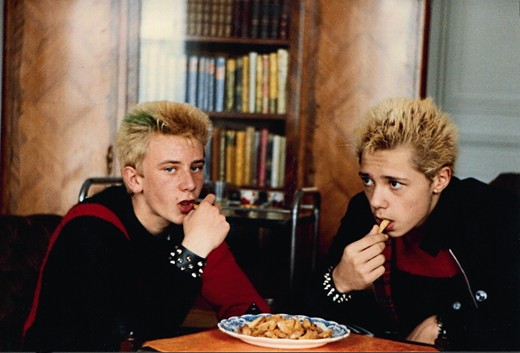
Punk fashion reflected this doomed quest for authenticity. The playful, postmodern plundering of rock history’s wardrobe, the deconstruction and reassembly, collage and bricolage; the ambiguous semiotics and DIY aesthetics, gave way to a drab, off-the-peg uniform. The look was radicalised and codified until it finally ossified into mohicaned cliché — a process which mainly took place between 1979 and 1981. By increasingly becoming itself, punk, paradoxically enough, lost its soul — that sense of feeling “almost” sixteen again; of being on the cusp of an awfully big adventure.




 ANDREW GALLIX