
My piece on controversial French author Marc-Edouard Nabe was published on the Guardian‘s website today.
My piece on controversial French author Marc-Edouard Nabe was published on the Guardian‘s website today.
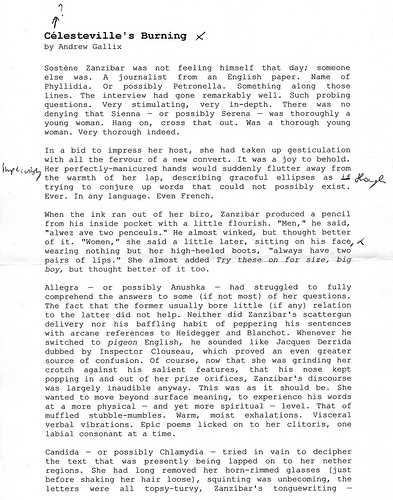
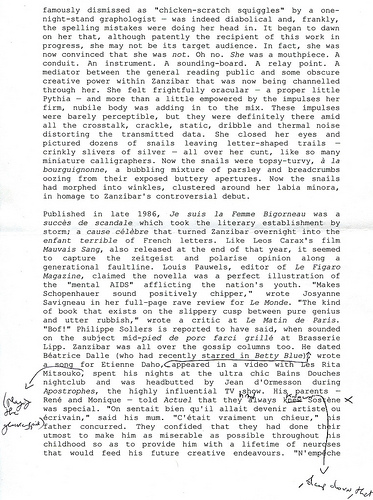
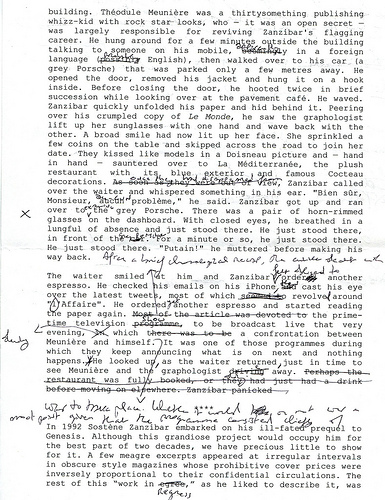
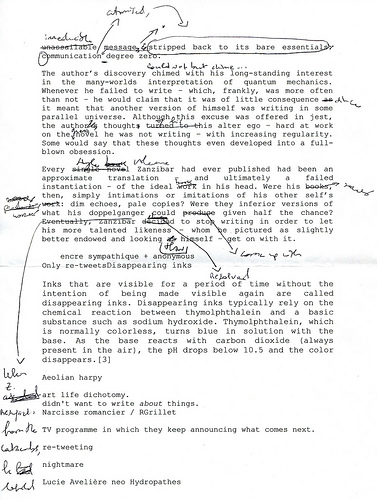
This is the original, incomplete, typescript of “Celesteville’s Burning” by yours truly:



A drawing by my 5-year-old. That’s William on the left, and me on the right — with a cup of tea — looking suspiciously like a diminutive Iggle Piggle. Gallery here.

I remember Guy the Gorilla — probably the only real-life ape to ever achieve celebrity status in Britain. In the simian firmament, he’s right up there alongside King Kong, Cheetah, and the PG Tips chimps. A great ape indeed. The poet Philip Larkin used to keep two framed photographs of him — in lieu of the habitual wife and kids — on his desk when he was head librarian at Hull University. Quotations from Goethe and Wilde, pasted on the pictures, seemed to emanate from his gaping mouth like speech bubbles in a comic strip.
To be honest, I hadn’t thought of Guy for a long time, but a documentary about Tony Hancock on BBC Four jogged my memory. It included archive footage of the celebrity primate in his cage, showing off his trademark alpha-male moves. Hancock, we learned, loved going to London Zoo. On one occasion, the keepers even let him slip under the protection barrier so that he could get a closer look at the star attraction. Apparently, he found the experience very moving, which doesn’t surprise me at all. Guy the Gorilla could knuckle-walk with the best of them, but he also had the uncanny ability to stare at the camera as if apeing his human observer’s melancholia.
The last time I visited London Zoo was in the summer of 1977. I remember being shocked by the gory, mutilated corpses of white mice that had been fed to many of the animals on display. I remember observing a Teddy boy with his blonde ponytailed girlfriend. I remember wearing a blue T-shirt laden with with safety pins and badges. I remember reading a review of the Stinky Toys’ first single (which I’d already acquired) in one of the music papers. It was a glorious summer’s day, and we sat at a wooden table, on a wooden bench, outside a cafeteria. I remember the bittersweet fragrance of the sun-warmed wood. I remember relishing the family outing but already feeling — with a sharp pang of regret — that I was outgrowing this sort of thing. I remember sensing that there was pretty much nothing I could do about it.
I can’t remember for sure if we saw Guy the Gorilla that time, but I’m almost certain we didn’t. I still recall the poster that had adorned my bedroom wall, at my mum’s, a few years earlier. It was a full-length portrait framed by a yellow border that almost matched the colour of the wall. By July 1977, Guy the Gorilla was a fading memory; a rolled-up poster in my chest of drawers. The following year, he died of a heart attack during an operation but, for me, he had disappeared on that warm summer’s day when we probably failed to pay him our respects. Seeing my loss mirrored in his liquid eyes would have been heart-rending. He had to be sacrificed.
Here is my interview with Tom McCarthy that appeared in 3:AM Magazine on 13 July 2006.

3:AM: It’s very rare, these days, to see a work of literary criticism being given such prominence. Do you agree that this is probably largely due to the fact that the main subject is not Balzac or Baudelaire — two key references here — but a comic-strip hero?
TMcC: First of all, I’m not sure I’d describe Tintin and the Secret of Literature as ‘criticism’. More as an essay. I like the idea of the essay as a primary literary form. You can trace it from David Foster Wallace through Blanchot all the way back to people like Hazlitt. But yes, the fact that it revolves around Tintin and not just Balzac and Baudelaire has certainly helped it get attention — although it wasn’t strategic to do this. I genuinely rate Hergé’s work, and wanted to read it alongside Balzac, Baudelaire, Bergson, Bachelard and all the rest, hopping from one to the other in a set of playful, serendipitous detours — which is exactly what the essay format allows.
3:AM: Your book is very much in the tradition of Barthes‘s Mythologies (an anthology which you fail to mention). I can’t remember if Barthes actually mentions Tintin anywhere, but he certainly could have done. In a way, the two figures go curiously well together: Tintin’s heyday corresponds roughly to that of Barthes and both, today, appear a little quaint. Was it Barthes who inspired this book? After all, your Tintin is primarily a semiologist who “can navigate [a key word in the McCarthy canon] the world of signs” (Tintin and the Secret of Literature p. 22), a deciphering cipher who embodies (along with Snowy?) the presence of absence — the Melvillian “whiteness of the whale” (p. 161) — but also, of course, Barthes’s “écriture blanche”.
TMcC: I do kind of mention Mythologies when I refer to wrestling and tomato tins early on in the book. I love Barthes: he’s a beautiful, generous writer. He never mentions Tintin directly as far as I know, although Derrida, another big presence (or present absence or whatever) in my book, does, glancingly, in The Post Card. Hergé read Barthes; you can see his influence very directly in the final book, Tintin and Alph-Art, in which language becomes a set of physical signs, giant letters which are held up and scrutinised by his characters.
ODETTE’S BITS
3:AM: Are you the first to draw a parallel between Sarrasine and the Tintin corpus? I haven’t read Balzac’s novel, but, from what you write, La Zambinella seems to bear a resemblance to Proust’s Odette de Crécy. Am I mistaken?
TMcC: As far as I know I am the first to draw a parallel between Tintin and Sarrasine. I re-read Barthes’s S/Z, which turns around that particular novella, initially because I wanted to write about Hergé’s total mastery of plot: the way he misdirects, doubles, occludes, jams and so on, all these devices Barthes describes so well in his take on Balzac. But as I did I realised that there were loads of points of correspondence between Sarrasine and the Tintin books. Balzac’s eponymous artist becomes obsessed by the opera singer la Zambinella, like Captain Haddock does with Bianca Castafiore; he copies her, like the sculptor Balthazar does the fetish in The Broken Ear; he’s murdered, as is Balthazar; the copy is copied and these copies are themselves copied, in both. Fundamentally, it’s about entering the realm of denatured simulation that is art. La Zambinella’s voice draws Sarrasine backstage, into a world of artifice, just as la Castafiore’s voice draws Haddock backstage and on into a world of inauthenticity. And these worlds prove fatal: the castrato la Zambinella effectively kills Sarrasine, and ultimately the not-really-pubescent Tintin effectively kills Hergé.
With Proust, I’ve got to admit I’ve never got as far as the Odette bits in the Remembrance. There are passages I find completely compelling, like the bit about how you can construct a composite memory of a house from various other houses you’ve known or read about or seen in pictures (which is more or less what my hero does in Remainder, but other bits lose me, and I put it down again for two years, then re-read as far as the house bit, then same again: a kind of incomplete repetition loop. Perhaps that’s what Old Marcel would have wanted.
ILLICIT FREQUENCIES
3:AM: Given that the literary status of the Tintin books is uncertain/debatable, isn’t it a little perverse to analyse them in order to uncover the “secret of literature”?
TMcC: Yes — and that’s why I wanted to do it. It would be easy to identify literary motifs in Faulkner or Dickens or someone. But what does it tell us when a corpus that makes no claims to being ‘literature’ displays a symbolic register as developed as Faulkner’s and characters as deep and rich as Dickens’s, not to mention themes and plots more or less identical to Sophocles’s and Shakespeare’s: the fall of the noble house, family secrets coming out into the open, the relation between host and guest gone disastrously wrong and so on? So much of the very best literature opens up illicit frequencies so that meaning can travel along channels other than the obvious or rational. The Tintin books are full of these frequencies, these channels; they even dramatise their setting up, hunting down, rumbling and relocating. And then it struck me that literature as a whole might hide its most intimate secrets in the most illicit of all zones, one tucked away ‘off-stage’, ‘aside’, below the radar of literature proper, which is of course the kind of zone that cartoons lurk in.

3:AM: Could you tell us about the cover of the book and Tintin’s absence from the illustrations inside?
TMcC: The cover is by Jochen Gerner, a French artist. I saw a book he’d done called TNT en Amérique, in which he buried the whole of Tintin in America under black ink but left a few symbols, mainly of money, divinity and violence (i.e. dollar signs, crosses and guns, all done in cartoony style) as markers for what he’d erased — all on the correct pages, corresponding to frames in the original book. So I contacted him and asked him to do the cover, and he was really into it. We looked at the main motifs in The Castafiore Emerald — the window, the piano, the cameras and spotlights that, ultimately, occlude more than they reveal — and he applied his technique (which, after Bataille, he calls ‘déformation’) to these. And in the foreground, as on Hergé’s, the tufted figure with his finger to his lips, saying ‘Shhhh!’ — what in the book I call “the condition of the secret become visible”.
To answer the second part of your question: I didn’t want images directly from the Tintin books inside my book. I was more interested in showing how these images (which I’m assuming most people who read my book will be at least slightly familiar with) mutate into and out of other ones: eighteenth-century portraits of castrato singers, stills from Buster Keaton films and, not least, ‘detourned’ versions of the Tintin books themselves. These last images break down into political activist ones, pornographic ones and ‘art’ ones: an interesting triangle.

THE BOY HAIRDRESSER
3:AM: Given your chapter devoted to “Castafiore’s Clit” (if you ever form a band, promise me that you’ll use that name) and your comments about Tintin’s androgyny, I was surprised you didn’t devote at least a few lines to the once-ubiquitous gay Tintin haircut…
TMcC: A band called Castafiore’s Clit is a great idea. Kind of Jane’s Addiction meets The Thompson Twins. Yes, it’s funny that Tintin has lent his haircut to gay culture. I found out recently that the Rocker quiff of the Fifties was taken directly from Jean Marais’s haircut in Cocteau’s Orphée, another big presence in my book.
THE SINS OF THE FATHER
3:AM: During the Second World War, Hergé had no qualms about publishing his comic strips in Le Soir, a newspaper that was under Nazi control and had clear Nazi sympathies. Interestingly enough, as you point out, Paul de Man also wrote for Le Soir. However, I was surprised that you did not make more of this coincidence. Paul de Man’s undermining of meaning and values having been reinterpreted (and partly discredited) in the light of the posthumous discovery of his youthful far-right views, should not we also be somewhat wary of Hergé’s “retroactive wiping-out of history” (p. 41), the erosion of Rastapopoulos’s “Semitic status” (pp. 44-45) or his reinvention as a “liberal leftist” (p. 46)? After all, anti-capitalism and anti-consumerism which, in your view, testify to the author’s “right-to-left trajectory” (p. 47) are common tenets on the far right as well as the far left…
TMcC: I never went with the argument that Paul de Man’s shameful youthful secret undermines all of deconstruction (is Derrida, a Jew, a secret anti-Semite too?), not least because when I was at university one of this argument’s main advocates serially harassed his female students while simultaneously espousing feminism, which for me kind of discredited anything he had to say. Yes, the anti-consumerist thing can serve a right-wing position as much as a left-wing one, and I point out in the book that Hergé kept the same villains in place throughout his career (secret cabals, men in hoods). But I think his right-to-left trajectory was a genuine one, as was Paul de Man’s. Things are connected. Fascism is a moment that the twentieth century goes through, in the arts as much as anywhere else. Think of Yeats, Spengler, Hamsun, Pound, Céline — brilliant and hugely influential writers who were fascists. Do we discount anything that’s come after them? Of course not: you trace the fallout of the disaster, how it mutates and develops. Think of Heidegger, a one-time Nazi out of whose thought the incredibly compelling ethical vision of Levinas (another Jew) has emerged. Anyway, it would be naive and liberal to want all our artists to be nice Guardian readers. Some people are arseholes. And another thing: Paul de Man doesn’t undermine meaning and value — just certain tired and reactionary notions of both.
[Just for the record: I didn’t mean to imply that Hergé’s, Céline’s or Yeats’s works should be rejected because of their political views, although I clearly gave that impression. Like Tom, I subscribe to a resolutely politically-incorrect conception of literature. My point simply concerned anti-capitalism and anti-consumerism (which the far left certainly has no monopoly over) along with the fact that certain thinkers’ seemingly-rational ideas are so obviously linked to individual history (Maurras’s deafness or Foucault’s masochism, for instance) that one should sometimes approach them with a little caution. Another issue we could have raised here is the Arendt-Heidegger relationship, but that would probably have been one serendipitous detour — to quote McCarthy — too many!]
FOUND IN TRANSLATION
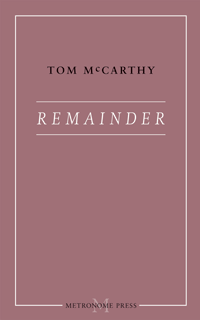
3:AM: Remainder — the best novel of 2005 which, due to its republication by Alma Books, looks set to be the novel of 2006 (ironically enough, given the theme of the book) — could be described as the best French novel ever written in English by an Englishman. With Tintin and the Secret of Literature, your approach is once again resolutely French. Almost all of your major references are French (Balzac, Baudelaire, Barthes, Derrida…), and even the vocabulary you use is Gallicized (“fictive,” for instance, which is far closer to the French “fictif” than “fictional”). Where does your familiarity with French culture and the French language come from? Was it deliberate on your part to largely avoid references to British or American literature? Wouldn’t it have been interesting to give a more English perspective on Tintin since Tintinologists have a habit of being Belgian or French?
TMcC: First of all, thanks for your kind words about Remainder, and I’ll try to persuade my French publisher, Hachette Littératures, to use your “best French novel in English” line as a blurb for their edition that’s coming out next September — I couldn’t think of better praise! Yes, most of the points of reference in Tintin and the Secret of Literature are French, although Defoe, Bunyan, Behn and other Anglo early novelists get a look in — plus there’s a big digression through Shakespeare’s Sonnets. I guess I just really like French literature. The English were going really well from the sixteenth to the nineteenth centuries, producing poets like Donne and Marvell and novels like Clarissa and Tristram Shandy, but it all went horribly wrong somewhere in the late nineteenth/early twentieth and, while the French (and Americans) embarked on the wildest adventures with thought and form — Mallarmé, Breton, Cendrars, Faulkner etc etc — we got Thomas fucking Hardy and DH fucking Lawrence. The only top-class twentieth century English writers are the ones we claim spuriously: Americans like Eliot and James, Poles like Conrad, Irishmen like Joyce and Beckett…
3:AM: At the same time, there is a sense of humour and earthiness which are very un-French, as it were. After the publication of a strange review in The Economist which presented your book as a send-up of French theory, you spoke to me of the astounding “idiocy of English empirical culture”: do you think Tintin and the Secret of Literature is going to reignite the critical Querelle des Anciens et des Modernes of the 80s and 90s?
TMcC: I think to ignite any thought at The Economist you’d need to stick a ton of semtex up their arses. That review was quite funny, though: it perfectly captured the red-faced, vein-popping fury of Little England once the values on which it bases its entire identity are ever-so-slightly “solicited”, as Derrida would say. English takes on Tintin always present Hergé as a ’satirist’ and only that: a self-sufficient, rational subject who uses words and images as tools to tell us something he knows because he’s worked it out, rationally, you see. That’s the empirical line on literature tout court: the rational expression of a self-sufficient subject — as though we weren’t constantly made and unmade within language, desire, history, symbolic networks and so on. It’s as moronic as crediting a surfer with creating the wave which carries him and allows him to ply his craft — and back into which he’s eventually going to sink.

McCARTHYISM
3:AM: You say that you were introduced to Tintin by your mother at the age of seven. That, in itself, probably says a lot about your social background — that and your early encounter with Hugo Williams (mentioned by the poet in an article he wrote in the TLS about your International Necronautical Society). In France, in the 70s, Le Journal de Tintin tended to be read in Catholic and conservative circles whereas kids from Communist families usually read a comic called Pif. What sort of social and cultural milieu were you raised in, Tom?
TMcC: I come from a liberal arts-steeped middle-class family. My mum would tell us the stories of The Odyssey and The Merchant of Venice on car journeys. My parents were left-ish but not radical. They voted Labour but I went to a private day-school from the age of twelve.
3:AM: You write that “Everybody wants to be Tintin,” but I get the feeling that that everybody applies, first and foremost, to you. You even bear a slight physical resemblance to Hergé’s hero…
TMcC: I went to a fancy dress party dressed as Tintin once…
3:AM: Susan Tomaselli rounds off her review with the claim that Tintin and the Secret of Literature made her feel like re-reading Remainder (your debut novel) rather than the Tintin books themselves. Do you see this as a success or a failure?
TMcC: Success — although she should read the Tintin books too. In a way, I used Tintin and the Secret of Literature to work through some of the themes in Remainder in a more conscious way: the relationship between trauma and repetition, for example, or the idea of inauthenticity which emerged from the de Man essay “The Rhetoric of Temporality”, which I hadn’t read when I wrote Remainder even though it could almost be describing that book. It’s great to be able to switch modes, and come at the same territory from a different angle.
WE WANTED TO BLOW UP TIME ITSELF
3:AM: Your whole oeuvre seems to be contained within this critical essay: Tintin and the Secret of Literature could thus be read as a work of internal intertextuality. First of all, there’s the importance of meridians which points to Greenwich Degree Zero, your recent artistic collaboration with Rod Dickinson…
TMcC: …when we blew up the Greenwich Observatory, or at least produced the documentation of having blown up the Observatory, completing the task of Martial Bourdin, model for Conrad’s Stevie in The Secret Agent. We wanted to blow up time itself. Funnily enough, there’s a scene in The Broken Ear where a secret agent like Stevie carries a time-bomb around and gets blown up by it because he doesn’t realise the town clocks have broken. I love the sequence in The Sound and the Fury where Quentin carries a broken clock around and rides trams in different directions in a sub-Einsteinian attempt to escape time — then dies…

WE WANTED TO BLOW UP BRIDGES
3:AM: Then you’ve got the references to Cocteau’s Orphée and, more generally, your fascination with the “transmission-reception figure” (as you put it elsewhere): “[Tintin] will also be aware, as a radio operator, that the waves which carry his transmissions will travel outwards endlessly through space. Who knows where the signals will end up, or what they will end up meaning?” (p. 91).
TMcC: If I had to select five things to put in a space capsule to show aliens what we were capable of, Orphée would be one of them. It’s the most perfect piece of art, which lays out our existence as being in relation to death, technology, transmission-reception and desire — not to mention repetition. Death, a beautiful princess (and arts patron) falls in love with Orphée so she has another poet snatched to the underworld so he can send illicit, looping radio messages to Orphée which draw him towards her, through a mirror. Cocteau based his radio messages on the ones sent to occupied France during World War Two: these short lines of poetry. Most of them meant nothing, but one in every two hundred meant — only to those who knew — ‘blow up the bridge’. A man or woman in London reads a line of poetry into a microphone and in France a bridge blows up — or not. Poetry — real poetry — should harbour that potentiality somehow.
3:AM: You talk about Alph-Art, the eponymous avant-garde movement of Hergé’s posthumous book, which is “a cover for a giant forgery operation” (p. 158). Couldn’t this also be a fitting definition of your own “semi-fictitious” avant-garde movement, the International Necronautical Society?
TMcC: The INS had its own radio transmission network, operating out of the ICA two years ago, generating messages like Cocteau’s and actually transmitting them over the radio London-wide (and, via collaborating radio stations, world-wide). It looked like a giant factory floor, with workers running everywhere carrying lines of text — lines which, having been plucked from other media sources, were kind of second-hand if not fake. The INS is itself semi-fake, as you point out. Although the fake can hide the real.
THE UNNAMEABLE
3:AM: On page 84, you explain that, according to Freud, trauma produces “a desire for repetition mixed with a need to disguise the scene being repeated”. Could you comment on this sentence with reference to your novel Remainder?
TMcC: It’s not just Freud who says this: even his most positivist counterparts concur. Under ultra-extreme stress, the part of the mind that processes raw data into the narrative thread we call ‘memory’ simply goes on strike and refuses to process. It’s called ‘dissociation’. So the data’s present, but not dealt with, and therefore keeps bobbing up and demanding to be incorporated somehow. As it can’t form part of normal memory, it plays itself out in weird ways — ones that contain elements of the original event but are also scrambled, disguised. And it will keep repeating, albeit in modulated form, until it is accommodated properly. Well, in Remainder the hero has undergone a traumatic event which he hasn’t retained as straight memory but rather as fragments of data: the sense of being about to be hit, blue lights, railings, being held above a tray or bed and so on. These induce a propensity to repeat stuff in him. Another interesting thing about post-trauma is that (to return to a motif we touched on a moment ago) it makes people feel inauthentic, fake, because everything is of a lesser magnitude of experience than the trauma-moment itself, the only ‘real’ thing. And then the subject back-projects for himself a time when he wasn’t fake, and longs for that time. That’s what my guy is doing with his re-enactments: repeating backwards to an imagined era of authenticity — but repeating, more accurately, towards the trauma-moment itself, the true, unnameable moment, the moment of truth and unnameability itself.
THE CHINK ON THE CARPET
3:AM: The re-enactments in Remainder or in your artistic work: mimesis or simulacrum?
TMcC: Aha: very good question, bang on the money. In Remainder, he wants the authentic, so he sets up a zone of mimesis, paying architects and designers to recreate his ‘remembered’ building and re-enactors to ‘be’ the lady he remembers frying liver on the floor below him, the pianist he remembers practising Rachmaninoff and so on. He wants to accede through these re-enactments to a mode of authenticity, of simply ‘being’ rather than simulating. But of course it doesn’t work: the re-enactments tend more towards the status of simulacra, what Plato defines as ‘a copy without an original’. But then, paradoxically, the most jarring and obviously inconsistent things, the ‘extra’ bits, the ones with no originals of any type at all, are what catapult him into ultra-authenticity — which, not coincidentally, is also pure violence. It’s the little chink on the carpet of his re-enacted bank heist that flips the whole re-enactment over into all-too-real-ness, when the re-enactor trips on it, or rather on its absence, and his gun goes off…

[Stewart Home and Tom McCarthy at 3:AM Magazine‘s Xmas Bash, London 2005]
THE CRACK IN THE WALL
3:AM: Barthes writes that “…the ‘realistic’ artist never places reality at the origin of his discourse, but only and always, as far back as can be traced, an already written real, a prospective code, along which we discern, as far as the eye can see, only a succession of copies” (quoted on p. 55): this is also, unwittingly, what the protagonist of Remainder does, right?
TMcC: Remainder has been read by some critics as an allegory of realism and of the realist mode of art, and this isn’t an entirely wrong reading — although if the hero had actually been an artist rather than an Everyman, some bloke, it would have been an entirely different, and inferior, book. But yes, it definitely turns around his copying, and even (as he sets about getting his re-enactors to re-enact the moments when they prepared for the previous re-enactment) his copying his moments of copying, endlessly regressive. We can try to work it out together, but ultimately I can’t give the definitive schematic meta-reading of the book any more than you — perhaps less. It was intuitive: I was looking at a crack in a wall and had a moment of dejà-vu and wished I had loads of money to re-enact this moment and there was the novel.
EVERYTHING LITERATURE SHOULD BE
3:AM: When discussing tobacco throughout the Tintin books, you explain (following Derrida) that it “goes up in smoke” but “also leaves remains, ashes, which maintain symbolic links to memory, death and inheritance. Baudelaire’s story takes off from the change left over from the two friends’ luxury expenditure: like the coin itself, it proceeds from the remainder” (p. 135). Why are remnants so important in your work?
TMcC: It’s what’s left. After the disaster, after thought, interpretation, writing itself. It’s like when Wallace Stevens says “The plum survives its poems”. Writing has to deal with this remainder, and good writing has to deal with the fact that it can never fully deal with it. Francis Ponge knows this. He writes brilliant prose poems about, for example, oranges: the texture of their cells, the way they leave goop on your hands so that even when you’ve ‘expressed’ them there’s a residue that’s not contained. If Susan Tomaselli or anyone else really want to do themselves a favour, they should re-read neither Remainder nor the Tintin books but rather Ponge’s Le Parti pris des choses (you can get it in dual text). It’s everything writing should be.
[This interview was initially posted here.]
I spent half the night tossing and turning, fending off panic attack upon panic attack, fretting over everything in general; in particular, a few sentences I’d spent ages trying — and failing — to write. To think that, on a good day, Michael Moorcock can toss off some 50,000 words — or so I read in Hari Kunzru’s fascinating interview in The Guardian yesterday.
Naturally, today was a bit of a blur. I met one of my three half-sisters at Anvers. As I was early, I had a coffee at Les Oiseaux, a café across the road from La Cigale, the famous concert hall. I remember going there after an Interpol gig, in 2003, with a group of friends that included the young lady who would become my wife: that’s obviously one of the reasons why I’m fond of that café. It’s also slightly secluded and a good spot for people-watching — the prerequisites for any good Parisian café. It was mild and sunny, so I sat outside. It almost felt as though spring had arrived. It felt good, or as good as could be in my present state. It felt almost good. It almost felt good.
The restaurant experience was slightly surreal. For starters, the owner, who I had down as a typically Gallic character, was entertaining a young English guy in perfect English. He may well have been bilingual; I couldn’t hear him well enough to make sure. Then another English guy came in and they all started talking about Zadie Smith. (I almost expected her to walk in at this juncture.) Was he a literary agent or a translator? He was accompanied by a young woman — probably a writer — who was all dressed in black. The gaffer remarked that she looked scary. I glanced over at her. She was staring blankly at the menu. I felt I knew how she felt. Of course, it may just have been the effect produced by the menu.
On my way home, I walked past another restaurant. In fact, I walked past many other restaurants, but in this particular one I spotted an old mate of mine. He had already spotted me, but pretended he hadn’t. I followed suit.
Switched on the telly this evening, and my friend Tom McCarthy, was being interviewed about Tristram Shandy. As usual, he was spot-on. “A novel,” he said, “is something that contains its own negation, right?” Right.
I have always been very ambivalent about journals. I’m wary of the idea of writing as self-expression. I’ve always found it very difficult to talk about myself, as I fail to understand how anyone could be interested. People are attracted to journals in order to discover other people’s secret, private lives but I would never record anything that could embarrass anyone or hurt anyone’s feelings. Simon Critchley writes — and I was re-reading this yesterday — that “In the journal, the writer desires to remember himself as the person he is when he is not writing. …” Perhaps I don’t want to remember. Or can’t. I’m not even sure such a person really exists anyway.
I’ve written a piece on “Céline: Great Author and ‘Absolute Bastard’” for The Guardian‘s blog.
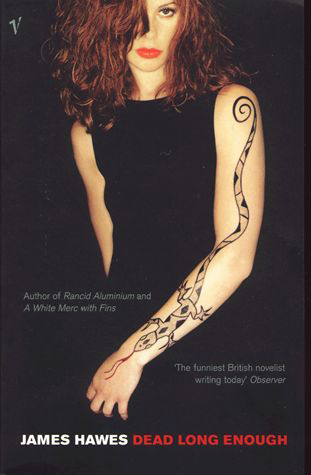
Here is my interview with novelist James Hawes, published in 3:AM Magazine in April 2005:
3:AM: When you burst onto the literary scene in 96, you already seemed to be a fully-formed, fully-fledged novelist. Tell us about your writing apprenticeship.
JH: I wanted to be an actor and playwright, but I was useless at both and thus managed to end up totally lost, broke and CV-less at 27, living among smackheads, crims and slumming-it trustafarians just as the Loadsamoney late 80s were starting. I knew I couldn’t last in that world, so I went back and did a PhD, which meant I got a grant to live on (ah, lost days) and a name-tag for my life. For the next seven years I quietly close-read Kafka, Nietzsche, Mann, Musil, Hesse and suchlike. I did it seriously and straight: by 1993 I was quite a respected Young Academic, but I was also trying to write again, this time a novel. In hindsight I suppose it looks as though I half-consciously made myself a bubble where I could be paid to dissect serious writers and see how they did it. But then we all have PhDs in Hindsight.
3:AM: A White Merc with Fins was part of that whole finger-on-the-pulse-of-the-zeitgeist post-Trainspotting chemical generation/lad lit wave. Were you influenced, or at least inspired, by Irvine Welsh or any of those writers?
JH: I didn’t know anything about them. I was still working full-time as a teacher of German lit. I knew almost nothing about Eng. Lit in general (I had never read anything by Martin Amis except Money or by Ian McEwan except his first story-collection, and still haven’t). When my younger, cooler Manchester brother heard I was trying seriously to write, he sent me Trainspotting, but by the time I read it White Merc was finished and sent off to my agent. When I read it I loved it and was jealous as hell. You could tell straight away that unlike most so-called “young gunslinger” Brit writers (see next question(s)!) Welsh was not a posh North London day-school/olde grammar-school/Eton boy slumming it.

3:AM: The consensus at the moment is that Speak for England is your first truly serious work (Alfred Hickling wrote in The Guardian that you have “filled out into a comic novelist of considerable stature”) after starting off as a hip young gunslinger in the Bret Easton Ellis/Welsh mode. I think it’s becoming increasingly clear that you’ve been sending up the zeitgeist all along à la Kingsley Amis or Evelyn Waugh (who you recently described as the “only English writer” you “read and re-read for sheer pleasure”). Is the angry young man turning into a middle-aged fogy? Are you in the process of doing a John Osborne?
JH: I don’t think my writing was ever “angry” in that way. Or “young”, come to think of it. The hero of White Merc was quite explicitly a middle-class boy knocking on 30 who really only wanted “a flat with tall windows” but had gone adrift. The book took the piss out of “alternative” IRA groupies, smackheads, hippies and suchlike. I love Waugh for the LACK of foregrounded psychology in his writing — a satirical tactic which (bizarre though it probably sounds to Anglo-Saxon ears) he shares with Kafka. As for Waugh’s snobbery, see later answers…
3:AM: As Toby Clements points out in The Telegraph, the narrator’s allegiances seem to be divided in your new book, Speak for England. To what extent were you — the author — seduced by the reactionary lost world Brian Marley encounters? I mean, even if your intent is clearly satirical, it must have been quite intoxicating — liberating, even — to write the unwriteable by envisioning the Empire literally striking back, Britain withdrawing from the EU, the public humiliation of the PM’s “Best Friend” etc.
JH: Writing satire is a way of having your cake and eating it. For example, anyone who reads Brecht can hardly miss that the supposedly Bad Guys, the wicked capitalists and chancers, get all the best lines and laughs. And the more you know about Brecht himself the more clear it is that these characters are far closer to his (concealed) heart than the Good Persons. Then again (cf Waugh, too), as Nietzsche says: “What do we care about the ORIGIN of a work? The artist is only the soil and the earth — sometimes the dung and shit — from which the WORK grows!” (fx: insane cackling).
3:AM: Your analysis of the psycho-sexual roots of power is fascinating. If we “are all forever small children”, as Carl Jung surmises in the epigraph to Chapter Three (Speak for England, 95), the past is “the only real home we shall have” (ibid 335) and, consequently, we all want to go back in order to go back home. In Speak for England, the past literally comes home. The protagonist Brian Marley — who is stranded in Papua New Guinea after taking part in a Survivor-type reality game show called Brit Pluck, Green Hell, Two Million — stumbles upon a corner of a foreign jungle that is forever England, created by the passengers of a plane crash which happened in 1958. The Colonists eventually return to Britain where they reintroduce no-nonsense Fifties values. Your academic work on Nietzsche must have had some bearing on this hankering after authority (“the ultimate perversion is repression,” 315) which drives the National Government’s counter-revolution.
JH: Yes, Nietzsche is fascinating on the psychology of power and I did a lot of work on Kafka/Nietszche in that light, so no doubt it filtered in. But even more so (and more importantly for Speak for England), he’s a master of insight about our crippling need for structures of belief and certainties — as he famously says “man would rather will nothingness than not will” — meaning that we tend to embrace (any old) system of thought that can deliver “Certainties”, at almost any price, rather than face the uncharted oceans of modernity. Today that insight is more serious than ever — it exactly explains the triumph of Muslim Fundamentalism in Iran, for example.
3:AM: You get a lot of mileage out of the past/present dichotomy. The scene in which the Prime Minister’s “Best Friend” is “seen live on TV, by about half a billion people, being caned thoroughly on his naked backside by an elderly gentleman while handsome, bronzed youths with ancient rifles and big shorts stood about and laughed at him” (254) could be innocent enough in a Boy’s Own story, but has strong S&M/homoerotic connations for us. Likewise the depiction of the PM’s Press Secretary being tossed, stark naked, in the Union Jack by sixth formers while a beautiful young lady looks on “holding her hips and shaking with laughter” (249). Could you tell us a bit about that?
JH: The bizarre thing about the 50’s was that in certain circles (i.e. ex-public school, theatrical, cinematic) people were openly gay in a way that has only become more generally possible in the last ten or fifteen years. To be honest, my conscious intentions in the above passages were simply Broad Comedy — but what do our intentions matter when it’s a question of subconcious enactments…
3:AM: If we are “all forever small children”, the childhood we long for only ever really existed in books — the kind of books which created our notion of childhood in the first place. Brian Marley (whose name advertises its own literary nature) has a Proustian moment when he rediscovers his 1965 Eagle Annual which strikes him as more real than reality itself. Speak for England often resembles one of those Disney films which mix flesh-and-blood actors with animated figures. The Colonists, for instance, seem to have stepped out of a typical Boy’s Own story: significantly, they use a toy Dan Dare radio station to make contact with the modern world. There are even two references to the Famous Five, one of which is made by a female character called George! So when people like Clemency Burton-Hill (whose name could come straight out of your book!) criticise the “dismal cliche” of the dialogue, they overlook the whole metatextual aspect, don’t they?
JH: Couldn’t out it better myself. How else would these characters talk? The whole point is that our Hero free-falls easily into that clipped, anti-emotional, impersonal, oh-so “English” mode — as a grateful escape from the pressures of Individuality.
3:AM: This childhood nostalgia can be likened to “a warm homecoming to something we have never truly known but yet missed all our lives” (28), first of all because it is fictitious, but also because the childhood depicted in most children’s books is an upper-class or at least very middle-class one. The same can be said about notions of Englishness which are also class-based. Do you think there is a link between these two notions of childhood and Englishness?
JH: Absolutely. There’s a striking difference between England and America here that goes all through cinema, especially U.S. depictions of “the golden times of youth” or whatever are always (right from Citizen Kane) small-town, close-to-the-soil, classless. Ours are Edwardian upper-middle. And in every U.S. film, the Hero has to prove his blue-collar cred (even if he’s a bigshot lawyer or the President himself) by e.g. smacking a baseball out of sight. Whereas in the UK we seem happy to accept Hugh Grant’s dithering shtick as “normal everyday Englishman”. Pinter marries into the nobility, Scruton goes hunting: to a middle-class Englishman there simply IS no other model of success than a mad sub-Austen Georgians At Home fairytale.
3:AM: Speak for England — which is partly a robinsonnade — is often reminiscent of Robinson Crusoe. Like Robinson Crusoe, the Colonists have recreated the society they came from in the middle of nowhere. Like Robinson Crusoe, Brian Marley’s problems stem from his relationship with his father (Robinson disobeys his father; fatherless Brian is in thrall to the Führer-type Headmaster, the ultimate father figure). Robinson Crusoe’s inability to accept the “middle Station of Life” is mirrored by Brian’s desire to become a “real Englishman”, ie a member of the upper-classes. The difference between the two novels is that Robinson Crusoe marks the triumph of middle-class social climbing whereas in Speak For England there is a constant distinction between becoming and being.
When Brian Marley thinks he is dying in the jungle and wishes to record a last message for his son, he cannot find his own voice. As a member of the lower middle-classes, he has no voice, no identity: being lower middle-class is a transitional state. But as you show in several of your works, the upward-mobility associated with the post-war consensus has disappeared leaving only frustration in its wake. People like Brian Marley struggle through their mediocre, ersatz lives (fake mail-order Agas!) with the nagging feeling that they are “below their imagined station” (80) and are denied “the unreflective joy of unthinking union” (222) which is shared by the working and upper classes. Tell us more about this opposition between becoming (the aspirational lower middle-classes) and being (“A caveman, that would be real”, 21).
JH: I have honestly not seen this “being” vs “belonging” business before (as an ex-academic I think I have to almost consciously repress the awareness of intellectual substructures in order to preserve any life and freedom in my writing) but you are quite right. Hmm. Yes, the salient facts of the middle-class are its very MIDDLE-ness (i.e. its lack of any “authentic” aspects) and (as Marx pointed out) its dynamism. Its relations with the Working Classes are a mixture of disdain, fear and envy, while the Upper Classes are objects of secret outrage mixed with public fawning. To my Hero’s mother’s generation the vision of “oak trees growing out of the ruins of Buckingham Palace” still implied a sort of Good Old Uncle Joe All Them Cornfields And Ballet In the Evenings left-wing project: but that Lower-Middle Radicalism is, in the saloon-bars of today, more often part of something very different: “get rid of the Posh Wasters (the Queen herself alone excepted), dismantle social security, do-gooding and multiculturalism, smash the unions, kick out the asylum seekers…”. And never underestimate the dynamism Marx spotted: we are facing what Brecht said we should dread — interesting times.

3:AM: As befits any novel about Englishness, class plays a central part. Your characters often sleepwalk through life, forgetting that “this is not a rehearsal” (Rancid Aluminium, 29), prolonging the “long vacation of extended adolescence” (A White Merc with Fins, 19), in order to maintain “the helpful fantasy that their true lives still lay in the future” (Speak for England, 80) until they make a last-ditch attempt at saving themselves by doing “something radical” (A White Merc with Fins, 22): robbing a bank, say, or taking part in an extreme reality TV show. Before reaching the end of his tether, the protagonist of Speak for England, Brian Marley, teaches English as a foreign language and flees “to some new foreign country” whenever “things get too tough or too real” (Speak for England, 41) because “moving about lets you kid yourself you are moving on” (A White Merc with Fins, 70). Countless authors of your generation have depicted the nihilistic slackerdom of the idle rich or its lumpen variety, but nobody else has dissected the “pre-emptive strike on living” of the lower middle-classes with such deadly accuracy. Would you agree that this is your great theme, and do you see it as a particularly English phenomenon?
JH: I think it’s my great theme because I’m English. Nietzsche again: “We are all just organ-grinders with only one tune, but eternity itself turns the handle”. I went to Oxford in 1978 from a rural comp like some mad innocent with a straw in his mouth, four years behind the fashion and quite literally having never met a boarding-school boy in my life. I found that the world (Oxford was then still largely a men-only-colleges place) was full of incredibly sophisticated, shamingly cool and impossibly well-connected young chaps who were used to partying in publishers’ holiday homes, skiing every Xmas vac and using mummy’s debenture at the Royal Court. They seemed two or three years older than me, never mind infinitely richer. And they (step forward in particular a certain person whom I learned ten years ago was none other than Will Self) naturally got the Posh Birds I wanted but hadn’t the faintest notion how to approach. You may detect a chip on ye olde Hawes shoulder. A sack of spuds, more like, my dear. I shudder to remember, never mind relate, the wretched idiocies I got into. And all based on class.
3:AM: You seem to imply that the linguistic class war goes far beyond the “Garridge”/”garaaj” dichotomy (256), that it is not merely a question of pronunciation.
JH: My own theory is that this can be traced right back to the Conquest. Show me a name like Percy Beaufort in the phone-book and I will call someone posh for you. I invented an Irish archaeological book from which to supposedly lift an epigraph on this subject in order to avoid forcing my views into the mouth of some hapless “character”…
3:AM: I thought the controversial end of the book (which could be described as the ultimate cliffhanger) was really effective. Did you know how it would (or would not) end right from the start, or did you come up with this — hum — aporetic non-dénouement precisely because you had no idea?
JH: No, I really didn’t know what to do with the Hero at the end, and the last thing I wanted was to manufacture a ghastly film-syle “upbeat” ending. I wish I’d ended it like A Good Man in Africa in retrospect, but I’m glad you think it worked.
3:AM: Did the Comet IV accident really happen?
JH: No, that was made up. Delighted you even have to ask.
3:AM: Many novelists of your generation like Jonathan Coe (The Rotters’ Club) or Toby Litt (Deadkidsongs) seem to be writing about their childhood. Is this a generational thing? Were you in any way inspired by these books?
JH: I haven’t read either of these. As you get older you realise that what you thought, when you were 20, was pure freedom to create your own, new, form of living is in fact tugged at by hidden (apron-)strings that go back even beyond your birth. By 40 — or maybe with parenthood? — you see that you will never know who you really are and what you could really do until you know what you actually were, and were being formed for. If anyone under 25 is reading this, my motto to them would be: “No, you don’t believe this, of course you don’t, you’re not MEANT to. But you will”.
3:AM: So what’s next?
JH: I’m putting the final touches to my first original screenplay so a Producer can take it to Cannes. It’s a screwball rom-com called Dr Kafka’s Love-Letter. I adore it and it’s had great initial come-back. I’m thinking of a novel version, but the next one will be a black-comic story about a cheated lower-middle-class man (hey, what else?) who is digging his little South London garden while wishing he’d had the guts to completely desert his ex-wife and kids by buying a bar in Valparaiso for $15,000 instead of paying £300K for this shitheap, when he comes across a long-buried, perfectly oiled and preserved AK-47…
One of my stories — “Dr Martens’ Bouncing Souls” — features in a new anthology entitled New Cross-Fucked Musings on a Manic Reality (Dog Horn Publishing, December 2010). Here is an extract from Tom Bradley‘s introduction:
In a universe ruled by karma and rebirth, “generation” is a bad word denoting as it does the stifling of spirits in coats of crass skin, the greatest disservice that can be done. Nevertheless, Hugh Fox got to christen the Invisible Generation, Andrew Gallix the Offbeats. So I’ll invent a name to embrace these people. I’ll make it doubly apt, as they produce electricity as well as useful heat: the Enigmatic Polygeneration.

This appears on the back cover:
This volume is ripe with prime produce sprung from minds that span five decades, but comprise a single literary generation. And who are the Enigmatic Polygeneration? They were christened by Tom Bradley in chapter four of Put It Down in a Book, as follows:
Digital connectivity has rendered physical locality irrelevant and made polyversality the new thing . . . Once space has been erased by the miracle of email, so has time, in terms of its effects on the human frame . . . In a creation where particles can spookily act upon each other at a distance of quadrillions of light years, the Seven Ages of Man are as days in the week, and a generation can span an open-ended number of decades . . . I’ll invent a name that’s doubly apt, as these writers produce electricity as well as useful heat.
In this vast anthology, among other delights, you will meet a pornographic ventriloquist and a man who has spent a lifetime getting laid only because he looks like certain famous people. You’ll be taken deep into the heads of such gentry as Charles Manson, Jack the Ripper (who, we learn, was actually Bram Stoker), and Kerry Thornley, author of a book about Lee Harvey Oswald published before the Kennedy assassination.
Andrew Gallix will give you a crash course in transgression, and underground press legend Hugh Fox will bring you to understand what it means to be the small Jewish boy who would one day become Charles Bukowski’s first biographer. Meanwhile, mighty Dave Migman teaches us how to live and die. Fabulous Adam Lowe reveals his adventures in cross-genre, multimedia literature. And lovely Deb Hoag . . . well, as usual, she’s got a surprise!
Anthony Cuthbertson, “From the Lost to the Beat to Now,” Notes From the Underground 19 November 2010
The expatriate literary scene in Paris
What Allen Ginsberg called, ‘The bewildering beauty of Paris’ has attracted writers and artists for centuries. It has been the setting of great novels and the home of great writers, and in the last hundred years has briefly been the stage for two waves of expatriate writers that changed the face of modern literature: the Lost Generation and the Beat Generation. Fifty years have passed since the latter faded away, and though the expatriate literary scene has remained vibrant, no significant movement has since emerged. However, with the arrival of new soirées, literary journals, writers’ workshops and readings, as well as a fresh generation of writers flocking to Paris, a new wave may well be rolling in.
Historically, Paris has been a place of refuge for artists and writers. It has attracted political and cultural exiles fleeing the injustice and intolerance of their homelands, offering them a liberal safe haven and allowing them artistic freedom. In the 1920’s and 1950’s it became a place of escape for those left disenfranchised by the World Wars. The Génération perdue, as Gertrude Stein named them, included writers like Ernest Hemingway, Ezra Pound, F. Scott Fitzgerald, T.S. Eliot, and later James Joyce and Samuel Beckett. They were a generation disillusioned by the horrors they had witnessed in the First World War, and who felt disaffected and betrayed by their governments back home. Pound wrote of his contemporaries, ‘(they) walked eye-deep in hell believing in old men’s lies, then unbelieving came home, home to a lie’. They gathered in cafés and hung about Stein’s salon to share ideas, bottles of absinthe and write, together forming a movement that still resonates strongly today.
By the time the Second World War and the occupation of Paris came about, these writers had for the most part moved on. Although some later returned after the war (Hemingway famously ‘liberated’ rue de l’Odéon, the then site of the bookshop Shakespeare and Company), a new literary movement in the form of the Beat Generation arrived. Leading figures of the Beats, including William Burroughs, Gregory Corso and Ginsberg, came to Paris for much the same reasons as their predecessors. They sought refuge from the strict conformist confines of McCarthy-era America and found it in Paris. In the years that have followed the departure of the Beats, Paris has remained a centre for culture and art. It continues to attract writers and artists with its history and beauty and the lively literary scene is a reflection of its magnetism.
The first stop for any would-be writer or literary pilgrim should be Shakespeare & Company. Its location may have moved over the years but the spirit and the name have remained. The current owner, George Whitman, has described it as ‘a den of poets and anarchists disguised as a bookshop’, having been sanctuary to writers of both the Lost and Beat Generations. The writers, whom George refers to as ‘tumbleweeds’, drift through the doors and find community and lodging in the poky upstairs rooms in exchange for helping out in the shop below. Supporting young writers continues to be one of the cornerstones of S&C. As well as providing a place to stay, they hold workshops, readings and even organize a literary festival every other year. They have also recently relaunched their literary magazine (The Paris Magazine), and announced the Paris Literary Prize (10,000€) for unpublished writers. In its current location on the banks of the Seine it is as much a tourist attraction as it is a bookshop, but between the piles of books still remain bunks for the next hopeful Hemingway to stay.
Beyond this pillar of the past not much remains of the old haunts of writers beyond landmarks and tourist traps. It is easy to get lost wallowing in the myth of Paris but for new writers it is essential to escape the seductive expatriate past, away from the romance of the Latin quarter and the ghosts that wander the left bank, and over to the other side of the river to where the literary scene is shifting.
Boulevard Saint Germain and its surrounds have developed from bohemian havens to bourgeois hangouts popular with tourists. The cafés once frequented by the likes of Hemingway and Joyce, such as Café de Flore, Les Deux Magots and Le Dôme, now sell souvenir memorabilia and a cup of coffee can set you back six euros.
Nowadays it is areas like Belleville and the 19th and 20th arrondissements in the east of Paris where the cost of living is the cheapest that have become the new centres of the literary scene. These parts of Paris continue to provide a conducive environment for young and aspiring writers.
Paris-based writers have often remarked that unlike other big city literary communities, Paris has an open-minded and accepting scene that encourages experimental forms and welcomes outsiders. David Barnes, the founder and compère of a spoken word poetry night in Belleville at Culture Rapide, describes Paris as “a beautiful backwater where life is slower than New York or London. It gives breathing space, distance from the anglo-metropoles that supports writing”.
He argues that the English speaking community in Paris is just the right size “to come together and do something, to provide a home and platform for, to nurture and be nourished by.” The spoken word nights that take place every week welcome anyone and everyone up on stage to read a poem, tell a story or perform a play — the only rule being ‘make the words come alive’. A collective has formed around this café with regulars comprising English speakers from around the world.
In an age where literary scenes and movements are becoming more international by way of the internet, less centred around a location and more around uniting notions and ideals, Paris has managed to retain its place as one of the world’s literary hubs. Since the turn of this century, a movement referred to as the Offbeat Generation has partly formed in Paris. They comprise of a loose collection of like-minded writers, including Lee Rourke and Booker prize nominee Tom McCarthy, who feel alienated by a mainstream publishing industry dominated by marketing. Paris is home to the founder of this movement, Andrew Gallix, whose Paris-based literary magazine 3:AM has provided the main platform for the Offbeats.
Other English language literary magazines that have formed in Paris in recent years include Double Change, Upstairs at Duroc and Platform. The most recent of these, Platform, formed around the spoken word night at Culture Rapide.
As fate would have it, this new scene that is emerging is forming beside where many of their predecessors have found their final resting place: the Père-Lachaise cemetery. It is behind these gates that you can find the graves of such literary icons as Gertrude Stein and Oscar Wilde.
Its legacy may be one of the great appeals of Paris, though it is the smallness and accessibility of the anglophone writing communities, combined with their supportive and inclusive atmospheres, that is currently causing such a surge in the scene. It seems now that the stories shape the city as much as the city once shaped the stories and for any aspiring writer coming to Paris it would be easy to feel intimidated by the past. For them it is perhaps best to consider again the words of Allen Ginsberg: “You can’t escape the past in Paris, and yet what’s so wonderful about it is that the past and present intermingle so intangibly that it doesn’t seem a burden”. The scenes may be as transient as the writers, but the essence of Paris endures.
 ANDREW GALLIX