On The Beat Anthology

Dan Holloway kindly mentions me a couple of times in his interview with Sean McGahey apropos of The Beat anthology. Here are the two relevant extracts:

beat-anthology-banner

Dan Holloway, “Beat Me Before I Come Up With Any More Crass Metaphors,” Eight Cuts 13 November 2010

A while ago I recommended the really rather fantastic Beat Anthology, the best of the also fantastic site The Beat UK, published by the equally fantastic Blackheath Books. It’s a remarkable collection of stories that it’s rather tricky to track down to a certain theme, oeuvre, or any other arts wank category. Well, almost. Because I did notice a preponderence of public transport. Is this a comment on our eco-aware age? Is it an anti-individualist statement? Are the authors actually, like me, just not quite up to getting a driving licence.

Do I have a favourite? No, not really. I loved Andrew Gallix’s train; and Melissa Mann’s car (hmm, car, it must have been one of those street share jobs). But I couldn’t say one story was better than another. Some have more modes of transport, and some fewer maybe, but better? That’s about more than planes, trains, and automobiles.

[…] I was intrigued reading some of these pieces — like Andrew Gallix’s and Lee Rourke’s. the short story is a great place for paying with voice and form, but I wonder if the results can ever really transfer to novels. What’s rich in shorts can be stodgy in novels; what’s piquant can become downright tedious. What IS the point of novels other than publishers don’t really know what else to do?

Upon Reading “Celesteville’s Burning”

Tom Bradley on “Celesteville’s Burning” 5 October 2010:

“Celesteville’s Burning” is brilliant. It’s the best thing of yours I’ve read. Assuming I’m familiar with all or most of your fiction, I would call this a breakthrough.

As always, the Gallixian wit is everwhere: the “doppelgänger given half the chance”; the “Holy Grail of Franco-Swiss rock criticism”; the “wind in his combover,” and countless other instances that pour forth from every sentence and phrase. You’ve always exploded with linguistic brilliance, syntactic agility and erudition. What a mood enhancer it’s been, throughout your work, to meet with these qualities in an author who does us the honor of assuming the same capacities in his readers.

In “Celesteville’s Burning” you’re displaying further technical mastery. With apparent effortlessness you move in and out of settings objective, subjective, and everything in between. The first to hit me was the light-speed spatial transition of the journalist’s cunt onto Zanzibar’s face, effected right in the middle of a paragraph. All of a sudden we are treated to a blending of her vaginal sensations with the literary sensation caused by Zanzibar: an announcement that we are in the light hands of a master.

You have achieved narrational virtuosity, signaled by your supremely perverse confidence in supplying a plethora of sensory detail in scenes that seem to come from out of nowhere, dreams whose larger purpose you haven’t yet established in our minds — e.g., Grandmother’s house. You know full well that we will not only endure but enjoy the moment of disorientation, and will follow.

The insistent, perverse, yet unfailingly lucid use of French and Franglais — is this also a symptom of a breakthrough? Have you staked out your own territory and sunk roots in the borderland between your two native cultures?

Zanzibar’s ludicrous early success, his lugubrious decline and late failure, his preposterously self-indulged “quantum” writer’s block, and the diseased way in which the established press will exploit it — I sense a breakthrough here, too. You’ve long acknowledged and bewailed the contemptible state of Franco-English letters. But here, with an amazing vastness of detail that only an insider could generate (where did you learn so much about these effete movers and shakers?), you have finally masticated this hideous situation, peristalsed it and shat it out. The despair which “the mainstream” must engender in less hardy souls can’t come near you any more. You are free to laugh from high up, to heap the kind of scorn that will humiliate any member of the lit establishment who reads this.

I can feel a Gallix novel coming on — and not an invisible palimpsest. This artistic unfolding of yours is heartening and exciting to watch. Some saggy asses in London-Paris-New York that have long needed kicking are in for it now.

Indie Literary Sites Start Coming of Age

Katie Allen, “Indie Literary Sites Start Coming of Age,” The Bookseller 8 October 2010:

For the time being, print still rules. There is no denying the cachet of Granta, the London Review of Books and the Times Literary Supplement, plus a number of smaller publications such as Litro and print-and-online publications such as Pen Pusher and Notes from the Underground.

Yet alongside Hamish Hamilton’s own project, Five Dials, the recent recruitment of publishing names including Scott Pack, Simon Trewin and Alma Books m.d. Alessandro Gallenzi as columnists for The View from Here is an example of how seriously the trade is taking independent literary websites.

Gallenzi became involved out of interest in “promoting new talent, new voices, new writers”. However, he is wary of the proliferation of online books content. “There is a certain hierarchy of critics and reviews. I respect the opinion of certain critics because of who he or she is and what they have done before . . . You have to take it on a blog-by-blog basis,” he said.

Sandra Taylor — Pan Mac publicity and digital communications manager — is a keen advocate of online literary magazines.“It’s hard to identify a spike in sales, as you can with a book being mentioned on Radio 4. But we definitely see it as part of a fully integrated campaign because if a reader wants to Google one of our authors, we want there to be richer content available. It’s interesting and important for Google rankings. It’s also important in terms of supporting new writers.”

Viola Fort, editor of untitledbooks.com, said: “Publishers are getting more web-savvy. From the beginning, they saw us as credible. We’ve got a much younger audience than traditional literary magazines. I wanted to do something on a par, but with a new way of access.”

Andrew Gallix, editor of 3:AM, said: “It’s easier today than [when we launched] in 2000, because online publications are taken far more seriously. Then again, it’s far more difficult for us as there are now hundreds of similar webzines.

“When we started out, webzines were looked down upon in Britain as being second-rate. [But] we’re now assiduously courted by publishers, big and small, especially since the credit crunch (which led them to look for cheaper ways to promote their books).

“The majors, in particular, know that we can give authors credibility, which is something that’s difficult to manufacture,” he added.

Jane Bradbury of For Books’ Sake said that publisher attention had been more noticeable since the site chose to focus exclusively on female writers five months ago.

“Independent and smaller presses have been so much more proactive and supportive,” she said, citing Serpent’s Tail and Pulp Press. “More mainstream publishing houses have mostly ignored us so far (with a couple of exceptions such as Virago).

She added: “Maybe that’s to do with them being much more rambling operations. With smaller publishers, they are usually much more on the ball in terms of monitoring online media, such as Twitter etc, and making mutually valuable connections.”

All the Latest

I’m quoted in an article by Katie Allen (“Indie Literary Sites Start Coming of Age”) that appeared in The Bookseller on 8 October 2010.

On 13 August 2010, Slow Travel Berlin republished a piece I wrote on “The Virtues of Slow Writing“.

On 5 August 2010, IKE published an article on the Offbeat Generation in which they quote Jim Ruland saying this about me, back in 2007: “Andrew Gallix writes as if he invented Warhol on Monday, punk rock on Tuesday and then took the rest of the week off after declaring the project a sodding mess. In this day and age when laundry detergent is bold and automobiles are innovative, Gallix’s prose is like a fresh breath of mercurochrome: sharp and acrid with truths that are hideous to behold even though it’s good for us. Never mind Gallix? Bollocks!”

On 3 August 2010, Susan Tomaselli devoted her “3:AM Cult Hero” column in 3:AM Magazine to a piece I’d written for the Guardian about fictitious non-author Félicien Marboeuf, “the greatest writer never to have written”.

It’s All Greek

Here is a short, unpublished review of Tom McCarthy‘s C:

It’s All Greek

How do we recombine the debris of literary history?

Inspired By: Cocteau’s Orphée in which dead poet broadcasts coded messages on living poet’s car radio, hence the author as listener-repeater; Background: Concept of the crypt (site of an encoded primal scene) linking Cocteau, Freud’s Wolf Man, invention of telephone, discovery of Tutankhamun and Nabokov’s Ada; Protagonist Modelled On: Alexander Bell, Maurice Blanchot, Howard Carter, Marinetti, Orpheus, Sergei Pankejeff, Georg Trakl; Obligatory Plot Summary: Born, fails to mourn dead teenage sister, treated for melancholia in central Europe, airborne radio operator during WWI, student in drug-fuelled 20s London, civil servant in spy-ridden Egypt, dies; Representative Sentence: “What he sees is darkness, but he sees it.”

The history of Tom McCarthy’s debut, Remainder, has almost achieved legendary status. It was first released on a tiny Parisian art press, having been spurned by all the major publishing houses in Britain, yet ended up making the cover of the New York Times, receiving the 2008 Believer Book Award and being lauded by Zadie Smith as “one of the great English novels of the past ten years”. Where do you go from there? Backwards, of course, like Dr. Learmont’s face that seems to multiply “down a telescoping corridor of memories” [77] or the archaeologists in Egypt — not to mention Serge with his predilection for coitus a tergo. McCarthy’s second novel, Men in Space, was mostly written before his first. His third — which is being touted as his big breakthrough — stems from Calling All Agents (2003), a fascinating essay that already contained all the keys to his book to come. Imagine a Bible concordance predating The Bible itself. In fact, C is CAA re-encrypted: a space in which the event that is true literature can take place.

With his first period piece, McCarthy goes back to the future (and Futurism) in order to rescue fiction from its current impasse. The timeline of this Bildungsroman is highly significant. It begins in 1898 — when Serge Carrefax is born to the “mechanical buzz” [10] of his father’s wireless radio experiments — and ends in 1922 — the year of The Waste Land and Ulysses — when he dies. The association between modern communications technology and modernism provides the backdrop to a redefinition of literature as transmission rather than self-expression.

Unsurprisingly for a novel revolving around incest — both literal and metaphorical — C contains numerous mises en abyme. There’s the tapestry of a staircase hanging above a staircase, or the school pageant (a nod to The Mousetrap in Hamlet) that dramatizes the Orphic theme underlying the entire work. The most apposite is Sophie’s “strange associative web” [71] that proliferates like a tumor and seems to harbor some dark secret within its intricate ramifications. McCarthy’s text also keeps generating new meanings, sometimes of its own volition, as words and ideas cross-fertilize in incestuous ways. Language, says Heidegger, speaks. Thus Sophie mutters beautiful schizophrenic gibberish as though she had “turned herself into a receiver” [75]. The Morse code clicks sometimes seem to be “speaking on their own” [67]. The deaf children are spoken through, their voices “ventriloquised” as if “piped in from somewhere else;” [4] their utterances resembling “a mispronounced version of something else, other sentences that are trying to worm their way up to the surface, make themselves heard” [79]. The headlong rush into modernity, away from the parodic pastoral setting, is paralleled by a return to the primitive magic of the oral tradition. The idea that something may even be lurking behind mere hearing is often hinted at. “[M]uffled signals” [83] are half-heard through wireless static (itself likened to “the sound of thought” [64]). Serge is haunted by “vague impressions of bodies hovering just beyond the threshold of the visible” [68] when riding “the dial’s far end” [83].

The protagonist teeters on the brink of some revelation that eludes him until he receives the ultimate, hallucinatory “call”. The reader can also break the code: incest is the encrypted primal scene of literature — the scene of our failed mourning for the works of the past. It’s all Greek, in the end.

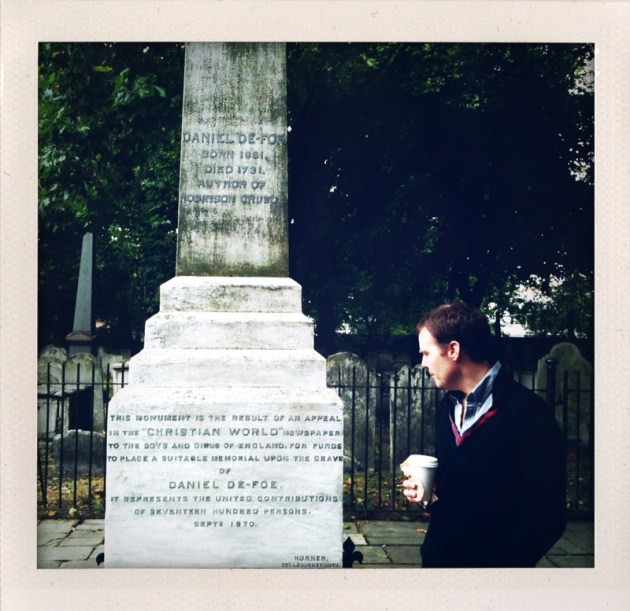
[Picture: Tom McCarthy and Daniel Defoe, Bunhill Fields, London, August 2010. By Andrew Gallix.]

C By Tom McCarthy

This appeared in the September 2010 issue of Dazed & Confused (vol. 2, issue 89, p. 196):

C by Tom McCarthy

Incest, spies and coke-fuelled adventures

Let’s not beat about the bush: Tom McCarthy’s third novel, C, is a masterpiece: a sprawling associative web that keeps generating new meanings as though of its own volition. “That’s the beautiful thing about what literature does to language,” says McCarthy. “You stick these slippery terms in and they start cross-fertilising in ways you never anticipated — incestuous ways.” C takes us from a fairytale English silk farm to spy-ridden Egypt by way of a central European spa town, aerial warfare and a coke-fuelled London filled with bright young Amazons. It is a comedy of errors, a gothic mystery, a boy’s own story; a traditional 19th-century novel seemingly rewritten by Burroughs or Ballard. You’ll find geometry, technology and trauma. Loops, repetitions and mutations. Incest, insects and radio bugs. And phantom words emanating from subterranean worlds half-glimpsed “at the dial’s far end”. Tune in…

DAZED & CONFUSED: C could be seen as a futurist novel. Serge, the protagonist, even seems to be partly modelled on Marinetti himself…
TOM MCCARTHY: I love Marinetti, and, yes, he’s part of Serge’s make-up, particularly in the war section. But Serge is equally a mixture of Freud’s Wolf Man, the beautifully fucked-up melancholic eternally grieving for his dead sister; and Alexander Bell, inventor of the phone (who also lost two siblings); and Howard Carter, the Egyptologist who disinterred the ur-family tomb; and a bunch of other people. I’m interested in the places where technology and mourning intersect.

There’s also a strong retro-futurist — even steampunk — element to C. Did you feel the need to revisit the early 20th century in order to reinvent the future of the novel?
Yes. Walter Benjamin says that the angel of history faces backwards. I think it’s the same for literature: you’ve got to look back in order to move forwards. It’s not just the foundations of contemporary technology that are being laid in the early 20th century (the code radio bugs used exactly anticipated text speak, just as lots of their output anticipated Twitter), but also literature’s period of high modernism that’s coming to a head. Not for nothing does the novel end in 1922: it’s the year that Ulysses and The Waste Land came out. The task for the contemporary writer (sadly, one which many writers of today are shirking) is to work through that period’s legacy — dynamically and radically, but attentively too.

All the major themes in C — from wireless technology to the discovery of Tutankhamun — come from your early experiments with the International Necronautical Society (INS), don’t they?
I had the idea for C while I was working on the INS project at the ICA. There, we had a radio station modelled on the illicit one in Jean Cocteau’s film Orphée (where the person transmitting is already dead), sending out all these coded poetic messages. I was looking at writing around encryption, and the concept of the ‘crypt’ that you get in psychoanalysis and philosophy.

Incest lies at the heart of C: this, for you, is the source code of western literature, right?
Yes. You go back from Nabokov through Faulkner through Racine right back to Sophocles, and incest is the central theme that keeps recurring. For Freud, the incest prohibition is what makes us civilised, socialised, even human, so that’s the taboo all tragic heroes, who are fundamentally doomed rebels, are most drawn towards transgressing.

Why do you think that all new means of telecommunication are linked to death, mourning and melancholia?
I don’t know if I can explain it. It’s just a pattern that keeps recurring. For every comm-tech invention, there seems to be a dead sibling somewhere. Bell even made a pact with his brother that, if one of them died like their other brother had, the surviving one would invent a device capable of receiving messages from the dead. Then the second brother dies, and Bell invents the telephone. He remained a rationalist, a sceptic — basically because his brothers never called. But the desire, the fantasy, is there in the technology: a ghost in the machine. It’s the same with radio. Seances in the 20s weren’t about spirit and ectoplasm any more: they were about “tuning in” to voices resonating on high frequencies, like radio waves. With the internet, it seems to be more about a presence than an absence: everything’s there, every click and keystroke ever made eternally retrievable, a giant archive. That’s a kind of haunting too, though.

Text and Photography
ANDREW GALLIX

All the Latest

One of my short stories — “Sweet Fanny Adams” — features in The Beat Anthology 2006-2010, edited by Sean McGahey and published on 30 April 2010 by Blackheath Books. The other contributors are: Darran Anderson, Jenni Fagan, Steve Finbow, Chris Killen, Melissa Mann, Sean McGahey, Ben Myers, UV Ray, Joseph Ridgwell, Lee Rourke and Susan Tomaselli. The first 52 copies include a playing card and a spoken word CD. More here.

Colossal Youth

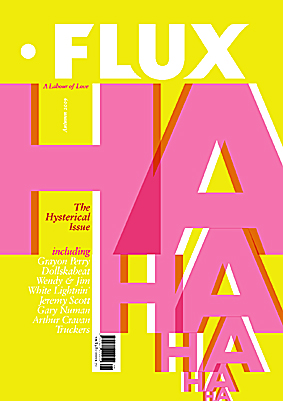
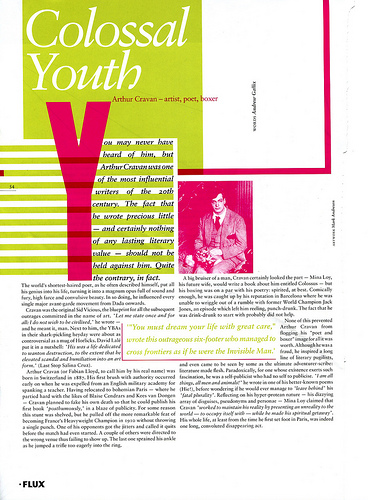
This appeared in the autumn 2009 issue of Flux magazine (issue 70, pp. 54-57):

Colossal Youth

Arthur Cravan — artist, poet, boxer

You may never have heard of him, but Arthur Cravan was one of the most influential writers of the 20th century. The fact that he wrote precious little — and certainly nothing of any lasting literary value — should not be held against him. Quite the contrary, in fact. The world’s shortest-haired poet, as he often described himself, put all his genius into his life, turning it into a magnum opus full of sound and fury, high farce and convulsive beauty. In so doing, he influenced every single major avant-garde movement from Dada onwards. Cravan was the original Sid Vicious, the blueprint for all the subsequent outrages committed in the name of art. “Let me state once and for all: I do not wish to be civilised,” he wrote — and he meant it, man. Next to him, the YBAs in their shark-pickling heyday were about as controversial as a mug of Horlicks. David Lalé put it in a nutshell: “His was a life dedicated to wanton destruction, to the extent that he elevated scandal and humiliation into an art form” (Last Stop Salina Cruz).

Arthur Cravan (or Fabian Lloyd, to call him by his real name) was born in Switzerland in 1887. His first brush with authority occurred early on when he was expelled from an English military academy for spanking a teacher. Having relocated to bohemian Paris — where he partied hard with the likes of Blaise Cendrars and Kees van Dongen — Cravan planned to fake his own death so that he could publish his first book “posthumously,” in a blaze of publicity. For some reason this stunt was shelved, but he pulled off the more remarkable feat of becoming France’s Heavyweight Champion in 1910 without throwing a single punch. One of his opponents got the jitters and called it quits before the match had even started. A couple of others were directed to the wrong venue thus failing to show up. The last one sprained his ankle as he jumped a trifle too eagerly into the ring.

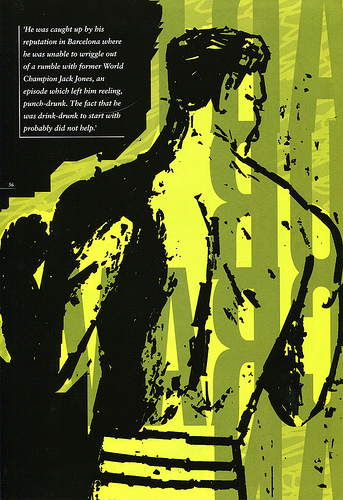
A big bruiser of a man, Cravan certainly looked the part — Mina Loy, his future wife, would write a book about him entitled Colossus — but his boxing was on a par with his poetry: spirited, at best. Comically enough, he was caught up by his reputation in Barcelona where he was unable to wriggle out of a rumble with former World Champion Jack Jones, an episode which left him reeling, punch-drunk. The fact that he was drink-drunk to start with probably did not help.

None of this prevented Arthur Cravan from flogging his “poet and boxer” image for all it was worth. Although he was a fraud, he inspired a long line of literary pugilists, and even came to be seen by some as the ultimate adventurer-scribe: literature made flesh. Paradoxically, for one whose existence exerts such fascination, he was a self-publicist who had no self to publicise. “I am all things, all men and animals!” he wrote in one of his better-known poems (“Hie!”), before wondering if he would ever manage to “leave behind” his “fatal plurality”. Reflecting on his hyper-protean nature — his dizzying array of disguises, pseudonyms and personae — Mina Loy claimed that Cravan “worked to maintain his reality by presenting an unreality to the world — to occupy itself with — while he made his spiritual getaway”. His whole life, at least from the time he first set foot in Paris, was indeed one long, convoluted disappearing act.

Cravan first gained the notoriety he so craved through Maintenant (“Now”), the literary journal in which he wrote everything under various noms de plume. It was partly a vanity outlet for his poems and essays, but primarily a means of courting controversy. Sourced from a butcher’s shop, the very paper it was printed on highlighted his utter contempt for belles-lettres. In the first issue, he ran a fake interview with Oscar Wilde — his late uncle — claiming that he was still alive. Cravan’s Bill Grundy moment occurred when he devoted an entire issue to gratuitous insults aimed at almost all the painters taking part in the 1914 Independents Exhibition. He opined, for instance, that only a good seeing-to would enable Marie Laurencin to fully grasp the true meaning of Art. As a result, her lover — the poet Guillaume Apollinaire — challenged Cravan to a duel which he narrowly avoided by apologising half-heartedly. He was also taken to court and almost lynched by a posse of avant-garde painters while selling copies of his journal from a wheelbarrow outside the exhibition room.

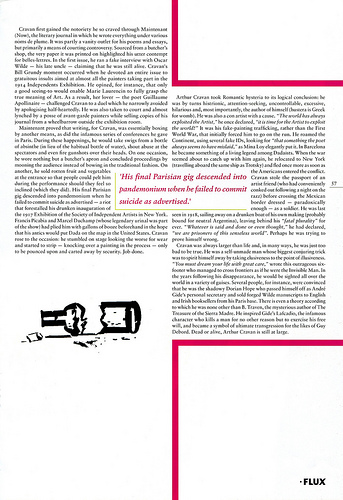
Maintenant proved that writing, for Cravan, was essentially boxing by another means, as did the infamous series of conferences he gave in Paris. During these happenings, he would take swigs from a bottle of absinthe (in lieu of the habitual bottle of water), shout abuse at the spectators and even fire gunshots over their heads. On one occasion, he wore nothing but a butcher’s apron and concluded proceedings by mooning the audience instead of bowing in the traditional fashion. On another, he sold rotten fruit and vegetables at the entrance so that people could pelt him during the performance should they feel so inclined (which they did). His final Parisian gig descended into pandemonium when he failed to commit suicide as advertised — a riot that forestalled his drunken inauguration of the 1917 Exhibition of the Society of Independent Artists in New York. Francis Picabia and Marcel Duchamp (whose legendary urinal was part of the show) had plied him with gallons of booze beforehand in the hope that his antics would put Dada on the map in the United States. Cravan rose to the occasion: he stumbled on stage looking the worse for wear and started to strip — knocking over a painting in the process — only to be pounced upon and carted away by security. Job done.

Arthur Cravan took Romantic hysteria to its logical conclusion: he was by turns histrionic, attention-seeking, uncontrollable, excessive, hilarious and, most importantly, the author of himself (hustera is Greek for womb). He was also a con artist with a cause. “The world has always exploited the Artist,” he once declared, “it is time for the Artist to exploit the world!” It was his fake-painting trafficking, rather than the First World War, that initially forced him to go on the run. He roamed the Continent, using several fake IDs, looking for “that something the poet always seems to have mislaid,” as Mina Loy elegantly put it. In Barcelona he became something of a living legend among Dadaists. When the war seemed about to catch up with him again, he relocated to New York (travelling aboard the same ship as Trotsky) and fled once more as soon as the Americans entered the conflict. Cravan stole the passport of an artist friend (who had conveniently conked out following a night on the razz) before crossing the Mexican border dressed — paradoxically enough — as a soldier. He was last seen in 1918, sailing away on a drunken boat of his own making (probably bound for neutral Argentina), leaving behind his “fatal plurality” for ever. “Whatever is said and done or even thought,” he had declared, “we are prisoners of this senseless world”. Perhaps he was trying to prove himself wrong.

Cravan was always larger than life and, in many ways, he was just too bad to be true. He was a self-unmade man whose biggest conjuring trick was to spirit himself away by taking elusiveness to the point of illusiveness. “You must dream your life with great care,” wrote this outrageous six-footer who managed to cross frontiers as if he were the Invisible Man. In the years following his disappearance, he would be sighted all over the world in a variety of guises. Several people, for instance, were convinced that he was the shadowy Dorian Hope who passed himself off as André Gide’s personal secretary and sold forged Wilde manuscripts to English and Irish booksellers from his Paris base. There is even a theory according to which he was none other than B. Traven, the mysterious author of The Treasure of the Sierra Madre. He inspired Gide’s Lafcadio, the infamous character who kills a man for no other reason but to exercise his free will, and became a symbol of ultimate transgression for the likes of Guy Debord. Dead or alive, Arthur Cravan is still at large.
In Theory: Mimetic Desire

This appeared in Guardian Books on 8 February 2010:

In Theory: Mimetic Desire

Nearly 50 years on, René Girard’s theory remains a powerfully illuminating insight into both literature and the world


Mediated desire … Amanda Drew as Emma and Simon Thorp as Rodolphe in Oxford Playhouse’s 2003 production of Madame Bovary. Photograph: PR

Many thanks for your insightful comments on “The Death of the Author” and interesting suggestions concerning future discussion topics — please keep them coming. All this feedback confirms the utility of a debate on the purpose of literary theory at a time when critics have all too often retreated into academia or become appendages of publishers’ marketing departments. Talented critics can do so much more than just test-drive the latest products for consumers. They can shape the zeitgeist, renew our perception of great literary works and even help authors make sense of their own worlds — a hat-trick René Girard pulled off with Deceit, Desire and the Novel.

Discovering Deceit, Desire and the Novel is like putting on a pair of glasses and seeing the world come into focus. At its heart is an idea so simple, and yet so fundamental, that it seems incredible that no one had articulated it before. Girard’s premise is the Romantic myth of “divine autonomy”, according to which our desires are freely chosen expressions of our individuality. Don Quixote, for instance, aspires to a chivalric lifestyle. Nothing seems more straightforward but, besides the subject (Don Quixote) and object (chivalry), Girard highlights the vital presence of a model he calls the mediator (Amadis of Gaul in this instance). Don Quixote wants to lead the life of a knight errant because he has read the romances of Amadis of Gaul: far from being spontaneous, his desire stems from, and is mediated through, a third party. Metaphysical desire — as opposed to simple needs or appetites — is triangular, not linear. You can always trust a Frenchman to view the world as a ménage à trois.

Mediation is said to be external when the distance between subject and mediator is so great that never the twain shall meet. This is the case of Don Quixote and Amadis, or Emma Bovary and the fashionable Parisian circles she dreams of. Here, the derivative nature of desire is clearly acknowledged. The hero of external mediation “worships his model openly and declares himself his disciple”. When mediation is internal, however, the distance between subject and mediator is small enough to give rise to rivalry between the two. The mediator, who aroused desire for the object in the first place, comes to be seen as an obstacle to the fulfilment of this very desire: “the model shows his disciple the gate of paradise and forbids him to enter with one and the same gesture”. Although now ostensibly a figure of hatred, the mediator continues to be idolised subterraneously or even subconsciously. In Proust‘s In Search of Lost Time, for instance, the Guermantes remain Mme Verdurin’s sworn enemies until the day when she marries into this family she had in fact secretly admired and envied all along.

Girard’s contention is that the need for transcendence has survived the decline of Christianity, resulting in the ersatz “inverted transcendence” of mimetic desire. The spread of this highly-contagious “ontological disease” gathers momentum in the works of Stendhal before reaching pandemic proportions in Proust and Dostoyevsky. Whereas Don Quixote is an “upside-down hero in a right-side-up world,” Julien Sorel (The Red and the Black) is a “right-side-up hero” in a topsy-turvy world. By the time we reach Dostoyevsky (Notes From the Underground, The Possessed), everything has gone awry. All these novels illustrate how internal mediation “triumphs in a universe where the differences between men are gradually erased”. The more egalitarian a society, the closer the mediator and the greater the rivalry.

In Stendhal’s worldview, there once was a golden age when the nobility’s social status was correlated with its nobility of spirit. Passion and spontaneity, which used to be the hallmarks of the true nobleman, have all but disappeared from The Red and the Black, giving way to abject vanity. After the French Revolution, it is no longer possible for the nobility to simply be: it must now justify its privileges in the eyes of “the Other”. In so doing, it becomes ignoble. The aristocrat mimics the bourgeois who mimics the aristocrat. At the level of individuals, this double mediation is a delicate balancing act in which the loser is the one who can no longer conceal his desire for the other, from the other. This revelation acts as an instant passion killer, since it shatters the illusion of “divine autonomy” that had proved so compelling. Open rejection, in turn, makes the heart of the spurned lover grow ever fonder.

Masochism — which features so prominently in both Proust and Dostoyevsky — is a by-product of the increasing proximity of the mediator; a means of enhancing his supposed divinity. The greater the obstacle he represents, the greater his divinity. Girard explains that we become masochists as soon as “we no longer choose our mediator because of the admiration which he inspires in us but because of the disgust we seem to inspire in him”. As the “ontological sickness” progresses, the desired object is increasingly forgotten — it virtually disappears in Dostoyevsky — to be replaced by the mediator. The masochist desires the obstacle which signals the divine presence of the mediator. In the same way, the Proustian snob puts up purely abstract barriers between himself and an object that is so ineffable it barely exists at all. This disappearance of the object is of no real consequence since it “loses its value in the very act of being possessed” anyway.

Writers themselves are not immune to mimetic desire. The release of a book is an “appeal to the public” which is frequently experienced as an affront to authorial pride. Aristocratic writers used to keep up appearances by claiming that they never intended their works to be printed. La Rochefoucauld even went as far as to claim that his manuscript had been stolen by a servant. The modern writer has no servants, so he makes “an anti-appeal to the public in the shape of anti-poetry, anti-novel, or anti-play. The main thing is to make the Other taste the rare, ineffable, and fresh quality of one’s scorn for him”. Sound familiar?

With Deceit, Desire and the Novel, René Girard wanted to demonstrate that the truly “great novelists reveal the imitative nature of desire” in their works. In the process, he reinterpreted some of the most important novels ever written, launched a devastating broadside against the inheritors of Romantic individualism and spawned a whole new sub-genre — mimetic theory — which has been applied to almost everything, from psychology to economics. Were it not for this brilliant debut, published in France back in 1961, incidentally, Facebook may have remained the plaything of a handful of Harvard geeks.

Peter Thiel — a venture capitalist whose mentor at Stanford was none other than Girard lui-même — soon spotted the commercial potential of a social networking site based on mimetic desire. In fact, the whole concept of viral, word-of-mouth marketing follows Girard’s principle according to which the strongest desires are those influenced by an admired third party. The gods haven’t withdrawn: they have gone online and their name is Legion. What the venerable Académicien makes of this exploitation of an “ontological disease” he has been denouncing for half a century is anyone’s guess.