
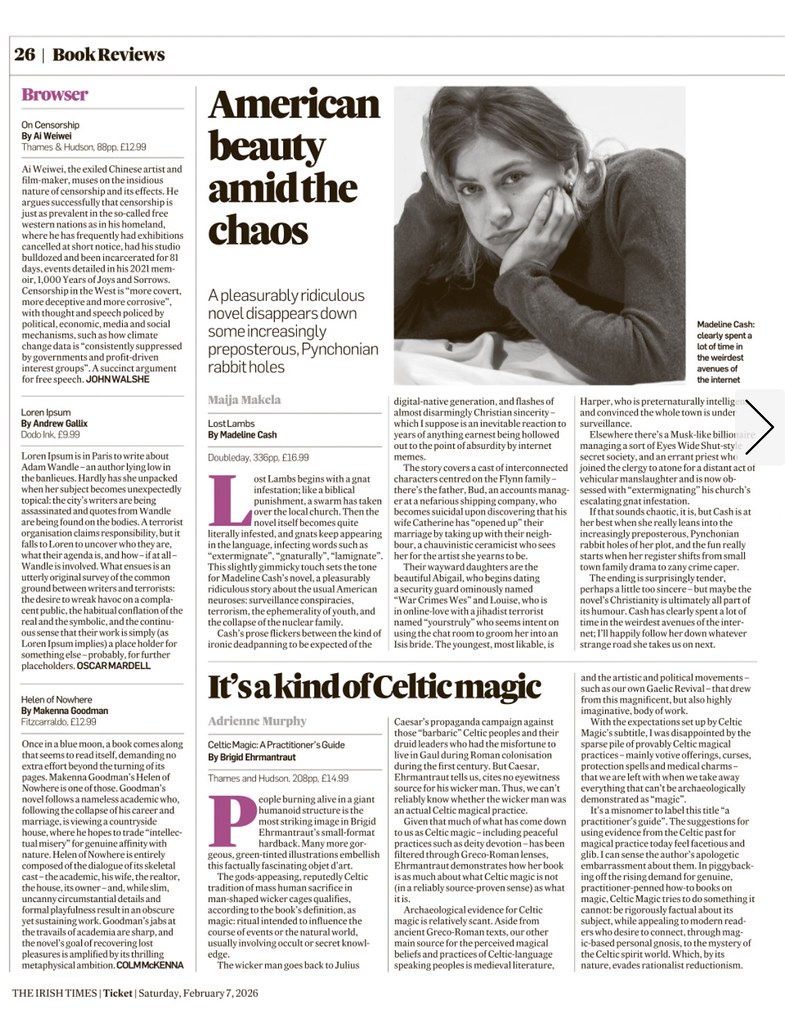
Oscar Mardell‘s review of Loren Ipsum in the Irish Times, 7 February 2026, p. 26.

In the 25 December 2025 edition of the TLS, Deborah Levy mentions the time I accompanied her to the Théâtre de la Huchette to see The Bald Soprano. Thankfully, she omits my coughing fit:
“…On a warm evening in October, I made my way with a friend to see The Bald Soprano / La Cantatrice chauve at the Théâtre de la Huchette, where it has been staged since 1957 in its original production, directed by Bataille and designed by Jacques Noël.”
“…My friend and I went to dine afterwards at a local bistrot, not on Rue de la Huchette. A few English tourists arrived and, as if summoned by Ionesco from the other side, began to talk loudly about shooting ducks on a country estate. All the clichés that Sontag loathed in Ionesco’s writing were performatively on display in 2025, as if harvested from an English-language textbook from 1948.”
Nesbitt, Huw. “Reading and Writing: Thirty Years of Textual Snapshots.” Review of Unwords by Andrew Gallix, Times Literary Supplement, 14 June 2024, p. 25
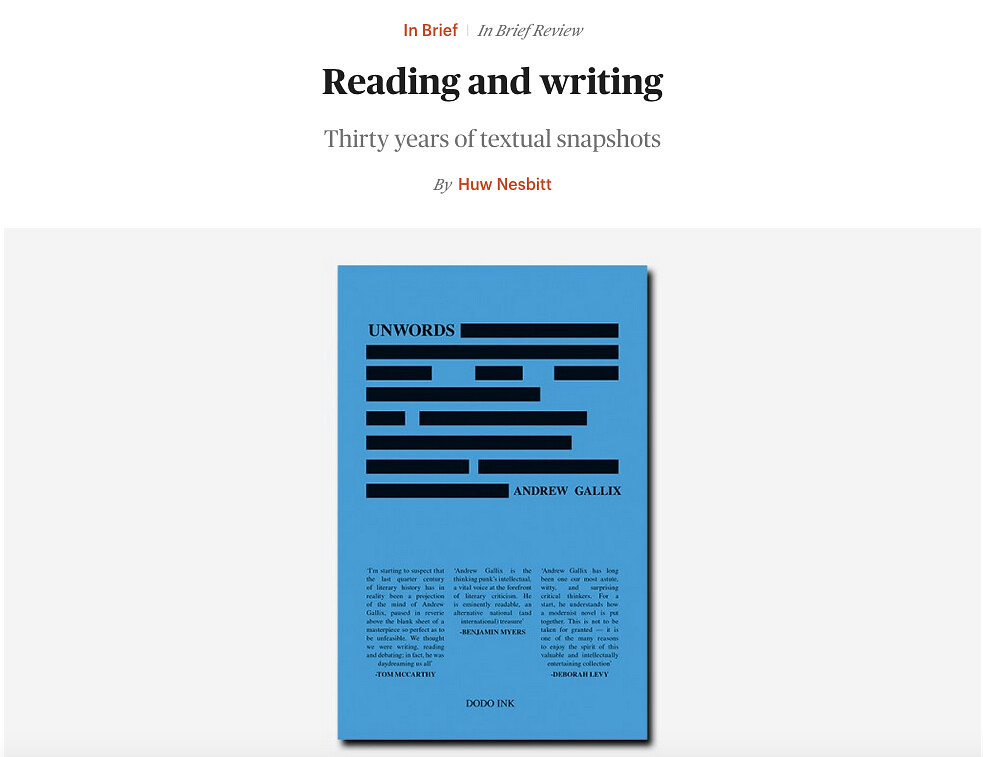
Masquerading as a wide-ranging collection of literary essays, Unwords is in fact a hybrid work of critical theory and biography. A reader might object that literature is already brimming with such experiments. Yet few are delivered with Andrew Gallix’s charm.
Originally published in the TLS, the Guardian, the Irish Times and 3:AM Magazine, the literary website Gallix founded in 2000, the essays in this collection are written in crisp newspaper prose, avoiding the preponderant “I” and paragraph-long sentences frequently found in creative non-fiction. At the book’s heart sits the story of Gallix’s writing career. In 1990, he landed a deal with a publisher for a book about a “middling English novelist and playwright (dead)”. Then Gallix blew it, writing an unwieldy, unfinishable Gesamtkunstwerk instead. Undeterred, he took to criticism, opting to sketch a treatise on literature via freelance commissions.
“The best authors … are wary of the consolations of fiction”, Gallix writes in an article on literary realism. “They sense that the hocus-pocus spell cast by storytelling threatens to transform their works into bedtime stories.” He prefers — and draws this collection’s title from — what Samuel Beckett described as the literature of the “unword”: fiction that isn’t just about something but is the thing itself. “The reality of any work of art is its form, and to separate style from substance is to ‘remove the novel from the realm of art'”, he notes in another essay, quoting the nouveau romancier Alain Robbe-Grillet.
To elaborate this thesis, he explores the work of authors often classed as stylists. Naturally there are big names: Jonathan Franzen, Joyce Carol Oates, Deborah Levy, Joshua Cohen. But, Gallix is equally at home with the obscure. “The book’s apparent lack of direction is part of a strategy … to ensure that it does not become another bogus piece of literary fiction”, he remarks of Lars Iyer’s Dogma (2012), a plotless novel about two bungling philosophy professors. “Perhaps what Tunnel Vision really aspires to be is a self-portrait without a self”, he observes of the Irish writer Kevin Breathnach’s autofictional debut (2019).
A sense of provocation permeates Unwords. This is reinforced by tributes to the Parisian punk icon Jacno (“He belongs to a long line of elegantly wasted rock dandies”) and the French-Egyptian postwar novelist Albert Cossery, who wrote only one sentence a day. For Gallix, literature doesn’t exist to be binged, to delight or comfort: novels are real objects requiring reflection, whose language and syntax very often lead us back to the world itself.
Unwords brings together thirty years of reading and literary contemplation. It offers what Roland Barthes termed biographemes, textual snapshots where life and literature are indistinguishable. “Simply put, life writing is writing as a way of life”, Gallix notes. From the disappointment of the book he never published, Unwords’ author has produced something rare: a work of criticism that aspires to the condition of art.
“New Novel, Old Master.” Review of Robbe-Grillet: L’aventure du Nouveau Roman by Benoît Peeters and Réinventer le roman: Entretiens inédits by Alain Robe-Grillet and Benoît Peeters, Times Literary Supplement, 23-30 December 2022, pp. 24-25.

Alain Robbe-Grillet was born in 1922 — modernism’s annus mirabilis — as though the future nouveau romancier were destined to inherit the experimental spirit of the times, taking postwar literature (and cinema) into uncharted territory. Nabokov, who described La Jalousie (1957) as the greatest love story since Proust, regarded Robbe-Grillet as the foremost French writer of his generation, and for several decades his international reputation, particularly in the United States, would place him firmly in the Camus and Sartre super-league. Yet official commemorations of the centenary of his birth have been conspicuous by their absence in France, a country usually prompt to celebrate its great authors and artists.
In his new biography, Robbe-Grillet: L’aventure du Nouveau Roman, Benoît Peeters suspects that he was deemed too “sexually and politically incorrect” to make the grade. Peeters goes on to suggest that this snub may well have appealed to the novelist’s contrarian temperament, adducing his belated election to the Académie française in 2004. Despite having coveted this accolade since the late 1950s, Robbe-Grillet would never be officially inducted owing to his obstinate refusal to follow protocol — a form of self-sabotage that enabled him to be both an insider and an outsider simultaneously. The arch avant-gardiste was not averse to playing the game, but wanted to do so on his own terms. His agonistic approach to fiction — writing “against” readers rather than “for” them — was matched by his controversial polemics on the novel as a genre. This combative attitude earned him a great deal of enmity at a time when literary matters were still taken very seriously indeed. Peeters reminds us at the outset that if no contemporary writer was ever subjected to so much vitriol (even his funeral elicited a bad write-up in Le Monde), Robbe-Grillet revelled in being reviled. “I owe everything to my opponents”, he once said, reflecting that he had been lucky enough to have had “good enemies” throughout his career. The extreme reactions he regularly inspired seemed, in his eyes, to prove that he was right, spurring him on while also providing his often difficult work with a great deal of free publicity in the mainstream media.
Peeters is a dab hand at biographies, having already produced weighty tomes on Hergé, Jacques Derrida, and Paul Valéry. The challenge here was that Robbe-Grillet had partly pre-empted this exercise with his Romanesques trilogy, published between 1985 and 1994, which combined personal reminiscences (particularly in Le Miroir qui revient) with delirious sexual fantasies (notably in Angélique ou l’enchantement) and outright fiction (see the passages devoted to the shadowy figure of Henri de Corinthe, a putative family friend who may or may not have existed). In the course of these three volumes, the “autobiographical system”, as Robbe-Grillet put it, gradually breaks down.
Another challenge was the sheer volume of material to sift through. Robbe-Grillet’s archives are contained in 459 large boxes — an embarrassment of riches that may serve, as the biographer surmises, as a rampart behind which the author can hide. In 2001 Peeters conducted a series of filmed interviews with the novelist, then almost 80, which were released as a double DVD. They have now been transcribed and published in book form. Réinventer le roman: Entretiens inédits is the perfect companion piece to the biography, giving us direct access not only to the author’s own conversational voice, interpretations and erudition on matters philosophical, historical and even botanical, but also to his jovial good humour and general geniality — characteristics with which he is seldom associated. It often feels, uncannily, as though Robbe-Grillet were giving a running commentary on Peeters’ future biography.
The greatest pitfall would have been to turn Robbe-Grillet into the kind of all-conquering hero he so detested in the novels of Balzac, yet there are definite shades of Rastignac to his boundless ambition. There is also another, more puzzling resemblance. In his infamous 1958 essay, “Nature, humanisme, tragédie”, he claims that in order to appear as true to life as possible, “a good ‘character’ in a [realist] novel must above all be double”. By this token Robbe-Grillet would have made a very good character indeed. As a child he frequently encountered his doppelgänger: he would enter a room and see himself sitting in the armchair. Peeters implies that this was a lifelong occurrence. With this in mind it is striking to note how frequently the question of Robbe-Grillet’s duality (and his duplicity) recurs throughout his career. As a young novelist he scoffed at the notion of vatic inspiration: the creator as a mere conduit, incapable of intelligent reflection on their work. Many of his detractors never forgave him for having the audacity to write novels while producing a theoretical discourse on his practice. The fact that his works were sometimes at odds with his theories enraged them even further — whether this was deliberate, as he later claimed, is open to debate.
The prime example here is La Jalousie — by his own admission (and from the title onwards) a veritable “festival of metaphors” — released at a time when he strongly objected in public to anthropocentric analogies. In the Entretiens Robbe-Grillet claims that some of the more far-fetched theories that were attributed to him, in the early days, actually stemmed from Roland Barthes, who had celebrated his first published novel, Les Gommes (1953), as an instance of object-oriented literature. He further explains that Barthes lost interest in his work as soon as it became patent — with Dans le labyrinthe (1959) — that his interpretations were no longer tenable.
This did not prevent Barthes from accepting to preface Bruce Morrissette’s The Novels of Robbe-Grillet (1963) and giving voice to the idea that there were, in fact, two Robbe-Grillets: the early, anti-humanist one, who slid down the surface of things and a humanist “Robbe-Grillet n° 2”, more preoccupied with symbols and feelings. In his postface to the 1964 paperback edition of Dans le labyrinthe, the theorist Gérard Genette argued, similarly, that Robbe-Grillet was driven to constantly justify himself because he was torn between his “positivist intelligence” and “poetic imagination”. In 1988, when Angélique ou l’enchantement appeared, Bertrand Poirot-Delpech, writing in Le Monde, reprised this view, opposing “Robbe”, the novelist, to “Grillet”, the essayist and critic. This theory was finally borne out — or, rather, enacted — by Franklin J. Matthews, who penned the postface to the 1972 paperback edition of La Maison de rendez-vous: in 2001 a researcher discovered that the “Australian academic” Matthews was none other than Robbe-Grillet himself, who had thus authored both the novel and its critique. In the Entretiens we learn that the writer replicated this pattern by dividing his oeuvre into two discrete periods. In the first, encompassing Les Gommes, Le Voyeur (1955) and La Jalousie (three books whose composition was carefully premeditated), everything is filtered through a single consciousness. Unlike its predecessors, Dans le labyrinthe was no longer based on a pre-existing plot line: the figure of the soldier lost in the city mirrors that of the writer now astray in the meanders of his work. It inaugurated a new period in which the narrative coherence of his early novels disappears altogether, along with most ontological certainties, leaving the text as a battleground, where various consciousnesses are vying for control.
Born and raised in Brest, Robbe-Grillet was a successful young agronomist, studying banana-crop parasites and even producing a face cream containing bull sperm. When attempting to account for his sudden turn to literature in 1950, he invoked “our two gendarmes”, Marx and Freud, according to whom everything is either political or sexual. The political explanation is that he came from a fanatically far-right family who supported Marshal Pétain and the Nazi invaders to the bitter end. The lies on which their values rested led him to reject the “world of ideology, where everything always works; everything is ordered”, including the humanist tenets of literary realism that cover up the messiness of the real world. Despite signing the pro-Algerian Manifesto of the 121 in 1960, Robbe-Grillet would always be suspected, in some quarters, of being a right-winger, notably for his rejection of social realism. Art, for him, is never just a means of embellishing a message: it is the message. A novel is therefore self-sufficient — “expresses nothing but itself” — and its “necessity” has nothing to do with its “utility”, political or otherwise.
The second explanation for Robbe-Grillet opting for literature revolves around his predilection for sadistic sexual practices, which — along with his impotence — set him apart, creating a need for artistic expression. This “sexual difference” manifested itself at an early age, with the porcelain dolls he delighted in torturing or the pictures of women being executed that exerted such a hold over him. Peeters describes his highly unconventional, but very happy, marriage to Catherine Rstakian, which lasted fifty years. In 1955 she offered him a whip as a birthday present; two decades on she offered him a young female admirer who longed to be his slave. At one stage they even shared the same mistress. Not only did she go on to write successful sado-masochistic books, she became a dominatrix, organising lavish S&M soirées. Robbe-Grillet, who was, unsurprisingly, often accused of misogyny, always encouraged her, believing it was important for women to express their sexual fantasies. His own played an increasingly important part in his work, even though he knew they would put off many readers.
He often claimed that the greatest opportunity of his career was that his first novel had been rejected by Gallimard, the embodiment of the French publishing establishment. This paved the way for his close relationship with Jérôme Lindon, at the head of Les Éditions de Minuit (which, ironically, was purchased by Gallimard in 2021), where all his books would be published. He soon became a literary adviser, reading hundreds of manuscripts for Minuit, and recruiting like-minded writers such as Nathalie Sarraute, Marguerite Duras, Michel Butor, Claude Simon and Robert Pinget (Samuel Beckett, an early admirer of Les Gommes, was already in-house). Lindon and Robbe-Grillet, who had a knack for publicity stunts, drew attention to this creative effervescence by capitalizing the phrase “nouveau roman” (new novel), which had been bandied about dismissively by a couple of critics. The Nouveau Roman was never a movement, like the surrealists, where you had to toe a certain line for fear of excommunication, but simply, as Robbe-Grillet put it, “a convenient label for writers seeking to express new relations between Man and the world”. In the late 1950s and early 1960s, he published a series of provocative articles in L’Express, outlining some of these new relations. They were collected in Pour un nouveau roman (1963), his most commercially successful book, which constitutes a devastating critique not only of the ideology that underpins much of nineteenth-century literature, but also of the contemporary novel’s ossification in the Balzacian mould. The novelist’s present task, he argues, is to describe the material world, not to project herself onto it or colonize it by assigning it a meaning; to record the distance between human beings and things without interpreting this distance as a painful division. “Man looks at the world”, but “the world does not look back”. However, in looking at the world, it undergoes a transformation: Robbe-Grillet’s descriptions seem to create their own objects, their own hallucinatory reality.
Benoît Peeters chronicles the ever-shifting alliances of the Nouveau Roman, the rivalry with Michel Butor (who thought Robbe-Grillet was jealous of his success), the rise and fall of Jean Ricardou as the movement’s theoretician, the American conferences; the times when the novelist was more interested in making films (following his collaboration with Alain Resnais on L’Année dernière à Marienbad) or simply living the life of a gentleman farmer, gardening and curating his collection of rare cacti. The Nouveau Roman was indeed the “last great French literary movement”, and it was high time its figurehead had his own biography.


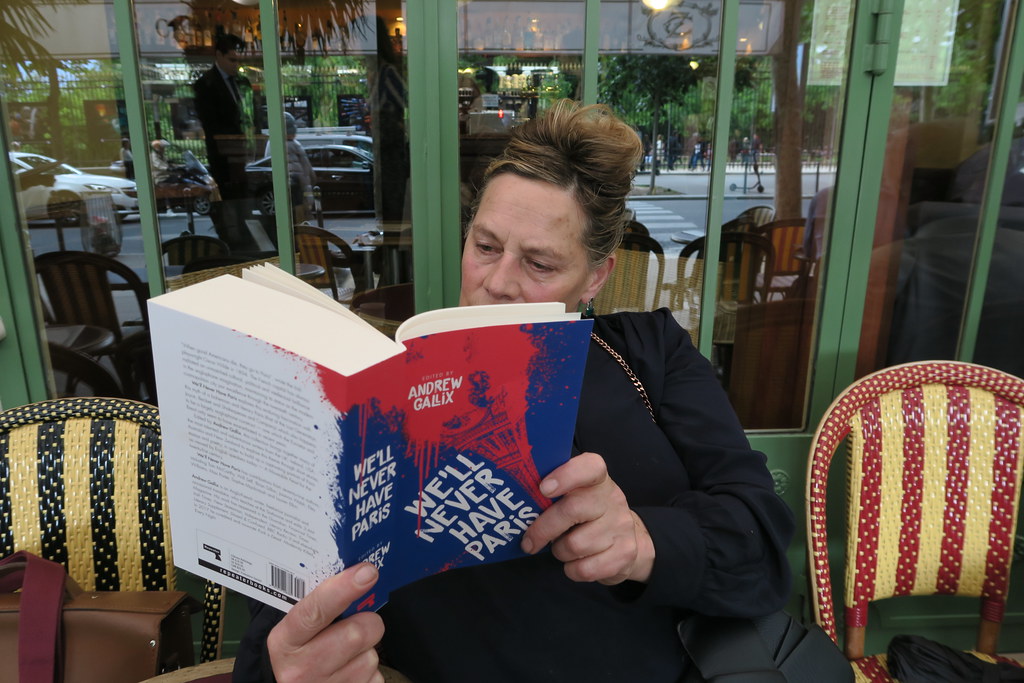
Catharine Morris — the Times Literary Supplement‘s travel editor — discusses We’ll Never Have Paris with Thea Lenarduzzi in the 30th May 2019 instalment of Freedom, Books, Flowers & the Moon, the TLS podcast. Listen to it here.

Natasha Lehrer has written an amazing, full-page review of We’ll Never Have Paris for the Times Literary Supplement, 31 May 2019, p. 12
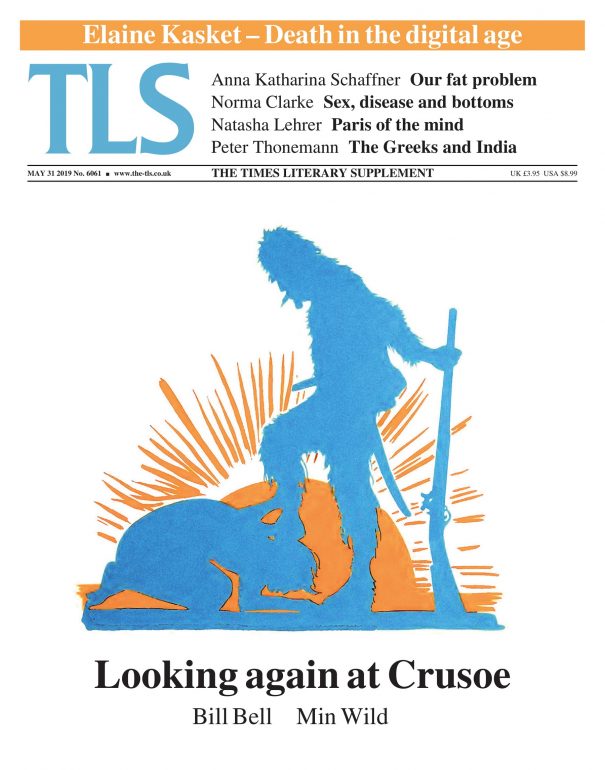
. . . In a fine introduction, the book’s editor Andrew Gallix claims Paris as a product of the anglophone imagination, ‘the locus of an art-life merger. . . It is the place that you have to go to to become, be recognised as, and lead the life of a writer”. . . . Gallix claims that the city is a “sort of neutral meeting ground for writers and readers from across the Anglosphere”, which, though possibly true, is not necessarily or always an entirely good thing for the writing that comes out of it. (Gallix’s own short story, featuring a cruelly plausible intellectual called Sostène Zanzibar, is one of the best pieces in the book — funny, allusive, clever and terribly French). . . .

My review of Steven Connor‘s Dream Machines appears in this week’s Times Literary Supplement.

Here’s a little teaser:
Dream Machines is an exercise in technography — an exercise, that is, in what Steven Connor defines as any kind of writing about technology that draws attention to the workings of its own machinery. Writing itself may be thought of as a kind of technology — a “mechanisation of speech”, as Connor puts it — and technology in turn may be thought of, perhaps less obviously, as writing. Demonstrating the latter, more counterintuitive proposition is the main purpose of this ground-breaking book.
For Connor, a professor of English at the University of Cambridge, all machines could stand as “preliminary sketches” towards an absolute machine: one that would align perfectly with the process of thinking itself. Examples abound, in both fact or fiction, of schemes for machines whose nuts and bolts evanesce into sheer fancy. Marie Corelli conjures up contraptions in her Romance of Two Worlds (1886) that are really…
My review of The Story of “The Face”: The Magazine That Changed Culture by Paul Gorman. The Times Literary Supplement, 24 & 31 August 2018, p. 43.
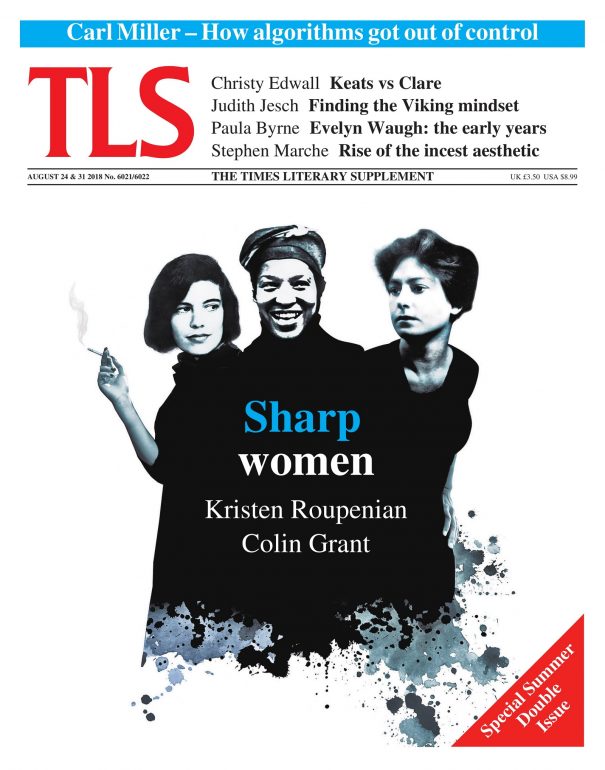
Paul Gorman’s The Story of “The Face” charts the rise and fall of the original style magazine, from its launch, on a shoestring, in 1980, to 1999, when it was sold off by its founder to a publishing giant. Nick Logan’s monthly would only survive five more years in the brave new digital world it had foreshadowed with its kaleidoscopic cultural coverage. Right from the start, The Face proved a victim of its own success. Having identified style as the prism through which to observe the zeitgeist — thereby eliding the distinction between men and women’s magazines — it soon spawned a host of imitators, not least among the Sunday supplements. At one stage, art director Neville Brody was producing a brand new typeface for every issue, in a frenetic bid to remain one step beyond.
This coffee-table book, with its hundreds of lavishly reproduced covers and innovative page layouts, does full justice to the “world’s best-dressed magazine”. Flicking through it, one witnesses The Face’s visual identity gradually shifting away from radical graphic design towards slick era-defining photography. The Story of The Face is a paean to its founder who, the author contends, has been airbrushed out of history. Logan’s fascination with the intersection between pop music and street style was rooted in his days as a young mod in the 1960s, which the title of his prime publication would allude to (a face being a top mod). After working for the local press, he graduated to the New Musical Express where he became editor at the age of twenty-six, in 1973, presiding over what was arguably the paper’s most important period. He left, following a breakdown, subsequently launching the hugely successful Smash Hits aimed at the post-punk teenybopper market.
The Face was ahead of its time, but also very much of it. The inaugural issue was even delayed by a printers’ strike. Although he knew that the Two Tone phenomenon had already peaked, Logan insisted on putting a picture of The Specials’ Jerry Dammers on the cover as the band typified the marriage of street style and popular music he intended to explore. In a landmark piece published a couple of years later, Robert Elms observed that youth culture now represented “not a rebellion but a tradition” — one, he may have sensed, that was drawing to a close. The days of the austerity dandies who, devoid of job or future, fashioned themselves into extravagant works of art, were numbered. Never again would style have so much substance. The Face chronicled the end of an era as much as it ushered in a new one, endowing its early strapline — “rock’s final frontier” — with a presciently valedictory tone.
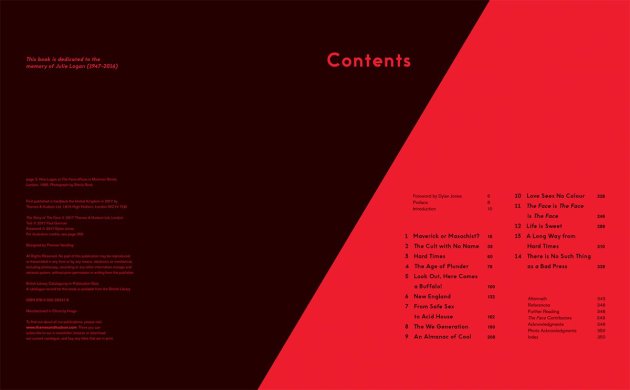


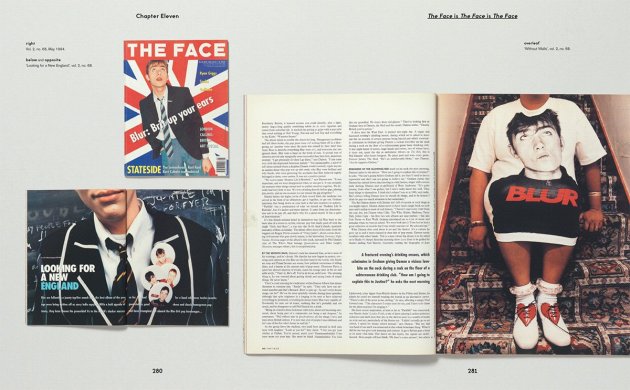

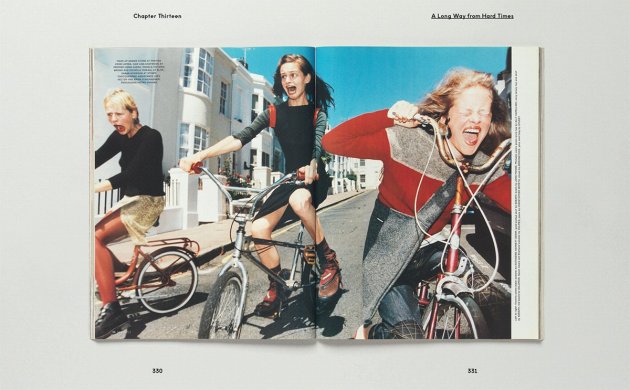
My short review of Paul Gorman‘s excellent The Story of “The Face”: The Magazine That Changed Culture features in the latest issue of The Times Literary Supplement, 24 & 31 August 2018, p. 43.

Here’s an extract:
. . . The Face was ahead of its time, but also very much of it. The inaugural issue was even delayed by a printers’ strike. Although he knew that the Two Tone phenomenon had already peaked, Logan insisted on putting a picture of The Specials’ Jerry Dammers on the cover as the band typified the marriage of street style and popular music he intended to explore. In a landmark piece published a couple of years later, Robert Elms observed that youth culture now represented “not a rebellion but a tradition” — one, he may have sensed, that was drawing to a close. The days of the austerity dandies who, devoid of job or future, fashioned themselves into extravagant works of art, were numbered. Never again would style have so much substance. The Face chronicled the end of an era as much as it ushered in a new one, endowing its early strapline — “rock’s final frontier” — with a presciently valedictory tone.
 ANDREW GALLIX