The Momus Questionnaire

Gallix, Andrew. “The Momus Questionnaire.” Minor Literature[s], 3 November 2017

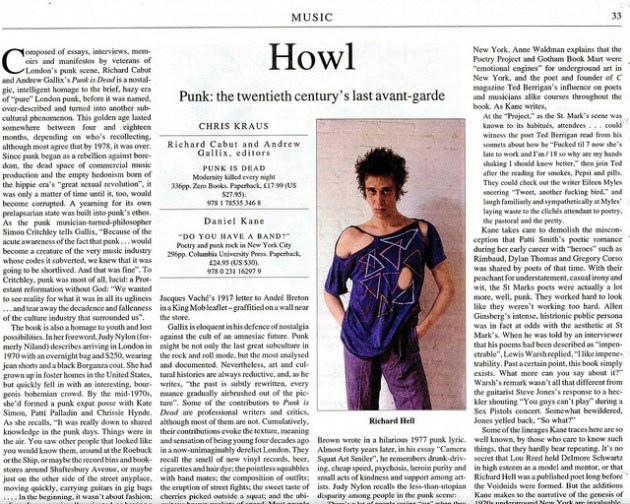
Punk is Dead: Modernity Killed Every Night, edited by Richard Cabutt and Andrew Gallix, is an academic investigation into the legacy of punk, featuring contributions from Penny Rimbaud of Crass, Tom Vague, Mark Fisher and many more. Investigating the philosophical lineage of punk, and the matrix which it provided for its adherents to explore fashion, politics and art, Punk is Dead brings together some of the most astute and insightful critical thinkers on punk in one volume. Andrew Gallix is also the founder and Editor-in-Chief of 3:AM Magazine, and lectures at the Sorbonne.

The Momus Questionnaire was created by musician Nick Currie, and is designed to identify the aspects of the subject’s personality which give them a positive self-image, or ‘subcultural capital’.

Have you rebelled against someone else’s dreary expectations of your life, and become something more unexpected?

My own, rather than someone else’s (then again, je est un autre). I promptly crush such occasional bouts of rebellion by expecting the unexpected, thus defeating the object.

What in your life can you point to and say, like Frankie, ‘I Did It My Way’?

Or, more fittingly in this instance, like Sid! Pointing is rude, but a recent ill-judged collaboration with a soi-disant friend does spring to mind. This dispiriting experience was an eye-opener worthy of Un Chien andalou, if you see what I mean. After all, vitreous humour is no laughing matter. As Flannery O’Connor observed — through her sizeable spectacles — some people ‘are interested in being a writer, not in writing. They are interested in seeing their names at the top of something printed, it matters not what’. Let them eat deadlines; I prefer mine alive!

What creative achievements are you most proud of?

My son, William.

If there was one event in your life which really shaped you, made you the person you are today, what would it be?

Being separated from my mother as a child was terribly traumatic. The pain was unspeakable, and it left me with a pervasive feeling of unreality. Being sent to France, when I did not speak a word of French, also left me with a lifelong sense of exile. Punk, which came along when I was 11, provided a refuge from all that. It was a home for the homeless. In his recent Asperger’s and Me documentary, Chris Packham talks about how punk allowed him to materialise his difference and flaunt it in the face of the world. I can really relate to that. I think that partly explains why the phenomenon was more important to some people who were involved than others.

If you had to make a rap song boasting about your irresistible charm and sexiness, how would you describe yourself?

As a filthy liar.

Have you ever made material sacrifices because of your integrity?

How long have you got?

Describe a public personality who exemplifies everything you’d like to be yourself, then another public personality who incarnates everything you’d least like to be.

I can’t think of two public figures who would really fit the bill offhand, but I can relate an odd anecdote that occurred, if memory serves, in the early 90s. I was walking in a local park, in South London, when I came upon a guy who was the spitting image of me. We walked past each other, then both stopped in our tracks and turned round at the same time. We faced each other — I myself and he himself — in shocked silence for a few seconds, then turned round and walked on again. I sometimes wonder if my doppelgänger (the word means double walker in German) is living the life I would have led had I remained in England. Has he stolen my life? In Johan Grimonprez‘s film Double Take, written by Tom McCarthy and based on a short story by Borges, we are told that ‘If you meet your double, you should kill him’. Is he still out there somewhere — and does he want to kill me?

If you were an Egyptian pharaoh and had to be buried with a few key objects to take to the next world, what would they be?

My collection of music papers and magazines that I began in 1977. When my mother moved into a smaller house, in 2012, I had to get rid of quite a few of them, but I managed to hold on to all those spanning the glory years of 77-81 and took pictures of all those that I disposed of. I know exactly where I was when I read a specific issue or article and, for some reason, they have always been of considerable importance to me. A tangible link to my past, no doubt. It’s also the interface between writing and punk that makes them so special. I was fascinated by people like Mark Perry, or Patrick Eudeline in France, who navigated from the page to the stage. I wanted to be a fanzine writer more than a musician. When my mother died, earlier this year, I had to bring the papers back to my place. I am surrounded by them now, and the realisation that they will never have the same significance to anyone else once I’m gone is rather disquieting. You keep all these things that mean the world to you, fret over losing them, and then you die.

Do you have a favourite joke, quotation or proverb?

Quotations. ‘”Everything is to be found in Peter Rabbit,” the Consul liked to say’ (from Malcolm Lowry’s Under the Volcano). ‘Awesome is the God who is not’ (from George Steiner’s My Unwritten Books).

Proverb. Never trust a punk with a property portfolio (from experience).

What’s your favourite portrait (it can be a song, a painting, a film, anything)?

My favourite portrait hangs in London’s Courtauld Gallery, sort of. On one occasion, I seemed to be the only visitor in the museum. Each new room I entered was empty, except one. At the far end stood a very elegant lady, probably in her late thirties, wearing an outsize New Look-style hat. She was gazing intently at a small golden frame in which one might expect to discover a little gem by one of the lesser masters. She looked round towards me, before departing, and I was able to see that she was also stunningly beautiful. I rushed towards the picture that had caught her attention for so long only to discover that it was a mirror.
Haunting Hauntology

Frances King, Georgia and Paul Smalera. “Nostalgia is the Ultimate Privilege.” Quartzy, 17 December 2017 2017:

Philosopher Jacques Derrida coined the term Hauntology in 1993 to describe nostalgia for an impossible future — a possible future that has since been overtaken by the events of reality. A sort of “what if” reverie, it is also a wordplay on the philosophical term ontology, or the study of the nature of being.

Hauntology is probably the first major trend in critical theory to have flourished online,” Andrew Gallix writes in the Guardian. “Today, hauntology inspires many fields of investigation, from the visual arts to philosophy through electronic music, politics, fiction and literary criticism. At its most basic level, it ties in with the popularity of faux-vintage photography, abandoned spaces and TV series like Life on Mars.”

Pretty Vacant Or Spiky-Haired Situationists?

Empire, Kitty. “Pretty Vacant Or Spiky-Haired Situationists?” The Observer (The New Review section), 19 November 2017, p. 36.

. . . Were the art school games of canny old hippies behind punk? Sometimes, but perhaps more in theory than practice. An essay in Punk Is Dead: Modernity Killed Every Night by fanzine writer Tom Vague retraces McLaren’s appetite for destruction back through the situationists, the lettrists, psychogeography and a tiny late 60s Notting Hill faction called King Mob (a reference to the Gordon Riots of 1780).

Authors Richard Cabut and Andrew Gallix have skin in the game; Cabut is an ex-punk (“In the summer of 1977 I am 17 – perfect”) who became a playwright, while Gallix is at the Sorbonne and edits a free-ranging literary webzine called 3:AM (“whatever it is, we’re against it”). The book’s title (Modernity Killed Every Night) quotes Jacques Vaché, friend to the surrealist André Breton. But Punk Is Dead isn’t end-to-end cultural theory; there’s a lot on clothes. Three strands unfurl — papers, essays and first-person accounts. Cabut and Gallix have included historical documents — such as Penny Rimbaud’s 1977 essay, Banned from the Roxy, newly annotated by the Crass drummer — while Gallix argues that punk started ending when it acquired a name. Jon Savage is here, and Ted Polhemus and Vermorel (again).

As that list attests, punk can be a tiresomely Boy’s Own narrative, to which former Slit Viv Albertine’s 2014 memoir was a potent corrective. With the exception of Judy Nylon’s introduction and the reminiscences of go-go dancer turned drummer Dorothy Max Prior, however, this collection is let down by its dearth of female voices. Perhaps the notion to take away from both books — indeed from punk itself — is the one of endless possibility. As an interview with the punk turned philosopher Simon Critchley attests, punk unleashed ideas. It palpably changed suburban teenage futures, rather than ending them.

Book of the Year

Booker Prize-shortlisted novelist and playwright Deborah Levy has kindly chosen my Punk is Dead: Modernity Killed Every Night as one of her two books of the year.

Levy, Deborah. “Books of the Year.” New Statesman, 17-23 November 2017, p. 41:

I thoroughly enjoyed Punk Is Dead: Modernity Killed Every Night (Zero Books). Edited by Richard Cabut and Andrew Gallix, this anthology of essays, interviews and personal recollections reflects on the ways in which punk was lived and experienced at the time. Gallix flips his finger at those who see nostalgia as an affliction and rightly attempts to promote the fragmented and contested legend of punk to “a summation of all the avant-garde movements of the 20th century … a revolution for everyday life”.

Rebuked

O’Sullivan, James. “Electronic Literature’s Contemporary Moment: Brezze and Campbell’s ‘All the Delicates Duplicates’.” Los Angeles Review of Books, 7 November 2017:

Almost a decade has passed since 3:AM Magazine founder Andrew Gallix, writing in the Guardian, proclaimed the imminent death of electronic literature, that is, literature with an inherently computational aesthetic. There was some merit to Gallix’s argument, his concern being that the form’s emphasis on multi-modality was such that the word would eventually get lost. In many instances — say, where play is accentuated — this has indeed been the case. But today, for every work of e-lit that is more game than literary game, there are those pieces where language remains essential. All the Delicate Duplicates, the latest brainchild of Mez Breeze and Andy Campbell, is a superlative example of the latter, and thus a serious rebuke of Gallix’s assertion.

Electronic literature can be a lot of things — literary games, hypertexts, interactive fiction, generative poetry, bots — but it is always more than the product of digitization; ebooks, which merely mimic print on a screen, typically don’t count. E-lit relies on computational affordances for creative expression, privileging language within a constellation of modalities. Still, resistance to its charms endures.

Responding to Gallix’s provocation in a piece published in the Electronic Book Review, Dene Grigar*, current president of the Electronic Literature Organization, points to those barriers that have marginalized e-lit in classrooms and popular culture, arguing that resistance to the form emanates from “deeply-held views of the proper relationship between humans and machines, of what constitutes the good, the beautiful and the true, and of the nature of art.” (…)

(…) But the achievements of Duplicates are not just contextual. If Breeze and Campbell are to be commended for any aspect of their ambition, it should be for their efforts to juxtapose the literary and the digital in a manner that genuinely advances the field and forcefully responds to naysayers such as Gallix that, no, electronic literature is not dead, it is everywhere, it is thriving, and it is literary. Ten years ago, the future of electronic literature was legitimately being questioned. Ten years from now, I expect that we will be reflecting on the present moment as that which saw the form truly begin to build on the work of its pathfinders — to borrow from Grigar and Moulthrop — and progress toward its potential, both as an aesthetic experience and as an act of expression capable of permeating the public consciousness. There is little doubt that such reflection will place much focus on the work of Mez Breeze and Andy Campbell, the pathfinders of their day.

[* She accused me at the time of misquoting her in my Guardian piece, which is absolutely not true. I quoted her verbatim, and — sensing that what she had written might be misconstrued by some of her colleagues — had even gone to the trouble to double-check that I had permission to quote anything from the email in which she had answered my questions.]

Slow Writing Revisited

Tranter, Rhys. “Andrew Gallix on the Virtues of Writing Slowly.” RhysTranter.com, 28 October 2017:

Since interviewing Michelle Boulous Walker about “slow philosophy” earlier this month, I have been thinking about the way we approach writing within institutional or commercial settings. It seems I am not the only one. Lauren Elkin has posted a link to a piece by Andrew Gallix where he reflects on the benefits of writing at a slower pace:

[B]ack in February, I expressed concern at the accelerating pace of publishing and called (half-jokingly) for the creation of a Slow Writing Movement (SWM), modelled on the Slow Food phenomenon. Word processing probably enables people to write faster than ever, and the internet provides the sometimes dubious means of instant publication.

As a result, what often passes for fiction today would have been considered no more than an early draft only a few years ago. In truth, however, the digital age has simply compounded a problem caused by the increasing hegemony of one school of writing (the Ionic) over another (the Platonic).”

Andrew Gallix, The Guardian

Sketching a brief history of Ionic vs. Platonic writing, Gallix identifies a social/economic bias that sets the quick work of the “hack” against the slow, patient verse that privilege can afford. But his central point remains crucially relevant in a digital age of around-the-clock productivity: perhaps a Slow Writing Movement can make us stop for a moment to catch our breath?


Punk is Dead: Modernity Killed Every Night Book Launch

J

Punk is Dead: Modernity Killed Every Night, the book I’ve co-edited and co-written with Richard Cabut, is published by Zero Books on 27th October.

It is composed of 3 elements, all mixed up:
— A (slightly) more theoretical approach than you’ll usually find in this kind of book (there’s an interview with philosopher Simon Critchley, for instance, or a piece on proto Dadaist Arthur Cravan).
— A series of personal recollections from musicians and fanzine writers highlighting the way punk was actually experienced at the time (Judy Nylon, Andy Blade of Eater, Paul Gorman, Tony D of Ripped & Torn/Kill Your Pet Puppy, Tom Vague…).
— Historical documents (Jonh Ingham’s first piece on the Patti Smith Band, for instance, or Penny Rimbaud’s “Banned from the Roxy” rant-manifesto, republished in book form for the very first time).

Here is a full list of contributors:

Andy Blade, Neal Brown, Richard Cabut, Simon Critchley, Tony Drayton (Tony D), Mark Fisher, Andrew Gallix, Paul Gorman, Barney Hoskins, Jonh Ingham, Judy Nylon, Dorothy Max Prior, Ted Polhemus, Simon Reynolds, Penny Rimbaud, Nicholas Rombes, Jon Savage, Bob Short, Tom Vague, David Wilkinson, David and Stuart Wise.

Where Place Takes Place

My piece on Ian Nairn’s Nairn’s Paris appears in this week’s New European, out today:

Nairn has a penchant for undistinguished locations, where “there is almost nothing to look at in the usual sense”; where space spaces out and place can take place. In an entry not included in the present edition, he praises Quevauvillers’ features, “all lying around waiting for nothing to happen”. Nothing happened with a vengeance, when he and his wife, high on hiatus, spent a “very wet day” near a suburban station “not going to the Air Museum”: “In London it would have been a misery; in Paris it became The Day the Rain Came, luminous and isolated”. Numinous too. There is a Zen-like quality to these mini epiphanies — these lulls in the topographer’s relentless perambulations — which signals a fleeting sense of arrival: “the moment you give up and relax, the city will accept you. All you have to do is put your arse on a café seat, park bench, or low wall, and look”.

All Representation is Ghostly

Walley, Joanne ‘Bob’ and Lee Miller. “The Hauntologies of Clinical and Artistic Practice.” Risk and Regulation at the Interface of Medicine and the Arts: Dangerous Currents, edited by Alan Bleakley, Larry Lynch and Greg Whelan, Cambridge Scholars Publishing, 2017, pp. 101-102:

And while it [hauntology] absolutely applies to the digital, the dispersed, the postmodern, it might also be indicative of all arts practice. As Andrew Gallix observes:

[w]hen you come to think of it, all forms of representation are ghostly. Works of art are haunted, not only by the ideal forms of which they are imperfect instantiations, but also by what escapes representation. See, for instance, Borges’s longing to capture in verse the “other tiger, that which is not in verse”. Or Maurice Blanchot, who outlines what could be described as a hauntological take on literature as “the eternal torment of our language, when its longing turns back toward what it always misses”. Julian Wolfrey argues in Victorian Hauntings (2002) that “to tell a story is always to invoke ghosts, to open a space through which something other returns” so that “all stories are, more or less, ghost stories” and all fiction is, more or less, hauntological (Gallix, 2011: UP).

Resemblance in the Work of Jochen Gerz

I have translated Octave Debary‘s Resemblance in the Work of Jochen Gerz (French title: La ressemblance dans l’oeuvre de Jochen Gerz) published by Créaphis éditions on 1 June 2017. It is a bilingual edition, with my English translation appearing on each page beside the original French text.

My aim here is to go on a journey down this road with Jochen Gerz. To strike up a conversation, not so much about his work as one that winds its way through his works. I wish to chart the trajectory I have been following as an anthropologist studying remains and the remains of history, which has led to a decade-long dialogue with Gerz’s oeuvre. Those artworks that he often abandons, once created, offering them up to the city and passers-by. Gerz is one of the foremost contemporary artists of memory and public space.