[SIC]

Jeff Bursey, Rev. of [SIC], by Davis Schneiderman, The Quarterly Conversation 10 March 2014

In 2011 Andrew Gallix, in the Guardian, wrote a piece on unread difficult books, and he mentioned “an anthology of blank books [edited by Michael Gibbs] entitled All Or Nothing.” We can consider Blank as continuing that line. Kenneth Goldsmith’s prefatory essay “Why Conceptual Writing? Why Now?” in Against Expression: An Anthology of Conceptual Writing (2011) contains these useful lines: “What has happened in the past fifteen years has forced writers to conceive of language in ways unthinkable just a short time ago. With an unprecedented onslaught of the sheer quantity of language . . . , the writer faces the challenge of exactly how best to respond.” In volume one of his trilogy, Schneiderman edged near to muteness, but in [SIC] he has positioned himself, the work, and us in a new spot. His latest book is filled with words. None of them are his.

The Texture of the Ripples

Nicholas Rombes, who was Writer in Residence over at Necessary Fiction in December 2013 and January 2014, invited Tobias Carroll, Cari Luna, Lincoln Michel, Masha Tupitsyn, Karolina Waklawiak, Joanna Walsh, and myself to contribute fiction and non-fiction pieces on the theme of movie writing. You will find Nicholas Rombes’s own fine offering here.

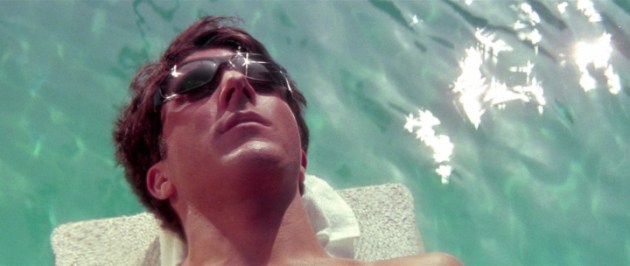
thegraduate1
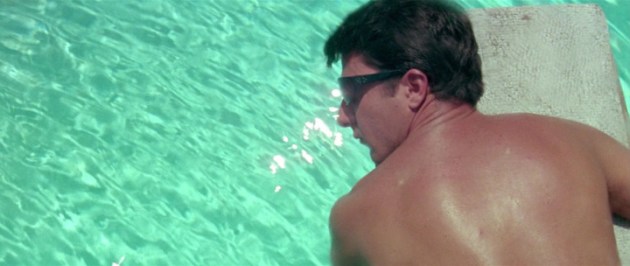
thegraduate2
thegraduate2
thegraduate4

And here’s a short extract from my essay, “The World Without Me“:

Soon Benjamin will need to escape, choose some course of action. He is on a collision course with Elaine, the accident that has already happened. In the meantime, he is a castaway adrift upon shimmering amniotic fluid. A young man without qualities, in trunks and sunglasses, cradling a can of beer on his belly — Bartleby Californian-stylee. I like him best when he just goes with the flow; that is, when he goes nowhere. The camera lingers longingly on the texture of the ripples. Sunny constellations twinkle on the celestial water’s surface. Benjamin, recumbent on his lilo, fades out as the ever-morphing abstract of light reflections fades in.

De Rigueur

My piece on realism is referenced, rather dismissively, by J. W. Cormack in a question he puts to the excellent Jason Schwartz. Is it really contentious to claim that most people’s idea of a traditional novel — a “proper” novel — is (alas) one which can be loosely defined as “realist”?

J. W. Cormack, “Jason Schwartz,” BOMB 7 January 2014

Speaking of category, I read a fairly de rigueur article from The Guardian, one of those “end of fiction” pieces you see every few years — although this one seemed to be equating “traditional fiction” with “the realist novel.” Is this a mistake? Do you feel like the world needs a different fictive vocabulary than the purely representational one we’ve become accustomed to?

Another Pint and Molotov Cocktail

My 2007 interview with George Berger appears in Let’s Submerge: Tales From the Punk Rock Underground (released on 26 November 2013). I get a lovely mention in the Introduction: “This is a collection of other writings, particularly columns I wrote for the excellent 3ammagazine.com at the bequest of its equally excellent editor Andrew Gallix. Their slogan ‘whatever it is, we’re against it’ neatly steals a great attitude from Groucho Marx”. I’m also mentioned at the beginning of the interview with Penny Rimbaud: “I interviewed Penny for Abisti, my online magazine in 1999. It was as a result of reading this interview that Andrew Gallix got in touch with me and invited me to write for 3:AM Magazine. Penny Rimbaud remains the most fascinating interviewee you could possible hope to spend time with”. Here’s a picture I took of George Berger at Waterloo Station in April 2006:

georgeberger

La faim du livre

Along with Gérard Berréby, Augustin Trapenard, and Hervé Laurent, I was interviewed by Linn Levy for a piece entitled “La faim du livre” which appeared in the December 2013 issue of Swiss magazine Edelweiss. The article features on pp. 44-47; my interview is on p. 46.

La faim du livre

Edelweiss part en quête de la littérature contemporaine, des mots qui dérangent et se demande si être écrivain veut encore dire quelque chose par les temps qui courent. Quatre intellectuels se penchent sur ces questions et nous éclairent.

«Nous sommes les visages de notre temps», clamaient les futuristes russes, le poète Maïakosvki en tête, il y a exactement un siècle, pétris de la conviction que l’art qu’ils inventaient allait renverser l’ordre des choses, qu’en récrivant le monde ils façonneraient le futur. Et aujourd’hui? A qui appartiennent les visages de l’époque contemporaine? Peut-on encore écrire? Et quels sont, parmi le demi-millier d’ouvrages publiés cette rentrée en Suisse et en France, ceux qui tordent la littérature, l’éprouvent, l’inventent? Oui, dans quels livres trouve-t-on les questions que nous ne nous sommes pas encore posées? Difficile pour le lecteur de se retrouver dans le magma de fictions qui ornent les étals des librairies comme les marchandises envahissent les hypermarchés. Le divertissement, devenu la norme au risque d’endormir insidieusement les esprits, laisse peu de place au doute, la tension semble diluée, presque rien ne dérange, pas grand-chose ne dépasse. Alors, pour celui qui a faim d’autre chose que de spectacle et qui ne déteste pas être dérangé – «Etre scandalisé, un plaisir», assurait Pasolini –, il s’agit de résister en cherchant les lignes qui dévient, la littérature, la vraie, ce souffle qui a «la faculté d’empêcher la folie du monde de s’emparer totalement de nous», comme l’écrit Alberto Manguel. Quatre experts nous éclairent sur les mots d’aujourd’hui, l’influence du web, la mort imminente du droit d’auteur, celle de la figure de l’écrivain, sur le remix aussi, et l’irrévérence anglo-saxonne ou helvétique… L’éditeur Gérard Berréby, l’écrivain et professeur Andrew Gallix, le journaliste Augustin Trapenard et le critique d’art Hervé Laurent ont accepté de surcroît de dévoiler leurs titres préférés de la rentrée.
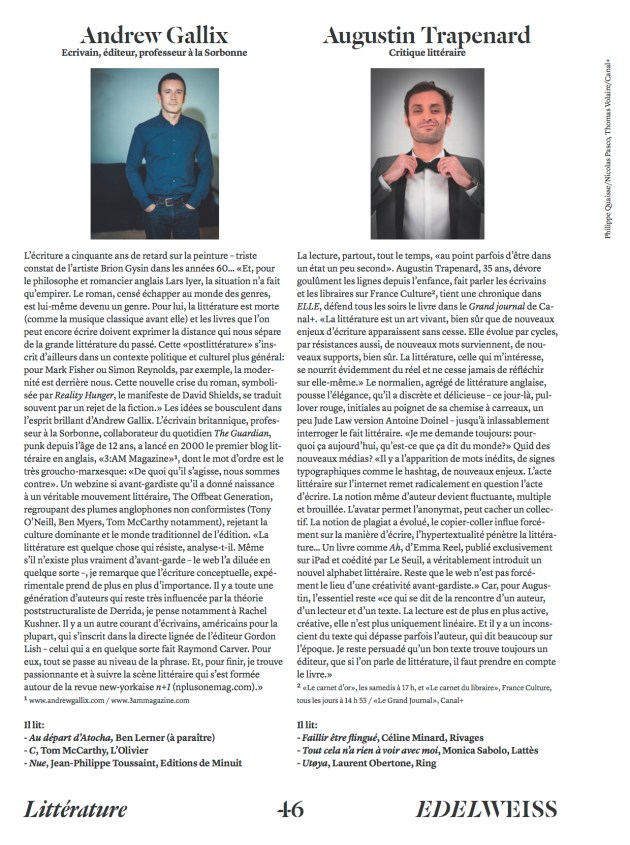
Andrew Gallix
Ecrivain, éditeur, professeur à la Sorbonne

L’écriture a cinquante ans de retard sur la peinture – triste constat de l’artiste Brion Gysin dans les années 60… «Et, pour le philosophe et romancier anglais Lars Iyer, la situation n’a fait qu’empirer. Le roman, censé échapper au monde des genres, est lui-même devenu un genre. Pour lui, la littérature est morte (comme la musique classique avant elle) et les livres que l’on peut encore écrire doivent exprimer la distance qui nous sépare de la grande littérature du passé. Cette «postlittérature» s’inscrit d’ailleurs dans un contexte politique et culturel plus général: pour Mark Fisher ou Simon Reynolds, par exemple, la modernité est derrière nous. Cette nouvelle crise du roman, symbolisée par Reality Hunger, le manifeste de David Shields, se traduit souvent par un rejet de la fiction.» Les idées se bousculent dans l’esprit brillant d’Andrew Gallix. L’écrivain britannique, professeur à la Sorbonne, collaborateur du quotidien The Guardian, punk depuis l’âge de 12 ans, a lancé en 2000 le premier blog littéraire en anglais, «3:AM Magazine»1, dont le mot d’ordre est le très groucho-marxesque: «De quoi qu’il s’agisse, nous sommes contre». Un webzine si avant-gardiste qu’il a donné naissance à un véritable mouvement littéraire, The Offbeat Generation, regroupant des plumes anglophones non conformistes (Tony O’Neill, Ben Myers, Tom McCarthy notamment), rejetant la culture dominante et le monde traditionnel de l’édition. «La littérature est quelque chose qui résiste, analyse-t-il. Même s’il n’existe plus vraiment d’avant-garde – le web l’a diluée en quelque sorte –, je remarque que l’écriture conceptuelle, expérimentale prend de plus en plus d’importance. Il y a toute une génération d’auteurs qui reste très influencée par la théorie poststructuraliste de Derrida, je pense notamment à Rachel Kushner. Il y a un autre courant d’écrivains, américains pour la plupart, qui s’inscrit dans la directe lignée de l’éditeur Gordon Lish – celui qui a en quelque sorte fait Raymond Carver. Pour eux, tout se passe au niveau de la phrase. Et, pour finir, je trouve passionnante et à suivre la scène littéraire qui s’est formée autour de la revue new-yorkaise n+1 (nplusonemag.com).»
1 http://www.andrewgallix.com / http://www.3ammagazine.com

Il lit:
Au départ d’Atocha, Ben Lerner (à paraître)
C, Tom McCarthy, L’Olivier
Nue, Jean-Philippe Toussaint, Editions de Minuit
New Modernist

Douglas Glover, “The End of Realist Stories — Andrew Gallix @ theguardian.com,” Numéro Cinq Blog 12 November 2013

Or “Fuck Realism” as he says on his blogpost linking to the essay, which, yes, is an impassioned cry against the reductive, prosaic monotony of what Northrop Frye called “low mimetic” realism, the realism of the middle of the road, market driven, read-and-toss, consumer fiction of our day (and days before). Gallix is a leading new Modernist (I keep trying to come up with a tag that will fit the bill — this one is provisional), founder of 3:AM Magazine in the UK, and contributor to Numéro Cinq. Put this new essay from the Guardian together with his essay “On Literary Bondage” from our August issue and then throw in my essay “The Novel as a Poem” and figure out where you stand.

Fighting Fiction with Fiction

Bethanie Blanchard, “This Week in Books,” Guardian Australia Culture Blog Sunday 17 November 2013

Lars Iyer, shortlisted for the Goldsmiths prize — an award celebrating innovation in the form of the novel — has argued that the time for literary novels is over. In an interesting response, Andrew Gallix considers the death of realist literary fiction and the uncertainty of its future. “Literature only coincides with itself when it claims to be what it is not. As soon as it acknowledges its made-up nature, the novel looks back at itself in anger; becomes its own worst enemy,” he writes. Gallix highlights the historical development of the form of the novel, the limitations of mimetic storytelling, and the uncertain way forward for “fighting fiction with fiction”.