The Never Before

Peter Markus, “Fiction as Magic, Language as Spell: Peter Markus with Lily Hoang,” The Brooklyn Rail 3 February 2015

The hum is what I’m ultimately and unfailingly chasing after in all of this: when I bring my gaze to a painting, when I lean my ears to any acoustical sound, when I hold in my hands the pages that belong to others, when I enter into whatever kind of church or other kind of cave that I seek to climb and hide inside. Some might call this a search for the primal, or the sublime, or the spiritual, or an encounter with the otherworldly, or better yet the hunting down for that thing itself which hasn’t yet been named. For me that’s what it all boils down to: the wish to tap into the never before. That’s the best way for me to try to say it with words. I want to be transported to a place where words no longer mean what we think they mean. Maybe this is the revelation behind it all, the magic herb for us to place beneath our tongues.

All Things Resist Being Written Down

Franz Kafka, Diaries, 1910-1923 (New York: Schocken Books)

20 October 1913. …I don’t even have the desire to keep a diary, perhaps because there is already too much lacking in it, perhaps because I should perpetually have to describe incomplete — by all appearances necessarily incomplete — actions, perhaps because writing itself adds to my sadness. …All things resist being written down.

The Book-Beyond-The-Book

Tom McCarthy, Satin Island (2015)

…this not-Report you’re reading now, this offslew of the real, unwritten manuscript… (p. 115)

I’d begun to suspect — in fact, I’d become convinced — that this Great Report was unplottable, unframeable, unrealizable: in short, an in whatever cross-bred form, whatever medium or media, unwritable. Not just by me, with my limited (if once celebrated) capabilities, but fundamentally, essentially, inherently unwritable. . . . Even when I reasoned these last, deranged notions back out to the fringes of my mind, I was still left with the immovable fact of the thing’s unwritability. This filled me with anger, and a feeling of stupidity, and sadness, too — grief not for an actual loss but, worse, for a potential or imaginary one: this beautiful, magnificent Report: this book, the Book, the fucking Book, that was to name our era, sum it up; this book that left the format of the book itself behind, this book-beyond-the-book. . . . (pp. 115-116)

A Normal Novel

Adam Thirlwell, Interview by Alex Clark, The Observer 25 January 2015

One problem with writing is to find something that survives its finishing, that still feels as ruthless or nasty or mischievous as when it was begun. The finished object is always neater than expected. The dream is of this entirely impolite object, a gruesome and difficult toy. And then always once you’ve finished it, it turns out to be a normal novel

The End

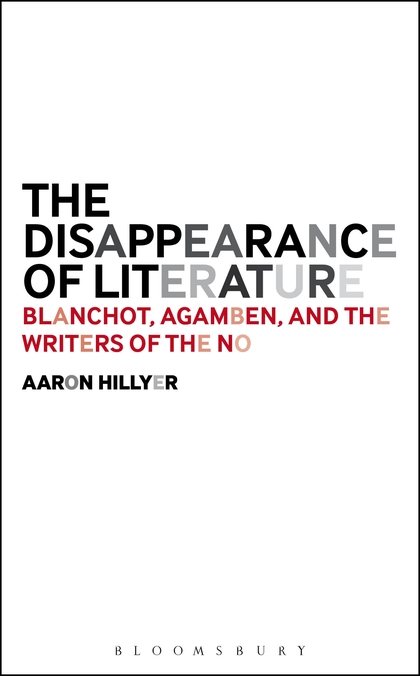
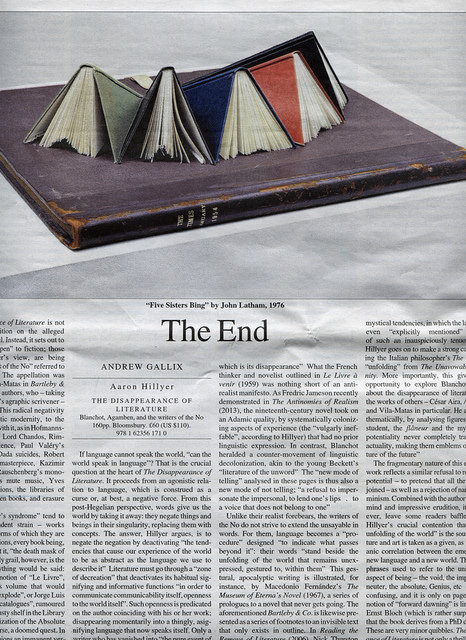
This review of Aaron Hillyer’s The Disappearance of Literature: Blanchot, Agamben, and the Writers of the No appeared in the Christmas double issue of the Times Literary Supplement 19-26 December 2014: 36.
disappearance

The End

The Disappearance of Literature is not another disquisition on the alleged death of the novel. Instead, it sets out to chart “the paths still open” to fiction; those that, in Aaron Hillyer’s view, are being explored by the “writers of the No” referred to in the book’s subtitle. The appellation was coined by Enrique Vila-Matas in Bartleby & Co. (2000) to designate authors, who — taking their cue from Melville’s agraphic scrivener — “would prefer not to”. This radical negativity is constitutive of artistic modernity, to the point of often merging with it, as in Hofmannstahl’s aphasia-afflicted Lord Chandos, Rimbaud’s years-long silence, Valéry’s Monsieur Teste, the Dada suicides, Robert Musil’s unfinishable masterpiece, Kazimir Malevich and Robert Rauschenberg’s monochromes, John Cage’s mute music, Yves Klein’s empty exhibitions, the libraries of unpublished or unwritten books, and erasure poetry.

Studies of “Bartleby’s syndrome” tend to focus on its transcendent strain — works haunted by the ideal forms of which they are but imperfect instantiations, every book being, as Walter Benjamin put it, “the death mask of its conception”. The holy grail, however, is the ur-text in which everything would be said: Stéphane Mallarmé’s notion of “Le Livre”, Ludwig Wittgenstein’s volume that would cause all the others “to explode”, or Jorge Luis Borges’s “catalogue of catalogues”, rumoured to be lurking on some dusty shelf in the Library of Babel. This materialization of the Absolute in codex form is, of course, a doomed quest. In its place, Hillyer champions an immanent version of literature, which no longer refers to “a richer source of meaning that cannot be conveyed in the word on the page or the voice in the air”. He attempts to discover what function fiction can fulfil once it has been liberated from mimesis and the spectre of the total book.

If language cannot speak the world, “can the world speak in language”? That is the crucial question at the heart of The Disappearance of Literature. It proceeds from an agonistic relation to language, which is construed as a curse or, at best, a negative force. From this post-Hegelian perspective, words give us the world by taking it away: they negate things and beings in their singularity, replacing them with concepts. The answer, Hillyer argues, is to negate the negation by deactivating “the tendencies that cause our experience of the world to be as abstract as the language we use to describe it”. Literature must go through a “zone of decreation” that deactivates its habitual signifying and informative functions “in order to communicate communicability itself, openness to the world itself”. Such openness is predicated on the author coinciding with his or her work; disappearing momentarily into a thingly, asignifying language that now speaks itself. Only a writer who has vanished into “the pure event of the word” — where the telling becomes the teller — may express (although not in so many words) “what absolutely escapes our language”.

Hillyer’s point of departure is Maurice Blanchot’s gnomic prediction that “Literature is heading towards itself, towards its essence, which is its disappearance”. What the French thinker and novelist outlined in Le Livre à venir (1959) was nothing short of an anti-realist manifesto. As Fredric Jameson recently demonstrated in The Antinomies of Realism (2013), the nineteenth-century novel took on an Adamic quality, by systematically colonizing aspects of experience (the “vulgarly ineffable”, according to Hillyer) that had no prior linguistic expression. In contrast, Blanchot heralded a counter-movement of linguistic decolonization, akin to the young Beckett’s “literature of the unword”. The “new mode of telling” analysed in these pages is thus also a new mode of not telling; “a refusal to impersonate the impersonal, to lend one’s lips… to a voice that does not belong to one”.

Unlike their realist forebears, the writers of the No do not strive to extend the unsayable in words. For them, language becomes a “procedure” designed “to indicate what passes beyond it”: their words “stand beside the unfolding of the world that remains unexpressed, gestured to, within them”. This gestural, apocalyptic writing is illustrated, for instance, by Macedonio Fernández’s The Museum of Eterna’s Novel (1967), a series of prologues to a novel that never gets going. The aforementioned Bartleby & Co. is likewise presented as a series of footnotes to an invisible text that only exists in outline. In Reading the Remove of Literature (2006), Nick Thurston erased the text of Blanchot’s The Remove of Literature, keeping only his own marginalia.

The Disappearance of Literature is a highly ambitious work that moves seamlessly from theory to praxis. Its theoretical underpinning is a critique by Giorgio Agamben of Blanchot’s mystical tendencies, in which the latter is never even “explicitly mentioned”. In spite of such an inauspiciously tenuous premiss, Hillyer goes on to make a strong case for reading the Italian philosopher’s The Opening as “unfolding” from The Unavowable Community. More importantly, this gives him the opportunity to explore Blanchot’s intuition about the disappearance of literature through the works of others — César Aira, Anne Carson and Vila-Matas in particular. He also does so, thematically, by analysing figures such as the student, the flâneur and the mystic, whose potentiality never completely translates into actuality, making them emblems of the “literature of the future”.

The fragmentary nature of this experimental work reflects a similar refusal to realize its full potential — to pretend that all the dots can be joined — as well as a rejection of narrative determinism. Combined with the author’s subtlety of mind and impressive erudition, it may, however, leave some readers baffled at times. Hillyer’s crucial contention that the “self-unfolding of the world” is the source of literature and art is taken as a given, as is the messianic correlation between the emergence of a new language and a new world. The numerous phrases used to refer to the unindividuated aspect of being — the void, the impersonal, the neuter, the absolute, Genius, etc — may prove confusing, and it is only on page 91 that the notion of “forward dawning” is linked back to Ernst Bloch (which is rather surprising given that the book derives from a PhD dissertation). These are very minor quibbles. The Disappearance of Literature is not only a thrilling addition to the growing body of work tracing the emergence of a literature of disappearance, but it also signals the birth of an important new critical voice. In recent years, few people have spoken about what escapes language with such extraordinary eloquence.
Unaltered By Perception

Nicholas Rombes, The Absolution of Roberto Acestes Laing

For I’ve come to see, in retrospect, that there was a void at the heart of the films that Laing destroyed, and that through his description of those films he was attempting to fill, somehow, that void, as if talking about the films might fill in the meaning that they themselves lacked. I also came to understand that Laingn didn’t think of the destroyed films as “lost treasures” at all, but instead as something more dangerous, as expressions of pure nothingness. A nothingness that goes beyond nihilism, beyond philosophy, a sort of absence that’s so seductive and so powerful that to look upon it is to corrupt a part of your soul (p. 67).

“…I’d watched them, all right, and seen something in them that should never be seen, and I’m not talking about a real-life killing on camera or a dangerous, evil idea convincingly expressed by an otherwise sympathetic character or anything like that. What I mean is that there was something there, in between the frames, something that wasn’t quite an image and wasn’t quite a sound. It was both and neither of those things at the same time. In other words, an impossibility that, because it expressed or represented a new way of being, had to be destroyed. An extreme, undiluted truth, that’s what I’m talking about” (p. 69).

As Laing looks down at the picture I think about the missing children, the ones in the news, and that Laing’s reasons for destroying the films only made sense if you believed there was such a thing, as he had called it, as undiluted truth because in fact, well let’s face it, we’re luckless when it comes to truth because there’s just no way to grasp it without polluting it or mucking it up with ourselves, as if the observer effect didn’t only apply just in physics, but in metaphysics as well because, sure, you can coax it out, the truth, but the moment it shows or reveals itself to you it’s changed in response to being detected, and maybe that’s what Laing meant, after all, that somehow, against all reason, the films in question had actually managed to capture the truth unaltered by perception and that’s why they had to be destroyed… (pp. 60-70).

The shoebox seemed to vibrate there on my lap, like a dying wasp, and I imagined opening it right there and unleashing a terrible fury and blaze that was meant for some apocalyptic future, like some carefully erased sentence slowly re-appearing across the page (p. 76).

See also Guillaume Apollinaire, Yves Bonnefoy (here and here), Stan Brakhage, Karl Ove Knausgaard (here and here), Steven Millhauser (here and here), and Simone Weil.

A Kind of Other-ing

Simon Critchley, “Cult of Memory: Simon Critchley Interviewed” by Daniel Fraser, The Quietus 2 November 2014

One moral of Memory Theatre is that it is a kind of parable of writing. Here is someone who writes and then goes crazy and then that writing becomes a sort of monumentalisation of death in this fantasy of total recall where everything would become meaningful at the moment of the extinction of one’s life in death. Which is a very reassuring picture of writing, writing helps us to remember but in many ways writing should be pushing us towards that which we can’t remember, that which escapes memory, that which really haunts us. Or again to push us towards something which actually involves other people rather than this masturbatory activity of writing which can lead to catastrophe.

I think there is a way of writing, a kind of Derridean theme: you can try to write in a way which encourages a certain otherness in the self, a certain self-distancing, and Memory Theatre therefore is a negative example, something to be avoided. However, Memory Theatre is also importantly a universe without love, this is what an existence without love looks like and love is also a kind of other-ing. It engenders a disposition in you which is orientated towards something which you cannot control or recollect. It is the same way I see psychoanalysis which again is not premised on a fantasy of total recall, it’s about an orientation towards something which is in you that is maybe not in your conscious memory, and is not really memorialisable in any way.