All the Latest

409692229_e75d124f7c_t

Check out “The Resurrection of Guy Debord” published today on the Guardian‘s website: “Guy-Ernest Debord would be spinning in his grave — had he not been cremated following his suicide in 1994. The arch-rebel who prided himself on fully deserving society’s ‘universal hatred’ has now officially been recognised as a ‘national treasure’ in his homeland.” For more, go here.

Many thanks to Alejandrino Delfos for translating my 3:AM Magazine interview with Simon Reynolds into Spanish.

Tom McCarthy & The Modern Lovers of Debris

409692229_e75d124f7c_t

This appeared in the March 2009 issue of Dazed & Confused (vol. 2 issue 71, p. 227):

Tom McCarthy & The Modern Lovers of Debris

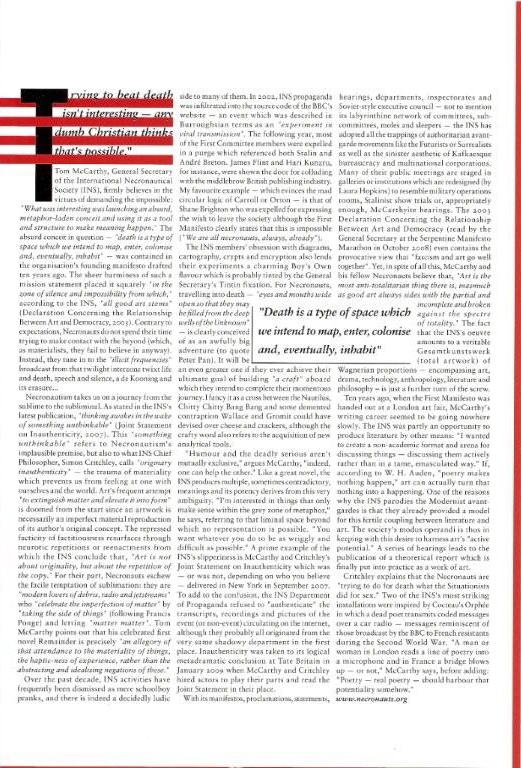
The General Secretary of the International Necronautical Society is devoted to literature by all means possible

Now that Tom McCarthy’s debut novel Remainder is toasted as a contemporary classic by the likes of Zadie Smith, it is easy to forget that no publisher would touch it. The young author increasingly looked to the art world, where he discovered a forum initially more congenial to serious literary investigations. But how has his organisation evolved since its launch ten years ago? “Like a virus,” he explains, “It started out as a tiny thing in a laboratory and has spread and mutated as it plays itself out on increasingly larger stages.” The laboratory was a London art fair on the South Bank where McCarthy handed out the International Necronautical Society’s founding manifesto to bemused passersby. Back then, the Necronauts’ mission statement — “death is a type of space which we intend to map, enter, colonise and, eventually, inhabit” — was probably often dismissed as yet another YBA-style stunt. In fact, the organisation’s deliberately absurd premise was intended to place it “in the zone of silence and impossibility from which all good art stems”. McCarthy wanted to create a “non-academic arena” in which he and his co-conspirators would be able to ogle theory making sweet love to practice.

The INS made a big splash with its 2002 “experiment in viral transmission”, which involved secretly inserting INS propaganda into the source code of the BBC’s website. The connection between aesthetics, technology and politics was further explored in 2004 when the INS set up its Broadcasting Unit at the ICA, inspired by the cryptic messages Orphée picks up on his car radio in Cocteau’s famous film. But the society’s breathtaking ambition only really became apparent last year when McCarthy and INS chief philosopher Simon Critchley unveiled their Joint Statement on Inauthenticity in New York. In a brilliant example of metadrama, doubts were cast on the authenticity of this event and the INS Department of Propaganda refused to “authenticate” the “unauthorised” transcripts and recordings circulating on the internet.

The Joint Statement was presented at Tate Britain this January and revolves around the notion of “originary inauthenticity” — the trauma of materiality which prevents us from feeling at one with ourselves or the world. Art and literature frequently try to deal with this problem by sublimating matter and “elevating it into form”. Necronauts reject this temptation — they are “modern lovers of debris” who choose to “celebrate the imperfection of matter”. McCarthy points out that “what makes the trajectory of Yeats’s work so fascinating is the shift from early idealism to late materialism. And that’s where Joyce begins: debris, detritus, fragments, Stephen Dedalus squelching rubbish on the beach. That’s the landscape that has to be navigated, here, now — and celebrated, not transcended.”

1

Interview with Simon Reynolds

409692229_e75d124f7c_t

This interview with Simon Reynolds appeared in 3:AM Magazine on 2 March 2009:

The Geist of the Zeit

monitorissue1cover

3:AM: Could you tell us how you came to start a fanzine — Monitor — while at Oxford University in 1984?

SR: We did one called Margin first, a pretty basic-looking zine about music and student stuff, e.g. like why most student parties were so boring. That turned into a wall poster that we hung up around town for free, and the content got more theoretical and manifesto-like. Monitor was started in 1984 after most of us had graduated and were living on the dole, and its focus was primarily music with some cultural overviews and some feminist pieces by the team’s female writer Hilary Little. We were keen to distinguish ourselves from other fanzines, which were generally quite scrappy-looking and descended from punk (they were anarcho, or indie-noise, or hardcore, or Goth…). So we had relatively high production values and a striking design aesthetic courtesy of Paul Oldfield, the editor in chief, and Hilary, who was an art student. In the first issue I wrote a critique of fanzine culture, in fact.

monitor-issue-5

We didn’t want to have interviews or reviews like regular zines, but be more of a pop culture journal with just thinkpieces and manifestos and rants (courtesy of David Stubbs, mostly). Then after three issues and a bit of a reputation that we’d garnered for ourselves, we came into an unexpected source of financial support, which allowed us to dramatically rachet up the production values: we had glossy, high quality paper stock, really clear typefaces and proper layout (courtesy of the early word processing programs that were just becoming available and which Paul mastered — and I happened to live above a business that offered computers for postgraduates to do their dissertations on). The last three issues of Monitor looked fantastic and the writing of the team — Oldfield, Little, Stubbs, Chris Scott and myself — really hit a synchronised peak.

monitor-issue-6

3:AM: How did you graduate to Melody Maker?

SR: I sent them some sample reviews. Steve Sutherland the reviews editor at the time was immediately enthusiastic, whereas NME at that time was difficult to penetrate. So although Melody Maker was very much the underdog then in terms of circulation and reputation I joined it and found it to be a very encouraging environment. Later in 1986, David Stubbs followed, followed the next year by Paul Oldfield. Stubbs and I were both given staff writer positions.

sr-in-1985
[Simon Reynolds circa 1985 in his Monitor days]

3:AM: Did you then decide to go freelance in order to have enough time to write books?

SR: No, I fell in love with an American, Joy Press, who, after a year of doing a postgraduate course in London, was obliged to return to New York. I couldn’t keep the staff writer position and be always going over to America for lengthy stays, so going freelance was the only option. Initially I was quite trepidatious about the move, calculating how much money in the bank I had and how many flights to America that would pay for before running out. It never occurred to me that spending half the year in America would actually be a boon for a freelance writer!

In terms of books, my first one Blissed Out came out almost exactly around the time I quit Melody Maker, but I had no particular notion I would do other books at that point, Blissed was a collection of the Melody Maker-era, mostly late Eighties stuff, it seemed like a one-off.

3:AM: Were you able to witness the whole Strokes/White Stripes rock revival scene?

SR: Not really. I was in New York when that happened but still focused largely on the dance scene which in the late 90s and early Noughties was pretty vibrant.

3:AM: Initially, you became famous for writing about rave music which is interesting since it is a phenomenon which rock critics (and the traditional British music papers) usually had a hard time dealing with. You turned this into an advantage…

blissedout

SR: Well, initially I was more known for writing about underground rock in the late Eighties — me and my comrades at Melody Maker were pushing groups like My Bloody Valentine, AR Kane, Butthole Surfers, Loop, Sonic Youth, Dinosaur Jr, etc. We also celebrated rap and electronic dance stuff and industrial things like The Young Gods, but that sort of neo-psychedelic rock is what I was generally associated with. And that is what Blissed Out is largely about. But yes the rave scene took over for me by 1992 and increasingly the various directions that came out that “chemical beats” culture — jungle, gabba, IDM, trip hop, big beat etc — were my primary focus in the Nineties as a writer. And that writing led to Energy Flash.

sr-blissed-out-1989
[Simon Reynolds blissed out in Brockwell Park, Brixton, circa 1989]

Rock magazines and rock critics do tend to approach electronic music in the standard auteur-focused way, they liked your Aphex Twins and Goldies, eccentric or colourful characters who can give good quote and did these Grand Masterpiece type records. I used to write about electronic dance in those terms too, before I got actively involved in raving and club culture. But I soon realised that the focus of the scene was on tracks and the DJ, it was much more about the anonymous collective — the interaction between the music, the club space, the crowd, the DJ — and drugs too, of course. So you had to try to bring those elements in really prominently rather than just pinpointing the pioneers and the outstanding auteur figures. They exist in even the most hardcore underground scenes but more important is the evolution of the music according to this almost depersonalised logic, where it feels like the music knows where it wants to go. It’s what Brian Eno calls scenius as opposed to genius.

3:AM: In the introduction to Rip It Up and Start Again, you write: “As a rock critic, when you reach a certain age, you begin to wonder if all the mental and emotional energy you’ve invested in this music was such a shrewd move. Not exactly a crisis of confidence, but a creasing of certainty”. Similarly, in Totally Wired, you wonder if the “searching for utopia through music” wasn’t “a mistake”. Aren’t these doubts mainly due to the fact that music no longer occupies the central cultural role that it did during the punk and post-punk years?

SR: I think you’re right, to an extent, but it’s also questioning what was actually achieved during those periods when it was central and seemed to have enormous power to motivate individuals and mobilise populations. A lot of great music was made but beyond that… Some nowadays would say, ‘well what did you expect?’, but at the time, something else, something extra, was expected. It felt like the music had a transformative power, a promise. Perhaps it’s just the slow fading of the Sixties dream (or delusion?), with punk/postpunk being the next and in some ways just as intense and far-reaching spasm of that excessive belief in the power of music, and rave in its own different way being another.

ripitup

3:AM: You’re known for having introduced critical theory into music journalism: wasn’t this in part a way of providing an intellectual justification to what you were doing?

SR: No, I don’t think so — I’ve never felt the need to justify or aggrandise music in that way. Music asserts its own importance and crucialness without any help from me or the books I’ve read! What it is, I’m a fan of critical theory, of that kind of philosophy and writing, and it just seemed like there was a natural fit between certain ideas and what was going on in the music. It wasn’t about legitimising “low” culture in high culture or highbrow terms, but just about intensification — the ideas would potentiate (to use drug terminology) the most radical aspects of the music. The combination of the music and the theorisation seemed to create a bigger buzz, basically.

3:AM: You point out that there is “a lot less theory” in Rip It Up than in your other books partly because many of the actors on the post-punk scene were themselves “musician/critics” who were already “eloquent in meta-talk”. I was wondering if post-punk bands had turned you on to theory in the first place?

SR: To an extent, because people like Green from Scritti Politti or the guys in Gang of Four (although they like to downplay it now) were fluent in a lot of neo-Marxist ideas. But really it was the NME journalists of that time who turned me onto the French theorists. When you read about one of your favourite bands and there’s chunks of Barthes or Kristeva or Foucault flying about, the sparks created light a fire in your brain. The music is enriched by the theory, but the theory is also enflamed by the music, if you get me. You might say that the theory is justified by the music, in a way. Much more so than the other way round. It’s brought alive by the music, and substantiated by the music.

3:AM: In his Guardian review of Totally Wired, David Sinclair claims that you don’t “so much put words into [your] subjects’ mouths as ram them down their throats”. Your response?

SR: I really think that’s rubbish, to be honest. The specific example he quoted, when I’m talking to Andy Gill, comes out like that because nowadays the members of Gang of Four like to downplay their debts to theory and make out they were never particularly Marxist. That’s probably got something to do with how they’re all involved in the business world nowadays! My question to Gill is naturally informed by reading the interviews they did back in the day, and of course listening to the lyrics of their songs — which are clearly shaped by awareness of concepts like reification and commodity-fetishism. It’s really not my fault if Andy Gill wants to make out that Gang of Four weren’t especially influenced by Marxism!

Generally the interviews are more like genial conversations than interrogations. I’m not looking to ambush them or find holes in their statements, but nor am I imposing my view of things. I’m asking questions and listening, finding out stuff I didn’t know, following up tangents. But there’s obviously areas and issues I’m looking to be covered. And I have my own opinions.

totallywired_

3:AM: Surely, you must have been tempted at times to write literary criticism or perhaps even fiction?

SR: I’ve written some book reviews. I have some pet projects, dream projects, that would be largely about literature. As for doing fiction myself, a long time ago, when I was a teenager maybe. I once wanted to write science fiction but was handicapped by my inability to come up with plots! I could do the s.f. scenario but not the narrative bit.

3:AM: Rock stars used to want to be writers; today writers want to be rock stars (at least that’s my theory)… The punk and post-punk years were undoubtedly the “golden age” of the music press (“The day the new issues of the music press came out was the best day of the week”) which explains why you were “as passionate about the journalism as the music”. However, why did you choose to “contribute to the music through writing” instead of producing music yourself? After all, many rock critics from that period (Nick Kent, Kris Needs, Giovanni Dadamo, Mark P, Paul Morley, the Vermorels spring to mind) made the move from the page to the stage with varying degrees of success and seriousness…

SR: Um, well, no offence to the above, but “varying degrees of success” — you’re kidding right! Chrissie Hynde would be a better example by far. There are music journalists who’ve acquitted themselves just fine as music-makers — most recently the grime/dubstep journalist Martin Clark aka Blackdown was the co-creator of a very fine dubstep-influenced album, Margins Music. I admire the balls of those who attempt it.

I’ve never made any serious attempt to make music because I’m aware of my limitations. But really I just always wanted to be a writer. It never seemed like a second-best option to me, not at all.

That said, if I had a shred of musical talent, I would probably have a go — why not, it would be fun, it would be challenging, I’d probably learn something that would make me a better critic.

3:AM: You argue that journalists could be as important as musicians in those days: bands would form after reading articles by Lester Bangs or Paul Morley. Do you think your writings will have a similar influence? Do you know if Rip It Up, for instance, had any impact on the recent post-punk revival?

SR: Rip It Up came out smack bang in the middle of the postpunk revival, which had a big momentum already rolling by the time it was published. It probably helped to keep the revival going a bit longer, maybe. It’s still ticking a long, isn’t it?

I’m not sure if any of my writings had a direct motivational effect on musicians. I do know some musicians who grew up reading my stuff but I can’t see how it’s affected what they do. In the late Eighties and early Nineties the kind of way me and my comrades at Melody Maker wrote about My Bloody Valentine and AR Kane probably contributed to the vibe at the time that led to shoegaze, but it’s obviously primarily the music itself — MBV, AR Kane, Cocteau Twins, etc — that birthed shoegaze. Whether having a role in it would be something to be proud of, I’m not sure! There were certainly things going on in that music which we as writers articulated and glamorized — this sort of narcoleptic, swoony, blissed-out dream-daze vibe — all that became hegemonic with shoegaze, and frankly rather predictable and played-out. But that was being articulated in the original shoegaze-inspiring music too, in the song titles and lyrics and things like Daydream Nation. It was all the Geist of the Zeit. So our writing was symptom rather than agent.

simonreynolds

3:AM: In both Rip It Up and Totally Wired, you talk about the “accidental innovation syndrome”: when post-punk bands tried to play music that was technically “beyond their reach”, it often came out wrong which is why it sounded interesting (you mention, for instance, the Gang of Four’s take on disco which you describe as an “abstraction of disco”). When these bands became more competent, their music often became bland and uninteresting. Was there a similar “accidental innovation syndrome” in rock criticism?

SR: I don’t know about that. I think rock criticism breaks the rules of other forms of journalism, but quite consciously most of the time. It is deliberately and even contrivedly more informal and sloppy, or more theoretical and neologistic, or…

When I started out I didn’t know any of the rules of reported journalism or feature writing — the idea of starting with a lead, having the nut graph, using a well-observed scene to draw in the reader — none of that I knew about, at all. I picked all that up much later, in the late Nineties really. My early Melody Maker interviews always started with some kind of bombastic micro-manifesto or oration, then slipped into a kind of Platonic dialogue, an exchange between disembodied minds. I seldom did any scene-establishing observational type writing, about clothes or where the interview took place or the gestures made by the interviewee and so forth. So you could say that was accidental innovation, perhaps. The pieces might have been improved by having some of that conventional journalistic framing, but they were also quite intense hits of rockcrit, through being so stripped down.

3:AM: You distinguish two types of rock critics: the gonzo “prophet/catalyst” who has been replaced today by the “analyst and historian”. Do you regret this trend? Even though rock criticism is far less influential than it was back in the punk/post-punk days, the British music press still played an important part in the rise of Suede, the subsequent Britpop phenomenon as well as the post-Strokes rock revival, so it’s not completely dead is it?

SR: I kind of have a foot in both camps, and enjoy both modes — the Lester Bangs and Greil Marcus approaches. I suppose the first form, the messianic mode, is the one that sets my heart on fire. I love to read that kind of stuff, and to write that kind of thing. The more measured and balanced kind of writing, I can do that easy enough, but…

The messianic mode I would distinguish from your standard hype-hype, “here’s a hot new scene” type journalism, though, since the prophetic style is always gesturing towards some kind of salvation for rock/music, which in turn would be a salvation or redemption or something like that for the world, given that the messianic mode of rockwriting is predicated on the attribution of monstrous world-historical importance to rock music (or rap, or rave, or whatever…). That explains both the born-again fervour and the rage at rock music when it fails to live up to its potential or goes through periods of doldrums.

3324065460_8a2e25877f

[Simon Reynolds, Williamsburg, 2007]

3:AM: “Post-punk completely inverted punk’s organization of sound: the guitar became more sporadic and thin-bodied; the bass becomes the melodic voice and centre of emotion in a song” (Totally Wired). You are renowned for your accurate descriptions of music (see the spot-on example above), but you also believe that “Myth is what rock music is all about”. In other words, you seem to be (or to have become) an “analyst and historian” but you’re also clearly a “prophet/catalyst”. Rock critics were important when rock was about far more than just music, right? In your case, one could even argue that you invented post-punk as a genre: nobody had brought all the threads together before…

SR: The problem with the “myth is what rock is all about” statement is that you can only have an insight like that from a fallen state of consciousness, a demystified mindset. To even say that statement is to already be incapable of participating in myth, falling for myth. People who think mythically don’t see it as myth, you see, they see it as The Truth.

That said there have been times when the music has been so powerful it’s knocked my hyper-aware self off its feet and I have believed — early rave and jungle was one such phase, and when I wrote about jungle I was helping to construct a myth while also believing in it with all my heart.

Postpunk — this idea some people put about that I came up with the term or the concept is such nonsense. It was used from about 1979 onwards, not in a huge way but it definitely cropped up in the music papers (and I’ve read every single issue of the NME and most Sounds and Melody Makers and Faces etc for the whole period covered by Rip It Up and Totally Wired). By the time we did Monitor, starting in 1984, postpunk was generally accepted as the term for that period, I refer to “postpunk” in my early articles in Monitor, which were often digesting what had happened to punk’s energies and where all that idealism and creativity had gone.

3:AM: In Totally Wired you write that “The nineties felt like this blur of constant change” — an affirmation which, in my opinion, seems far more suited to the punk and post-punk days when things were changing from week to week. (What fundamental difference was there between, say, 1998 and 1999? But 1978 had a totally different feel from 1979.) This constant activity took place, paradoxically, within what you call an “economy of delay and anticipation” — music and music news weren’t instantly accessible like they are now. Don’t you think these two contradictory phenomena played an essential part in the rise of rock criticism? Rock critics were there to make sense of the frenetic activity that was taking place and music fans spent ages poring over their articles (just as they spent hours scrutinising album covers while listening to records)…

SR: My Nineties comment is referring to the electronic dance music culture, all the energies that came out of rave, in which category I also include post-rock and trip hop as adjuncts (trippy, samples-beats-electronics based mood music). That’s how it felt, from 1990 to the end of 1998! It was a rollercoaster ride.

You’re right though about the totally different feel between 1978 and 1979, and 1980 and 1981 and 1982. That was one of the things that I wanted to convey in Rip It Up, the reactive way that music evolved, rebelling against the preceding phase.

Back then, things took longer, but the culture as a whole felt like it was hurtling. Nowadays the sense of temporality is completely inverted: everything is too instant, too fast (the speed of downloading, the impatient, skimming way one reads text on the computer screen etc), yet on the larger cultural level it feels like everything is stalled. We have this paradoxical combination of acceleration and standstill. The worst of both worlds!

3:AM: The original idea for Rip It Up was a book chronicling the “punk diaspora”. Do you think you will ever return to this project one day?

SR: I think with Rip It Up I’ve kind of done the “good bit”. Tracking the other streams of the punk delta might not be so enticing — second and third wave industrial, or Pogues-y punk-folk, or…

Some of the tangents that came out of punk — Situationist, McLaren-imitator bands, for instance — are covered quite intensively in Blissed Out. During our Melody Maker days, me and the ex-Monitor types were often working through stuff that related to punk, to the hangover of its ideas, which we felt had become unhelpful and counterproductive. We talked about the need to un-punk British music culture. We got interested in reclaiming late Sixties type ideas and even progressive rock type values. Which of course was going on in the music of the late Eighties, it was getting wiggy and blissed out. We thought that was the current in leftfield music that was crucial and to be championed against stuff that was still tied to punk and the various “creation myths” of what 1977 had signified.

robert-wyatt-and-sr-hay-2007-pic-2
[Robert Wyatt and Simon Reynolds, Hay Literary Festival, 2007]

3:AM: In Totally Wired, you write that the “shared point of origin — the mythic site of lost unity — is punk. That’s the ignition point. The Big Bang”. The strength of punk, and the reason why it was (and indeed is) so important, was its ambiguity: the political, arty, fun, fashion and hooligan elements all coexisted for a short but exhilarating time. More than with any other movement, there is a fascination with the origins of punk — the days before it even had a proper name (see John Ingham’s October 76 “Welcome to the (?) Rock Special” article in Sounds), when the movement seemed to have appeared out of nowhere, when the clothes and music still escaped categorization. All the disparate elements started going their own way as soon as the movement could be pinned down. Do you agree with this?

SR: The archaeology of the origins of punk is this massive thing, you’re right. One thing that interests me about punk is how long the idea was in circulation before it took off. Lester Bangs and others were writing about the need for something like punk from about 1970 onwards! There were various false starts, the most famous being The Stooges, and The New York Dolls, but you could also see punk figuring in aspects of glam rock, and obviously in pub rock. And you have stray figures like The Sensational Alex Harvey Band, or Ian Dury’s first group Kilburn and the High Roads…

I’m quite into this idea that the best phase of a music is before it is named, before it gets codified. Often there’s a semantic profusion/confusion syndrome. The early days of what would be codified as drum’n’bass were very unstable in terms of nomenclature — over about three years you had terms like “breakbeat house”, “hardcore techno”, “ardkore”, “jungle techno”, “darkside”, “jungle” etc all competing and overlapping. Or with grime, where it took the longest time for anybody in the scene to settle on a name, and Wiley even released a song called “Wot U Call It” addressing this issue.

But equally it’s the aftermath era that seems fruitful too. In some ways it’s the before and the after of any musical revolution that seems richer and more suggestive than the Moment itself.

3:AM: As you write in the introduction to Totally Wired, “Books continue to write themselves in your head long after the official end of the project” which is why you have several blogs which you use to publish “footnotes” to your books. What impact has the internet had on rock criticism?

SR: That’s too big a question, really. But one effect it’s had on me is this idea that I can put the left-overs and stray thoughts on the web — it has made me more comfortable with the cutting of things down to size, whether it’s an article or a book. I can run the director’s cut version or the ideas that were never integrated into the piece on the web, for the small minority of people who are interested.

3:AM: Were you disappointed by any of the people you interviewed for Rip It Up and Totally Wired?

SR: I don’t think I was, actually. Frustrated in a few cases. Martin Fry for instance has this thing of not replying to the question — not in the least! He’ll just talk about something else altogether. But after I realised this was going on I just let go of the reins and let him flow, and he did bring up a lot of interesting stuff along the way, even if there were many things I would have liked to have had discussed that weren’t. But you know it was cool to meet him, he’s certainly a charismatic guy. No, I can’t think of any disappointments.

3:AM: Who is your all-time favourite rock critic and why?

SR: It would be a close race between Paul Morley and Barney Hoskyns. But Barney would win. First off I suppose it comes down to taste. The definition, the sine qua non, of a great critic is having great taste. You can have the most elegant prose style and the sharpest insights and wittiest wisecracks, but if you can’t lead me to amazing music, then you’re of a limited use, I think.

Barney’s writing at the NME in the early Eighties introduced me to so much amazing music. So many of my all-time favourites, I wonder if I would have heard without his advocacy… He introduced me to Astral Weeks, John Martyn… The Blue Orchids… Meat Puppets… all the US hardcore stuff in fact: Black Flag, Flipper, Husker Du… But also things like Donna Summer, who I knew for her more famous hits but would I have otherwise bothered to chase down “Working the Midnight Shift/Now I Need You”, this amazing Moroderized electronic dreamscape song-suite, if he hadn’t written so alluringly about it? All kinds of soul music… old stuff, but also great New York black postdisco and club music of the early Eighties. But at the opposite end of the spectrum, he made certain heavy metal things intriguing. And it was actually his writing that got me interested in The Smiths, who I’d initially found a bit mundane-sounding.

Barney Hoskyns had this thing of having an incredibly wide range of music he wrote about but the effect was never merely eclectic, there was an overall vision that encompassed all these disparate and seemingly remote from each other things.

What I also really dug was this Dionysian view of music he was pushing in the early Eighties in reaction to the New Pop philosophy of Paul Morley’s that was so widely adopted by other UK journalists. Hoskyns was a renegade against that hegemony, he was celebrating music in terms of obsession, madness, dirt, danger, frenzy, sickness, “convulsive bliss”, druggy oblivion… This at a time when music was very much about cleanliness and health and non-intoxication and this sort of uptight hyper-rationality. He was championing Nick Cave and The Birthday Party and also placing them in a lineage that included The Stooges, The Saints, Suicide, The Stones and so forth. He was celebrating rock at a time when rock’n’roll was a dirty word, a complete no-no. But he didn’t reject New Pop completely, he championed certain artists within it who he felt had a certain excess and tragic intensity like The Associates, Soft Cell and Scritti Politti.

His writing style at its height is incomparable, the mixture of prose poetry and theoretical penetration, shot through with humour. And he was one of the NME guys who used critical theory and riffs from philosophers (Nietzche was a favourite) in a very effective way.

I suppose the NME-era Hoskyns was kind of my own Lester Bangs. Later on he switched to the other mode, he went from prophet to historian/analyst; he became an excellent critic and writer of histories and biographies, such as his Tom Waits books. But it’s the more adolescent phase — the fucked-up phase, a period he had to leave behind for his own well-being (because he was walking it like he talked it) that had the massive impact on me. It hit me at a very impressionable age. And it took me a long time to develop my own vision of music, incorporating Hoskyns’s ideas and developing them, embracing other approaches. Perhaps I only fully managed to invent my own identity as a writer and thinker thanks to rave culture, which was my own Dionysian moment but based around really radically different music.

Barney is also a really nice guy, which is not always the case with your heroes!

[This interview was translated into Spanish by Alejandrino Delfos and posted on his site on 17 March 2009.]

All the Latest

409692229_e75d124f7c_t

ArtGerust, a Spanish social network which focuses on the arts, published an article on the Offbeats on 18 February 2009:

ArtGerust, “La literatura Offbeat, el nacimiento de una nueva generación”

Se está hablando últimamente de una nueva generación literaria conocida como los “Offbeat”, término acuñado por uno de sus máximos exponentes el responable de la revista online 3:AM Magazine, Andrew Gallix, el conocido como Rimbaud de la red y también francés como él, y que se refiere a esos autores de entre 18 y 40 años -año arriba año abajo- que usan Internet para colgar su obra, que tienen como máxima influencia a la Generación Beatnik y el “surrealismo de fregadero”, es decir, Ginsberg, Kerouac, Burroughs, Bukowski, beben de la música de Tom Waits, Lou Reed, Scott Walker, David Bowie, etcétera, y que si tienen un lema común es “sea lo que sea, estoy contra ello”. Todo un fenómeno literario. Y ArtGerust, con su pretensión de ser una red social cultural lo más integral posible tiene que dar cuenta de este fenómeno.

Como sucesores de aquella generación de escritores malditos, estos autores suelen andar un poco al margen de la industria editorial -no demasiado, seamos sinceros, la industria hoy es día es tan amplia que puede dar cabida a cualquier grupúsculo por pequeño y políticamente incorrecto que sea- y aprovechan la libertad que da Intenet para darse a conocer y mostrar su imágen cínica e irónica del mundo.

La lista de integrantes es bastante amplia aunque todos tienen en común ciertas cosas que nos permiten hablar ya de una nueva genración en la literatura, una generación que esperamos que de sí todo lo posible, ya que falta hace al mundo cultural actual algo de originalidad y de calidad. Y que esta generación sea el primer paso al nacimiento de muchas otras.

Destacan autores como Laura Hird, escritora escocesa, Noah Cicero, novelista norteamericano, Ben Myers, idem inglés, Adelle Stripe, poeta británica, el mismo Andew Gallix, Heidi James, la que no esá muy conforme con la acuñación de Gallix, Tao Lin y muchos otros. Pero quizás si alguno destaca más que ningún otro es Tony O’Neill, neoyorkino devoto de Bukowski. Ex heroinómano y autor ya de cuatro novelas.

En España, está vez hemos tenido algo de suerte, y pronto llegarán alguna de estas obras en nuestro idioma. Se sabe que en marzo se publicará en español la última novela de Tony O’Neill Down and Out On Murder Mile, y también en marzo podremos disfrutar de Carbono de Heidi James, de la obra de Tao Lin, y a lo largo del año “The Bird Room” novela de Chris Killen.

Por supuesto, cualquier industria, incluida la editorial, quiere vender su producto. Es normal, el dinero es lo mantiene cualquier negocio. Pero hay que reconocer que esta generación tiene muy buena pinta. Y aunque, como siempre, desde el fin de la Segunda Guerra Mundial, se nos pretenda hacer creer que todo movimiento artístico de calidad e innovador, llega de EEUU y de su sucursal en Europa, Inglaterra, sin embargo, nos puede ayudar a dar a conocer una idea de literatura que en España -y por supuesto en otros países- ya había cuajado y dejaba auténticas joyas muy desconocidas para el gran público pero muy asentadas en ciertos círculos de Internet. Nosotros no creemos que éste sea un movimiento anglosajón sino más bien común a todos, por nacido de la abulia que crea la vida en esta aldea global, y no hay forma más sibarita y buguesa, eso está claro, que manifestar nuestro descontento social creando arte. Si bien es cierto que tenemos una prensa que primero se fija en lo que pasa allí que en lo que pasa aquí, bienvenido sea que, al fin, se vayan haciendo eco que hay una nueva forma de hacer literatura. Espero que disfruten del viaje.

Para terminar alguna recomendación:

– Sabemos que es un poco endogámico, pero la endogamia no es estrictamente negativa si tiene sentido. En ArtGerust contamos con dos autores -dentro de la red de blogs- que por influencias, modos y formas podrían enmarcarse dentro de esta generación Offbeat, que son IDT y Marquitos, y que todas las semanas nos dejan unos artículos que son una delicia. Por supuesto, no desmerecemos al resto de nuestros bloggers, pero sus influencias y formas ya no están ancladas en este tipo de generación de escritores.

All the Latest

409692229_e75d124f7c_t

Inés Martin Rodrigo has published an in-depth article on the Offbeats in top Spanish daily ABC in which I — “el Rimbaud de la Red”! — am quoted at length:

Inés Martin Rodrigo, “‘Se lo que sea, estoy contra ello,” ABC 16 February 2009

Es el lema de un nuevo grupo de escritores anglosajones con sede en Internet que está revolucionando la industria editorial. No tienen reglas ni manifiestos, pero la Generación Offbeat reclama su lugar en la escena literaria

La industria editorial es aburrida, está embotada y estreñida, desprende un cierto tufillo rancio y amenaza con eliminar todo fragmento de imaginación que aún quede en la mente del lector menos conformista. No es una sentencia categórica de un crítico cabreado con el ultimo best seller que ha llegado a sus manos, ni siquiera la reflexión concienzuda de un intelectual con complejo de Nostradamus. Es el pensamiento y la bandera literario revolucionaria de un nuevo grupo de escritores con sede en la Web y que se (auto)definen como Generación Offbeat.

Qué menos se podía esperar de los potenciales sucesores de Charles Bukowski, Allen Ginsberg, Jack Kerouac, William S. Burroughs y compañía. Autores todos ellos enraizados en la libertad y el compromiso con ser fiel a uno mismo, filosofía de la que dieron buena cuenta en sus años de lucha literaria con las armas de las que disponían. Las armas de la razón hecha palabra y empleada en defensa de la paz, en contra de la Guerra de Vietnam o como sagaz discurso contra el recalcitrante conformismo de la sociedad de la época.

Una generación pegada a los libros

Los años han transcurrido y el discurso se ha transformado, al igual que las armas para evocarlo y defenderlo. Pero la raíz prendió con fuerza en una generación de jóvenes que creció leyendo el “Junky” de Burroughs, “uno de los mayores trabajos literarios sobre el mundo de la droga, al lograr algo que muchos libros que le siguieron fueron incapaces: habló del modo de vivir de un drogadicto”, en palabras de Tony O’Neill, escritor offbeat por excelencia. Y es que Burroughs describió el oscuro laberinto de la drogadicción sin ejercer de falso predicador para el lector, sin miedo a llamar a cada cosa por su nombre. Porque, le pese a quien le pese, un heroinómano no será nunca un pervertido al que adoctrinar. Así, llamando a las cosas por su nombre y leyendo, sobre todo leyendo, empapándose de los popes del movimiento beat fue como este grupo de autores fue regando su propio discurso.

Un discurso que se vertebra en un nuevo y excitante trabajo de ficción, que corre riesgos y que, cada vez con más intensidad, empieza a generar demanda en cuantos lectores se topan con él casi sin pretenderlo. Y es que, demasiado ácidos, diferentes y afilados para la industria editorial tradicional, la generación offbeat se esconde (de momento, aunque cada vez menos) en los amplios (y libres) márgenes de la Web y en alguna que otra editorial independiente.

El origen del movimiento

El primero en usar el término offbeat (y por tanto quien lo acuñó) fue Andrew Gallix, redactor jefe y responsable de la revista literaria online 3:AM Magazine (puestos a hacer comparaciones, valdría decir que sería algo así como el New Yorker de los offbeats). De eso hace ya casi tres años aunque, como el propio Andrew reconoce, “el movimiento llevaba bastante tiempo emergiendo. Es un poco lo que pasó con el punk o los nuevos románticos, al principio no tenían nombre por lo que mucha gente desconocía su existencia”.

Un desconocimiento que se fue disipando a medida que los grupos fueron proliferando en el ciberespacio. Eran escritores, guionistas, periodistas, bloggers, artistas… con un interés común por la literatura pura (sin artificios), que empezaron a gravitar alrededor de 3:AM y a organizar lecturas, conciertos e incluso festivales. “Fue en esos eventos donde comenzaron a establecerse las relaciones –explica Gallix-. La primera vez que fui consciente de que había aparecido un nuevo movimiento fue en el baño de Filthy Macnasty’s (uno de los pubs londinenses preferidos por Pete Doherty), cuando Lee Rourke (escritor y a la postre integrante de la Generación Offbeat) se abalanzó sobre mi y empezó a hablar de la enorme revolución literaria que habíamos iniciado. Aquello fue realmente el comienzo de todo”.

Un inicio virtualmente surrealista para un movimiento con integrantes de carne y hueso. Son muchos los offbeats que, incluso sin saberlo, engrosan la lista de esta generación pero, si hubiera que etiquetar al movimiento como tal cabría decir que se caracteriza por la variedad de voces y estilos y la ausencia de reglas (aquí no hay manifiestos). “A pesar de la diversidad, muchos escritores offbeat comparten características. La mayoría son británicos, treintañeros y creen que la escritura es mucho más que un mero entretenimiento”, enfatiza Gallix. Y sienten la música como elemento catalizador y de equilibrio.

Una lista repleta de talento

La lista es interminable y suena francamente bien. Noah Cicero (novelista estadounidense a medio camino entre Samuel Beckett y The Clash), Ben Myers (autor inglés mezcla de Richard Brautigan con Lester Bangs), Adelle Stripe (poeta londinense heredera del cinematográfico “realismo de fregadero” de Sidney Lumet), el propio Andrew Gallix (el Rimbaud de la Red), Tom McCarthy (novelista estadounidense afanado en la deconstrucción de una nueva idea de novela), HP Tinker (joven inglés al que comparan con Pynchon y Barthelme), Tao Lin (el aventajado protegido de Miranda July –a quien pronto veremos publicada en nuestro país gracias a Seix Barral-, con todo lo que eso supone hoy en día) y los primeros (parece que las grandes editoriales empiezan a tomar apuntes) que aterrizarán en España: Chris Killen, cuya novela “The Bird Room” será publicada este año por Alfabia, y Heidi James y Tony O’Neill, ambos con la editorial El Tercer Nombre.

Todos ellos influidos por el particular lirismo de Tom Waits, Lou Reed, Scott Walker o David Bowie, de la misma manera que estos sintieron la influencia de los autores de los que la Generación Offbeat es heredera. Aunque también están los que prefieren huir de las comparaciones. Tal es el caso de Heidi James, para quien la comparación es un poco “perezosa, basada en el hecho de que evitamos formar parte de la corriente principal”. Esta joven autora británica, que en marzo publicará su primera novela en España (“Carbono”, Ed. El Tercer Nombre) y que se confiesa fascinada por Lynne Tillman, Clarice Lispector, Marie Darrieussecq, Angela Carter o Virginia Woolf, es dueña de su propia editorial en Reino Unido, Social Disease. Con ella, que debe su nombre a la famosa frase de Andy Warhol -“Tengo una enfermedad social. Tengo que salir todas las noches”-, Heidi se ha convertido en uno de los estandartes de la Generación Offbeat al publicar “literatura única y genuina al margen de su valor en el mercado”.

Un movimiento coordinado

La propia Heidi James, en una prueba evidente de que el movimiento está coordinado y sabe hacia dónde se dirige, ha publicado en Reino Unido a autores como HP Tinker o Lee Rourke pero, sobre todo, a Tony O’Neill, el máximo exponente de los offbeats. Este joven neoyorquino, devoto de Bukowski, responsable de una prosa brutalmente descarnada, ex heroinómano, miembro de bandas como The Brian Jonestown Massacre, ha publicado ya cuatro novelas (la última, “Colgados en Murder Mile”, llegará a España en primavera) y se erige en líder (sin pretenderlo) del movimiento con ansias de seguir reclutando adeptos.

Como su propio nombre (offbeat) indica, una generación extraña e inusual de escritores, para los que la Red es su campo de acción, con espíritu punk y ganas de comerse la industria literaria tal y como ahora está concebida. El mundo anglosajón ya ha sido testigo de los primeros bocados. En España está al caer, ¡y ni siquiera es una generación! Que tiemble Zafón.

Dead Philosophers Society

409692229_e75d124f7c_t

Here is my interview with philosopher Simon Critchley, published in 3:AM Magazine on 26 June 2008:

Dead Philosophers Society: An Interview With Simon Critchley

3:AM: Did the idea for The Book of Dead Philosophers come from the Montaigne quote you use as an epigraph? Was that the first spark?

SC: It was one of the first sparks. As so often happens in writing, it was a coincidence: a close friend sent me that quotation from Montaigne just as I was rereading the latter’s “To philosophie is to learne how to die” in Florio’s florid translation. Montaigne is really the hero of the book and I love his suspicion of suspicion, his skepticism and the deeply personal quality of his prose, which is never narcissistic. It is ourselves that we find in Montaigne, not him. But I suppose that’s a narcissistic thing to say.

3:AM: Commenting on another passage from Montaigne, you state that “The denial of death is self-hatred”. This reminded me of Dostoevsky’s Kirilov who attempts to defeat God by committing suicide. His rationale is that, in order to negate transcendence, Man must learn to love himself for what he is and must therefore embrace his own finitude — desire his own death. (One could wonder if the espousal of death isn’t a form of self-love?) Your own conclusion — “Accepting one’s mortality…means accepting one’s limitation” — isn’t that far removed from Kirilov’s way of thinking, is it?

SC: It is very similar to Kirilov and you are right to point that out. I think I wrote about Kirilov somewhere, maybe in Very Little…Almost Nothing. If the denial of death is self-hatred, as it is to deny our freedom and live in fear of death (which is to say, to live in a form of bondage), then the acceptance and affirmation of death is indeed a form of self-love. But I’d want to make a distinction between a form of self-love which is essential to what it means to be human, and a narcissism of self-regard, like Rousseau’s distinction between amour de soi and amour propre, self-love and pride.

coverl.jpg

3:AM: You remind us that Socrates’ last words “articulate the view that death is the cure for life”. This idea that life is a kind of disease to be cured through extinction is key to the likes of Schopenhauer, Leopardi, Beckett and Cioran. Do you agree that there’s a kind of lineage here?

SC: I am hugely attracted to the idea of life as a mistake, as a kind of natural error for which we try and find some metaphysical assurance or consolation. This is the core of Schopenhauer’s dark comic genius. It attracts me because it is based on the idea of life as rooted in an experience of contingency, physical contingency, which we forget and convert into various forms of necessity. I do see a lineage from forms of ancient skepticism and cynicism through Schopenhauer and into figures like Beckett and Cioran. One of the peculiar features of The Book of Dead Philosophers is that I simultaneously play on a number of different and contradictory tendencies in the history of the last few thousand years: cynicism, skepticism, Epicureanism, primitive Christianity, occasionalism, rationalism. The fragmentary form of the book allows me to move across and through a number of different philosophical registers. It is so ridiculous to limit oneself to one version of the truth.

2614324306_5988f39a8f.jpg

3:AM: I’ve always felt that the rise of the writer/artist as alter deus that accompanied the secularisation of many European countries led to the spread of a kind of death wish in literature and the arts (culminating with people like Arthur Cravan and Jacques Rigaut). My theory is that many writers/artists believed the hype and were so frustrated when they realised that godlike, ex nihilo creation eluded them that they turned to destruction. Is (to paraphrase Bakunin) the urge to destroy also a creative one (or, as Larkin put it: “Beneath it all, desire of oblivion runs”)?

SC: I completely agree: one of the outcomes of Romanticism for me is the idea of the writer as imago dei without a deus where art becomes a Promethean creation ex nihilo. I think this tradition also inspired a related Promethean tendency in politics, from the ‘nihilism’ of Nechaev, through to Lenin’s Bolshevism and Marinetti’s futurism. It’s the tradition of what I call “active nihilism“. I criticize this tradition heavily in a number of places, but only because it is so compelling.

3:AM: Wouldn’t you agree that the “fantasies of infantile omnipotence” you hope will disappear through an acceptance of our “limitedness” are often at the root of great art and literature?

SC: Sure. Much of literature in what we might call its rigorously Hegeliano-Sadist development is about the dream of infantile omnipotence which is rooted in the idea that the artist is like Adam in the Garden of Eden, baptizing things into existence through nomination. I don’t think that this tradition can simply be eliminated or overcome, but it should be contrasted with what Blanchot calls “the second slope” of literature, which is concerned with allowing things to be in their irreducible materiality. This is what I think of as the Levinasiano-Stevensian (if that’s an adjective) succession. This is the sort of materialism that Tom McCarthy and I have experimented with in the writing we have done together on Joyce, Shakespeare and others.

3:AM: Some think that art and literature are predicated on what Eluard called “le dur désir de durer” (the painful desire to last) — a desire you don’t seem too keen on…

SC: No, I am perfectly happy with the idea of literature as le dur désir de durer and would want to put the virtue of endurance at the core of much that I think about. But that is not the same as denying one’s mortality. On the contrary, I think.

thumbnail.jpeg

3:AM: The Book of Dead Philosophers has lofty ambitions. You set out to write “a history of philosophers” as opposed to “a history of philosophy” in the teleological mould. In effect, you are defending a specific conception of philosophy against another…

SC: Yes, I am against the idea of the history of philosophy as a history of systems that can be arranged in a certain logical and historical order, such as one finds in Hegel or Heidegger. It is one of the many aspects of being deluded by the idea of progress (Hegel) or even the idea of regress (Heidegger). I am opposing it with an idea of the history of philosophy as a history of philosophers, that is, a history of mortal, fragile and limited creatures like you and I. I am against the idea of clean, clearly distinct epochs in the history of philosophy or indeed in anything else. I think that history is always messy, contingent, plural and material. I am against the constant revenge of idealism in how we think about history.

3:AM: You praise the “ideal of the philosophical death”: what exactly do you mean by that?

SC: The idea of the philosophical death is the core teaching of philosophy in antiquity from Socrates and Epicurus onwards: we can go to our death freely and without fear having given up the consolation of any belief in an afterlife. As Wittgenstein says, is some problem solved by the idea of my living forever? Of course not. It is, however, difficult to fully and completely renounce any idea of the afterlife.

2613539055_0ff865b078.jpg

3:AM: You write that “Death is the last great taboo” and question the unthinking belief in ever-increasing longevity: are we turning into a race of Struldbruggs?

SC: Absolutely. I think we are turning into a world of Struldbruggs. That is all I saw last year in Los Angeles last year when writing the book: bloody botoxed suntanned Struldbruggs. To that extent, I completely agree with Swift. The flip-side of his seeming misanthropy is an affirmation of virtue.

3:AM: Your book also has a self-help quality (to “begin to enable us to face the reality of our death”) — aren’t you afraid of being accused of having done an Alain de Botton?

SC: No comment. My problem with self-help is that I don’t think there is a self to help. The self is something that we become through a series of acts.

3:AM: Don’t you think your attempt to bring philosophers closer to us (“It is in the odd details of a philosopher’s life that they become accessible to us”) runs the risk of being seen as a little reactionary — the equivalent of basing an interpretation of a novel on its author’s life?

SC: It is profoundly reactionary. Absolutely. I’ve turned into some sort of dreadful cultural conservative. No, but seriously, I am not engaging in some sort of biographical reductionism and I loathe such tendencies in relation to literature. I am reacting – and perhaps over-reacting – to an allergy to biography in relation to philosophy and philosophers. Also, much of the biographical information in the book is highly dubious and all the more interesting for that reason.

3:AM: In The Guardian you were recently described as having “found a vocation in teaching philosophy, although [your] passions still lie in music, poetry and politics”. Are you less passionate about philosophy? And how did you end up at university by “complete accident”?

SC: Yes, I don’t know where The Guardian found that stuff, but maybe I said something similar in another interview. The truth is actually much worse and would have to include sob stories about years at catering college, working in factories, a series of industrial accidents and even a year and a half as a lifeguard. I did not mean to suggest that I am less passionate about philosophy than I was. On the contrary, I have an immense childish enthusiasm for the history of philosophy and for what is going on right now and remain stupidly optimistic. The thing is that after leaving school with one ‘O’ level, I played in bands for some years, then became a poet before going to an FE college in Stevenage where someone said that I should apply to university. The thought had never previously crossed my mind. Something to do with social class, no doubt.

3:AM: On the subject of music, please tell us about the “large number of punk bands” you played in. Does that period still resonate as it does with so many of us?

SC: Punk was the crucible out of which my paltry subjectivity was formed. My years watching bands and performing in bands allowed me the imaginative space to try and conceive of a life a little different from what I was meant to do. It was a relentlessly affirmative nihilism. Of course, this was sheer luck. I was born in 1960, and so I was 16 when punk began to happen just down the road in London. Suddenly I found myself at the edge of the world’s centre. And it was because of punk that I began reading Burroughs, Bataille and the Situationists. It was also the time when I became politicized through Rock Against Racism and the Anti-Nazi League. My bands had silly names: The Social Class Five, Panic, The Fur Coughs (who became The Bleach Boys*, I thought of that name) and The Good Blokes. I still mess around with music and have done a lot of work with my oldest friend, John Simmons. I think it is somewhere on YouTube.

[* See their current website]

All the Latest

409692229_e75d124f7c_t

Nick Kocz and Manisha Sharma, Managing Editors of The New River, respond to my Guardian blog on e-literature in their introduction to the Fall 2008 issue (December 2008):

“In September of 2008, The Guardian devoted space to an Andrew Gallix essay on the current state of Electronic Literature. This in itself is significant — an acknowledgement by one of the major newspapers of the English-speaking world that new media writing is worthy of its thoughtful attention. Yet after recapping some of the highlights of the form, the column’s tone becomes dispiriting: ‘So far, the brave new world of digital literature has been largely anti-climatic… Perhaps e-lit is already dead.’

Friends, rest assured we do not share this conclusion.

However, we understand how one can come to believe that electronic literature is a dud: it’s been two decades since the first hypertexts appeared and there’s yet to be a single electronic work that has generated a fraction of the commercial interest as the latest Stephen King novel. Or, for that matter, a fraction of the mainstream critical attention typically bestowed upon the latest Philip Roth or Marilyn Robinson novel. There are no blockbusters, no best sellers in the world of electronic literature. Despite all the ballyhoo, enthusiasts of electronic literature remain a relatively small coterie of practitioners and academics. Far from being relegated to antique store shelves next to Edison cylinders and stereoscopic cards, the book is alive and well.

Also in September, Robert Coover, a longtime advocate of literary experimentalism, gave the keynote address at the Electronic Literature in Europe conference. Needless to say, Coover paints a much more forgiving picture:

‘It took a millennia of cuneiform writing and the demise of the [Sumerian] civilization that invented it before the first known extended narrative was composed using it.

‘In America, book publishing had to wait nearly two centuries for the definitive American novel to appear [Herman Melville’s Moby Dick] and even then it took better than another half century while Melville’s reputation languished before its value was finally understood.’

Coover’s right. People have this idea that European culture was immediately transformed by Gutenberg’s mechanical printing press, but in truth culture lags behind technology. Elizabeth L. Eisenstein, in her landmark 1979 study on the historical effects of the printing press (The Printing Press as an Agent of Change, Cambridge University Press), found that ‘[t]he output of early presses drew on a backlog of scribal work; the first century of printing produced a bookish culture that was not very different from that produced by scribes.’

Much the same seems to be happening today. Gallix asserts that one reason for the curtailed development of electronic literature is that university humanities departments’ “emphasis on digitalising traditional books [comes] at the expense of promoting creative electronic writing.’ Virtually all online literary journals exist to publish work that was primarily intended for the printed page rather than the screen.

While there’s an abundance of MFA programs feeding writers into the traditional print genres of poetry, short story, novel, and memoir, comparatively few programs exist within the academy where emerging new media writers can nurture their talents.

Indeed, there are very few venues where an emerging (or even an established) new media writer can place his or her work.

One such venue, increasingly, is the contemporary art institution. Digital Art, now a museum staple, is but a variant of Digital Literature: both often incorporate textual elements, dreamy and/or surreal narratives, and derive from the same aggressively experimental impulse.

Mark Amerika’s groundbreaking 1997 hypertext Grammatron was cited by The Village Voice as being ‘the first major Internet-published work of fiction to produce an experience unique to the medium.’

Today, Amerika’s work is often intended for gallery exhibition. As he said in a recent interview at London’s Tate Modern, he is ‘consciously trying to blur the distinction between different forms and the venues in which they appear… I mean, what is the difference between what we think of as Cinema, Digital Video, Digital Narrative, Net Art, et cetera, Web 2.0 even?’

Amerika has a point: the distinctions between these media spectrums are getting fuzzier. There’s a cross-fertilization going on that will likely strengthen strains of electronic literature. While Gallix sees digital literature being ‘subsumed into the art world,’ others see it as a sign of the form’s relevancy that it can have such an impact on the contemporary art scene.

‘The real problem,’ Dene Grigar (who co-chaired the 2008 Electronic Literature Organization’s Visionary Landscapes conference in Vancouver) writes elsewhere, ‘would be if digital writing is not included [in contemporary art], which does not seem to be the case.’

Of course, distinctions between digital writing and contemporary art still remain. As a tradeoff for the ability to be read simultaneously by multiple viewers off a single gallery screen, Digital Art just does not feature the same level of interactivity as Digital Literature. This is no small distinction, interactivity being one of the earliest perceived advantages Digital Literature had over its paper-bound forebears.

But the question remains: why does Digital Art thrive in museum environments while Digital Literature is perceived in some quarters as being ‘already dead’?

Certainly audience expectation plays no small role in answering this question. People who step into modern art galleries go so with the understanding that some of what they see will confound them. There is, if you will, a certain humility within the museum-goer. Or at least a marked willingness to engage with that which she cannot immediately understand.

That tolerance for the new and the stylistically different does not exist at the same level in the literary world. Instead, people expect to understand that which they read. When they come across complex or experimental works that resist easy comprehension, readers grumble. American book culture, with its emphasis on accessibility and sales, punishes writers who take risks. Earlier this year, we came across an essay indicating that Donald Barthelme — one of the country’s most respected short story innovators — never sold more than 7,000 copies of any of his collections in his lifetime (he died in 1989). We would be shocked if more than a few of today’s most experimental writers sell half as well as Barthelme.

Seen in this light, should it be surprising that Digital Literature remains at the cultural periphery? Because it is a complex and evolving form born from aggressive experimentalism, it is not as user-friendly as, say, a Harlequin romance. Digital Literature, luckily, resists pandering. Style and complexity, more than any other factor, explains why mainstream culture has yet to embrace the form.

In our survey of the field, we’ve yet to stumble upon the equivalent of a digital Harlequin. Should such a thing exist, and we’re not convinced that it can, its blatant accessibility could very well ensure it a mass-market niche, and perhaps even critical acclaim, for despite however pure-minded we like to imagine Criticism, there is a link in the digital world between accessibility and acclaim.

One of the more fascinating observations in N. Katherine Hayles’ Electronic Literature — New Horizons for the Literary (University of Notre Dame Press, 2008 — order it now, it’s good!) is on the responses garnered by two Michael Joyce hypertexts. The first, 1990’s afternoon: a story, was developed in hypertext’s infancy and in many ways can be seen as an adaptation of a standard book-form narrative for the computer screen. In Hayles’ analysis, ‘afternoon has received many excellent interpretations.’

Joyce’s Twelve Blue appeared just one year later (1991) but was much more complex, both in its technological interpretations and its aesthetic and intellectual intentions. Despite these advances, or, more precisely, because of these advances, reader response suffered. As Hayles notes, ‘The player who comes to Twelve Blue with expectations formed by print will inevitably find it frustrating and enigmatic, perhaps so much so that she will give up before fully experiencing the work. It is no accident that compared to afternoon, Twelve Blue has received far fewer good interpretations and, if I may say so, less comprehension even among people otherwise familiar with electronic literature.’

The good news is that the more creative technologies infuse themselves into daily mainstream life, Electronic Literature as a form will appear less ‘frustrating and enigmatic’ to casual readers.

As Amerika notes, ‘Net Art has changed — let’s call it Net Art 2.0 — it’s really more embedded in daily practice. So when we think of the practice of every day life, Net Art is no longer like this kind of left field thing coming out of nowhere… [People are no longer asking,] ‘What are these artists trying to do?’

‘A lot of people have integrated all this media into their own daily experiences and so for them to experience art as well as part of that networked environment isn’t so odd any more.’

Beware though: leavening is a two-way street. Early hypertexts with their link-heavy emphasis on interactivity helped form what we expect — if not demand — from electronic media. As web usage changes the way we perceive and interact with media, digital literature changes — meaning that digital literature can not remain static.

David Foster Wallace, in perhaps his most insightful essay, “E Unibus Pluram: Television and U.S. Fiction,” deconstructed the reasons why contemporary post-modern fiction can seem stale and out-dated. The self-conscious irony that was the hallmark of post-modernists and meta-fictionists of Barthelme’s generation has been appropriated to better and more pervasive effect by Television: ‘And this is the reason why this irreverent postmodern approach fails…TV has beaten [today’s post-modernists] to the punch.’

There is ample reason to believe digital literature will not be ‘beaten to the punch’ any time soon by other forms. Five of those reasons — Andy Campbell, Angela Ferraiola, Michael J. Maguire, Nick Montfort, and the combo of Davin Heckman & Jason Nelson — are included in this issue. Many more submissions of excellent quality were sent for our consideration — and we received more submissions for this New River Journal issue than any previous issue.

…Despite Gallix’s suspicions, electronic literature is not a stillborn or moribund form. He is not, to say the least, prone to good cheer. Nor is he blindly dismissive. Instead, he is sober in his assessment — which is healthy, if not necessary. We enjoyed his column for the difficult questions it posed about the form’s state of development.

And this made us think. Absent something as crass as sales or distribution figures, how does a new form prove its relevancy? Are there critical or aesthetic benchmarks that we should strive for?

Grigar is quoted by Gallix as saying, ‘One of the most difficult aspects of e-lit is the ability to talk about it fast enough, so fast is the landscape changing.’

Which brings us back to Coover’s guarded yet hopeful keynote:

‘That no such widely acknowledged masters have as yet made their mark on the digital landscape is hardly surprising. All previous masters of a form were born into its technology and environed by it and so far only for pre-teens is that really true today.

‘The new computer technology of our age is still developing and may well need another half century to achieve some sort of maturity… meaning that even if digital novelistic masterpieces are improbably already being created, it will likely take at least that long for them to be widely recognized as such.’

It took generations for the contemporary art institution to become as welcoming as it is today to aggressive experimentalism. Remember how the Impressionists, whose work seems positively quaint today, could not gain entry into officially-sanctioned salons; at the same time, James Abbot McNeil Whistler was being slandered in the London popular press by the age’s most esteemed critic as being not an artist but a ‘cockney… coxcomb… flinging a pot of paint in the public’s face.’

Given the speed in which new technologies are being embraced in what Amerika calls our ‘daily practices,’ we are hopeful that Digital Literature’s gestation period will not be as long as Coover suggests. Which is a good thing, for we believe that the writers presented in this current issue are close to delivering the ‘digital novelistic masterpieces’ we all seek.”

AIDS in French Culture

409692229_e75d124f7c_t

This review of David Caron‘s AIDS in French Culture: Social Ills, Literary Cures (University of Wisconsin Press, 2001) appeared in the inaugural issue of the Hyde Park Review of Books (winter 2002):

David Caron weaves literary criticism, cultural history and gay studies into a brilliant, sometimes dazzling, examination of “AIDS in French Culture.” The importance of his book is beyond doubt — given the extent of the AIDS pandemic in France — but one cannot help feeling that the whole is somehow less than the sum of its parts. Paradoxically enough, for one whose purpose is to dispel the preposterous idea that AIDS appeared to fulfill a purpose, Caron imposes an overarching, teleo(il)logical narrative thread upon what is essentially an episodic structure. Each chapter is a little island of Flaubertian self-containment in which the author introduces regular recaps and pointers to give a semblance of continuity or direction. As a result, the conclusion (where the author belatedly develops his ‘central’ thesis) seems tagged on to a collection of related articles. If the weaving is a little décousu, however, it is mainly because AIDS in French Culture is much more than just another polemical tract.

The author’s premise is that France’s inability to cope with AIDS in an effective manner has been largely due to intellectual muddle. He argues convincingly that the AIDS debate of the 1980s was couched in terms dating back to the Third Republic. The young regime’s blissfully optimistic religion of science was mirrored, in Jekyll and Hyde fashion, by a pathological fin-de-siècle fear of degeneration. Caron analyses skillfully how these forces of unreason were recast as rational discourse to absurd yet devastating effect. The newly-medicalized figure of the male homosexual became the first scapegoat of this “evil side of progress,” before the rise of an unprecedented wave of anti-Semitism.

In a catch-22 situation reminiscent of the mad, circular logic of Joe Orton’s psychiatrist in What the Butler Saw, homosexuals were accused of being both the cause and the consequence of national decadence. In short, they were guilty of being victims: “The homosexual found himself twice determined, and was held responsible for a disorder of which he was also an outcome.” The author tracks down such pseudoscientific postures or impostures from Zola’s attempt to model literature on a medical discourse which itself was “structured by metaphors” to the AIDS epidemic which was simultaneously explained through supposedly-meaningful metaphors and used as a trope “for the collapse of moral values.” Close reading is clearly Caron’s forte and his studies of Zola and Genet offer invaluable insights into the authors’ works. The chapter devoted to Hervé Guibert’s literary détournement of contamination — “the principle governing metaphors” — which enabled the novelist to reclaim infection “not only as a destructive but as a productive process” is a tour de force.

Above all, Caron counters the misconception according to which we are equal in front of the disease: “If, biologically speaking, anybody can get AIDS, not everybody will.” This “humanist cant” is prevalent in France where the “founding narrative of universal equality” has been applied to HIV “as if the virus were to abide by the ‘Declaration of the Rights of Man and the Citizen.'” By refusing to recognize the existence of a gay community, the “French model of republican integration” has been partly responsible for “the deaths of tens of thousands of people.” One can only hope that a French translation will follow shortly. As a form of public service.

516dztyzn3l_ss500_

Mad Anatomy

409692229_e75d124f7c_t

This very short review of Mad Anatomy (Del Sol Press), Kimberly Nichols‘s collection of short stories, was posted on the publisher’s website when the book came out in 2003:

Kimberly Nichols carves a razor-sharp crescent out of a plucked pregnant moon to adorn a dirty martini. Barefoot dances around cactus-skeleton plots like some snake-hipped offspring of Rimbaud and Huck Finn. Skinny dips in the swamp blues of tormented souls or in the tropical storm of conflicting emotions. Like all good American authors, Kim shows us the spiritual rooted in the elemental. Like all great American authors, she shows us that there is another America.

Degeneration X

409692229_e75d124f7c_t

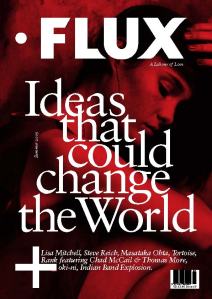
This appeared in the winter 2008/2009 edition of Flux magazine (issue 67, pp. 66-67):

Degeneration X

Shooting up and getting high to plumb the lowest depths with Tony O’Neill

Suffering from unspeakable withdrawal symptoms, a junkie bashes herself in the face with a book — repeatedly. Tony O’Neill does not mention the title, but a copy of Down and Out on Murder Mile, the hard-hitting sequel to his celebrated debut, would be most apposite. “My books are meant to read as immersive experiences,” he says. “You are dragged into the toilet stall and feel the needle going in.” This time round, however, the in-your-face squalor is shot through with the whitest flashes of transcendence. Whereas Digging the Vein showed the author “digging a big hole” for himself, Murder Mile relates how he crawled out of it.

There are cult writers, and then there is Tony O’Neill: the junkie’s junkie. This is a man who used to chase the dragon with the zeal of St George — even his dealer tried to persuade him to quit on one occasion.

O’Neill was born in 1978, on the wrong side of the track marks, as it were. He describes Blackburn as a “dying-on-its-arse old cotton town” where — according to one of his poems — those who fail to escape “pray for cancer or a speeding truck”. O’Neill legged it on the tail end of Britpop, playing keyboards with the likes of Kenickie and Marc Almond (he describes a later stint with dope fiends the Brian Jonestown Massacre as “Exile on Main Street, on a budget”). After his music career fizzled out, he relocated to the States and plunged headlong into the dark underbelly of Tinseltown, soon acquiring a serious habit and a couple of ill-suited wives. This dramatic period provided most of the material for his first novel, Digging the Vein, which he wrote while on the methadone programme described in his second.

3188278835_d42a728ea4_m

Although Down and Out on Murder Mile is billed as “semi-autobiographical fiction,” it seems to be based so faithfully on the author’s past that one wonders what is really fictitious about it. “My first and main reason for not labelling the book as autobiography is really simple,” he explains. “Who the hell would want to read my autobiography?”

Just as Morrissey grew into the kind of icon that graced the sleeves of his early records, O’Neill has become a biography waiting to be written. And inevitably, some readers are attracted to his work, not so much for its intrinsic value, but because the author has descended to the underworld Orpheus-style, and lived to tell the tale. But O’Neill (who mocks the idea that “drugs are a shortcut to any kind of insight” and is loath to ever become a “professional ex-addict”) knows that “you’d better bring something more to the table than your track marks and some missing teeth” if you are to become a proper author. “When I sit down to write, I don’t think that people will be fascinated by my story because of my personal history. I hope that the telling of it will fascinate them”. That said, he recalls attempting to compose a novel when he was 16 and realising that he had no story to tell. “Maybe for other people it’s different, but for me life had to knock several rounds of shit out of me before I knew what I wanted to say”.

More than its prededecessor, Murder Mile is what the Germans would call a Künstlerroman — a novel that is a portrait of the young artist. It chronicles its own genesis, but never in a tricksy, postmodern fashion.

The opening sentence hits a low point (“The first time I met Susan she overdosed on a combination of Valium and Ecstasy”) and then it goes downhill for most of the way. Despite the seediness and hardship, the narrator’s loveless, and largely sexless, marriage to Susan — the aforementioned book basher — is quite romantic, in a Sid-and-Nancy kind of fashion. Here, drugs stand in for the love potion of so many traditional love stories, and there’s the obligatory coupling of Eros and Thanatos, the “unspoken agreement that [they] would eventually die together”. Witnessing this junkie couple in freefall, shooting up and getting high to plumb the lowest depths, is often as exhilarating as a rollercoaster ride, at least on paper. “There’s something really romantic about death and self-destruction when you’re at a certain point in your life,” admits O’Neill. This death wish was underpinned by a kind of nihilistic hedonism coupled with a wide-eyed rejection of compromise and mediocrity. “Our lives are ultimately meaningless, so why not pass the time pleasurably? Heroin fed into that excessive, idealistic part of me: if I can feel this good for one moment, then I should be able to feel this good every moment of every day. Of course it can’t be, but I feel that there is some intellectual justification in saying that a life spent in the futile pursuit of some kind of transcendence is a life better spent than if you accept that it will never be as perfect as you hoped.” Drugs and sex offer fleeting intimations of immortality, but only unconditional love provides a way out. “Would I be dead if I hadn’t met Vanessa when I did?” wonders O’Neill. “In all honesty, the chances are yes. There certainly wouldn’t be any books.”

3188258243_f94ce1fc79

3189111346_860b04609e