The Emperor’s New Clothes in Reverse

Jack Henry, “3:AM Magazine Interview: Andrew Gallix,” Heroin Love Songs 5 Spring 2009: 87-90

JH: Thank you for taking the time to answer my questions.

AG: My pleasure!

JH: My primary interest is in New Media and what some refer to as New Media Literature. In addition there seems to be resurgence in writing and poetry. Perhaps this is due to so many on-line outlets. Also, movements such as the Brutalist and Offbeat Generation owe their existence to the Internet and various on-line outlets, including 3:AM. I think some of these movements and/or on-line journals have sprung from some post-punk anarchy reaction against mainstream publishing. I’ve read as much and agree with it. Some of these questions may seem obvious, but I am sure others are curious, as am I, to your unique perspective.

What is the importance of a movement or school of work? Is it an idea or concept developed from a historical perspective or can it be witnessed in the present, as it emerges?

AG: We never sat down one day and said ‘Let’s launch a new literary movement!’. We sat down one day and realised that we were part of a movement. It was already there, and all it needed was a name to gain visibility. It was the Emperor’s New Clothes in reverse. So, to answer your question, we have been observing the development of the Offbeat phenomenon since 2005 when we became conscious of it.

JH: What can a writer gain, if anything, from the inclusion within a movement?

AG: First of all, I must make it quite clear that the Offbeats are a movement and not a school of writing. Offbeat writers are individuals — they all have different styles and influences, even though they all share certain values and a certain rebellious spirit. Writing is a solitary activity, so it feels good to also have that collective experience.

JH: What are the unifying characteristics of the Brutalists or Offbeats? What is their historical heritage?

AG: The Brutalists are not a movement; they’re a trio of writers (Adelle Stripe, Ben Myers, and Tony O’Neill) who sometimes come together to write under that banner. Instead of forming a band, they write poetry. The Brutalists are very much part of the Offbeat scene. What unites all the Offbeats is a rejection of a publishing industry increasingly dominated by marketing, rather than literary, concerns. The name ‘Offbeat’ is an obvious nod to the Beats, but punk is perhaps the biggest historical reference. At least for some of us.

JH: In a few interviews I have read, the Offbeat Generation does not exist within a single style or genre, I am curious what the literary influences have been to this group? And, more specifically, any influences from areas outside of writing?

AG: That’s quite right, and since there is no house style, influences are pretty diverse. There’s the Bukowski-John Fante Real McCoy school of writing embodied by Tony O’Neill. There’s the Maurice Blanchot-Francis Ponge-William Burroughs axis led by Tom McCarthy. There’s the Barthelmesque comic postmodernism of HP Tinker. There’s the more quirky Brautigan-tinged world of Chris Killen or Tao Lin. And then there’s all the others with their personal influences.
Music is indeed very important to many Offbeats. Tony O’Neill played in bands like Kenickie or the Brian Jonestown Massacre. Ben Myers is also a music journalist and he even used to have his own indie label. Will Ashon has a hip hop label. As far as I’m concerned, Howard Devoto’s early lyrics are right up there with the works of the greatest writers.

JH: As the Beats of the 50s/60s gained popularity, pop culture turned them into a caricature of their origins. Is there a fear that current movements could be mainstreamed and, potentially, lose their power as a dissenting voice?

AG: Definitely. In a way, it’s already happened. There are lots of young writers who think they’re being Offbeat by spouting clichés about sex and drugs.

JH: What is the goal of a movement? Is it collective? Or individualistic?

AG: Total surrender of mainstream publishing!
It’s both individual and collective.

JH: It is my opinion that America’s “disposable mentality” has migrated to literature and our literary tradition. Publishers rely on a bestseller to support their efforts with other books. In my opinion, a majority of these best sellers are total shit. Writers that repeatedly appear on best-sellers’ lists utilize formula and structure that will satisfy the widest possible audience, with lim-ited concern for craft, exploration and daring. Subsequently, the wider audience is “dumbed down.” Additionally, marketing departments focus a majority of their budgets on bestsellers thereby limiting marketing funds for up and coming writers. In short, big publishers continue to promote disposable writing in order to earn the quick buck. Does literature still exist, either via New Media or traditional outlets? What is the future of literature?

AG: I totally agree with your analysis of the state of things. It’s the same in Britain — perhaps even worse because of the presence of a huge middlebrow market. In the States, it’s either total shit or pure genius.
But, yes, literature still exists and will continue to exist. I can’t predict what its future will be, but I think the western notion of The Writer may be on the way out. I think there will be fewer career writers in the future: writers who write simply because that’s what writers do. People will write a novel when they really feel the need to do so, but will also have other creative outlets.

JH: Returning to New Media, how important are New Media platforms (blogs, social networks, YouTube, etc.) to writers? Is there such a thing as New Media Literature?

AG: Well, I think you need to make a distinction between e-literature which uses the Internet as a new medium, and most online creative writing which simply uses the web as a medium. As I wrote here, I get the impression that the future of e-literature is to merge into digital art. That view seems to be highly controversial in e-lit circles. As for webzines, blogs etc. I think their role has been essential. The Offbeat movement is the first literary movement of the digital age. Without the Internet, it probably wouldn’t have existed in the first place.

JH: 3:AM is a widely admired online journal and has been around a while now. I have always been impressed with the quality of writing that comes out of it. With the Internet providing a global platform and on-line outlets (websites, blogzines, etc.) is there a dilution of quality writing? Or, more specifically, is there too much content? Or, perhaps, is it just too easy to get published online?

AG: Thanks for the kind words.
Interesting questions. A band that releases an album on its own label has credibility. Writers who do that are accused of vanity publishing. It’s true that there are thousands of rubbish writers out there who publish themselves on the Internet, but there are also stacks of rubbish writers whose works are published by big concerns — just visit any bookshop to see what I’m talking about. Bad writers will give up eventually; the good ones will float to the surface.

JH: How important is marketing to a New Media outlet or, as a whole, “underground” writers and publishers? With my journal I market wholly to exposure the writers I admire and feel have talent. The only real cost is time. With the press, I have a different attitude. I want to promote the writer, but I want to have some profit, no matter how minimal, in order to publish more writers. In the age of New Media Literature and the expectation of everything on the Internet should be free or relatively inexpensive, how does a press survive?

AG: I’ve been editing 3:AM Magazine since 2000; we get thousands of unique visitors a day, and yet I’ve never made any money out of it. There’s very little money in serious fiction.

JH: Is it more important to publish than publish and profit?

AG: Definitely.

JH: Okay, enough of my bullshit, let’s focus on 3:AM. Would 3:AM exist without the Internet?

AG: An emphatic no. I’d been toying with the idea of a post-punk literary journal for years, but the logistics just made it virtually impossible.

JH: In researching this project I have read through a number of issues from 3:AM. In terms of quality and content, it is definitely one of the better online magazines available. You have had a long tenure on the Internet, longer than most. What do you attribute that to?

AG: To the fact that we’re genuinely interested in writing, and that we don’t expect to make any money out of it.

JH: What are the future goals of 3:AM?

AG: To continue to spread the word.

Interview conducted on 21 May 2009.

The Offbeats

Ben Ashwell, “An Interview with Tony O’Neill,” Bookslut 138 (November 2013)

… O’Neill built a strong reputation for his needles-and-all accounts of addiction by publishing his stories online, on sites like 3:AM Magazine. This led him to be grouped with a range of other writers — such as Ben Myers, Lee Rourke, Adelle Stripe, and Andrew Gallix — who were collectively branded “The Offbeat Generation” by The Guardian.

gallixoneill
[Me and Tony O’Neill, Paris, June 2009]

Never Taken As Read

Richard Marshall, “No Thing,” 3:AM Magazine 29 March 2013

. . . Dworkin hopes that through erasure writing can be recovered by attending to its essential detritus, its material media and its event. He suggests this retrieval comes by a palimpsest enacting a “double play of concealment and revelation”, a way of obstructing to make something visible. Andrew Gallix writes that “Words become visible; the bloody things keep getting in the way. From this perspective, the literary is what can never be taken as read”. . . .

orphée

As Tight As Wire

Richard Marshall, “Modernist Ghosts,” 3:AM Magazine 18 June 2013

apparitionalexperience

. . . Reality is inevitably, and tragically, the boss, relentless and remorselessly impervious to the dreams of its inhabitants. We hope for autonomy, agency, but fear it’s just the drink talking post hoc most of time. ‘When you say my name, you retain nothing of me but my absence. And nobody is present behind these words I speak’ says Emilie in the Andrew Gallix short story “Fifty Shades of Grey Matter“. The story presents a doomed lover contemplating his lost love. The materiality, the bodily anxiety presses in against the frenetic, desperate and seething mind of the protagonist and throughout there’s a need to try and combine the two — the mind and the body — to understand the relationship in some way. The story is implacable and granite strong in this. The violence of physical action, the dangerous crime that bodies seem to presuppose in the narrative, carries ‘the mute reminder of the possibility of impossibility’ symbolized by an insane aside about anal rape. What kind of dark matter is being imagined in this? The subject is Occasionalism, the question of powers and causality.

. . . Gallix’s odd fiction seems also to hold lyricism in a merciless fixed embrace. The facts are stone, as dry as archaism, stratified, absorbed and the utter indifference to the sensual passion of its protagonist is expressed in a language chisselled and polished like marble. Everything is imagined with prodigal allusiveness. It’s as tight as wire, extremes of tragedy, pathos and irony are cut like contours ploughed into copper with a burin. If the effect is a dismembered cruelty, it is a cruelty of the universe, of a cause from somewhere else altogether, somewhere or some agency that knows enough to cause it.

Gallix’s approach is not alone in the Fiddleblack collection. Nor is this conceit I’m pressing — arbitrarily at times, but then making a run of it to see where we might go, for there are others that might be mysteriously pressed into action. The impossibility of causality without knowledge of how to create or annhiliate, well, that has some edge, even if we think it exactly false. But Gallix, to continue using him as a catalyst here, has that line about the ‘possibility of impossibility,’ and who cannot unforgive a paradox when we’re telling each other stories about how it isn’t?

. . . But the orgiastic demonstration of writing’s imaginative physique is best in the antiquity of Gallix’s Roman fairy tale of Valentin Vermot, a ghost haunted by ghosts that, abbreviated to an essentialist verbatim, goes: ‘Once upon a time there was a man called Valentin. Valentin Vermot. Just like you. He thought he was haunted by a ghost, but his ex-wife assured him that there was no such thing. “There are no ghosts,” she said. “There are no ghosts.” Valentin opened his eyes. He was all alone, but Emilie’s voice was still ringing in his ears. There are no ghosts, there are no ghosts, there are no ghosts, there are no ghosts…’ . . .

A Writing Against Itself

Andrew Gallix, “Go Forth (Vol. 4)” by Nicolle Elizabeth, The Believer Logger 14 November 2012

Andrew Gallix is editor-in-chief of 3:AM Magazine, which the Guardian credits as technically the first literary blog ever. He writes fiction and criticism, edits books, and teaches at the Sorbonne, and I love him.

NICOLLE ELIZABETH: What is 3:AM, and how did it start?

ANDREW GALLIX: 3:AM is one of the oldest literary webzines out there, as it was launched in April 2000. We were among the first to make use of the international dimension of the web: the founder was American, our first webmaster was Canadian, and the rest of the team was located in Britain, France, Ireland and the US. We were the first, or one of the first, to launch a literary blog (if by that you mean a compendium of literary news links). We innovated by placing fiction in a wider cultural (artistic, in particular musical) context. We also pioneered the revival of live literary events in London, mixing music, art, and spoken word.

NE: This is a collective thing?

AG: Very much so. The whole point of 3:AM was to foster a community of literary loners; to create a space where we can be alone together.

NE: Print ever or no?

AG: Two anthologies of 3:AM short stories (edited by Andrew Stevens) have been published, but the magazine itself is online-only. I think we were also pioneers from that point of view: we realized that online publications were the way forward. They cost virtually nothing, which means that only literary/artistic criteria apply, instead of financial considerations. There are no space constraints (a piece can be as long or as short as it needs to be). You can reach so many more readers than if you publish a story in a small literary journal. Christiana Spens has just launched 3:AM Press, which releases both ebooks and limited print editions, showing our attachment to both formats.

NE: Main concerns ethically?

AG: There is no party line, although we are rather contrarian, hence our tagline (a nod to Groucho Marx, the Ramones, and Adorno): “Whatever it is, we’re against it.” It sounds rather pedantic, I know, but what I consider to be real literature is always, at some level, a writing against itself.

NE: Main concerns aesthetically?

AG: Once again, 3:AM is a very broad anti-church. Personally, I think we should publish fiction that has the inevitability of death.

NE: What advice do you have for those who wish to start a magazine?

AG: Don’t give up the day job.

NE: Anything else you’d like to tell us here?

AG: Sure, but only things which cannot be told.

Whatever Happened to 3:AM Magazine?

This appeared in Guardian Books on 10 July 2012:

Whatever Happened to 3:AM Magazine?

When the 3:AM website suddenly vanished last week, the might of social media helped track down the person who could switch the server back on. But what are the implications for online magazines?

[Turn it on again … server outages were undeniably on the rise, but this time there was no website to check. Photograph: Thomas Northcut/Getty Images]
I concluded my last contribution to this site with a quotation from Maurice Blanchot: “Literature is going toward itself, toward its essence, which is disappearance”. Little did I know that 3:AM Magazine — the literary webzine I had edited with a group of friends for more than a decade — would shortly after vanish suddenly into cyberspace. Whether it was going toward its essence is a moot point, which falls outside of our present remit.

When I am not running late, I often check the website, along with my email, before setting off for work. The last time I performed this routine, I sat, for what seemed like ages, staring, bleary-eyed, at an empty page that obstinately refused to load. Blogger’s block, as I like to call it, is a less heroic, technological version of l’angoisse de la page blanche: the agony experienced by writers in front of a blank page. The only sign of activity came from the little dotted line going round and round in vicious circles like Sisyphus‘s boulder or — rather fittingly in this instance — nobody’s business. With hindsight, I realise it should have put me in mind of the proverbial dotted line on which dodgy contracts are carelessly signed. At this juncture, however, I wasn’t unduly worried — or at least I wasn’t yet aware that my relative (and frankly uncharacteristic) nonchalance may have been (was) inappropriate. After all, this sort of thing had been happening — not happening — on and off for several months, and each time normal service had resumed of its own accord, as if by magic.

Although rare, server outages were undeniably on the rise, and downtime had gone from a couple of hours to a couple of days. This, of course, should have prompted a reassessment of my non-interventionist attitude, but there was little I could do, short of moving the entire website to a new company and server, which is precisely the kind of drastic measure I was eager to postpone for as long as possible. Attempting to make contact with our host — whether by phone, email, carrier pigeon or Ouija board — was a fruitless exercise I had long given up in favour of more fulfilling pursuits such as staring at empty web pages failing to load. Besides, these outages afforded me a few guilty pleasures, not least a little breathing space from the frenzy of online activity: they reminded me of the carnivalesque atmosphere brought about, in my childhood household, by the power cuts of the 1970s. And there was the frisson of flirting with disaster without going all the way — until that fated morning when I tried to check the website only to discover that there was no website to check. There was still no website when I came home from work that evening, nor the following day, nor the day after that. When the expected resurrection had failed, Godot-like, to materialise for almost a week, we were forced to contemplate the nightmare scenario of having lost 12 years’ worth of archives.

The web is a Library of Babel that could go the way of the Library of Alexandria. It is the last word in the quest for a book in which everything would be said — a tradition that extends from epic poetry to Joyce’s Ulysses through the Bible, the Summa Theologica, Coleridge‘s omnium-gatherum and the great encyclopedias, as well as Mallarmé‘s “Grand Oeuvre”. It is the ultimate Gesamtkunstwerk — “the catalog of catalogs”, the “total” library conjured up by Borges — but it also marks the triumph of the ephemeral.

In order to mimic the instant gratification provided by the web, Argentinian publisher Eterna Cadencia recently published an anthology of short stories using disappearing ink. Once you open the volume, the ink begins to fade in contact with light and air, vanishing completely within two months. In recent years, I have received a growing number of requests from early contributors to 3:AM Magazine, asking me to delete a poem or story of theirs. These people are usually applying for a new job, and find themselves haunted online by youthful incarnations of themselves that may jeopardise their futures. Yet it only took an instant for someone to switch off 3:AM‘s server and solve this problem. The past does not pass on the web; it lingers or resurfaces — unless, of course, it is wiped away. In our case, most of the material was retrievable via the Internet Archive, but as Sam Jordison pointed out in a recent email, how can we be sure that this site, or a similar one, will always be around? At least, in the old days of dead trees, you could safeguard copies of your journal in libraries or universities. When 3:AM was launched, I used to print out every new article we posted, but stopped when the site started running to thousands of pages. I had never imagined that the company I was paying to host, and indeed back up, our webzine would vanish without a word of warning, like disappearing ink.

3:AM‘s servers (located in Dallas, Texas) were owned by a company (based in Saint Joseph, Missouri) whose website was down. Emails bounced back and the phone had been disconnected. We naturally assumed that the owner — whose main claim to fame was his contribution to the penis-enlargement business — had done a runner. But as soon as the word was out, we were inundated with heart-warming messages of support and offers of help via social media, and within a few hours, Twitter had located the owner’s whereabouts. 3:AM readers informed us that he was now the landlord of — or an employee in (there were conflicting reports) — a tattoo parlour. Someone even kindly mailed me an overexposed picture of the aforementioned establishment.

American novelist Steve Himmer spotted that he and the alleged fugitive had a friend in common on Facebook, who was able to send a direct message. London-based author Susana Medina friended him and striked up a conversation. His mobile phone number and personal email addresses were soon unearthed and passed on by amateur sleuths. Blogger Edward Champion conducted a phone interview with the errant entrepreneur in which the latter claimed that he had wound up his web hosting business in 2008 and had no idea that he was still hosting us. He mentioned a “server admin in Bucharest” — name of Florin — who had been handling the company’s “lingering details”. If this is all true, and it could well be, 3:AM had been running on some unattended phantom server. I also wonder whom I have been paying all these years.

Thanks to our readers’ support, and to Champion’s fine detective work, the server has been switched back on (possibly by Florin) … until we migrate elsewhere.

Italian Blackout

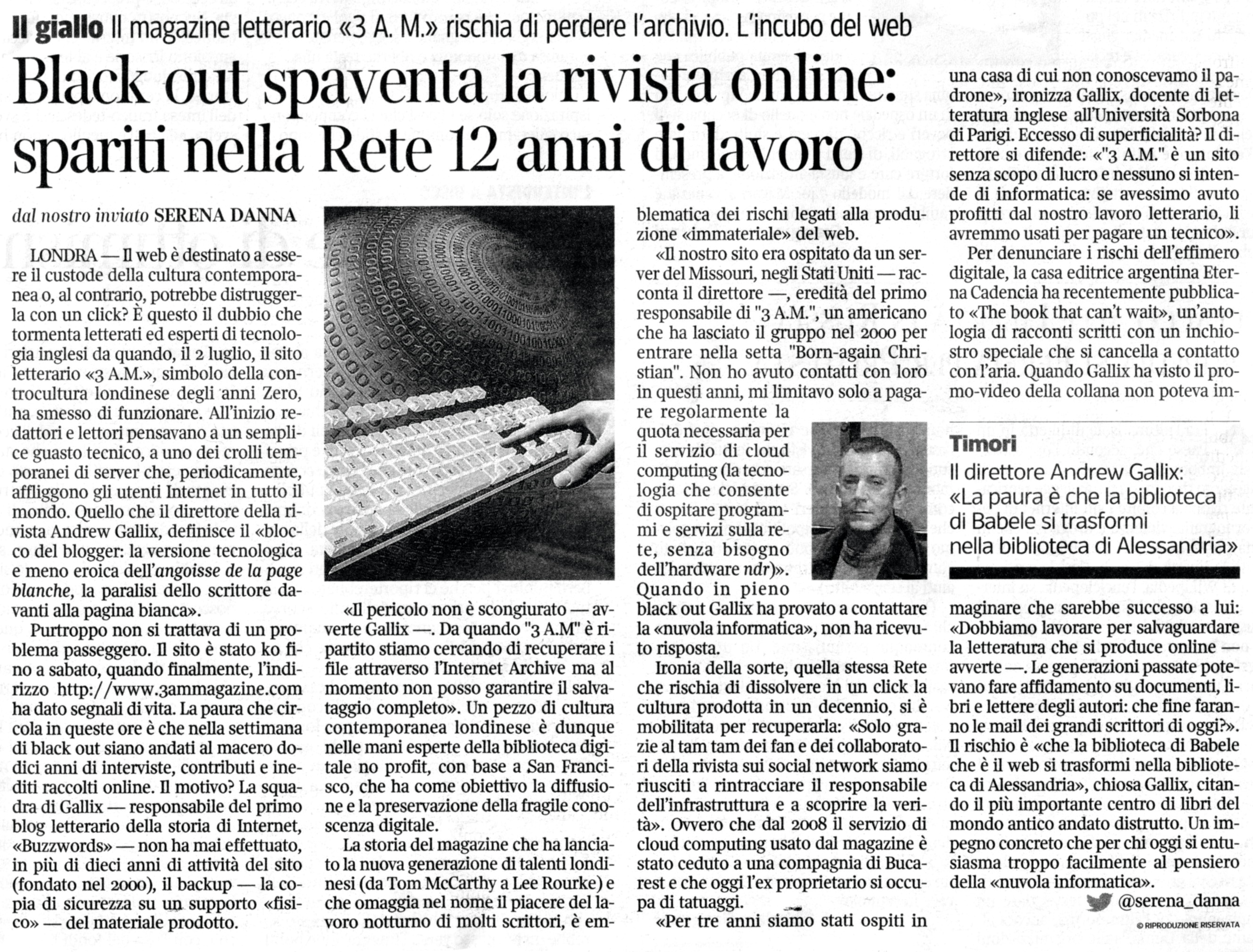
Serena Danna, “Black out spaventa la rivista online: spariti nella Rete 12 anni di lavoro,” Corriere della Sera 11 July 2012: 29.

A larger version of this newspaper cutting can be found here.

A few selected extracts:
“[…] il sito letterario 3:AM, simbolo della controcultura londinese degli anni Zero […] il direttore della rivista Andrew Gallix, definisce il “bloco del blogger: la versione tecnologica e meno eroica dell’angoisse de la page blanche, la paralisi dello scrittore davanti alla pagina bianca”. […] La squadra di Gallix — responsabile del primo blog letterario di Internet, “Buzzwords” […] La storia del magazine che ha lanciato la nuova generazione di talenti londinesi (da Tom McCarthy a Lee Rourke) e che omaggia nel nome il piacere del lavoro notturno di molti scrittori, è emblematica dei rischi legati alla produzione “immateriale” del web. […] “Per tre anni siamo stati ospiti in una casa di cui non conoscevamo il padrone”, ironizza Gallix, docente di letteratura inglese all’Università Sorbona di Parigi. Eccesso di superficialità? Il direttore si difende: “3:AM è un sito senza scopo di lucro e nessuno si intende di informatica: se avessimo avuto profitti dal nostro lavoro letterario, li avremmo usati per pagare un tecnico”. […] Quando Gallix ha visto il promo-video della collana non poteva imaginare che sarebbe successo a lui: “Dobbiamo lavorare per salvaguardare la letteratura che si produce online — avverte —. Le generazioni passate potevano fare affidamento su documenti, libri e lettere degli autori: che fine farano le mail dei grandi scrittori di oggi?”. Il rischio è “che la biblioteca di Babele che è il web si transformi nella biblioteca di Alessandria”, chiosa Gallix, citando il più importante centro di libri del mondo antico andato distrutto […]”

Digital Vanishing Act

Edward Champion, “3:AM Magazine — How Twelve Years of Literary Content Disappeared in an Instant,” Reluctant Habits 6 July 2012

3:AM Magazine, the first literary magazine to champion Tom McCarthy’s work and a pioneering avant vanguard that had published the early work of Tao Lin, Tony O’Neill, and Ben Myers, had vanished in an instant, with the hosting company seemingly disappearing along with it. While a substantial chunk of the magazine’s content was still available through the Internet Archive’s Wayback Machine, there was no backup. And according to editor-in-chief Andrew Gallix, the site was held together by little more than “a doctored WordPress system”.

“It never occurred to me that our server could just be switched off without a word of warning and that the owner would do a runner!” wrote Gallix to me by email. Gallix’s efforts earlier in the week to reach the host were unsuccessful. Emails bounced. The phone had been disconnected. Gallix hadn’t received so much as a notice that his valiant magazine was disconnected and no longer in service.

While Gallix had used another host for a site dedicated to McCarthy’s work, he never switched 3:AM over during the twelve years he ran the site. He had a full-time day job. He wanted to read and he wanted to write. If the server crapped out, it would find a way to resurface after a time. “I kept postponing the move in the hope that things would improve,” said Gallix.

There was no reason for Gallix to worry. Because he had experienced very few problems. “The site was down on some occasions,” said Gallix, “sometimes just for a couple of hours; at worst for a whole day: there didn’t seem to be any real cause for concern”.

* * *

3:AM began, as many literary magazines begin, with a short story. Gallix started corresponding with an American named Kent Wilson, and a website was born. 3:AM Magazine, initially a static site comprised of a handful of stories, was founded in 1999. But Wilson had an unanticipated spiritual awakening. And 3:AM, which abided by the motto “Whatever it is, we’re against it,” didn’t fit into these mysterious ways. Wilson asked Gallix to take over 3:AM in April 2000.

“We were the first to really make use of the global dimension of the web,” said Gallix. “All the editors and contributors met online, and it was only after that some of us became friends in real life”.

This commitment to friendship and passion sustained a literary magazine with a distinct and inimical tone. “While in the middle of a feverish pawing at the back-clip of her bra,” begins one typically edgy and entertaining story around this time, “I did not think much of her whispering in my ear that she could not stay for the night because she had to go home feed Satan”.

But as long as the website continued to work, Gallix didn’t rue over the technical logistics. Wilson had given Gallix the name of a host: RMIhost.com, which was run by Reece Marketing Inc. Reece Marketing Inc. was a one man operation run by Brandon Reece. And when I tracked Reece down by telephone on Friday afternoon, he told me that he was stunned that someone was still using it.

“We haven’t done hosting for four or five years,” said Reece, who sounded somewhat surprised at the news that 3:AM had vanished. “I haven’t hosted anybody’s site since 2008.”

Gallix informed me later in the afternoon that he had paid an annual hosting fee, but it was unclear whether someone had taken over from Reece. He received an email every year asking to pay for the next year. So what was RMIhost.com?

“That’s all still up there,” replied Reece. “It’s not doing any business.”

Reece claimed to not know anything about 3:AM Magazine. He said his company had once specialized in website design and had operated out of Dallas. “It was never a successful side company,” said Reece.

Reece recalled a guy named Kent when I asked him. He identified a “born again Christian,” and confirmed that this was Kent Wilson when I provided the surname. But Reece didn’t appear to know what Wilson had given him. Was it possible that he wasn’t even paying attention to RMIHost?

“I don’t ever remember hosting 3:AM Magazine,” said Reece. “I think I would know.”

Reece referred to “a server admin in Bucharest” — a gentleman named Florin — who he promised to email tonight. When I asked Reece if RMIhost had leased any particular server, he seemed baffled.

“DNS,” said Reece. “I haven’t done anything like this in a while.”

Reece was busy “looking for something new right now”. He intimated that he was in a transition period and that the hosting company had been more of an unprofitable sideline. These days, he was living on savings.

“I don’t trust my personal expertise,” said Reece when I asked him about his technical chops. “I don’t even know how to do that myself. You forget everything you do.” But he did promise to get on the case by Monday. He also allowed me to pass along his contact information to Gallix.

As for Gallix, he informed me that he had tech people retrieving what they could off the Internet Archive. But even if 3:AM manages to extract the content, he’s unsure about what “more reliable and reputable host” he’ll offload his content onto. The experience revealed to Gallix “the fragility of online content”.

It remains unclear whether Reece was playing dumb or acting in good faith. But he was willing to pass along his contact info to Gallix, even after I informed him of the significant online outcry that had followed 3:AM‘s server outage. And these efforts do represent a step in the right direction to preserve 3:AM‘s vast archive.

No matter how the 3:AM predicament works out — and there are positive signs that it will — preserving online work may very well be as dangerous as other historical precedents. Or as Tom McCarthy, reached on holiday, declared to me upon learning the news, “My first reaction is: ALEXANDRIA!”

[7/6/2012 6:45 PM UPDATE: As of 6:45 PM EST, 3:AM Magzine has been restored. Many thanks to all who helped out with this story and to Mr. Reece for following through with his promise.]