Never Taken As Read

Richard Marshall, “No Thing,” 3:AM Magazine 29 March 2013

. . . Dworkin hopes that through erasure writing can be recovered by attending to its essential detritus, its material media and its event. He suggests this retrieval comes by a palimpsest enacting a “double play of concealment and revelation”, a way of obstructing to make something visible. Andrew Gallix writes that “Words become visible; the bloody things keep getting in the way. From this perspective, the literary is what can never be taken as read”. . . .

orphée

As Tight As Wire

Richard Marshall, “Modernist Ghosts,” 3:AM Magazine 18 June 2013

apparitionalexperience

. . . Reality is inevitably, and tragically, the boss, relentless and remorselessly impervious to the dreams of its inhabitants. We hope for autonomy, agency, but fear it’s just the drink talking post hoc most of time. ‘When you say my name, you retain nothing of me but my absence. And nobody is present behind these words I speak’ says Emilie in the Andrew Gallix short story “Fifty Shades of Grey Matter“. The story presents a doomed lover contemplating his lost love. The materiality, the bodily anxiety presses in against the frenetic, desperate and seething mind of the protagonist and throughout there’s a need to try and combine the two — the mind and the body — to understand the relationship in some way. The story is implacable and granite strong in this. The violence of physical action, the dangerous crime that bodies seem to presuppose in the narrative, carries ‘the mute reminder of the possibility of impossibility’ symbolized by an insane aside about anal rape. What kind of dark matter is being imagined in this? The subject is Occasionalism, the question of powers and causality.

. . . Gallix’s odd fiction seems also to hold lyricism in a merciless fixed embrace. The facts are stone, as dry as archaism, stratified, absorbed and the utter indifference to the sensual passion of its protagonist is expressed in a language chisselled and polished like marble. Everything is imagined with prodigal allusiveness. It’s as tight as wire, extremes of tragedy, pathos and irony are cut like contours ploughed into copper with a burin. If the effect is a dismembered cruelty, it is a cruelty of the universe, of a cause from somewhere else altogether, somewhere or some agency that knows enough to cause it.

Gallix’s approach is not alone in the Fiddleblack collection. Nor is this conceit I’m pressing — arbitrarily at times, but then making a run of it to see where we might go, for there are others that might be mysteriously pressed into action. The impossibility of causality without knowledge of how to create or annhiliate, well, that has some edge, even if we think it exactly false. But Gallix, to continue using him as a catalyst here, has that line about the ‘possibility of impossibility,’ and who cannot unforgive a paradox when we’re telling each other stories about how it isn’t?

. . . But the orgiastic demonstration of writing’s imaginative physique is best in the antiquity of Gallix’s Roman fairy tale of Valentin Vermot, a ghost haunted by ghosts that, abbreviated to an essentialist verbatim, goes: ‘Once upon a time there was a man called Valentin. Valentin Vermot. Just like you. He thought he was haunted by a ghost, but his ex-wife assured him that there was no such thing. “There are no ghosts,” she said. “There are no ghosts.” Valentin opened his eyes. He was all alone, but Emilie’s voice was still ringing in his ears. There are no ghosts, there are no ghosts, there are no ghosts, there are no ghosts…’ . . .

The Unread and the Unreadable

This appeared in Guardian Books on 18 February 2013:

The Unread and the Unreadable

We measure our lives with unread books — and ‘difficult’ works can induce the most guilt. How should we view this challenge?

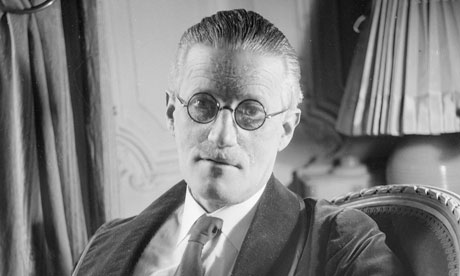
[Samuel Beckett said of James Joyce's Finnegans Wake … 'It is not only to be read. It is to be looked at and listened to.' Photograph: Lipnitzki/Roger Viollet/Getty Images

[Samuel Beckett said of James Joyce’s Finnegans Wake … ‘It is not only to be read. It is to be looked at and listened to.’ Photograph: Lipnitzki/Roger Viollet/Getty Images]

There was a time when a learned fellow (literally, a Renaissance man) could read all the major extant works published in the western world. Information overload soon put paid to that. Since there is “no end” to “making many books” — as the Old Testament book Ecclesiastes prophesied, anticipating our digital age — the realm of the unread has spread like a spilt bottle of correction fluid. The librarian in Robert Musil‘s The Man Without Qualities only scans titles and tables of contents: his library symbolises the impossibility of reading everything today. The proliferation of lists of novels that you must, allegedly, have perused in your lifetime, reflects this problem while compounding it. On a recent visit to a high street bookshop, I ogled a well-stacked display table devoted to “great” novels “you always meant to read”. We measure out our lives with unread books, as well as coffee spoons.

The guilt and anxiety surrounding the unread probably plays a part in our current fascination with failed or forgotten writers. Hannah Arendt once wondered if “unappreciated genius” was not simply “the daydream of those who are not geniuses”, and I suspect there is indeed a touch of schadenfreude about this phenomenon too. On the book front, we could mention Mark O’Connell’s Epic Fail, the brilliantly idiosyncratic Failure, A Writer’s Life by Joe Milutis, and Christopher Fowler‘s Invisible Ink: How 100 Great Authors Disappeared, based on the longstanding column in the Independent on Sunday. Online, there is The New Inquiry‘s Un(der)known Writers series, as well as entire blogs — (Un)justly (Un)read, The Neglected Books Page, Writers No One Reads — devoted to reclaiming obscure scribes from oblivion. One of my personal favourites is The Biographical Dictionary of Literary Failure, which celebrates the lives of writers who have “achieved some measure of literary failure”. The fact that they all turn out to be fictitious (à la Félicien Marboeuf) and that the website will vanish after a year, make it even more delightful. I recommend the tale of Stanhope Sterne who, like TE Lawrence, lost a manuscript on a train — at Reading, of all places: “Is there, I wonder, some association with that dull junction’s homonym, that it is a writer’s fear of someone actually reading their work that causes these slips?”

When Kenneth Goldsmith published a year’s worth of transcribed weather reports, he certainly did not fear anyone would read his book from cover to cover — or even at all. That was not the point. With conceptual writing, the idea takes precedence over the product. This is an extreme example of a trend that began with the advent of modernity. Walter Benjamin famously described the “birthplace of the novel” — and hence that of modern literature — as “the solitary individual”: an individual now free from tradition, but also one whose sole legitimacy derived from him or herself, rather than religion or society.

In theory, the novel could thus be anything, everything, the novelist wanted it to be. The problem, as Kierkegaard observed, is that “more and more becomes possible” when “nothing becomes actual”. Literature was a blank canvas that increasingly dreamed of remaining blank. “The most beautiful and perfect book in the world,” according to Ulises Carrión, “is a book with only blank pages.” Such books had featured in eastern legends for centuries (echoed by the blank map in “The Hunting of the Snark” or the blank scroll in Kung Fu Panda), but they only really appeared on bookshelves in the 20th century. They come in the wake of Rimbaud‘s decision to stop writing, the silence of Lord Chandos; they are contemporaneous with the Dada suicides, Wittgenstein‘s coda to the Tractatus, the white paintings of Malevich and Rauschenberg, as well as John Cage‘s 4’33”.

Michael Gibbs, who published an anthology of blank books entitled All Or Nothing, points out that going to all the trouble of producing these workless works “testifies to a faith in the ineffable”. This very same faith prompts Borges to claim that “for a book to exist, it is sufficient that it be possible” and George Steiner to sense that “A book unwritten is more than a void.” For Maurice Blanchot, Joseph Joubert was “one of the first entirely modern writers” because he saw literature as the “locus of a secret that should be preferred to the glory of making books”.

If literature cannot be reduced to the production of books, neither can it be reduced to the production of meaning. Unreadability may even be a deliberate compositional strategy. In his influential essay on “The Metaphysical Poets”, TS Eliot draws the conclusion that modern poetry must become increasingly “difficult” in order “to force, to dislocate if necessary, language into its meaning”. The need to breathe life back into a moribund language corrupted by overuse, chimes with Stéphane Mallarmé‘s endeavour to “purify the words of the tribe”. The French writer was very much influenced by Hegel, according to whom language negates things and beings in their singularity, replacing them with concepts. Words give us the world by taking it away. This is why the young Beckett‘s ambition was to “drill one hole after another” into language “until that which lurks behind, be it something or nothing, starts seeping through”.

Literature (for the likes of Mallarmé and Blanchot) takes linguistic negation one step further, by negating both the real thing and its surrogate concept. As a result, words no longer refer primarily to ideas, but to other words; they become present like the things they negated in the first place. When critics objected that Joyce‘s Finnegans Wake was unreadable, Beckett responded: “It is not to be read — or rather it is not only to be read. It is to be looked at and listened to. His writing is not about something; it is that something itself”. Unlike ordinary language, which is a means of communication, literary language resists easy, and even complete, comprehension. Words become visible; the bloody things keep getting in the way. From this perspective, the literary is what can never be taken as read. In a recent article, David Huntsperger gives an interesting contemporary twist to this debate. He views the opacity of some contemporary novels as a healthy corrective to our “clickthrough culture, where the goal of writing is to get you from one place to another as effortlessly as possible, so that (let’s be honest here) you can buy something”.

Droll, Mischievous and Wonderfully Intelligent

Douglas Glover, “Fifty Shades of Grey Matter: Fiction,” Numéro Cinq 8 June 2013

Droll, mischievous and wonderfully intelligent confection, a Modernist riposte to the vacancy (absence) of E. L. James’s Fifty Shades of Grey, in which Gabriel Josipovici has a walk-on role and the protagonist images himself as Caspar Friedrich’s Wanderer AND Roy Scheider in Jaws in the same instant and someone wears a Clarice Lispector frock. It all begins with a mother telling a bedtime story, yes, yes, a scene of sadistic psychic violence like none other. Brilliantly witty. Deploys many of the Modern erotic positions: sex and text, love as desire for absence, and self as ghost (we all have that sense of the self being something that haunts itself). The teaser below accurately describes love and art, or maybe not. By Andrew Gallix who edits 3AM Magazine.

Your heart still skips like a trip of jackrabbits in the Arizona desert, where we carved our names on a bench close to the abyss. But when I look at you, well, I just feel dead inside. It has to be like this and no other way; otherwise it wouldn’t be art, would it? I’m in love with Jay now: I feed him mini Milano cookies and give him snug harbor. Anyway, I was never quite all there, was I? Long before we met, I was a character in one of your stories — ‘Sweet Fanny Adams.’ Young man goes looking for girl of his dreams in order to break up straight away. ‘At last,’ he says upon meeting her, ‘I have found my sense of loss.’ See? I haven’t forgotten. I started off as fiction, and to fiction I have returned. Our relationship was only a movement towards my disappearance. I am your sense of loss: the self-effacing subject of your work…”

“Emilie…” said Valentin.

“When you say my name, you retain nothing of me but my absence. And nobody is present behind these words I speak.”

Read the rest.

Paris in American Literatures

I am mentioned in Jeffrey Herlihy-Mera and Vamsi K. Koneru, eds, Paris in American Literatures: On Distance as a Literary Resource, Madison NJ: Fairleigh Dickson University Press, 2013

Page 152: “As Andrew Gallix observes; ‘It seems now that the stories shape the city as much as the coty once shaped the stories’ (Gallix 2010, 1).”

Page 153: “The Paris of the tourist and student imagination drives the repetition and commodification of the pilgrimage; Gallix’s assertion here about the development of Paris in the collective imagination is somewhat misleading — the stories, like the screenplays and the somewhat limited study-abroad impressions, shape the impression of the city for the foreigner.”

What is also somewhat misleading is the fact that both the quote and the article in which it appears are by Anthony Cuthbertson!

The French Protect Their Language Like the British Protect Their Currency

This first appeared in The Guardian‘s Comment is Free section on 23 May 2013. It was reprised in The Guardian Weekly (31 May-6 June 2013, p. 48):

The French Protect Their Language Like the British Protect Their Currency

A row over using English in universities has blown up in France, where language is at the heart of the national identity

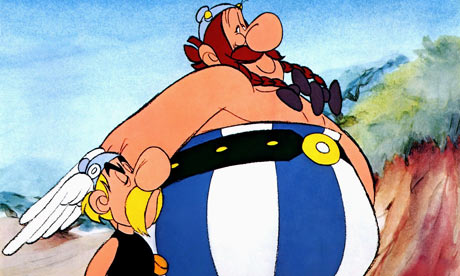
'The nod to Asterix (left, pictured with Obelix) – the diminutive comic-strip hero who punches above his weight thanks to his cunning and occasional swigs of magic potion – is highly significant.' Photograph: Allstar/Cinetext/United Artist

‘The nod to Asterix (left, pictured with Obelix) – the diminutive comic-strip hero who punches above his weight thanks to his cunning and occasional swigs of magic potion – is highly significant.’ Photograph: Allstar/Cinetext/United Artist

The front page of Libération, one of France’s leading dailies, was printed entirely in English on Tuesday. “Let’s do it,” ran the banner headline. Sounding like a Nike slogan penned by Cole Porter, it in fact referred to a new bill, which, if passed, would allow some university courses to be taught in English.

Inside the paper (and in French), the editorialists urged their compatriots to “stop behaving like the last representatives of a besieged Gaulish village”. The nod to Asterix — the diminutive comic-strip hero who punches above his weight thanks to his cunning and occasional swigs of magic potion — is highly significant. For decades, France has identified with the plucky denizens of Asterix’s village, the last corner of Gaul to hold out against Roman invasion. This is how the French fancy themselves: besieged but unbowed — a kind of Gallic take on the Blitz spirit.

The reason Uderzo and Goscinny’s books resonated at the time of their publication is that they replayed the myth of French resistance in the context of the cold war. This time around the invaders were no longer German or Roman, but American. Asterix’s first outing (in a long-defunct magazine called Pilote) occurred in 1959, the year Charles de Gaulle became president, and grammarian Max Rat coined the word “franglais“. My contention is that this is not purely coincidental.

France’s identity has long been bound up with its language, more so possibly than anywhere else. This may be due to the fact that French is treated as a top-down affair, policed by the state: an affaire d’état, if you will. Language, for instance, is at the heart of the Organisation Mondiale de la Francophonie, France’s answer to the Commonwealth. The flipside of a state-sponsored language has been a deep-rooted anxiety over linguistic decay and decline. The official custodian of the French tongue — the Académie française — was partly created, back in 1635, to counter pernicious Italian influences.

French nationalism was largely discredited after the second world war, because of the Vichy regime and collaboration. As a result, it often took refuge in cultural — particularly linguistic — concerns. De Gaulle’s inflammatory 1967 speech in Quebec, when he took the linguistic battle into the very heart of enemy territory, speaks volumes. “Long live free Quebec! Long live French Canada! And long live France!” declaimed de Gaulle (en français dans le texte, of course). Quebec was repositioned as a besieged Gaulish village, and French as a symbol of resistance — perhaps even as a surrogate magic potion. For de Gaulle, liberating Quebec meant reversing France’s defeat at the hands of the English in 1763.

My feeling is that France is haunted by its lost American future. Had the US fallen under Gallic domination, French would probably be the world’s lingua franca today. Fears over the decline of French vis-à-vis English are exacerbated by the knowledge that the enemy is also within. Although the linguistic watchdogs regularly come up with alternatives to anglicisms — “mercatique” for “marketing”; “papillon” for “Post-it note” — American expressions are often adopted with far more enthusiasm in France than across the Channel. David Brooks’s portmanteau word bobo (bourgeois bohemian) is more ubiquitous here than in Britain. Even more worrying, perhaps, is the French penchant for unwittingly redefining (“hype” for “hip”) or making up new English expressions (brushing, footing, fooding etc.).

The unregulated flexibility of English probably gives it an extra edge in our ever-shifting digital world. As Susan Sontag once pointed out, French is “a language that tends to break when you bend it”. It is significant that many young French speakers today should suddenly switch to English when writing a mél or courriel (if you’ll pardon my French) to a friend.

So what is all the fuss about right now? The higher education minister, Geneviève Fioraso, wants to amend the 1994 Toubon law so that French universities are allowed to teach a limited number of courses in English (which is already the case in the elite grandes écoles and top private business schools). The main aim of this is to attract foreign students, particularly from rapidly expanding economies such as China, India, or Brazil.

Unfortunately, Fioraso committed an unforgivable faux pas — on a par with Sarkozy’s disparaging comments about the Princess of Cleves — when the idea was first mooted in March. She warned that if teaching in English were not introduced, French research would eventually mean “five Proust specialists sitting around a table”. This led to accusations of philistinism on the part of those who believe that sitting around a table discussing the works of Proust is precisely what being French is all about.

Not surprisingly, reactions have been far more favourable in the scientific community than in literary circles. The Académie française is up in arms over what it sees as “linguistic treason”. Prominent academic and author Antoine Compagnon fears that the measure may lead to dumbing down, since most of these lectures would be spoken in “Globish” rather than the true language of Shakespeare. Bernard Pivot, who used to host a top literary TV programme (and belongs to the Académie), argues that French will become a dead language if it relies on English borrowings to describe the modern world. Claude Hagège, a renowned linguist, concurs, saying that France’s very identity is at stake.

Roland Barthes famously described language as essentially “fascist”, not because it censors but, on the contrary, because it forces us to think and say certain things. The idea that we are spoken by language as much as we speak through it is, I think, an important one here: French offers a different world view from English. Today, the symbol of British sovereignty is an independent currency. In France, it is an independent language, and that is indeed something to be cherished.

***

Here is a longer, unedited version of the same piece:

On Tuesday, the front page of Libération, one of France’s leading dailies, was printed entirely in English. “Let’s do it,” ran the banner headline. Despite sounding like a Nike slogan penned by Cole Porter, it referred to a new bill, which, if passed, would allow some university courses to be taught in English. Inside (and in French), the editorialists urged their compatriots to “stop behaving like the last representatives of a besieged Gaulish village”. The nod to Asterix — the diminutive comic-strip hero who punches above his weight thanks to his cunning and occasional swigs of magic potion — is highly significant. For decades, France has identified with the plucky denizens of Asterix’s village, the last corner of Gaul to hold out against Roman invasion. This is how the French fancy themselves: besieged but unbowed — a kind of Gallic take on the Dunkirk/Blitz spirit. Part of the resonance of Uderzo and Goscinny’s books is that they replayed the myth of the French resistance in the context of the Cold War. Now, of course, the invaders were no longer German or Roman, but American imperialists who spoke the tongue of perfidious Albion (or at least a variant thereof). Asterix’s first outing (in a long-defunct magazine called Pilote) occurred in 1959, the year de Gaulle became president, and grammarian Max Rat coined the word “franglais”. My contention is that this is not purely coincidental.

France’s identity has long been bound up with its language, more so possibly than anywhere else. This may be due to the fact that French is treated as a top-down affair, policed by the state: an affaire d’état, if you will. Language, for instance, is at the heart of the Organisation Mondiale de la Francophonie, France’s answer to the Commonwealth. The flipside of a state-sponsored language has been a deep-rooted anxiety over linguistic decay and decline. The official custodian of the French tongue — the Académie française — was partly created, back in 1635, in order to counter pernicious Italian influences. The title of Joachim du Bellay’s Defence and Illustration of the French Language (1549) — one of the first concerted efforts to raise French to the level of Latin and Greek — is eloquent: defence takes precedence over illustration.

French nationalism was largely discredited after the Second World War, due to the Vichy regime and collaboration. As a result, it often took refuge in cultural — particularly linguistic — concerns. The defence of the French language would be instrumental in de Gaulle’s attempt to counter Anglo-Saxon domination by embodying a third way between the United States and Soviet Union. The President’s inflammatory 1967 speech in Quebec, when he took the linguistic battle into the very heart of enemy territory, speaks volumes. “Long live free Quebec! Long live French Canada! And long live France!” declaimed de Gaulle (en français dans le texte, of course). Quebec was repositioned as a besieged Gaulish village, and French as a symbol of resistance — perhaps even as a surrogate magic potion. The Canadian PM countered that “Canadians do not need to be liberated. Indeed, many thousands of Canadians gave their lives in two world wars in the liberation of France and other European countries”. The two leaders were talking at cross purposes. For de Gaulle, liberating Quebec meant reversing France’s defeat at the hands of the English in 1763.

My feeling is that France is haunted by its lost American future. Had the United States fallen under Gallic domination, French would probably be the world’s lingua franca today. Fears over the decline of French vis-à-vis English are exacerbated by the knowledge that the enemy is also within. Although the linguistic watchdogs regularly come up with alternatives to anglicisms – “mercatique” for “marketing”; “papillon” for “Post-it note” — American expressions are often adopted with far more enthusiasm in France than across the Channel. David Brooks’s portmanteau word “bobo” (bourgeois bohemian) is ubiquitous over here, but has failed so far to take off in Britain. Even more worrying, perhaps, is the French penchant for unwittingly redefining (“hype” for “hip”) or making up new English expressions (brushing, footing, fooding etc.). None of this is new, of course. Dropping English phrases in conversation was already the last word in chic for the crème de la crème in the days of Proust, and René Etiemble’s famous Parlez-vous franglais ? was published as far back as 1964. The unregulated flexibility of English probably gives it an extra edge in our ever-shifting digital world. As Susan Sontag once pointed out, French is “a language that tends to break when you bend it”. It is significant that many young French speakers today should suddenly switch to English when writing a “mél” or “courriel” (if you’ll pardon my French) to a friend.

So what is all the fuss about right now? Higher Education Minister Geneviève Fioraso wants to amend the 1994 Toubon law (or “loi all good” as it is sometimes called) so that French universities are allowed to teach a limited number of courses in English (which is already the case in the elite grandes écoles and top private business schools). The main aim of this reform is to attract foreign students, particularly from rapidly-expanding economies such as China, India, or Brazil. Unfortunately, Ms Fioraso committed an unforgivable faux pas — on a par with Sarkozy’s disparaging comments about the Princess of Cleves — when the idea was first mooted in March. She warned that if teaching in English were not introduced, French research would eventually mean “five Proust specialists sitting around a table”. This led to accusations of philistinism on the part of those who believe that sitting around a table discussing the works of Proust is precisely what being French is all about.

Not surprisingly, reactions have been far more favourable in the scientific community than in literary circles. The Académie française is up in arms over what it sees as “linguistic treason”. Prominent academic and author Antoine Compagnon fears that the measure may lead to dumbing down, since most of these lectures would be spoken in “Globish” rather than the true language of Shakespeare. Bernard Pivot, who used to host a top literary TV programme (and belongs to the Académie), argues that French will become a dead language if it relies on English borrowings to describe the modern world. Claude Hagège, a renowned linguist, concurs, saying that France’s very identity is at stake.

Roland Barthes famously described language as essentially “fascist”, not because it censors but, on the contrary, because it forces us to think and say certain things. The idea that we are spoken by language as much as we speak through it is, I think, an important one here: French offers a different world view from English. Today, the symbol of British sovereignty is an independent currency. In France, it is an independent language, and that is indeed something to be cherished.

[* In The Guardian Weekly, this article appeared under the following heading: “The French Are Right to Protect their Language: It Runs to the Heart of their Identity and Offers a Different Worldview to English”.]

A Besieged Gaulish Village

I have written a piece on the current French row over the introduction of courses in English at university. It appears in the Guardian‘s Comment is Free section, and you can read it here:

Inside the paper (and in French), the editorialists urged their compatriots to “stop behaving like the last representatives of a besieged Gaulish village”. The nod to Asterix — the diminutive comic-strip hero who punches above his weight thanks to his cunning and occasional swigs of magic potion — is highly significant. For decades, France has identified with the plucky denizens of Asterix’s village, the last corner of Gaul to hold out against Roman invasion. This is how the French fancy themselves: besieged but unbowed — a kind of Gallic take on the Blitz spirit.

Killing the Literary

Illya Szilak, “Killing the Literary: The Death of E-Lit,” The Huffington Post 19 March 2013

“Is e-literature one big anti-climax?” complained Andrew Gallix in The Guardian in September 2008. For many of us working in the field, the question still needles. Gallix’s argument that e-lit is hobbled by its association with print literature is valid. Five years on, most English literature departments don’t offer courses in e-lit, and most creative writing programs don’t include it.

[…] For e-lit to be accepted as a legitimate art form, we must stop using print literature as the sole paradigm for judging and experiencing it. What the standard should be is, as yet, unclear. Gallix ends his article with a quote from Mark Amerika which emphasizes the evolving status of e-lit.

Amerika may well be on to something when he claims that we are witnessing the emergence of a ‘digitally-processed intermedia art’ in which literature and all the other arts are being ‘remixed into yet other forms still not fully developed.’

[…]

Reading the Unreadable

This appeared on The New York Times‘s Opinionator blog on 27 February 2013. It featured in The Stone, a column devoted to philosophy moderated by Simon Critchley:

Reading the Unreadable
So many books, so little time. Who doesn’t feel the anxiety of it all? In a post at The Guardian’s Books blog, Andrew Gallix moves from a meditation on the phenomenon of the “failed or forgotten” writer, to the deliberate unreadability of the “conceptual writing” championed by the poet Kenneth Goldsmith, to the inevitability of the “blank book” prophesied by Kierkegaard. Gallix wonders whether this kind of literary elusivity isn’t ultimately a gift; he claims, following Hegel, that “words give us the world by taking it away.”

Fifty Shades of Grey Matter

This short story appeared in: Fiddleblack Annual 1: Apparitional Experience. Peninsula, Ohio: Fiddleblack ltd, 2013. 109-118.

apparitionalexperience

Fifty Shades of Grey Matter

“Once upon a time…”
She looked up from the big picture book.
“Lie down now, there’s a good boy, or I shan’t read you a bedtime story.”
Her voice was stern but soothing. Soon it would speak from some secret wound, secreting senseless squander. Tales of strange voyages to enigmatic climes would pour forth; unmoored, rudderless. Suddenly, he felt himself all at sea: drowning in the wide inky-black yonder, dissolving like sugar in absinthe. Giant crabs threw him sidelong glances. Tentacles coiled, vine-like, around his legs and testicles. Mermaids, following some ancient sushi recipe, were wrapping his erect penis in seaweed. And just out of earshot, the unspeakable sound of behemoths rutting amongst the flotsam and jetsam of idioms, both dead and yet unborn. Somewhere, impossible worlds were being mapped, somehow — and there he was bound, on his bouncy bed, with his impossible words, striped pajamas and incarnadined buttocks. Shivering all over from sheer delight, he snuggled up under the eiderdown down, down, down…
“Are we all comfy now? Then I’ll begin. Once upon a time…”
She paused for effect. He was hooked: reel him in.
“…there was a man called Valentin. Valentin Vermot. Just like you.”

Valentin was lurking at the far end of the grand ballroom. He tried to picture himself à rebours, as though he were another, but failed to make the imaginative leap. A blinding flash of bald patch — the kind he occasionally glimpsed on surveillance monitors — was all he could conjure up: Friedrich’s Wanderer with rampant alopecia. He squinted at the polished floorboards, and slowly looked up as the world unfolded, leaving him behind. He was James Stewart in Vertigo; Roy Scheider in Jaws. He was the threshold he could never cross. At the far end of the grand ballroom Valentin was lurking.
All eyes were on Emilie Pierrade, Marquise de Villette, who had just arrived, fashionably late, at the lavish publishing party. Her absence had haunted the labyrinthine corridors of the château for several long hours. Speculation was rife among industry movers and shakers. Had she got the date wrong? wondered Philiberte Moreau. Was it a publicity stunt? wondered Théodule Meuniaire. Did she take a wrong turn at Crépy-en-Valois? wondered Sostène Zanzibar. Smoldering behind a gold-tipped Sobranie, Emilie looked more glamorous than ever, in her crisp Clarice Lispector frock and speculative realist boots. Her neck was adorned with pearls of great worth and love bites that resembled those wild strawberries you happen upon by the roadside.
“Marquise, vous n’êtes pas Villette pour des prunes,” boomed Gabriel Josipovici, before making a big show of kissing her hand in the manner of Mitteleuropa, interrupting a conversation which had meandered from Ingeborg Bachmann to Stig Saeterbakken by way of László Krasznahorkai’s pop-up mint garden.
Sidonie de Nananaire rushed to greet her distinguished guest. Valentin charted the progress of her signature exploding bouffant across the grand ballroom. A few minutes later, having ascertained that no one was watching, he followed in the footsteps of the self-styled neo-rombière.
“Allez ma chérie — mwah, mwah — tell us all about him,” said the hostess, “on veut tout savoir. Tout.”
“Ladies,” said Emilie, hugging a giant golden dildo, “meet Jay Kühlotts, my new fiancé.”
They all went into raptures, gasping and mock-swooning like a shrill of schoolgirls.
“So what’s he really like, underneath?” inquired Philiberte Moreau, when all the whooping had subsided. She increasingly resembled an approximation of one of her own doodles, and Emilie was unsure whether this was a good thing or not.
“Je ne vais pas énumérer toutes ses qualités,” she replied, trying not to appear too smug, “mais je crois que j’ai vraiment de la chance.” She seemed to dwell on each word as though it were a world in which she might dwell. Forever.
Entranced, Valentin scrutinized his estranged wife from a safe distance. Like the past, she was another country now — out of bounds. She had returned herself to a place that precluded complete recognition. A place before them; before him, but mostly after. Valentin was rediscovering Emilie in her strangeness, bathed in an otherworldly glow. This disquieting experience reminded him of standing outside his childhood home and feeling that he was haunting himself.
He was haunting himself again.
As soon as Emilie spotted Valentin, all the other women turned round and melted away, out of politeness or embarrassment. For a few seconds, they just stood there, facing each other.
“Yes,” she said, breaking the ice with the same cruelty with which she had broken his heart, “I do that bunny nose thing. And, yes, I put on a mean moose voice — so, sue me. I’m blessed with honeyed hair and bee-stung lips, and wear purple panties like no other. All that is a given I have taken away. I’m in love with Jay now. When you look at me, your eyes light up like the 45,037 bulbs on the Plaza hotel in Las Vegas, where I wore a white see-through pencil skirt to our midnight wedding. Your heart still skips like a trip of jackrabbits in the Arizona desert, where we carved our names on a bench close to the abyss. But when I look at you, well, I just feel dead inside. It has to be like this and no other way; otherwise it wouldn’t be art, would it? I’m in love with Jay now: I feed him mini Milano cookies and give him snug harbor. Anyway, I was never quite all there, was I? Long before we met, I was a character in one of your stories — ‘Sweet Fanny Adams.’ Young man goes looking for girl of his dreams in order to break up straight away. ‘At last,’ he says upon meeting her, ‘I have found my sense of loss.’ See? I haven’t forgotten. I started off as fiction, and to fiction I have returned. Our relationship was only a movement towards my disappearance. I am your sense of loss: the self-effacing subject of your work…”
“Emilie…” said Valentin.
“When you say my name, you retain nothing of me but my absence. And nobody is present behind these words I speak.”
And with these words she was gone. The celebrity translator hailed a young waiter who was naked save for a polka dot bow tie. She picked a glass from the tray he bandied about with the recklessness of a seasoned tightrope walker. Her International Klein Blue eyes lingered on the departing buttocks as they threaded their way through the throng. She swished her drink around in the glass, absentmindedly. The waiter swayed to the cool clinking of the Zizek-shaped ice cubes. She swished some more.
Sidonie de Nananaire sidled up to her. “So, how did you two meet?”

Chiselled of chop, shiny of shoe and striped of sock, Jay Kühlotts was not one to be shushed lightly. He exuded natural authority. It was in his stature, posture, and ancestry; the cut of his suits and crispness of his shirts. It was in the size of his bank balance, the knobs on his timepiece and, above all, the bulge in his trousers. The latter was never openly acknowledged: like an eclipse, it could not be observed directly. The bulge was a given; its hegemonic presence always lurking in the background, just out of sight, or else glimpsed out of the corner of the eye — a black shape moving underwater. It hummed in unison with the air conditioning, an integral part of the ambient music of the corporate universe. No, Jay Kühlotts was not one to be shushed lightly. He had been headhunted by the American multinational that provided technical support for concentration-camp management during the war. As a proud citizen of a nation which had turned collaboration into government policy, this was a marriage made in heaven. Kühlotts lorded it over board meetings with a patrician sense of entitlement everyone sensed he was entitled to. With his property portfolio, gold cuff links and sports cars, he fancied himself as an enlightened despot, although he would never have put it in those terms, of course. He was a stickler for democracy, only imposing his own views once his colleagues had had ample opportunity to expose theirs. No, Jay Kühlotts really was not one to be shushed lightly. In fact, he was not one to be shushed at all. Yet shushed he had been, and nothing would ever be the same again. Nothing. Granted, it was not the loudest of shushes, not by a long chalk or any stretch of the imagination. More of a hush, really, if that. In truth, half a hush would probably cover it. And then some.
Yet this curt exhalation — this ill wind of change — had reverberated around the table like a violence without measure. Kühlotts played it over and over again in his mind, and each time it sounded more like a guillotine: shh! He began to wonder if it had not just been a loud sniffle, a muffled sneeze, or even a mere figment of his imagination. Confused, he made another attempt to get a word in edgeways, but the same young woman motioned him to hold his peace once more. The look of utter disbelief on his face was something to behold. He felt like Nicolae Ceausescu when his balcony speech was rudely interrupted by chanting, or Saddam Hussein’s statue in Firdos Square, just before its toppling.
“Madame, for all I know you may be the best translator in France,” he said, “but that’s no excuse for…”
Emilie Pierrade raised a manicured index finger to her puckered lips before resuming her conversation with the man sitting to her right. Still in full flow, she unbuttoned her blouse and cupped a pert breast out of her scalloped brassiere. She let it defy gravity for a few minutes, while leafing through the thick brochure in front of her.
“Hang on, hang on… Ah, here’s the passage!” she said, and without even really looking, reached out and placed her hand on the back of Kühlott’s head, slowly bringing him level with her exposed mammary gland. Holding him tight by the scruff of the neck, she smeared his mouth across her nipple and round and round the areola. Thus embosomed, he had no other option but to suckle down at her teat. He did so greedily and soon closed his eyes.
“There, there,” she whispered, running her fingers through his hair, “all better now. The Marquise is here. Shh… Shh… Right. Where were we? Ah, yes, that passage on page 707…”

“In any event,” she said, doing her trademark bunny nose, “you’re not hard enough to take me up the backside.” By not she meant not ever. There was a finality to the sentence that left little room for interpretation. Valentin watched her pick some fluff off the pink roll-neck she had just folded on the bed. The double bed that might as well have been two singles. He wondered if a woman lost all respect for her man — and a fortiori her husband — as soon as the threat of anal rape was removed from the equation. Perhaps it should always be lurking in the background, a mute reminder of the possibility of impossibility. That was in San Francisco.

On one of the corners of rue des Abbesses and rue Aristide Briand stands a cafe called La Villa. The decor could — and indeed shall — be described as gentlemen’s club stroke colonial chic. African masks look down, with long faces, from dark oak panelling. The lamps are always dimmed, as though some hallowed mystery had to be preserved from the cold light of day. In the first section, there are twelve black leather armchairs on either side of six black round tables. Valentin faces the armchair where Emilie once sat, with him, by the window. It is impossible to say for sure if it is the exact same one, or if the armchairs have been moved around. At bottom, it is a question of belief. Valentin believes, with every fibre of his being, that this is the armchair in which Emilie is no longer sitting. He believes that she has left something behind. He believes that her buttocks are haunting the leather seat — that everything must leave some kind of mark, for fuck’s sake. The distance separating the armchair in which Valentin is sitting from the luxury villa where Kühlotts is feeling Emilie’s breasts and cunt is 787.2 kilometres. A distance, his mobile also informs him, that he could — and indeed shall — cover by car in seven hours and thirty-five minutes. He pinches out the screen repeatedly to magnify the satellite picture. He is a missile, zeroing in — past fields and forests — on the Med’s answer to Southfork. Emilie slinks out to the pool in a sky-blue bikini and wide-brim sun hat, a slim volume dangling from her right hand. The distance separating the armchair in which Valentin is sitting from the armchair in which Emilie is no longer sitting is absolute. Valentin stands up and walks towards the empty armchair. 787.2 kilometres away, Kühlotts is feeling Emilie’s breasts and cunt. In five steps, he should be there. Seven hours and thirty-five minutes away, Emilie slinks out to the pool in a sky-blue bikini and wide-brim sun hat, a slim volume dangling from her right hand. With each step, the cafe grows wider and the armchair recedes. The universe is expanding faster and faster, pushing everything away; tearing everyone apart.

When Valentin Vermot put pen to paper that day, he found it difficult to concentrate. His mind kept wandering, although no source of distraction was immediately detectable. No motorbikes mooing past down below. No high heels peppering the pavement with desire. No children shouting merry profanities on their way home from school. Yet his mind kept wandering, though he still knew not where. He focused on his mind focusing, but it did not seem to be going anywhere at all. Having drawn a blank — by applying layer upon layer of Tipp-Ex — he proceeded to make a point, until the nib of his pen had pierced the near virginal sheet of paper, which only a few crossed-out words had thus far desecrated. He picked up a printout of an e-mail Emilie had sent him eight years earlier, on Sunday 30, May 2004 at 9:26 pm:
I LOVE YOU
I WANT YOU
I NEED YOU
I ADORE YOU
I MISS YOU
I AM OBSESSED WITH YOU
I ADMIRE YOU
I WORSHIP YOU
I CANNOT LIVE WITHOUT YOU
Having read it, he reached for the Tipp-Ex:
I LOVE YOU
I WANT YOU
I NEED YOU
I ADORE YOU
I MISS YOU
I AM OBSESSED WITH YOU
I ADMIRE YOU
I WORSHIP YOU
I CANNOT LIVE WIThOUT YOU
The universe was expanding, tearing them apart.

Are those spots of blood he spots on her riding breeches? Not spots per se, perhaps, or even — upon closer inspection — spots at all, for that matter, which is not to say, of course, that the breeches are ipso facto spotless. Far from it, in fact. Spot-free, yes, probably — possibly — but not spotless, no, on account of those flecks — or are they spots? — all down the inside of her left thigh. Was any cupping involved, he wonders? Did his testes roll around in her hand like wine in a taster’s palate? If so, was that before slipping on her latex gloves? Did she apply a little pressure at any point, possibly towards the end? Did it remind him of the way she squeezes the bulb on her vintage atomizer? Did he reflect, however briefly, upon the transformation of liquid into fine spray? Did he marvel, if only for a split second, at that small miracle? Did he picture her in a mist of musk and black silk stockings? At what stage did she place her left foot on the milking stool? Was that before slipping on her latex gloves? Did she assume this position on practical or aesthetic grounds? Was it a bit of both? Did he read anything into it, and if not, why not? Did he think, on reflection, that he should have done, and if so, why? Would he say that the adoption of this posture accounts (at least in part) for the presence of those spots (or flecks) on her riding breeches? Was it, shall we say, a contributory factor? Did he witness the appearance of a pattern on her left thigh? Was it like a slowly exposed action painting caught on Polaroid? Was it like a time-lapse of a newborn’s features morphing, over the years, into a death mask? Is the corpse the truth of the biological individual? Was it at this juncture that he slipped on her latex gloves?

The Marquise went out at seven. It could have been at six, of course, or even at five; indeed it usually was. That day, however, it was at seven, on account of her husband being frightfully late. Consistent is the life he leads, said the maid, who often likened him to the ever punctual pater familias in Mary Poppins. You could set the time by his comings and goings; indeed everybody did. At five o’ clock sharp, the maid would start dusting, scrubbing, mopping and ironing as if propelled by the velocity of a hard day’s work. At five on the dot, Madame la Marquise — freshly abluted and made up — stood poised to greet her husband like a domestic goddess who would never dream of spending the afternoon in the company of impossibly young bell boys with the stamina of Duracell bunnies. No, it really was not like him at all, said the maid, shaking her head; totally out of character. Lost in thought, the Marquise gazed out of the window, blinking into the blinding light that was streaming in. She was fiddling with her pearl necklace as if it were a rosary. You always know where you are with him, said the maid. And what about without him? Lost tout court, the Marquise gazed out of the window, blinking into the blinding light that was streaming in from long, long ago. I have seen the light and now I cannot see. She was fiddling with her pearl necklace as if rolling testicles around between thumb and forefinger. Her late husband was in fact so late now that it could only be too late. He would never be coming home again, not least, of course, because he was lying in a pool of blood with a gaping hole where his heart once was — or should have been. Dinner would be ruined now.

Seven hours and thirty-five minutes later, Emilie slunk out to the pool in a sky-blue bikini and wide-brim sun hat. She screamed, dropping a slim volume by Raymond Roussel into the crimson water. She screamed louder still when she caught sight of Valentin standing there, holding a notebook. He raised his index finger to his lips: “I will cause you to be absent,” he said, “I will annihilate you.” He opened the notebook and wrote This Woman over and over again.

When he finally looked up, she had disappeared. Valentin was tired after driving 787.2 kilometres. He walked into the villa and fell asleep on a leather sofa. He dreamt that Emilie was pregnant with his novel.
“It’s been in here for more than nine months,” she said pointing to her belly, “but the bloody thing won’t come out.”
He woke up still sleeping to find himself in bed, wearing his striped pajamas. He was trying to read a big picture book, but the pages were all stuck together. He threw a tantrum and Emilie had to smack his bottom in the end. A man wearing shiny shoes and striped socks was watching. Valentin caught sight of his gold cuff links as he left the room. Once Valentin had stopped sobbing, Emilie tucked him in, picked up the big picture book and started reading out loud:
“Once upon a time…”
She paused for effect. He was hooked.
“…there was a man called Valentin. Valentin Vermot. Just like you. He thought he was haunted by a ghost, but his ex wife assured him that there was no such thing. ‘There are no ghosts,’ she said. ‘There are no ghosts.’”
Valentin opened his eyes. He was all alone, but Emilie’s voice was still ringing in his ears. There are no ghosts, there are no ghosts, there are no ghosts, there are no ghosts…