Carpe Diem Recollected in Cacophony

A piece of mine, entitled “The Boy Looked at Eurydice” appeared in Berfrois today. That’s me in the picture, reading to my sister Sarah, when we were both very young indeed.

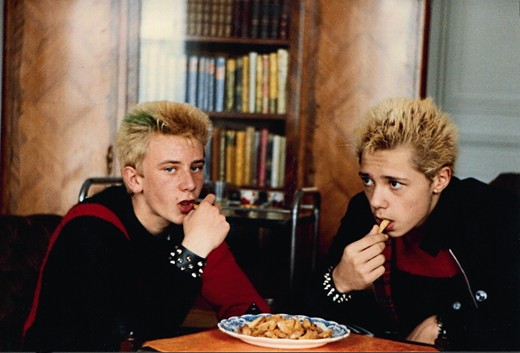
Punk was carpe diem recollected in cacophony — living out your ‘teenage dreams,’ and sensing, almost simultaneously, that they would be ‘so hard to beat’ (The Undertones). The movement generated an instant nostalgia for itself, so that it was for ever borne back to the nebulous primal scene of its own creation. Its forward momentum was backward-looking, like Walter Benjamin’s angel of history.

Moments of Being

I have interviewed Nicholas Rombes for Bomb Magazine:

AG: The seventy-minute-mark screen grab of The Blair Witch Project (1999) just happens to be “the single most iconic image of the film,” but such serendipity is rare. In the case of a monster movie like The Host (2006), for instance, the 10/40/70 method fails to yield a single picture of the creature. As a result, your approach tends to defamiliarize films by pointing to the uncanny presence of other films within them — phantom films freed from the narcotic of narrative:

Such moments could be cut or trimmed without sacrificing the momentum of the plot, and yet the cast-in-poetry filmmakers realize that plot and mood are two sides of the same coin and that it is in these in-between moments—the moments when the film breaks down, or pauses—where the best chances for transcendence lie. […] It is in moments like these that films can approximate the random downtimes of our own lives, when we are momentarily freed from the relentless drive to impose order on chaos.

As this quote makes clear, your constrained methodology is “designed to detour the author away from the path-dependent comfort of writing about a film’s plot, the least important variable in cinema.” It is often a means of exploring the “infra-ordinary” — what happens in a film when nothing happens, when a movie seems to be going through the motions. One thinks of Georges Perec, of course, but also of Karl Ove Knausgaard, who recently explained that he wanted “to evoke all the things that are a part of our lives, but not of our stories—the washing up, the changing of diapers, the in-between-things—and make them glow.” When such in-between moments lose their liminality, do they become “moments of being” (to hijack Virginia Woolf’s expression) during which a movie simply is?

NR: I think they do, and I very much like that phrase from Woolf. At the heart of this is the notion that films — all films — are documentaries in the sense that they are visual records of their own production. In a narrative film, for instance Ben Wheatley’s A Field in England (2013), we have a documentary record of so many things: the actors playing their roles; the landscape, whether natural or constructed; and of course filmic technology itself, insofar as the film is created with equipment that, in recording the narrative, is also leaving behind traces of itself. This is much easier to see in older films that are historically removed from us (i.e., a Griffith film “looks” filmic and reminds us of the technologies of, say, 1906 or 1907) or films that call for immediate and sustained attention to the process of their production (again, The Blair Witch Project). And, in that sense, as documentaries, I like to think that no matter how controlled, how airtight, how totalizing their efforts to minimize chance are, there will always be gaps, fissures, eruptions of the anarchy of everyday life. Even in something so small as the accidental twitch of an actor’s face, or the faint sound of a distant, barking dog that “shouldn’t” be in the film but is, or the split-second pause in a actor’s line and the worry that crosses her face that suggests she is really thinking about something else, something far apart and far away from the movie at hand. And so that’s one of the things I’m hoping to capture in pausing at ten, forty, and seventy minutes, though any numbers would do.

Read the interview here.
Fragmentos escritos

Carlos Magro, “Gallix,” fragmentos escritos 25 January 2014

fragmentosescritos

El “contenido” está “ahí fuera” -siempre ahí- toda la literatura es “paráfrasis”: “¿Quién estaría interesado en un discurso nuevo y no transmitido? Lo importante no es contar, sino volverlo a contar, y en esta repetición, contarlo de nuevo como si fuera la primera vez” (Maurice Blanchot. L’Entretien infini, 1969)

Andrew Gallix. “La influencia de la ansiedad

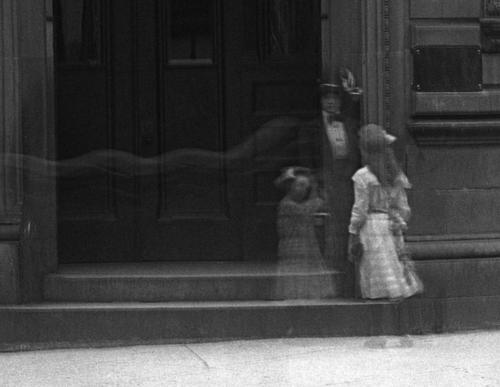
[Foto: Fotografía tomada fuera del Royal Bank Branch. Notre Dame Street, Montreal, Canada. 1911]

[SIC]

Jeff Bursey, Rev. of [SIC], by Davis Schneiderman, The Quarterly Conversation 10 March 2014

In 2011 Andrew Gallix, in the Guardian, wrote a piece on unread difficult books, and he mentioned “an anthology of blank books [edited by Michael Gibbs] entitled All Or Nothing.” We can consider Blank as continuing that line. Kenneth Goldsmith’s prefatory essay “Why Conceptual Writing? Why Now?” in Against Expression: An Anthology of Conceptual Writing (2011) contains these useful lines: “What has happened in the past fifteen years has forced writers to conceive of language in ways unthinkable just a short time ago. With an unprecedented onslaught of the sheer quantity of language . . . , the writer faces the challenge of exactly how best to respond.” In volume one of his trilogy, Schneiderman edged near to muteness, but in [SIC] he has positioned himself, the work, and us in a new spot. His latest book is filled with words. None of them are his.

The Texture of the Ripples

Nicholas Rombes, who was Writer in Residence over at Necessary Fiction in December 2013 and January 2014, invited Tobias Carroll, Cari Luna, Lincoln Michel, Masha Tupitsyn, Karolina Waklawiak, Joanna Walsh, and myself to contribute fiction and non-fiction pieces on the theme of movie writing. You will find Nicholas Rombes’s own fine offering here.

thegraduate1
thegraduate2
thegraduate2
thegraduate4

And here’s a short extract from my essay, “The World Without Me“:

Soon Benjamin will need to escape, choose some course of action. He is on a collision course with Elaine, the accident that has already happened. In the meantime, he is a castaway adrift upon shimmering amniotic fluid. A young man without qualities, in trunks and sunglasses, cradling a can of beer on his belly — Bartleby Californian-stylee. I like him best when he just goes with the flow; that is, when he goes nowhere. The camera lingers longingly on the texture of the ripples. Sunny constellations twinkle on the celestial water’s surface. Benjamin, recumbent on his lilo, fades out as the ever-morphing abstract of light reflections fades in.

De Rigueur

My piece on realism is referenced, rather dismissively, by J. W. Cormack in a question he puts to the excellent Jason Schwartz. Is it really contentious to claim that most people’s idea of a traditional novel — a “proper” novel — is (alas) one which can be loosely defined as “realist”?

J. W. Cormack, “Jason Schwartz,” BOMB 7 January 2014

Speaking of category, I read a fairly de rigueur article from The Guardian, one of those “end of fiction” pieces you see every few years — although this one seemed to be equating “traditional fiction” with “the realist novel.” Is this a mistake? Do you feel like the world needs a different fictive vocabulary than the purely representational one we’ve become accustomed to?