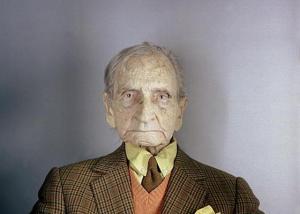
Andy Warhol, Serious Writer

This appeared on the Guardian Books Blog on 2 April 2008:

Andy Warhol, Serious Writer
Best-known as a photographer, filmmaker, designer and illustrator, pope of pop Andy Warhol was also an influential novelist

warhol

Andy Warhol was a painter, illustrator, designer, photographer, filmmaker, producer, journalist, editor, anchorman, and model. In her book Warhol Spirit Cécile Guilbert argues, more contentiously, that he was also a serious writer.

She makes much of his influence on Bret Easton Ellis, himself one of the most influential authors of recent years. In one instance, an extract from American Psycho and a social column penned by Warhol in 1973 are printed side by side. The similarities are striking: same tonal blankness, compulsive name-dropping and seemingly endless lists of designer goods. (Fittingly, the film adaptation of American Psycho was directed by Mary Harron, whose previous movie had been I Shot Andy Warhol.)

Warhol’s name has frequently cropped up in reviews of Ellis’s work, but the connection has been most clearly established by Ellis himself. One of the characters in Glamorama is mocked because she only owns two books: the Bible plus the Andy Warhol Diaries (“and the Bible was a gift”). The inference here is that the Diaries appeal to superficial hipsters, but the juxtaposition with scripture is just as significant. The Pope of Pop presides over the celebrity culture and branded environment Glamorama is steeped in, but his presence runs the paradoxical risk of being overlooked — it is part of the novel’s wallpaper. When Victor, the protagonist, quotes one of Warhol’s epigrams (“Baby, Andy once said that beauty is a sign of intelligence”), it is immediately disproved by his girlfriend’s admission that she has no idea who he is (“Andy who?”). The fact that she could have walked straight out of the Factory or the Chelsea Hotel adds a nice touch of dramatic irony.

Apparently, the two men met at a launch party for Less Than Zero in 1985. Warhol had not read Ellis’s debut, but was much taken with its title (a nod to Elvis Costello) that resonated with his own rhetoric. Cécile Guilbert zeroes in on the quasi-Zen minimalism of his interview performances. She sees Warhol as a Candide-like figure rather than the usual sub-Wildean ironist: a mystical idiot savant whose very passivity turns him into a mirror or a tape recorder. In his memoir, POPism, Warhol claimed that the words he uttered during interviews always seemed to be “coming from someplace else, someplace behind [him]”. This oracular ventriloquism raises issues of authorship, as does his approach to the novel.

a: A Novel — Warhol’s answer to Ulysses, published in 1968 — is the verbatim transcription of a series of taped conversations between the author and actor Ondine. The typescripts (courtesy of four typists including Velvet Underground drummer Mo Tucker who excised all swear words) were themselves faithfully reproduced down to the last typo and abbreviation. The outcome is largely unreadable, in the same way that Warhol’s films are largely unwatchable.

Perhaps I am missing the point here. After all, Warhol deliberately set out to produce a “bad” novel as an experiment and his hands-off approach provided a nice variation on Roland Barthes’s “Death of the Author” (an almost literal one given the Valerie Solanas incident which had just occured). He can also be credited with taking the objectivity of the nouveau roman to its logical conclusion and fulfilling B. S. Johnson‘s dream of capturing the “enormity of life” between the covers of a book.

Warhol was a prescient writer, if not a great one. He anticipated that the truth of fiction would be ditched in favour of the fictionalization of truth and invented reality TV in the process. In a way, he was not a writer at all. All his books were either dictated or transcribed from recordings, and in this respect he was part of a curiously old-fashioned tradition that predates the Gutenberg Galaxy.

Custard Pie in the Sky

409692229_e75d124f7c_t.jpg

This article appeard in 3:AM Magazine in April 2000:

Custard Pie in the Sky
Slapstick tactics and patisserie terrorism in Noël Godin’s Groucho-Marxist manifesto. Revenge has never been so sweet.

“Everything is to be found in Peter Rabbit,” the Consul liked to say.
– Malcolm Lowry, Under the Volcano

Marguerite Duras (nouveau roman), Jean-Luc Godard (nouvelle vague), Bernard-Henri Lévy (nouveau philosophe) and Bill Gates (nouveau riche) have one thing in common, besides their former novelty value. They have all ended up with egg on their faces after falling foul of Noël Godin (nouvelle cuisine), a colourful, cream-tart-toting terrorist, given to fits of Falstaffian histrionics. Since 1969, this boisterous Belgian has stalked some of the most prominent members of the literati, glitterati and politi — Europe’s crème de la crème — intent on giving them a taste of his anger: now he is going global. As reference points, imagine Nechayev starring in one of Mack Sennett’s commotion pictures, Ravachol sparking off a custard-pie free-for-all, or Delia Smith advocating gateau guerilla warfare at a chimpanzees’ tea party. These oft-fêted, sometimes ill-fated, culinary crimes are chronicled in Godin’s toothsomely-titled memoirs, Crème et châtiment (“Cream and Punishment”). Even in print, revenge has never been so sweet.

Dairy devils & doughy deeds
M. Godin, better known under his preposterous nom de guerre Georges Le Gloupier, is an unlikely if delightful desperado. Pie-eyed, pudding-faced and potbellied, he is the proud possessor of an unprepossessing appearance which seems to laugh in the airbrushed mugshot of our aesthetically-correct times. As if that were not enough, he adds insult to injury by displaying a penchant for unsuitable suits of the tatty Tatie variety — a dirt-cheap-and-cheerful Parisian department store — indicating a rejection of Savile Row chic in favour of skid row chicanery. Cheeky sideburns apart, he looks like your average, run-of-the-mill, middle-aged man on the street, all greying temples and tired attire. In fact, he could be anybody, or even nobody for all we know; indeed he is.

Godin-Le Gloupier inhabits a twilight world suspended between plot-hatching obscurity and limelight-hogging ubiquity. His patisserie pranks regularly hit the headlines, and yet he can still strike unawares in broad daylight, confounding the tightest of security measures Fantômas-fashion. France’s top TV producers fall over themselves to invite him on their prime-time tabloid shows for another havoc-wreaking (let alone alcohol-reeking) performance that will send the ratings sorely soaring, but his name does not even appear on the cover of his autobiography. This is where revolutionary abnegation and the proverbial death of the author meet neat marketing strategy.

For promotional purposes, Godin is Le Gloupier, although Le Gloupier is not necessarily Godin. To begin with, the phantom flan-flinger has always been a resolutely collective effort. Whenever la bande à Godin go on the warpath, several comrades are tarted up as Le Gloupier in order to create a diversion, or simply to ensure that at least one of them gets a bull’s-eye. Moreover, from the point of view of characterization, Le Gloupier is as flat as a baking tray. He is a Bergsonian textbook case — the degré zéro of comique de répétition. Any number of dairy devils itching for doughy, doughty deeds can flesh out this most basic of actantial functions: casting a confection at a figure of authority. It’s a piece of cake, so to speak. No wonder, then, that the pie-thrower should have contracted the Purple Rose of Cairo syndrome.

In the time-honoured tradition of Galatea, Pinocchio and sundry gingerbread men legging it after rising from the pastry board, Le Gloupier has taken on a life of his own. Being the stuff folk heroes are made of, he was bound to become public property sooner or later. Today, he is a runaway running gag, popping up all over the place, unbeknown to his creator, who is sometimes associated with attacks he has taken no part in, but is only too willing to take credit for. En un mot, Le Gloupier has become a name to conjure with — a name with which Godin attempts to conjure himself away. Thanks to the recent spate of copycat crimes, he has found it easy as pie to go on playing cat-and-mouse with the gendarmes, despite being shadowed round the clock by a police officer. In any case, arresting him would be neither here nor there because, to all intents and purposes, he is neither here nor there. Making due allowances, a parallel could be drawn with the well-nigh legendary Zapatist leader. When 60,000 Mexicans took to the streets like ducks to water chanting “We are all Marcos,” it became obvious that the masked poet-guerillero (half-Dante, half-Subcomandante) had succeeded in transforming his elusiveness into illusiveness. Godin has reached a similar, semi-mythical status, but disappearing into thin air is not always such an easy task in his case: unobtrusiveness ill-becomes a Belgian braggadocio. Try as he may, Godin never manages to convince us that he is merely the vanguard of gateau guerilla warfare, the icing on the cake, as it were. The interview format of Crème et châtiment captures the virtuoso volubility of his television performances, thus reinforcing the impression of an overpowering presence. The presence of a unique voice which seldom has the opportunity of expressing itself at any length.

Textual harassment
Surprisingly enough, considering that the eponymous “gloup! gloup!” slogan repeated ad nauseam is all his victims ever get out of him, Noël Godin comes over as a mesmerizing conversationalist-cum-consummate stylist. In truth, he can rabbit on like his hero Bugs Bunny on speed until the vaches (French for pigs) come home. Reminiscing over the public humiliation of public figures seems to microwave the cockles of his little heart, setting his tongue a-wagging as if there were no tomorrow and the world needed an urgent talking-to. Eloquent and grandiloquent by turns, Godin turns out to be the talk of the town — a glutton for oratory, an inveterate verbal bulimic, cramming his unsavoury memoirs with meaty mouthfuls, kilograms of epigrams and wondrous witticisms. The author, pleased as Punch, leaves the reader reeling, punch-line-drunk.

Although he loathes the type of postmodern fiction that disappears up its own ars rhetorica, language is the pièce de résistance (a rococo pièce montée would be a more apt description) which Godin dishes out with evident relish. We are talking language with bite here, the mordant kind that bares its teeth and just about everything else, pouring forth at full lick like spewed-up moules frites, when it is not swooning at its own swagger. An acquired taste, of course, but one well worth acquiring if you have the stomach for a gargantuan four-course discourse. The spicy anecdotes are sometimes a mere pre-text: all the fun of the fare resides in their cocasse recountal. Around these veracious, elated, voraciously-related vignettes, Godin erects a Babel of babble, a towering inferno of titillating tittle-tattle: a pleasure-principle dome. Beyond the picaresque peripeteia — in the nooks and crannies of the tortuous sentences, the kooky portmanteau words (“attentarte”) and pithy, presumably off-the-cuff, one-liners — lies the plaisir du texte. The sheer-stocking bliss of textual harassment. The stoccado, scattato stiletto style. Even the cantankerous cursing is quaint and recherché; a devilishly efficacious cross between an eighteenth-century libertine (“foutre Dieu!”) and Tintin’s foul-mouthed sidekick, Captain Haddock (“ventre de boeuf !”, “mille tonerres!”, “jambon à cornes !”). If Godin won’t eat his words — every other sentence is a sentence to death — then the reader probably will: who would refuse to be fed a diet to die for in an age of Prozac prose and Lit Lite?

There are shades of Rabelais, a pervading sense of démesure, in this verbal surfeit, as well as in the constant oscillation between refinement and vulgarity. Gab-gifted Godin’s Gallic garrulity — with its declamatory, tribun-style tournures, and robust Third-Republic, école communale flavour — often degenerates into a slang slanging match with the world as it is and should not be. His cyclothymic style swells up into a bomb blast of bombast in the mock-heroic mode, then collapses from within into an understated, deadpan shorthand like a soufflé gone awry. There is always a rapid detumescent descent from the giddy heights of Godin’s furor loquendi: after each yackety-yack attack, the scintillating syntax grinds to a halt, not with a bang but a whimper. This self-deflating prose, which pricks its own champagne bubble of pomposity every now and then, gives the hilarious impression of an orgy ending in a bout of digestive-biscuit nibbling. Bref, Crème et châtiment is a feisty feast of lingual felicity, which is not to say that it is short on substance.

Prose & cons
Like an epic poem, the book begins in medias res, and then proceeds by successive flashbacks until halfway through the narrative. The first chapter zooms in on Bernard-Henri Lévy’s discomfiture at the 1994 Cannes Film Festival, which sums up Le Gloupier’s oeuvre in Godin’s view. Its title (“B.H.L., mon amour”), modelled on Hiroshima, mon amour, is an oblique reference to the original pie attack perpetrated against Marguerite Duras some fifteen years earlier. A potted history of Le Gloupier’s genesis (“Fondements théoriques de l’attentat pâtissier”) is interpolated into the account of the comical Duras incident which stretches out over two chapters. The three following chapters are devoted to a further analepsis. They form a kind of mini Bildungsroman, taking us from Godin’s early pranks as a fallen choirboy to his post-1968 agitprop. The rest of the book, covering more familiar territory, is devoted to the growth of the “révolution crémière”.

Global village idiot
Some, no doubt, will find this exercise in self-aggrandizement difficult to swallow — a trifle rich — and will probably make a meal of it. To them, Godin will remain a gredin, an oafish loafer whose bread and butter is to slice the upper crust down to size. Alternatively, he will be branded a frustrated loser, a sort of global-village idiot bent on pooping the jet set’s party, or dismissed as a mild irritant, the gratin‘s poil à gratter. Others will see Godin as as the maître farceur of our virtual-reality age, making a spectacle of the disintegrating société du spectacle; a globe-trotting terrorrist, whose stage is the world, forever hitting and running off to creamy, unpasteurized pastures new.

Ultimately, the author remains something of an enigma: a protean master of disguise, a Machiavellian maverick, an avant-garde film director, a pathological liar (in his incapacity as a critic), a righter of wrongs and a writer of sorts. A fruitcake, perhaps, but Crème et châtiment shows us that there is a recipe in his madness.

Godin’s juvenilia & other delinquencies
Noël Godin seems to have been a prankster with a cause for as long as he can remember. His strict Catholic upbringing at the slap-happy hands of Salesian fathers in Liège brought out the little devil in him. Young Godin’s spirited anticlerical capers would stop at nothing: hitching up the nuns’ skirts and shouting “Vive Diderot!” when Jacques Rivette’s La Religieuse was banned in 1966, playing a recorded concert of farts during mass, unleashing flocks of pigeons while The Birds was being shown at school, or even stooping to pissing in stoops — Manneken-Pis-fashion — on the odd occasion.

His law studies came to a sticky end when he poured a pot of glue over a right-wing professor who had worked for the Portuguese dictator Salazar. That was just before getting caught up in the student uprising of 1968 which was to change the course of his life. In 1995, he told The Observer that he was “never cured of the fever of May 1968.” As Walter Pater put it: “To burn always with this hard, gem-like flame, to maintain this ecstasy, is success in life.”

Demon cherub
The demon cherub soon attracted a motley crew of genial freaks and terminal dropouts. Jean-Pierre Bouyxou, the one-time editor of a popular pornographic publication and renowned B-movie pundit, ranked high among them in terms of inspiration. Anatole Atlas, whose fifteen minutes of fame occured in 1972 when he showered Marxist egghead Jacques Lacan in pâtisseries flamandes, was another early convert. Jan Bucquoy, the eccentric agent provocateur whose misdeeds are legion, often lent a helping hand. In 1991, he burned a Magritte, framed the ashes, and entitled the new work of art Les Cendres de Magritte. He is also the founder of two rather unusual museums: the first, for some reason, is devoted exclusively to male underwear; the second is the infamous Musée de la Femme where one can visit a collection of live, naked women of all ages, colours and sizes (which may, or may not, have inspired Tilda Swinton’s stint as the sleeping Serpentine Gallery beauty a few years back). Besides editing a satirical newspaper (Belge) which is regularly banned, Bucquoy is the author of countless obscene Tintin books (in which Snowy the dog is invariably buggered by his bequiffed master), and the director of bittersweet, autobiographical films like La Vie sexuelle des Belges (1995).

Psycho analysis
With his mates, some of whom ended up as inmates, Godin set about gatecrashing the world of politics. In 1969, for instance, a mass meeting of Walloon nationalists degenerated into a western-style saloon rumble, when the agitators started brandishing their flag: the skull and crossbones.

Georges Tutukjian’s undelivered speech on psychoanalysis — three years and many acts of sabotage later — is another typical example. No sooner had the mandarin appeared on stage, than he was joined by Anatole Atlas who argued convincingly, and in no uncertain terms, that psychoanalysis was a load of tripe because it aimed at reintegrating sick people into a society which had made them sick in the first place. The heckler was immediately pounced upon by a couple of burly bouncers and forcibly ejected from the auditorium. Taking advantage of the pandemonium, Noël Godin jumped on stage and launched into a hearty, albeit slightly out-of-tune rendition of “Who’s Afraid of the Big, Bad Stalinist wolf?” The doctored lyrics — establishing a parallel between Uncle Joe and Hitler through a reference to Tex Avery’s lupine portait of the German tyrant — proved well ahead of their time for Belgian intellectual circles, and anathema to M. Tutukjian, a notorious hardline Communist who was one of Claude Lévi-Strauss’s closest collaborators. The second heckler was consequently pounced upon by a couple of burly bouncers, and forcibly ejected from the auditorium. The speaker — who still had not been able to get a word in edgeways — then threw a primadonna wobbly, announcing that the conference was off as far as he was concerned. After protracted negotiations, he finally accepted to answer a few questions from the members of the audience. This turned out to be a big mistake, and even a grave error, on his part. The first question had a decidedly familiar ring to it: “Who’s afraid of the big, bad Stalinist wolf?” enquired Godin (whom Bucquoy had let in again through an emergency exit) with the placid obstinacy of Droopy. By that time, M. Tutukjian’s nerves were in shreds. He pondered the vexed question for a few seconds, getting increasingly hot and bothered by the minute. Suddenly, he got up, pushed his way past a couple of burly bouncers, and left the auditorium almost in tears.

High-flying flyers
Spoof political tracts were also circulated to great effect. One of them, inciting children to take up arms against the adulterated adult world, was distributed outside many Italian schools by people disguised as the cat and fox out of Pinocchio. Another, printed on the day Baader, Meinhof and Ensslin were “suicided” in jail, threatened assorted figures of authority with the most appalling, grand-guignolesque tortures as a retaliatory measure.

Godin was a scrupulous tractarian. When he travestied the tracts of established political parties, he always made sure that they were strikingly true to life. He was literally obsessed with linguistic and typographic punctilios: everything had to look just right, down to the slightest scintilla of detail. When the Soviet forces invaded Czechoslovakia, for instance, he produced a handbill on which the Belgian Communists invited the population to demonstrate its joy. And demonstrate, it did: an angry mob stormed the party’s headquarters, smashing it to smithereens.

Powder-puffed Kirilov
Godin’s extra-curricular activities were just as potent. Isolating the Consul’s comment, in Under the Volcano, that “Everything is to be found in Peter Rabbit,” he reinterpreted Beatrix Potter’s classic in the light of Malcolm Lowry’s (“Jeannot Lapin au-dessous du volcan,” Etudes Comparées 2, 1970).

It is well worth looking up, if only for the psychoanalytical purple patch in which he makes much of the Oedipal tensions and death wish underlying Peter’s compulsion to explore Mr McGregor’s garden, despite his mother’s express order never to go near it — the very same garden where his father had met his fate, ending up, incidentally, in a pie. (The disappointing conclusion, however, is not worth a pet de lapin.) Puffing up Peter Rabbit into a powder-puffed Kirilov was thus the first step towards Godin’s more expeditious literary criticism: the flinging of flans at writers he did not appreciate (not that Lowry ranked among them).

Rapscallion agitprop
These custard-pie scandals have revived interest in Godin’s three courts métrages which, in some circles, are now considered as celluloid classics in the “Dada-punk” vein. Incredibly enough, Godin seasons have already been organized in Paris, Geneva, Berlin and Moscow, as well as in other lesser cultural centres. A compilation video is even in the offing. Of course, one could argue that these short films have all the insolence of Duchamp’s bearded and mustachioed Mona Lisa but, in the final analysis, cheekiness is their only redeeming feature. As works of art, they are irredeemable. Godin himself claims that their only merit is to have established a new genre, which he defines as “la polissonnerie d’agitation” (“rapscallion agitprop”).

Proper gander
The Danish artist Asger Jorn used to doodle on daubs he found at the flea market: Godin did something similar with his first movie. He took, or rather stole, a pre-existing artefact (an army-training film aimed at national-service conscripts), but instead of doctoring it — in keeping with the Situationist tenet of détournement — left it exactly as it was, apart from the inconsequential title (Les Cahiers du Cinéma) and wacky credits. Convinced that the army’s self-praise was self-defeating, he let the public take a proper gander at the propaganda itself. Godin’s artless approach was vindicated by the spectators’ reactions. Stupefied by the stupendous stupidity of the voice-over, none of them were prepared to believe that they were actually listening to the genuine article — quod erat demonstrandum.

Pprrpffrrppff
Prout, prout, tralala, Godin’s second film, was a denunciation of what is now known as ageism; a sort of video-nasty reading of Arsenic and Old Lace. The title is untranslatable literally, and literally untranslatable. “Prout,” an onomatopoeia mimicking the sound of flatulence, could be rendered by James Joyce’s celebrated “Pprrpffrrppff.” “Gone with the Wind” would also do the trick had it not been used before, as well as “I’m For Ever Blowing Raspberries” (the musical reference standing in for “tralala”). However, in all three cases one loses the wind-up windbag element; the childish, polymorphously-perverse delight in verbal diarrhoea (the “Pprrpffrrppff” coda is far too sophisticated). Something along the lines of “pooh,” “weewee” rather than the less juvenile “wee” (“pee” is positively grown-up) or even “knicky-knacky-noos” would do justice to the coprophilious spirit of the title, but not to its committed substance. There is more to “Prout, prout, tralala” than meets the nose. It is not all playful passing of wind, and the subsequent wallowing in the smell thereof, you know. That would be plain old “Prout, prout” without the “tralala” as in faire du tralala (to make a lot of fuss) or avec tout le tralala (with all the trimmings). The full phrase expresses contempt for snobbish airs and graces; it is an up-your-nostril raspberry blown in the face of social pretensions (“la-di-da pprrpffrrppff,” that kind of shit). In view of the plot — which centres on a grandmother who refuses to grow old gracefully — I would plump for “Boring Old Fart Tralalalala Lala La La.” Behind a benign, shrivelled and dishevelled exterior lurks an OTT OAP who blows up police stations, burns down churches, loots supermarkets, horsewhips bailiffs, stones soldiers, kills judges with poisoned gobstoppers, throws custard pies at her children, sleeps with her granddaughter and urinates in the street: a dear old dear!

Noël Godin was in a pickle when his celluloid prank landed a prize for Best Short Film in Belgium. “I had a dilemma there,” he explained to The Observer. “The award was presented by a mayor — the personification of every value I found distasteful. But the prize was two movie cameras. In the end I went up on the podium and threw my arms round him. I said ‘Thank you thank you my mayor’ and kissed him and licked him all over. I pushed him over and with our limbs intertwined, we rolled around the stage while I covered him with kisses. …Every time he tried to get up, I hauled him back by the buttocks.”

Lone loin purloiner
Grève et pets (“Strike and Farts”), with its homophonic echo of Guerre et paix (War and Peace), was Godin’s final foray into filmmaking. Although it was not a radical departure from his previous effort, the film caused quite a stir because it had been subsidized by the Belgian government.

Not that the governmental agency knew what it was promoting with the taxpayer’s hard-earned money. Apart from a lot of lollipop ladies lolloping in the nude and a lone loin purloiner pinching every buxom backside in sight, the original screenplay simply mentioned factory workers downing tools to obtain the abolition of work and the “immediate satisfaction of all their instincts.” What Godin had in mind was probably beyond their wildest nightmares: a close-up of a pair of bare, farting buttocks illustrating “geothermal airstreams” (hence the title), orgies on the shopfloor involving a sow, a blind man, two lesbians from Lisbon and several crocodiles; a truly obscene scene in which a Zairean choirboy is fellated by a nymphomaniac, and another depicting King Baudoin being impaled on a sword. The impalement sequence in particular was deemed beyond the pale, bringing about accusations of lese-majesty from the press, and the scrapping of public funds to the film industry. Even the private co-producer got cold feet, abandoning the distribution of Grève et pets at the first whiff of scandal. Godin was somewhat surprised by this desertion, for he knew for a fact that the man had balls, and enviably large ones at that: he had happened on them in a public lavatory where the priapic producer was auditioning a young female extra.

Aesthetics & Anaesthetics
If Godin’s politics were a development of his aesthetics, his aesthetics was a reaction against anaesthetic politics. While some were trying to make movies which were as wretched as life, he was flaunting the idea that life should be as glamorous as a Hollywood movie. When his righteous, right-on contemporaries — in thrall to the Verfremdungseffekt — were denouncing the American celluloid dream, he was advocating total identification with the impossibly-charming action men and action-packed plots of Tinseltown. In the interview he gave to The Observer, Godin drew a telling parallel between the Baader-Meinhof gang and “the novels of Dumas or the films of Howard Hawks”: “I have a powerful sympathy for the Baader gang, for instance. They gambled their lives, and it was an adventure that could only end one day. Their commitment reminds me of the flame that burns in the novels of Dumas or the films of Howard Hawks: unbridled friendship, reckless joie de vivre , the love of risk, the refusal to accept any limits.” Again that hard, gem-like flame.

Tinpot Red Guards & rearguard tosspots
In keeping with the zeitgeist , Godin believed that demanding the impossible was being realistic. The impossible, of course, had nothing to do with freedom fighters fighting freedom, sawdust Caesars having seizures over Che Guevara posters, or mentally-unemployed, latter-day Lotus-eaters, sheepishly waving about their copies of the Little Red Book. Those opiniated people were the opiate of the people, as far as Godin was concerned. Not that his concern stretched very far. Arguing the dialectical toss with tinpot Red Guards and rearguard tosspots seemed pointless when he could be at the pictures wooing Natalie Wood, or decimating slave traders with Caribbean pirates aboard the Captain Blood.

The grand scheme of things
All aboard, those who will not marry Time, sailing the seven seas to by-corners Byzantine, or wondrous Wherevers, to the end of the earth, at the end of their tethers. Those who have heard the roaring violence on the other side of silence, the cacophony of the spheres, the trickling sand in the hour-glass and the deafening din of the growing grass. Hark the deadening, scythe-like sound of the cycles, going through their implacable motions.

Musical beds the rotating, mating-game overture. Over there, everywhere. The guttural, gutter grunts — evil, primeval — of the climaxing embrace race. Crotch crotchet echoeing siren snare, transfixed by Medusean stare, drowned out by Bacchante blare. Follow, follow, through caverns hollow, and abandon all hope ye who enter there.

Enter Man. A buoy, bobbing up and down on the scrotum-tightening sea. The peacock pelvic thrusts, jerky juttings, and aquatic acrobatics; the alas and alack of it. A boy bobbing up and down on the scrotum-emptying She. She — a lass, alascivious, playing join-the-dots with the cracks in the ceiling. The sallee-man is not the man he used to be. Yo-heave-ho, and alack poor Yoprick! All passion spent, at a price.

A limp lover panting over his prey, like a dying man praying over his own tomb, the vassal of his vessel worship. And harbouring the seaman’s semen, a woman in every seedy port. And all around, the parturition partition. The embowered wooing of the womb: jellied ire entombed in the quagmire of desire. The icky, sticky time bomb ticking away within the womb. Already ticking away, Time within the wombomb; icky, dickory dock. The tempestuous breaking of waters, like all hell let loose, and the throbbing of the plucked umbilical cord. Let loose in Hell to the thrumming, humdrumming humbilical chord: another gurgling baby wreathed in smiles, pushing up daisies. Already pushing up daisies.

“Our world is so sinister,” says Godin, “that we have to laugh, to play the fool a bit” (L.A. Times).

Chief of mischief
In the beginning was the word. Le Gloupier was simply a journalistic hoax, a figment of Jean-Pierre Bouyxou’s skittish imagination. As a film critic in swinging Brussels, Bouyxou would spice up his reviews by peppering them with references to his whimsical creation. Week after week, readers were regaled with cocky, cock-and-bull stories which they seem to have lapped up without so much as batting an eyelid. They learned that Le Gloupier’s authority on all things creepy-crawly (he was the alleged author of a learned treatise on cockchafers written in slang) was matched by his ground-breaking contribution to the arts. Nobody, claimed the counterfeit critic, could remain unmoved by movies such as Moi, rien que moi, toujours moi: at each performance the director would prance about in puris naturabilis before a blank screen, after doing a striptease to the strains of a soppy pop song which he belted out ad captandum vulgus. Even in those early days, Le Gloupier was a chief of mischief. Accusing Pierre Boulez of plagiarizing his symphony for organ, gruyère grater and percussion, he was said to have challenged the composer to a duel, choosing the fire hose as his weapon!

Cooking up, or the critic as artist
At the time, Godin was another talented exponent of the critic-as-artist school. In his time, he conducted more than a hundred interviews with leading directors and actors (from Fritz Lang to Robert Mitchum) without ever actually meeting any of them. This enabled him to mete out the punishment he deemed appropriate to their aestheic or political misdemeanours. During one of these pseudo interviews, Henry Hathaway made the startling revelation that “manure spreads the flu”. In another, Robert Ryan, caught in philosophical mood, stated that there would no longer be any need to go out to work if we all became herbivores. Richard Brooks, who described himself as a “complete moron,” went on record as saying that his films were a load of “hot air”. As for Frédéric Rossif, he promised that his forthcoming efforts would be “dismal failures” just like the previous ones.

Gushing geezer
Godin’s coup de génie, however, was the invention of some forty filmmakers whose fictitious works he diligently reviewed, l’air de rien, using his own family snaps as illustrations (Adam’s too, too bogus gossip column in Vile Bodies obviously springs to mind). There was André Thurdulle’s verisimilar remake of L’Arroseur arrosé. It was very similar to the original, apparently, but made quite a splash on account of the garden hose which sprayed water on the spectators through a hole in the screen. The English title of this cinéma-vérité classic, Hose and Pantihose, reflected its racy climax (“Blooms and Bloomers” with its Joycean overtones and “Libideau” were both rejected by the American distributor on grounds of intellectual pretentiousness). Giving free rein to his fantasies, in fine and in close-up, Thurdulle decided to have the gardener spank the pert postérieur of a silk-stockinged, mini-skirted demoiselle (instead of a little boy’s), thus enhancing the sexual symbolism of the gushing geyser in the closing shot. The avant-garde cinéaste always became a gushing geezer when it came to becoming young ladies’ arrière-trains, explained Godin, getting a little carried away himself in his description par le menu of the nymphet’s chastisement.

Hypocritic
Jean Clabau’s body of work was also lauded as a watershed in the history of the septième art, although female fundaments never played a fundamental part in it. Plants, potted or otherwise, figured more prominently. His masterpiece was a film de genre — a thinly-veiled pastiche of third-rate movies which the French, for reasons best known to themselves, refer to as navets (turnips). Firmly-rooted in the grotesque tradition of Arcimboldo, Légumes de bonne volonté (loosely translated as “Goodwill Grosseries”) was viewed by the hypocritic as an extended metaphor; the metaphor, as Dr Chasuble would put it, being drawn from vegetables. What the film actually meant at the end of the day, you had to rise early to ascertain. For the reviewer — who made it a point of principle never to get up before mpidday — it remained a bottomless mystery, which was all for the best, really, considering that explanations are wicked when works are incomprehensible. Suffice it to say that the plot was based on some sentimental passion of a vegetable fashion: Bertolucci was cast as an old has-bean and Rossellini as an artychoke, but Mastroianni towered above them in the part of the lanky leak.

Mum’s the word
At least one of Godin’s rave reviews had truly far-reaching consequences. It prompted a French historian of Asian cinema to travel all the way to Thailand in search of Vivian Peï, the very first “visually-challenged” filmmaker who, on closer inspection, turned out to be a lot of eyewash. When he came back, incensed, Godin greeted him with a bottle of bourbon and the complete works of Rabelais, to make sure he did not let the word out.

Schoolboy anarchy
The word was made flesh shortly after Godin teamed up with Bouyxou in 1968. Bliss was it that dawn to be young, but to be a perky prankster was very heaven! The two men shared a passion for popular movies and uprisings; they shared their girlfriends, and even their employers (by penning each other’s reviews pending more subversive activities).

Their brand of schoolboy anarchy was reminiscent of the antisocial antics which Joe Orton and Kenneth Halliwell had celebrated, more than a decade earlier, in The Boy Hairdresser: “Donelly had a great enthusiasm for anarchy. The theft of toilet-rolls from public lavatories, pens from post-offices; the obscene telephone calls, the cards inserted in Praed Street windows giving the addresses of vicars’ aunts and aldermens’ widows.” This heady mix of high jinks and low comedy — Godin is the proud owner of a daunting collection of slapstick movies including the complete works of the Three Stooges — also harks back to the insurrectionary humour of late nineteenth-century French anarcho-pranksters like the Hydropathes or the Zutistes to whom he paid homage in his anthology of radical subversion (Anthologie de la subversion carabinée, 1988).

Confectionery con
It was Godin who transformed the original, far-too-farfelu Le Gloupier concoction (buggery, humbuggery and maybugs) into an explosive Molotov cocktail. Although the very first custard pie was a confectionery con, its impact soon snowballed out of all proportion.

In 1969, Godin wrote an article reporting that Le Gloupier had been so outraged by Robert Bresson’s latest film, that he had felt compelled to chuck a “Mack Sennett-style” pie smack in the director’s face. In a sequel worthy of one of Orton’s classic epistolary pranks, he went on to describe how Marguerite Duras had avenged the initial “creamy affront” by giving Le Gloupier an impromptu pastry pasting while he was dining out in Saint-Germain-des-Prés. “Madame,” said the biter bit after licking his frothy chops, “I prefer your patisserie to your novels”.

Incredible, edible weapons
Through some quirk of fate, the publication of the second article coincided with Mme Duras’s arrival in Belgium on a promotional tour. This proved a godsend to Godin. The affair was causing so much fuss that the novelist was immediately forced to hold a press conference during which she repeatedly denied all prior knowledge of “Le Gloutier” (sic). As was to be expected (this is l’ère du soupçon after all) her protestations fell on deaf ears, most commentators suspecting her of being a two-faced, po-faced killjoy who could not appreciate a custard pie if it hit her in the visage. The punters, obeying their baser instincts, were baying for cream. Godin decided to give a final twist to his burlesque saga, thus illustrating Wilde’s dictum that life imitates art. He ambushed the prime exponent of the “empty novel,” and treated her to a real custard pie this time round. A visiting card was nestling in the incredible, edible weapon. It read: “With the compliments of Le Gloupier”.

Noble bandit
The seminal Duras drubbing provided a blueprint for all the subsequent pie attacks. Le Gloupier’s metamorphosis from Ubuesque clown into a latter-day noble bandit figure had occured overnight. A few months later, it was choreograher Maurice Béjart’s turn to fall victim to a chantilly crime. By that time, Le Gloupier had acquired all his distinctive features: the refined dinner jacket and bow tie of gentleman-cambrioleur Arsène Lupin, the false beard and spectacles of a cartoon, bomb-throwing anarchist and, last but not least, the infamous “gloup! gloup!” absurditty. From then on, the “creamy revolution” gathered momentum.

According to Godin, custard pies are the weapons of “the weak and powerless” (L.A. Times). A well-aimed pie can shatter the pompous and vacuous public image of a celebrity in a matter of seconds. Le Gloupier’s targets (politicians, journalists, actors, pop stars, writers) are never selected at random (“Every victim has to be thoroughly justified,” The Observer) and his weapons are chosen with the same meticulous care (“We only use the finest patisserie ordered at the last minute from small local bakers. Quality is everything. If things go wrong, we eat them”). Pseudo-philosopher Bernard-Henri Lévy was flanned on five different occasions because he was “totally in love with himself” and epitomized “empty, vanity-filled literature”.

Godin claims that a custard pie is “an uncannily precise barometer of human nature”. It breaks through the public image and lays bare the victim’s true character. News cameras caught Lévy, the champion of wishy-washy tolerance, beating the shit out of Le Gloupier on one celebrated occasion. Had he responded in good-humoured fashion like New Wave director Jean-luc Godard, Godin would not have pursued this personal vendetta.

The “creamy revolution” has many sympathizers. Bill Gates, for instance, was flanned in 1998 thanks to the information provided by a member of his entourage. Godin can also count on Alfred, a pedigree dog who sometimes carries the pies through security barriers.

Pastry cooks of the world unite! You have nothing to lose.

Forty Tiddly Winks

409692229_e75d124f7c_t.jpg

He found it difficult to get up of a morning because he found it difficult to wake up of a morning. The waking-up problem lay in the fact that he did not want to.

Some people cannot go to sleep for fear of passing away in their slumber. Not him, though. Unconsciousness was a state he positively aspired to, and often contrived to reach — through artificial means — whenever nature would not take its course which, truth be told, was more often than not these days.
Others can just doze off as soon as their heads hit the pillow. Not Tim, though. He needed knocking out flat by dint of drinking himself into a stupor. Otherwise, he was condemned to toss and turn till dawn at the thought of Time’s winged chariot hurrying near: Chitty Chitty Bang Bang you’re dead.
Instinctively, Tim would tune into the hypnotic ticking of his wristwatch on the bedside table. Like a clock in a crocodile, it grew closer by the minute with the implacable inevitability of tragedy until the din became truly deafening. Now, he just knocks back another stiff one and waits for the effect to kick in. The clockodial starts melting, Dali-stylee. The ticking gradually fades into a tiny, tinny background backbeat. Soon it is drowned out by Pomme’s sonorous snoring. Forty tiddly winks.

****

Tim is back in the general science class wearing his old school uniform. He cannot see himself wearing it, but a dormant sensation of itchy acrylic chafing skinny white-boy skin is rudely awakened. A remembered forgotten land of man-made fabrics.

That morning after, he emerged more dead than alive from his customary semi-coma. A Caterpillar boot had been moonstomping on his face — for ever. Nothing else could account for the excruciating pain. Straight away, Tim spotted the tell-tale stigmata: skull resonating like a flushing toilet bowl, snail’s trail of saliva smeared across right cheek, dried-up mucus encrusting limp upper lip having seeped nightly from cavernous nostrils. To think that these were the very same orifices in which the breath of life had been breathed thirty-three years earlier! It really did not bear thinking about. Really.

Behold the tiny tots sitting two by two behind dinky desks, all chubby chops and tuck-shop tums, bless ’em.

As a dog returneth to its vomit, so he looked back and noticed a saline snowfall of dandruff liberally sprinkled all over the black pillowcase. He was petrified. God knows how much of his mortal coil ended up in the hoover on a weekly basis — it was a slow shuffling off. Dust bunnies thou art, Tim, and unto dust bunnies shalt thou return along with every creepy-crawly that creepeth and crawleth upon the earth. He yawned: a putrid, piscine stench issued forth from the cesspool of his mouth, as if he had spent the night snogging a siren in the snot-green sea. Or something.

In pursuit of a good blushing, Miss Ramsay wags an incarnadined digit at some dumpling demon cherub. A few vigorous wags are enough to finger-paint him the colour of her nail varnish. Having achieved the desired chromatic merger, she surveys row upon row of wonky ties and concertinaed tights and sees that it is good. Oh, of course, there are socks to pull up, crinkly smirks to wipe off, curly-wurly minds to straighten out and what-not. But she can tell by the smarmy look on their collective face that Nobody Else has forgotten to bring his/her apple as specified, quite audibly and in plain English, on Thursday last at nine o’ clock sharp. To drive the point home, hadn’t she chalked the instructions up there on the blackboard for all to see? The writing was on the wall, for Christ’s sake! In fancy curlicue letters.

And it came to pass that Tim came to piss. Fishing Moby Dick out of his Calvins was a daily battle, a classic struggle between Man and Beast, the outcome of which seemed most uncertain, considering. In the sweat of thy face shalt thou toil in the toilets.

‘A-pples,’ she hisses as she click-clicks past Adam, sh-shaking her head from side to side and tut-tutting for added effect, ‘The lesson of the day is: a-pples.’ (She has a good mind to expel him, cast him into the wilderness.)

After faffing around his nether-nether regions, Tim gave in to what was, by any standard, a formidable, and indeed enviable, gravity-defying pull. A skyscraping tumescence and no mistake. Oh yes, it was at times like this — when up was the only way — that you grasped the true meaning of transcendence. Casting all remnants of dignity to the wind, he dropped his kecks around his ankles, and braced himself for the daunting challenge that still lay ahead. They were both bollock naked, the man and his manhood, and were not ashamed.

‘Don’t let me catch anybody eating during the lesson,’ she roars, ‘or that body will have hell to pay.’ Miss Ramsay paces the classroom, handing out the odd pre-emptive clip round the proverbial earhole.

He stepped back, psyching himself up, mentally gauging distances like a top athlete, stood on tiptoe, took aim and… shshshit. There she blows! A sudden spurt of steamy, spumy liquid came pissing down onto the lid which Pomme — silly moo that she was — would insist on using as a lavatorial fig leaf. Tim tensed his pubococcygeus to stop the flow by way of a damage-limitation exercise. Still effing and blinding, he micturated in the sink, mopped up the spillage with wads of pink toilet paper, was out of there like a flush in the pan.

Miss Ramsay’s is the mother of all fuck-off apples. Genetically modified by a Dr Frankenstein multinational to the specifications of gangsta Eurotwats, it squats obscenely on the daddy desk, complete in its ur-ness, replete in its rotundity, surfing on surfeit. And it puts the fear of God in the tiny tots, who, for some reason, are now hitting puberty. “All right! Welcome to the New World Order, kids. I’m Uncle Alpha and Omega, the first and the last, you’d better believe it baby.” Thus speaks the golden Überapfel in a global twang that tails off into apple-pie American.

Somehow, Tim stumbled into the kitchen, morning glory at half-mast dripping all over the shop. Upon thy belly shalt thou go. His mind was void and without form. His joints felt well rusty, a Tin Woodman in dire need of lubrication. Like some right divvynity, he fumbled for the switch (fiat lux!) and went to pick a mug from the tree in the midst of the IKEA table. It was a toss-up between James Joyce and Gromit. Predictably enough, given his habitual matutinal regression, he plumped for the reassuring cosiness of the latter.

The apples are drawn, quartered, dissected and analysed right down to the very last pip. Mission accomplished, class dismissed. They can stuff their freckly faces now, for all she cares.

After feeding the dog a pyramid-shaped PG Tip, Tim stood before the work surface, scratching his balls, contemplating yesterday’s dirty dishes dotted with miniature bow ties, waiting for the boil to kettle. Over to the right, the leftover soup, primordial-looking in its present enforced-gazpacho incarnation. Click: Tea for Tim. He chose to pour in the milk first although he didn’t make a religion of it. In these small matters, as in others, Tim liked to exercise his free-will.

Shifting all her weight on one cheek, Eve dislodges her wayward panties by plucking the elastic like a harp string — smack! In so doing, she bares her gleaming pearlies. Tim can smell her fragrant bubblegum breath, passion-fruit flavoured. He will write an ode to that west wind with his Magnetic Poetry Kit as soon as he gets a fridge of his own. Eve’s wide-open mouth is moist and warm. Tim’s wily willy will worm itself willy-nilly into the moist warmth of Eve’s yumyum mouth. Her glossed lips quiver over the polished surface of the apple. She dribbles a little, giggles a lot and finally puts it down.

Tim was out of joints. Paranoia was slowly setting in. He switched on the radio to catch the news before the news caught him, and felt relieved when he relived the expected sense of dejà entendu. As always, Today sounded like yesterday or the day before. Different but the same in a same-difference kind of way. Two female critics were discussing a cutting-edge novel which was causing some sort of sensation. If you hadn’t heard of E-Den, it was like, Hello-o, where have you been for the past seven days? basically.
‘It’s very gritty.’
‘Well, he spares us no details, if that’s what you mean.’
‘It’s very nitty gritty.’
As per usual, the reception was crispy-bacon crackly, but simply hearing James Naughtie’s voice in between sonorous slurps microwaved the cockles of his little heart.

Row upon row of crisp, unblemished apples looking sorry for themselves. The word ‘pristine’ springs to mind. It’s all sinking in like a body falling down its own precipice. The tree, the not-eating thereof. Tim’s classmates, their placid, bovine features. His head spins. His heart pounds. It’s like that wrinkled old lady who lives in a shoe or a cupboard or something down the road, you know, the one with the facial hair. Well, she wasn’t always hunched over that walking stick of hers you know. In fact, she was very much like Eve once upon a time, and Eve will be very much like her sooner or later. You know it’s true, of course you do, on a rational level you do, but not deep down you don’t. Deep down you know nothing. This is huge, this is, this is where Mark P meets Socrates. Tim looks round the classroom. ‘Nothing,’ he wants to scream, ‘we don’t know nothing,’ but the words remain stuck in his throat. Pause. They don’t know they don’t know, do they? He knows. He alone. He. Alone. Panic.

Apparently, scientists were flocking in droves to Azerbaijan where hundredsomethings still rear their sheep on a daily basis. The BBC correspondent introduced an elderly couple who could actually remember the Bolshevik revolution. Professor Gordon Bennett claimed that they may have some ‘genetic predisposition’ to living awfully-long lives. The locals who were interviewed reckoned that Nature was an essential part of the equation: simple healthy lifestyles, clean air and smoothies. Then it was the turn of someone else, a young lady whose voice had a very prickly quality which suggested the kind of angular looks a Vorticist would have killed for. She pointed out that even the sheep live longer in that neck of the woods. One of them could actually recall being buggered by Bulgakov, and a bloody good shag it was too, allegedly. ‘The question, at the end of the day, isn’t so much why these good people and their hospitable sheep enjoy exceptionally-long life-spans,’ Mr Bennett concluded, ‘but why they should die at all.’ Tim winked at the mad professor in the battered transistor radio. He was a bit of a winker was old Tim.

Scattergun impact of killer cha-cha heels marching towards the window: stocky stoccado, scatty scattato, click click click. Well Stacked of Stockwell looks up with heaving bosom, erect nipples standing to attention beneath tight lab coat. A plane flutters by like a butterfly high above the playground tree.

One cuppa, of course, was grossly inadequate, especially after getting trolleyed in such a reckless fashion. He needed three or four at best of times to feel halfway awake, which is as awake as he would probably ever feel now. What he knew — he alone, for some inexplicable reason — was simply too much to bear. As a result, Tim no longer rose from the half-dead: he went through life like a somnambulist on a treadmill. This is how he found himself in the bathless bathroom, face to face with a vaguely-familiar figure he couldn’t quite place.

Juicy fruit hang heavy from the branches of the playground tree. Dewy drops glisten metaphysically on the juicy fruit that hang heavy from the branches of the playground tree. Eve wants to climb up the well-hung playground tree. Eve wants to dip the tip of her tongue in the saccharine stickiness of the angel come. ‘Look, the apples are crying,’ says pig-tailed Natasha to pig-faced Saffron. Both, by the way, are ovulating wildly.

Rooted to the suppurating spot, downright rotting upright, Tim grinned ever so painfully at the imperfect stranger who was likewise wreathed in smiles, pushing up daisies. In times past, he would probably have squinted disdainfully at the random combination of atoms through a lorgnette. Instead, he unscrewed his plastic optics, slicing them in half, and dipped a rigid digit deep into the tear-filled, gouged-out sockets. Left, then right. Putting the lenses in orbit brought about a bout of briny blinking, seeing as they clung on to his forefinger for dear life. They looked like circular, ocular shellfish, but felt like spiky sea urchins. A strange thought occured to him at this juncture. Was the Sandman trying to scupper his cuppa by kicking the beach in his face? Or what?

Miss Ramsay is still gazing up into heaven, marmalade head tilted right back. ‘Sod this for a skylark,’ she whispers under her breath.

No sooner had his eyes stopped their stroboscopic lashing than high resolution replaced the impressionistic blur. Picture a Monet with the fog left out. Tim could now recognize the crow’s feet which had been gaining ground at an alarming rate since John Major’s general election victory and the release of Suede’s first single. A river of rivulets branched out symmetrically on either side of his once sacred temples, producing a groovy, deltoid-etching effect. His complexion bore a striking resemblance to a soundly-slapped bare bottom, or a ruddy red-pencil drawing by one of the lesser masters. He stood staring at this receding hair- and life-line as if it were some grizzly road accident. ‘I’m the chosen one,’ he said by way of introduction, ‘can’tcha fuckin see?’

Dappled-shadow camouflage war-dances upon Miss Ramsay’s folicular waterfall; it’s a jolly kind of jig. ‘Mark my words’ — she warns jabbing the air with a menstruous fingernail — ‘the day cometh that shall burn as an oven.’

There was a handy timing device on Tim’s electric toothbrush. You got two minutes flat of serious rotation before a little green light came on indicating that your time was up. Like the green jelly baby at pedestrian crossings telling you when to walk, he often reflected. Sometimes, he was caught with his pants down which made him come over all ubi sunt and carpe diem, unnecessarily so in the eyes of his young wife. Accidents will happen. Today, however, it was like waiting for the second coming. Tim was strongly put in mind of those times when he would pump away at his snoring sleeping beauty way into the small hours, way beyond the call of marital duty. With baking-soda toothpaste dribbling down the hairs of his chinny-chin-chin, he drew back the plastic curtain and glanced at the waterproof fish clock hanging from the shower head. Jeeeesus Christ!

She notices four shadowy figures beyond the plane, silhouetted against the sun of righteousness. Four ghostly figures beyond the pale, skimming candy-floss clouds on foot-propelled micro-scooters.

‘If thou wilt, thou canst make me clean,’ said Tim to the yellow plastic duckling in the chipped polka dot soap dish. He repeated his plea over and over again like a monotonous dirge on a loop until the yellow plastic duckling told him, in no uncertain terms, to cleanse first that which is within. ‘Yeah, right,’ he said, ‘but after such knowledge, what forgiveness, eh?’ Tim often ended up mourning absolution during his morning ablution.

Miss Ramsay’s serpentine locks start coiling and recoiling in anticipation of a summery execution.

He stepped gingerly into the bedroom, a sodden towel wrapped round his waist, mumbling something about the duck being a quack. Pomme’s black stockings lay legless on the rugged rug. He quickly averted his eyes so as not to reawaken The Beast at this crucial stage in his grooming routine. The urge to stick his tongue down her throat got the better of him in the bitter end. After all, he reasoned, it could be the very last time. As he closed the front door behind him, reeking of Escape by Calvin Klein, Tim felt that there was something odd about the apple logo on his old PowerBook Duo 210. He could have sworn that the bitten-off chunk on the right-hand side was missing. Surely it could not have grown back. No time to check.

An apple falls in slo-mo from the playground tree: Tim sees its reflection in the apple of her eye.

The pit bull in the flat opposite started howling as it did almost every bloody morning. They called it Inky Pit because a) it was as black as sin and because b) its howl was the first thing they had heard upon moving into their studio apartment two years earlier. Its real name was Cerberus. It was a he, no doubt about that. He lived at number sixty-six. They called it the six shop. Each time he walked by, Tim felt like adding the third, missing six with a chunky black marker pen: six, six, six. All he ever found at the bottom of his briefcase, though, was this tiny stump of a pencil that had almost been sharpened into non-existence.

Glass, shattered, damage, collateral, moans, despair, guts, gore, everywhere, everywhere. It’s a nightmare. ‘C’est rien, chéri. T’as encore fait un cauchemar. Allez, rendors toi’: Pomme’s soothing tones. She wanks him back to sleep. It is not the most professional of wanks, but it certainly does the trick.

A babel of babble buzzed round Tim’s head. Whenever he could reasonably expect his descent to start grinding to a halt, another flight of steps appeared out of nowhere and the ground floor receded again. The staircase was winding him up as it wound down. He would never get to the bottom, it was symbolic, they knew he understood symbolism, they were fucking with his brain, that’s what they were doing, they wanted him to jump, they did, over the banister and into the bottomless pit. Core instability. Dizziness. The World Trade Center cannot hold.

Next thing he knows, Pomme is trying to wake him up. She is less successful in this endeavour than in the previous one. She is also far less soothing: ‘Allez, debout, tu vas être en retard si ca continue. C’est toujours la même chose, fais chier a la fin.’ Sitting up in bed looking utterly pissed off, she watches him emerge more dead than alive from his customary semi-coma.

The night before, it came to pass that Tim dreamed The Dream. Tim dreamed The Dream the night before it came to pass.

He crossed the cobbled courtyard and opened the heavy blue door with the panting lion’s head poking its tongue out at passers-by on the other side. Rattling his car keys in his khakis, he walked towards the battered old banger, a Cinquecento straight out of the quattrocento that bore more than a passing resemblance to Noddy’s autoymobile. Thing is, it was not there anymore. The car to the keys had vanished as if erased by some postmodern cartoonist alter deus.
Tim stood in the vacant space left by his car like an invisible scar. He was on the horns of a devilish dilemma. If he did not call Pomme on the mobile straight away, well, frankly, his life just would not be worth living. If he did call her, however, she would tell him to go to the police station. He would then have to explain why that was simply out of the question and she, of course, would not understand. He would be convincing: Oh, for fuck’s sake, woman, what kind of fucking fuckwit would nick our fucking car in a street full of fucking Mercs and BMfuckingWs? But she would be unconvinced. He would be moving: the prophet that hath a dream, let him tell a dream, and Tim would tell her his Dream all over again. But she would be unmoved. He would be argumentative; she would pick an argument. He would remain calm; she would drum her nails on the table. He would be gentle; she would threaten him with the spatula or, worse still, the chopping board.

Tim walked down the street to the metro station, trying to work out how late he would be for his second lecture on Milton.
As he pontificated on auto-pilot, he recalled that vain, inglorious paper he had published in Etudes Anglaises at the beginning of his academic career. The thrust of his argument was that Adam and Eve, or rather Eve and Adam, were in effect committing suicide when they partook of the fruit of the tree of knowledge. It had made quite a stir in the English Department at the time. He’d even got a few extra-marital fucks out of it. Little did he know, of course, that, contrary to popular belief, Adam and Eve, or rather Eve and Adam, had never eaten of the tree at all. He still did not know why today, why was beside the point, the tree may have been fruitless for all he knew. Back then, though, he had no idea that their eyes were never opened, and that they were never as gods, knowing good and evil. If all this ran counter to received wisdom, it was simply because no wisom had been received in the first place.

Tim was walking up the street from the metro station when, lo and behold, he spotted his car in the very same spot where he had parked it the day before. Inside, there was a letter which, loosely translated, went something like this: We needed wheels, it was an emergency, a matter of life and death, we’re really, really sorry and all, please accept these two tickets to the opera in compensation, ta very much. Pomme, who believed in noble bandits and absolutely adored the opera (‘J’a-dore l’opéra’), thought it was a very romantic story. She whooped. She squealed. She even cried. She cried some more when she found out that the flat had been burgled in their absence.

Tim went straight for the bottle. This time, they were just poking and prying, trying to find out if he had any proof. It was only the beginning. They would not leave him alone. They were closing in on him. After all, he had stumbled upon the greatest genocide in the history of humanity. The genocide of humanity itself.

He knocked back another stiff one and waited for the effect to kick in. Forty tiddly winks.

Petit Guignol

409692229_e75d124f7c_t.jpg

Here is my story which appears in 3:AM London, New York, Paris edited by Andrew Stevens and published by Social Disease in February 2008.

Petit Guignol

I was feeling homesick for the event while it was happening
– Douglas Coupland, Generation X

Daintily, a faun-like figure stole across the cluttered room, pirouetting over the bottles and ashtrays that littered the splattered floorboards. She was the first to notice, having been awakened by a muffled squishy sound as of manifold foreskins peeled back in unison.
Fanny sat up and fumbled for her cigarettes which she dimly recalled leaving beside a dog-eared magazine. She pouted outrageously, mimicking Asia Argento on the glossy cover, but feeling (if truth be told) more like Ségolène Royal gone feral. Not that anyone could see her, nor she anyone. Except when she sparked up and caught a glimpse of the other partygoers who had crashed on the rugs. The expensive Persian rugs with their expansive mindfuck designs: it was all coming back now.

Frédéric Beigbeder in hot pursuit of a statuesque demi-mondaine modelling a lampshade hat. That fucking twat, with his sweater knotted around his neck, whose inanities were still audible above Naast. Astrid surrounded by livid creatures of indeterminate gender lapping up the dark glamour of a voluptuous breakaway Zutiste. Patrick Eudeline reclining on a Moroccan pouffe drinking champagne from a shiny boot of leather. An amazon (with a blonde beehive and the blank expression of a blow-up doll) fellating an oversize banana in some dark (dank?) corner. Gérard Genette doing the twist to Klaxons: rather tentatively at first, then letting rip. Some obscure artist (with an impressive pompadour and an unresolved mother fixation) showing off his collection of potato prints to a bemused Chloé Delaume. A boy who looked like a girl almost kissing a girl who looked like a boy before recoiling in sheer horror. Nick Kent, ashen-faced, claiming to have seen the ghost of Alain Pacadis. Astrid astride an up-and-coming neo-Post-Structuralist who kept neighing and bucking bronco-fashion. Jean-Luc Godard describing his new film project as Blake Edwards meets Russ Meyer. Florian Zeller in hot pursuit of a statuesque demi-mondaine modelling a lampshade hat…

…At some point, there had been a blackout. Matches were struck, candles were lit, she could remember that distinctly.
Probing eyes, disembodied, unblinking and bloodshot, trained on her, boring through. Bleeding gashes in the cloak of night.
Writhing couples, vertical, horizontal or higgledy-piggledy, their serpentine hips suddenly illuminated like quattrocento manuscripts. A torch flashed into the deepest recess.
Astrid, bent over a Formica table — Jackie O hairdo in disarray, retro ski pants concertinaed around her ankles — emitting unmistakably teutonic grunts while a rolly-polly Pataphysician with a twirly moustache bobbed up and down behind her in slo-mo.
Wall-to-wall hip young gunslingers, every one a baby Johnny Thunders.
Pointillist ponces in pointy shoes atomised under the strobe light: lithe, lank youths, all floppy fringes and flailing arms, moonstomping to Plastiscines like there was no tomorrow, although tomorrow was today.

Today was tomorrow when Fanny’s angelic features were bathed in gold, her halo melting like fondue cheese, and sparkling fruit carved in dewdrops dangled lasciviously from chandeliers like overripe testes.
How could she ever forget what it was like?

2260650664_9e72417f50.jpg

He had pounced out of nowhere and pinned her by the arms to the soft furnishings, his breath as fresh as a lungful of menthol, his greedy fingers foraging deep and she had put up a feeble show of resistance like a heroine in some cheap novel and the only time he ever smiled was when he slapped her and it only made her wetter still and she was confused because her mum was a feminist and Gülcher were on the stereo and she closed her eyes as soul surrendered to body and the world melted all around.

“You can only take so much beauty,” he said blowing a plume of smoke at the plaster putti on the ceiling, “before you hit the bottle”. Up close, he looked even more like Jean-Paul Belmondo in Breathless. Same fragile strength. Same studied abandon. A panther in a tonic suit. A pugilist cherub after a few rounds.

Later on that night, Fanny pictured him whizzing by at the speed of light on his shiny Lambretta, pork-pie hat cockily at half-cock, skinny tie flailing the air, high on hormones, bent on being. He was just wind in her hair now. A dot in the distance, merging with the background, at one with the cosmos. Pure life force. …Just wind in her hair. …She closed her eyes, but the world did not melt like it had the first time.
How could she ever forget what it was like? What it was like would never be forgotten — of that she was sure — but what it was like was not what it was.

Yet her heart still pounded to yesterday’s pogobeat. Someone said: Nobody has ever been this young, whereupon Astrid and her fawning retinue had repaired to a dodgy sheesha bar near La Flèche d’Or. In the metro, they mingled with the vanguard of the rush hour. Overground, daylight competed with sodium. Several other revellers had woken up to the dinky farting sound of the faun darting around. As their eyes adjusted to the semi-obscurity, it transpired that he had been dipped, stark naked, in silver greasepaint. It also dawned on them that he was stealing everything his slender frame could carry. They all looked on, entranced, as if he were a cross between Vaslav Nijinsky and Arsène Lupin. A smattering of applause accompanied his final exit while tears rolled down Fanny’s eyes. In that instant, she sensed she had lost something she had never found.

Andrew Gallix is editor of 3:AM Magazine, created the first literary weblog and launched the Offbeat Generation movement.

On Joey Kowalski

409692229_e75d124f7c_t.jpg

In 2007, I wrote four entries for The Little Black Book of Books (Cassell Illustrated) edited by Lucy Daniel.

littleblackbook

Here is my entry on Joey Kowalski, the protagonist of Witold Gombrowicz‘s Ferdydurke (p. 270):

Key character: Joey Kowalski
Title: Ferdydurke
Date: 1937
Author: Witold Gombrowicz (1904 – 1969)
Nationality: Polish
Impact: Gombrowicz’s most famous character embodies the prescient idea that modernity is immaturity.

Joey Kowalski provides us with a thinly-disguised portrait of the author as a young man. In the opening pages, we are even told that he has written an unsuccessful book bearing the very same title as Gombrowicz’s 1933 debut. Although he is clearly the (anti-) hero and first-person narrator, one is reluctant to describe Kowalski as the protagonist because he is constantly acted upon. In the most famous passage, this amorphous thirty-year-old is visited by an eminent old professor who treats him like a kid before marching him off to school where — curiouser and curiouser — he fits in as naturally as a pupil half his age. Ferdydurke (1937) could be defined as a deformation, rather than a formation, novel.

If Kowalski embodies the notion (later popularised by Sartre) that identity is in the eye of the beholder, his own sense of immaturity reflects Poland’s cultural inferiority complex which itself symbolises the growing infantilism of society. Gombrowicz’s first novel is not only an existentialist masterpiece, it also chronicles the emergence of the “new Hedonism” Lord Henry had called for in Dorian Gray as well as the shifting human relations Virginia Woolf had observed in the early years of the twentieth century. Outwardly, we strive for completion, perfection and maturity; inwardly, we crave incompletion, imperfection and immaturity. The natural progression from immaturity to maturity (and death) is paralleled by a corresponding covert regression from maturity to immaturity. Mankind is suspended between divinity and puerility, torn between transcendence and pubescence. Through Joey Kowalski — as well as the schoolgirl and the farmhand — Gombrowicz was able to diagnose this tantalizing tryst with trivia which characterises the modern world.

On Generation X

409692229_e75d124f7c_t.jpg

In 2007, I wrote four entries for The Little Black Book of Books (Cassell Illustrated) edited by Lucy Daniel.

littleblackbook

Here is my entry on Douglas Coupland‘s Generation X (p. 680):

Key Event: Generation X
Title: Generation X: Tales For an Accelerated Culture
Date: 1991
Author: Douglas Coupland (1961- )
Nationality: Canadian
Impact: The book that defined a generation

Although its first recorded occurrence dates back to the early 1950s, “Generation X” gained currency as the name of an English punk band (1976) lifted from the title of an early study on youth culture (1964). Billy Idol’s group was later namechecked by Douglas Coupland in one of his zeitgeist-defining articles (1987-89) that developed into a comic strip and, eventually, a book, published in 1991 (the same year as indie film Slackers and another Gen-X classic, American Psycho). Paradoxically, Generation X gave visibility to a nameless ‘X generation’ of post-baby boomers which, according to Coupland, was “purposefully hiding” — not so much a lost generation, then, as one bent on losing itself. Thereafter, the expression became ubiquitous — supplanting “twentysomething” — and the Canadian author was hailed as the poet laureate of grunge (a phenomenon which also went mainstream in 91).

St Martin’s Press had envisaged an updated version of the Yuppie Handbook, but Coupland penned a bittersweet novel about the search for meaning in a world devoid of grand narratives. The result — a kind of Arabian Nights for slackers — accounts for the book’s instant-classic status and enduring impact. Andy, Claire and Dag all experience mid-twenties crises when they realise their existence has become “a series of scary incidents that simply [aren’t] stringing together to make for an interesting book”. In a bid to become latter-day Scheherazades, they “[q]uit everything”, relocate to the Californian desert where they take on McJobs (another neologism popularised by this book) and transform their lives into “worthwhile tales” through storytelling. Their radical take on downshifting can be seen as a quest for the inscription of absence that points to a prelapsarian Neverland called America. It also happens to be one of the oldest, and indeed greatest, themes in American literature.

On Notable American Women

409692229_e75d124f7c_t.jpg

In 2007, I wrote four entries for The Little Black Book of Books (Cassell Illustrated) edited by Lucy Daniel.

littleblackbook

Here is the full-length entry on Ben Marcus‘s Notable American Women which was abridged (p. 759).

Key Passage: introduction
Title: Notable American Women
Date: 2002
Author: Ben Marcus (1967 – )
Nationality: American
Impact: The book that sealed Ben Marcus’s reputation as one of the most singular voices in contemporary fiction.

Ben Marcus’s Notable American Women (2002) is a work of baffling originality which often reads like a user’s guide to some weird-but-wonderful contraption that does not exist. Ostensibly, it is a dystopian family drama set on a farm in deepest Ohio. Jane Marcus joins a feminist cult that aims to achieve total silence and stillness. As a result, her son (Ben) is subjected to the mother of all child-rearing experiments while her husband (Michael) is confined to a hole in the backyard.

Most of the action, however, takes place at a linguistic level. The figments of the author’s fertile imagination are couched in legalese and other technical terms culled from how-to handbooks or business manuals. Freed from its utilitarian raison d’être, this affectless — mock-unheroic — prose produces a jarring poetic note which sounds “like nothing at all” and conjures up the dream of a book that “would go without saying”.

One could argue that Notable American Women dramatises the tension between what goes “without saying” and what goes unsaid. The female Silentists’ decision to suppress their own voices is primarily a political act, but it is also reminiscent of the aesthetics of silence which — from Rimbaud’s agraphia to Cioran and beyond — has cast a shadow over contemporary literature. The first part of the novel is a “disclaimer” attributed to Michael that aims to “mute all that follows”. In a bid to pre-empt the symbolic killing of the paterfamilias (the author plays upon this Oedipal dimension by lending his own name to the protagonist), Michael discredits his son’s credentials as a writer and a human being. Ben, we are told, is ugly, weak, neurotic, retarded and — worse still — an unreliable narrator whose book he invites us to burn: “[H]ow can a single word from Ben Marcus’s rotten, filthy heart be trusted?” For good measure, he exploits the anxiety-of-influence motif by explaining that a father is “the first author” of his son’s work and that the latter’s voice is the product of “sheer ventriloquism”. The struggle to reassert authority which lies at the heart of these notes from underground could be construed as a deranged revenge — beyond the Barthesian grave — of the author over the scriptor.

On My Idea of Fun

409692229_e75d124f7c_t.jpg

In 2007, I wrote four entries for The Little Black Book of Books (Cassell Illustrated) edited by Lucy Daniel.

littleblackbook

Here is my original entry for Will Self‘s My Idea of Fun: A Cautionary Tale which I then cut down to size to fit the format of the book (p. 698):

Book: My Idea of Fun: A Cautionary Tale
Date: 1993
Author: Will Self (1961- )
Nationality: British
Impact: The enfant terrible of British letters lives up to the hype.

My Idea of Fun (1993) was greeted with the kind of vein-popping indignation Will Self had probably anticipated when he chose the title. One reviewer famously described it (on the strength of a couple of American Psycho-style scenes) as the “most loathsome” book he had ever read — a verdict the enfant terrible of British letters must have relished. Self’s debut novel was so much more, however, than just another succès de scandale.

Under the tutelage of a gargantuan Svengali called The Fat Controller, Ian Wharton comes to see himself as a “towering superman” whose gratuitous outrages are beyond good and evil. The protagonist’s “divided personality” (marketing executive / serial killer) enables Self to play upon different levels of reality (à la Lewis Carroll) and tap into the rich doppelgänger tradition (which he would revisit almost a decade later in Dorian). Is The Fat Controller simply Ian’s “personified id”? By undermining all ontological certainty, the author gets to grips with the very nature of fiction.

The plot revolves around a Nietzschean struggle between Apollonian and Dionysian forces. Ian is an eidetiker who can “replicate” anything he sees “with near-photoreal accuracy” — a gift which also turns out to be a curse. The Faustian bargain he strikes with the Mephistophelean Fat Controller (“the Dionysian other”) stipulates that penetrating a woman would result in the immediate loss of his penis. Fearing that he may be “suffering from an excess of imagination” — a charge often levelled at Self himself — he attempts to leave behind the world of magic (but also of incest, masturbation and autism) in order to become “generic”. The whole novel is an analeptic account of how this plan fails. The pleasure principle seems about to prevail, in fine, but Ian’s desire to destroy his suburban idyll can also be seen as the impotent rage of the alter deus unable to bridge the gap between fun and the retrospective “idea of fun” which is only a “tired allusion” to the real thing. Replication (read: realism) cannot grasp the essence of things.

A Reader’s Guide to the Unwritten

409692229_e75d124f7c_t.jpg

This appeared on the Guardian Books Blog on 26 February 2008:

A Reader’s Guide to the Unwritten

Modernism’s strong, silent types not only redefined the purpose of literature – they saved on paper, too

3339

“Neither am I,” quipped Peter Cook, when a fellow partygoer boasted that he was working on a novel. There is far more to this bon mot than meets the eye, as George Steiner‘s My Unwritten Books illustrates. In fact, the “non genre” lies at the very heart of literary modernity. Blaise Cendrars, for instance, toyed with the idea of a bibliography of unwritten works. Marcel Bénabou went one step further by publishing a provocative volume entitled Why I Have Not Written Any of My Books. In this manifesto of sorts, the anti-author argues that the books he has failed to write are not “pure nothingness”: they actually exist, virtually, in some Borgesian library of phantom fictions. This is precisely what Steiner means when he states that “A book unwritten is more than a void.” But what prompts writers to withhold themselves at the conception?

Some say that everything has already been said (La Bruyère et al); others have spoken of the futility of writing in the shadow of Joyce (Sollers) or in the wake of the Holocaust (Adorno) and 9/11 (McInerney). At a more fundamental level, as Tom McCarthy recently reasserted, literature is “always premised on its own impossibility”. Kafka even went as far as to state that the “essential impossibility of writing” is the “only thing one can write about”. Or not. Taking their cue from Rousseau (“There is nothing beautiful except that which does not exist”) the proponents of the “literature of the No” (or “workless artists” as Jean-Yves Jouannais calls them) prefer to abstain rather than run the risk of compromising their perfect vision. Written books are sweet, but those unwritten are sweeter.

This sense of creative impotence stems in part from a dual historical process which deified authors while defying the very authority of their authorship. In Europe, writers and artists were called upon to fill the spiritual vacuum left by the growing secularisation of society. For a while, the alter deus stood above his handiwork, paring his fingernails, but then “I” — the “onlie begetter” — became another, the signifier dumped the signified, and it all went pear-shaped. To compound matters, the gradual relaxation of censorship laws proved that the unsayable remained as elusive as ever when everything could be said.

The realisation that, at best, writers could only hope to dress old words new and recreate what was already there led to a spate of literary eclipses. Hofmannstahl’s Lord Chandos, who renounces literature because language cannot “penetrate the innermost core of things”, epitomises this mute mutiny instigated (in real life) by Rimbaud. Wittgenstein would later insist that the most important part of his work was the one he had not written, presumably because it lay beyond his coda to the Tractatus: “Whereof one cannot speak, thereof one must be silent.”

Keeping stum and tuning in to the roar on the other side of silence was a soft option. Dostoevsky’s Kirilov — who attempts to defeat God by desiring his own humanity and therefore his own mortality and death — heralded a wave of phantom scribes. Forced to recognise that divine ex nihilo creation was beyond their grasp, writers such as Marcel Schwob came to the conclusion that the urge to destroy was also a creative urge — and perhaps the only truly human one.

Authors, of course, have always been tempted to destroy works which failed to meet their impossibly high standards (vide Virgil), but never before had auto-da-fé been so closely related to felo-de-se. The Baron of Teive (one of Pessoa‘s numerous heteronyms) destroys himself after destroying most of his manuscripts because of the impossibility of producing “superior art”. In Dadaist circles, suicide even came to be seen as a form of inverted transcendence, a rejection of the reality principle, an antidote to literary mystification as well as a fashion. “You’re just a bunch of poets and I’m on the side of death,” was Jacques Rigaut‘s parting shot to the Surrealists. Like him, Arthur Cravan, Jacques Vaché, Danilo Kupus, Boris Poplavsky, Julien Torma and René Crevel all chose to make the ultimate artistic statement. The rest, of course, is silence.