Poetic Fragments of Recollection

Volpert, Megan. “Punk is Dead is Very Alive.” Popmatters, 16 April 2018

… If you want to learn a tremendous quantity of information about punk that has been obscured by a lack of reputable first-hand accounts, look no further than Punk Is Dead: Modernity Killed Every Night. It’s a collection of weird histories and poetic fragments of recollection strung together by two editors: Richard Cabut, who was 17 in the summer of 1977, and Andrew Gallix, who is best known as chief of 3:AM Magazine. The focal point of the book is London in late 1976, during the 15-minutes where pretty much everybody agrees that “punk” was a genuinely existing thing. …

Throttling the Helm

Marshall, Richard. “A Personal Golgotha.” 3:AM Magazine, 19 May 2018:


Richard Marshall writes: “A bit of fun… Stuff I’ve done over the years here at 3:AM thanks to legends Andy Gallix and Andrew Stevens… It’s all DIY — hardly proofread and done too fast in between day jobs to be anything but jump-start writing. So forget about the writing. What matters is what its about. It adds up to a boss reading list and a cranked up gang of characters smoking up the haunted back bars of the eerie early morning. 3:AM’s been around since 2000 and I joined Gallix’s punkstorm early on. It’s one of the oldest literary sites on the web. And back in the early days there was hardly anything out there so we were literally making it up as we went along. We still are. Lots of things have changed since the start and people have come and gone of course. There’s a new crew now. Still, I like that Andy’s still throttling the helm and Andrew keeps lighting fires. …”


[Pictures from top:
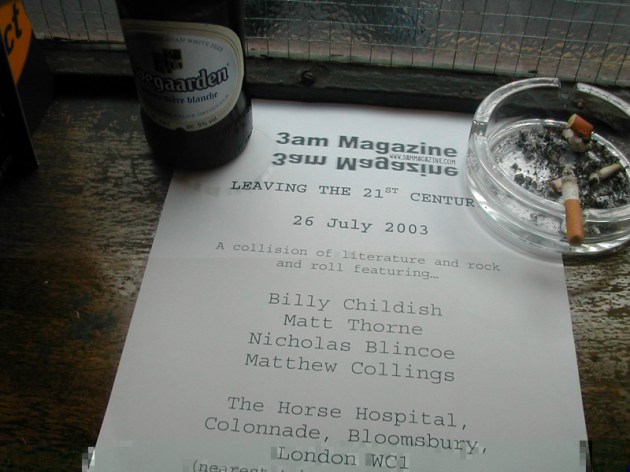
Flyer advertising 3:AM Magazine‘s ‘Leaving the 21st Century‘ gig at London’s Horse Hospital, 26 July 2003.
‘Leaving the 21st Century’, 26 July 2003.
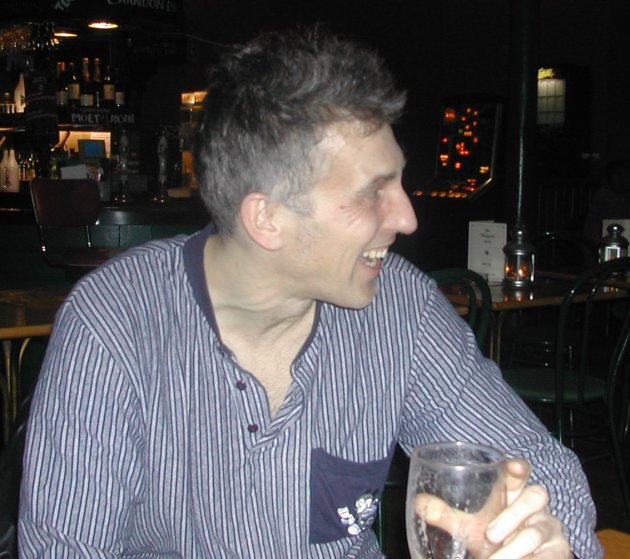
Richard Marshall, London, 2003.
Me sporting a 3:AM T-shirt, London, 2003.
Andrew Stevens at Death Disco, London, 2003.]


The Cost of Living

This review of Deborah Levy’s The Cost of Living appeared in the Irish Times on 7 April 2018, p. 34:

The Price a Woman Has to Pay For Unmaking a Home

The Cost of Living is the second instalment, and future centrepiece, in Deborah Levy’s autobiographical trilogy. Its pivotal nature becomes apparent when the narrator is loaned a shed of her own, where three books — “including the one you are reading now” — will be conceived. Such foregrounding of the work’s primal scene is no metafictional gimmick, however. It is consonant with Levy’s commitment to looking life in the eye, rather than reflected in the shield of allegory.

“It was there,” she explains, “I would begin to write in the first person, using an I that is close to myself and yet is not myself”. Gazing back at her textual avatar – becoming the reader, as well as the author, of herself – Levy opens up this gap through which she journeys towards the “vague destination” of a “freer life”.

There is a deeply moving, albeit somewhat disquieting, passage, where the nine-year-old Deborah, fresh off the boat from her native South Africa, comes knocking on the door of her middle-aged self in London, and ends up watching Bake Off with the two daughters she will later give birth to. This is a variation on the “flashback in the present” technique that the author frequently deploys to great effect in her fiction, but spectacularly fails to get across to a boardroom full of film executives, in one of the book’s many comic scenes.

Describing this ongoing project as a “living biography” is particularly apposite, not only because the author is alive, kicking and evidently at the height of her creative powers, but also because she eschews nostalgia, firmly convinced that the past is never written in stone. Towards the end of the book, she speaks to her mother for the first time since her passing: “She is listening. I am listening. That makes a change”. She goes on to recount a heart-rending anecdote about a pair of earrings she almost buys her as a gift in a department store, before the unspeakable enormity of death suddenly sinks in at the till.

If Things I Don’t Want to Know (2013) was a response to Orwell’s Why I Write, the emphasis here is on how to write in the wake of two traumatic events which occurred within a year of each other: the break-up of the author’s marriage and her mother’s demise. In the Booker-shortlisted Swimming Home (2011), one of the characters claims to only enjoy biographies once the subjects have escaped “from their family and spend the rest of their life getting over them”. Finding herself in a similar situation, the author now seems to be putting into practice all the themes she has been rehearsing in her works since the 1980s, as though the fiction were a prelude to her vita nova.

As Levy downsizes, her life grows bigger and she feels emboldened and energised by the adventure she has embarked upon despite all the hardship. She has no regrets about swapping her book-lined study for a “starry winter night sky”, now that she writes on a tiny balcony, where she falls asleep fully dressed “like a cowgirl”, in her north London “apartment on the hill”. Other people – including the family from down the road that she borrows for Sunday lunches, the Turkish newsagents and the Welsh octogenarian firebrand who kindly lends her the shed – are a constant source of fascination, but so too are the bees, moths, squirrels and birds she shares the world with: “everything,” she observes, “is connected in the ecology of language and living”. She delights in the practicalities of daily life, even proving a dab hand with a Master Plunger, and when she zips along the road on her electric bicycle, her party dress “flying in the wind”, she finds it difficult not to whoop.

The Cost of Living refers to the price a woman has to pay for unmaking the home she no longer feels at home in. In Levy’s case, this radical act of erasure inaugurates a quest for a new life that is inseparable from the writing of a new narrative. No longer willing to take part in the masquerade of femininity – that “societal hallucination” – she fumbles for a different kind of role to play. At this juncture, all she knows is that it will be a “major [as yet] unwritten female character”. The process of transitioning “from one life to another” also prompts her to reinterpret some of her fondest memories and past attitudes: “Did I mock the dreamer in my mother and then insult her for having no dreams?”

Deborah Levy describes women’s often thankless homemaking enterprise as “an act of immense generosity”. It is also a perfect description of this truly joyous book.


Hidden by the Surface

Gallix, Andrew, translator. “Trash, Or Tainted Culture” by Octave Debary. Hidden by the Surface: Works About Marine Debris. By Swaantje Güntzel, Herausgeber, 2017, pp. 6-11.

“. . . When Swaantje Güntzel offers us the incongruous spectacle of a cleaning lady diligently vacuuming a field (Staubsauger 2004), she is reminding us that nature produces no waste. This impurity is culture’s privilege, culture’s dirty “sin”, which is that of existence itself. The objective is to express one’s finitude and fear of loss — a loss culture wishes to lose: we seek to get rid of what we produce as it is also the source of our finitude. At the heart of this logic, waste enables us to express the passing of time and the end looming on the horizon; decay and dirt as depletions of life. This is where our contemporary eschatology, linked to environmental disasters, fits in. The more we live, producing ever more waste, the more we pollute the world (an immaculate nature?) where the danger to the environment always comes from culture. It is the border between waste and non-waste that makes our social and cultural condition possible. Waste’s exclusion from culture signals the end of a story that can no longer take place within a cultural context. It must be sacrificed (sacrum) because it is through this process of relinquishment that culture traces the boundary between what is pure and impure. Culture produces waste, which it then excludes. . . .” (original French text by Octave Debary)

Ménage à Trois

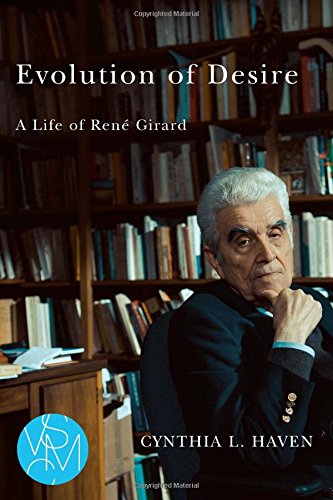
Haven, Cynthia. “’The Genius to Glue Them Together: On René Girard and His Ideas.” Los Angeles Review of Books, 25 March 2018.

Deceit, Desire, and the Novel already bears Girard’s signature writing style — formal yet engaging and approachable, erudite, incisive, and masterful — it’s the book that would make his reputation. I found the book rather addictive, though Library Journal called it “a highly complex critique of the structure of the novel,” and added a warning: “As may be expected, the interpretations are highly psychological, the argument philosophical, and the intellectual footwork, dazzling; but for the reader, the going is slow, and conviction, grudging.”

For many, however, it was a revelation. “You can always trust a Frenchman to view the world as a ménage à trois,” wrote Andrew Gallix in the Guardian, describing Girard’s theory of mediated desire. “Discovering Deceit, Desire and the Novel is like putting on a pair of glasses and seeing the world come into focus. At its heart is an idea so simple, and yet so fundamental, that it seems incredible that no one had articulated it before.”

Hauntology Under the Volcano

La Mont III, Alfredo. “Sin maquillaje” Excelsior, 25 December 2017.

. . . Sí, y el filósofo Jacques Derrida acuñó el término hauntología en 1993 para describir la nostalgia de un futuro imposible: un posible futuro que desde entonces ha sido superado por los acontecimientos de la realidad. Una especie de ensueño “qué pasa si…”, es también un juego de palabras sobre el término filosófico ontológico o el estudio de la naturaleza del ser.

“La hauntología es probablemente la primera tendencia importante en teoría crítica que floreció en línea”, escribe Andrew Gallix, en The Guardian. “Hoy, la hauntología inspira muchos campos de investigación, desde las artes visuales a la filosofía a través de la música electrónica, la política, la ficción y la crítica literaria. En su nivel más básico, se relaciona con la popularidad de la fotografía de faux vintage, espacios abandonados y series de televisión como Life on Mars”.

The Deep Fuck We Found Ourselves In

This appeared in Review 31 on 7 March 2018:

The Deep Fuck We Found Ourselves In

Neil Armstrong hoped that someone, some day, would erase the footprints he had left on the moon. It is in this spirit that American author Russell Persson revisits the ill-fated Narváez expedition, covering the explorers’ tracks before loosing his characters into lostness. The Way of Florida, his outlandish debut, begins in medias res like an epic poem: ‘And waiting another day to enter port, a south wind took us and drove us away from land’. The colonial enterprise — blown off course after grinding to a halt — has already failed, and will keep on failing better as if The Odyssey had been redrafted by Beckett. Trapped in a ‘maze of unhaving’, increasingly ‘abundant in [their] lack’, the Spaniards soon want nothing more than ‘to not want’. For most of them, the voyage — ‘long for the things [they] do not come upon’ — will be a one-way ticket to ‘[h]igh nowhere of the utmost’. ‘I know there is no return,’ the narrator laments, ‘and I know there is no thing toward of which all of us sail’. Cut adrift from any destination, the journey loses its telos, becoming an end in itself. ‘I must be a man who walks,’ he acknowledges, likening life to an excursion we go on awhile until ‘the world moves on without us’.

With no backstory to speak of, or veritable narrative arc, The Way of Florida is a historical novel from which history has been all but excised. Were it not for the publisher’s blurb, I would have ignored that this quixotic attempt to establish Spanish settlements along the Gulf Coast was first chronicled by Cabeza de Vaca, one of only four survivors, or that his 1542 account had provided Persson with a general direction of travel. The erasure of most period markers (the first occurrence of the explorer’s name that I spotted was on page 175) allows a deep immersion in the here and now of lives conducted in extremis. A whole year elapses in the course of a four-line paragraph, while a single, unpunctuated sentence — reflecting the flow of real time — winds its way through an entire ten-page chapter. Significantly, the narrator comes to see his existence as a solitary long take, ‘the string of days entire from one until the end’: ‘Inside this now I live with my body underneath the sky’.

The beleaguered colonisers seek refuge in their corporeal abodes, envisioned with doors leading to closets where ‘olden acts’ are ‘ungone forever’. A counter-movement sees the self projected on to the hallucinatory landscape. The protagonist evokes ‘the lands inside [him] yet to fold out’ as though conjuring up the very ground on which he treads. This projection, imperialist as it may sound, inaugurates a fugue state; a desperate drive to leave oneself behind. Striding forth, he explains, is ‘our only path our only way toward some otherwhere some place we were not’. The narrative feeds off itself, like those stranded Christians who survive by partaking of the deceased — until there is only one cannibal left and nobody else ‘to enfooden him’.

It is through writing, however, that Cabeza de Vaca achieves an ecstatic, out-of-body experience. The true ‘otherwhere’ is the book in which he records his misadventures, ‘to bring me to the outside of this [situation] where I can look down to me and witness my own sentence’. Whether he is the author of his own sentence — his work, as well as his plight — remains a moot point. The narrator believes that he and his compatriots are doing penance for their sins, and that what appears like aimless drifting is all part of a grand design. He also claims to have been chosen as the recipient of divine messages, thereby establishing a direct link between ‘Our Lord our mapmaker’ and the figure of the writer.

The Way of Florida is thus a journey into fiction. The survivors — four unwitting horsemen of the Apocalypse — enter Indian lore as ‘holy men from the sky’. In the final part, there is a sudden switch from first to third-person narration, perhaps signalling that Cabeza de Vaca has absented himself through his work, reemerging as a godlike, omniscient voice. A subtle parallel is drawn between colonialism and the realist novel’s linguistic imperialism, exemplified by the narrator’s frustration at not being able to describe certain gestures or the sound the sun makes on the sand. The jarring notes provided by the regular intrusion of expletives — ‘the deep fuck we found ourselves in’ — advertises the underlying tension between contingency and necessity. The neat little blocks of text stranded in an ocean of blank space recall the breath clouds of the storytelling explorers (‘it is air in the shape of our sound in the shape of tales’) and the soothing blowing therapy of the faith healers. These typographical havens stand in stark contrast to the wildly poetic, often challenging, run-on sentences that compose them, stamping their hypnotic rhythm upon the reader. This is English, but not as we know it. The novelist seems to have taken it back to the dawn of language, producing a newly-minted idiom that feels both antiquated and timeless. It is this Adamic English that makes The Way of Florida sui generis, despite being based on a pre-existing text. As Maurice Blanchot put it, ‘What is important is not to tell, but to tell once again and, in this retelling, to tell again each time a first time’.

Golden Age

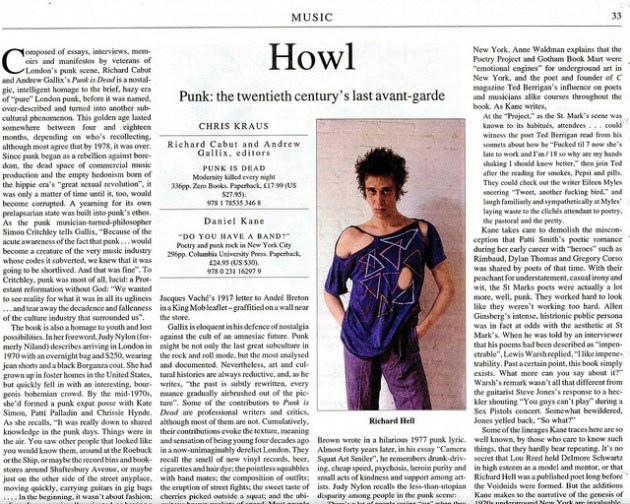
Kraus, Chris. “Howl – Punk: the Twentieth Century’s Last Avant-Garde.” Times Literary Supplement, 12 January 2018 , p. 33

Composed of essays, interviews, memoirs and manifestos by veterans of London’s punk scene, Richard Cabut and Andrew Gallix’s Punk is Dead is a nostalgic, intelligent homage to the brief, hazy era of “pure” London punk, before it was named, over-described and turned into another sub­cultural phenomenon. This golden age lasted somewhere between four and eighteen months, depending on who’s recollecting, although most agree that by 1978, it was over. Since punk began as a rebellion against boredom, the dead space of commercial music production and the empty hedonism born of the hippie era’s “great sexual revolution”, it was only a matter of time until it, too, would become corrupted. A yearning for its own prelapsarian state was built into punk’s ethos. As the punk musician-turned-philosopher Simon Critchley tells Gallix, “Because of the acute awareness of the fact that punk . . . would become a creature of the very music industry whose codes it subverted, we knew that it was going to be shortlived. And that was fine”. To Critchley, punk was most of all, lucid: a Protestant reformation without God: “We wanted to see reality for what it was in all its ugliness . . . and tear away the decadence and fallenness of the culture industry that surrounded us”.

. . . “Bands are necessarily approximations of the dreams that conjured them up”, Gallix writes in his essay “Unheard Melodies”. Punk is Dead shows the transmission of culture as a kind of lucid group dreaming. The accounts of its contributors capture the role that coincidence plays in history. Ideas can rarely be traced back to one person; they accrete and recur. . . .

Gallix is eloquent in his defence of nostalgia against the cult of an amnesiac future. Punk might be not only the last great subculture in the rock and roll mode, but the most analysed and documented. Nevertheless, art and cultural histories are always reductive, and, as he writes, “the past is subtly rewritten, every nuance gradually airbrushed out of the picture”. . . .

It Was Bound to Go Wrong

Walton, Stuart. “It Was Bound to Go Wrong.” Review 31, 24 January 2018:

… On the other hand, co-editor Andrew Gallix’s essay on the rootless Anglo-Swiss provocateur Arthur Cravan, a gifted self-mythologist who was ‘just too bad to be true’, is a pertinent contribution.

The same author’s ‘Unheard Melodies’, on bands who never got to record anything and, in some pristine cases, never even performed live, existing only as hypothetical propositions, but were nonetheless profoundly influential as such, is a fascinating study of cultural subversion all on its own.

The Unmapped Country

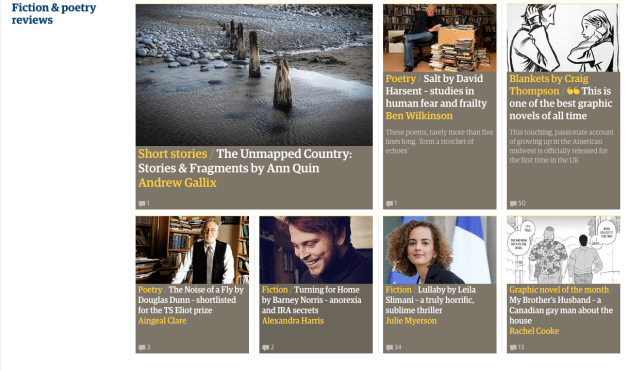
My review of The Unmapped Country: Stories and Fragments by Ann Quin. The Guardian (Review), 13 January 2018, p. 10.

Reduced to an anomalous footnote in British literary history — a female, working-class, avant-garde author — Ann Quin is all too often taken as read. Yet her work is as open-ended as those sentences she regularly produced that trail off into silence, casting a spell instead of spelling out; floating away on their reserve of potentiality. As open-ended, indeed, as her life, which she took at the age of 37, swimming out to sea off Brighton’s Palace Pier in 1973. She left behind four novels — including her celebrated debut, Berg (1964) — along with scores of short-form pieces, some which now appear in a thrilling new collection of miscellanea.

Spanning the author’s entire career, The Unmapped Country, edited and introduced by Jennifer Hodgson, builds up a portrait of the artist as a restless spirit, forever adventuring into the unknown. In an autobiographical skit, Quin mocks her reputation as an experimental author, attributing the Arts Council’s rejection of her grant application to their having read her last book. The diversity on display is impressive, however, as she studiously avoids getting trapped in any one style or genre. “Every Cripple Has His Own Way of Walking”, with its enchanting evocation of childhood and unflinching depiction of the decrepitude of old age, is a technically accomplished but surprisingly conventional short story.

“A Double Room” is kitchen sink drama set in Patrick Hamilton territory, while “Tripticks”, which developed into the novel of the same name, recalls Donald Barthelme at his quirkiest. “Living in the Present” (1968), a Burroughsian exercise in cut-ups conducted with the American poet Robert Sward (her then lover) seems to pave the way for JG Ballard’s media-saturated The Atrocity Exhibition.

Some pieces are straightforward memoir; others are clearly fiction, but there is a great deal of overlapping between the two (from this perspective, the author could be considered as a pioneer of autofiction). Quin frequently displays an ambivalent attitude towards mothers in general, and her own in particular, mirrored by a love-hate relationship with a dreary postwar England, where vegetables were still served up “as though chewed already”.

She resolved to become a writer after being “struck dumb” during her RADA audition, and her work always retained a strong theatrical quality. Several stories here are monologues. The two pieces written in the early 60s for pop artist Billy Apple (another lover) give voice to the ludic, transatlantic idiom of the emerging counterculture. Inevitably, considering her recurring bouts of depression and the electroconvulsive therapy she endured, mental illness looms large. The eponymous novella offers a devastating — albeit often hilarious — critique of psychiatry. Sudden shifts in perspective are common, as one character points out during a train journey: “Already I’m thinking in the third person. Seeing us as another passenger might.” And then there is the encroachment of the sea. A girl envisions her bedridden grandmother’s legs as sticks with “barnacles and millions of half-dead fish clinging”. In “Nude and Seascape”, which channels the affectlessness of Camus, a woman’s corpse becomes an object in a gruesome still life composition: “Against the landslide he found the body alone spoilt the effect, it was really only the head that was needed. He searched for his pocket-knife, it was a little rusty, which meant it would take some time”.

This struggle between order and chaos runs through Quin’s work. The husband in “Never Trust a Man Who Bathes With His Fingernails” wants to impose a tight schedule on his handyman to curtail the “impression he gives of unlimited time”. Sandra’s descent into madness, in “The Unmapped Country” (1973), takes the form of a hermeneutic disease, whereby everything — even birdsong or “the placing of twigs and leaves” in a park — is construed as a cosmic message. This is, of course, an eminently literary malady: “It takes me a long time to read now, a paragraph holds so much significance, and everything links up.” After being sectioned, she attempts in vain to piece together her hallucinatory journey: “Last events came first, the beginning at the end, or suddenly reversed, or slid into panels mid-way.” The grand narrative eludes her, leaving only “vague notes for the basis of a shape”. A subtle parallel is drawn between the signals Sandra picks up – the broadcasts she tunes into – at the height of her delirium, and the analyst’s Freudian worldview. In her journal, she scoffs at his “stupidity in listening and believing in the radio he switches on” at the beginning of each session.

Although the novella remains unfinished, an alternative to the absolutist, patriarchal vision of art depicted in “Nude and Seascape” seems to emerge when Sandra dismisses her boyfriend’s pursuit of posterity through painting: “How much better to create like the Navajo Indians, beginning at sunrise in the desert, a sand painting that would be rubbed out by sundown.” Having burned her latest contribution to the hospital’s weekly art session, she elects to make “paintings with her footprints in the snow”. The temptation to go beyond the confines of the canvas or page finds its natural expression in Quin’s penchant for juxtapositions and lists. This vagabond style is the perfect vehicle for the ecstatic urge to “go over” and “live beyond” oneself. To keep on walking through the snow, like Sandra, with unlimited time on your hands.