We’re Late…

Clare Margetson, “The Hay Relay: The End-less Wait is Over,” The Guardian 4 July 2007

I blame Andrew Gallix’s slow writing movement. David Hockney, too. Sparked by his concerns about our non-visual age I’ve taken a leaf out of his book and taken to gazing out of the window a great deal recently. But all these fantastic clouds in the sky are a huge distraction. So, we’re late, we’re late in putting up this post.

Stories That Would Prefer Not To

Jonathon Sturgeon, “In Praise of Literary Failure,” Flavorwire 30 October 2014

The book’s introduction, too, is one of the finer pieces of literary criticism to be released this year. Written by Andrew Gallix, editor-in-chief of 3:AM Magazine, which purports to be “the first literary blog,” the intro deftly surveys the gamut of literary failure. Especially good and poetic is Gallix’s take on the scourge of the writer, the blank page:

Blankness is the sine qua non for inclusion in the BDLF, but it is seldom sought after directly. Manuscripts and books remain blank to us through being censored, lost, drowned, shredded, pulped, burned, used as cigarette paper or wrapped around kebabs, fed to pigs or even ingested by their own authors…These brief biographies are sketches that merely gesture towards the possibility of narrative development; stories that are cut short or fall silent. Stories that would prefer not to.

The Biographical Dictionary of Literary Failure 300dpi

Don’t Be Taken In

Douglas Lord, Rev. of The Biographical Dictionary of Literary Failure by CD Rose, Library Journal 16 October 2014

Don’t be taken in, as I first was, by Sorbonne instructor Andrew Gallix’s Very Serious Introduction in which he notes all sorts of high-level details, such as that most of the writers “…devoted their lives to the pursuit of some Gesammtkunstwerk…”.
The Biographical Dictionary of Literary Failure 300dpi

An Anarchic Ship of Fools

David Winters, “An Interview with David Winters” by Matthew Jakubowski, truce 21 October 2014

My first book review was of Barthes’ The Preparation of the Novel. I sent it to Andrew Gallix at 3:AM. He published it, and made me an editor shortly afterwards. I’m grateful to Andrew for that. And to Barthes!

… As for “guiding” the magazine, for me the most attractive aspect of 3:AM is its refusal to “stand for” anything! As Andrew often puts it, the site has “no party line”. It was always supposed to be a broad church — or an anarchic ship of fools, to mix the metaphor. The most amusing attacks on us have come from bloggers who treat book reviewing as if it were some sort of moral crusade; who want to divide readers’ tastes into “right” and “wrong”. We find factionalism quite infantile, and upsetting these dogmatists is as good a reason as any to keep publishing.

In the Beginning was the Unword

The Boy Looked at Eurydice” featured in The Paris Review‘s “On the Shelf” daily links roundup yesterday.

“The history of punk is, above all, the story of the traumatic loss of its elusive essence: that brief moment in time when a new sensibility was beginning to coalesce … Punk died as soon as it ceased being a cult with no name.”

Carpe Diem Recollected in Cacophony

A piece of mine, entitled “The Boy Looked at Eurydice” appeared in Berfrois today. That’s me in the picture, reading to my sister Sarah, when we were both very young indeed.

Punk was carpe diem recollected in cacophony — living out your ‘teenage dreams,’ and sensing, almost simultaneously, that they would be ‘so hard to beat’ (The Undertones). The movement generated an instant nostalgia for itself, so that it was for ever borne back to the nebulous primal scene of its own creation. Its forward momentum was backward-looking, like Walter Benjamin’s angel of history.

Britain At Its Finest

Will Coldwell, “Throwback Thursday: On Holiday in the 1980s – In Pictures,” The Guardian 3 April 2014

Caption: A photo that captures Britain at its finest: “That’s my stepdad rocking the sandals-and-socks combo,” says the reader who submitted it. “I’m wearing a Royal Wedding T-shirt showing Charles and Diana in punk attire.” Photograph: gallix/GuardianWitness

This is a picture of me (right) and Allen taken by my mum in Jersey, July 1981. When it featured on the Guardian‘s home page, they added a “How to wear socks with sandals” fashion piece just above!

Leaving the 20th Century

“What We Wore by” by Jesse Barron, i-D Magazine 2O December 2013

punktwins

What We Wore by Nina Manandhar

From the Clapham Soul Heads and the Anarcho Punks in Dreamland to the Spliffy-Chicks and Teenage Shoegazers, British subculture and street style from 1950 to 2010 has been one of the most thriving, varied and crazy anywhere in the world. In What We Wore, photographer Nina Manandhar invited fashion, music and art stars including Dizzee Rascal, Carrie Munden and Alasdair McLellan as well as the general public to submit photos from their youth with explanations of their life and style. The result is an eye-grabbing melange of young twin punks, bleach blonde boys and photo collages of kids in visors and hoodies with ‘WHERE MY DOGS AT???’ cut ‘n’ pasted along the top. Instagram your own with #whatweworeuk or submit at submit@what-we-wore.com and see the top picks in Autumn 2014 when What We Wore, which will be published by Prestel, will be on shelves.

Fragmentos escritos

Carlos Magro, “Gallix,” fragmentos escritos 25 January 2014

fragmentosescritos

El “contenido” está “ahí fuera” -siempre ahí- toda la literatura es “paráfrasis”: “¿Quién estaría interesado en un discurso nuevo y no transmitido? Lo importante no es contar, sino volverlo a contar, y en esta repetición, contarlo de nuevo como si fuera la primera vez” (Maurice Blanchot. L’Entretien infini, 1969)

Andrew Gallix. “La influencia de la ansiedad

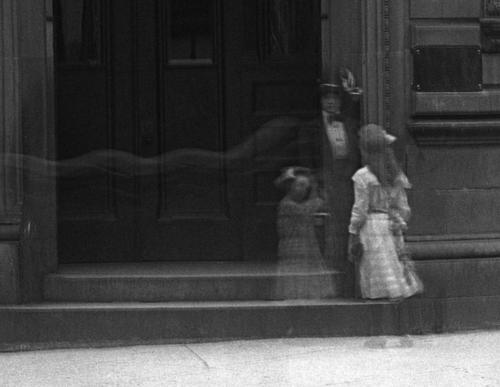
[Foto: Fotografía tomada fuera del Royal Bank Branch. Notre Dame Street, Montreal, Canada. 1911]