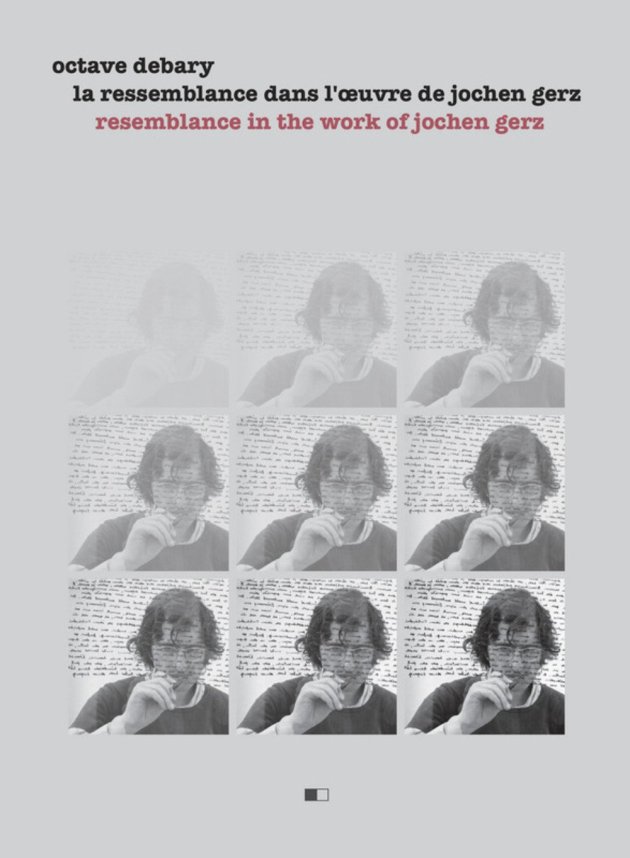
Resemblance in the Work of Jochen Gerz

I have translated Octave Debary‘s Resemblance in the Work of Jochen Gerz (French title: La ressemblance dans l’oeuvre de Jochen Gerz) published by Créaphis éditions on 1 June 2017. It is a bilingual edition, with my English translation appearing on each page beside the original French text.

My aim here is to go on a journey down this road with Jochen Gerz. To strike up a conversation, not so much about his work as one that winds its way through his works. I wish to chart the trajectory I have been following as an anthropologist studying remains and the remains of history, which has led to a decade-long dialogue with Gerz’s oeuvre. Those artworks that he often abandons, once created, offering them up to the city and passers-by. Gerz is one of the foremost contemporary artists of memory and public space.

A Deterritorialised Voice

My review of Zygmunt Bauman‘s Retrotopia appears in today’s Irish Times. Here is an extract:

Zygmunt Bauman, who died in January at the age of 91, was one of the last intellectual heavyweights of the 20th century. He belonged to a generation that derived its aura and wisdom from the second World War, even winning a medal for gallantry in combat. He was a Polish Jew, and so his life and work were shaped by both Nazi and communist persecution, the latter forcing him to relinquish his citizenship as a prerequisite for exile.

Although he became professor of sociology at the University of Leeds in 1971 – residing in England, with his family, for the rest of his life – he always retained a strong accent, not dissimilar to a comedy impression of Sigmund Freud. You can hear it in his numerous books, ostensibly written in English but frequently reading like literal translations from sundry continental tongues. This deterritorialised voice, poised somewhere between Yorkshire and Mitteleuropa, never tries to conceal its cosmopolitan origins. It speaks the language of liquid modernity, the era-defining concept that will doubtless serve as his epitaph.

Composed in the shadow of Brexit and Trump, Retrotopia — Bauman’s last, posthumously published work — revisits this rapidly evolving phenomenon. The sociologist had long argued that a loss of faith in society’s perfectibility was one of the main distinctions between the “solid” and “liquid” phases of modernity, a theme that he reprises and expands on here.

His argument hinges on the “emancipation of power from territory”, as a result of which nation states, with increasingly “porous” borders, are no longer able to fulfil their traditional functions. This political impotence, compounded by the stupefying pace of change, has redirected the utopian impulse towards the “space of collective memory”. We take refuge in the past because it can be “remodelled at will”, thus providing the “blissful omnipotence lost in the present”.

The future is now associated not with progress but with stasis or regression. At best it seems to offer more of the same; at worst it holds out the prospect of “social degradation” and “impending catastrophe”. Hence the privatisation of happiness, sought no longer through collective endeavours but through self-improvement and personal “wellness”….

Phantom Plot

My review of Laurent Binet’s The Seventh Function of Language will appear in the FT tomorrow. It was posted on their website today. Here is an extract:

In his 1967 essay “The Death of the Author”, Barthes contends that lang­uage, ceasing to be merely instrument­al, “loses its origin” when it enters the fictive realm. A thinly veiled reference to this theory recurs throughout Binet’s novel. The reader’s quest for the narrator’s identity gradually forms a phantom plot that shadows (and even overshadows) the overt whodunnit, sending us on a wild-goose chase. A description of Bayard sitting in a café is interrupted by a parenthetical aside: “Which café? The little details are important for reconstructing the atmosphere, don’t you think?” Pleading ignorance, he (or indeed she) enjoins us, à la Tristram Shandy, to picture the superintendent wherever we so please.

Here, Binet reprises a theme tackled in HHhH, where the author’s stand-in frets over the minutiae of historical reconstitution: the colour of the Nazi security chief’s Mercedes, for instance. Such “little details” are important in fiction as well as history books: they produce what Barthes called the “reality effect”. Highlighting their contingency — why this Latin Quarter café rather than another? — is a ruse by which the narrative voice enhances the reality effect while seemingly undermining it. After all, a fallible storyteller is far more credible than an omniscient one (with the added convenience of allowing Binet to paper over a few gaps in his research).

The strands of the plot are skilfully interwoven through a dual process of fictionalisation of the real and realisation of the fictional. At one stage the narrator observes that it is difficult “to imagine what Julia Kristeva is thinking in 1980”, as though this were not the case with any real-life person at any given moment. A similar statement is later made about one of the fictitious protagonists, about whom anything could be imagined: “We have no way of knowing what Simon dreams about because we are not inside his head, are we?”

Or are we? As the plot thickens, Simon feels increasingly “trapped in a novel”: “How do you know you are not living inside a work of fiction? How do you know that you’re real?” This growing ontological crisis — doubtless stemming from Barthes having read the world like a text — sends us back to the opening sentences: “Life is not a novel. Or at least you would like to believe so”.

Wrapped Around Kebabs

Alexander Oliver, Review of The Biographical Dictionary of Literary Failure, by C.D. Rose, The Literary Review 5 March 2015:

As Andrew Gallix writes in his introduction, “Manuscripts and books remain blank to us through being censored, lost, drowned, shredded, pulped, burned, used as cigarette paper or wrapped around kebabs, fed to pigs or even ingested by their own authors… Marta Kupka produces a blank memoir, not of her own volition, but due to a potent combination of failing eyesight and dried-up typewriter ribbon”.

Peter Rabbit is to be Found in Everything

Interview with Andrew Gallix, “The Brief: 3:AM Magazine,” Silent Frame 1 April 2017:

3:AM Magazine is a literary webzine that comprises reviews, critical essays, prose fiction, poetry, and interviews with prominent writers and philosophers. The interview responses below are given by the site’s Editor-in-Chief, Andrew Gallix. Alongside editing 3:AM, Gallix works as a freelance journalist, translator, and lecturer at the Sorbonne in Paris. He has written for various publications, including the Financial Times, The Guardian, and the Times Literary Supplement. With Richard Cabut, he co-edited and contributed to Punk is Dead: Modernity Killed Every Night (Zero Books, October 2017).

Which book would you recommend to our readers?
Remainder by Tom McCarthy. The best French novel ever written in English. It has a special place in 3:AM Magazine’s history, as we were the very first to champion it. This is where twenty-first-century literature began.

Which film would you recommend to our readers?
Berberian Sound Studio, directed by Peter Strickland, which revolves around a particularly gruesome giallo, evoked only through sound effects and snatches of overdubbed dialogue and howls — because films should be heard and not seen.

Which architectural work would you recommend to our readers?
The Serpentine Gallery Pavilion in Kensington Gardens, where Peter Pan poetically dwells — a new pavilion is built from scratch each year.

Which television episode would you recommend to our readers?

‘Episode 8’ from Series 1 of Life on Mars, directed by John Alexander — the episode where time-travelling protagonist Sam Tyler comes face to face with his young parents, and even catches a glimpse of himself as a child.

Which Mexican artwork would you recommend to our readers?
Under the Volcano, a novel by Malcolm Lowry. What I most admire about this most admirable novel is the line, ‘Everything is to be found in Peter Rabbit’.

[NB: Though an English author, Lowry briefly lived in Mexico, where Under the Volcano is also set.]

Which Serbian artwork would you recommend to our readers?
Complete Poems by Danilo Kupus, some of which were inspired by Beatrix Potter — because Peter Rabbit is to be found in everything.

Can art erase history?
No, but history can erase art. If art is a de Kooning drawing, history is Robert Rauschenberg’s rubber.

Can children make art?
Yes, but can adults?

Could art end civilisation?
No, but I suspect all great art aspires to do just that.

Is the alphabet a system of oppression?
Absolutely. Language, as Roland Barthes once remarked, is ‘fascist’. It speaks us; compels us to see things in a certain way.

Why discover?
Because the temptation to peek underneath is too great?

What question would you like to ask other Silent Frame interviewees?
What question would you fail to answer?

More to discover: You can read 3:AM Magazine here, visit Andrew Gallix’s website here, view his contributions to The Guardian here, and follow them on Twitter @3ammagazine and @andrewgallix.

Click on any of the following links to find out more about today’s recommended artists and artworks: Remainder (excerpt), Berberian Sound Studio (trailer), The Serpentine Gallery Pavilion (information), Life on Mars (trailer), Under the Volcano (excerpt).

On the Slow Writing Movement

Eva Orúe, “Slowhand es un artista, pero no (siempre) el que crees,” infoLibre 19 March 2017:

Cierto es que escribir no es lo que era. Trabajar con ordenadores y procesadores de texto permite a los autores juntar palabras más rápido que nunca, e Internet les brinda la oportunidad de publicar de manera instantánea, sin esperar a que un editor dé el plácet a tu texto. Consecuencia de lo cual es, sostiene el escritor Andrew Gallix, que lo que hoy pasa por narrativa publicable, “hace sólo unos años habría sido considerado si acaso como un borrador temprano”. De ahí que su propuesta de crear un Slow Writing Movement (SWM) a imagen (literaria) del fenómeno Slow Food, lanzada medio en serio medio en broma, quizá merezca una nueva oportunidad.

Doomed Quest

Ira Solomatina, “Fashion’s History of the Patch,” Sleek 4 August 2016:

The first sub-culture to subvert the patch was the hippies in the 1960s, whose patchwork clothes were laden with references to ethnic styles. However, it was the punks who really made it their own. As writer Andrew Gallix puts it, “The evolution of punk fashion was the doomed quest for authenticity” — hence why their bold DIY-aesthetic was opposed to all things conventional.

La Fayette Revisited

Erin Blakemore, “France’s Famous High School Exam Will Soon Feature Its First Woman Author,” Smithsonian 21 March 2017:

…But the novella isn’t La Fayette’s most famous work. That would be The Princess of Cleves, a dramatic novel that’s widely cited as France’s first historical novel. The book became a big deal in France again in 2009, when France’s then-president, Nicolas Sarkozy, mocked its inclusion on the civil service exam. As The Guardian‘s Andrew Gallix reported at the time, the president’s public hatred of the book turned it into a political symbol and short-lived bestseller.

The Abode of Fancy

This appeared in The Guardian (Guardian Review) on 24 December 2016: 10.

samcoll

We have all met him: the precocious Irish student who can talk the hind legs off a donkey and would be a shoo-in for the next Joyce if only he deigned to put pen to paper. Sam Coll did put pen to paper, and then some. And then some more, until he had completed 69 chapters spanning almost 500 pages. Born in 1989, he was still an undergraduate at Trinity College Dublin when the first draft was produced. The Abode of Fancy, his all-embracing debut, is fiendishly difficult to summarise: it is episodic and digressive, yet everything is skilfully connected.

There are two main plot lines. The first revolves around Simeon Collins, a young student who shares his initials with the author, and the washed-up, world-weary older friends in whose company he seeks solace. The second concerns a godlike figure, the Mad Monk, who returns to Ireland to herald the advent of the “new lusty age” along with other fantastical creatures: the Pooka, the Puck, the White Dog, the Clunge Monkey, Banshee Megan Devlin. The book is also about one man’s unrequited love for his bull, a pair of garrulous hares who are accidentally killed by golf-playing university lecturers, and countless other twisted tales.

There are shades of Rabelais in this gargantuan feast of lingual felicity, peopled with giants and morbidly obese alcoholic grotesques. The long-winded sentences seem to have been secreted rather than accreted (which is apt since the novel is awash with jizz, piss, puke, shit and snot). A single sentence describing a young woman walking towards her boyfriend under the anguished eye of a third character, who secretly pines for her, is agonisingly and hilariously drawn out over the best part of three pages.

Not surprisingly for a book whose heft exposes the reader to the risk of carpal tunnel syndrome, The Abode of Fancy draws boastful attention to its endowment. A doggerel epic, which appears in several instalments, prompts the following critique: “It’s a bloody gardener you need to edit that behemoth, mate!” Beautiful Saruko, whose essay is “5,000 words over the limit”, cajoles the protagonist into whittling down her “unwieldy word count”. Simeon composes a short story that becomes a book that mutates into a “gargantuan behemoth of a book”: “There would be room for infinity in the grandiose cathedral he dimly foresaw.”

The Abode of Fancy contains multitudes. All great Irish writers are here in name or spirit, from Swift and Sterne to Flann O’Brien and beyond. The novel even contains itself. The four-page-long inventory, in the prologue, of the “vast collection of assembled objects” found on a table, provides a preemptive index to all the ensuing narrative strands: “A fragment, contained in a jar, of the surviving bones of Peadar Lamb’s Bull”, for instance, or “A postcard for a Connemara golf-course, with two hares in the foreground”. Reminiscent of Joyce’s “Sirens” overture, this framing device is completed by the revelation, in the epilogue, that the first character to appear has been reading a lengthy comic book all along. No sooner has he put it down, however, than its fanciful cast come knocking at his door.

The Abode of Fancy actually evolved out of an epic comic strip, in which the speech bubbles gradually took over. The dialogue is often pitch-perfect and Coll (pictured) displays an emotional intelligence beyond his years: the unflinching, compassionate depiction of loneliness and ageing provides a melancholy undertow to the lusty comedy. There are shifts in tone, but the default mode is mock-heroic, with the quixotic cast out of place in a hastily delineated contemporary Ireland: the bored Polish blonde at the till, the “surly youths in hoodies and trainers”, Tesco’s “four euro red” and the 2008 recession.

In one of the frequent self-referential passages, a would-be bohemian poet contends that novels “can never be perfect” because they are “just too long”. The Abode of Fancy’s main flaw is neither its length nor its sophomoric quality, but the almost exclusive focus on masculine concerns. Nearly all the characters are male and women only feature as objects of affection and attraction.

According to Witold Gombrowicz, it is no longer possible for a serious novelist to go back to the “good old days” when one could write “as a child might pee against a tree”. Coll seems to have proved him wrong with this tour de force. Some may call it postmodern, but pre-modern is probably nearer the mark: the novel is returned to its picaresque roots, when everything was up for grabs. What fanciful abode will he build next to house his poetic impulse?

samcoll2

Here is a longer, slightly different version:

We have all met him: the precocious Irish student who can talk the hind legs off a donkey and would be a shoe-in for the next Joyce if only he deigned to put pen to paper. Sam Coll did put pen to paper, and then some. And then some more, until he had completed 69 chapters spanning almost 500 pages of scatological high jinks and coruscating wit. Born in 1989, he was still an undergraduate at Trinity College — a mere 20 years old — when the first draft was produced. The Abode of Fancy, his all-embracing debut, is fiendishly difficult to synopsize: it is episodic and digressive, yet everything is skilfully connected. For what it is worth, there are two main plot lines. The first one revolves around a young student, Simeon Collins, his sentimental travails, and his father’s washed-up, world-weary friends in whose company he seeks solace. The second concerns a godlike figure, the Mad Monk, who returns to Ireland to herald the advent of the “new lusty age” along with other fantastical creatures: the Pooka, the Puck, the White Dog, the Clunge Monkey, Banshee Megan Devlin, and Elijah, who, like one of the author’s nested narratives, takes up abode in a deceased character’s body from which it emits gnomic utterances. But the book is also about one man’s unrequited love for his bull, a pair of garrulous hares (most of the animals can speak) who are accidentally killed by golf-playing university lecturers, and countless other twisted tales. It even includes a donkey called Balthazar (as in Bresson’s classic) who — “or so he claimed” — was a film star in a previous life.

There are shades of Rabelais in this gargantuan feast of lingual felicity, peopled with giants and morbidly obese alcoholic grotesques. The long-winded sentences seem to have been secreted rather than accreted (which is quite apt since the novel is awash with jizz, piss, puke, shit, snot and whatnot). A single sentence describing a young woman walking towards her boyfriend under the anguished eye of a third character, who secretly pines for her, is agonisingly and hilariously drawn out over the best part of three pages. Not surprisingly for a book whose heft exposes the reader to the risk of carpal tunnel syndrome, The Abode of Fancy draws boastful attention to its endowment. A doggerel epic, which appears in several instalments, prompts the following critique from the aforementioned wisecracking ass: “It’s a bloody gardener you need to edit that behemoth, mate!” Beautiful Saruko, whose essay is “5000 words over the limit”, cajoles the protagonist into whittling down her “unwieldy word count”. A bookmark on page 390 in Arsene O’Colla’s copy of Swann in Love proves “how far he got” in Proust’s oeuvre and, crucially, “from whence he never proceeded”. Simeon Collins (whose initials are also the author’s) starts off composing a short story that becomes a book that mutates into a “gargantuan behemoth of a book”: “There would be room for infinity in the grandiose cathedral he dimly foresaw”.

The Abode of Fancy contains multitudes. All great Irish writers, from Swift and Sterne to Flann O’Brien and beyond, are here, in name or spirit. One thinks of Albert Potter’s dingy subterranean flat, in the novel, where books “copulate and fecundate, book begetting book”. Detailed descriptions of photographs open up new vistas; worlds within worlds. The novel even contains itself. The four-page-long inventory, in the prologue, of the “vast collection of assembled objects” found on a table, provides a preemptive index to all the ensuing narrative strands: “A fragment, contained in a jar, of the surviving bones of Peadar Lamb’s Bull”, for instance, or “A postcard for a Connemara golf-course, with two hares in the foreground”. Reminiscent of Joyce’s “Sirens” overture, this framing device is completed by the revelation, in the epilogue, that Martin Graves (the first character to appear) has been reading a lengthy comic book all along. No sooner has he put it down, however, than the fanciful characters come knocking at his door.

The Abode of Fancy actually evolved out of an epic comic strip, in which the speech bubbles gradually took over. The dialogue — “You’re not, no, are you not, yeah” — is often pitch-perfect. Despite his youth, Sam Coll displays an emotional intelligence far beyond his years. His unflinching, albeit compassionate, depiction of loneliness and ageing provides a melancholy undertow to the lusty comedy. There are shifts in tone (as well as point of view) but the default mode is mock-heroic. When the Mad Monk asks for directions, bemused passersby fail to comprehend the “antique cast in which he couched his query”. The Irish-American Tadgh O’Mara spurns his “own accursed tongue” in favour of bookish Gaelic gibberish. As a result, the poetry he produces is “like reading a dictionary of the most obscure Irishness that had been spliced all out of order”. The implicit critique of the “impoverished idiom” of our age is part of the characters’ quixotic cast. For various reasons, they feel out of place in contemporary Ireland, which is hastily delineated: the bored Polish blonde at the till, the “surly youths in hoodies and trainers”, Tesco’s “four euro red” (that “can’t be beat”) and the 2008 recession.

Like most great works, The Abode of Fancy comes equipped with its own critical apparatus. The description of the Mad Monk’s doggerel as a “happy fusion of Sterne and Yeats, two names one would not have suspected of ever being conducive to successful welding” provides a fitting definition of the novel itself. A mock-Yeatsian mythology runs parallel to, and gradually merges with, the disenchanted world of piss artistry and unrequited love embodied by Simeon and his entourage.

In one of the frequent self-referential passages, a would-be bohemian poet contends that novels “can never be perfect” because they are “just too long”. The Abode of Fancy’s main flaw is neither its length nor its sophomoric quality, but the almost exclusive focus on masculine concerns. Barring a couple of exceptions, the characters are all male to a man and women only feature as objects of affection and attraction.

According to Witold Gombrowicz, it is no longer possible for a serious novelist to go back to the “good old days” when one could write “as a child might pee against a tree”. Sam Coll seems to have proved him wrong with this tour de force. Some may call it postmodern, but pre-modern is probably nearer the mark: the novel is returned to its picaresque roots, when everything was up for grabs. What fanciful abode will he build next to house his poetic impulse? And will he micturate against the wall whilst whistling a jaunty Celtic ditty?