
My piece on René Girard‘s mimetic desire appeared on the Guardian Books Blog today.
My piece on René Girard‘s mimetic desire appeared on the Guardian Books Blog today.
This appeared in the winter 2009 issue of Flux magazine (issue 71, p. 14):
One Thousand Cranes Can’t Be Wrong
An introduction to Matthew Coleman’s “action painting of the heart”
Matthew Coleman had always been an artist — even when he saw himself as a writer or a filmmaker — but it took the mother of all depressions to open up his eyes. “The intensity, the violence of what I went through completely changed me,” he explains. Coleman’s work is the product of “heightened states of feelings”: the canvas is a “battleground” on which the artist squares up to his demons, wielding the palette knife like “a sword”.
The (noble) savage beauty of the Hand Bursts series — which culminates in a bloody mess that could incarnadine the multitudinous seas — conjures up the fleeting patterns Coleman creates on sundry beaches and then captures on camera. The Lines You Should Not Cross are vicious red pencil renditions of the artist’s bouts of self-harming, but they are also reminiscent of those lines literally drawn in the sand that will be, as it were, littorally washed away. The vibrancy of Coleman’s works often comes from this tension between the compulsion to freeze moments in time and the desire to dissolve into an eternal here and now.
The Cry of a Thousand Cranes — red, blue and yellow origami birds hanging in the Saatchi Gallery or from a tree in the artist’s back garden — was inspired by the old Japanese legend according to which whoever folds 1,000 paper cranes will be granted a wish. When I ask him if he believes in this legend, Matthew Coleman just smiles. Then he says, “I want yellows and blues and reds, I want to see them everywhere I walk, all exploding like fireworks”. We both stare in silence at the cranes gently swaying in the breeze.

This appeared on the Guardian Books Blog on 13 January 2010:
In Theory: The Death of the Author
Kicking off a new occasional series about the most influential literary theory, Andrew Gallix revisits a classic essay by Roland Barthes

Roland Barthes in 1979. Photograph: Fabian Cevallos/Corbis
Ecclesiastes famously warns us that “Of making many books there is no end” — the same, of course, applies to book commentaries. George Steiner has long denounced the “mandarin madness of secondary discourse” which increasingly interposes itself between readers and works of fiction. For better or worse, the internet — with its myriad book sites — has taken this phenomenon to a whole new level. Since Aristotle’s Poetics, literature has always given rise to its exegesis, but now that no scrap of literary gossip goes untweeted, it may be time to reflect a little on the activity of literary criticism.
I have chosen to inaugurate this series with a few considerations on “The Death of the Author” because of its truly iconic nature: it symbolises the rise of what would come to be known as “theory“. Even if he never names them, Roland Barthes (like Proust before him) launches an attack on the traditional biography-based criticism à la Sainte-Beuve or Lanson which still dominated French academia in the sixties. The paradox, of course, is that this essay — with its symbolic slaying of the paternal “Author-God” — could lend itself to a textbook psychological reading given that Barthes lost his own father before his first birthday. The “Death of the Author” theme itself takes on added meaning, in hindsight, when you consider that Barthes’s critical career was, at least in part, a displacement activity to avoid writing the novel he dreamed of. Does any of this invalidate his theories? I’ll let you be the judge of that…
In 2002, the prestigious Pompidou Centre in Paris devoted a major exhibition, not to an artist, philosopher, scientist or novelist, but a literary critic: Roland Barthes. Now that the “theory wars” — which had once torn apart literature departments on both sides of the Atlantic — were largely over, it served as a reminder of a time when a posse of structuralists and post-structuralists superseded the likes of Jean-Paul Sartre as France’s premier intellectual icons. Many of them were primarily philosophers, anthropologists, historians, linguists or psychoanalysts — Jacques Lacan, Michel Foucault, Gilles Deleuze, Julia Kristeva et al. — but the locus of this intellectual revolution was undoubtedly literary criticism.
La nouvelle critique was flavour of the month, much like its culinary counterpart, nouvelle cuisine, albeit more of a mouthful. Critics-cum-thinkers such as Barthes himself — who was equally at home at the lofty Collège de France or down the trendy Le Palace nightclub — achieved bona fide celebrity status. Their works often became bestsellers in spite of their demanding and iconoclastic nature. Soon, NME journalists were peppering their articles with arcane references to Baudrillard while Scritti Politti dedicated a postmodern ditty to Jacques Derrida. The whole movement seemed as provocative, and indeed exciting, as Brigitte Bardot in her slinky, sex kitten heyday. Its defining moment was the publication of a racy little number called “The Death of the Author“.
As if mimicking one of its central themes, Roland Barthes’s article first featured in an American journal in 1967: the original (an English translation of a French text) was thus, in effect, already a copy. With a nice sense of historical timing, it appeared in the critic’s homeland in the quasi-insurrectionary context of the 1968 student protests. As it was only anthologised much later (first in Image-Music-Text in 1977 and then in The Rustle of Language in 1984), the essay was photocopied and distributed samizdat-fashion on campuses all over the world, which enhanced its subversive appeal.
Subversive, it certainly was. In France, perhaps more than anywhere else, the secularisation of society (compounded by the Republic’s struggle against the Roman Catholic Church) had led to the adoption of art and literature as substitute religions. Nietzsche had announced the death of God only to see Him replaced by the “Author-God”. Enter Roland Barthes.
His starting-point is a sentence lifted from Sarrasine (1830), a little-known Balzac novella about an artist who falls in love with a young castrato he believes to be a woman. Barthes (who was gay) was so taken with this gender-bending tale of mistaken identity that he would study it at length in S/Z (1970). Here, he draws a parallel between the ambiguity of Sarrasine’s feelings and the ambiguous identity of the speaker who, ironically, describes the castrato as the essence of womanhood. Is it the deluded, love-struck protagonist? The narrator? Balzac the writer? Balzac the man?… Having exhausted all possibilities, the critic draws the conclusion that it is impossible to say for sure who the sentence should be attributed to. He goes on to describe literature as a space “where all identity is lost, beginning with the very identity of the body that writes”. The death of the author marks the birth of literature, defined, precisely, as “the invention of this voice, to which we cannot assign a specific origin”.
Indeed, the “modern writer” — or “scriptor” as Barthes calls him — can only mimic “a gesture forever anterior, never original” by recombining what has already been written. Whereas the “Author-God” maintained with his work “the same relation of antecedence a father maintains with his child,” the scriptor “is born simultaneously with his text”: for him, “there is no other time than that of the utterance, and every text is eternally written here and now”. As Barthes puts it, apropos of Mallarmé, “it is language which speaks, not the author” — or the scriptor for that matter. Works of fiction are palimpsests and as such are devoid of any “single ‘theological’ meaning (the ‘message’ of the Author-God)”. The key to a text is not to be found in its “origin” but in its “destination”: “the birth of the reader must be at the cost of the death of the Author”.
Next time, I’m planning to investigate the notion of mimetic desire — unless there’s anywhere else you’d rather visit first. Suggestions on future topics are most welcome…
This was published on the Flux magazine website on 13 November 2009:
Only Disconnect
Andrew Gallix on this year’s new literary model

“All of this intellect stuff is fine as a consolation (which is how it developed in the first place: Socrates not being Alcibiades),” claims the narrator of an early Toby Litt story. He has a point, of course. Jean-Paul Sartre, for instance, famously confided that he had become a philosopher in order to make up for his ugliness and attract women. Conversely, ghostwriters keep churning out books for celebrity airheads in search of intellectual credibility. And then there’s Gavin James Bower. The author of Dazed & Aroused is the stuff publishers’ wet dreams are made of: a model turned writer; Socrates and Alcibiades rolled into one. “I’m too pretty to be a serious novelist but not pretty enough to be a top model,” he aphorises, “I have no consolation.” Call me jealous, but I have no sympathy.
Bower is far more than just another clothes horse who can string a few sentences together. He started putting pen to paper when he was still reading history at university. Among his influences, he cites Fitzgerald, Burroughs, Ellis, Marx, Sartre and Camus, but also Flux magazine editor Lee Taylor, who gave him his first break: “He was one of the first people who got me excited about being a writer myself”. An internship at Dazed & Confused took an unexpected turn when he was encouraged to go into modelling rather than journalism. After a year or so, his career went the way of the “skinny-jeans-and-winklepickers look,” but not before it had provided him with enough material for a stunning debut novel.

Having walked the (cat)walk, Gavin James Bower can talk authentically about inauthenticity. Alex, the narrator and anti-hero of Dazed & Aroused, slides down the surface of things, barely batting an eyelid when he is fellated by his father’s gorgeous girlfriend. In a rare moment of insight, he realises that the “nauseating truth” about a world in which anything is possible is that nothing is also a distinct possibility. The key to the book probably lies in this oscillation between surfeit and emptiness. Instead of leading to objectivity, Alex’s psychopathological detachment conjures up nightmarish dreamscapes — unreal cities — in which glamorous models are for ever tripping over the vagrants who litter the streets. From the ranters whose messages are always incomprehensible to the news bulletins invariably watched on mute, information overload leads to communication breakdown. The protagonist is bombarded by messages — via leaflets, billboards, freesheets, bumper stickers, graffiti or even fridge magnets — but they remain mere juxtapositions. On Oxford Street, for instance, he passes two men holding placards: “One sells Jesus to passers-by while the other advertises a buffet lunch deal”. The only point, if there is one, is that everything has been commodified. Gavin James Bower describes his character as a “personification of the capitalist social relation — an estranged individual who exploits others and refuses to connect to anything”. Yet, in spite of all that, he remains strangely alluring. Even when it comes to coke, the devil has all the best lines.
Dazed & Aroused is published by Quartet Books.
This piece was meant to appear on the website of a magazine in November 2009, but the artist who is the subject of the article objected to certain passages. Here it is, for the record, minus the artist’s name:
One Thousand Cranes Can Be Wrong
An introduction to **’s “action painting of the heart”
“I want to paint massive canvases so that I can stand in front of them and sense a wave of shade rising high above my head and it feels as if it will break and come crashing down on top of me with surf and sand like the sea.” ** often resorts to maritime similes when describing his elemental artwork. “Each piece,” he says, “is as different as each swell of the ocean”. Not only is this perfectly true — the techniques he employs range from candle-wax dripping to origami via oil painting and photography — but also most apposite for one born in Brighton and bred in nearby Worthing. Like Venus, his giant oil monochromes seem to have sprung fully-formed from the ocean spray. There is also this sense in much of *’s work that the tide is slowly rising. It is both a threat and a promise.
The (noble) savage beauty of the Hand Bursts series — which culminates in a bloody mess that could incarnadine the multitudinous seas — conjures up the fleeting patterns * creates on sundry beaches and then captures on camera. The Lines You Should Not Cross are vicious red pencil renditions of the artist’s bouts of self-harming, but they are also reminiscent of those lines literally drawn in the sand that will be, as it were, littorally washed away. The vibrancy of *’s works often comes from this tension between the compulsion to freeze moments in time (the large paintings are even entitled Frozen Moments in Texture) and the desire to dissolve into an eternal here and now. One of the most poignant pictures is that of hundreds of footprints left by so many Man Fridays on some deserted, seemingly godforsaken South Coast beach. Have all the holidaymakers gone home? Are we looking at fossilised vestiges of prehistoric humanity or the posthistoric consequences of Armageddon? Stone Age or Stoned Age? All we can be sure of is that the image is full of emptiness, achingly so. * shores these fragments against his — indeed our — ruin, but that, I suspect, is only part of the story. I can see him — all at sea on Worthing or Brighton sands — connecting nothing with nothing. Soon, however, the slate will be wiped clean and the canvas will heal: the world will return to its pristine, prelapsarian state. He closes his eyes, sensing a wave of shade rising high above his head… “We are the sea,” he writes, in his beautifully exalted, seer-like prose, “rushing in and out, forever changing as we alter with each swell of the waves. We are the sea.”
I first met ** at a reading I had co-organised at London’s Aquarium Gallery back in 2005 to showcase the thriving underground literary scene. He was just a member of the audience, but most female eyes were on him owing to his dashing Clark Gable looks. I remember a young lady in thigh-high boots gushing to no one in particular that he was the most handsome man she had ever seen. At the time, Coleman was shooting videos for up-and-coming bands and organising events at a trendy Shoreditch pub. He was also convalescing from a suitably ill-fated affair with a Norwegian junkie he had fallen madly in love with while exploring South East Asia. Soon he would gain a degree of notoriety as the Lord of the Unbuttoned Flies; a kind of Divine Marquis for the Offbeat Generation. Through his prolific priapic prose, he came across as the bastard offspring of Valmont and Sid James — the missing link between libertinage and the saucy seaside postcard.
Deep down, * had always been an artist — rather than just a peddler of literary smut or a budding avant-garde filmmaker — but it took the mother of all depressions to open up his eyes. His breakdown acted like a conversion; suddenly, he was born again. “The intensity, the violence of what I went through completely changed me,” he explains. ‘Intensity’ is a keyword here. *’s artwork is the product of “heightened states of feelings,” hence its air of jubilant inevitability. This, one senses, is a matter of life and death rather than a mere distraction. The canvas is a “battleground” on which the artist squares up to his demons, wielding the palette knife like “a sword”. *, however, is at pains to point out that depression is only the catalyst for his “action painting of the heart,” not its subject.
“I paint from within. I paint what I am.” Contrary to appearances, * is in no danger of disappearing up his own ars rhetorica. The result of his painting “from within” never feels introverted at all. In fact, it looks remarkably like without. Reflecting some kind of inverted pathetic fallacy, mindscapes are expressed as landscapes. Escaping the petty confines of the self is what this is all about. The aforementioned Hand Bursts could be the bloody handprints left by cavemen pounding away at the walls of their caves. When superimposed, they begin to resemble the graceful beating of wings. This metamorphosis reflects the artist’s desire to shed “the thing that wraps an anchor around the self and lets it drop into the dark abyss of fear” — an idea best expressed by his origami installations.
The Cry of a Thousand Cranes — red, blue and yellow paper birds hanging in the Saatchi Gallery or from a tree in the artist’s back garden — was inspired by the old Japanese legend according to which whoever folds 1,000 paper cranes will be granted a wish. When I ask him if he believes in this legend, — just smiles. Then he says, “I want yellows and blues and reds, I want to see them everywhere I walk, all exploding like fireworks”. We both stare in silence at the cranes gently swaying in the breeze.
An abridged version of “Colossal Youth,” my piece on Arthur Cravan, was posted on the Flux magazine website on Friday 13 November 2009:
Colossal Youth


You may never have heard of him, but Arthur Cravan was one of the most influential writers of the 20th century. The fact that he wrote precious little — and certainly nothing of any lasting literary value — should not be held against him. Quite the contrary, in fact. Oscar Wilde’s nephew put all his genius into his life, turning it into a magnum opus full of sound and fury, high farce and convulsive beauty. In so doing, he influenced every single major avant-garde movement from Dada onwards. Cravan was the original Sid Vicious, the blueprint for all the subsequent outrages committed in the name of art. “Let me state once and for all: I do not wish to be civilised,” he wrote — and he meant it, man.
Arthur Cravan (or Fabian Lloyd, to call him by his real name) was born in Switzerland in 1887. After being expelled from an English military academy for spanking a teacher, he relocated to bohemian Paris where he partied hard with the likes of Blaise Cendrars and managed to become France’s Heavyweight Champion without throwing a single punch.
Cravan first gained the notoriety he so craved through Maintenant (“Now”), the literary journal in which he wrote everything under various noms de plume. Sourced from a butcher’s shop, the very paper it was printed on highlighted his utter contempt for belles-lettres. He filled an entire issue with gratuitous insults aimed at the artists taking part in the 1914 Independents Exhibition. As a result, he was challenged to a duel by the poet Apollinaire and almost lynched by a posse of avant-garde painters. Result.
Art, for Cravan, was essentially boxing by another means, as proved by the infamous conferences he gave in Paris and New York. During these happenings, he would knock back absinthe, perform drunken stripteases, shout abuse at the spectators and even fire gunshots over their heads. His final Parisian gig descended into pandemonium when he failed to commit suicide as advertised.
The onset of the First World War marked the beginning of a convoluted vanishing act that led him — in various guises — from Paris to Mexico where he disappeared at sea on a drunken boat of his own making. His body was never found. For years to come, he would continue to be spotted throughout the world. Arthur Cravan is still at large.
This appeared in 3:AM Magazine on 14 September 2007. It was reprinted in George Berger’s Let’s Submerge: Tales From the Punk Rock Underground, published on 26 November 2013:
A Pint and a Molotov Cocktail
George Berger interviewed by Andrew Gallix.
3:AM: How did you get into punk?
GB: Seeing the bizarrely-dressed head-turners strolling around Bromley and surrounding areas really turned my head. Clothes and hair and a way of walking that just said “fuck off” to everyone, and straight society in particular. I don’t remember the individuals individually, just the feeling of seeing unrepentant weirdos expressing themselves via their appearance. I’d imagine this was before the word ‘punk’ came into popular use, but it doesn’t really matter either way. Seeing similar — or perhaps the same — people then interviewed on the London Weekend Show by Janet Street Porter, and then on ‘Young Nation’ on Nationwide turned my head yet further: they were sullen and obnoxious and that confused my hormones. I can’t say I liked the look of them, but it opened a door in my mind that had previously been locked and marked ‘no entry’. Finally, the famed Bill Grundy interview drew a line in the sand as I watched it with my outraged parents, trying to conceal my glee. This was clearly a step beyond their affectionate mock-outrage at glam rock.
‘No more apologies’, as Morrissey later described it so beautifully. My zits cleared up almost immediately, perhaps because I wasn’t scared of them anymore. Freedom of feeling, the feeling’s appealing. In other words, punk pushed the right buttons by opening the right (mental) doors at the right time. The music was often great, but was never the point.

3:AM: Your band, Flowers in the Dustbin, were part of the anarcho-punk scene, so you wrote this Crass book as an insider…
GB: Is there any self-respecting anarchist who would admit to being such? I wouldn’t know…
Being part of the London anarcho-punk-goth-crazy-coloured-fools-with-no-rules scene certainly informed the perspective that the book is written with of course, because it meant my early experience with anarchist thought and practice wasn’t limited to Crass. A sense of perspective, as Tap philosophised. But I’m not so sure FITD as a band were as much a part of all that in the way it’s now remembered. There’s a book about anarcho-punk coming out called The Hippies Now Wear Black — we were innocent on both those charges!

3:AM: To what extent did the members of Crass help you with your research and how have they reacted to the book?
GB: The members of Crass — Andy Palmer excepted — were as helpful as anyone could reasonably be expected to be, and in the cases of most, well beyond that.
The Crass members were also strikingly, unusually, generous and kind in a way that prods your conscience into examining its own parameters. Whatever happened to the members of Crass in their respective life-journeys at the time, it seems to have left an indelible urge to be kind and generous. Perhaps that was the energy that originally attracted so many towards them. In fact, I’m certain it was.

3:AM: In another interview you said: “I always felt a bit sorry for the people who bought into Crass at the expense of everything else”. However, when you read the book, it is obvious that the Ants/Crass dichotomy still seems to rankle after all these years. Crass offered a whole lifestyle that was difficult to reconcile with non-anarcho punk bands like the Ants or UK Subs. It was a bit like joining a fundamentalist sect, wasn’t it? Do you think you might have been attracted to this aspect of the band because of your Catholic upbringing?
GB: Meaning Crass were a part of the whole and people who bought into the sideshow ‘anarcho-punk’ often missed out on the other colours of the rainbow — Killing Joke, Bauhaus, Swell Maps, Au Pairs, Slits, etc etc… I don’t think it was a dichotomy at all in the early days, but sadly neither side could resist the bitching that subsequently became one of anarcho-punk’s main characteristics.
I should point out that I wasn’t attracted to Crass so much as fascinated by them, i.e. I was massively drawn to the idea of somewhere like Dial House working for decades as an open house, but could never quite reconcile the difference between the harsh Crass rhetoric and the gentle people in Crass. Frankly, you’d expect Crass to be aggressive and confrontational as people, but they were — and are — lovely. Delibrate dada contradictions? Maybe.
The Crass image encouraged the fundamentalist thing, which I would suggest was due to some kind of archetype hangover from the hippie times (where sects flourished of course). The Ants, Subs etc were far more healthy in this respect, I’d say, as they weren’t playing the parent. Saying ‘be yourself’ is great (Ants / Subs / punk), but the minute you start defining what that self should be, albeit unintentionally, you’re risking straying into a difficult place. The Crass output became self-conscious and ‘preachy’ once they got an audience — I felt sorry for the people who were perhaps young and encountering Crass / punk for the first time at this juncture and so bought into an opinion as though it was a reality. The map is not the territory.
I was repelled by the perceived fundamentalist aspect of Crass, not attracted to it. Whether or not this was connected to being brought up a Catholic, I’ve really no idea.

3:AM: Crass’s obsession with political freedom was so extreme that it enslaved some members. Steve Ignorant actually describes leaving the band as a liberation from the band’s politically-correct shackles: “I couldn’t look at the barmaid’s arse without being branded sexist. I couldn’t have milk in my tea without being called a bastard cos I wasn’t a vegan”. He also told you that if he’d been a 16-year-old punk at the time Crass’s rhetoric would have put him off and he would probably have been an Exploited fan. Even Penny Rimbaud, the band’s éminence grise, admits that they were “too serious”. It’s a double-edged thing, though, isn’t it? Crass meant so much because they were for real, but that purity also implied a po-faced, puritan zealotry…
GB: I don’t think Crass came across like that initially (before Penis Envy, if I’m forced to draw a line in the sand). I’m also not sure Steve is right – I don’t think that whatever took him to Dial House would have otherwise taken him to the Exploited; just a glib quote possibly out of context here. (In book interviews, Steve just spoke his mind whereas some other members of Crass pondered for literally minutes before replying to questions — which is quite unnerving but simultaneously inspiring).

3:AM: Your book often reads like a demystification of Crass’s political correctness. Whereas at the time, they appeared so self-assured — with their black uniforms, military backdrops and corporate logo — here, they come across as far more human and vulnerable. Steve and Pete admit that they knew little about anarchist history; Eve Libertine explains that she had qualms about “Reality Asylum” because of her Christian upbringing; Steve wrote “So What” as a kind of childish dare “to see if there’d be a bolt of lightning” when he sang the blasphemous lyrics… Did all this change the way you perceived the members of the band and the Crass phenomenon or were you conscious of this vulnerability at the time?
GB: I didn’t know the band well enough as people at the time to be sure of the vulnerability. I’d wager few, if any did.
With the book, I wanted to try and find the people behind the image / wall of anynomity. Demystification hits the nail on the head. Whilst Crass were always approachable back then as ‘Crass’, the individuals behind the job were often impossible to discover. Even to themselves, it would appear. At the time, I thought this was counter-productive to ideas that ‘anyone can do it’, so with the book I tried to show that the people that made up Crass and did/didn’t change the world (delete as your reality tunnel dictates) did so without being special and without access to any privilege that you or I haven’t got. And surprised myself with my findings…

3:AM: The more I read your book, the more contradictions appeared. Crass avoided the star system through anonymity but this very anonymity inevitably created a mystique of its own. But the paradox doesn’t stop here as the band were also one of the most accessible ever…
GB: Were they? On one level yes: you could go meet them, chat to them, even visit their house. But as I’ve said, getting to know the real people was out of the question for fans. Still, they did draw the line in a very different place to the stars of the day, even the punk rock stars.
Did they avoid the star system? I’m not so sure — accessibility is surely only one aspect of stardom. People looked up to Crass and looked to them for guidance. By the time they were getting big, they appeared to want to give it, albeit way more responsibly than most of their peers.

3:AM: A couple of other contradictions highlight the band’s unique nature. Politically, they were caught between the old school anarchists and the pacifists; financially, the more records they sold, the more money they lost.
Crass created a massive grassroots anarchist movement, for the first time in British history. They invented their own brand of anarcho-pacifism. They were also the only political band to practise what they preached which is why they sold records by the truckload without any advertising. I remember an interview with Joe Strummer, in the early 80s, in which he said that wherever you went, even in a remote Greek village, you’d see graffiti of the Crass symbol. He was gobsmacked and clearly envious. The band’s achievements were huge, but until your book came out their story went largely unrecorded — weird, isn’t it?
GB: Weird yes, but what Crass were offering was so beautiful — yet so fragile — that it was only ever going to appeal to the demographic who considered it a possible reality.
You’re wrong about their losing money on records — that only happened with “Reality Asylum” — otherwise they made a lot of money. Then showed an inspiring amount of integrity by returning it to what they considered ‘the movement’ and simultaneously arguable tactics and taste in the way they did this by releasing records by a plethora of copyists (not all of course, but many).

3:AM: Crass are obviously still influential and will continue to be so, but they were also very much of their time, weren’t they? I don’t know if you remember, but a few years ago, David Beckham was photographed sporting a T-shirt bearing the Crass logo: I’m sure he had no idea what it was; it didn’t mean anything anymore. I don’t think Crass would have been as influential in a prosperous, post-Thatcherite Britain, do you?
GB: I believe that T-shirt was a Jean-Paul Gaultier creation, but don’t quote me on it. The Crass symbol never meant anything beyond ‘Crass’ and it wasn’t even designed to mean that in the first place.
Crass were of their time, obviously. Our job is to be of ours… I think Crass would have got nowhere without punk, but then neither would so many bands, or any of the rest of us for that matter — it’s all so many ifs and buts.
I’d also mention that I don’t think we do live in a post-Thatcherite age yet.

3:AM: I’ve always thought that anarcho-punk was killed by the fans. All the bands were banging on about peace while the fans were beating the shit out of each other — there was such a contrast between rhetoric and reality…
GB: The anarcho-punks were generally peaceful. Trouble at anarcho gigs was invariably from skinheads, usually right-wing and preying on pitifully-easy pickings. The inherent aesthetic contradiction between the ranting aggressive anarcho noise and the ‘peace’ lyrics was bound to attract a percentage of people who liked the former to the point where they didn’t care about the latter. I’d say the lack of trouble at Poison Girls gigs illustrates that.
Of course, to treat anarcho-punk as a music scene is to ignore the much more pervasive and lasting political movement that included the popularisation of animal rights, the peace camps, the birth of the anti-capitalist demonstrations etc. — you can beat the shit out of a few people at a gig, but you can’t kill the spirit.
3:AM: You write that “If the Buzzcocks wanted a generation of kids to turn up the volume to annoy their parents, Crass made you turn it down so they couldn’t hear the blasphemy”. Maybe that was also part of the problem: over the years, Crass’s righteous anger seemed to turn into a permanent tantrum…
GB: Yes, I’d say so. They weren’t like this at all as people, so one can only conclude that they’d got too stuck into ‘punk’ as cliché and failed to follow their own advice. What seemed so vital and loyal to ‘the cause’ at first ended up feeling reactionary to me, particularly as newcomers appeared to buy into the scene as some kind of rule-book.
3:AM: Another big problem was the old class thing. In spite of the anarchist rhetoric, a class divide remained within the band — in particular between Steve Ignorant, the geezer who wanted to wink at the girls in the front row, and Penny Rimbaud, the public-school educated hippie intellectual…
GB: Actually, I don’t think there was any personal divide between Penny and Steve, but I do think that going on about classlessness against a backdrop of the biggest war of the 20th century in the UK against the working class caught them a bit short.
3:AM: It’s interesting that both Steve Ignorant and John Lydon were influenced by Brighton Rock, which they both read at school…
GB: I bet they’d love a drink together — Steve, Johnny and Pinky, getting leathered in Horatio’s at the end of the pier! I’ll get the first round in: mine’s a pint and a molotov cocktail!
3:AM: When Penny Rimbaud claims, for instance, to have seen flying tribesmen in Africa, do you ever think: this guy is a nutcase not a visionary genius?
GB: I’m amazed people haven’t picked up on this more. If Penny was deliberately winding me up saying this, then he was doing so with an intensity that would put him up there with Brando and De Niro as one of the greatest actors of all time.
Nutcase / visionary genius — as Penny himself has asked on many occasions regarding Wally Hope, where do you draw the line? I think Penny Rimbaud’s whole life appears to be lived as polemic, which may give a clue here, as may his interest in existentialism.

3:AM: On the hippie vs punk debate, you claim that “Crass was right and Malcolm McLaren was wrong”. Obviously, there was continuity as well as rupture, but wouldn’t you agree that punk was the first movement to create a generation gap among youth itself? The hippies were the first generation to refuse to grow up, then punk came along with Sid Vicious stating that he couldn’t remember the Summer of Love because he was too busy playing with his Action Men…
GB: I’d say that there was a generation gap between teds and hippies, mods and teds (rockers) etc
Sid was a great comedian for the zeitgeist one-liners and I’m sure a generation knew instinctively where he was coming from with lines like that. But I think to pick up on generational trivia is to miss the point, particularly in hindsight.
3:AM: You seem to agree with Stewart Home that Crass took the fun out of punk…
GB: Yes, I do. But maybe half the fun was the incredibly broad church punk produced — seeing as that would have disappeared with or without Crass, it’s possible it would have gone anyway. Look at some of the others around then: Six Minute War, Crisis, Pop Group, Discharge, Au Pairs etc: hardly a laugh a minute. Maybe it was something in the air.
3:AM: You have described the composition of this book as an “intense experience”: did you need to write it in order to put this whole period behind you?
GB: Not the period itself — that’s already and unavoidably behind me. This was the period I became a vegetarian and turned the teenage angst into something more structured in my head. But, yes, there is a definite sense of catharsis in writing this book — I still find myself referring to ‘punk’ attitude all the time with a nagging sense that I must sound like an old ted. So I hope that all this ‘30 years of punk’ lark will help me draw a line somewhere if I’m honest. Not with the attitudes it imbibed me with, but maybe with the word itself.

ABOUT THE INTERVIEWEE
George Berger’s latest book is The Story Of Crass. His previous one was a biography of the Levellers. His next one is under contemplation. He also fronts Flowers In The Dustbin and writes a blog from there.

Dr Martens’ Bouncing Souls
It didn’t hit me at first. Not straight away it didn’t. For a few long seconds there, the world was freeze-framed. I half expected to see tumbleweed blow by. All around, people emitted muffled sounds as if sporting ball-gags under water. Possibly swathed in cotton wool, they spoke in slow motion, their syllables hideously elongated like limbs on the rack. I distinctly recall being put in mind of an unravelling audio cassette, or one of those avant-garde sound poems that were all the rage back in the day. And then it hit me.
Hard.
Really hard.
Repeatedly.
To describe the pain as excruciating just wouldn’t do it justice. It was unspeakable, unsputterable; not even stutterable — utterly unutterable. What I can attempt to convey, however — to a certain degree, at least, though not, alas, to the third — is the unrelenting nature of the whole episode. I was stunned. Dumbfounded. Gobsmacked. At a loss for words. Mouth agog, screaming on mute. Bent triple, pissing bleeding blood. Pummelled into that liminal zone beyond which no representation is possible. With the benefit of hindsight, I see it as a crash course in transgression, no less. Nothing would ever be the same again. Not quite. Not for me. Uh-uh. Blown was my mind. Rocked were my foundations. Shaken was my core. Topsy-turvy was my world. Over tit was my arse. And then it hit me again.
Hard.
Really hard.
Really, really hard.
Repeatedly.
Repeatedly.
Repeatedly.
Repeatedly…
I blame it on Effie. Effing Effie and her fucking iffy frock. A brown flower-print number, the kind usually modelled by ladies of a certain age. Ladies who have long ceased to turn heads. Ladies who are fading away inexorably. Ladies who are almost invisible already. Ladies who, even as we speak, are being cut out of the equation with tiny toenail scissors. Slowly. Surely. Snip, snip — snip. But draped around Effie’s nubility it became impossibly erotic, as if the breath of life had suddenly been pumped into a long deflated blow-up doll. As if all the old biddies in their flower-print dresses were in bloom again, having magically recovered their pertness of yore. As if our very planet were a tight pair of bouncy buttocks and the whole wide universe had a massive hard-on.
Hard.
Really hard.
Rock-hard.
Rock on.
Blowing mellow bellows from below, a bracing breeze sported with the hem. Effie even had to hold it down on occasion, which lent her an air of charming vulnerability. Despite this precaution, and after a great deal of hemming and hawing, the flimsy material finally resolved to flare up, possibly in answer to the prayers of all those who had slowed down to admire the young lady’s graceful sway. Time almost came to a standstill as the dress made its giddy ascent in the manner of a Big Dipper inching up the steepest of Battersea slopes. I half expected to see tumbleweed blow by. Then suddenly — amid a cacophony of catcalls, wolf whistles and screeching tyres — the world went into overdrive frock’n’roll-style. Effie gasped in surprise, looking back instinctively to see how many oglers would be going home with a spring in their proverbial and diaphanous black lace on their minds. As she did so, I couldn’t help but notice the imaginary ejaculates from a hundred passers-by glistening in her hair like so many constellations of icicles. It was hard not to really.
Really hard.
Really, really hard.
The heat was well and truly on. You could almost feel the sap rising as Effie walked by. Men for miles around seemed to be picking up illicit frequencies, pricking up their ears at the mere sound of her killer heels in the distance. I tried to throw them off the scent by accelerating or crossing the road at regular intervals, but to no avail. I knew I would bump into him eventually, or rather he would bump into me. He was out there somewhere — everywhere — whoever he may be. It was just a matter of time now, and now was the time. He loomed up, he loomed large, hurtling towards me with all the inevitability of tragedy. There was no way I could avoid him. In fact, he veered slightly to the right to ensure that we were on a collision course. It was fight or flight. It was lose face and face loss. It was too fucking late.
Effie didn’t notice anything at first. She pursued her monologue looking straight ahead as he rammed into me, only pulling up when I remonstrated with my assailant. This, of course, was the cue he had been waiting for. I was playing right into his big lumberjack hands, which he balled into mighty fists before felling me like a sapling. Effie screamed while I attempted to regain verticality by means of the wall. Paying no heed to the abuse that was being hurled his way, he slowly removed his jacket and folded it rather fastidiously. By the time he had finished rolling up his shirtsleeves, Effie had run out of expletives or patience. I noticed how she rolled her eyes in desperation as I finally staggered to my feet, still puffing and panting, only to hear that I was going to be taught a bloody good lesson in front of my wife. And then he hit me again. Hard. Really hard. Repeatedly. He decked me, then he floored me, then he pulled me up again and decked me some more. At first I was under the cosh, but I soon became conversant with the sentence that was being executed with such surgical precision; I could even distinguish the nuances of each blow. It was like learning a new language.
Taking on the demeanour of an impartial spectator at a boxing match, Effie stepped back to embrace the whole scene. She was more open-minded now, wanted to hear him out. She was hedging her bets: let the best man win, like. At one point — a couple of cheeky jabs followed by a cracking right cross — she even started seeing his, which he put across so eloquently, so forcefully. After all, he was only being fair. Firm but fair. So fair and so firm. Hard, really hard. With her arms folded across her ample bosom, she looked down upon me, sighing and shaking her head, as if she thought, on reflection, that a good lesson would indeed do me the world of good. She was bowing to the inevitable, submitting to a superior force and was silently urging me to do likewise, to let go. All resistance was futile: I had this coming all along and now it had come, and that was that. It was in the order of things to put things in order. It felt right; it even felt good, so good. Hard, so hard. The wicked gleam in her eye proved that she was now baying for blood. Baying, obeying some primitive urge. Harder, really harder.
After an uppercut and a left hook had left me on my knees again, begging for mercy, he slipped his jacket back on and bitch-slapped me to the ground. Blinking through the streaming blood, I caught a glimpse of my wife’s expensive black panties as she stepped over me to join him. They walked off hand in hand into the sunset.
[This story appeared in Everyday Genius on 28 October 2009. It was commissioned by Lee Rourke (who curated the site throughout October 09). The final version (above) features in New Cross-Fucked Musings on a Manic Reality (Dog Horn Press), an anthology edited by Tom Bradley and published in December 2010.]
This review of Jean-Yves Jouannais’s Artistes sans oeuvres: I Would Prefer Not To appeared in the Times Literary Supplement dated 25 September 2009 (No 5556, p. 30):
Nothing At All
With his bovine-sounding surname, Félicien Marboeuf (1852-1924) seemed destined to cross paths with Flaubert. He was the inspiration for the character of Frédéric Moreau in L’Education sentimentale, which left him feeling like a figment of someone else’s imagination. In order to wrest control of his destiny, he resolved to become an author, but Marboeuf entertained such a lofty idea of literature that his works were to remain imaginary and thus a legend was born. Proust — who compared silent authors à la Marboeuf to dormant volcanoes — gushed that every single page he had chosen not to write was sheer perfection.
Or did he? One of the main reasons why Marboeuf never produced anything is that he never existed. Jean-Yves Jouannais planted this Borgesian prank at the heart of Artistes sans oeuvres when the book was first published in 1997. The character subsequently took on a life of his own, resurfacing as the subject of a recent group exhibition and, more famously, in Bartleby & Co., Enrique Vila-Matas’s exploration of the “literature of the No”. Here the Spanish author repays the debt he owes to Jouannais’s cult essay (which had been out of print until now) by prefacing this new edition.
Marboeuf has come to symbolize all the anonymous “Artists without works” past and present. Through him, Jouannais stigmatizes the careerists who churn out new material simply to reaffirm their status or iinflate their egos, as well as the publishers who flood the market with the “little narrative trinkets” they pass off as literature on the three-for-two tables of bookshops. In so doing, he delineates a rival tradition rooted in the opposition to the commodification of the arts that accompanied industrialization. A prime example is provided by the fin-de-siècle dandies who reacted to this phenomenon by producing nothing but gestures. More significantly, Walter Pater’s contention that experience — not “the fruit of experience” — was an end in itself, led to a redefinition of art as the very experience of life. A desire to turn one’s existence into poetry — as exemplified by Arthur Cravan, Jacques Vaché or Neal Cassady — would lie at the heart of all the major twentieth-century avant-gardes. “My art is that of living”, Marcel Duchamp famously declared, “Each second, each breath is a work which is inscribed nowhere, which is neither visual nor cerebral; it’s a sort of constant euphoria.”
Jouannais never makes the absurd claim that creating nothing is better than creating something: like Emil Cioran, he has little time for what he calls the “failure fundamentalists”. He does not dwell on the Keatsian notion (also found in Rousseau and Goethe) that unheard melodies are sweeter, or wonder why the attempts at a merger between life and art have so often resulted in death. Jouannais’s “Artists without works” are essentially of a sunny disposition. They are dilettantes, driven solely by their own enjoyment; cultural skivers who never feel that they owe it to posterity, let alone their public, to be productive. They let time do its work and are often militantly lazy — like Albert Cossery, the francophone writer of Egyptian origin who, on a good day, would fashion a single carefully crafted sentence, or the American artist Albert M. Fine who is quoted as saying: “If I did anything less it would cease to be art”. It is this divine indolence which differentiates Artistes sans oeuvres from darker essays on the subject.
Some of the most interesting passages in the book concern those larger-than-life figures (Félix Fénéon, Arthur Cravan, Jacques Vaché, Jacques Rigaut, Roberto Bazlen) who entered the literary pantheon as characters in other writers’ novels rather than through their own. Cravan, Vaché and Cassady — who embodied respectively the spirits of Dada, Surrealism and Beat — published virtually nothing during their lifetimes. Naturally, phantom works abound here, from Stendhal’s numerous unfinished novels to the unpublished manuscripts of the Brautigan Library (modelled on the library in Richard Brautigan’s The Abortion) through to Roland Barthes’s criticism, which provided him with the perfect excuse not to write the novel he dreamed of. Jouannais also considers summarizers such as Fénéon, whose “elliptical novels” were no longer than haiku, or Borges, who compiled synopses of fictitious novels so that no one would have to waste time writing or reading them. In fact, the Argentinian’s entire oeuvre — haunted as it is by the possibility of its own silence — is reinterpreted as a paradoxical “pre-emptive production” designed to spare the already overcrowded bookshelves of the Library of Babel. Borges’s Pierre Ménard (along with Bouvard, Pécuchet and Bartleby) is, of course, one of the patron saints of the copiers, another category surveyed in these pages. The destroyers (Virgil, Kafka, Bruno Schulz et al.) who seek to cover their aesthetic tracks only get a brief look-in, Jouannais being more interested in the long line of erasers starting with Man Ray’s 1924 “Lautgedicht” (an obliterated poem) and including such works as Robert Rauschenberg’s “Erased de Kooning Drawing”, Yves Klein’s infamous empty exhibition or Walter Ruttmann’s “blind” film. The author argues convincingly — in a style both eloquent and elegant — that Cravan’s proto-Dadaist provocations, Rigaut’s suicide or Brautigan’s notorious kitchen shoot-outs should be construed as poetic gestures in their own right. Deliberately misquoting Flaubert, he concludes that the works of these so-called “Artists without works” are “present everywhere and visible nowhere”, which may explain why they are so often misunderstood.
I have a piece on Arthur Cravan in the new issue of Flux magazine (issue 70, subtitled “The Hysterical Issue”).
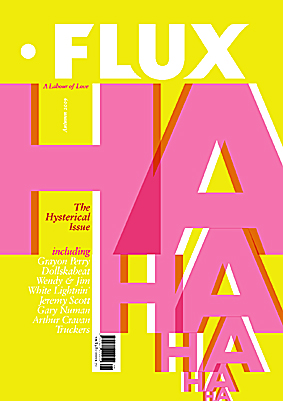
Here’s the announcement:
Arthur Cravan: artist, poet & boxer put all his genius into a life full of sound and fury, high farce and convulsive beauty that influenced every major avant-garde movement from Dada onwards.
 ANDREW GALLIX