The Impossibility of Narrating the Event

Tom McCarthy interviewed by Richard Wolinsky, Bookwaves (KPFA) 1 November 2010:

“This idea of reconstruction, of how to narrate the event: this is the kind of conceptual impossibility at the core of Remainder, which involves this guy elaborately spending millions of pounds to hire people to reconstruct events that he vaguely remembers — and they never get it right because you can’t. And, I suppose, this is almost a metaphor for all of narrative: the impossibility of actually narrating the event.”

The Expatriate Literary Scene in Paris

Anthony Cuthbertson, “From the Lost to the Beat to Now,” Notes From the Underground 19 November 2010

The expatriate literary scene in Paris

What Allen Ginsberg called, ‘The bewildering beauty of Paris’ has attracted writers and artists for centuries. It has been the setting of great novels and the home of great writers, and in the last hundred years has briefly been the stage for two waves of expatriate writers that changed the face of modern literature: the Lost Generation and the Beat Generation. Fifty years have passed since the latter faded away, and though the expatriate literary scene has remained vibrant, no significant movement has since emerged. However, with the arrival of new soirées, literary journals, writers’ workshops and readings, as well as a fresh generation of writers flocking to Paris, a new wave may well be rolling in.

Historically, Paris has been a place of refuge for artists and writers. It has attracted political and cultural exiles fleeing the injustice and intolerance of their homelands, offering them a liberal safe haven and allowing them artistic freedom. In the 1920’s and 1950’s it became a place of escape for those left disenfranchised by the World Wars. The Génération perdue, as Gertrude Stein named them, included writers like Ernest Hemingway, Ezra Pound, F. Scott Fitzgerald, T.S. Eliot, and later James Joyce and Samuel Beckett. They were a generation disillusioned by the horrors they had witnessed in the First World War, and who felt disaffected and betrayed by their governments back home. Pound wrote of his contemporaries, ‘(they) walked eye-deep in hell believing in old men’s lies, then unbelieving came home, home to a lie’. They gathered in cafés and hung about Stein’s salon to share ideas, bottles of absinthe and write, together forming a movement that still resonates strongly today.

By the time the Second World War and the occupation of Paris came about, these writers had for the most part moved on. Although some later returned after the war (Hemingway famously ‘liberated’ rue de l’Odéon, the then site of the bookshop Shakespeare and Company), a new literary movement in the form of the Beat Generation arrived. Leading figures of the Beats, including William Burroughs, Gregory Corso and Ginsberg, came to Paris for much the same reasons as their predecessors. They sought refuge from the strict conformist confines of McCarthy-era America and found it in Paris. In the years that have followed the departure of the Beats, Paris has remained a centre for culture and art. It continues to attract writers and artists with its history and beauty and the lively literary scene is a reflection of its magnetism.

The first stop for any would-be writer or literary pilgrim should be Shakespeare & Company. Its location may have moved over the years but the spirit and the name have remained. The current owner, George Whitman, has described it as ‘a den of poets and anarchists disguised as a bookshop’, having been sanctuary to writers of both the Lost and Beat Generations. The writers, whom George refers to as ‘tumbleweeds’, drift through the doors and find community and lodging in the poky upstairs rooms in exchange for helping out in the shop below. Supporting young writers continues to be one of the cornerstones of S&C. As well as providing a place to stay, they hold workshops, readings and even organize a literary festival every other year. They have also recently relaunched their literary magazine (The Paris Magazine), and announced the Paris Literary Prize (10,000€) for unpublished writers. In its current location on the banks of the Seine it is as much a tourist attraction as it is a bookshop, but between the piles of books still remain bunks for the next hopeful Hemingway to stay.

Beyond this pillar of the past not much remains of the old haunts of writers beyond landmarks and tourist traps. It is easy to get lost wallowing in the myth of Paris but for new writers it is essential to escape the seductive expatriate past, away from the romance of the Latin quarter and the ghosts that wander the left bank, and over to the other side of the river to where the literary scene is shifting.
Boulevard Saint Germain and its surrounds have developed from bohemian havens to bourgeois hangouts popular with tourists. The cafés once frequented by the likes of Hemingway and Joyce, such as Café de Flore, Les Deux Magots and Le Dôme, now sell souvenir memorabilia and a cup of coffee can set you back six euros.

Nowadays it is areas like Belleville and the 19th and 20th arrondissements in the east of Paris where the cost of living is the cheapest that have become the new centres of the literary scene. These parts of Paris continue to provide a conducive environment for young and aspiring writers.

Paris-based writers have often remarked that unlike other big city literary communities, Paris has an open-minded and accepting scene that encourages experimental forms and welcomes outsiders. David Barnes, the founder and compère of a spoken word poetry night in Belleville at Culture Rapide, describes Paris as “a beautiful backwater where life is slower than New York or London. It gives breathing space, distance from the anglo-metropoles that supports writing”.

He argues that the English speaking community in Paris is just the right size “to come together and do something, to provide a home and platform for, to nurture and be nourished by.” The spoken word nights that take place every week welcome anyone and everyone up on stage to read a poem, tell a story or perform a play — the only rule being ‘make the words come alive’. A collective has formed around this café with regulars comprising English speakers from around the world.

In an age where literary scenes and movements are becoming more international by way of the internet, less centred around a location and more around uniting notions and ideals, Paris has managed to retain its place as one of the world’s literary hubs. Since the turn of this century, a movement referred to as the Offbeat Generation has partly formed in Paris. They comprise of a loose collection of like-minded writers, including Lee Rourke and Booker prize nominee Tom McCarthy, who feel alienated by a mainstream publishing industry dominated by marketing. Paris is home to the founder of this movement, Andrew Gallix, whose Paris-based literary magazine 3:AM has provided the main platform for the Offbeats.

Other English language literary magazines that have formed in Paris in recent years include Double Change, Upstairs at Duroc and Platform. The most recent of these, Platform, formed around the spoken word night at Culture Rapide.

As fate would have it, this new scene that is emerging is forming beside where many of their predecessors have found their final resting place: the Père-Lachaise cemetery. It is behind these gates that you can find the graves of such literary icons as Gertrude Stein and Oscar Wilde.

Its legacy may be one of the great appeals of Paris, though it is the smallness and accessibility of the anglophone writing communities, combined with their supportive and inclusive atmospheres, that is currently causing such a surge in the scene. It seems now that the stories shape the city as much as the city once shaped the stories and for any aspiring writer coming to Paris it would be easy to feel intimidated by the past. For them it is perhaps best to consider again the words of Allen Ginsberg: “You can’t escape the past in Paris, and yet what’s so wonderful about it is that the past and present intermingle so intangibly that it doesn’t seem a burden”. The scenes may be as transient as the writers, but the essence of Paris endures.

It’s All Greek

Here is a short, unpublished review of Tom McCarthy‘s C:

It’s All Greek

How do we recombine the debris of literary history?

Inspired By: Cocteau’s Orphée in which dead poet broadcasts coded messages on living poet’s car radio, hence the author as listener-repeater; Background: Concept of the crypt (site of an encoded primal scene) linking Cocteau, Freud’s Wolf Man, invention of telephone, discovery of Tutankhamun and Nabokov’s Ada; Protagonist Modelled On: Alexander Bell, Maurice Blanchot, Howard Carter, Marinetti, Orpheus, Sergei Pankejeff, Georg Trakl; Obligatory Plot Summary: Born, fails to mourn dead teenage sister, treated for melancholia in central Europe, airborne radio operator during WWI, student in drug-fuelled 20s London, civil servant in spy-ridden Egypt, dies; Representative Sentence: “What he sees is darkness, but he sees it.”

The history of Tom McCarthy’s debut, Remainder, has almost achieved legendary status. It was first released on a tiny Parisian art press, having been spurned by all the major publishing houses in Britain, yet ended up making the cover of the New York Times, receiving the 2008 Believer Book Award and being lauded by Zadie Smith as “one of the great English novels of the past ten years”. Where do you go from there? Backwards, of course, like Dr. Learmont’s face that seems to multiply “down a telescoping corridor of memories” [77] or the archaeologists in Egypt — not to mention Serge with his predilection for coitus a tergo. McCarthy’s second novel, Men in Space, was mostly written before his first. His third — which is being touted as his big breakthrough — stems from Calling All Agents (2003), a fascinating essay that already contained all the keys to his book to come. Imagine a Bible concordance predating The Bible itself. In fact, C is CAA re-encrypted: a space in which the event that is true literature can take place.

With his first period piece, McCarthy goes back to the future (and Futurism) in order to rescue fiction from its current impasse. The timeline of this Bildungsroman is highly significant. It begins in 1898 — when Serge Carrefax is born to the “mechanical buzz” [10] of his father’s wireless radio experiments — and ends in 1922 — the year of The Waste Land and Ulysses — when he dies. The association between modern communications technology and modernism provides the backdrop to a redefinition of literature as transmission rather than self-expression.

Unsurprisingly for a novel revolving around incest — both literal and metaphorical — C contains numerous mises en abyme. There’s the tapestry of a staircase hanging above a staircase, or the school pageant (a nod to The Mousetrap in Hamlet) that dramatizes the Orphic theme underlying the entire work. The most apposite is Sophie’s “strange associative web” [71] that proliferates like a tumor and seems to harbor some dark secret within its intricate ramifications. McCarthy’s text also keeps generating new meanings, sometimes of its own volition, as words and ideas cross-fertilize in incestuous ways. Language, says Heidegger, speaks. Thus Sophie mutters beautiful schizophrenic gibberish as though she had “turned herself into a receiver” [75]. The Morse code clicks sometimes seem to be “speaking on their own” [67]. The deaf children are spoken through, their voices “ventriloquised” as if “piped in from somewhere else;” [4] their utterances resembling “a mispronounced version of something else, other sentences that are trying to worm their way up to the surface, make themselves heard” [79]. The headlong rush into modernity, away from the parodic pastoral setting, is paralleled by a return to the primitive magic of the oral tradition. The idea that something may even be lurking behind mere hearing is often hinted at. “[M]uffled signals” [83] are half-heard through wireless static (itself likened to “the sound of thought” [64]). Serge is haunted by “vague impressions of bodies hovering just beyond the threshold of the visible” [68] when riding “the dial’s far end” [83].

The protagonist teeters on the brink of some revelation that eludes him until he receives the ultimate, hallucinatory “call”. The reader can also break the code: incest is the encrypted primal scene of literature — the scene of our failed mourning for the works of the past. It’s all Greek, in the end.

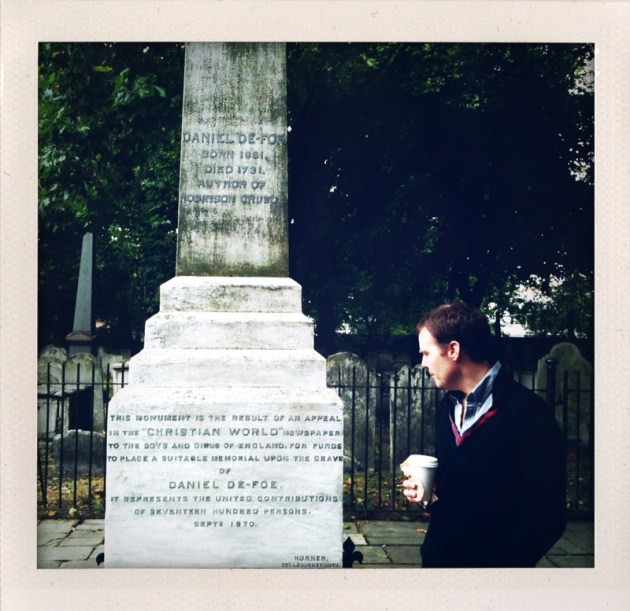
[Picture: Tom McCarthy and Daniel Defoe, Bunhill Fields, London, August 2010. By Andrew Gallix.]

Melancholia as Ultimate Rebellion

Excerpts from Lee Rourke, “In Conversation: Lee Rourke and Tom McCarthy,” The Guardian (Guardian Review p.12) Saturday 18 September 2010

Lee-Rourke-and-Tom-McCart-006
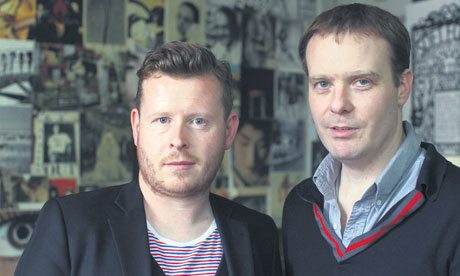
[Lee Rourke (left) and Tom McCarthy. Photograph: Eamonn McCabe for the Guardian]

LR: You’ve said in the past that all art is repetition.

TMcC: Yeah: Joyce’s “commodius vicus of recirculation” . . . Or Mark E Smith’s three Rs: repetition, repetition and repetition . . .

LR: I’ll drink to that. It’s like a never-ending transmission that can’t be switched off.

TMcC: The transmission thing is important. There’s that Kraftwerk song, “I am the receiver and you are the transmitter”, or however it goes. One way of thinking about art, or the novel, is that the writer is the transmitter, the originator: I have something to say about the world and I’m going to transmit it. But this isn’t how I see it, I see it as exactly the inverse: the writer is a receiver and the content is already out there. The task of the writer is to filter it, to sample it and remix it — not in some random way, but conscientiously and attentively. This is what Heidegger says about poets: to be a poet is to listen before speaking; it’s first and foremost a listening and not a speaking. Kafka said it as well: “I write in order to affirm and reaffirm that I have absolutely nothing to say.” Writing, or art, is not about having something to say; it’s about aspiring to a heightened state of hearing. It’s why C is a totally acoustic novel and a receptive novel. The hero, Serge, sits there for hours trawling the aether waves, absorbing, listening to ship-to-shore transmissions, stock market prices, sports results, writing them all down. In a way, if you could see Serge’s transcript it would probably read like an Ezra Pound canto.

LR: This is why Serge is so brilliant, because all this absorption culminates in a form of pure poetry. I’m thinking of the novel’s “Chute” section, especially the first world war passages. Serge in his plane over enemy lines, flying above and below, marking the sky around him with these wonderful vapour trails while shooting up heroin and quoting Hölderlin, and so on. Where does all that come from? I know you’re interested in Marinetti’s manifestos.

TMcC: For Serge the whole battlefield becomes a sound box. He thinks of his machine gun, when he’s firing it into the trenches below, as like a needle being aligned with the groove of a record. When the needle goes in, static comes out, and it all resonates: the percussion of machine-gun fire, the siren wail of howitzers. The difference between Serge and Wilfred Owen is that Serge loves war. By the way, talking of Marinetti: it’s interesting that Marinetti’s novels, which supposedly enact the propositions of his many manifestos, are much less interesting than the manifestos. And the paintings that people did based on his manifestos are much less good as well. The manifestos are a kind of field of potentiality that to actually realise would spoil.

LR: You’ve stated recently that C is essentially a novel about desire as much as about technology, and the “looping” of both within time. This puts me in mind of Beckett’s Krapp’s Last Tape. This idea that technology doesn’t take you forwards into the future, but actually takes you back towards your past.

TMcC: When Beckett’s old man is listening to these old tapes of himself, what it actually comes down to is desire — it’s incredibly moving. He’s there at the end, the end of his life, he wants to stop replaying it, all the loopings, snarling “Wasn’t once enough?”; but he listens again and again and again to this incredibly lyrical passage that he’s recorded about 30 or 40 years ago about him floating in a punt, with a girl, and the water all around them, I mean, it’s fucking amazing, it’s really, really beautiful. This is it, you see: what we find in technology and networks is desire. Which doesn’t mean the desiring individual; it means desiring consciousness itself. That’s why I wanted Serge Carrefax to be more than an individual; if he was a circuit he’d be over-charged. The surge is too much, it blows. It’s about the desire for impossibility. Giorgio Agamben, when describing melancholia (which Serge has in spades), says that the condition isn’t at all a detachment from the world, even though it may seem like it; in fact it’s an investment in the world so much that the desire for the world exceeds its own limit. The melancholic wants what is impossible; he wants impossibility itself — to experience it and to merge with it. To surge towards it. That’s why the melancholic is the ultimate rebel.

LR: Is it a desire for the impossible, or nothingness, to become real? To become a tangible thing?

TMcC: No, I think it’s more than that. I mean Pygmalion gets that: he wants the statue and then it becomes real, and that’s cute. But take Orpheus looking back: he’s far more interesting. He doesn’t really want Eurydice, he wants the dark night. As Maurice Blanchot brilliantly points out, he wants death itself. Not to make the night illuminated or present, but to have it in its absence, to have the presence of absence, something that is impossible. It’s doomed, beautiful and tragic.

LR: This is Blanchot’s Orpheus’s Gaze

TMcC: Right. It’s an essay about five pages long and it’s the most amazing summary of what literature is, or could be, ever written. It’s not about representing the world, it’s not about criticising the world even. It’s about surrendering to a vertigo that can never be mastered, to an abyss that can never be commanded, or excavated or filled in.

LR: But you can leave your mark, right?

TMcC: Yeah, the scratch. Scratching the negative. That’s what artists do at their very best.

C By Tom McCarthy

This appeared in the September 2010 issue of Dazed & Confused (vol. 2, issue 89, p. 196):

C by Tom McCarthy

Incest, spies and coke-fuelled adventures

Let’s not beat about the bush: Tom McCarthy’s third novel, C, is a masterpiece: a sprawling associative web that keeps generating new meanings as though of its own volition. “That’s the beautiful thing about what literature does to language,” says McCarthy. “You stick these slippery terms in and they start cross-fertilising in ways you never anticipated — incestuous ways.” C takes us from a fairytale English silk farm to spy-ridden Egypt by way of a central European spa town, aerial warfare and a coke-fuelled London filled with bright young Amazons. It is a comedy of errors, a gothic mystery, a boy’s own story; a traditional 19th-century novel seemingly rewritten by Burroughs or Ballard. You’ll find geometry, technology and trauma. Loops, repetitions and mutations. Incest, insects and radio bugs. And phantom words emanating from subterranean worlds half-glimpsed “at the dial’s far end”. Tune in…

DAZED & CONFUSED: C could be seen as a futurist novel. Serge, the protagonist, even seems to be partly modelled on Marinetti himself…
TOM MCCARTHY: I love Marinetti, and, yes, he’s part of Serge’s make-up, particularly in the war section. But Serge is equally a mixture of Freud’s Wolf Man, the beautifully fucked-up melancholic eternally grieving for his dead sister; and Alexander Bell, inventor of the phone (who also lost two siblings); and Howard Carter, the Egyptologist who disinterred the ur-family tomb; and a bunch of other people. I’m interested in the places where technology and mourning intersect.

There’s also a strong retro-futurist — even steampunk — element to C. Did you feel the need to revisit the early 20th century in order to reinvent the future of the novel?
Yes. Walter Benjamin says that the angel of history faces backwards. I think it’s the same for literature: you’ve got to look back in order to move forwards. It’s not just the foundations of contemporary technology that are being laid in the early 20th century (the code radio bugs used exactly anticipated text speak, just as lots of their output anticipated Twitter), but also literature’s period of high modernism that’s coming to a head. Not for nothing does the novel end in 1922: it’s the year that Ulysses and The Waste Land came out. The task for the contemporary writer (sadly, one which many writers of today are shirking) is to work through that period’s legacy — dynamically and radically, but attentively too.

All the major themes in C — from wireless technology to the discovery of Tutankhamun — come from your early experiments with the International Necronautical Society (INS), don’t they?
I had the idea for C while I was working on the INS project at the ICA. There, we had a radio station modelled on the illicit one in Jean Cocteau’s film Orphée (where the person transmitting is already dead), sending out all these coded poetic messages. I was looking at writing around encryption, and the concept of the ‘crypt’ that you get in psychoanalysis and philosophy.

Incest lies at the heart of C: this, for you, is the source code of western literature, right?
Yes. You go back from Nabokov through Faulkner through Racine right back to Sophocles, and incest is the central theme that keeps recurring. For Freud, the incest prohibition is what makes us civilised, socialised, even human, so that’s the taboo all tragic heroes, who are fundamentally doomed rebels, are most drawn towards transgressing.

Why do you think that all new means of telecommunication are linked to death, mourning and melancholia?
I don’t know if I can explain it. It’s just a pattern that keeps recurring. For every comm-tech invention, there seems to be a dead sibling somewhere. Bell even made a pact with his brother that, if one of them died like their other brother had, the surviving one would invent a device capable of receiving messages from the dead. Then the second brother dies, and Bell invents the telephone. He remained a rationalist, a sceptic — basically because his brothers never called. But the desire, the fantasy, is there in the technology: a ghost in the machine. It’s the same with radio. Seances in the 20s weren’t about spirit and ectoplasm any more: they were about “tuning in” to voices resonating on high frequencies, like radio waves. With the internet, it seems to be more about a presence than an absence: everything’s there, every click and keystroke ever made eternally retrievable, a giant archive. That’s a kind of haunting too, though.

Text and Photography
ANDREW GALLIX

Inalienable Silence

Tom McCarthy, Calling All Agents (London: Vargas Organisation, 2003). 4-5.

“…And yet the Hearings left us with the impression that if (as Gil Scott Heron says) the Revolution will not be televised, then perhaps its nucleus will not be caught on audio tape or broadcast on the airwaves either — or if it will, then it will take the form of silence. For Heidegger, everything stems from the Unspoken: Being calls us, but it does so ‘in the uncanny mode of keeping silent.’ Burroughs’s revolutionary drive extends to a transformation of language that will help cast off the ‘IS’ of identity: this language, he tells us, will be a hieroglyphic one that ‘will give one the option of silence.’ Hollings, discussing Burroughs in an article, writes: ‘Recorded silence only becomes a political act once it is played back.’ There are echoes of Cégeste’s first message here. Hollings was a contributor to Violent Silence (a book about Bataille), a collaborator with John Cage and at the time of the Hearings was conducting research into the erased passages in Nixon’s Watergate tapes. What did he mean ‘recorded silence only becomes a political act once it is played back,’ we asked him. ‘Playing a blank tape,’ he told us, ‘breaking the seal on something and sticking it in a machine and listening to it, is an act of refusal.’ ‘So there is a kind of inalienable silence that is encrypted somehow?’ Anthony Auerbach asked; ‘And this potentially contains the revolutionary moment?’ ‘Exactly so,’ said Hollings. This is the violent silence of Shakespeare’s Cordelia, who tells her father ‘Nothing’ — a single word which leads to general annihilation, wars and madness; or of Stephen Daedalus, self-styled ‘Cordoglio’ who, as he brings about ‘the ruin of all space, shattered glass and toppling masonry, and time one livid final flame,’ says ‘Nothing!’ ‘Maybe,’ I suggested, ‘our radio project should be a quest for that silence’ — a suggestion to which Hollings answered, in what turned out to be the Hearings’ final exchange: ‘I would strongly recommend it.’…”

On p. 12, McCarthy mentions Burroughs’s “putative hushed-up language”.

On p. 16: “This silent word is so charged and so seductive, Abraham and Torok conclude [in Cryptonomy: the Wolf Man’s Magic Word], that it and it alone becomes the object of the Wolf Man’s love. To keep it safe he buries it inside the crypt ‘like a chrysalis in its cocoon’ and carries it around for all his life, showing and hiding it, saying it without saying it, ‘repeating tirelessly to one and all, especially to his analyst: ‘Here is nothing, hold it tight’.”

“‘Poetry,’ in the words of Auden, ‘makes nothing happen’ — an active construct in which ‘nothing’ designates an event, perhaps even a momentous one. In looking into the abyssal ground, reading its source code and transmitting this nothing outwards, maybe we will find that our culture also [like Freud’s Wolf Man] has a secret, silent word.”

We Are All Necronauts

409692229_e75d124f7c_t

This appeared in the summer 2009 issue of Flux magazine (issue 69, pp. 42-43):

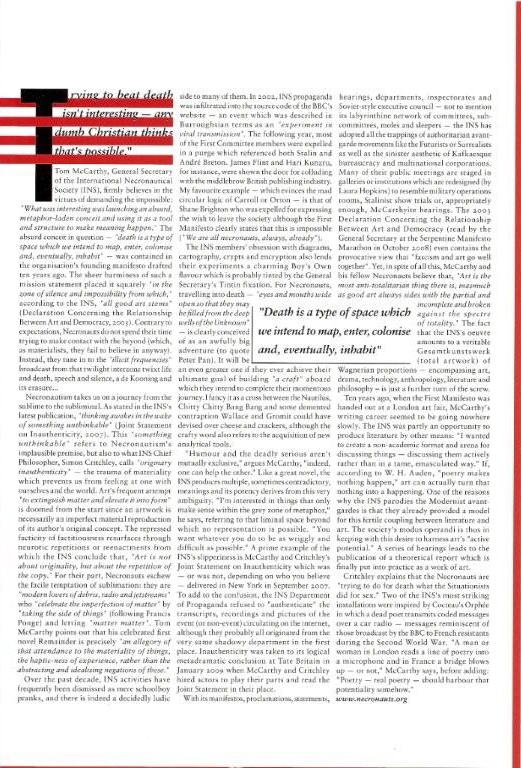
We Are All Necronauts

For the past decade, the International Necronautical Society has been encouraging us to learn to die in new, imaginative ways

“Trying to beat death isn’t interesting — any dumb Christian thinks that’s possible.” Tom McCarthy, General Secretary of the International Necronautical Society (INS), firmly believes in the virtues of demanding the impossible: “What was interesting was launching an absurd, metaphor-laden conceit and using it as a tool and structure to make meaning happen.” The absurd conceit in question — “death is a type of space which we intend to map, enter, colonise and, eventually, inhabit” — was contained in the organisation’s founding manifesto drafted ten years ago. The sheer barminess of such a mission statement placed it squarely “in the zone of silence and impossibility from which,” according to the INS, “all good art stems” (Declaration Concerning the Relationship Between Art and Democracy, 2003). Contrary to expectations, Necronauts do not spend their time trying to make contact with the beyond (which, as materialists, they fail to believe in anyway). Instead, they tune in to the “illicit frequencies” broadcast from that twilight interzone twixt life and death, speech and silence, a de Kooning and its erasure…

Necronautism takes us on a journey from the sublime to the subliminal. As stated in the INS’s latest publication, “thinking awakes in the wake of something unthinkable” (Joint Statement on Inauthenticity, 2007). This “something unthinkable” refers to Necronautism’s implausible premise, but also to what INS Chief Philosopher Simon Critchley calls “originary inauthenticity” — the trauma of materiality which prevents us from feeling at one with ourselves and the world. Art’s frequent attempt “to extinguish matter and elevate it into form” is doomed from the start since an artwork is necessarily an imperfect material reproduction of its author’s original concept. The repressed facticity of factitiousness resurfaces through neurotic repetitions or reenactments from which the INS conclude that “Art is not about originality, but about the repetition of the copy”. For their part, Necronauts eschew the facile temptation of sublimation: they are “modern lovers of debris, radio and jetstreams” who “celebrate the imperfection of matter” by “taking the side of things” (following Francis Ponge) and letting “matter matter”. Tom McCarthy points out that his celebrated first novel Remainder is precisely “an allegory of that attendance to the materiality of things, the haptic-ness of experience, rather than the abstracting and idealising negations of these”.

Over the past decade, INS activities have frequently been dismissed as mere schoolboy pranks, and there is indeed a decidedly ludic side to many of them. In 2002, INS propaganda was infiltrated into the source code of the BBC’s website — an event which was described in Burroughsian terms as an “experiment in viral transmission”. The following year, most of the First Committee members were expelled in a purge which referenced both Stalin and André Breton. James Flint and Hari Kunzru, for instance, were shown the door for colluding with the middlebrow British publishing industry. My favourite example — which evinces the mad circular logic of Carroll or Orton — is that of Shane Brighton who was expelled for expressing the wish to leave the society although the First Manifesto clearly states that this is impossible (“We are all necronauts, always, already”).

The INS members’ obsession with diagrams, cartography, crypts and encryption also lends their experiments a charming Boy’s Own flavour which is probably tinted by the General Secretary’s Tintin fixation. For Necronauts, travelling into death — “eyes and mouths wide open so that they may be filled from the deep wells of the Unknown” — is clearly conceived of as an awfully big adventure (to quote Peter Pan). It will be an even greater one if they ever achieve their ultimate goal of building “a craft” aboard which they intend to complete their momentous journey. I fancy it as a cross between the Nautilus, Chitty Chitty Bang Bang and some demented contraption Wallace and Gromit could have devised over cheese and crackers, although the crafty word also refers to the acquisition of new analytical tools.

“Humour and the deadly serious aren’t mutually exclusive,” argues McCarthy, “indeed, one can help the other”. Like a great novel, the INS produces multiple, sometimes contradictory, meanings and its potency derives from this very ambiguity. “I’m interested in things that only make sense within the grey zone of metaphor,” he says, referring to that liminal space beyond which no representation is possible. “You want whatever you do to be as wriggly and difficult as possible”. A prime example of the INS’s slipperiness is McCarthy and Critchley’s Joint Statement on Inauthenticity which was — or was not, depending on who you believe — delivered in New York in September 2007. To add to the confusion, the INS Department of Propaganda refused to “authenticate” the transcripts, recordings and pictures of the event (or non-event) circulating on the internet, although they probably all originated from the very same shadowy department in the first place. Inauthenticity was taken to its logical metadramatic conclusion at Tate Britain in January 2009 when McCarthy and Critchley hired actors to play their parts and read the Joint Statement in their place.

With its manifestos, proclamations, statements, hearings, departments, inspectorates and Soviet-style executive council — not to mention its labyrinthine network of committees, sub-committees, moles and sleepers — the INS has adopted all the trappings of authoritarian avant-garde movements like the Futurists or Surrealists as well as the sinister aesthetic of Kafkaesque bureaucracy and multinational corporations. Many of their public meetings are staged in galleries or institutions which are redesigned (by Laura Hopkins) to resemble military operations rooms, Stalinist show trials or, appropriately enough, McCarthyite hearings. The 2003 Declaration Concerning the Relationship Between Art and Democracy (read by the General Secretary at the Serpentine Manifesto Marathon in October 2008) even contains the provocative view that “fascism and art go well together”. Yet, in spite of all this, McCarthy and his fellow Necronauts believe that “Art is the most anti-totalitarian thing there is, inasmuch as good art always sides with the partial and incomplete and broken against the spectre of totality.” The fact that the INS’s oeuvre amounts to a veritable Gesamtkunstswerk (total artwork) of Wagnerian proportions — encompassing art, drama, technology, anthropology, literature and philosophy — is just a further turn of the screw.

Ten years ago, when the First Manifesto was handed out at a London art fair, McCarthy’s writing career seemed to be going nowhere slowly. The INS was partly an opportunity to produce literature by other means: “I wanted to create a non-academic format and arena for discussing things — discussing them actively rather than in a tame, emasculated way.” If, according to W. H. Auden, “poetry makes nothing happen,” art can actually turn that nothing into a happening. One of the reasons why the INS parodies the Modernist avant-gardes is that they already provided a model for this fertile coupling between literature and art. The society’s modus operandi is thus in keeping with this desire to harness art’s “active potential.” A series of hearings leads to the publication of a theoretical report which is finally put into practice as a work of art.

Critchley explains that the Necronauts are “trying to do for death what the Situationists did for sex”. Two of the INS’s most striking installations were inspired by Cocteau’s Orphée in which a dead poet transmits coded messages over a car radio — messages reminiscent of those broadcast by the BBC to French resistants during the Second World War. “A man or woman in London reads a line of poetry into a microphone and in France a bridge blows up — or not,” McCarthy says, before adding: “Poetry — real poetry — should harbour that potentiality somehow.”

http://www.necronauts.org

1

2

Tom McCarthy & The Modern Lovers of Debris

409692229_e75d124f7c_t

This appeared in the March 2009 issue of Dazed & Confused (vol. 2 issue 71, p. 227):

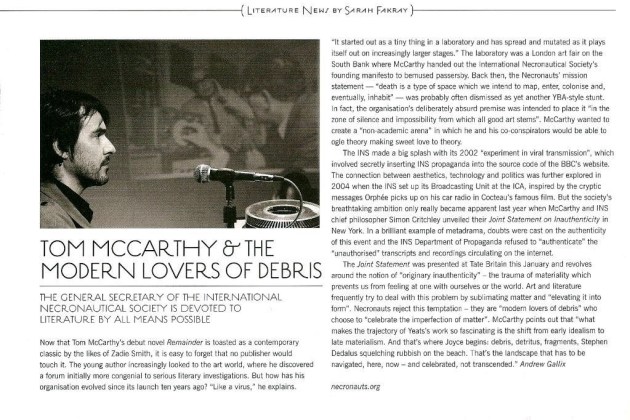
Tom McCarthy & The Modern Lovers of Debris

The General Secretary of the International Necronautical Society is devoted to literature by all means possible

Now that Tom McCarthy’s debut novel Remainder is toasted as a contemporary classic by the likes of Zadie Smith, it is easy to forget that no publisher would touch it. The young author increasingly looked to the art world, where he discovered a forum initially more congenial to serious literary investigations. But how has his organisation evolved since its launch ten years ago? “Like a virus,” he explains, “It started out as a tiny thing in a laboratory and has spread and mutated as it plays itself out on increasingly larger stages.” The laboratory was a London art fair on the South Bank where McCarthy handed out the International Necronautical Society’s founding manifesto to bemused passersby. Back then, the Necronauts’ mission statement — “death is a type of space which we intend to map, enter, colonise and, eventually, inhabit” — was probably often dismissed as yet another YBA-style stunt. In fact, the organisation’s deliberately absurd premise was intended to place it “in the zone of silence and impossibility from which all good art stems”. McCarthy wanted to create a “non-academic arena” in which he and his co-conspirators would be able to ogle theory making sweet love to practice.

The INS made a big splash with its 2002 “experiment in viral transmission”, which involved secretly inserting INS propaganda into the source code of the BBC’s website. The connection between aesthetics, technology and politics was further explored in 2004 when the INS set up its Broadcasting Unit at the ICA, inspired by the cryptic messages Orphée picks up on his car radio in Cocteau’s famous film. But the society’s breathtaking ambition only really became apparent last year when McCarthy and INS chief philosopher Simon Critchley unveiled their Joint Statement on Inauthenticity in New York. In a brilliant example of metadrama, doubts were cast on the authenticity of this event and the INS Department of Propaganda refused to “authenticate” the “unauthorised” transcripts and recordings circulating on the internet.

The Joint Statement was presented at Tate Britain this January and revolves around the notion of “originary inauthenticity” — the trauma of materiality which prevents us from feeling at one with ourselves or the world. Art and literature frequently try to deal with this problem by sublimating matter and “elevating it into form”. Necronauts reject this temptation — they are “modern lovers of debris” who choose to “celebrate the imperfection of matter”. McCarthy points out that “what makes the trajectory of Yeats’s work so fascinating is the shift from early idealism to late materialism. And that’s where Joyce begins: debris, detritus, fragments, Stephen Dedalus squelching rubbish on the beach. That’s the landscape that has to be navigated, here, now — and celebrated, not transcended.”

1

All the Latest

409692229_e75d124f7c_t

Inés Martin Rodrigo has published an in-depth article on the Offbeats in top Spanish daily ABC in which I — “el Rimbaud de la Red”! — am quoted at length:

Inés Martin Rodrigo, “‘Se lo que sea, estoy contra ello,” ABC 16 February 2009

Es el lema de un nuevo grupo de escritores anglosajones con sede en Internet que está revolucionando la industria editorial. No tienen reglas ni manifiestos, pero la Generación Offbeat reclama su lugar en la escena literaria

La industria editorial es aburrida, está embotada y estreñida, desprende un cierto tufillo rancio y amenaza con eliminar todo fragmento de imaginación que aún quede en la mente del lector menos conformista. No es una sentencia categórica de un crítico cabreado con el ultimo best seller que ha llegado a sus manos, ni siquiera la reflexión concienzuda de un intelectual con complejo de Nostradamus. Es el pensamiento y la bandera literario revolucionaria de un nuevo grupo de escritores con sede en la Web y que se (auto)definen como Generación Offbeat.

Qué menos se podía esperar de los potenciales sucesores de Charles Bukowski, Allen Ginsberg, Jack Kerouac, William S. Burroughs y compañía. Autores todos ellos enraizados en la libertad y el compromiso con ser fiel a uno mismo, filosofía de la que dieron buena cuenta en sus años de lucha literaria con las armas de las que disponían. Las armas de la razón hecha palabra y empleada en defensa de la paz, en contra de la Guerra de Vietnam o como sagaz discurso contra el recalcitrante conformismo de la sociedad de la época.

Una generación pegada a los libros

Los años han transcurrido y el discurso se ha transformado, al igual que las armas para evocarlo y defenderlo. Pero la raíz prendió con fuerza en una generación de jóvenes que creció leyendo el “Junky” de Burroughs, “uno de los mayores trabajos literarios sobre el mundo de la droga, al lograr algo que muchos libros que le siguieron fueron incapaces: habló del modo de vivir de un drogadicto”, en palabras de Tony O’Neill, escritor offbeat por excelencia. Y es que Burroughs describió el oscuro laberinto de la drogadicción sin ejercer de falso predicador para el lector, sin miedo a llamar a cada cosa por su nombre. Porque, le pese a quien le pese, un heroinómano no será nunca un pervertido al que adoctrinar. Así, llamando a las cosas por su nombre y leyendo, sobre todo leyendo, empapándose de los popes del movimiento beat fue como este grupo de autores fue regando su propio discurso.

Un discurso que se vertebra en un nuevo y excitante trabajo de ficción, que corre riesgos y que, cada vez con más intensidad, empieza a generar demanda en cuantos lectores se topan con él casi sin pretenderlo. Y es que, demasiado ácidos, diferentes y afilados para la industria editorial tradicional, la generación offbeat se esconde (de momento, aunque cada vez menos) en los amplios (y libres) márgenes de la Web y en alguna que otra editorial independiente.

El origen del movimiento

El primero en usar el término offbeat (y por tanto quien lo acuñó) fue Andrew Gallix, redactor jefe y responsable de la revista literaria online 3:AM Magazine (puestos a hacer comparaciones, valdría decir que sería algo así como el New Yorker de los offbeats). De eso hace ya casi tres años aunque, como el propio Andrew reconoce, “el movimiento llevaba bastante tiempo emergiendo. Es un poco lo que pasó con el punk o los nuevos románticos, al principio no tenían nombre por lo que mucha gente desconocía su existencia”.

Un desconocimiento que se fue disipando a medida que los grupos fueron proliferando en el ciberespacio. Eran escritores, guionistas, periodistas, bloggers, artistas… con un interés común por la literatura pura (sin artificios), que empezaron a gravitar alrededor de 3:AM y a organizar lecturas, conciertos e incluso festivales. “Fue en esos eventos donde comenzaron a establecerse las relaciones –explica Gallix-. La primera vez que fui consciente de que había aparecido un nuevo movimiento fue en el baño de Filthy Macnasty’s (uno de los pubs londinenses preferidos por Pete Doherty), cuando Lee Rourke (escritor y a la postre integrante de la Generación Offbeat) se abalanzó sobre mi y empezó a hablar de la enorme revolución literaria que habíamos iniciado. Aquello fue realmente el comienzo de todo”.

Un inicio virtualmente surrealista para un movimiento con integrantes de carne y hueso. Son muchos los offbeats que, incluso sin saberlo, engrosan la lista de esta generación pero, si hubiera que etiquetar al movimiento como tal cabría decir que se caracteriza por la variedad de voces y estilos y la ausencia de reglas (aquí no hay manifiestos). “A pesar de la diversidad, muchos escritores offbeat comparten características. La mayoría son británicos, treintañeros y creen que la escritura es mucho más que un mero entretenimiento”, enfatiza Gallix. Y sienten la música como elemento catalizador y de equilibrio.

Una lista repleta de talento

La lista es interminable y suena francamente bien. Noah Cicero (novelista estadounidense a medio camino entre Samuel Beckett y The Clash), Ben Myers (autor inglés mezcla de Richard Brautigan con Lester Bangs), Adelle Stripe (poeta londinense heredera del cinematográfico “realismo de fregadero” de Sidney Lumet), el propio Andrew Gallix (el Rimbaud de la Red), Tom McCarthy (novelista estadounidense afanado en la deconstrucción de una nueva idea de novela), HP Tinker (joven inglés al que comparan con Pynchon y Barthelme), Tao Lin (el aventajado protegido de Miranda July –a quien pronto veremos publicada en nuestro país gracias a Seix Barral-, con todo lo que eso supone hoy en día) y los primeros (parece que las grandes editoriales empiezan a tomar apuntes) que aterrizarán en España: Chris Killen, cuya novela “The Bird Room” será publicada este año por Alfabia, y Heidi James y Tony O’Neill, ambos con la editorial El Tercer Nombre.

Todos ellos influidos por el particular lirismo de Tom Waits, Lou Reed, Scott Walker o David Bowie, de la misma manera que estos sintieron la influencia de los autores de los que la Generación Offbeat es heredera. Aunque también están los que prefieren huir de las comparaciones. Tal es el caso de Heidi James, para quien la comparación es un poco “perezosa, basada en el hecho de que evitamos formar parte de la corriente principal”. Esta joven autora británica, que en marzo publicará su primera novela en España (“Carbono”, Ed. El Tercer Nombre) y que se confiesa fascinada por Lynne Tillman, Clarice Lispector, Marie Darrieussecq, Angela Carter o Virginia Woolf, es dueña de su propia editorial en Reino Unido, Social Disease. Con ella, que debe su nombre a la famosa frase de Andy Warhol -“Tengo una enfermedad social. Tengo que salir todas las noches”-, Heidi se ha convertido en uno de los estandartes de la Generación Offbeat al publicar “literatura única y genuina al margen de su valor en el mercado”.

Un movimiento coordinado

La propia Heidi James, en una prueba evidente de que el movimiento está coordinado y sabe hacia dónde se dirige, ha publicado en Reino Unido a autores como HP Tinker o Lee Rourke pero, sobre todo, a Tony O’Neill, el máximo exponente de los offbeats. Este joven neoyorquino, devoto de Bukowski, responsable de una prosa brutalmente descarnada, ex heroinómano, miembro de bandas como The Brian Jonestown Massacre, ha publicado ya cuatro novelas (la última, “Colgados en Murder Mile”, llegará a España en primavera) y se erige en líder (sin pretenderlo) del movimiento con ansias de seguir reclutando adeptos.

Como su propio nombre (offbeat) indica, una generación extraña e inusual de escritores, para los que la Red es su campo de acción, con espíritu punk y ganas de comerse la industria literaria tal y como ahora está concebida. El mundo anglosajón ya ha sido testigo de los primeros bocados. En España está al caer, ¡y ni siquiera es una generación! Que tiemble Zafón.
New York Review of Books

409692229_e75d124f7c_t

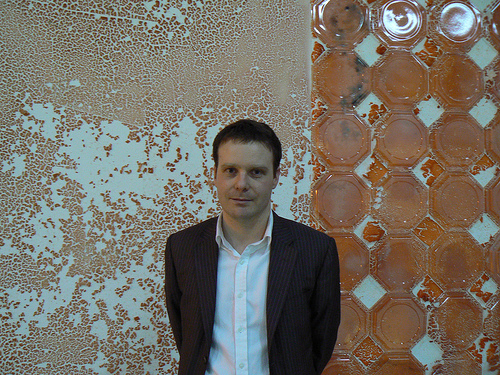
Here is the picture I took of Tom McCarthy at the Palais de Tokyo (Paris) back in February 2007 which now appears in the special anniversary issue of The New York Review of Books (celebrating 45 years in print). It features on the second page (p. 90) of Zadie Smith’s in-depth article on Joseph O’Neill’s Netherland and McCarthy’s Remainder.

Zadie Smith, “Two Paths For the Novel,” The New York Review of Books (volume 55, number 18) 20 November 2008: 89-94.

392173592_d1eb09c8f6