But They Aren’t Writing Anything At All!

An extract from “Literature’s New Clothes,” A Life Unfurnished 4 July 2011:

Contemporary literary fiction is a case of the Emperor’s new clothes. It is time somebody shouted out from the crowd: “But they aren’t writing anything at all!”

[…] Contemporary literary fiction continues the attempt to live up to Plato’s definition of art — which, for Plato, made art true — by writing in a manner to give the appearance alone of literature. The effect is a genre in which, for the writer, the sense of Writing Literature is dominant, and, for the reader, the sense of Reading Literature is dominant. And this effect is produced, not simply by the abandonment of most of the elements of character and plot, not simply even by an avoidance of high-literary language and style, but by a self-conscious juxtaposition of the signs of excruciating effort — short, elliptical sentences; absence of fulsome description; muted tone of painful sublimation — with the signs of iconoclastic casualness — colloquialisms; lack of trajectory; air of the incidental. This is how the appearance alone of literature is pursued: by the combination of painful retention, of a Literature that will never appear, and easy production, of a Literature that need only appear. […]

As a Child Might Pee Against a Tree

An extract from Biblioklept Interviews Novelist Lars Iyer,” Biblioklept 15 July 2011:

[…] Literature continues. But it does so, in contemporary literary fiction, as a kind of empty form. As the anonymous blogger of Life Unfurnished has put it: contemporary literary fiction gives ‘the appearance alone of literature’; it is a genre ‘in which, for the writer, the sense of Writing Literature is dominant, and, for the reader, the sense of Reading Literature is dominant’.

Reviewing Jean-Luc Godard’s film Every Man For Himself, Pauline Kael writes, ‘I got the feeling that Godard doesn’t believe in anything anymore; he just wants to make movies, but maybe he doesn’t really believe in movies anymore, either’. Without agreeing with Kael’s assessment of Godard, I’d like to paraphrase her formulation: I think literary writers want to write literary fiction without believing in literature — without, indeed, believing in anything at all.

It seems to me that the literary gestures are worn out — the creation of character, plot, the contrivance of high-literary language and style as much as the avoidance of high-literary language and style, and the abandonment of most elements of the creation of character and plot. The ‘short, elliptical sentences’ of which the blogger of Life Unfurnished writes, the ‘absence of fulsome description’, the ‘signs of iconoclastic casualness’, the ‘colloquialisms’, the ‘lack of trajectory’, the ‘air of the incidental’: all are likewise exhausted.

What, then, is to be done? As writers, as readers, we are posthumous. We’ve come too late. We no longer believe in literature. Once you accept this non-belief, once you affirm it in a particular way, then something may be possible.

Witold Gombrowicz seems to be advocating a return to older forms of literary insouciance: ‘Where are the good old days, when Rabelais wrote as a child might pee against a tree, to relieve himself? The old days when literature took a deep breath and created itself freely, among people, for people!’ But we cannot simply return to Rabelais, as Gombrowicz knew. Too much has happened! If a kind of self-consciousness is a distinguishing mark of the contemporary literary novelist, this is not something that can be relinquished altogether. The role of centuries of writing — of the rise of the nineteenth century bourgeois novel, of modernism and so on — must be marked.

But it can be marked by portraying our distance now from the conditions in which the great works of literature and philosophy were written. W. and Lars, the characters in Spurious, revere Rosenzweig. But this is also reverence for a culture that would deem Rosenzweig and his work important – a culture that is completely different from the one which W. and Lars occupy. True, they revere contemporary masters, too — the filmmaker Béla Tarr, for example — but Tarr lives far away, in very different conditions. W. and Lars occupy the world of the present, and the world that valued the ideas they value, the world that sustained those ideas and nurtured their production, has disappeared. Much of the humour of the book comes from the fact that its characters are men out of time — gasping in awe at Rosenzweig’s work at one moment, leafing through gossip magazines at another; proclaiming a great love of Kafka one minute, playing Doom on a mobile phone the next.

All the Latest

I’ve written a piece about custard-pie activism for the Guardian‘s Comment is Free section. You can read it here. An expanded version of my review of Marc-Edouard Nabe‘s latest novel appeared in 3:AM Magazine. Also in 3:AM, I talk about my summer reading list.

Hauntology

This appeared in Guardian Books on 17 June 2011:

Hauntology: A Not-So-New Critical Manifestation
The new vogue in literary theory is shot through with earlier ideas
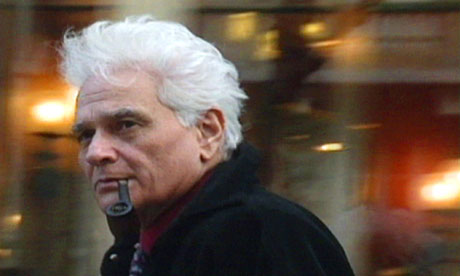
[Haunting presence … Jacques Derrida, who coined the term hauntology, in a still from the documentary Derrida]

Hauntology is probably the first major trend in critical theory to have flourished online. In October 2006, Mark Fisher — aka k-punk — described it as “the closest thing we have to a movement, a zeitgeist”. A mere three years later, Adam Harper prefaced a piece on the subject with the following caveat: “I’m all too aware that it’s no longer 2006, the year to blog about hauntology”. Two months ago, James Bridle predicted that the concept was “about six months away from becoming the title of a column in a Sunday supplement magazine”. Only four months to go, then. My hunch is that hauntology is already haunting itself. The revival starts here.

Like its close relative psychogeography, hauntology originated in France but struck a chord on this side of the Channel. In Spectres of Marx (1993), where it first appeared, Jacques Derrida argued that Marxism would haunt Western society from beyond the grave. In the original French, “hauntology” sounds almost identical to “ontology”, a concept it haunts by replacing — in the words of Colin Davis — “the priority of being and presence with the figure of the ghost as that which is neither present, nor absent, neither dead nor alive”.

Today, hauntology inspires many fields of investigation, from the visual arts to philosophy through electronic music, politics, fiction and literary criticism. At its most basic level, it ties in with the popularity of faux-vintage photography, abandoned spaces and TV series like Life on Mars. Mark Fisher — whose forthcoming Ghosts of My Life (Zer0 Books) focuses primarily on hauntology as the manifestation of a specific “cultural moment” — acknowledges that “There’s a hauntological dimension to many different aspects of culture; in fact, in Moses and Monotheism, Freud practically argues that society as such is founded on a hauntological basis: the voice of the dead father”. When you come to think of it, all forms of representation are ghostly. Works of art are haunted, not only by the ideal forms of which they are imperfect instantiations, but also by what escapes representation. See, for instance, Borges‘s longing to capture in verse the “other tiger, that which is not in verse”. Or Maurice Blanchot, who outlines what could be described as a hauntological take on literature as “the eternal torment of our language, when its longing turns back toward what it always misses“. Julian Wolfreys argues in Victorian Hauntings (2002) that “to tell a story is always to invoke ghosts, to open a space through which something other returns” so that “all stories are, more or less, ghost stories” and all fiction is, more or less, hauntological. The best novels, according to Gabriel Josipovici, share a “sense of density of other worlds suggested but lying beyond words“. For the reader or critic, the mystery of literature is the opacity — the irreducible remainder — at the heart of writing that can never be completely interpreted away. The whole western literary tradition itself is founded on the notion of posterity, which Paul Eluard described as the “harsh desire to endure” through one’s works. And then, of course, there’s the death of the author… All this, as you can see, could go on for quite a while, so perhaps we should wonder if the concept does not just mean all things to all (wo)men. Steen Christiansen, who is writing a book on the subject, explains that “hauntology bleeds into the fields of postmodernism, metafiction and retro-futurism and that there is no clear distinction — that would go against the tension which hauntology aims at”.

As a reflection of the zeitgeist, hauntology is, above all, the product of a time which is seriously “out of joint” (Hamlet is one of Derrida’s crucial points of reference in Spectres of Marx). There is a prevailing sense among hauntologists that culture has lost its momentum and that we are all stuck at the “end of history“. Meanwhile, new technologies are dislocating more traditional notions of time and place. Smartphones, for instance, encourage us never to fully commit to the here and now, fostering a ghostly presence-absence. Internet time (which is increasingly replacing clock time) results in a kind of “non-time” that goes hand in hand with Marc Augé’s non-places. Perhaps even more crucially, the web has brought about a “crisis of overavailability” that, in effect, signifies the “loss of loss itself”: nothing dies any more, everything “comes back on YouTube or as a box set retrospective” like the looping, repetitive time of trauma (Fisher). This is why “retromania” has reached fever pitch in recent years, as Simon Reynolds demonstrates in his new book — a methodical dissection of “pop culture’s addiction to its own past”.

Hauntology is not just a symptom of the times, though: it is itself haunted by a nostalgia for all our lost futures. “So what would it mean, then, to look for the future’s remnants?” asks Owen Hatherley at the beginning of Militant Modernism, “Can we, should we, try and excavate utopia?” It might just be worth a shot.

Only an Imitation of the Ideal

Rick Gekoski, Writing is Bad for You (in the Rick Gekoski: Fingers on the Page column), The Guardian 7 July 2011:

“…Alan Hollinghurst has recently observed a similar phenomenon in himself, and used it to explain why he lives alone. “I’m not at all easy to live with,” he says. “I wish I could integrate writing into ordinary social life, but I don’t seem to be able to. I could when I started. I suppose I had more energy then. Now I have to isolate myself for long periods.”

You don’t, of course, need to live by yourself to become isolated. When I am writing I wander in a fug all day, wake in the middle of the night — waking my wife Belinda as well — and stagger downstairs to record a thought or two. Leave the bed with my mind whirling with gorgeously formed sentences which are as evanescent as the smell of lily of the valley, and about as easy to recall. By the time I get to the keyboard their perfection (as it seems to me in my drowsy creative mode) has dissipated, and though I can catch something of what seemed a sensational formulation it is already, in that Platonic way, only an imitation of the ideal. I fiddle about, rewrite and reconsider, and go back to bed an hour later thoroughly stimulated, dissatisfied, and unable to sleep. I read for another hour. The next day I complain that I am tired, and show all the signs of it: irritability, abstraction, and a tendency to fall asleep on a sofa at any time, including when I am being spoken to. …”

Quotes

“It would be in contradiction to the conservative nature of the drives if the goal of life were a state of things which had never yet been attained. On the contrary, it must be an old state of things, an initial state from which the living entity has at one time or another departed and to which it is striving to return by the mazings along which its development leads. …For a long time, perhaps, living substance was thus being constantly created afresh and easily dying, till decisive external influences altered in such a way as to make ever more complicated mazings before reaching its aim of death. These mazings to death, faithfully kept to by the conservative drives, would thus present us today with the picture of the phenomena of life.”
Sigmund Freud, Beyond the Pleasure Principle

Nudisme

Jacques Cégeste, in Jean Cocteau’s film Orpheus (1949), is a young writer who has published his first poems in a journal called Nudisme, which is made up of blank pages.

Orphée (extract from film)

Un ancien poète est attablé à un bar, en compagnie de jeunes poètes.

ancien poète, s’adressant à Orphée
Asseyez-vous une minute.

les jeunes poètes, à l’ancien poète
Vous êtes fou !
Ils se lèvent et s’en vont

orphée
Je fais le vide…

ancien poète

Vous êtes venu vous mettre dans la gueule du loup.

orphée

Je tenais à me rendre compte…

ancien poète
Qu’est-ce que vous boirez ?

orphée
Rien merci. J’ai bu. C’était plutôt amer…
Vous avez du courage de m’adresser la parole.

ancien poète
Oh moi ! Je ne suis plus dans la lutte ! J’ai arrêté d’écrire à vingt ans : je n’apportais rien de neuf ! On respecte mon silence…

orphée

Ils estiment sans doute que je n’apporte rien de neuf, et qu’un poète, ne doit pas être trop célèbre…

ancien poète
Ils ne vous aiment pas beaucoup.

orphée
Dîtes plutôt qu’ils me haïssent.
Quel est ce jeune ivrogne qui vient de me traiter si aimablement et qui n’a pas l’air de mépriser le luxe ?

ancien poète
C’est Jacques Cégeste. Un poète ! Il a dix-huit ans et on l’adore. La princesse qui l’accompagne commandite la revue où il vient de publier ses premiers poèmes.

orphée

Cette princesse est fort belle, et fort élégante.

ancien poète
Elle est étrangère et elle ne peut pas se passer de notre milieu. Voilà sa revue.
Il tend à Orphée un album de pages blanches

orphée
Je ne vois que des pages blanches !

ancien poète
Celà s’appelle «NUDISME».

orphée
Mais c’est ridicule !

ancien poète

Moins ridicule que si ces pages étaient couvertes de textes ridicules ! Aucun excès n’est ridicule !
Orphée, votre plus grave défaut est de savoir jusqu’où on peut aller trop loin.

To Write the Thing That is to be Written

An extract from Astri von Arbin Ahlander‘s interview with Tom McCarthy in The Days Of Yore 2011:

…So after college, in Prague, there was always the project: To write the thing that is to be written. …There was a project. I couldn’t name it, I didn’t know what it was, but it was to write. So, all of this was somehow part of the project. Even partying was somehow part of the project. …It was a very good place for being a painter, writer or filmmaker without painting, writing or making films, necessarily. It was conducive to taking the scenic route. But, I mean, look at Baudelaire. He sits in his bed in Paris smoking hashish for weeks on end and then that becomes “the thing.”

…Read. Read, read, read. That would be the thing. Because, ultimately, it’s not about having something to say. It’s what Kafka said, “I write in order to affirm and re-affirm that I have nothing to say.” Writing is not about having something to say. It’s about an intense relationship with the symbolic. Which means being completely immersed in literature, which means in other literature, but also in the world and all its mediations. So, maybe that would be the advice: Go and get immersed.

…People who proclaim the end of the book just haven’t read their literary history. I mean, the first novel, Don Quixote, is about the end of the book. That is the premise of literature.

I think this is a unique thing about literature: It’s a medium that only works because it doesn’t work. Right? It’s always about the experience of failure. The people who have best theorized about what literature essentially is — like Blanchot, Derrida — they keep coming back to this: It’s a system failure, like a computer crash, like Macs used to be before Steve Jobs came back. They would crash every few minutes — that is what literature is. And so it has always been living out its own death.

The problem would not be if literature was doomed, the problem would be if it wasn’t. Then we would have something to worry about. That is the state the middlebrow novel is in; it is genuinely doomed.

…I think any writing that confronts its own impossibility, its embedding within media, mediation, the interruptedness and so on that this involves, is, because of its very impossibility, actually destined to paradoxically survive the same way that fish grow lungs when the seas dry up, or something. It’ll find its biological form.