Droll, Mischievous and Wonderfully Intelligent

Douglas Glover, “Fifty Shades of Grey Matter: Fiction,” Numéro Cinq 8 June 2013

Droll, mischievous and wonderfully intelligent confection, a Modernist riposte to the vacancy (absence) of E. L. James’s Fifty Shades of Grey, in which Gabriel Josipovici has a walk-on role and the protagonist images himself as Caspar Friedrich’s Wanderer AND Roy Scheider in Jaws in the same instant and someone wears a Clarice Lispector frock. It all begins with a mother telling a bedtime story, yes, yes, a scene of sadistic psychic violence like none other. Brilliantly witty. Deploys many of the Modern erotic positions: sex and text, love as desire for absence, and self as ghost (we all have that sense of the self being something that haunts itself). The teaser below accurately describes love and art, or maybe not. By Andrew Gallix who edits 3AM Magazine.

Your heart still skips like a trip of jackrabbits in the Arizona desert, where we carved our names on a bench close to the abyss. But when I look at you, well, I just feel dead inside. It has to be like this and no other way; otherwise it wouldn’t be art, would it? I’m in love with Jay now: I feed him mini Milano cookies and give him snug harbor. Anyway, I was never quite all there, was I? Long before we met, I was a character in one of your stories — ‘Sweet Fanny Adams.’ Young man goes looking for girl of his dreams in order to break up straight away. ‘At last,’ he says upon meeting her, ‘I have found my sense of loss.’ See? I haven’t forgotten. I started off as fiction, and to fiction I have returned. Our relationship was only a movement towards my disappearance. I am your sense of loss: the self-effacing subject of your work…”

“Emilie…” said Valentin.

“When you say my name, you retain nothing of me but my absence. And nobody is present behind these words I speak.”

Read the rest.

Review of Dogma

This appeared in Bookslut on 5 March 2012 (issue 118):

Dogma by Lars Iyer

For Scheherazade, storytelling cannot end; for Lars Iyer, it cannot begin. Two novels in, and some reviewers are wondering where his trilogy is going, if anywhere. According to Alfred Hickling, in The Guardian, this “lack of direction becomes self-defeating”. He has a point. It is, in fact, the point.

Spurious, last year’s debut, precedes Dogma, its nominal sequel, but it would make little difference if one were to read them in reverse order, simultaneously, or even back to front. Both volumes can be dipped into at random, safe in the knowledge that the very same obsessions and characters will recur, like some trauma-induced repetition compulsion. Readers of Spurious will rediscover Lars and W. — the self-styled “landfill thinkers” — modeled on the author himself and his colleague William Large, two English philosophy lecturers who have both published books on the works of Maurice Blanchot. Their relationship revolves around the cruel but hilarious abuse that W. constantly heaps on Lars, a modus operandi that baffles their North American hosts: “Don’t they understand that it’s the only way we can express affection? It’s a British working class thing, W. told them, but they only looked at us blankly”. Lars is mocked for everything from his lack of style (“No woman would have permitted your vest phase“) to his non-thinking (“‘It’s like Zen,’ says W. ‘Pure absence'”). On the very first page, W. likens the roaring of the sea to his friend’s alleged stupidity: “It’s the sound of unlearning, he says. It’s the sound of Lars, of the chaos that undoes every idea”. They go off on a sparsely-attended lecture tour of the Deep South (“Six bored people, looking at their watches. Did we come all the way for this?”) during which they pontificate over pints of Big Ass Beer, buy souvenir togas in Athens, and are immortalized on the banks of the Mississippi for W.’s Facebook page: “He rides me like a horse. I ride him like a horse. Sal rides both of us, like two horses, with the camera set on automatic”. W. and Lars also attend music festivals, where they neck Plymouth Gin from water bottles, discussing Jandek’s “non-music” (“the ‘non-‘ is not privative”) and Josh T. Pearson’s integrity (“He speaks from inside the burning bush”). They look for religion in the everyday (“‘Are you going religious?’ says Sal. ‘I hate it when you go religious'”) and attempt to step into life like Rosenzweig (“This is where philosophy must begin anew, right here in the pub!”). Most significantly perhaps, they launch their own intellectual movement, the eponymous Dogma: “Dogma was greater than us. Dogma was broader, more generous. Weren’t we only swallows in the updraft? Weren’t we leaves swept up in an autumn storm?”

On the final page, W. asks his companion to be his Boswell, thus providing the trilogy with its creative primal scene. Lars, Dogma‘s narrator, plays the part of “the Delphic Pythia, speaking for the Oracle”: he carries out his duties to the letter, almost completely erasing his own voice from the book. Most of the time, it is W. we hear speaking through Lars. He speaks of Lars, but also for Lars — in his place — as though he were a ventriloquist, but the ventriloquist is himself ventriloquized since Lars is reporting all of this. W. even begins to wonder if Lars has not conjured him up “from a sense of his own failure,” and some reviewers have speculated that he may indeed be a figment of the narrator’s imagination. Lars’s very self-effacement provides a kind of passive (possibly passive-aggressive) resistance to W., simply by letting him express himself fully. One is reminded of that medieval depiction of Socrates taking dictation from Plato, in which Derrida makes out “Plato getting an erection in Socrates’s back” (The Post Card: From Socrates to Freud and Beyond). Moving on from Lars’s hypothetical erection, there are two explicit references to ventriloquism in Dogma. The second one is clearly attributed to W., and provides a nice instance of dramatic irony: “Our eternal puppet show, says W. Our endless ventriloquy. Who’s speaking through us? Who’s using our voices?” The first reference, however, remains anonymous. W’s external monologue seems to have been completely absorbed, here, by a narrative voice whose origin is no longer clearly Lars: “We were ventriloquised; we spoke, but not with our voices”.

Like its predecessor, Dogma is composed of individual fragments that originated as blog posts on the author’s website. In spite of this episodic pattern, the novel is expertly crafted throughout. A few throwaway remarks about the “famous Poles of Plymouth” in the opening pages segue seamlessly into an evocation of Stroszek; itself forestalling the American lecture tour during which W. and Lars identify with the protagonists of Herzog’s film: “They’d come to escape the past! And what did Bruno find? The dancing chicken, W. says”.

Some of these fragments are arranged in sequences, while others could be shuffled around like the loose pages in Marc Saporta’s book-in-a-box. Structurally, as well as thematically, each stand-alone vignette embodies the hope — ever dashed, but eternally springing — of a radical new departure: “We need a realitätpunkt, W. says. A point of absolute certainty, from which everything could begin. But the only thing of which he can be certain is the eternal crumbling of our foundations, the eternal stop sign of our idiocy”.

The very possibility of starting afresh — of turning over a new leaf, and then another — seems to have vanished, hence the lack of direction; of narrative drive. Spurious never really begins: it opens in medias res. Dogma never really ends, as the final Beckettian sentence testifies: “It’s time to die, says W. But death does not come”. The novel stops and starts; it repeats on itself as though it had binged on Plymouth Gin: “Every day, the same failure”. Lars and W. mooch about in the dead time of stasis, a disjointed time, which is not so much dead, as endlessly dying. “But that’s just it: death doesn’t want us, W. says,” in an earlier passage, “It isn’t our time, and it will never be our time.” Things are forever coming to an end, but the end itself never comes: “The conditions for the end are here, W. says, but not the end itself, not yet…” The two characters are suspended in this liminal state, stupefied by the non-stop inertia of late capitalism, “pushing [their] shopping cart full of Plymouth Gin through the gathering darkness,” biding their time: “The apocalypse is imminent, things are coming to an end, but in the meantime…? It’s always the meantime in the pub, W. says”. And again: “Only the disaster is real, W. says. There is no future. And isn’t that a relief: that there is no future? And meanwhile, his long fall. Meanwhile our long fall through the clouds…” And yet again: “Perhaps this is a great waiting room; this, the time before a dentist’s appointment, when nothing very important happens: we leaf through a magazine, we gaze out of the window … But they’ve forgotten to call our names, haven’t they? They’ve forgotten we are here, in the eternal waiting room”.

And what exactly is this mean limbo time? Even the seemingly gormless narrator has an answer, albeit a second-hand one: “The infinite wearing away, I said, quoting Blanchot. Eternullity, I said, quoting Lefebvre”. “We’re dead men,” W. later concurs, “the walking dead.”

Messianism — that desperate hope, or hopeful despair — lies at the very heart of Dogma. “You need a volume of Rosenzweig with you at all times,” W. explains, producing The Star of Redemption from his trusty man bag aboard a Greyhound bus bound for Memphis (of all places). Back in Britain, he boasts that he is “still reading Rosenzweig, very slowly, in German, every morning” despite failing to “understand a word” of it. He describes himself as “a man of the end who yearns for the beginning,” but beginning and end are but interchangeable opt-outs from the “endless end,” symbolized by the “eternal scratching of the rats” under Lars’s floorboards, or the “endless, remorseless teaching” that is the “wreck of the humanities“. The Mersey Estuary at sunset is likened to “the end of the world” or “the beginning,” as though both times were indeed identical. The desire to be born again is just that: a desire to be born again, to be borne back. W.’s longing for the Apocalypse is thus mirrored by his nostalgia for an idyllic childhood (“Ah, his Canadian years!”), his vision of Lars and himself as “idiot Whitmans” in “blousy shirts” roaming a prelapsarian America, and even his matutinal work routine:

    Four AM; five AM — he’s ready for work; he opens his books, he takes notes as the sky brightens over Stonehouse roofs. He’s there at the inception, at the beginning of everything, even before the pigeons start cooing like maniacs on his window-ledge. He’s up before anyone else, he knows that, but there’s still no chance of thinking. Not a thought has come to him in recent months; not one. He’s stalled, W. says. […] But when wasn’t he stalled? […] No matter how early he gets up, he misses his appointment with thought; no matter how he tries to surprise it by being there before everyone else.

It is never early enough for W. (who believes things started going downhill in the mid-Neolithic); but neither is it ever late enough. Just as the end keeps on ending endlessly, the novel itself keeps on beginning inexorably. In the paradoxical incipit of Grammars of Creation, George Steiner declares that “We have no more beginnings”: here, we have nothing but beginnings, but it comes to the same thing really. One is reminded of W., “looking for the America hidden by America”: “a perpetually new America stretching its limbs in the sun”. Dogma is also constantly in the process of becoming, which is why — for all the talk of exhaustion and Armageddon — it feels so vital and remarkably angst-free. We learn that Lars had once travelled to Patmos, where the Book of Revelation was written, but ended up by accident on Paros, “the party island.” Short of a revelation, the novel turns into a comic celebration.

Each new fragment harbors the potential to disrupt the continuum represented by the (theoretically infinite) succession of paragraphs. This promise of a revolutionary revelation — the achievement of artistic closure — is never fulfilled, and it produces a daisy chain of failed fragments: a compulsion to retread the same ground. W. claims that our reading is “only the shadow of reading, the search for the world-historical importance that reading once had”. Likewise, Dogma is only the shadow of a novel, the search for the world-historical importance that novels once had. It gestures towards the kind of book it could be if novels still mattered; if only it could take itself seriously enough to really get going. At times, this phantom book shines through the pages “like a watermark”.

Roland Barthes famously argued that “to be modern is to know that which is not possible any more”. By this token, Dogma is resolutely modern. Lars and W.’s saving grace is their acute awareness of their limitations; an awareness that can be extended to the book itself: “We know we fall short, desperately short. We know our task is too great for us, but at least we have a sense of it, its greatness”. In a recent interview at Ready Steady Book, Iyer explained that “Kafka’s work transmits a sense of the importance of notions of God, of belief, even as it deprives us of them”. This is precisely what Dogma does for literature. The book’s apparent lack of direction is part of a strategy to sabotage its literariness; to ensure that it does not become another bogus piece of literary fiction.

For the Romantics, the early German Romantics, in particular, a fragment was a synecdoche standing for a larger, ideal work left to the reader’s imagination. What is missing here is not a bigger, better book that could have been, or indeed could still be, written, but one that is no longer possible at all. In Dogma, W. is nagged by the fear that he may already have had his great idea without knowing it. When he finally loses his university job, he is caught unawares, although it is something he had been predicting right from the start: “He had been waiting for the end, W. says, and still the end surprised him”. Gradually, almost imperceptibly, we move from a sense of impending doom to a feeling that the disaster is already behind us; haunting us: “It’s time, W. says. No, it’s after time. It’s too late. We’re living a posthumous life”. In the final pages, Lars is also described as living each day “as though it were the day after the last”.

According to Iyer, who recently wrote an anti-manifesto on the subject, ours is a “literature which comes after literature”. If John Barth (“The Literature of Exhaustion,” 1967) and the High Postmodernists wrote literature’s conclusion, we are now writing its epilogue. Whereas Harold Bloom’s Romantic poets felt “belated” vis-à-vis their illustrious predecessors, we feel belated with regards to literature itself. For us, literature can no longer be “the Thing itself”; it can only be “about the vanished Thing”. From this point of view, Lars Iyer’s work ranks alongside the hauntological novels of Tom McCarthy and Lee Rourke, which excavate the lost futures of literary modernity.
It’s All Greek

Here is a short, unpublished review of Tom McCarthy‘s C:

It’s All Greek

How do we recombine the debris of literary history?

Inspired By: Cocteau’s Orphée in which dead poet broadcasts coded messages on living poet’s car radio, hence the author as listener-repeater; Background: Concept of the crypt (site of an encoded primal scene) linking Cocteau, Freud’s Wolf Man, invention of telephone, discovery of Tutankhamun and Nabokov’s Ada; Protagonist Modelled On: Alexander Bell, Maurice Blanchot, Howard Carter, Marinetti, Orpheus, Sergei Pankejeff, Georg Trakl; Obligatory Plot Summary: Born, fails to mourn dead teenage sister, treated for melancholia in central Europe, airborne radio operator during WWI, student in drug-fuelled 20s London, civil servant in spy-ridden Egypt, dies; Representative Sentence: “What he sees is darkness, but he sees it.”

The history of Tom McCarthy’s debut, Remainder, has almost achieved legendary status. It was first released on a tiny Parisian art press, having been spurned by all the major publishing houses in Britain, yet ended up making the cover of the New York Times, receiving the 2008 Believer Book Award and being lauded by Zadie Smith as “one of the great English novels of the past ten years”. Where do you go from there? Backwards, of course, like Dr. Learmont’s face that seems to multiply “down a telescoping corridor of memories” [77] or the archaeologists in Egypt — not to mention Serge with his predilection for coitus a tergo. McCarthy’s second novel, Men in Space, was mostly written before his first. His third — which is being touted as his big breakthrough — stems from Calling All Agents (2003), a fascinating essay that already contained all the keys to his book to come. Imagine a Bible concordance predating The Bible itself. In fact, C is CAA re-encrypted: a space in which the event that is true literature can take place.

With his first period piece, McCarthy goes back to the future (and Futurism) in order to rescue fiction from its current impasse. The timeline of this Bildungsroman is highly significant. It begins in 1898 — when Serge Carrefax is born to the “mechanical buzz” [10] of his father’s wireless radio experiments — and ends in 1922 — the year of The Waste Land and Ulysses — when he dies. The association between modern communications technology and modernism provides the backdrop to a redefinition of literature as transmission rather than self-expression.

Unsurprisingly for a novel revolving around incest — both literal and metaphorical — C contains numerous mises en abyme. There’s the tapestry of a staircase hanging above a staircase, or the school pageant (a nod to The Mousetrap in Hamlet) that dramatizes the Orphic theme underlying the entire work. The most apposite is Sophie’s “strange associative web” [71] that proliferates like a tumor and seems to harbor some dark secret within its intricate ramifications. McCarthy’s text also keeps generating new meanings, sometimes of its own volition, as words and ideas cross-fertilize in incestuous ways. Language, says Heidegger, speaks. Thus Sophie mutters beautiful schizophrenic gibberish as though she had “turned herself into a receiver” [75]. The Morse code clicks sometimes seem to be “speaking on their own” [67]. The deaf children are spoken through, their voices “ventriloquised” as if “piped in from somewhere else;” [4] their utterances resembling “a mispronounced version of something else, other sentences that are trying to worm their way up to the surface, make themselves heard” [79]. The headlong rush into modernity, away from the parodic pastoral setting, is paralleled by a return to the primitive magic of the oral tradition. The idea that something may even be lurking behind mere hearing is often hinted at. “[M]uffled signals” [83] are half-heard through wireless static (itself likened to “the sound of thought” [64]). Serge is haunted by “vague impressions of bodies hovering just beyond the threshold of the visible” [68] when riding “the dial’s far end” [83].

The protagonist teeters on the brink of some revelation that eludes him until he receives the ultimate, hallucinatory “call”. The reader can also break the code: incest is the encrypted primal scene of literature — the scene of our failed mourning for the works of the past. It’s all Greek, in the end.

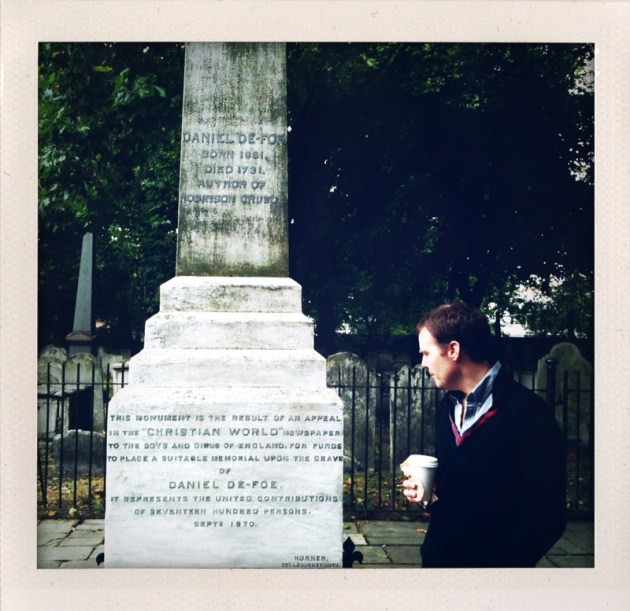
[Picture: Tom McCarthy and Daniel Defoe, Bunhill Fields, London, August 2010. By Andrew Gallix.]

Nothing At All

409692229_e75d124f7c_t

This review of Jean-Yves Jouannais’s Artistes sans oeuvres: I Would Prefer Not To appeared in the Times Literary Supplement dated 25 September 2009 (No 5556, p. 30):

Nothing At All

With his bovine-sounding surname, Félicien Marboeuf (1852-1924) seemed destined to cross paths with Flaubert. He was the inspiration for the character of Frédéric Moreau in L’Education sentimentale, which left him feeling like a figment of someone else’s imagination. In order to wrest control of his destiny, he resolved to become an author, but Marboeuf entertained such a lofty idea of literature that his works were to remain imaginary and thus a legend was born. Proust — who compared silent authors à la Marboeuf to dormant volcanoes — gushed that every single page he had chosen not to write was sheer perfection.

Or did he? One of the main reasons why Marboeuf never produced anything is that he never existed. Jean-Yves Jouannais planted this Borgesian prank at the heart of Artistes sans oeuvres when the book was first published in 1997. The character subsequently took on a life of his own, resurfacing as the subject of a recent group exhibition and, more famously, in Bartleby & Co., Enrique Vila-Matas’s exploration of the “literature of the No”. Here the Spanish author repays the debt he owes to Jouannais’s cult essay (which had been out of print until now) by prefacing this new edition.

Marboeuf has come to symbolize all the anonymous “Artists without works” past and present. Through him, Jouannais stigmatizes the careerists who churn out new material simply to reaffirm their status or iinflate their egos, as well as the publishers who flood the market with the “little narrative trinkets” they pass off as literature on the three-for-two tables of bookshops. In so doing, he delineates a rival tradition rooted in the opposition to the commodification of the arts that accompanied industrialization. A prime example is provided by the fin-de-siècle dandies who reacted to this phenomenon by producing nothing but gestures. More significantly, Walter Pater’s contention that experience — not “the fruit of experience” — was an end in itself, led to a redefinition of art as the very experience of life. A desire to turn one’s existence into poetry — as exemplified by Arthur Cravan, Jacques Vaché or Neal Cassady — would lie at the heart of all the major twentieth-century avant-gardes. “My art is that of living”, Marcel Duchamp famously declared, “Each second, each breath is a work which is inscribed nowhere, which is neither visual nor cerebral; it’s a sort of constant euphoria.”

Jouannais never makes the absurd claim that creating nothing is better than creating something: like Emil Cioran, he has little time for what he calls the “failure fundamentalists”. He does not dwell on the Keatsian notion (also found in Rousseau and Goethe) that unheard melodies are sweeter, or wonder why the attempts at a merger between life and art have so often resulted in death. Jouannais’s “Artists without works” are essentially of a sunny disposition. They are dilettantes, driven solely by their own enjoyment; cultural skivers who never feel that they owe it to posterity, let alone their public, to be productive. They let time do its work and are often militantly lazy — like Albert Cossery, the francophone writer of Egyptian origin who, on a good day, would fashion a single carefully crafted sentence, or the American artist Albert M. Fine who is quoted as saying: “If I did anything less it would cease to be art”. It is this divine indolence which differentiates Artistes sans oeuvres from darker essays on the subject.

Some of the most interesting passages in the book concern those larger-than-life figures (Félix Fénéon, Arthur Cravan, Jacques Vaché, Jacques Rigaut, Roberto Bazlen) who entered the literary pantheon as characters in other writers’ novels rather than through their own. Cravan, Vaché and Cassady — who embodied respectively the spirits of Dada, Surrealism and Beat — published virtually nothing during their lifetimes. Naturally, phantom works abound here, from Stendhal’s numerous unfinished novels to the unpublished manuscripts of the Brautigan Library (modelled on the library in Richard Brautigan’s The Abortion) through to Roland Barthes’s criticism, which provided him with the perfect excuse not to write the novel he dreamed of. Jouannais also considers summarizers such as Fénéon, whose “elliptical novels” were no longer than haiku, or Borges, who compiled synopses of fictitious novels so that no one would have to waste time writing or reading them. In fact, the Argentinian’s entire oeuvre — haunted as it is by the possibility of its own silence — is reinterpreted as a paradoxical “pre-emptive production” designed to spare the already overcrowded bookshelves of the Library of Babel. Borges’s Pierre Ménard (along with Bouvard, Pécuchet and Bartleby) is, of course, one of the patron saints of the copiers, another category surveyed in these pages. The destroyers (Virgil, Kafka, Bruno Schulz et al.) who seek to cover their aesthetic tracks only get a brief look-in, Jouannais being more interested in the long line of erasers starting with Man Ray’s 1924 “Lautgedicht” (an obliterated poem) and including such works as Robert Rauschenberg’s “Erased de Kooning Drawing”, Yves Klein’s infamous empty exhibition or Walter Ruttmann’s “blind” film. The author argues convincingly — in a style both eloquent and elegant — that Cravan’s proto-Dadaist provocations, Rigaut’s suicide or Brautigan’s notorious kitchen shoot-outs should be construed as poetic gestures in their own right. Deliberately misquoting Flaubert, he concludes that the works of these so-called “Artists without works” are “present everywhere and visible nowhere”, which may explain why they are so often misunderstood.

AIDS in French Culture

409692229_e75d124f7c_t

This review of David Caron‘s AIDS in French Culture: Social Ills, Literary Cures (University of Wisconsin Press, 2001) appeared in the inaugural issue of the Hyde Park Review of Books (winter 2002):

David Caron weaves literary criticism, cultural history and gay studies into a brilliant, sometimes dazzling, examination of “AIDS in French Culture.” The importance of his book is beyond doubt — given the extent of the AIDS pandemic in France — but one cannot help feeling that the whole is somehow less than the sum of its parts. Paradoxically enough, for one whose purpose is to dispel the preposterous idea that AIDS appeared to fulfill a purpose, Caron imposes an overarching, teleo(il)logical narrative thread upon what is essentially an episodic structure. Each chapter is a little island of Flaubertian self-containment in which the author introduces regular recaps and pointers to give a semblance of continuity or direction. As a result, the conclusion (where the author belatedly develops his ‘central’ thesis) seems tagged on to a collection of related articles. If the weaving is a little décousu, however, it is mainly because AIDS in French Culture is much more than just another polemical tract.

The author’s premise is that France’s inability to cope with AIDS in an effective manner has been largely due to intellectual muddle. He argues convincingly that the AIDS debate of the 1980s was couched in terms dating back to the Third Republic. The young regime’s blissfully optimistic religion of science was mirrored, in Jekyll and Hyde fashion, by a pathological fin-de-siècle fear of degeneration. Caron analyses skillfully how these forces of unreason were recast as rational discourse to absurd yet devastating effect. The newly-medicalized figure of the male homosexual became the first scapegoat of this “evil side of progress,” before the rise of an unprecedented wave of anti-Semitism.

In a catch-22 situation reminiscent of the mad, circular logic of Joe Orton’s psychiatrist in What the Butler Saw, homosexuals were accused of being both the cause and the consequence of national decadence. In short, they were guilty of being victims: “The homosexual found himself twice determined, and was held responsible for a disorder of which he was also an outcome.” The author tracks down such pseudoscientific postures or impostures from Zola’s attempt to model literature on a medical discourse which itself was “structured by metaphors” to the AIDS epidemic which was simultaneously explained through supposedly-meaningful metaphors and used as a trope “for the collapse of moral values.” Close reading is clearly Caron’s forte and his studies of Zola and Genet offer invaluable insights into the authors’ works. The chapter devoted to Hervé Guibert’s literary détournement of contamination — “the principle governing metaphors” — which enabled the novelist to reclaim infection “not only as a destructive but as a productive process” is a tour de force.

Above all, Caron counters the misconception according to which we are equal in front of the disease: “If, biologically speaking, anybody can get AIDS, not everybody will.” This “humanist cant” is prevalent in France where the “founding narrative of universal equality” has been applied to HIV “as if the virus were to abide by the ‘Declaration of the Rights of Man and the Citizen.'” By refusing to recognize the existence of a gay community, the “French model of republican integration” has been partly responsible for “the deaths of tens of thousands of people.” One can only hope that a French translation will follow shortly. As a form of public service.

516dztyzn3l_ss500_

Mad Anatomy

409692229_e75d124f7c_t

This very short review of Mad Anatomy (Del Sol Press), Kimberly Nichols‘s collection of short stories, was posted on the publisher’s website when the book came out in 2003:

Kimberly Nichols carves a razor-sharp crescent out of a plucked pregnant moon to adorn a dirty martini. Barefoot dances around cactus-skeleton plots like some snake-hipped offspring of Rimbaud and Huck Finn. Skinny dips in the swamp blues of tormented souls or in the tropical storm of conflicting emotions. Like all good American authors, Kim shows us the spiritual rooted in the elemental. Like all great American authors, she shows us that there is another America.

Fresh Out of Dope

409692229_e75d124f7c_t

This review of Tony O’Neill‘s Down and Out on Murder Mile appeared in the Times Literary Supplement dated 21 November 2008 (No 5512, p. 20):

Fresh Out of Dope

While suffering from withdrawal symptoms, a drug addict hits herself around the face with a book. Tony O’Neill does not tell us the title, but a copy of his new novel — in which this harrowing scene appears — would be appropriate. Down and Out on Murder Mile is the sequel to Digging the Vein (2006), the novel which established its young author as a figurehead of the “Offbeat” literary movement, alongside the more experimental Tom McCarthy. Unlike McCarthy, whose novels subvert the idea of authenticity, O’Neill belongs to the authentic school of writing as exemplified by Charles Bukowski and John Fante. To his admirers, he is a combination of Jack Kerouac and Neal Cassady (or André Breton and Jacques Vaché), a resolution in himself of the art/life dichotomy.

Although Down and Out on Murder Mile is subtitled “A novel” and described by its publisher as “semi-autobiographical fiction”, O’Neill makes no bones about how closely it is based on his own history so that one wonders what, if anything, is fictitious about it. In the acknowledgements, for instance, he thanks his “wife and muse” — whose name in fiction, as in fact, is Vanessa — because she does not object to his “airing [their] dirty laundry in public”. The first-person narrator remains anonymous throughout, making him indistinguishable from the author, and the systematic use of the past tense (except for dialogue) reinforces the biographical feel.

Far from being a simple memoir, however, Down and Out on Murder Mile is a deceptively literary work, one which chronicles its own genesis. When the protagonist describes the mental games he once played to provide himself with “a perfect excuse for a little hit”, he takes a dig at the glamorization of junkie writers: “Did William Burroughs sit around, worrying about taking dope? Or did he just do it and then write immortal books?”. At times, heroin stands for the magic potion found in the traditional love story; at others, it brings about the obligatory mating of Eros and Thanatos: the “unspoken agreement” that the junkie couple will “eventually die together”. The fairy-tale qualities of the narrator’s romance with Vanessa are striking, especially in the squalid circumstances in which it takes place. Contact is first made when he drunkenly speed-dials a number at random on someone else’s mobile phone. Vanessa falls for him when he is at his “lowest ebb”, his “worst point”, his “most destroyed, destitute and bankrupted”, and she sees through all that as if he were a prince in disguise. The fatal attraction of dope is depicted in the novel as the result of a childlike rejection of compromise and mediocrity: “I start to realize that the war on drugs is a war on beauty — a war on perfection, because everything is perfect on heroin”. Addiction is thus an attempt to give permanence to the “lightning crack of divinity” glimpsed at when shooting up. Epiphanies like these are better served by writing than by heroin; and this is the concealed theme of a novel ostensibly concerned with the day-to-day survival of an addict.

The opening sentence hits an almost comically low note: “The first time I met Susan she overdosed on a combination of Valium and Ecstasy at a friend’s birthday party at a Motel 6 on Hollywood Boulevard”. The two soon get married and live unhappily ever after until they relocate to Murder Mile in East London, where the narrator is saved in extremis by unconditional love. A late chapter, entitled “Adulthood”, closes in true coming-of-age fashion: “And I know now, I need to grow up”. This is indeed a Bildungsroman but it is also a Künstlerroman — a portrait of the artist as a young junkie. O’Neill never mentions his first novel, which he wrote while on the methadone programme described here, but its composition haunts the book like a character in search of an author.

3061739368_b78c354b49

On Joey Kowalski

409692229_e75d124f7c_t.jpg

In 2007, I wrote four entries for The Little Black Book of Books (Cassell Illustrated) edited by Lucy Daniel.

littleblackbook

Here is my entry on Joey Kowalski, the protagonist of Witold Gombrowicz‘s Ferdydurke (p. 270):

Key character: Joey Kowalski
Title: Ferdydurke
Date: 1937
Author: Witold Gombrowicz (1904 – 1969)
Nationality: Polish
Impact: Gombrowicz’s most famous character embodies the prescient idea that modernity is immaturity.

Joey Kowalski provides us with a thinly-disguised portrait of the author as a young man. In the opening pages, we are even told that he has written an unsuccessful book bearing the very same title as Gombrowicz’s 1933 debut. Although he is clearly the (anti-) hero and first-person narrator, one is reluctant to describe Kowalski as the protagonist because he is constantly acted upon. In the most famous passage, this amorphous thirty-year-old is visited by an eminent old professor who treats him like a kid before marching him off to school where — curiouser and curiouser — he fits in as naturally as a pupil half his age. Ferdydurke (1937) could be defined as a deformation, rather than a formation, novel.

If Kowalski embodies the notion (later popularised by Sartre) that identity is in the eye of the beholder, his own sense of immaturity reflects Poland’s cultural inferiority complex which itself symbolises the growing infantilism of society. Gombrowicz’s first novel is not only an existentialist masterpiece, it also chronicles the emergence of the “new Hedonism” Lord Henry had called for in Dorian Gray as well as the shifting human relations Virginia Woolf had observed in the early years of the twentieth century. Outwardly, we strive for completion, perfection and maturity; inwardly, we crave incompletion, imperfection and immaturity. The natural progression from immaturity to maturity (and death) is paralleled by a corresponding covert regression from maturity to immaturity. Mankind is suspended between divinity and puerility, torn between transcendence and pubescence. Through Joey Kowalski — as well as the schoolgirl and the farmhand — Gombrowicz was able to diagnose this tantalizing tryst with trivia which characterises the modern world.

On Notable American Women

409692229_e75d124f7c_t.jpg

In 2007, I wrote four entries for The Little Black Book of Books (Cassell Illustrated) edited by Lucy Daniel.

littleblackbook

Here is the full-length entry on Ben Marcus‘s Notable American Women which was abridged (p. 759).

Key Passage: introduction
Title: Notable American Women
Date: 2002
Author: Ben Marcus (1967 – )
Nationality: American
Impact: The book that sealed Ben Marcus’s reputation as one of the most singular voices in contemporary fiction.

Ben Marcus’s Notable American Women (2002) is a work of baffling originality which often reads like a user’s guide to some weird-but-wonderful contraption that does not exist. Ostensibly, it is a dystopian family drama set on a farm in deepest Ohio. Jane Marcus joins a feminist cult that aims to achieve total silence and stillness. As a result, her son (Ben) is subjected to the mother of all child-rearing experiments while her husband (Michael) is confined to a hole in the backyard.

Most of the action, however, takes place at a linguistic level. The figments of the author’s fertile imagination are couched in legalese and other technical terms culled from how-to handbooks or business manuals. Freed from its utilitarian raison d’être, this affectless — mock-unheroic — prose produces a jarring poetic note which sounds “like nothing at all” and conjures up the dream of a book that “would go without saying”.

One could argue that Notable American Women dramatises the tension between what goes “without saying” and what goes unsaid. The female Silentists’ decision to suppress their own voices is primarily a political act, but it is also reminiscent of the aesthetics of silence which — from Rimbaud’s agraphia to Cioran and beyond — has cast a shadow over contemporary literature. The first part of the novel is a “disclaimer” attributed to Michael that aims to “mute all that follows”. In a bid to pre-empt the symbolic killing of the paterfamilias (the author plays upon this Oedipal dimension by lending his own name to the protagonist), Michael discredits his son’s credentials as a writer and a human being. Ben, we are told, is ugly, weak, neurotic, retarded and — worse still — an unreliable narrator whose book he invites us to burn: “[H]ow can a single word from Ben Marcus’s rotten, filthy heart be trusted?” For good measure, he exploits the anxiety-of-influence motif by explaining that a father is “the first author” of his son’s work and that the latter’s voice is the product of “sheer ventriloquism”. The struggle to reassert authority which lies at the heart of these notes from underground could be construed as a deranged revenge — beyond the Barthesian grave — of the author over the scriptor.