Hazards of Time travel

“We Could Have Had a Haiku Instead of this Doorstop.” Review of Hazards of Time Travel by Joyce Carol Oates. The Irish Times, 22 December 2018, p. 136:

Joyce Carol Oates. Photograph: Jeremy Sutton-Hibbert/Getty Images

Can a character develop some degree of awareness — however dim — of the book it inhabits? This preposterous question wormed its way into my mind midway through Hazards of Time Travel, haunting me until the final page.

Joyce Carol Oates’s compendious new novel is set 20 years hence in a derivative dystopian world, replete with the habitual initialisms. The RNAS (Reconstituted North American States) is a one-party regime characterised by a rigid caste system based on 10 ST (Skin Tone) categories, permanent warfare conducted by proxy through “robot-missiles” and, of course, ubiquitous high-tech surveillance of the population. At school, where education is limited to the rote learning of undisputed facts — for example, the inferiority of the average female IQ — students “hold back” so as not to stand out by appearing too clever: “In a True Democracy all individuals are equal — no one is better than anyone else”.

Adriane Strohl, the 17-year-old narrator-protagonist, proves more equal than others and is made to suffer the consequences. Given that her scientist father was already an MI (Marked Individual) due to his association with an SI (Subversive Individual), his own brother, who was “deleted” by DDS (Domestic Drone Strike) — although it later transpires, for no obvious reason, that the execution did not take place — she should perhaps have known better. This, however, is the whole point. We are made to understand, by the third sentence, and then relentlessly throughout the rest of the book, that free will is both her tragic flaw and the mark of her humanity. To think that Oates could have produced a haiku instead of a doorstop!

For having the audacity to enquire what came “before the beginning of Time”, which in the RNAS refers to the “Great Terrorist Attacks of 9/11”, Adriane is charged with “Treason-Spech” and exiled in the past — a sentence that strangely provides an answer to the question for which she is punished. Her molecules are dissolved, teleported, and reconstituted in 1959, before her parents were even born. She is now Mary Ellen Enright, a freshman at Wainscotia University in Wisconsin. As an EI (Exiled Individual) she is not allowed to stray beyond a 10-mile radius from her “epicentre”, or reveal her status to anyone, on threat of instant deletion. Worse still, she is exiled from exile: a microchip planted in her head blocks out memories of her past life, which appear like “shadowy shapes” viewed through a “frosted glass window”. This raises one of the central questions in the novel — “What is a human being except the sum of her memories?” — and triggers an extended metaphor (the Nabokovian glass flowers; the “glassy eyes” of the stuffed animals in the Gothic museum scene) that expresses the totalitarian quality of transparency.

Located in Zone 9, an area which does not appear on any map back in the RNAS, Wainscotia — aka the “Happy Place” — provides ample opportunity for Life on Mars-style culture shocks. Scratch the idyllic surface, and you discover a more sinister world of rampant anti-Semitism and misogyny. Pacifists are hounded out of campus, female students aspire to be Stepford Wives and the university is a “hotbed of mediocrity”. The author, revisiting her own youth, evidently wants to show that the seeds of totalitarianism were sown in the 1950s, but Wainscotia seems so wholesome compared with NAS-23 that the strategy all but backfires.

The moral (human beings are not machines and it is always now) is sophomoric. The narrator’s cloying diary style and intemperate deployment of exclamation marks becomes grating after a while. Soliloquies masquerade as dialogue. The fussy descriptions of minor characters seem to come straight out of a middlebrow potboiler circa 1959. Embarrassing repetitions should have been edited out.

For all its flaws, Oates’s 46th novel is a page-turner, with cliffhanger chapter endings that may well have been written with Netflix in mind. Once Adriane and Ira Wolfman — the dashing assistant psychology professor with a fittingly Freudian name — have failed to flee, following a trail that loops back on itself (as in TV drama The Returned), the novelist loses her (Ariadne’s) thread and the plot begins to unravel.

When the heroine laments her inability to suspend disbelief at the cinema — “The actors were so obviously acting. The film was so obviously a film” — or dismisses the unconvincing “realistic” paintings hanging in the Fine Arts Building, she almost seems to sense that her exile in Wainscotia is but a metaphor for being trapped in this novel.

Male Order

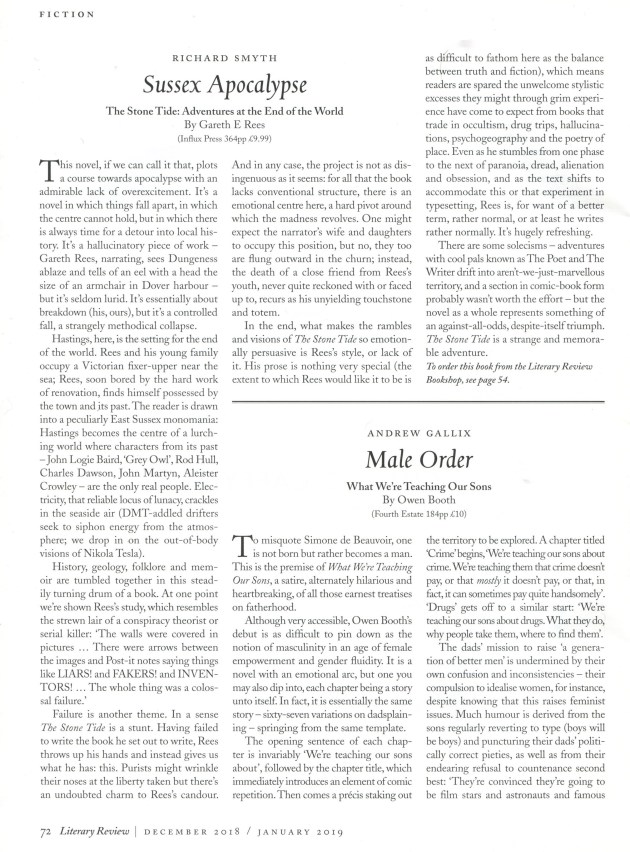
“Male Order.” Review of What We’re Teaching Our Children by Owen Booth. Literary Review, December 2018, pp. 72-73:

To misquote Simone de Beauvoir, one is not born but rather becomes a man. This is the premise of What We’re Teaching Our Sons, a satire, alternately hilarious and heartbreaking, of all those earnest treatises on fatherhood.

Although very accessible, Owen Booth’s debut is as difficult to pin down as the notion of masculinity in an age of female empowerment and gender fluidity. It is a novel with an emotional arc, but one you may also dip into, each chapter being a story unto itself. In fact, it is essentially the same story — sixty-seven variations on dadsplaining — springing from the same template.

The opening sentence of each chapter is invariably ‘We’re teaching our sons about’, followed by the chapter title, which immediately introduces an element of comic repetition. Then comes a précis staking out the territory to be explored. A chapter titled ‘Crime’ begins, ‘We’re teaching our sons about crime. We’re teaching them that crime doesn’t pay, or that mostly it doesn’t pay, or that, in fact, it can sometimes pay quite handsomely’. ‘Drugs’ gets off to a similar start: ‘We’re teaching our sons about drugs. What they do, why people take them, where to find them’.

The dads’ mission to raise ‘a generation of better men’ is undermined by their own confusion and inconsistencies — their compulsion to idealise women, for instance, despite knowing that this raises feminist issues. Much humour is derived from the sons regularly reverting to type (boys will be boys) and puncturing their dads’ politically correct pieties, as well as from their endearing refusal to countenance second best: ‘They’re convinced they’re going to be film stars and astronauts and famous comic book artists. They’re not interested in all the ways we managed to screw up our stupid lives.’

The sins-of-the-fathers trope is introduced early on, when the sons are taken to meet the ‘heartbroken men’. These sad relics from the past, with their beer guts, firearm fetishes and ’embarrassing’ penchants for military or superhero outfits, are prisoners of the patriarchal system they uphold: ‘The fathers of the heartbroken men loom large. Their hard-drinking, angry fathers. And their fathers and their fathers and their fathers before them.’ The grandfathers (to whom a later chapter is devoted) embody a less toxic masculinity, yet their stiff upper lips conceal a sense of loss so deep that it can only be assuaged by railway modelling on a Joycean scale. Having ‘survived wars and fifty-year marriages’, they are now holed up in their attics, where memories are stored away, obsessively reconstructing a childhood scene, right down to the diminutive figures of themselves as little boys, ‘searching desperately through the streets for their own silent, unknowable fathers’. The same formulation recurs in a chapter where, having failed to teach their sons about emotional literacy, the dads end up extolling the virtues of hobbies as a time-honoured means of keeping feelings bottled up. It was ever thus, they explain. This scene takes place on a miniature steam railway operated by middle-aged enthusiasts — ‘all men’ — whose reluctance to share their toy with the public (children in particular) inevitably leads to a confrontation and display of cockmanship.

As this comic tour de force testifies, Booth is a miniaturist. His meticulous craft bears more than a passing resemblance to that of his hobbyists, all those haunted men who seem to pour an excess of emotion into elaborate displacement activities. The novel’s repetitive format and collective narrative voice provide a safety net of impersonality, allowing the tenderest of moments to bloom in the nooks and crannies of its vignettes. In the changing rooms at the swimming pool, for instance, the dads — feeling ‘the terrible responsibility of lost socks, and impending colds’ — try not to contemplate ‘all the upcoming catastrophes’ they will never be able to shield their sons from. In another tale of innocence and experience, the dads tell their lads about the nights they were born, before evoking what was deliberately left unsaid: ‘These are not things we talk about, not even to each other. Especially not to each other. We’re terrified that if we started we wouldn’t know how to stop.’

Cosmic Knitting

My review of Dream Machines by Steven Connor. The Times Literary Supplement, 12 October 2018, p. 29.

Dream Machines is an exercise in technography — an exercise, that is, in what Steven Connor defines as any kind of writing about technology that draws attention to the workings of its own machinery. Writing itself may be thought of as a kind of technology — a “mechanisation of speech”, as Connor puts it — and technology in turn may be thought of, perhaps less obviously, as writing. Demonstrating the latter, more counter-intuitive proposition is the main purpose of this ground-breaking book.

For Connor, a professor of English at the University of Cambridge, all machines could stand as “preliminary sketches” towards an absolute machine: one that would align perfectly with the process of thinking itself. Examples abound, in both fact or fiction, of schemes for machines whose nuts and bolts evanesce into sheer fancy. Marie Corelli conjures up contraptions in her Romance of Two Worlds (1886) that are really avatars of “the most powerful machinery of all, that of fantasy or the thing that makes fantasy actual and able to work on the world, writing”. In 1919 the psychoanalyst Viktor Tausk published an article on the elaborate imaginary apparatus his schizophrenic patients claimed to be persecuted by: this “Influencing Machine” is, likewise, but “an allegory of the machine of writing that sums and summons it up”. If the “orgone box” — an “accumulator” of “orgone energy” dreamt up by Wilhelm Reich in the 1930s and realized some years later by a student of his — produced any pleasure at all, it was through the wish fulfilment of seeing reality “entirely subjugated to imagination”.

It is this visionary component in all technology — the ghost in every machine  — that Connor attempts to isolate by focusing on deficient or, better still, impossible devices. The perfect machine, he suggests, may well be one that, in always going wrong at some stage, is “endlessly perfectible”: planned obsolescence as ontological necessity. This is a notion best exemplified by the “Ultimate Machine” invented by Claude Shannon, following the examples of Bruno Munari and Marvin Minsky. A small box with a single switch, its sole purpose is to “fail to be what it is”: it is a machine with no purpose other than to turn itself off (which it does via a “hand” that emerges, flips the switch and then “immediately retreats into the box”). Perpetual motion mechanisms, to which Connor  devotes a fascinating final chapter, do something similar not not only out of design but necessity (i.e., the laws of thermodynamics). And then there are Michel Carrouges’s drawings of machines célibataires — wondrous yet useless affairs, “whose function is not to work, but to elaborate non-function” — as well as Novalis’s disquieting vision of a “mill grinding itself” or Joseph Conrad’s nightmarish cosmic knitting machine (in a letter from 1897: “It knits us in and it knits us out”), two haunting images that recur throughout the book.

Machines that can only exist in potentia, and preferably on paper, are Connor’s beau idéal. “‘Imaginary’ work makes us work at imagining the work of imagining”, as he puts it in one of his typically recursive aphorisms. He observes how dreams have a propensity to conjure up machines that, in turn, reflect “the machinery of the act of dreaming itself”. This mise en abyme is critical: machines “mediate us to ourselves”, and hence the author’s definition of technology as “the self’s manner of writing, or making itself known to itself”. Connor speculates that Henry James found the sound of his secretary’s typewriter so soothing because it evoked the smooth operation of his imagination, which would have been disrupted had he focused on it directly.

Steven Connor also observes how medical machines are endowed with symbolic value, functioning as “visible allegories” for the body, its workings envisaged as mechanisms of some kind. This mediatory role of all technology is threatened, however, by the advances of miniaturization and dematerialization, processes which render their machine components increasingly invisible. All machines are dream machines, it turns out, not only because they are of necessity bound up with human affect and fancy (humankind is “Homo mechanicus”), but also because their condition, today, is “essentially to-be-imagined”.

The brilliant dialectical turn of mind on show throughout this book runs the risk of becoming a stylistic tic, as though the kinetic were developing its own momentum, hijacking the author’s rhetoric. The “force of fantasy” morphs, with machine-like predictability, into the “fantasy of force”; the “work of dreaming” into the “dream of working”; the “narrated machinery” into the “machinery of narration”; the “negation of the machine” into the “machinery of negation”; and so on. At times Dream Machines almost seems to be writing itself. And this is, after all, quite fitting.


A Bird’s Eye View On Destroying the World to Save It

My review of The End of the End of the Earth by C.D. Rose. The Irish Times, 8 December 2018, p. 28.

A Bird’s Eye View On Destroting the World to Save It

Jonathan Franzen’s description of himself as “someone who cares more about birds than the next man” sounds innocent enough. Endearing, even. It is rather more controversial, however, when construed as a rabbit-duck illusion. Is the “Great American Novelist” — to quote a famous Time cover headline — simply a passionate, albeit obsessive, ornithologist? Or does he actually prefer birds to fellow human beings? This question lies at the heart of The End of the End of the Earth, his third non-fiction collection, in which he sets out to use the essay as a vehicle for “honest self-examination and sustained engagement with ideas”.

If, as F. Scott Fitzgerald wrote, the “test of a first-rate intelligence is the ability to hold two opposing ideas in the mind at the same time, and still retain the ability to function”, then Franzen has passed with flying colours. Alongside longer birdwatching travelogues, there are pieces on photography, technology, short-termism, Manhattan in the early Eighties, and of course literature (his “Ten Rules for the Novelist” have already earned him a great deal of online ribbing).

Franzen is “miserably conflicted” about climate change. On the one hand, he is convinced that it is the greatest challenge facing humanity, but on the other, he feels “bullied by its dominance” in environmental circles, where it has become a dogma that precludes any nuanced discussion.

In particular, he takes the National Audubon Society to task for jumping on the bandwagon, by claiming that global warming today is the “number-one threat” to birds in North America. In fact, he explains, not a single bird death can be “definitively” ascribed to this phenomenon right now unlike, say, wind farms. This leads him to wonder if we are not “destroying the natural world in order to save it”. It also prompts a great deal of soul-searching, as he grapples with feelings of guilt over “caring more about birds in the present” than people in the future. This notion that he is somehow deficient in “brotherly love” recurs throughout the book, although it is amply disproved by the warmth and tenderness with which he evokes his friend, the writer Bill Vollmann, or his gregarious late uncle Walt.

The simplistic message of global warming can be conveniently conveyed “in fewer than a hundred and forty characters” as opposed to the more complex — “novelistic” — narrative of wildlife conservation favoured by the author. Climate change has the added advantage of being a problem “with a human face”, one that is everybody’s fault and therefore nobody’s, hence its appeal to our narcissism both as a species and as individuals. More crucially still, it provides us with a ready-made belief system, New England Puritanism 2.0: “Unless we repent and mend our ways, we’ll all be sinners in the hands of an angry Earth”. At the latest reckoning, we have ten years left before Judgement Day, but in a decade — when we fail to meet our latest carbon-emission targets — the goalposts will be moved again. The end is never nigh enough.

Eschewing eschatology, Franzen outlines an alternative approach to environmentalism based on “loving what’s concrete and vulnerable and right in front of us”. He calls it “Franciscan” — after Saint Fancis of Assisi, that other bird lover — but Emersonian would do just as well. Instead of focusing on a hypothetical future, he seeks to reconnect, here and now, with a past in which nature was still untainted by human intervention. Being the “most vivid and widespread representatives of the Earth as it was before people arrived on it”, birds allow us to take flight momentarily from the Anthropocene. That house finch outside our window is, he reminds us, “a tiny and beautifully adapted living dinosaur”. Birds’ flight paths “bind the planet together”, offering a tantalising glimpse of a totalising worldview. “If you could see every bird in the world, you’d see the whole world,” writes Franzen, fully aware that bird-watching (or “birding” in American parlance) is predicated on its own failure (which does not prevent him from being a compulsive “lister”).

The author’s avian passion remains unrequited, and this is as it should be. Birds’ indifference to us serves as “a chastening reminder that we’re not the measure of all things”. Though they defecate on us from a great height, birds could not give a shit about human beings, and this is also how it should be. After all, it is “we, not they, who need life to have a meaning”.

Flogging a Dead Clothes Horse

Gallix, Andrew. “Flogging a Dead Clothes Horse.” Interview by Thom Cuell. Minor Literature[s], 14 September 2018:

Punk is Dead: Modernity Killed Every Night is a wide-ranging collection of writing on punk, taking in memoir and theory, and examining the subject as a social movement, musical genre, artistic project, philosophy and political statement. Here, co-editor Andrew Gallix discusses the project, alongside his own experiences of Punk, and its impact on his later career.

In your own intro, you talk about punk being, of all youth movements, the most resistant to academic analysis (although, god knows, plenty of academics have tried to analyse it). Why is this? And what can we learn from the sheer number of books which have attempted to make this analysis?

Punk was a product of the failure of the counterculture and the advent of the tax-exile rock dinosaurs, who had become too remote — socially, musically and culturally — from their audience. So the whole issue of ‘selling out’ was high on the agenda, right from the start. Take Mark Perry, who decreed that punk died on the day The Clash signed to a major label (CBS) in January 1977. In the book, I argue that all the splinter groups that sprang from the original scene — Oi!, Two-Tone, the mod revival, the New Romantics, goth, anarcho-punk, etc. — were essentially attempts to recapture punk’s original spirit, untainted by compromise and commercialism.

No other youth cult had ever been so conscious of itself as a youth cult, and of its place in rock history. Sure, punk was a new beginning — Year Zero, and all that — but it was also a summation of the subcultures which had preceded it, and one of the traits it inherited was that quintessentially adolescent contrarian streak best expressed by Alan Sillitoe’s rebel without a cause, Arthur Seaton, in Saturday Night and Sunday Morning (1958): “Whatever people say I am, that’s what I’m not”. Punk’s juxtaposition of contradictory signifiers — the swastika, say, and the hammer and sickle — was, in part, a means of ensuring that the straight adult world would not get it. Not that that was very likely, of course: the mainstream media did not have a clue what was going on. We forget just how wide the generation gap was in those days. The rush hour, in London, was a sea of men in pinstripe suits and bowler hats. Today, many of those people would have hipster beards and tattoos. (One of the unfortunate, unintended consequences of punk is that it largely killed off the generation gap — at least in pop cultural terms.)

There are, of course, other factors. Punk’s (frequently feigned) anti-intellectualism, which would lead some fanzine writers to add spelling mistakes to their articles, or the (at the time largely subterranean) influence of Situationism, which was obsessed with “recuperation”.

When they were not by insiders (Julie Burchill and Tony Parsons’ The Boy Looked at Johnny: The Obituary of Rock and Roll, 1978) or fellow-travellers (Caroline Coon’s 1988: The New Wave Punk Rock Explosion, 1977), early punk books were either mainly collections of photographs (Val Hennessy’s In the Gutter, 1978; Isabelle Anscombe’s Not Another Punk Book, 1978) or compendia of fanzine extracts (Julie Davis’s Punk, 1977). Punk, I think, succeeded in making any external discourse sound naff and illegitimate. Even Dick Hebdige’s Subculture: The Meaning of Style (1979) felt artificial, a bit earnest and fuddy-duddy: the work of a student. You have to wait until the late 80s / early 90s — when the original punk movement was effectively dead — to see the first thoughtful analyses appear (Greil Marcus’s Lipstick Traces in 1989 and Jon Savage’s England’s Dreaming in 1991).

What can we infer from the large number of books devoted to this subject? How incredibly rich such a short-lived movement was. There is a school of thought that sees punk as a simulacrum of Situationism, with the latter being the real McCoy. I beg to differ. I think punk’s strength was due to the fact that most of its practitioners had no idea where the references came from, so that ideas or gestures derived from Symbolism, Dada, Futurism, Surrealism or Situationism were embodied — lived out. Once the movement had died, all that background material needed to be unravelled, which is why of making many punk books there is no end.

Then there’s the fact that punk has never been out-punked — it has become a byword for ultimate rebellion. My contention is that it was also the last real avant-garde artistic movement of the 20th century.

Tell us a little about your own experiences of punk, and how that has impacted on your approach to culture.

I often say that punk had the same cultural impact on me as Surrealism or May 68 on earlier generations. I was 11 in 1976, when I first got into punk, so for me it’s also bound up with childhood memories, and growing up. It offered me a haven at a time when I was deeply unhappy. All of a sudden, I realised that there were others like me out there. It informs everything I do in some way or other.

Again, in your introduction, punk seems almost intangible — it’s hard to say when it coalesced, and when it began to shift into something more regimented. What approximate timespan do you set for the punk movement you discuss in your book, and events you use to pinpoint those moments?

Punk’s influence remains huge, and there are, of course, punk bands all over the world. Forming a punk band is almost a rite of passage for American teenagers. I know that some young people resent the title of my book. However, I’m not saying that you can’t be a punk today — my point is simply that the original British punk scene was very much a product of its socio-economic, political and artistic context. Walking around London with red hair in 1977 and in 2018 are two completely different experiences. The glory days were obviously 76-77 — how long you make it last beyond that is a question of opinion. The first punks are usually those for whom it ended earliest — with the 100 Club festival, say, the Bill Grundy affair or the Silver Jubilee. In a way, the whole history of punk, at least through 1981, has been one of newcomers denying that the phenomenon was dead, and reviving it. It’s interesting how the primal energy of tracks like “New Rose” or “White Riot” seems to be replicated in dozens of debut singles. As soon as a band can no longer sustain that level of energy or has become too sophisticated musically, the baton is passed on to the latest gang in town.

For me, it lasted 10 years. By 1986, I had to draw the conclusion that it was over and that I had very little in common with those who still described themselves as punks.

Punk is Dead blends theoretical work with personal recollections from fans and musicians and contemporary texts from fanzines and the music press — what effect were you hoping to create by bringing these three approaches to punk together?

To give a more nuanced idea of what punk was really like when it was still in the process of becoming. Once it had become what it was, it was dead. If a kid discovers Never Mind the Bollocks today, he or she will not have the same experience as someone who bought every single when it came out, lived through all the controversies, remembers when Boots and Smith’s wouldn’t even mention “God Save the Queen” in their charts, couldn’t see the band live, waited for what seemed like an eternity for the album to come out…

In Clinton Heylin’s Punk in the Year Zero (2016), attendees at early punk gigs talk about the visual presentation of the bands and their fans as much as, if not more than, the music they heard — presenting the Sex Pistols as a performance art group almost as much as a musical one. Is it this semiotic richness which sets punk aside from other movements, and gives it its unique character?

As you suggest, the performance art was produced by the band in conjunction with the audience. Breaking down the fourth wall was such an important part of the phenomenon. Punk was an artwork you could inhabit — it came close to abolishing the distinction between art and life, which had been the dream of all the avant-garde movements of the 20th century. It really was a revolution of everyday life.

You, and many of the contributors to Punk is Dead, are concerned with punk as a Gesamtkunstwerk, or all-embracing art form. Is that something you put down to the influence of Svengali-like figures such as Malcolm McLaren, or a broader impact of the culture which punk grew out of?

Both. McLaren was eager to create a scene around the Pistols that was partly modelled on Warhol’s Factory. In hindsight, it’s obvious that it wasn’t just about the bands, but also about the clothes, the fanzines, graphic design, the politics, the indie record labels. You’ve got to see the whole picture. That’s the artwork.

In your essays ‘Sexy Eiffel Towers’, and ‘Unheard Melodies’, you argue that some of the greatest punk bands never made any music at all, whether that is the punk-art interventions of Bazooka Productions, or the largely conceptual band L.U.V. If the music of punk is almost able to take a back seat to other aspects, which strand of punk has ultimately produced the greatest legacy?

That’s a tough question. All I can say is that many, if not most, of the early converts — Devoto and Shelley (Buzzcocks), T.V. Smith (The Adverts), Pauline Murray (Penetration) et al. — had read Neil Spencer’s first live review of the Pistols. They fell in love with the Romantic notion of a band that was into chaos rather than music. The same could be said about the CBGB scene: the future British punks were reading about bands like Television without really knowing what they sounded like. They had to dream their music into existence. The importance of the British music press in all this still hasn’t been adequately documented.

What was the most surprising thing about working on this anthology? Did you find yourself reconsidering any of your views on punk, or discovering anything you’d overlooked?

It reinforced my intuition that rock music lost its ‘telos’ after punk. Punk was a new departure, but also a summation of rock history and perhaps its end point. Everything that has happened since has been a kind of coda or postscript to that rock narrative that started in the mid-50s.

I was shocked by how exploitative and two-faced some ageing punks turned out to be. The kind of privileged popinjays who hide their lack of substance behind a puerile obsession with style, kidding themselves that they’re artists or anarchists while living off their inherited wealth. At times, working on this book felt like flogging a dead clothes horse.

It’s tempting to take the Zhou Enlai approach and say ‘too soon to tell’, but — what do you see as the lasting influence of punk?

Its influence is so all-pervasive that you no longer notice it. It’s important to remember that punk, at the time, was very much a minority interest. Almost everybody hated it. Now, all the influential people in the arts and media acknowledge its significance. It’s an extraordinary reversal of fortune.

Finally, Joe Strummer apparently threatened to beat Greil Marcus up for titling his anthology of punk writing In The Fascist Bathroom. Do you expect any similar responses from punk legends to anything in your book?

No, they’d be afraid of getting creases in their clothes.

In the book I describe Strummer as the Citizen Smith of punk — which he was, although that doesn’t mean he wasn’t very sincere and talented. I met him on two occasions. The last time he bought me a pint. Can’t say fairer than that.


Dream Machines (Teaser)

My review of Steven Connor‘s Dream Machines appears in this week’s Times Literary Supplement.

Here’s a little teaser:

Dream Machines is an exercise in technography — an exercise, that is, in what Steven Connor defines as any kind of writing about technology that draws attention to the workings of its own machinery. Writing itself may be thought of as a kind of technology — a “mechanisation of speech”, as Connor puts it — and technology in turn may be thought of, perhaps less obviously, as writing. Dem­onstrating the latter, more counterintuitive proposition is the main purpose of this ground-breaking book.

For Connor, a professor of English at the University of Cambridge, all machines could stand as “preliminary sketches” towards an absolute machine: one that would align perfectly with the process of thinking itself. Examples abound, in both fact or fiction, of schemes for machines whose nuts and bolts evanesce into sheer fancy. Marie Corelli conjures up contraptions in her Romance of Two Worlds (1886) that are really…

Who’s Who When Everyone is Someone Else

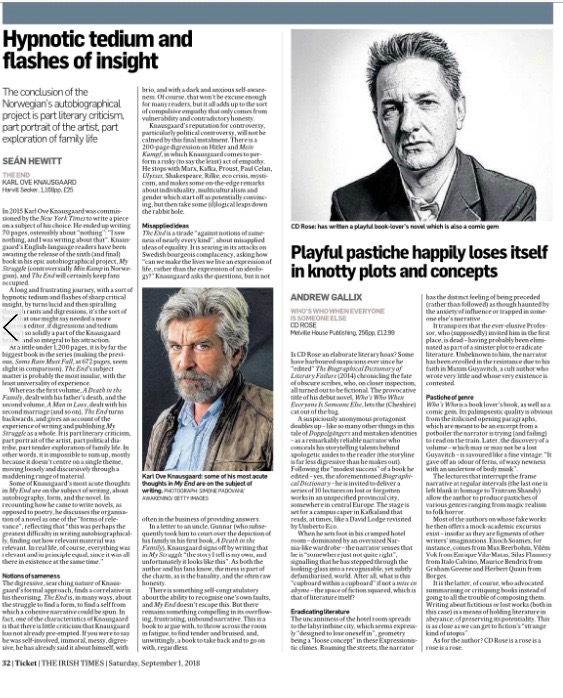
My review of Who’s Who When Everyone is Someone Else by C.D. Rose. The Irish Times, 1 September 2018, p. 32.

Is C.D. Rose an elaborate literary hoax? Some have harboured suspicions ever since he “edited” The Biographical Dictionary of Literary Failure (2014) chronicling the fate of obscure scribes, who, on closer inspection, all turned out to be fictional. The provocative title of his debut novel, Who’s Who When Everyone is Someone Else, lets the (Cheshire) cat out of the bag.

A suspiciously anonymous protagonist doubles up — like so many other things in this tale of doppelgängers and mistaken identities — as a remarkably reliable narrator who conceals his storytelling talents behind apologetic asides to the reader (the storyline is far less digressive than he makes out). Following the “modest success” of a book he edited — yes, the aforementioned Biographical Dictionary — he is invited to deliver a series of 10 lectures on lost or forgotten works in an unspecified provincial city, somewhere in central Europe. The stage is set for a campus caper in Kafkaland that reads, at times, like a David Lodge revisited by Umberto Eco.

When he sets foot in his cramped hotel room — dominated by an oversized Narnia-like wardrobe — the narrator senses that he is “somewhere just not quite right”, signalling that he has stepped through the looking-glass into a recognisable, yet subtly defamiliarised, world. After all, what is this “cupboard within a cupboard” if not a mise en abyme — the space of fiction squared, which is that of literature itself?

The uncanniness of the hotel room spreads to the labyrinthine city, which seems expressly “designed to lose oneself in”, geometry being a “loose concept” in these Expressionistic climes. Roaming the streets, the narrator has the distinct feeling of being preceded (rather than followed) as though haunted by the anxiety of influence or trapped in someone else’s narrative. It transpires that the ever-elusive Professor, who (supposedly) invited him in the first place, is dead — having probably been eliminated as part of a sinister plot to eradicate literature. Unbeknown to him, the narrator has been enrolled in the resistance due to his faith in Maxim Guyavitch, a cult author who wrote very little and whose very existence is contested.

Who’s Who is a book lover’s book, as well as a comic gem. Its palimpsestic quality is obvious from the italicised opening paragraphs, which are meant to be an excerpt from a potboiler the narrator is trying (and failing) to read on the train. Later, the discovery of a volume — which may or may not be a lost Guyavitch — is savoured like a fine vintage: “It gave off an odour of ferns, of waxy newness with an undertow of body musk”. The lectures that interrupt the frame narrative at regular intervals (the last one is left blank in homage to Tristram Shandy) allow the author to produce pastiches of various genres ranging from magic realism to folk horror. Most of the authors on whose fake works he then offers a mock-academic excursus exist — insofar as they are figments of other writers’ imaginations. Enoch Soames, for instance, comes from Max Beerbohm, Vilém Vok from Enrique Vila-Matas, Silas Flannery from Italo Calvino, Maurice Bendrix from Graham Greene and Herbert Quain from Borges.

It is the latter, of course, who advocated summarising or critiquing books instead of going to all the trouble of composing them. Writing about fictitious or lost works (both in this case) is a means of holding literature in abeyance; of preserving its potentiality. This is as close as we can get to fiction’s “strange kind of utopia”.

As for the author? C.D. Rose is a rose is a rose is a rose.

The Story of “The Face”

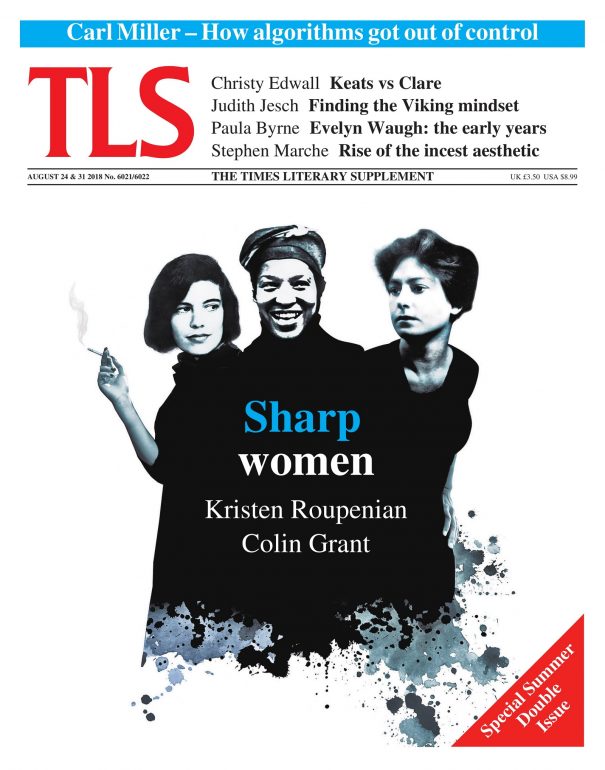
My review of The Story of “The Face”: The Magazine That Changed Culture by Paul Gorman. The Times Literary Supplement, 24 & 31 August 2018, p. 43.

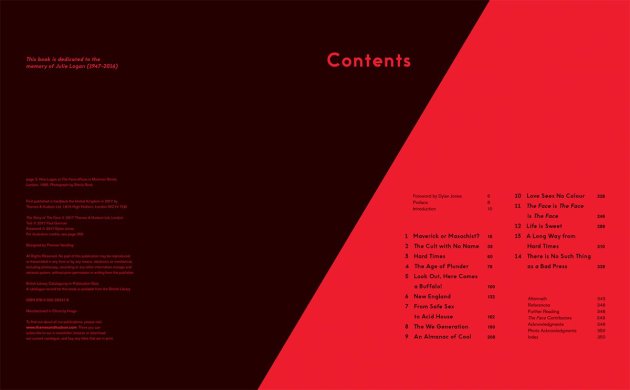
Paul Gorman’s The Story of “The Face” charts the rise and fall of the original style magazine, from its launch, on a shoestring, in 1980, to 1999, when it was sold off by its founder to a publishing giant. Nick Logan’s monthly would only survive five more years in the brave new digital world it had foreshadowed with its kaleidoscopic cultural coverage. Right from the start, The Face proved a victim of its own success. Having identified style as the prism through which to observe the zeitgeist — thereby eliding the distinction between men and women’s magazines — it soon spawned a host of imitators, not least among the Sunday supplements. At one stage, art director Neville Brody was producing a brand new typeface for every issue, in a frenetic bid to remain one step beyond.

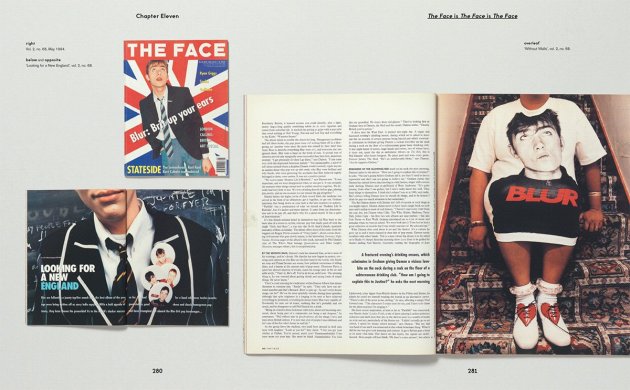
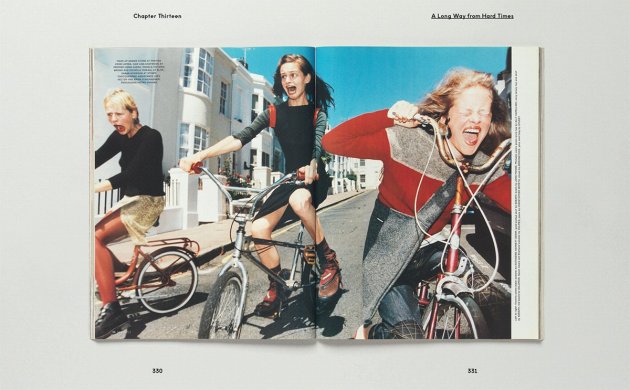
This coffee-table book, with its hundreds of lavishly reproduced covers and innovative page layouts, does full justice to the “world’s best-dressed magazine”. Flicking through it, one witnesses The Face’s visual identity gradually shifting away from radical graphic design towards slick era-defining photography. The Story of The Face is a paean to its founder who, the author contends, has been airbrushed out of history. Logan’s fascination with the intersection between pop music and street style was rooted in his days as a young mod in the 1960s, which the title of his prime publication would allude to (a face being a top mod). After working for the local press, he graduated to the New Musical Express where he became editor at the age of twenty-six, in 1973, presiding over what was arguably the paper’s most important period. He left, following a breakdown, subsequently launching the hugely successful Smash Hits aimed at the post-punk teenybopper market.

The Face was ahead of its time, but also very much of it. The inaugural issue was even delayed by a printers’ strike. Although he knew that the Two Tone phenomenon had already peaked, Logan insisted on putting a picture of The Specials’ Jerry Dammers on the cover as the band typified the marriage of street style and popular music he intended to explore. In a landmark piece published a couple of years later, Robert Elms observed that youth culture now represented “not a rebellion but a tradition” — one, he may have sensed, that was drawing to a close. The days of the austerity dandies who, devoid of job or future, fashioned themselves into extravagant works of art, were numbered. Never again would style have so much substance. The Face chronicled the end of an era as much as it ushered in a new one, endowing its early strapline — “rock’s final frontier” — with a presciently valedictory tone.


The Story of “The Face” (excerpt)

My short review of Paul Gorman‘s excellent The Story of “The Face”: The Magazine That Changed Culture features in the latest issue of The Times Literary Supplement, 24 & 31 August 2018, p. 43.

Here’s an extract:

. . . The Face was ahead of its time, but also very much of it. The inaugural issue was even delayed by a printers’ strike. Although he knew that the Two Tone phenomenon had already peaked, Logan insisted on putting a picture of The Specials’ Jerry Dammers on the cover as the band typified the marriage of street style and popular music he intended to explore. In a landmark piece published a couple of years later, Robert Elms observed that youth culture now represented “not a rebellion but a tradition” — one, he may have sensed, that was drawing to a close. The days of the austerity dandies who, devoid of job or future, fashioned themselves into extravagant works of art, were numbered. Never again would style have so much substance. The Face chronicled the end of an era as much as it ushered in a new one, endowing its early strapline — “rock’s final frontier” — with a presciently valedictory tone.

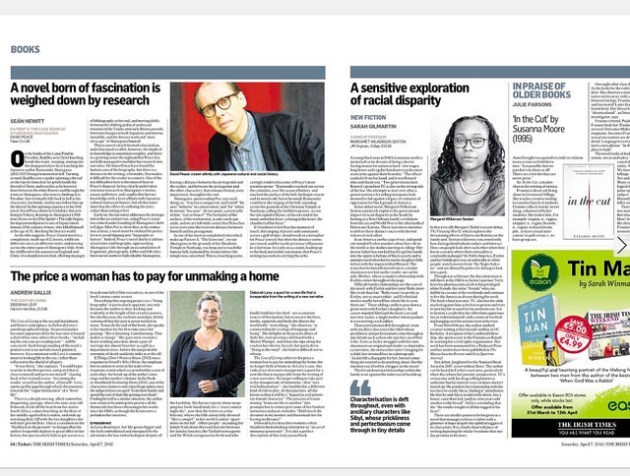
The Cost of Living

This review of Deborah Levy’s The Cost of Living appeared in the Irish Times on 7 April 2018, p. 34:

The Price a Woman Has to Pay For Unmaking a Home

The Cost of Living is the second instalment, and future centrepiece, in Deborah Levy’s autobiographical trilogy. Its pivotal nature becomes apparent when the narrator is loaned a shed of her own, where three books — “including the one you are reading now” — will be conceived. Such foregrounding of the work’s primal scene is no metafictional gimmick, however. It is consonant with Levy’s commitment to looking life in the eye, rather than reflected in the shield of allegory.

“It was there,” she explains, “I would begin to write in the first person, using an I that is close to myself and yet is not myself”. Gazing back at her textual avatar – becoming the reader, as well as the author, of herself – Levy opens up this gap through which she journeys towards the “vague destination” of a “freer life”.

There is a deeply moving, albeit somewhat disquieting, passage, where the nine-year-old Deborah, fresh off the boat from her native South Africa, comes knocking on the door of her middle-aged self in London, and ends up watching Bake Off with the two daughters she will later give birth to. This is a variation on the “flashback in the present” technique that the author frequently deploys to great effect in her fiction, but spectacularly fails to get across to a boardroom full of film executives, in one of the book’s many comic scenes.

Describing this ongoing project as a “living biography” is particularly apposite, not only because the author is alive, kicking and evidently at the height of her creative powers, but also because she eschews nostalgia, firmly convinced that the past is never written in stone. Towards the end of the book, she speaks to her mother for the first time since her passing: “She is listening. I am listening. That makes a change”. She goes on to recount a heart-rending anecdote about a pair of earrings she almost buys her as a gift in a department store, before the unspeakable enormity of death suddenly sinks in at the till.

If Things I Don’t Want to Know (2013) was a response to Orwell’s Why I Write, the emphasis here is on how to write in the wake of two traumatic events which occurred within a year of each other: the break-up of the author’s marriage and her mother’s demise. In the Booker-shortlisted Swimming Home (2011), one of the characters claims to only enjoy biographies once the subjects have escaped “from their family and spend the rest of their life getting over them”. Finding herself in a similar situation, the author now seems to be putting into practice all the themes she has been rehearsing in her works since the 1980s, as though the fiction were a prelude to her vita nova.

As Levy downsizes, her life grows bigger and she feels emboldened and energised by the adventure she has embarked upon despite all the hardship. She has no regrets about swapping her book-lined study for a “starry winter night sky”, now that she writes on a tiny balcony, where she falls asleep fully dressed “like a cowgirl”, in her north London “apartment on the hill”. Other people – including the family from down the road that she borrows for Sunday lunches, the Turkish newsagents and the Welsh octogenarian firebrand who kindly lends her the shed – are a constant source of fascination, but so too are the bees, moths, squirrels and birds she shares the world with: “everything,” she observes, “is connected in the ecology of language and living”. She delights in the practicalities of daily life, even proving a dab hand with a Master Plunger, and when she zips along the road on her electric bicycle, her party dress “flying in the wind”, she finds it difficult not to whoop.

The Cost of Living refers to the price a woman has to pay for unmaking the home she no longer feels at home in. In Levy’s case, this radical act of erasure inaugurates a quest for a new life that is inseparable from the writing of a new narrative. No longer willing to take part in the masquerade of femininity – that “societal hallucination” – she fumbles for a different kind of role to play. At this juncture, all she knows is that it will be a “major [as yet] unwritten female character”. The process of transitioning “from one life to another” also prompts her to reinterpret some of her fondest memories and past attitudes: “Did I mock the dreamer in my mother and then insult her for having no dreams?”

Deborah Levy describes women’s often thankless homemaking enterprise as “an act of immense generosity”. It is also a perfect description of this truly joyous book.