Purposely with Ghosts

Tom Bradley, Rev. of Apparitional Experience, 3:AM Magazine 6 March 2013

Fiddleblack Annual #1: Apparitional Experience, Fiddleblack Press 2013

This is a collection of ghost stories “purposely without ghosts”. The epigraph, from On the Road, serves to announce the emphatic Americanness of the contents. Like Kerouac with his continuous roll of typing paper, most of the authors herein have opted for the unadorned style, which has its roots in that country’s Puritan past. The collection satisfies eminently one’s appetite for such work. There are few or no ghosts of the literary sort haunting the first hundred or so pages of this book.

And then, all of a sudden, in the last story, up springs a manifestation that couldn’t be more unAmerican, in the best of all the good senses of that near-universally approbative adjective. It’s Andrew Gallix, and he is purposely with ghosts.

His story, “Fifty Shades of Grey Matter”, displays all the anti-Puritannical virtuosity, erudition, urbanity and sensory luxuriousness that have been established as his trademarks in such works as “Dr Martens’ Bouncing Souls“, “Celesteville’s Burning“, “Half-Hearted Confessions of a Gelignite Dolly-Bird” and “Forty Tiddly Winks“. Andrew Gallix stands out, not only in this book, but on the literary scene at large, as a major exponent of literary sophistication, both syntactical and philosophical.

When he goes On the Road (in his case, that would be the rue Victor Cousin, on his way to teach at one of the world’s oldest universities), Andrew Gallix treads in the astral traces of such unabashed eschewers of the unadorned style as Aquinas, Erasmus, Saint Francis Xavier, Balzac, Saisset, Victor Hugo, de Beauvoir, Teilhard de Chardin, Barthes, Deleuze, Ricoeur, et al. It stands to reason that he’s not obsessed with counting and banishing modifiers and flagellating subordinate clauses down to the bare declarative bones. He knows nothing of the retentive rules of deportment laid down by creative writing programs in the country that invented those institutions.

“Joycean” has been whored out as an adjective for so long, especially by Americans, that it lost meaning two generations ago. But if the term could be resurrected and shriven, it would apply to “Fifty Shades of Grey Matter” better than any fiction I’ve read in years. Andrew Gallix has done precisely what the stream of consciousness demands — and I don’t mean the long-hackneyed literary device, but the complex phenomenological proposition. Every sentence, every phrase, depicts and serves the multiple functions of human awareness, all at once, without discontinuity. The lush descriptions are delivered in a voice that delineates its own quirky persona and those around it, while moving the plot along, expanding upon thematic material, and being hilarious in the bargain.

This complexity can only be achieved by a writer who has at his fingertips all the resources of a longstanding culture, the full vocabulary of two languages, and none of the self-conscious laconicism of those perpetual Puritans who pout, unhaunted, across the Atlantic.

That Something Itself

Samuel Beckett,”Dante…Bruno. Vico…Joyce,” 1929

[Apropos of Joyce’s Finnegans Wake] Here form is content, content is form. You complain that this stuff is not written in English. It is not written at all. It is not to be read — or rather it is not only to be read. It is to be looked at and listened to. His writing is not about something; it is that something itself. [More.]

Whatever Happened to 3:AM Magazine?

This appeared in Guardian Books on 10 July 2012:

Whatever Happened to 3:AM Magazine?

When the 3:AM website suddenly vanished last week, the might of social media helped track down the person who could switch the server back on. But what are the implications for online magazines?

[Turn it on again … server outages were undeniably on the rise, but this time there was no website to check. Photograph: Thomas Northcut/Getty Images]

I concluded my last contribution to this site with a quotation from Maurice Blanchot: “Literature is going toward itself, toward its essence, which is disappearance”. Little did I know that 3:AM Magazine — the literary webzine I had edited with a group of friends for more than a decade — would shortly after vanish suddenly into cyberspace. Whether it was going toward its essence is a moot point, which falls outside of our present remit.

When I am not running late, I often check the website, along with my email, before setting off for work. The last time I performed this routine, I sat, for what seemed like ages, staring, bleary-eyed, at an empty page that obstinately refused to load. Blogger’s block, as I like to call it, is a less heroic, technological version of l’angoisse de la page blanche: the agony experienced by writers in front of a blank page. The only sign of activity came from the little dotted line going round and round in vicious circles like Sisyphus‘s boulder or — rather fittingly in this instance — nobody’s business. With hindsight, I realise it should have put me in mind of the proverbial dotted line on which dodgy contracts are carelessly signed. At this juncture, however, I wasn’t unduly worried — or at least I wasn’t yet aware that my relative (and frankly uncharacteristic) nonchalance may have been (was) inappropriate. After all, this sort of thing had been happening — not happening — on and off for several months, and each time normal service had resumed of its own accord, as if by magic.

Although rare, server outages were undeniably on the rise, and downtime had gone from a couple of hours to a couple of days. This, of course, should have prompted a reassessment of my non-interventionist attitude, but there was little I could do, short of moving the entire website to a new company and server, which is precisely the kind of drastic measure I was eager to postpone for as long as possible. Attempting to make contact with our host — whether by phone, email, carrier pigeon or Ouija board — was a fruitless exercise I had long given up in favour of more fulfilling pursuits such as staring at empty web pages failing to load. Besides, these outages afforded me a few guilty pleasures, not least a little breathing space from the frenzy of online activity: they reminded me of the carnivalesque atmosphere brought about, in my childhood household, by the power cuts of the 1970s. And there was the frisson of flirting with disaster without going all the way — until that fated morning when I tried to check the website only to discover that there was no website to check. There was still no website when I came home from work that evening, nor the following day, nor the day after that. When the expected resurrection had failed, Godot-like, to materialise for almost a week, we were forced to contemplate the nightmare scenario of having lost 12 years’ worth of archives.

The web is a Library of Babel that could go the way of the Library of Alexandria. It is the last word in the quest for a book in which everything would be said — a tradition that extends from epic poetry to Joyce’s Ulysses through the Bible, the Summa Theologica, Coleridge‘s omnium-gatherum and the great encyclopedias, as well as Mallarmé‘s “Grand Oeuvre”. It is the ultimate Gesamtkunstwerk — “the catalog of catalogs”, the “total” library conjured up by Borges — but it also marks the triumph of the ephemeral.

In order to mimic the instant gratification provided by the web, Argentinian publisher Eterna Cadencia recently published an anthology of short stories using disappearing ink. Once you open the volume, the ink begins to fade in contact with light and air, vanishing completely within two months. In recent years, I have received a growing number of requests from early contributors to 3:AM Magazine, asking me to delete a poem or story of theirs. These people are usually applying for a new job, and find themselves haunted online by youthful incarnations of themselves that may jeopardise their futures. Yet it only took an instant for someone to switch off 3:AM‘s server and solve this problem. The past does not pass on the web; it lingers or resurfaces — unless, of course, it is wiped away. In our case, most of the material was retrievable via the Internet Archive, but as Sam Jordison pointed out in a recent email, how can we be sure that this site, or a similar one, will always be around? At least, in the old days of dead trees, you could safeguard copies of your journal in libraries or universities. When 3:AM was launched, I used to print out every new article we posted, but stopped when the site started running to thousands of pages. I had never imagined that the company I was paying to host, and indeed back up, our webzine would vanish without a word of warning, like disappearing ink.

3:AM‘s servers (located in Dallas, Texas) were owned by a company (based in Saint Joseph, Missouri) whose website was down. Emails bounced back and the phone had been disconnected. We naturally assumed that the owner — whose main claim to fame was his contribution to the penis-enlargement business — had done a runner. But as soon as the word was out, we were inundated with heart-warming messages of support and offers of help via social media, and within a few hours, Twitter had located the owner’s whereabouts. 3:AM readers informed us that he was now the landlord of — or an employee in (there were conflicting reports) — a tattoo parlour. Someone even kindly mailed me an overexposed picture of the aforementioned establishment.

American novelist Steve Himmer spotted that he and the alleged fugitive had a friend in common on Facebook, who was able to send a direct message. London-based author Susana Medina friended him and striked up a conversation. His mobile phone number and personal email addresses were soon unearthed and passed on by amateur sleuths. Blogger Edward Champion conducted a phone interview with the errant entrepreneur in which the latter claimed that he had wound up his web hosting business in 2008 and had no idea that he was still hosting us. He mentioned a “server admin in Bucharest” — name of Florin — who had been handling the company’s “lingering details”. If this is all true, and it could well be, 3:AM had been running on some unattended phantom server. I also wonder whom I have been paying all these years.

Thanks to our readers’ support, and to Champion’s fine detective work, the server has been switched back on (possibly by Florin) … until we migrate elsewhere.

(Wo)men Without Qualities

Tim Parks, “The Chattering Mind,” The New York Review of Books (NYRblog), 29 June 2012.

“Who is the most memorable character in the novels of the twentieth century?”

[…] I can’t be bothered to think of a name myself. […] But now suddenly it occurs to me that by far the main protagonist of twentieth century literature must be the chattering mind, which usually means the mind that can’t make up its mind, the mind postponing action in indecision and, if we’re lucky, poetry.

There were plenty of forewarnings. Hamlet is the most notable. To take action would be to confirm his identity as his father’s son, his father’s avenger, but Hamlet thinks too precisely on the event, he’s too smart, and so fails to become anyone at all, either his father’s son or Ophelia’s husband. He suffers for that failure and spins out unhappy procrastination in fine poetry. In a comic vein, Tristram Shandy is another forerunner, too aware of his narrative performance to narrate anything coherent, let alone act. Both Hamlet and Tristram are characters who didn’t reach the height of their popularity until the twentieth century. We had become like them.

Prone to qualification, self-contradiction, interminable complication, this new kind of character finds his most sinister early manifestation in the narrator of Dostoevsky’s Notes from Underground. “I am a wicked man,” this nameless individual introduces himself, then reflects “but as a matter of fact, I was never able to become wicked. I never managed to become anything: neither wicked nor good, neither a scoundrel nor an honest man, neither a hero nor an insect.”

Again, the reason for this indeterminacy is an excess of intellectual activity; so the cause for failure is also a source of self-esteem: “An intelligent man of the nineteenth century,” Doestoevsky’s narrator tells us, with a mixture of complacency and despair, “must be and is morally obliged to be primarily a characterless being; and a man of character, an active figure — primarily a limited being.”

Seeing the pros and cons of every possible move, this modern man is paralysed, half-envying those less intelligent than himself who throw themselves instinctively into the fray: “[The man of action] is stupid, I won’t argue with you about that, but perhaps a normal man ought to be stupid.” And the voice is actually pleased with this formulation. It’s great to feel superior to those happier than oneself.

In the twentieth century this monstrously heightened consciousness meshes with the swelling background noise of modern life and we have the full-blown performing mind of modernist literature. It starts perhaps in that room where the women come and go, talking of Michelangelo. Soon Leopold Bloom is diffusing his anxiety about Molly’s betrayal in the shop signs and newspaper advertisements of Dublin. In Mrs Dalloway’s London people muddle thoughts of their private lives with airborne advertisements for toffee, striking clocks, sandwich men, omnibuses, chauffeur-driven celebrities.

Looking back, what surprises how enthusiastically the literary world welcomed this new hero. Prufrock’s mind might be trapped, inept and miserable, but it is wonderfully poetic. I’ll never forget how my high school teacher gushed. Bloom may be incapable of imposing any direction on his marriage, drifting between fantasy and frustration as his wife prepares to betray, and Stephen Dedalus may be marooned in an impossible relationship with his father and jobs that give him no satisfaction, yet Ulysses is a celebration of the inexhaustible fertility of their minds as they move through the commercial flotsam and jetsam of Dublin against the vast backdrop of world literature and myth. It’s all quite reassuring, even self-congratulatory. What wonderful minds we have, even though they don’t seem to get us anywhere, or make us happy.

Virginia Woolf sounds darker notes, warning us that the mind risks being submerged by the urgent blather of modern life, yet in the end even the crazy, shell-shocked Septimus Warren Smith gives us paragraph after paragraph of poetic prose before he throws himself to his death from a high window, something that Clarissa Dalloway will think of as an act of impulsive generosity. It’s as if the stream of consciousness had been invented to allow the pain of a mind whose chatter is out of control to be transformed into a strange new beauty, which then encompasses the one action available to the stalled self: suicide.

The way this aesthetic consolation is constructed shifts constantly through the century. Faulkner has no time for the easy lyricism of the mind adrift on the ebb and flow of urban trivia. Now the unending voice revolves obsessively around the traumas that block any positive forward movement: past wrongs, sexual violence and betrayal, incest, the disgrace of institutionalized discrimination. Still, there is grandeur in the sheer scale and awfulness of the mind’s shipwreck, individual and collective. Slowly you get the feeling that only mental suffering and impasse confer dignity and nobility. Our twentieth century author is simply not interested in a mind that does not suffer, usually in extended syntax, and not interested in dramatizing the traumatic event itself, only the blocked and suffering consciousness that broods on it afterwards.

Beckett resists and confirms the formula. He understands its perversity: pleasure taken in the performance of unhappiness: “Can there be misery loftier than mine?” he has the aptly named Hamm remark in the first moments of Endgame. Beckett exposes the spiral whereby the more the mind circles around its impasse, taking pride in its resources of observation, so the deeper the impasse becomes, the sharper the pain, the greater the need to find a shred of self-respect in the ability at least to describe one’s downfall. And so on. But understanding the trap, and the perversity of the consolation that confirms the trap, doesn’t mean you’ve found a way out of it; to have seen through literary consolation is just another source of consolation: at least I’ve understood and brilliantly dramatized the futility of my brilliant exploration of my utter impotence.

Butor, Sarraute, Robbe-Grillet, Thomas Bernhard, Phillip Roth, Updike, David Foster Wallace, James Kelman, Alison Kennedy, Will Self, Sandro Veronesi, and scores upon scores of others all find new ways of exasperating and savouring this mental chatter: minds crawling through mud in the dark, minds trapped in lattices of light and shade, minds dividing into many voices, minds talking to themselves in second person, minds enthralled in sexual obsession, minds inflaming themselves with every kind of intoxicant, minds searching for oblivion, but not finding it, fearing they may not find it even in death.

[…] I suspect our destiny is to pursue our literary sickness for years to come. It is hard not to congratulate oneself on the quality of one’s unhappiness. “Every word,” Beckett told us “is an unnecessary stain on silence”…

The Death of Literature

This appeared in Guardian Books on 10 January 2012:

The Death of Literature
The fact that people have been proclaiming its passing for centuries only makes the sense of its ending more acute

[The end: headstone in Lund Cemetery, Nevada. Photograph: Deon Reynolds/Getty]

“We come too late to say anything which has not been said already,” lamented La Bruyère at the end of the 17th century. The fact that he came too late even to say this (Terence having pipped him to the post back in the 2nd century BC) merely proved his point — a point which Macedonio Fernández took one step backwards when he sketched out a prequel to Genesis. God is just about to create everything. Suddenly a voice in the wilderness pipes up, interrupting the eternal silence of infinite space that so terrified Pascal: “Everything has been written, everything has been said, everything has been done.” Rolling His eyes, the Almighty retorts (doing his best Morrissey impression) that he has heard this one before — many a time. He then presses ahead with the creation of the heavens and the earth and all the creepy-crawlies that creepeth and crawleth upon it. In the beginning was the word — and, word is, before that too.

In his most influential book, The Anxiety of Influence (1973), Harold Bloom argued that the greatest Romantic poets misread their illustrious predecessors “so as to clear imaginative space for themselves”. The literary father figure was killed, figuratively speaking, through a process of “poetic misprision”. TS Eliot had already expressed a similar idea in 1920, when he claimed that “Immature poets imitate; mature poets steal; bad poets deface what they take, and good poets make it into something better, or at least something different”. Borges (a disciple of Fernández, whom Bloom references) was on the same wavelength (but at the other end of the dial) when he claimed that “each writer creates his precursors”.

According to Bloom, this feeling of “secondariness” is not specifically a Romantic phenomenon, but rather the very engine of literary history. Down the centuries, literature has always been a two-way dialogue between past and present — the former living on in the latter; the latter casting new light upon the former. George Steiner thus contends that the highest form of literary criticism is to be found within literature itself: “In the poet’s criticism of the poet from within the poem, hermeneutics reads the living text which Hermes, the messenger, has brought from the undying dead” (Real Presences, 1989). This implies that writing is not, primarily, about self-expression, but about reception and transmission; as Winnie the Pooh once put it, with uncharacteristic menace, “Poetry and Hums aren’t things which you get, they’re things which get you”. What is striking here is that Steiner — steeped in the Judaeo-Christian tradition; scourge of Gallic theory — should be in total agreement, on this point, with novelist Tom McCarthy, who comes, as it were, from the other side of the barricades. For the author of C — a novel which is all about fiction as reception and transmission — “the writer is a receiver and the content is already out there. The task of the writer is to filter it, to sample it and remix it — not in some random way, but conscientiously and attentively”. Turning chronology on its head, he sees Finnegans Wake as the source code of anglophone literature — a new beginning — rather than a dead end or a full stop. The novel, says McCarthy, has been “living out its own death” ever since Don Quixote; the “experience of failure” being integral to its DNA. If it weren’t dying, the novel would not be alive.

According to Steiner, the rise of the novel was contemporaneous with a growing linguistic crisis. After the 17th century — after Milton — “the sphere of language” ceased to encompass most of “experience and reality” (“The Retreat from the Word“, 1961). Mathematics became increasingly untranslatable into words, post-Impressionist painting likewise escaped verbalisation; linguistics and philosophy highlighted the fact that words refer to other words … The final proposition in Wittgenstein‘s Tractatus (1921) bears witness to this encroachment of the unspeakable: “Whereof one cannot speak, thereof one must be silent”. Four years earlier, Kafka had conjectured that it may have been possible to escape the sirens’ singing, but not their silence.

Harold Bloom is right: belatedness is not merely an “historical condition”. After all, it was already one of the major themes in Don Quixote. Yet, as Gabriel Josipovici points out, “this sense of somehow having arrived too late, of having lost for ever something that was once a common possession, is a, if not the, key Romantic concern” (What Ever Happened to Modernism?, 2010). Against the backdrop of declining confidence in the powers of language — just as Schiller‘s “disenchantment of the world” was becoming ever more apparent, and the writer’s legitimacy, in a “destitute time” (Hölderlin) of absent gods and silent sirens, seemed increasingly arbitrary — literature came to be considered as an “absolute“. Walter Benjamin famously described the “birthplace of the novel” as “the solitary individual”: an individual cut off from tradition, who could no longer claim to be the mouthpiece of society. As soon as this “solitary individual” was elevated to the status of an alter deus, the essential belatedness of human creativity became glaringly obvious. “No art form,” says Steiner, “comes out of nothing. Always, it comes after,” and the “human maker rages at [this] coming after, at being, forever, second to the original and originating mystery of the forming of form”.

As early as 1758, Samuel Richardson had wondered if the novel were not just a fad, whose time had already run out. By the 20th century, the picture looked far bleaker. Theodor Adorno felt that there could be no poetry after Auschwitz. In 1959, Brion Gysin complained that fiction was lagging 50 years behind painting. In the early 60s, Alain Robbe-Grillet attacked the mummification of the novel in its 19th-century incarnation. In 1967, John Barth published “The Literature of Exhaustion” in which he spoke of “the used-upness of certain forms or exhaustion of certain possibilities”. The same year, Gore Vidal diagnosed that the novel was already in its death throes: “we shall go on for quite a long time talking of books and writing books, pretending all the while not to notice that the church is empty and the parishioners have gone elsewhere to attend other gods”. The death of literature, and the world as we know it, became a fashionable topic among US academics in the early 90s (see, for instance, Alvin Kernan’s aptly-titled The Death of Literature, 1992). Their argument was usually that English departments had been hijacked by cultural studies, Continental theory or political correctness gone mad (Bloom’s “School of Resentment”).

Since then, two things have happened. The novel — which was meant to fuse poetry and philosophy, to subsume all other genres and even the entire universe (following Mallarmé‘s conception of The Book or Borges’s dream of a “Total Library”) — has been reduced to “literary fiction”: a genre that approaches writing as if the 20th century had never happened. At the same time, the digital age has taken information overload to a whole new level. As a result, David Shields believes that the novel is no longer equipped to reflect the vitality and complexity of modern life (Reality Hunger, 2010). Kenneth Goldsmith — the poet to whom we owe the wonder that is UbuWeb — urges us to stop writing altogether in order to focus on recombining the texts we’ve accumulated over the centuries (Uncreative Writing, 2011). We may all be “remixologists” now, but what if (as Lewis Carroll wondered) word combinations were limited, and we had used them all up?

According to Steiner, we are “terminalists”, “latecomers”: “we have no more beginnings“. For us, language “is worn by long usage” and the “sense of discovery, of exuberant acquisition” exhibited by writers during the Tudor, Elizabethan and Jacobean periods “has never been fully recaptured”. On the eve of the unspeakable horrors of the second world war, Adorno already felt that “the carcass of words, phantom words” was all we had left. Language had been corrupted; irredeemably soiled by “the usage of the tribe” (Mallarmé). Perhaps is it no longer possible for us to follow Ezra Pound‘s injunction to “make it new”.

“Even originality itself no longer has the ability to surprise us,” writes Lars Iyer in a remarkable essay recently published by The White Review. According to the author of Spurious (shortlisted for the Guardian‘s Not the Booker Prize), we live in “an unprecedented age of words”, but one in which Important Novelists have given way to “a legion of keystroke labourers”. Literature only survives as literary-fiction kitsch: a “parody of past forms”; a “pantomime of itself”. In “The Literature of Exhaustion”, Barth had envisaged how the “felt ultimacies of our time” (ie the end of the novel as “major art form”) could become the material of future works. Iyer cranks this up a notch. We are no longer writing literature’s conclusion but its “epilogue”: ours is a “literature which comes after literature”. Where Bloom’s Romantic poets felt “belated” vis-à-vis their predecessors, Iyer feels that we have come too late for literature, full stop. Literature today is thus no longer “the Thing itself, but about the vanished Thing”. The writer’s task is “to conjure the ghost” of a tradition that has given it up. By this token, the novels of Tom McCarthy, Lee Rourke and Iyer himself are not so much evidence of a nouveau roman revival as instances of a new type of hauntological fiction which explores the lost futures of Modernism.

Given that Iyer has published two books on the work of Maurice Blanchot, one cannot but think of the French author’s answer to the question ‘Where is literature going?’: “literature is going toward itself, toward its essence, which is disappearance”. Perhaps the “Thing itself” was about “the vanished Thing” all along – but stop me, oh-oh-oh, stop me, stop me if you think that you’ve heard this one before.

The Influence of Unread Books

An extract from Umberto Eco‘s This is Not the End of the Book published in The Guardian on 22 May 2011:

There are more books in the world than hours in which to read them. We are thus deeply influenced by books we haven’t read, that we haven’t had the time to read. Who has actually read Finnegans Wake — I mean from beginning to end? Who has read the Bible properly, from Genesis to the Apocalypse?

And yet I’ve a fairly accurate notion of what I haven’t read. I have to admit that I only read War and Peace when I was 40. But I knew the basics before then. The Mahabharata — I’ve never read that, despite owning three editions in different languages. Who has actually read the Kama Sutra? And yet everyone talks about it, and some practise it too. So we can see that the world is full of books that we haven’t read, but that we know pretty well.

And yet when we eventually pick them up, we find they are already familiar. How is that? First, there’s the esoteric explanation — there are these waves that somehow travel from the book to you — to which I don’t subscribe. Second, perhaps it’s not true that you’ve never opened the book; over the years you’re bound to have moved it from place to place, and may have flicked through it and forgotten that you’ve done so. Third, over the years you’ve read lots of books that have mentioned this one and so made it seem familiar.

Illicit Frequencies, or All Literature is Pirated

Here is my interview with Tom McCarthy that appeared in 3:AM Magazine on 13 July 2006.
3:AM: It’s very rare, these days, to see a work of literary criticism being given such prominence. Do you agree that this is probably largely due to the fact that the main subject is not Balzac or Baudelaire — two key references here — but a comic-strip hero?

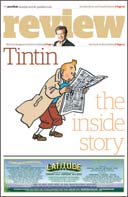
TMcC: First of all, I’m not sure I’d describe Tintin and the Secret of Literature as ‘criticism’. More as an essay. I like the idea of the essay as a primary literary form. You can trace it from David Foster Wallace through Blanchot all the way back to people like Hazlitt. But yes, the fact that it revolves around Tintin and not just Balzac and Baudelaire has certainly helped it get attention — although it wasn’t strategic to do this. I genuinely rate Hergé’s work, and wanted to read it alongside Balzac, Baudelaire, Bergson, Bachelard and all the rest, hopping from one to the other in a set of playful, serendipitous detours — which is exactly what the essay format allows.

3:AM: Your book is very much in the tradition of Barthes‘s Mythologies (an anthology which you fail to mention). I can’t remember if Barthes actually mentions Tintin anywhere, but he certainly could have done. In a way, the two figures go curiously well together: Tintin’s heyday corresponds roughly to that of Barthes and both, today, appear a little quaint. Was it Barthes who inspired this book? After all, your Tintin is primarily a semiologist who “can navigate [a key word in the McCarthy canon] the world of signs” (Tintin and the Secret of Literature p. 22), a deciphering cipher who embodies (along with Snowy?) the presence of absence — the Melvillian “whiteness of the whale” (p. 161) — but also, of course, Barthes’s “écriture blanche”.

TMcC: I do kind of mention Mythologies when I refer to wrestling and tomato tins early on in the book. I love Barthes: he’s a beautiful, generous writer. He never mentions Tintin directly as far as I know, although Derrida, another big presence (or present absence or whatever) in my book, does, glancingly, in The Post Card. Hergé read Barthes; you can see his influence very directly in the final book, Tintin and Alph-Art, in which language becomes a set of physical signs, giant letters which are held up and scrutinised by his characters.

ODETTE’S BITS

3:AM: Are you the first to draw a parallel between Sarrasine and the Tintin corpus? I haven’t read Balzac’s novel, but, from what you write, La Zambinella seems to bear a resemblance to Proust’s Odette de Crécy. Am I mistaken?

TMcC: As far as I know I am the first to draw a parallel between Tintin and Sarrasine. I re-read Barthes’s S/Z, which turns around that particular novella, initially because I wanted to write about Hergé’s total mastery of plot: the way he misdirects, doubles, occludes, jams and so on, all these devices Barthes describes so well in his take on Balzac. But as I did I realised that there were loads of points of correspondence between Sarrasine and the Tintin books. Balzac’s eponymous artist becomes obsessed by the opera singer la Zambinella, like Captain Haddock does with Bianca Castafiore; he copies her, like the sculptor Balthazar does the fetish in The Broken Ear; he’s murdered, as is Balthazar; the copy is copied and these copies are themselves copied, in both. Fundamentally, it’s about entering the realm of denatured simulation that is art. La Zambinella’s voice draws Sarrasine backstage, into a world of artifice, just as la Castafiore’s voice draws Haddock backstage and on into a world of inauthenticity. And these worlds prove fatal: the castrato la Zambinella effectively kills Sarrasine, and ultimately the not-really-pubescent Tintin effectively kills Hergé.

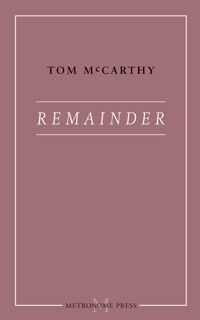
With Proust, I’ve got to admit I’ve never got as far as the Odette bits in the Remembrance. There are passages I find completely compelling, like the bit about how you can construct a composite memory of a house from various other houses you’ve known or read about or seen in pictures (which is more or less what my hero does in Remainder, but other bits lose me, and I put it down again for two years, then re-read as far as the house bit, then same again: a kind of incomplete repetition loop. Perhaps that’s what Old Marcel would have wanted.

ILLICIT FREQUENCIES

3:AM: Given that the literary status of the Tintin books is uncertain/debatable, isn’t it a little perverse to analyse them in order to uncover the “secret of literature”?

TMcC: Yes — and that’s why I wanted to do it. It would be easy to identify literary motifs in Faulkner or Dickens or someone. But what does it tell us when a corpus that makes no claims to being ‘literature’ displays a symbolic register as developed as Faulkner’s and characters as deep and rich as Dickens’s, not to mention themes and plots more or less identical to Sophocles’s and Shakespeare’s: the fall of the noble house, family secrets coming out into the open, the relation between host and guest gone disastrously wrong and so on? So much of the very best literature opens up illicit frequencies so that meaning can travel along channels other than the obvious or rational. The Tintin books are full of these frequencies, these channels; they even dramatise their setting up, hunting down, rumbling and relocating. And then it struck me that literature as a whole might hide its most intimate secrets in the most illicit of all zones, one tucked away ‘off-stage’, ‘aside’, below the radar of literature proper, which is of course the kind of zone that cartoons lurk in.
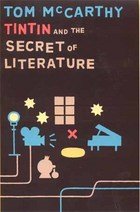
3:AM: Could you tell us about the cover of the book and Tintin’s absence from the illustrations inside?

TMcC: The cover is by Jochen Gerner, a French artist. I saw a book he’d done called TNT en Amérique, in which he buried the whole of Tintin in America under black ink but left a few symbols, mainly of money, divinity and violence (i.e. dollar signs, crosses and guns, all done in cartoony style) as markers for what he’d erased — all on the correct pages, corresponding to frames in the original book. So I contacted him and asked him to do the cover, and he was really into it. We looked at the main motifs in The Castafiore Emerald — the window, the piano, the cameras and spotlights that, ultimately, occlude more than they reveal — and he applied his technique (which, after Bataille, he calls ‘déformation’) to these. And in the foreground, as on Hergé’s, the tufted figure with his finger to his lips, saying ‘Shhhh!’ — what in the book I call “the condition of the secret become visible”.

To answer the second part of your question: I didn’t want images directly from the Tintin books inside my book. I was more interested in showing how these images (which I’m assuming most people who read my book will be at least slightly familiar with) mutate into and out of other ones: eighteenth-century portraits of castrato singers, stills from Buster Keaton films and, not least, ‘detourned’ versions of the Tintin books themselves. These last images break down into political activist ones, pornographic ones and ‘art’ ones: an interesting triangle.

THE BOY HAIRDRESSER

3:AM: Given your chapter devoted to “Castafiore’s Clit” (if you ever form a band, promise me that you’ll use that name) and your comments about Tintin’s androgyny, I was surprised you didn’t devote at least a few lines to the once-ubiquitous gay Tintin haircut…

TMcC: A band called Castafiore’s Clit is a great idea. Kind of Jane’s Addiction meets The Thompson Twins. Yes, it’s funny that Tintin has lent his haircut to gay culture. I found out recently that the Rocker quiff of the Fifties was taken directly from Jean Marais’s haircut in Cocteau’s Orphée, another big presence in my book.

THE SINS OF THE FATHER

3:AM: During the Second World War, Hergé had no qualms about publishing his comic strips in Le Soir, a newspaper that was under Nazi control and had clear Nazi sympathies. Interestingly enough, as you point out, Paul de Man also wrote for Le Soir. However, I was surprised that you did not make more of this coincidence. Paul de Man’s undermining of meaning and values having been reinterpreted (and partly discredited) in the light of the posthumous discovery of his youthful far-right views, should not we also be somewhat wary of Hergé’s “retroactive wiping-out of history” (p. 41), the erosion of Rastapopoulos’s “Semitic status” (pp. 44-45) or his reinvention as a “liberal leftist” (p. 46)? After all, anti-capitalism and anti-consumerism which, in your view, testify to the author’s “right-to-left trajectory” (p. 47) are common tenets on the far right as well as the far left…

TMcC: I never went with the argument that Paul de Man’s shameful youthful secret undermines all of deconstruction (is Derrida, a Jew, a secret anti-Semite too?), not least because when I was at university one of this argument’s main advocates serially harassed his female students while simultaneously espousing feminism, which for me kind of discredited anything he had to say. Yes, the anti-consumerist thing can serve a right-wing position as much as a left-wing one, and I point out in the book that Hergé kept the same villains in place throughout his career (secret cabals, men in hoods). But I think his right-to-left trajectory was a genuine one, as was Paul de Man’s. Things are connected. Fascism is a moment that the twentieth century goes through, in the arts as much as anywhere else. Think of Yeats, Spengler, Hamsun, Pound, Céline — brilliant and hugely influential writers who were fascists. Do we discount anything that’s come after them? Of course not: you trace the fallout of the disaster, how it mutates and develops. Think of Heidegger, a one-time Nazi out of whose thought the incredibly compelling ethical vision of Levinas (another Jew) has emerged. Anyway, it would be naive and liberal to want all our artists to be nice Guardian readers. Some people are arseholes. And another thing: Paul de Man doesn’t undermine meaning and value — just certain tired and reactionary notions of both.

[Just for the record: I didn’t mean to imply that Hergé’s, Céline’s or Yeats’s works should be rejected because of their political views, although I clearly gave that impression. Like Tom, I subscribe to a resolutely politically-incorrect conception of literature. My point simply concerned anti-capitalism and anti-consumerism (which the far left certainly has no monopoly over) along with the fact that certain thinkers’ seemingly-rational ideas are so obviously linked to individual history (Maurras’s deafness or Foucault’s masochism, for instance) that one should sometimes approach them with a little caution. Another issue we could have raised here is the Arendt-Heidegger relationship, but that would probably have been one serendipitous detour — to quote McCarthy — too many!]


FOUND IN TRANSLATION

3:AM: Remainder — the best novel of 2005 which, due to its republication by Alma Books, looks set to be the novel of 2006 (ironically enough, given the theme of the book) — could be described as the best French novel ever written in English by an Englishman. With Tintin and the Secret of Literature, your approach is once again resolutely French. Almost all of your major references are French (Balzac, Baudelaire, Barthes, Derrida…), and even the vocabulary you use is Gallicized (“fictive,” for instance, which is far closer to the French “fictif” than “fictional”). Where does your familiarity with French culture and the French language come from? Was it deliberate on your part to largely avoid references to British or American literature? Wouldn’t it have been interesting to give a more English perspective on Tintin since Tintinologists have a habit of being Belgian or French?

TMcC: First of all, thanks for your kind words about Remainder, and I’ll try to persuade my French publisher, Hachette Littératures, to use your “best French novel in English” line as a blurb for their edition that’s coming out next September — I couldn’t think of better praise! Yes, most of the points of reference in Tintin and the Secret of Literature are French, although Defoe, Bunyan, Behn and other Anglo early novelists get a look in — plus there’s a big digression through Shakespeare’s Sonnets. I guess I just really like French literature. The English were going really well from the sixteenth to the nineteenth centuries, producing poets like Donne and Marvell and novels like Clarissa and Tristram Shandy, but it all went horribly wrong somewhere in the late nineteenth/early twentieth and, while the French (and Americans) embarked on the wildest adventures with thought and form — Mallarmé, Breton, Cendrars, Faulkner etc etc — we got Thomas fucking Hardy and DH fucking Lawrence. The only top-class twentieth century English writers are the ones we claim spuriously: Americans like Eliot and James, Poles like Conrad, Irishmen like Joyce and Beckett…

3:AM: At the same time, there is a sense of humour and earthiness which are very un-French, as it were. After the publication of a strange review in The Economist which presented your book as a send-up of French theory, you spoke to me of the astounding “idiocy of English empirical culture”: do you think Tintin and the Secret of Literature is going to reignite the critical Querelle des Anciens et des Modernes of the 80s and 90s?

TMcC: I think to ignite any thought at The Economist you’d need to stick a ton of semtex up their arses. That review was quite funny, though: it perfectly captured the red-faced, vein-popping fury of Little England once the values on which it bases its entire identity are ever-so-slightly “solicited”, as Derrida would say. English takes on Tintin always present Hergé as a ’satirist’ and only that: a self-sufficient, rational subject who uses words and images as tools to tell us something he knows because he’s worked it out, rationally, you see. That’s the empirical line on literature tout court: the rational expression of a self-sufficient subject — as though we weren’t constantly made and unmade within language, desire, history, symbolic networks and so on. It’s as moronic as crediting a surfer with creating the wave which carries him and allows him to ply his craft — and back into which he’s eventually going to sink.

McCARTHYISM

3:AM: You say that you were introduced to Tintin by your mother at the age of seven. That, in itself, probably says a lot about your social background — that and your early encounter with Hugo Williams (mentioned by the poet in an article he wrote in the TLS about your International Necronautical Society). In France, in the 70s, Le Journal de Tintin tended to be read in Catholic and conservative circles whereas kids from Communist families usually read a comic called Pif. What sort of social and cultural milieu were you raised in, Tom?

TMcC: I come from a liberal arts-steeped middle-class family. My mum would tell us the stories of The Odyssey and The Merchant of Venice on car journeys. My parents were left-ish but not radical. They voted Labour but I went to a private day-school from the age of twelve.

3:AM: You write that “Everybody wants to be Tintin,” but I get the feeling that that everybody applies, first and foremost, to you. You even bear a slight physical resemblance to Hergé’s hero…

TMcC: I went to a fancy dress party dressed as Tintin once…

3:AM: Susan Tomaselli rounds off her review with the claim that Tintin and the Secret of Literature made her feel like re-reading Remainder (your debut novel) rather than the Tintin books themselves. Do you see this as a success or a failure?

TMcC: Success — although she should read the Tintin books too. In a way, I used Tintin and the Secret of Literature to work through some of the themes in Remainder in a more conscious way: the relationship between trauma and repetition, for example, or the idea of inauthenticity which emerged from the de Man essay “The Rhetoric of Temporality”, which I hadn’t read when I wrote Remainder even though it could almost be describing that book. It’s great to be able to switch modes, and come at the same territory from a different angle.

WE WANTED TO BLOW UP TIME ITSELF

3:AM: Your whole oeuvre seems to be contained within this critical essay: Tintin and the Secret of Literature could thus be read as a work of internal intertextuality. First of all, there’s the importance of meridians which points to Greenwich Degree Zero, your recent artistic collaboration with Rod Dickinson…

TMcC: …when we blew up the Greenwich Observatory, or at least produced the documentation of having blown up the Observatory, completing the task of Martial Bourdin, model for Conrad’s Stevie in The Secret Agent. We wanted to blow up time itself. Funnily enough, there’s a scene in The Broken Ear where a secret agent like Stevie carries a time-bomb around and gets blown up by it because he doesn’t realise the town clocks have broken. I love the sequence in The Sound and the Fury where Quentin carries a broken clock around and rides trams in different directions in a sub-Einsteinian attempt to escape time — then dies…
WE WANTED TO BLOW UP BRIDGES

3:AM: Then you’ve got the references to Cocteau’s Orphée and, more generally, your fascination with the “transmission-reception figure” (as you put it elsewhere): “[Tintin] will also be aware, as a radio operator, that the waves which carry his transmissions will travel outwards endlessly through space. Who knows where the signals will end up, or what they will end up meaning?” (p. 91).

TMcC: If I had to select five things to put in a space capsule to show aliens what we were capable of, Orphée would be one of them. It’s the most perfect piece of art, which lays out our existence as being in relation to death, technology, transmission-reception and desire — not to mention repetition. Death, a beautiful princess (and arts patron) falls in love with Orphée so she has another poet snatched to the underworld so he can send illicit, looping radio messages to Orphée which draw him towards her, through a mirror. Cocteau based his radio messages on the ones sent to occupied France during World War Two: these short lines of poetry. Most of them meant nothing, but one in every two hundred meant — only to those who knew — ‘blow up the bridge’. A man or woman in London reads a line of poetry into a microphone and in France a bridge blows up — or not. Poetry — real poetry — should harbour that potentiality somehow.

3:AM: You talk about Alph-Art, the eponymous avant-garde movement of Hergé’s posthumous book, which is “a cover for a giant forgery operation” (p. 158). Couldn’t this also be a fitting definition of your own “semi-fictitious” avant-garde movement, the International Necronautical Society?

TMcC: The INS had its own radio transmission network, operating out of the ICA two years ago, generating messages like Cocteau’s and actually transmitting them over the radio London-wide (and, via collaborating radio stations, world-wide). It looked like a giant factory floor, with workers running everywhere carrying lines of text — lines which, having been plucked from other media sources, were kind of second-hand if not fake. The INS is itself semi-fake, as you point out. Although the fake can hide the real.

THE UNNAMEABLE

3:AM: On page 84, you explain that, according to Freud, trauma produces “a desire for repetition mixed with a need to disguise the scene being repeated”. Could you comment on this sentence with reference to your novel Remainder?

TMcC: It’s not just Freud who says this: even his most positivist counterparts concur. Under ultra-extreme stress, the part of the mind that processes raw data into the narrative thread we call ‘memory’ simply goes on strike and refuses to process. It’s called ‘dissociation’. So the data’s present, but not dealt with, and therefore keeps bobbing up and demanding to be incorporated somehow. As it can’t form part of normal memory, it plays itself out in weird ways — ones that contain elements of the original event but are also scrambled, disguised. And it will keep repeating, albeit in modulated form, until it is accommodated properly. Well, in Remainder the hero has undergone a traumatic event which he hasn’t retained as straight memory but rather as fragments of data: the sense of being about to be hit, blue lights, railings, being held above a tray or bed and so on. These induce a propensity to repeat stuff in him. Another interesting thing about post-trauma is that (to return to a motif we touched on a moment ago) it makes people feel inauthentic, fake, because everything is of a lesser magnitude of experience than the trauma-moment itself, the only ‘real’ thing. And then the subject back-projects for himself a time when he wasn’t fake, and longs for that time. That’s what my guy is doing with his re-enactments: repeating backwards to an imagined era of authenticity — but repeating, more accurately, towards the trauma-moment itself, the true, unnameable moment, the moment of truth and unnameability itself.

THE CHINK ON THE CARPET

3:AM: The re-enactments in Remainder or in your artistic work: mimesis or simulacrum?

TMcC: Aha: very good question, bang on the money. In Remainder, he wants the authentic, so he sets up a zone of mimesis, paying architects and designers to recreate his ‘remembered’ building and re-enactors to ‘be’ the lady he remembers frying liver on the floor below him, the pianist he remembers practising Rachmaninoff and so on. He wants to accede through these re-enactments to a mode of authenticity, of simply ‘being’ rather than simulating. But of course it doesn’t work: the re-enactments tend more towards the status of simulacra, what Plato defines as ‘a copy without an original’. But then, paradoxically, the most jarring and obviously inconsistent things, the ‘extra’ bits, the ones with no originals of any type at all, are what catapult him into ultra-authenticity — which, not coincidentally, is also pure violence. It’s the little chink on the carpet of his re-enacted bank heist that flips the whole re-enactment over into all-too-real-ness, when the re-enactor trips on it, or rather on its absence, and his gun goes off…
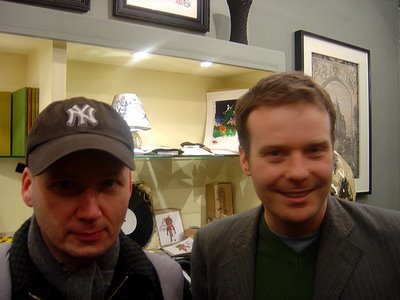

[Stewart Home and Tom McCarthy at 3:AM Magazine‘s Xmas Bash, London 2005]

THE CRACK IN THE WALL

3:AM: Barthes writes that “…the ‘realistic’ artist never places reality at the origin of his discourse, but only and always, as far back as can be traced, an already written real, a prospective code, along which we discern, as far as the eye can see, only a succession of copies” (quoted on p. 55): this is also, unwittingly, what the protagonist of Remainder does, right?

TMcC: Remainder has been read by some critics as an allegory of realism and of the realist mode of art, and this isn’t an entirely wrong reading — although if the hero had actually been an artist rather than an Everyman, some bloke, it would have been an entirely different, and inferior, book. But yes, it definitely turns around his copying, and even (as he sets about getting his re-enactors to re-enact the moments when they prepared for the previous re-enactment) his copying his moments of copying, endlessly regressive. We can try to work it out together, but ultimately I can’t give the definitive schematic meta-reading of the book any more than you — perhaps less. It was intuitive: I was looking at a crack in a wall and had a moment of dejà-vu and wished I had loads of money to re-enact this moment and there was the novel.

EVERYTHING LITERATURE SHOULD BE

3:AM: When discussing tobacco throughout the Tintin books, you explain (following Derrida) that it “goes up in smoke” but “also leaves remains, ashes, which maintain symbolic links to memory, death and inheritance. Baudelaire’s story takes off from the change left over from the two friends’ luxury expenditure: like the coin itself, it proceeds from the remainder” (p. 135). Why are remnants so important in your work?

TMcC: It’s what’s left. After the disaster, after thought, interpretation, writing itself. It’s like when Wallace Stevens says “The plum survives its poems”. Writing has to deal with this remainder, and good writing has to deal with the fact that it can never fully deal with it. Francis Ponge knows this. He writes brilliant prose poems about, for example, oranges: the texture of their cells, the way they leave goop on your hands so that even when you’ve ‘expressed’ them there’s a residue that’s not contained. If Susan Tomaselli or anyone else really want to do themselves a favour, they should re-read neither Remainder nor the Tintin books but rather Ponge’s Le Parti pris des choses (you can get it in dual text). It’s everything writing should be.

[This interview was initially posted here.]

Céline: Great Author and ‘Absolute Bastard’

This appeared in Guardian Books on 31 January 2011:

Céline: Great Author and ‘Absolute Bastard’


Special case: Louis-Ferdinand Céline. Photograph: Lipnitzki/Roger Viollet/Getty Images

Every year, the French government publishes a list of cultural events and personalities to be commemorated over the next 12 months. Compiling it is a lengthy and carefully-considered process. A High Committee of National Celebrations draws up a provisional list, which is then submitted to the Culture Ministry and, once approved, published in book form. Some 10,000 copies of the Recueil des Célébrations nationales 2011 were printed last autumn ahead of last week’s launch. Frédéric Mitterrand — the culture minister lui-même — had even penned a foreword, proving beyond a shadow of doubt that the project had received his imprimatur. However, when word got out that Louis-Ferdinand Céline was to feature alongside the likes of Blaise Cendrars, Théophile Gautier, Franz Liszt and Georges Pompidou, all hell broke loose.

Serge Klarsfeld, the country’s most famous Nazi hunter and Holocaust memorialist, expressed his indignation in the name of the Association of Sons and Daughters of Jews Deported from France. The Republic, he argued, shouldn’t celebrate “the most antisemitic” Frenchman of his day — a time, lest we forget, when antisemitism was so rife that it led to state-sanctioned Jewish persecution under the Vichy regime. Mitterrand’s decision, two days later, to remove the novelist from the list was logical in light of this backlash, but also somewhat surprising since he must have known that his inclusion would prove controversial in the first place (was he protecting Sarkozy, whose favourite author happens to be Céline?)

Far more surprising, however, was the reaction of the French intelligentsia, who were almost unanimous in their defence of the author of Journey to the End of the Night. Literary heavyweight Philippe Sollers accused the Culture Ministry of “censorship”. Frédéric Vitoux, a member of the prestigious Académie française who wrote a biography of Céline, likened this decision to the airbrushing of history under Stalin. Pop philosopher Alain Finkielkraut feared that some people would draw the conclusion that a “Jewish lobby” was dictating policy to the French government. Bernard-Henri Lévy, another celebrity philosopher, claimed that the commemoration of Céline’s death should have been an opportunity to try to understand how a “truly great author” can also be an “absolute bastard”. Even more surprising, perhaps, was the fact that Serge Klarsfeld himself felt the need to declare that he rated Céline as a “great writer” before going on to describe him as a “despicable human being”.

France is a place where authors and artists are granted a special status — a kind of poetic licence or artistic immunity. In fact, the country continues to view itself, and sometimes to be regarded as, the natural second home of all artists. It is this very liberal attitude which attracted many members of the Lost and Beat generations after the second world war, and that still attracts outsider writers such as Dennis Cooper. Some of the greatest works of contemporary fiction in English — Joyce’s Ulysses, Nabokov’s Lolita or Burroughs’s Naked Lunch — were available in France when they were banned or considered unpublishable in Britain or the US. A telling culture shock occurred on live television, in 1990, when a journalist from Quebec told Gabriel Matzneff that only in Paris would he be feted for writing — however exquisitely — about his liaisons with underage partners (of both genders). Anywhere else, she stated, he would probably end up in prison. The journalist was subsequently depicted as a philistine, unable to appreciate the subtlety of Matzneff’s feelings or the beauty of his style. Baudelaire once wrote that “literature and the arts pursue an aim independent of morality” and, for better or worse, this has clearly become France’s official artistic credo.

Trying to account for this “exception française” is no mean task, but I suspect it has something to do with the elevation of art to the status of surrogate religion during the second half of the 19th century. A similar phenomenon was taking place all over Europe, of course, but it probably had more resonance against the backdrop of the ongoing struggle between Republicanism and Catholicism. Both Flaubert and Baudelaire were prosecuted for public obscenity, but when French MPs called for the banning of Jean Genet‘s The Screens in 1966 (for political reasons, this time), the culture minister (and novelist) André Malraux immediately stepped in to defend the inviolability of artistic freedom. By then, artistic creation was largely considered as a value in itself, beyond morals and politics; even beyond good and evil.

The dominant French view on literature was probably best expressed by Oscar Wilde, who ended his life in exile in Paris: “There is no such thing as a moral or an immoral book. Books are well written, or badly written. That is all.” Not quite, though, in this case. No one is denying Céline’s talent as one of the greatest French writers of the 20th century — probably the greatest, with Proust. Is it possible, however, to distinguish the author of antisemitic tracts from the genius novelist; the man from the artist?

Inalienable Silence

Tom McCarthy, Calling All Agents (London: Vargas Organisation, 2003). 4-5.

“…And yet the Hearings left us with the impression that if (as Gil Scott Heron says) the Revolution will not be televised, then perhaps its nucleus will not be caught on audio tape or broadcast on the airwaves either — or if it will, then it will take the form of silence. For Heidegger, everything stems from the Unspoken: Being calls us, but it does so ‘in the uncanny mode of keeping silent.’ Burroughs’s revolutionary drive extends to a transformation of language that will help cast off the ‘IS’ of identity: this language, he tells us, will be a hieroglyphic one that ‘will give one the option of silence.’ Hollings, discussing Burroughs in an article, writes: ‘Recorded silence only becomes a political act once it is played back.’ There are echoes of Cégeste’s first message here. Hollings was a contributor to Violent Silence (a book about Bataille), a collaborator with John Cage and at the time of the Hearings was conducting research into the erased passages in Nixon’s Watergate tapes. What did he mean ‘recorded silence only becomes a political act once it is played back,’ we asked him. ‘Playing a blank tape,’ he told us, ‘breaking the seal on something and sticking it in a machine and listening to it, is an act of refusal.’ ‘So there is a kind of inalienable silence that is encrypted somehow?’ Anthony Auerbach asked; ‘And this potentially contains the revolutionary moment?’ ‘Exactly so,’ said Hollings. This is the violent silence of Shakespeare’s Cordelia, who tells her father ‘Nothing’ — a single word which leads to general annihilation, wars and madness; or of Stephen Daedalus, self-styled ‘Cordoglio’ who, as he brings about ‘the ruin of all space, shattered glass and toppling masonry, and time one livid final flame,’ says ‘Nothing!’ ‘Maybe,’ I suggested, ‘our radio project should be a quest for that silence’ — a suggestion to which Hollings answered, in what turned out to be the Hearings’ final exchange: ‘I would strongly recommend it.’…”

On p. 12, McCarthy mentions Burroughs’s “putative hushed-up language”.

On p. 16: “This silent word is so charged and so seductive, Abraham and Torok conclude [in Cryptonomy: the Wolf Man’s Magic Word], that it and it alone becomes the object of the Wolf Man’s love. To keep it safe he buries it inside the crypt ‘like a chrysalis in its cocoon’ and carries it around for all his life, showing and hiding it, saying it without saying it, ‘repeating tirelessly to one and all, especially to his analyst: ‘Here is nothing, hold it tight’.”

“‘Poetry,’ in the words of Auden, ‘makes nothing happen’ — an active construct in which ‘nothing’ designates an event, perhaps even a momentous one. In looking into the abyssal ground, reading its source code and transmitting this nothing outwards, maybe we will find that our culture also [like Freud’s Wolf Man] has a secret, silent word.”

In Theory: Towards a New Novel

This appeared in Guardian Books on 13 May 2010:

In Theory: Towards a New Novel

Alain Robbe-Grillet’s provocative essays on creating new literature outside the ‘dead rules’ of the past resonate now

Alain Robbe-Grillet

A novel ‘expresses nothing but itself’ … Alain Robbe-Grillet. Photograph: Daniel Janin/AFP/Getty Images

David Shields recently dismissed most contemporary novels as “antediluvian texts” that “could have been written by Flaubert 150 years ago”. “In no way,” claimed the author of Reality Hunger, “do they convey what it feels like to live in the 21st century.”

He has a point — albeit one that Alain Robbe-Grillet had already made in 1965 when he deplored the fact that young French novelists were praised for writing “like Stendhal” but castigated as soon as they refused to abide by the “dead rules” of a bygone age. Along with Michel Butor, Nathalie Sarraute and Claude Simon — the main proponents of the new novel (nouveau roman) — Robbe-Grillet stood resolutely in the second camp. In his essays, he returns time and again to the notion that the novel, from Stendhal to Joyce, has constantly evolved — hence the absurdity of using “the norms of the past” to judge the fiction of today. Far from representing a rejection of the past, the quest for a new novel was thus very much in keeping with the history of a genre which, by definition, must always be renewed.

Feeling that his work was too often misrepresented by the critical establishment (with a few notable exceptions including Barthes, Blanchot and Nabokov), Robbe-Grillet published a series of articles to set the record straight. In 1963 they were collected in Towards a New Novel — for my money, one of the most important works of postwar literary criticism. However, these “critical reflections” were never meant to constitute a manifesto. Every novel, according to Robbe-Grillet, is a self-sufficient work of art which cannot be reduced to some external meaning or truth that is “known in advance”. “The New Novel,” as he put it, “is not a theory, it is an exploration.” Why bother writing a book that illustrates a rule when “the statement of the rule would suffice”?

Quoting Heidegger at the beginning of an essay on Waiting For Godot, Robbe-Grillet writes that the human condition is “to be there”. In another essay, he states that it is “chiefly in its presence that the world’s reality resides”. So there you have it. Man is here, the world is there and the distance between the two lies at the heart of the new novel project. We endow the world with meaning (or meaninglessness) in order to control it. From this point of view, the writer’s traditional role was to excavate nature in order to unearth the “hidden soul of things”. Robbe-Grillet calls for the creation of a new form of fiction that reflects the “more modest, less anthropomorphic world” we live in today — one which is “neither significant nor absurd,” but simply is.

This seemingly anodyne observation has serious literary ramifications. Gone is the traditional hero of yore who believed the world was there to be conquered and whose hour of glory coincided with the triumph of individualism. Gone is the humanist “communion” between people and things: “Things are things, and man is only man”. Gone is the notion of tragedy, which Robbe-Grillet sees as a twisted ploy to reaffirm this solidarity: “I call out. No one answers. Instead of concluding that there is no one there (…) I decide to act as if someone were there, but someone who, for some reason or other, will not answer”. In the new novel, “Man looks at the world” but “the world does not look back,” which precludes any symbolism or transcendence. The novelist’s task now is to describe the material world, not to appropriate it or project himself onto it; to record the distance between human beings and things without interpreting this distance as a painful division. All this implies that the “entire literary language” be reformed. Similes and metaphors, which are often used gratuitously to confer literary status upon a text, are seldom innocent since they tend to anthropomorphise the world.

The new novel is routinely attacked for being inhuman and coldly descriptive. Robbe-Grillet responds that his work is in fact far less objective than the godlike, omniscient narrator who presides over so many traditional novels. Description here is purely subjective and takes centre stage, whereas in Balzac, for instance, it simply sets the scene by lending the plot an air of authenticity. Instead of referring to an external, pre-existing reality, Robbe-Grillet’s descriptions seem to create their own objects, their own hallucinatory reality. “Nothing,” he explains, “is more fantastic, ultimately, than precision.”

The reality of any work of art is its form, and to separate style from substance is to “remove the novel from the realm of art”. Art, Robbe-Grillet reminds us, is not just a pretty way of presenting a message: it is the message. Like the world out there, a novel is self-sufficient and “expresses nothing but itself”. Its “necessity” has nothing to do with its “utility”. Whenever an author envisages a future book, “it is always a way of writing which first of all occupies his mind,” which leads Robbe-Grillet to state — provocatively — that “the genuine writer has nothing to say. He has only a way of speaking”. Creative writing classes should always start and end on that note.

****

Here is a slightly longer version of the same piece:

David Shields recently dismissed most contemporary novels as “antediluvian texts” that “could have been written by Flaubert 150 years ago”. “In no way,” claimed the author of Reality Hunger, “do they convey what it feels like to live in the 21st century.” He has a point — one that Alain Robbe-Grillet had already made, back in 1965, when he deplored the fact that young French novelists were praised for writing “like Stendhal” but castigated as soon as they refused to abide by the “dead rules” of a bygone age. Along with Michel Butor, Nathalie Sarraute and Claude Simon — the main proponents of the so-called New Novel (Nouveau Roman) — Robbe-Grillet stood resolutely in the second camp. Throughout his essays, he returns time and again to the notion that the novel, from Stendhal to Joyce, has constantly evolved, hence the absurdity of using “the norms of the past” (and specifically those of the 19th century) to judge the fiction of today. He defends the nouveaux romanciers from accusations of formalism by arguing that the true “formalists” are in fact those who write formulaically, as if “the ‘true novel'” had been cast “once and for all” in the Balzacian mould: “But we, on the contrary, who are accused of being theoreticians, we do not know what a novel, a true novel, should be; we know only that the novel today will be what we make it, today, and that it is not our job to cultivate a resemblance to what it was yesterday, but to go forward”. Far from representing a rejection of the past, the quest for a new novel was thus very much in keeping with the history of a genre which, by definition, must always be renewed. “Flaubert wrote the new novel of 1860, Proust the new novel of 1910”: it was up to the nouveaux romanciers to bring the novel kicking and screaming into the 1950s.

Feeling that his work was too often misrepresented by the critical establishment (with a few notable exceptions like Barthes, Blanchot or Nabokov) and misunderstood by large sections of the reading public, Robbe-Grillet started publishing a series of articles in order to set the record straight. In 1963, they were collected in Towards a New Novel (For a New Novel in the American version; Pour un nouveau roman in the original) which, for my money, remains one of the most important works of post-war criticism. Not surprisingly, these essays cover the period during which Robbe-Grillet was also producing some of his greatest works of fiction: The Voyeur (1955), Jealousy (1957) and the screenplay for Last Year at Marienbad (1961).

In retrospect, some of the author’s predictions may seem wide of the mark: the New Novel did not, for instance, bring about “a revolution more complete” than “romanticism or naturalism”. Robbe-Grillet’s Pascalian “wager” that “man, some day, will free himself” of the concept of tragedy, strikes me as impossibly naive. The claim that calling upon the reader to play an active part in the creation of the world of a novel will also enable him “to learn to invent his own life” probably sounds a tad too ambitious — or even pretentious — for us today. But all this is just nitpicking when set against the radical renewal of fiction that is heralded within these pages. Whereas Finnegans Wake feels like a one-off or a dead end, Towards a New Novel still reads like a blueprint for a truly novel novel.

Robbe-Grillet’s forays into criticism were frowned upon by those who clung to the old cliché of the great writer in the throes of creation as “a kind of unconscious monster” emitting “‘messages’ which only the reader may decipher”. Not only did the author claim that there was no “antinomy between creation and consciousness,” but he was also convinced that literature had entered an age of self-conscious creation in which “critical preoccupations” would prove a “driving force”. However, his “critical reflections” were in no way intended to constitute “a theory, a pre-existing mould into which to pour the books of the future”. Every novel, according to Robbe-Grillet, is a self-sufficient work of art which cannot be reduced to some external meaning or truth that is “known in advance”: “The New Novel is not a theory, it is an exploration”. Why bother writing a book that illustrates a rule when “the statement of the rule would suffice”?

Towards a New Novel is neither a theory of the novel nor the manifesto of a new literary movement. Robbe-Grillet speaks of “a possible novel of the future,” “this literature still in progress” and the search for “a realistic style of an unknown genre beyond Flaubert and Kafka”. It is all very modest and tentative. There are few references to the “New Novel” as such — a term coined by a journalist in 1957 — and none to “L’Ecole du regard” (literally the School of Sight) or “L’Ecole de Minuit” (many of the nouveaux romanciers were published by Les Editions de Minuit where Robbe-Grillet was a literary advisor for 30 years). The New Novel, we are told, is simply a “convenient label for writers seeking new forms to express new relations between Man and the world”. This is as close to a programme that we get.

Quoting Heidegger at the beginning of an essay on Waiting For Godot, Robbe-Grillet writes that the human condition is “to be there”. In another essay, he states that it is “chiefly in its presence that the world’s reality resides”. So there you have it. Man is here, the world is there and the distance between the two lies at the heart of the New Novel project. We endow the world with meaning (or meaninglessness) in order to control it. From this point of view, the writer’s traditional role was to excavate nature in order to unearth the “hidden soul of things”. Words were traps “in which the writer captured the universe” before handing it over to society. Robbe-Grillet calls for the creation of a new form of fiction that reflects the “more modest, less anthropomorphic world” we live in today — one which is “neither significant nor absurd,” but simply is. This seemingly anodyne observation has huge literary ramifications.

Gone is the traditional hero of yore who considered the world was only there to be conquered and whose hour of glory coincided with the triumph of individualism. Gone is the humanist “communion” or “solidarity” between people and things: “Things are things, and man is only man”. Gone is the notion of tragedy, which Robbe-Grillet sees as a twisted ploy to reaffirm this “solidarity”: “I call out. No one answers. Instead of concluding that there is no one there (…) I decide to act as if someone were there, but someone who, for some reason or other, will not answer”. In the New Novel, “Man looks at the world” but “the world does not look back,” which precludes any symbolism or transcendence. The novelist’s task now is to describe the material world (not to appropriate it or project himself onto it); to record the distance between human beings and things (without interpreting this distance as a painful division). All this implies that the “entire literary language” be reformed. Similes and metaphors, which are often used gratuitously to confer literary status upon a text, are seldom innocent since they tend to anthropomorphize the world.

The New Novel is routinely attacked for being inhuman and coldly descriptive. Robbe-Grillet responds that his work is in fact far less objective than the godlike omniscient narrator who presides over so many traditional novels. Description here is purely subjective and takes centre stage whereas in Balzac, for instance, it simply sets the scene by lending the plot an air of authenticity. Instead of referring to an external, pre-existing reality, Robbe-Grillet’s descriptions seem to create their own objects, their own hallucinatory reality. “Nothing,” he explains, “is more fantastic, ultimately, than precision.”

The reality of any work of art is its form, and to separate style from substance is to “remove the novel from the realm of art”. Art, Robbe-Grillet reminds us, is not just a pretty way of presenting a message: it is the message. Like the world out there, a novel is self-sufficient and “expresses nothing but itself”. Its “necessity” has nothing to do with its “utility”. Whenever an author envisages a future book, “it is always a way of writing which first of all occupies his mind,” which leads Robbe-Grillet to state — somewhat provocatively — that “The genuine writer has nothing to say. He has only a way of speaking”. Creative writing classes should always start and end on that note.