Illicit Frequencies, or All Literature is Pirated

Here is my interview with Tom McCarthy that appeared in 3:AM Magazine on 13 July 2006.

3:AM: It’s very rare, these days, to see a work of literary criticism being given such prominence. Do you agree that this is probably largely due to the fact that the main subject is not Balzac or Baudelaire — two key references here — but a comic-strip hero?

TMcC: First of all, I’m not sure I’d describe Tintin and the Secret of Literature as ‘criticism’. More as an essay. I like the idea of the essay as a primary literary form. You can trace it from David Foster Wallace through Blanchot all the way back to people like Hazlitt. But yes, the fact that it revolves around Tintin and not just Balzac and Baudelaire has certainly helped it get attention — although it wasn’t strategic to do this. I genuinely rate Hergé’s work, and wanted to read it alongside Balzac, Baudelaire, Bergson, Bachelard and all the rest, hopping from one to the other in a set of playful, serendipitous detours — which is exactly what the essay format allows.

3:AM: Your book is very much in the tradition of Barthes‘s Mythologies (an anthology which you fail to mention). I can’t remember if Barthes actually mentions Tintin anywhere, but he certainly could have done. In a way, the two figures go curiously well together: Tintin’s heyday corresponds roughly to that of Barthes and both, today, appear a little quaint. Was it Barthes who inspired this book? After all, your Tintin is primarily a semiologist who “can navigate [a key word in the McCarthy canon] the world of signs” (Tintin and the Secret of Literature p. 22), a deciphering cipher who embodies (along with Snowy?) the presence of absence — the Melvillian “whiteness of the whale” (p. 161) — but also, of course, Barthes’s “écriture blanche”.

TMcC: I do kind of mention Mythologies when I refer to wrestling and tomato tins early on in the book. I love Barthes: he’s a beautiful, generous writer. He never mentions Tintin directly as far as I know, although Derrida, another big presence (or present absence or whatever) in my book, does, glancingly, in The Post Card. Hergé read Barthes; you can see his influence very directly in the final book, Tintin and Alph-Art, in which language becomes a set of physical signs, giant letters which are held up and scrutinised by his characters.

ODETTE’S BITS

3:AM: Are you the first to draw a parallel between Sarrasine and the Tintin corpus? I haven’t read Balzac’s novel, but, from what you write, La Zambinella seems to bear a resemblance to Proust’s Odette de Crécy. Am I mistaken?

TMcC: As far as I know I am the first to draw a parallel between Tintin and Sarrasine. I re-read Barthes’s S/Z, which turns around that particular novella, initially because I wanted to write about Hergé’s total mastery of plot: the way he misdirects, doubles, occludes, jams and so on, all these devices Barthes describes so well in his take on Balzac. But as I did I realised that there were loads of points of correspondence between Sarrasine and the Tintin books. Balzac’s eponymous artist becomes obsessed by the opera singer la Zambinella, like Captain Haddock does with Bianca Castafiore; he copies her, like the sculptor Balthazar does the fetish in The Broken Ear; he’s murdered, as is Balthazar; the copy is copied and these copies are themselves copied, in both. Fundamentally, it’s about entering the realm of denatured simulation that is art. La Zambinella’s voice draws Sarrasine backstage, into a world of artifice, just as la Castafiore’s voice draws Haddock backstage and on into a world of inauthenticity. And these worlds prove fatal: the castrato la Zambinella effectively kills Sarrasine, and ultimately the not-really-pubescent Tintin effectively kills Hergé.

With Proust, I’ve got to admit I’ve never got as far as the Odette bits in the Remembrance. There are passages I find completely compelling, like the bit about how you can construct a composite memory of a house from various other houses you’ve known or read about or seen in pictures (which is more or less what my hero does in Remainder, but other bits lose me, and I put it down again for two years, then re-read as far as the house bit, then same again: a kind of incomplete repetition loop. Perhaps that’s what Old Marcel would have wanted.
ILLICIT FREQUENCIES

3:AM: Given that the literary status of the Tintin books is uncertain/debatable, isn’t it a little perverse to analyse them in order to uncover the “secret of literature”?

TMcC: Yes — and that’s why I wanted to do it. It would be easy to identify literary motifs in Faulkner or Dickens or someone. But what does it tell us when a corpus that makes no claims to being ‘literature’ displays a symbolic register as developed as Faulkner’s and characters as deep and rich as Dickens’s, not to mention themes and plots more or less identical to Sophocles’s and Shakespeare’s: the fall of the noble house, family secrets coming out into the open, the relation between host and guest gone disastrously wrong and so on? So much of the very best literature opens up illicit frequencies so that meaning can travel along channels other than the obvious or rational. The Tintin books are full of these frequencies, these channels; they even dramatise their setting up, hunting down, rumbling and relocating. And then it struck me that literature as a whole might hide its most intimate secrets in the most illicit of all zones, one tucked away ‘off-stage’, ‘aside’, below the radar of literature proper, which is of course the kind of zone that cartoons lurk in.

3:AM: Could you tell us about the cover of the book and Tintin’s absence from the illustrations inside?

TMcC: The cover is by Jochen Gerner, a French artist. I saw a book he’d done called TNT en Amérique, in which he buried the whole of Tintin in America under black ink but left a few symbols, mainly of money, divinity and violence (i.e. dollar signs, crosses and guns, all done in cartoony style) as markers for what he’d erased — all on the correct pages, corresponding to frames in the original book. So I contacted him and asked him to do the cover, and he was really into it. We looked at the main motifs in The Castafiore Emerald — the window, the piano, the cameras and spotlights that, ultimately, occlude more than they reveal — and he applied his technique (which, after Bataille, he calls ‘déformation’) to these. And in the foreground, as on Hergé’s, the tufted figure with his finger to his lips, saying ‘Shhhh!’ — what in the book I call “the condition of the secret become visible”.

To answer the second part of your question: I didn’t want images directly from the Tintin books inside my book. I was more interested in showing how these images (which I’m assuming most people who read my book will be at least slightly familiar with) mutate into and out of other ones: eighteenth-century portraits of castrato singers, stills from Buster Keaton films and, not least, ‘detourned’ versions of the Tintin books themselves. These last images break down into political activist ones, pornographic ones and ‘art’ ones: an interesting triangle.

THE BOY HAIRDRESSER

3:AM: Given your chapter devoted to “Castafiore’s Clit” (if you ever form a band, promise me that you’ll use that name) and your comments about Tintin’s androgyny, I was surprised you didn’t devote at least a few lines to the once-ubiquitous gay Tintin haircut…

TMcC: A band called Castafiore’s Clit is a great idea. Kind of Jane’s Addiction meets The Thompson Twins. Yes, it’s funny that Tintin has lent his haircut to gay culture. I found out recently that the Rocker quiff of the Fifties was taken directly from Jean Marais’s haircut in Cocteau’s Orphée, another big presence in my book.

THE SINS OF THE FATHER

3:AM: During the Second World War, Hergé had no qualms about publishing his comic strips in Le Soir, a newspaper that was under Nazi control and had clear Nazi sympathies. Interestingly enough, as you point out, Paul de Man also wrote for Le Soir. However, I was surprised that you did not make more of this coincidence. Paul de Man’s undermining of meaning and values having been reinterpreted (and partly discredited) in the light of the posthumous discovery of his youthful far-right views, should not we also be somewhat wary of Hergé’s “retroactive wiping-out of history” (p. 41), the erosion of Rastapopoulos’s “Semitic status” (pp. 44-45) or his reinvention as a “liberal leftist” (p. 46)? After all, anti-capitalism and anti-consumerism which, in your view, testify to the author’s “right-to-left trajectory” (p. 47) are common tenets on the far right as well as the far left…

TMcC: I never went with the argument that Paul de Man’s shameful youthful secret undermines all of deconstruction (is Derrida, a Jew, a secret anti-Semite too?), not least because when I was at university one of this argument’s main advocates serially harassed his female students while simultaneously espousing feminism, which for me kind of discredited anything he had to say. Yes, the anti-consumerist thing can serve a right-wing position as much as a left-wing one, and I point out in the book that Hergé kept the same villains in place throughout his career (secret cabals, men in hoods). But I think his right-to-left trajectory was a genuine one, as was Paul de Man’s. Things are connected. Fascism is a moment that the twentieth century goes through, in the arts as much as anywhere else. Think of Yeats, Spengler, Hamsun, Pound, Céline — brilliant and hugely influential writers who were fascists. Do we discount anything that’s come after them? Of course not: you trace the fallout of the disaster, how it mutates and develops. Think of Heidegger, a one-time Nazi out of whose thought the incredibly compelling ethical vision of Levinas (another Jew) has emerged. Anyway, it would be naive and liberal to want all our artists to be nice Guardian readers. Some people are arseholes. And another thing: Paul de Man doesn’t undermine meaning and value — just certain tired and reactionary notions of both.

[Just for the record: I didn’t mean to imply that Hergé’s, Céline’s or Yeats’s works should be rejected because of their political views, although I clearly gave that impression. Like Tom, I subscribe to a resolutely politically-incorrect conception of literature. My point simply concerned anti-capitalism and anti-consumerism (which the far left certainly has no monopoly over) along with the fact that certain thinkers’ seemingly-rational ideas are so obviously linked to individual history (Maurras’s deafness or Foucault’s masochism, for instance) that one should sometimes approach them with a little caution. Another issue we could have raised here is the Arendt-Heidegger relationship, but that would probably have been one serendipitous detour — to quote McCarthy — too many!]

FOUND IN TRANSLATION

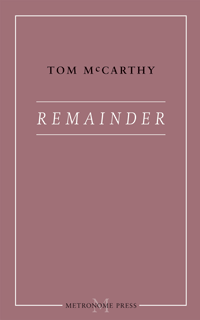
3:AM: Remainder — the best novel of 2005 which, due to its republication by Alma Books, looks set to be the novel of 2006 (ironically enough, given the theme of the book) — could be described as the best French novel ever written in English by an Englishman. With Tintin and the Secret of Literature, your approach is once again resolutely French. Almost all of your major references are French (Balzac, Baudelaire, Barthes, Derrida…), and even the vocabulary you use is Gallicized (“fictive,” for instance, which is far closer to the French “fictif” than “fictional”). Where does your familiarity with French culture and the French language come from? Was it deliberate on your part to largely avoid references to British or American literature? Wouldn’t it have been interesting to give a more English perspective on Tintin since Tintinologists have a habit of being Belgian or French?

TMcC: First of all, thanks for your kind words about Remainder, and I’ll try to persuade my French publisher, Hachette Littératures, to use your “best French novel in English” line as a blurb for their edition that’s coming out next September — I couldn’t think of better praise! Yes, most of the points of reference in Tintin and the Secret of Literature are French, although Defoe, Bunyan, Behn and other Anglo early novelists get a look in — plus there’s a big digression through Shakespeare’s Sonnets. I guess I just really like French literature. The English were going really well from the sixteenth to the nineteenth centuries, producing poets like Donne and Marvell and novels like Clarissa and Tristram Shandy, but it all went horribly wrong somewhere in the late nineteenth/early twentieth and, while the French (and Americans) embarked on the wildest adventures with thought and form — Mallarmé, Breton, Cendrars, Faulkner etc etc — we got Thomas fucking Hardy and DH fucking Lawrence. The only top-class twentieth century English writers are the ones we claim spuriously: Americans like Eliot and James, Poles like Conrad, Irishmen like Joyce and Beckett…

3:AM: At the same time, there is a sense of humour and earthiness which are very un-French, as it were. After the publication of a strange review in The Economist which presented your book as a send-up of French theory, you spoke to me of the astounding “idiocy of English empirical culture”: do you think Tintin and the Secret of Literature is going to reignite the critical Querelle des Anciens et des Modernes of the 80s and 90s?

TMcC: I think to ignite any thought at The Economist you’d need to stick a ton of semtex up their arses. That review was quite funny, though: it perfectly captured the red-faced, vein-popping fury of Little England once the values on which it bases its entire identity are ever-so-slightly “solicited”, as Derrida would say. English takes on Tintin always present Hergé as a ’satirist’ and only that: a self-sufficient, rational subject who uses words and images as tools to tell us something he knows because he’s worked it out, rationally, you see. That’s the empirical line on literature tout court: the rational expression of a self-sufficient subject — as though we weren’t constantly made and unmade within language, desire, history, symbolic networks and so on. It’s as moronic as crediting a surfer with creating the wave which carries him and allows him to ply his craft — and back into which he’s eventually going to sink.

McCARTHYISM

3:AM: You say that you were introduced to Tintin by your mother at the age of seven. That, in itself, probably says a lot about your social background — that and your early encounter with Hugo Williams (mentioned by the poet in an article he wrote in the TLS about your International Necronautical Society). In France, in the 70s, Le Journal de Tintin tended to be read in Catholic and conservative circles whereas kids from Communist families usually read a comic called Pif. What sort of social and cultural milieu were you raised in, Tom?

TMcC: I come from a liberal arts-steeped middle-class family. My mum would tell us the stories of The Odyssey and The Merchant of Venice on car journeys. My parents were left-ish but not radical. They voted Labour but I went to a private day-school from the age of twelve.

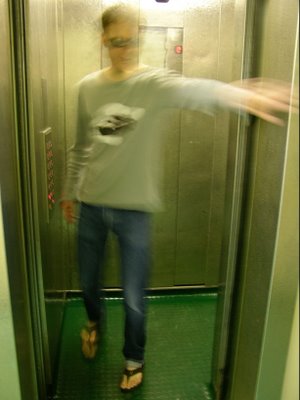
3:AM: You write that “Everybody wants to be Tintin,” but I get the feeling that that everybody applies, first and foremost, to you. You even bear a slight physical resemblance to Hergé’s hero…

TMcC: I went to a fancy dress party dressed as Tintin once…

3:AM: Susan Tomaselli rounds off her review with the claim that Tintin and the Secret of Literature made her feel like re-reading Remainder (your debut novel) rather than the Tintin books themselves. Do you see this as a success or a failure?

TMcC: Success — although she should read the Tintin books too. In a way, I used Tintin and the Secret of Literature to work through some of the themes in Remainder in a more conscious way: the relationship between trauma and repetition, for example, or the idea of inauthenticity which emerged from the de Man essay “The Rhetoric of Temporality”, which I hadn’t read when I wrote Remainder even though it could almost be describing that book. It’s great to be able to switch modes, and come at the same territory from a different angle.

WE WANTED TO BLOW UP TIME ITSELF

3:AM: Your whole oeuvre seems to be contained within this critical essay: Tintin and the Secret of Literature could thus be read as a work of internal intertextuality. First of all, there’s the importance of meridians which points to Greenwich Degree Zero, your recent artistic collaboration with Rod Dickinson…

TMcC: …when we blew up the Greenwich Observatory, or at least produced the documentation of having blown up the Observatory, completing the task of Martial Bourdin, model for Conrad’s Stevie in The Secret Agent. We wanted to blow up time itself. Funnily enough, there’s a scene in The Broken Ear where a secret agent like Stevie carries a time-bomb around and gets blown up by it because he doesn’t realise the town clocks have broken. I love the sequence in The Sound and the Fury where Quentin carries a broken clock around and rides trams in different directions in a sub-Einsteinian attempt to escape time — then dies…

WE WANTED TO BLOW UP BRIDGES

3:AM: Then you’ve got the references to Cocteau’s Orphée and, more generally, your fascination with the “transmission-reception figure” (as you put it elsewhere): “[Tintin] will also be aware, as a radio operator, that the waves which carry his transmissions will travel outwards endlessly through space. Who knows where the signals will end up, or what they will end up meaning?” (p. 91).

TMcC: If I had to select five things to put in a space capsule to show aliens what we were capable of, Orphée would be one of them. It’s the most perfect piece of art, which lays out our existence as being in relation to death, technology, transmission-reception and desire — not to mention repetition. Death, a beautiful princess (and arts patron) falls in love with Orphée so she has another poet snatched to the underworld so he can send illicit, looping radio messages to Orphée which draw him towards her, through a mirror. Cocteau based his radio messages on the ones sent to occupied France during World War Two: these short lines of poetry. Most of them meant nothing, but one in every two hundred meant — only to those who knew — ‘blow up the bridge’. A man or woman in London reads a line of poetry into a microphone and in France a bridge blows up — or not. Poetry — real poetry — should harbour that potentiality somehow.

3:AM: You talk about Alph-Art, the eponymous avant-garde movement of Hergé’s posthumous book, which is “a cover for a giant forgery operation” (p. 158). Couldn’t this also be a fitting definition of your own “semi-fictitious” avant-garde movement, the International Necronautical Society?

TMcC: The INS had its own radio transmission network, operating out of the ICA two years ago, generating messages like Cocteau’s and actually transmitting them over the radio London-wide (and, via collaborating radio stations, world-wide). It looked like a giant factory floor, with workers running everywhere carrying lines of text — lines which, having been plucked from other media sources, were kind of second-hand if not fake. The INS is itself semi-fake, as you point out. Although the fake can hide the real.

THE UNNAMEABLE

3:AM: On page 84, you explain that, according to Freud, trauma produces “a desire for repetition mixed with a need to disguise the scene being repeated”. Could you comment on this sentence with reference to your novel Remainder?

TMcC: It’s not just Freud who says this: even his most positivist counterparts concur. Under ultra-extreme stress, the part of the mind that processes raw data into the narrative thread we call ‘memory’ simply goes on strike and refuses to process. It’s called ‘dissociation’. So the data’s present, but not dealt with, and therefore keeps bobbing up and demanding to be incorporated somehow. As it can’t form part of normal memory, it plays itself out in weird ways — ones that contain elements of the original event but are also scrambled, disguised. And it will keep repeating, albeit in modulated form, until it is accommodated properly. Well, in Remainder the hero has undergone a traumatic event which he hasn’t retained as straight memory but rather as fragments of data: the sense of being about to be hit, blue lights, railings, being held above a tray or bed and so on. These induce a propensity to repeat stuff in him. Another interesting thing about post-trauma is that (to return to a motif we touched on a moment ago) it makes people feel inauthentic, fake, because everything is of a lesser magnitude of experience than the trauma-moment itself, the only ‘real’ thing. And then the subject back-projects for himself a time when he wasn’t fake, and longs for that time. That’s what my guy is doing with his re-enactments: repeating backwards to an imagined era of authenticity — but repeating, more accurately, towards the trauma-moment itself, the true, unnameable moment, the moment of truth and unnameability itself.

THE CHINK ON THE CARPET

3:AM: The re-enactments in Remainder or in your artistic work: mimesis or simulacrum?

TMcC: Aha: very good question, bang on the money. In Remainder, he wants the authentic, so he sets up a zone of mimesis, paying architects and designers to recreate his ‘remembered’ building and re-enactors to ‘be’ the lady he remembers frying liver on the floor below him, the pianist he remembers practising Rachmaninoff and so on. He wants to accede through these re-enactments to a mode of authenticity, of simply ‘being’ rather than simulating. But of course it doesn’t work: the re-enactments tend more towards the status of simulacra, what Plato defines as ‘a copy without an original’. But then, paradoxically, the most jarring and obviously inconsistent things, the ‘extra’ bits, the ones with no originals of any type at all, are what catapult him into ultra-authenticity — which, not coincidentally, is also pure violence. It’s the little chink on the carpet of his re-enacted bank heist that flips the whole re-enactment over into all-too-real-ness, when the re-enactor trips on it, or rather on its absence, and his gun goes off…


[Stewart Home and Tom McCarthy at 3:AM Magazine‘s Xmas Bash, London 2005]

THE CRACK IN THE WALL

3:AM: Barthes writes that “…the ‘realistic’ artist never places reality at the origin of his discourse, but only and always, as far back as can be traced, an already written real, a prospective code, along which we discern, as far as the eye can see, only a succession of copies” (quoted on p. 55): this is also, unwittingly, what the protagonist of Remainder does, right?

TMcC: Remainder has been read by some critics as an allegory of realism and of the realist mode of art, and this isn’t an entirely wrong reading — although if the hero had actually been an artist rather than an Everyman, some bloke, it would have been an entirely different, and inferior, book. But yes, it definitely turns around his copying, and even (as he sets about getting his re-enactors to re-enact the moments when they prepared for the previous re-enactment) his copying his moments of copying, endlessly regressive. We can try to work it out together, but ultimately I can’t give the definitive schematic meta-reading of the book any more than you — perhaps less. It was intuitive: I was looking at a crack in a wall and had a moment of dejà-vu and wished I had loads of money to re-enact this moment and there was the novel.

EVERYTHING LITERATURE SHOULD BE

3:AM: When discussing tobacco throughout the Tintin books, you explain (following Derrida) that it “goes up in smoke” but “also leaves remains, ashes, which maintain symbolic links to memory, death and inheritance. Baudelaire’s story takes off from the change left over from the two friends’ luxury expenditure: like the coin itself, it proceeds from the remainder” (p. 135). Why are remnants so important in your work?

TMcC: It’s what’s left. After the disaster, after thought, interpretation, writing itself. It’s like when Wallace Stevens says “The plum survives its poems”. Writing has to deal with this remainder, and good writing has to deal with the fact that it can never fully deal with it. Francis Ponge knows this. He writes brilliant prose poems about, for example, oranges: the texture of their cells, the way they leave goop on your hands so that even when you’ve ‘expressed’ them there’s a residue that’s not contained. If Susan Tomaselli or anyone else really want to do themselves a favour, they should re-read neither Remainder nor the Tintin books but rather Ponge’s Le Parti pris des choses (you can get it in dual text). It’s everything writing should be.

[This interview was initially posted here.]
The Not-Oyster Bit

Tom McCarthy interviewed about Tristram Shandy in Henry HitchingsBirth of the British Novel broadcast on BBC Four, 7 February 2011:

HH: What is a novel?

(Tom McCarthy laughs.)

TMC: A novel is something that contains its own negation, right? So a novel is not a novel without an anti-novel lodged in it. It’s like an oyster: it isn’t interesting unless it has got a bit of grit in it as well — that not-oyster bit that kind of produces the pearl. In Tristram Shandy, this is precisely what produces the drama: the central drama of that book is its own undermining. And I think, in a way, this is what every book should be, in one way or another.

The Impossibility of Narrating the Event

Tom McCarthy interviewed by Richard Wolinsky, Bookwaves (KPFA) 1 November 2010:

“This idea of reconstruction, of how to narrate the event: this is the kind of conceptual impossibility at the core of Remainder, which involves this guy elaborately spending millions of pounds to hire people to reconstruct events that he vaguely remembers — and they never get it right because you can’t. And, I suppose, this is almost a metaphor for all of narrative: the impossibility of actually narrating the event.”

The Expatriate Literary Scene in Paris

Anthony Cuthbertson, “From the Lost to the Beat to Now,” Notes From the Underground 19 November 2010

The expatriate literary scene in Paris

What Allen Ginsberg called, ‘The bewildering beauty of Paris’ has attracted writers and artists for centuries. It has been the setting of great novels and the home of great writers, and in the last hundred years has briefly been the stage for two waves of expatriate writers that changed the face of modern literature: the Lost Generation and the Beat Generation. Fifty years have passed since the latter faded away, and though the expatriate literary scene has remained vibrant, no significant movement has since emerged. However, with the arrival of new soirées, literary journals, writers’ workshops and readings, as well as a fresh generation of writers flocking to Paris, a new wave may well be rolling in.

Historically, Paris has been a place of refuge for artists and writers. It has attracted political and cultural exiles fleeing the injustice and intolerance of their homelands, offering them a liberal safe haven and allowing them artistic freedom. In the 1920’s and 1950’s it became a place of escape for those left disenfranchised by the World Wars. The Génération perdue, as Gertrude Stein named them, included writers like Ernest Hemingway, Ezra Pound, F. Scott Fitzgerald, T.S. Eliot, and later James Joyce and Samuel Beckett. They were a generation disillusioned by the horrors they had witnessed in the First World War, and who felt disaffected and betrayed by their governments back home. Pound wrote of his contemporaries, ‘(they) walked eye-deep in hell believing in old men’s lies, then unbelieving came home, home to a lie’. They gathered in cafés and hung about Stein’s salon to share ideas, bottles of absinthe and write, together forming a movement that still resonates strongly today.

By the time the Second World War and the occupation of Paris came about, these writers had for the most part moved on. Although some later returned after the war (Hemingway famously ‘liberated’ rue de l’Odéon, the then site of the bookshop Shakespeare and Company), a new literary movement in the form of the Beat Generation arrived. Leading figures of the Beats, including William Burroughs, Gregory Corso and Ginsberg, came to Paris for much the same reasons as their predecessors. They sought refuge from the strict conformist confines of McCarthy-era America and found it in Paris. In the years that have followed the departure of the Beats, Paris has remained a centre for culture and art. It continues to attract writers and artists with its history and beauty and the lively literary scene is a reflection of its magnetism.

The first stop for any would-be writer or literary pilgrim should be Shakespeare & Company. Its location may have moved over the years but the spirit and the name have remained. The current owner, George Whitman, has described it as ‘a den of poets and anarchists disguised as a bookshop’, having been sanctuary to writers of both the Lost and Beat Generations. The writers, whom George refers to as ‘tumbleweeds’, drift through the doors and find community and lodging in the poky upstairs rooms in exchange for helping out in the shop below. Supporting young writers continues to be one of the cornerstones of S&C. As well as providing a place to stay, they hold workshops, readings and even organize a literary festival every other year. They have also recently relaunched their literary magazine (The Paris Magazine), and announced the Paris Literary Prize (10,000€) for unpublished writers. In its current location on the banks of the Seine it is as much a tourist attraction as it is a bookshop, but between the piles of books still remain bunks for the next hopeful Hemingway to stay.

Beyond this pillar of the past not much remains of the old haunts of writers beyond landmarks and tourist traps. It is easy to get lost wallowing in the myth of Paris but for new writers it is essential to escape the seductive expatriate past, away from the romance of the Latin quarter and the ghosts that wander the left bank, and over to the other side of the river to where the literary scene is shifting.
Boulevard Saint Germain and its surrounds have developed from bohemian havens to bourgeois hangouts popular with tourists. The cafés once frequented by the likes of Hemingway and Joyce, such as Café de Flore, Les Deux Magots and Le Dôme, now sell souvenir memorabilia and a cup of coffee can set you back six euros.

Nowadays it is areas like Belleville and the 19th and 20th arrondissements in the east of Paris where the cost of living is the cheapest that have become the new centres of the literary scene. These parts of Paris continue to provide a conducive environment for young and aspiring writers.

Paris-based writers have often remarked that unlike other big city literary communities, Paris has an open-minded and accepting scene that encourages experimental forms and welcomes outsiders. David Barnes, the founder and compère of a spoken word poetry night in Belleville at Culture Rapide, describes Paris as “a beautiful backwater where life is slower than New York or London. It gives breathing space, distance from the anglo-metropoles that supports writing”.

He argues that the English speaking community in Paris is just the right size “to come together and do something, to provide a home and platform for, to nurture and be nourished by.” The spoken word nights that take place every week welcome anyone and everyone up on stage to read a poem, tell a story or perform a play — the only rule being ‘make the words come alive’. A collective has formed around this café with regulars comprising English speakers from around the world.

In an age where literary scenes and movements are becoming more international by way of the internet, less centred around a location and more around uniting notions and ideals, Paris has managed to retain its place as one of the world’s literary hubs. Since the turn of this century, a movement referred to as the Offbeat Generation has partly formed in Paris. They comprise of a loose collection of like-minded writers, including Lee Rourke and Booker prize nominee Tom McCarthy, who feel alienated by a mainstream publishing industry dominated by marketing. Paris is home to the founder of this movement, Andrew Gallix, whose Paris-based literary magazine 3:AM has provided the main platform for the Offbeats.

Other English language literary magazines that have formed in Paris in recent years include Double Change, Upstairs at Duroc and Platform. The most recent of these, Platform, formed around the spoken word night at Culture Rapide.

As fate would have it, this new scene that is emerging is forming beside where many of their predecessors have found their final resting place: the Père-Lachaise cemetery. It is behind these gates that you can find the graves of such literary icons as Gertrude Stein and Oscar Wilde.

Its legacy may be one of the great appeals of Paris, though it is the smallness and accessibility of the anglophone writing communities, combined with their supportive and inclusive atmospheres, that is currently causing such a surge in the scene. It seems now that the stories shape the city as much as the city once shaped the stories and for any aspiring writer coming to Paris it would be easy to feel intimidated by the past. For them it is perhaps best to consider again the words of Allen Ginsberg: “You can’t escape the past in Paris, and yet what’s so wonderful about it is that the past and present intermingle so intangibly that it doesn’t seem a burden”. The scenes may be as transient as the writers, but the essence of Paris endures.

It’s All Greek

Here is a short, unpublished review of Tom McCarthy‘s C:

It’s All Greek

How do we recombine the debris of literary history?

Inspired By: Cocteau’s Orphée in which dead poet broadcasts coded messages on living poet’s car radio, hence the author as listener-repeater; Background: Concept of the crypt (site of an encoded primal scene) linking Cocteau, Freud’s Wolf Man, invention of telephone, discovery of Tutankhamun and Nabokov’s Ada; Protagonist Modelled On: Alexander Bell, Maurice Blanchot, Howard Carter, Marinetti, Orpheus, Sergei Pankejeff, Georg Trakl; Obligatory Plot Summary: Born, fails to mourn dead teenage sister, treated for melancholia in central Europe, airborne radio operator during WWI, student in drug-fuelled 20s London, civil servant in spy-ridden Egypt, dies; Representative Sentence: “What he sees is darkness, but he sees it.”

The history of Tom McCarthy’s debut, Remainder, has almost achieved legendary status. It was first released on a tiny Parisian art press, having been spurned by all the major publishing houses in Britain, yet ended up making the cover of the New York Times, receiving the 2008 Believer Book Award and being lauded by Zadie Smith as “one of the great English novels of the past ten years”. Where do you go from there? Backwards, of course, like Dr. Learmont’s face that seems to multiply “down a telescoping corridor of memories” [77] or the archaeologists in Egypt — not to mention Serge with his predilection for coitus a tergo. McCarthy’s second novel, Men in Space, was mostly written before his first. His third — which is being touted as his big breakthrough — stems from Calling All Agents (2003), a fascinating essay that already contained all the keys to his book to come. Imagine a Bible concordance predating The Bible itself. In fact, C is CAA re-encrypted: a space in which the event that is true literature can take place.

With his first period piece, McCarthy goes back to the future (and Futurism) in order to rescue fiction from its current impasse. The timeline of this Bildungsroman is highly significant. It begins in 1898 — when Serge Carrefax is born to the “mechanical buzz” [10] of his father’s wireless radio experiments — and ends in 1922 — the year of The Waste Land and Ulysses — when he dies. The association between modern communications technology and modernism provides the backdrop to a redefinition of literature as transmission rather than self-expression.

Unsurprisingly for a novel revolving around incest — both literal and metaphorical — C contains numerous mises en abyme. There’s the tapestry of a staircase hanging above a staircase, or the school pageant (a nod to The Mousetrap in Hamlet) that dramatizes the Orphic theme underlying the entire work. The most apposite is Sophie’s “strange associative web” [71] that proliferates like a tumor and seems to harbor some dark secret within its intricate ramifications. McCarthy’s text also keeps generating new meanings, sometimes of its own volition, as words and ideas cross-fertilize in incestuous ways. Language, says Heidegger, speaks. Thus Sophie mutters beautiful schizophrenic gibberish as though she had “turned herself into a receiver” [75]. The Morse code clicks sometimes seem to be “speaking on their own” [67]. The deaf children are spoken through, their voices “ventriloquised” as if “piped in from somewhere else;” [4] their utterances resembling “a mispronounced version of something else, other sentences that are trying to worm their way up to the surface, make themselves heard” [79]. The headlong rush into modernity, away from the parodic pastoral setting, is paralleled by a return to the primitive magic of the oral tradition. The idea that something may even be lurking behind mere hearing is often hinted at. “[M]uffled signals” [83] are half-heard through wireless static (itself likened to “the sound of thought” [64]). Serge is haunted by “vague impressions of bodies hovering just beyond the threshold of the visible” [68] when riding “the dial’s far end” [83].

The protagonist teeters on the brink of some revelation that eludes him until he receives the ultimate, hallucinatory “call”. The reader can also break the code: incest is the encrypted primal scene of literature — the scene of our failed mourning for the works of the past. It’s all Greek, in the end.

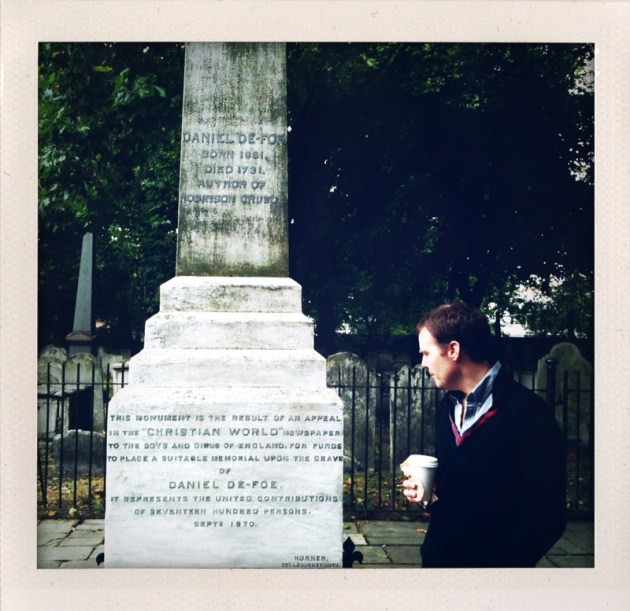
[Picture: Tom McCarthy and Daniel Defoe, Bunhill Fields, London, August 2010. By Andrew Gallix.]

Melancholia as Ultimate Rebellion

Excerpts from Lee Rourke, “In Conversation: Lee Rourke and Tom McCarthy,” The Guardian (Guardian Review p.12) Saturday 18 September 2010

Lee-Rourke-and-Tom-McCart-006
[Lee Rourke (left) and Tom McCarthy. Photograph: Eamonn McCabe for the Guardian]

LR: You’ve said in the past that all art is repetition.

TMcC: Yeah: Joyce’s “commodius vicus of recirculation” . . . Or Mark E Smith’s three Rs: repetition, repetition and repetition . . .

LR: I’ll drink to that. It’s like a never-ending transmission that can’t be switched off.

TMcC: The transmission thing is important. There’s that Kraftwerk song, “I am the receiver and you are the transmitter”, or however it goes. One way of thinking about art, or the novel, is that the writer is the transmitter, the originator: I have something to say about the world and I’m going to transmit it. But this isn’t how I see it, I see it as exactly the inverse: the writer is a receiver and the content is already out there. The task of the writer is to filter it, to sample it and remix it — not in some random way, but conscientiously and attentively. This is what Heidegger says about poets: to be a poet is to listen before speaking; it’s first and foremost a listening and not a speaking. Kafka said it as well: “I write in order to affirm and reaffirm that I have absolutely nothing to say.” Writing, or art, is not about having something to say; it’s about aspiring to a heightened state of hearing. It’s why C is a totally acoustic novel and a receptive novel. The hero, Serge, sits there for hours trawling the aether waves, absorbing, listening to ship-to-shore transmissions, stock market prices, sports results, writing them all down. In a way, if you could see Serge’s transcript it would probably read like an Ezra Pound canto.

LR: This is why Serge is so brilliant, because all this absorption culminates in a form of pure poetry. I’m thinking of the novel’s “Chute” section, especially the first world war passages. Serge in his plane over enemy lines, flying above and below, marking the sky around him with these wonderful vapour trails while shooting up heroin and quoting Hölderlin, and so on. Where does all that come from? I know you’re interested in Marinetti’s manifestos.

TMcC: For Serge the whole battlefield becomes a sound box. He thinks of his machine gun, when he’s firing it into the trenches below, as like a needle being aligned with the groove of a record. When the needle goes in, static comes out, and it all resonates: the percussion of machine-gun fire, the siren wail of howitzers. The difference between Serge and Wilfred Owen is that Serge loves war. By the way, talking of Marinetti: it’s interesting that Marinetti’s novels, which supposedly enact the propositions of his many manifestos, are much less interesting than the manifestos. And the paintings that people did based on his manifestos are much less good as well. The manifestos are a kind of field of potentiality that to actually realise would spoil.

LR: You’ve stated recently that C is essentially a novel about desire as much as about technology, and the “looping” of both within time. This puts me in mind of Beckett’s Krapp’s Last Tape. This idea that technology doesn’t take you forwards into the future, but actually takes you back towards your past.

TMcC: When Beckett’s old man is listening to these old tapes of himself, what it actually comes down to is desire — it’s incredibly moving. He’s there at the end, the end of his life, he wants to stop replaying it, all the loopings, snarling “Wasn’t once enough?”; but he listens again and again and again to this incredibly lyrical passage that he’s recorded about 30 or 40 years ago about him floating in a punt, with a girl, and the water all around them, I mean, it’s fucking amazing, it’s really, really beautiful. This is it, you see: what we find in technology and networks is desire. Which doesn’t mean the desiring individual; it means desiring consciousness itself. That’s why I wanted Serge Carrefax to be more than an individual; if he was a circuit he’d be over-charged. The surge is too much, it blows. It’s about the desire for impossibility. Giorgio Agamben, when describing melancholia (which Serge has in spades), says that the condition isn’t at all a detachment from the world, even though it may seem like it; in fact it’s an investment in the world so much that the desire for the world exceeds its own limit. The melancholic wants what is impossible; he wants impossibility itself — to experience it and to merge with it. To surge towards it. That’s why the melancholic is the ultimate rebel.

LR: Is it a desire for the impossible, or nothingness, to become real? To become a tangible thing?

TMcC: No, I think it’s more than that. I mean Pygmalion gets that: he wants the statue and then it becomes real, and that’s cute. But take Orpheus looking back: he’s far more interesting. He doesn’t really want Eurydice, he wants the dark night. As Maurice Blanchot brilliantly points out, he wants death itself. Not to make the night illuminated or present, but to have it in its absence, to have the presence of absence, something that is impossible. It’s doomed, beautiful and tragic.

LR: This is Blanchot’s Orpheus’s Gaze

TMcC: Right. It’s an essay about five pages long and it’s the most amazing summary of what literature is, or could be, ever written. It’s not about representing the world, it’s not about criticising the world even. It’s about surrendering to a vertigo that can never be mastered, to an abyss that can never be commanded, or excavated or filled in.

LR: But you can leave your mark, right?

TMcC: Yeah, the scratch. Scratching the negative. That’s what artists do at their very best.

C By Tom McCarthy

This appeared in the September 2010 issue of Dazed & Confused (vol. 2, issue 89, p. 196):

C by Tom McCarthy

Incest, spies and coke-fuelled adventures

Let’s not beat about the bush: Tom McCarthy’s third novel, C, is a masterpiece: a sprawling associative web that keeps generating new meanings as though of its own volition. “That’s the beautiful thing about what literature does to language,” says McCarthy. “You stick these slippery terms in and they start cross-fertilising in ways you never anticipated — incestuous ways.” C takes us from a fairytale English silk farm to spy-ridden Egypt by way of a central European spa town, aerial warfare and a coke-fuelled London filled with bright young Amazons. It is a comedy of errors, a gothic mystery, a boy’s own story; a traditional 19th-century novel seemingly rewritten by Burroughs or Ballard. You’ll find geometry, technology and trauma. Loops, repetitions and mutations. Incest, insects and radio bugs. And phantom words emanating from subterranean worlds half-glimpsed “at the dial’s far end”. Tune in…

DAZED & CONFUSED: C could be seen as a futurist novel. Serge, the protagonist, even seems to be partly modelled on Marinetti himself…
TOM MCCARTHY: I love Marinetti, and, yes, he’s part of Serge’s make-up, particularly in the war section. But Serge is equally a mixture of Freud’s Wolf Man, the beautifully fucked-up melancholic eternally grieving for his dead sister; and Alexander Bell, inventor of the phone (who also lost two siblings); and Howard Carter, the Egyptologist who disinterred the ur-family tomb; and a bunch of other people. I’m interested in the places where technology and mourning intersect.

There’s also a strong retro-futurist — even steampunk — element to C. Did you feel the need to revisit the early 20th century in order to reinvent the future of the novel?
Yes. Walter Benjamin says that the angel of history faces backwards. I think it’s the same for literature: you’ve got to look back in order to move forwards. It’s not just the foundations of contemporary technology that are being laid in the early 20th century (the code radio bugs used exactly anticipated text speak, just as lots of their output anticipated Twitter), but also literature’s period of high modernism that’s coming to a head. Not for nothing does the novel end in 1922: it’s the year that Ulysses and The Waste Land came out. The task for the contemporary writer (sadly, one which many writers of today are shirking) is to work through that period’s legacy — dynamically and radically, but attentively too.

All the major themes in C — from wireless technology to the discovery of Tutankhamun — come from your early experiments with the International Necronautical Society (INS), don’t they?
I had the idea for C while I was working on the INS project at the ICA. There, we had a radio station modelled on the illicit one in Jean Cocteau’s film Orphée (where the person transmitting is already dead), sending out all these coded poetic messages. I was looking at writing around encryption, and the concept of the ‘crypt’ that you get in psychoanalysis and philosophy.

Incest lies at the heart of C: this, for you, is the source code of western literature, right?
Yes. You go back from Nabokov through Faulkner through Racine right back to Sophocles, and incest is the central theme that keeps recurring. For Freud, the incest prohibition is what makes us civilised, socialised, even human, so that’s the taboo all tragic heroes, who are fundamentally doomed rebels, are most drawn towards transgressing.

Why do you think that all new means of telecommunication are linked to death, mourning and melancholia?
I don’t know if I can explain it. It’s just a pattern that keeps recurring. For every comm-tech invention, there seems to be a dead sibling somewhere. Bell even made a pact with his brother that, if one of them died like their other brother had, the surviving one would invent a device capable of receiving messages from the dead. Then the second brother dies, and Bell invents the telephone. He remained a rationalist, a sceptic — basically because his brothers never called. But the desire, the fantasy, is there in the technology: a ghost in the machine. It’s the same with radio. Seances in the 20s weren’t about spirit and ectoplasm any more: they were about “tuning in” to voices resonating on high frequencies, like radio waves. With the internet, it seems to be more about a presence than an absence: everything’s there, every click and keystroke ever made eternally retrievable, a giant archive. That’s a kind of haunting too, though.

Text and Photography
ANDREW GALLIX

Inalienable Silence

Tom McCarthy, Calling All Agents (London: Vargas Organisation, 2003). 4-5.

“…And yet the Hearings left us with the impression that if (as Gil Scott Heron says) the Revolution will not be televised, then perhaps its nucleus will not be caught on audio tape or broadcast on the airwaves either — or if it will, then it will take the form of silence. For Heidegger, everything stems from the Unspoken: Being calls us, but it does so ‘in the uncanny mode of keeping silent.’ Burroughs’s revolutionary drive extends to a transformation of language that will help cast off the ‘IS’ of identity: this language, he tells us, will be a hieroglyphic one that ‘will give one the option of silence.’ Hollings, discussing Burroughs in an article, writes: ‘Recorded silence only becomes a political act once it is played back.’ There are echoes of Cégeste’s first message here. Hollings was a contributor to Violent Silence (a book about Bataille), a collaborator with John Cage and at the time of the Hearings was conducting research into the erased passages in Nixon’s Watergate tapes. What did he mean ‘recorded silence only becomes a political act once it is played back,’ we asked him. ‘Playing a blank tape,’ he told us, ‘breaking the seal on something and sticking it in a machine and listening to it, is an act of refusal.’ ‘So there is a kind of inalienable silence that is encrypted somehow?’ Anthony Auerbach asked; ‘And this potentially contains the revolutionary moment?’ ‘Exactly so,’ said Hollings. This is the violent silence of Shakespeare’s Cordelia, who tells her father ‘Nothing’ — a single word which leads to general annihilation, wars and madness; or of Stephen Daedalus, self-styled ‘Cordoglio’ who, as he brings about ‘the ruin of all space, shattered glass and toppling masonry, and time one livid final flame,’ says ‘Nothing!’ ‘Maybe,’ I suggested, ‘our radio project should be a quest for that silence’ — a suggestion to which Hollings answered, in what turned out to be the Hearings’ final exchange: ‘I would strongly recommend it.’…”

On p. 12, McCarthy mentions Burroughs’s “putative hushed-up language”.

On p. 16: “This silent word is so charged and so seductive, Abraham and Torok conclude [in Cryptonomy: the Wolf Man’s Magic Word], that it and it alone becomes the object of the Wolf Man’s love. To keep it safe he buries it inside the crypt ‘like a chrysalis in its cocoon’ and carries it around for all his life, showing and hiding it, saying it without saying it, ‘repeating tirelessly to one and all, especially to his analyst: ‘Here is nothing, hold it tight’.”

“‘Poetry,’ in the words of Auden, ‘makes nothing happen’ — an active construct in which ‘nothing’ designates an event, perhaps even a momentous one. In looking into the abyssal ground, reading its source code and transmitting this nothing outwards, maybe we will find that our culture also [like Freud’s Wolf Man] has a secret, silent word.”

We Are All Necronauts

409692229_e75d124f7c_t

This appeared in the summer 2009 issue of Flux magazine (issue 69, pp. 42-43):

We Are All Necronauts

For the past decade, the International Necronautical Society has been encouraging us to learn to die in new, imaginative ways

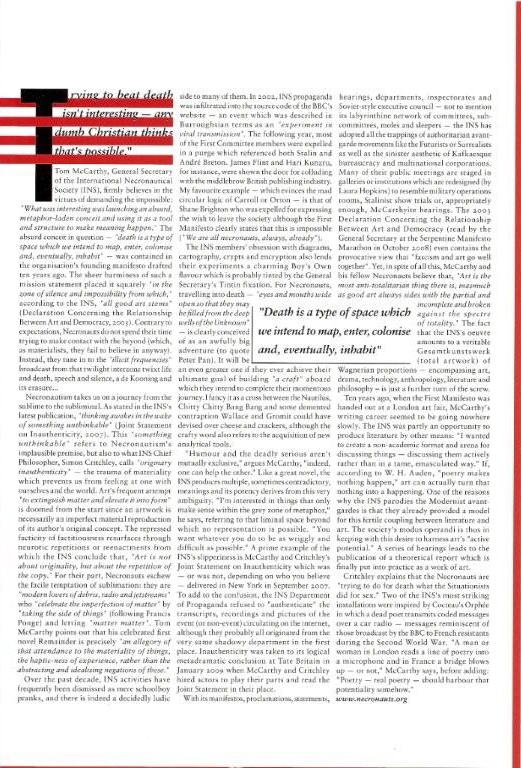
“Trying to beat death isn’t interesting — any dumb Christian thinks that’s possible.” Tom McCarthy, General Secretary of the International Necronautical Society (INS), firmly believes in the virtues of demanding the impossible: “What was interesting was launching an absurd, metaphor-laden conceit and using it as a tool and structure to make meaning happen.” The absurd conceit in question — “death is a type of space which we intend to map, enter, colonise and, eventually, inhabit” — was contained in the organisation’s founding manifesto drafted ten years ago. The sheer barminess of such a mission statement placed it squarely “in the zone of silence and impossibility from which,” according to the INS, “all good art stems” (Declaration Concerning the Relationship Between Art and Democracy, 2003). Contrary to expectations, Necronauts do not spend their time trying to make contact with the beyond (which, as materialists, they fail to believe in anyway). Instead, they tune in to the “illicit frequencies” broadcast from that twilight interzone twixt life and death, speech and silence, a de Kooning and its erasure…

Necronautism takes us on a journey from the sublime to the subliminal. As stated in the INS’s latest publication, “thinking awakes in the wake of something unthinkable” (Joint Statement on Inauthenticity, 2007). This “something unthinkable” refers to Necronautism’s implausible premise, but also to what INS Chief Philosopher Simon Critchley calls “originary inauthenticity” — the trauma of materiality which prevents us from feeling at one with ourselves and the world. Art’s frequent attempt “to extinguish matter and elevate it into form” is doomed from the start since an artwork is necessarily an imperfect material reproduction of its author’s original concept. The repressed facticity of factitiousness resurfaces through neurotic repetitions or reenactments from which the INS conclude that “Art is not about originality, but about the repetition of the copy”. For their part, Necronauts eschew the facile temptation of sublimation: they are “modern lovers of debris, radio and jetstreams” who “celebrate the imperfection of matter” by “taking the side of things” (following Francis Ponge) and letting “matter matter”. Tom McCarthy points out that his celebrated first novel Remainder is precisely “an allegory of that attendance to the materiality of things, the haptic-ness of experience, rather than the abstracting and idealising negations of these”.

Over the past decade, INS activities have frequently been dismissed as mere schoolboy pranks, and there is indeed a decidedly ludic side to many of them. In 2002, INS propaganda was infiltrated into the source code of the BBC’s website — an event which was described in Burroughsian terms as an “experiment in viral transmission”. The following year, most of the First Committee members were expelled in a purge which referenced both Stalin and André Breton. James Flint and Hari Kunzru, for instance, were shown the door for colluding with the middlebrow British publishing industry. My favourite example — which evinces the mad circular logic of Carroll or Orton — is that of Shane Brighton who was expelled for expressing the wish to leave the society although the First Manifesto clearly states that this is impossible (“We are all necronauts, always, already”).

The INS members’ obsession with diagrams, cartography, crypts and encryption also lends their experiments a charming Boy’s Own flavour which is probably tinted by the General Secretary’s Tintin fixation. For Necronauts, travelling into death — “eyes and mouths wide open so that they may be filled from the deep wells of the Unknown” — is clearly conceived of as an awfully big adventure (to quote Peter Pan). It will be an even greater one if they ever achieve their ultimate goal of building “a craft” aboard which they intend to complete their momentous journey. I fancy it as a cross between the Nautilus, Chitty Chitty Bang Bang and some demented contraption Wallace and Gromit could have devised over cheese and crackers, although the crafty word also refers to the acquisition of new analytical tools.

“Humour and the deadly serious aren’t mutually exclusive,” argues McCarthy, “indeed, one can help the other”. Like a great novel, the INS produces multiple, sometimes contradictory, meanings and its potency derives from this very ambiguity. “I’m interested in things that only make sense within the grey zone of metaphor,” he says, referring to that liminal space beyond which no representation is possible. “You want whatever you do to be as wriggly and difficult as possible”. A prime example of the INS’s slipperiness is McCarthy and Critchley’s Joint Statement on Inauthenticity which was — or was not, depending on who you believe — delivered in New York in September 2007. To add to the confusion, the INS Department of Propaganda refused to “authenticate” the transcripts, recordings and pictures of the event (or non-event) circulating on the internet, although they probably all originated from the very same shadowy department in the first place. Inauthenticity was taken to its logical metadramatic conclusion at Tate Britain in January 2009 when McCarthy and Critchley hired actors to play their parts and read the Joint Statement in their place.

With its manifestos, proclamations, statements, hearings, departments, inspectorates and Soviet-style executive council — not to mention its labyrinthine network of committees, sub-committees, moles and sleepers — the INS has adopted all the trappings of authoritarian avant-garde movements like the Futurists or Surrealists as well as the sinister aesthetic of Kafkaesque bureaucracy and multinational corporations. Many of their public meetings are staged in galleries or institutions which are redesigned (by Laura Hopkins) to resemble military operations rooms, Stalinist show trials or, appropriately enough, McCarthyite hearings. The 2003 Declaration Concerning the Relationship Between Art and Democracy (read by the General Secretary at the Serpentine Manifesto Marathon in October 2008) even contains the provocative view that “fascism and art go well together”. Yet, in spite of all this, McCarthy and his fellow Necronauts believe that “Art is the most anti-totalitarian thing there is, inasmuch as good art always sides with the partial and incomplete and broken against the spectre of totality.” The fact that the INS’s oeuvre amounts to a veritable Gesamtkunstswerk (total artwork) of Wagnerian proportions — encompassing art, drama, technology, anthropology, literature and philosophy — is just a further turn of the screw.

Ten years ago, when the First Manifesto was handed out at a London art fair, McCarthy’s writing career seemed to be going nowhere slowly. The INS was partly an opportunity to produce literature by other means: “I wanted to create a non-academic format and arena for discussing things — discussing them actively rather than in a tame, emasculated way.” If, according to W. H. Auden, “poetry makes nothing happen,” art can actually turn that nothing into a happening. One of the reasons why the INS parodies the Modernist avant-gardes is that they already provided a model for this fertile coupling between literature and art. The society’s modus operandi is thus in keeping with this desire to harness art’s “active potential.” A series of hearings leads to the publication of a theoretical report which is finally put into practice as a work of art.

Critchley explains that the Necronauts are “trying to do for death what the Situationists did for sex”. Two of the INS’s most striking installations were inspired by Cocteau’s Orphée in which a dead poet transmits coded messages over a car radio — messages reminiscent of those broadcast by the BBC to French resistants during the Second World War. “A man or woman in London reads a line of poetry into a microphone and in France a bridge blows up — or not,” McCarthy says, before adding: “Poetry — real poetry — should harbour that potentiality somehow.”

http://www.necronauts.org

1

2

Tom McCarthy & The Modern Lovers of Debris

409692229_e75d124f7c_t

This appeared in the March 2009 issue of Dazed & Confused (vol. 2 issue 71, p. 227):

Tom McCarthy & The Modern Lovers of Debris

The General Secretary of the International Necronautical Society is devoted to literature by all means possible

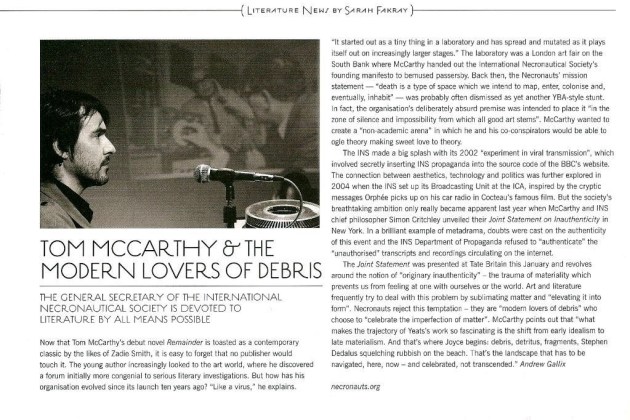
Now that Tom McCarthy’s debut novel Remainder is toasted as a contemporary classic by the likes of Zadie Smith, it is easy to forget that no publisher would touch it. The young author increasingly looked to the art world, where he discovered a forum initially more congenial to serious literary investigations. But how has his organisation evolved since its launch ten years ago? “Like a virus,” he explains, “It started out as a tiny thing in a laboratory and has spread and mutated as it plays itself out on increasingly larger stages.” The laboratory was a London art fair on the South Bank where McCarthy handed out the International Necronautical Society’s founding manifesto to bemused passersby. Back then, the Necronauts’ mission statement — “death is a type of space which we intend to map, enter, colonise and, eventually, inhabit” — was probably often dismissed as yet another YBA-style stunt. In fact, the organisation’s deliberately absurd premise was intended to place it “in the zone of silence and impossibility from which all good art stems”. McCarthy wanted to create a “non-academic arena” in which he and his co-conspirators would be able to ogle theory making sweet love to practice.

The INS made a big splash with its 2002 “experiment in viral transmission”, which involved secretly inserting INS propaganda into the source code of the BBC’s website. The connection between aesthetics, technology and politics was further explored in 2004 when the INS set up its Broadcasting Unit at the ICA, inspired by the cryptic messages Orphée picks up on his car radio in Cocteau’s famous film. But the society’s breathtaking ambition only really became apparent last year when McCarthy and INS chief philosopher Simon Critchley unveiled their Joint Statement on Inauthenticity in New York. In a brilliant example of metadrama, doubts were cast on the authenticity of this event and the INS Department of Propaganda refused to “authenticate” the “unauthorised” transcripts and recordings circulating on the internet.

The Joint Statement was presented at Tate Britain this January and revolves around the notion of “originary inauthenticity” — the trauma of materiality which prevents us from feeling at one with ourselves or the world. Art and literature frequently try to deal with this problem by sublimating matter and “elevating it into form”. Necronauts reject this temptation — they are “modern lovers of debris” who choose to “celebrate the imperfection of matter”. McCarthy points out that “what makes the trajectory of Yeats’s work so fascinating is the shift from early idealism to late materialism. And that’s where Joyce begins: debris, detritus, fragments, Stephen Dedalus squelching rubbish on the beach. That’s the landscape that has to be navigated, here, now — and celebrated, not transcended.”

1