Illicit Frequencies, or All Literature is Pirated

Here is my interview with Tom McCarthy that appeared in 3:AM Magazine on 13 July 2006.
3:AM: It’s very rare, these days, to see a work of literary criticism being given such prominence. Do you agree that this is probably largely due to the fact that the main subject is not Balzac or Baudelaire — two key references here — but a comic-strip hero?

TMcC: First of all, I’m not sure I’d describe Tintin and the Secret of Literature as ‘criticism’. More as an essay. I like the idea of the essay as a primary literary form. You can trace it from David Foster Wallace through Blanchot all the way back to people like Hazlitt. But yes, the fact that it revolves around Tintin and not just Balzac and Baudelaire has certainly helped it get attention — although it wasn’t strategic to do this. I genuinely rate Hergé’s work, and wanted to read it alongside Balzac, Baudelaire, Bergson, Bachelard and all the rest, hopping from one to the other in a set of playful, serendipitous detours — which is exactly what the essay format allows.

3:AM: Your book is very much in the tradition of Barthes‘s Mythologies (an anthology which you fail to mention). I can’t remember if Barthes actually mentions Tintin anywhere, but he certainly could have done. In a way, the two figures go curiously well together: Tintin’s heyday corresponds roughly to that of Barthes and both, today, appear a little quaint. Was it Barthes who inspired this book? After all, your Tintin is primarily a semiologist who “can navigate [a key word in the McCarthy canon] the world of signs” (Tintin and the Secret of Literature p. 22), a deciphering cipher who embodies (along with Snowy?) the presence of absence — the Melvillian “whiteness of the whale” (p. 161) — but also, of course, Barthes’s “écriture blanche”.

TMcC: I do kind of mention Mythologies when I refer to wrestling and tomato tins early on in the book. I love Barthes: he’s a beautiful, generous writer. He never mentions Tintin directly as far as I know, although Derrida, another big presence (or present absence or whatever) in my book, does, glancingly, in The Post Card. Hergé read Barthes; you can see his influence very directly in the final book, Tintin and Alph-Art, in which language becomes a set of physical signs, giant letters which are held up and scrutinised by his characters.

ODETTE’S BITS

3:AM: Are you the first to draw a parallel between Sarrasine and the Tintin corpus? I haven’t read Balzac’s novel, but, from what you write, La Zambinella seems to bear a resemblance to Proust’s Odette de Crécy. Am I mistaken?

TMcC: As far as I know I am the first to draw a parallel between Tintin and Sarrasine. I re-read Barthes’s S/Z, which turns around that particular novella, initially because I wanted to write about Hergé’s total mastery of plot: the way he misdirects, doubles, occludes, jams and so on, all these devices Barthes describes so well in his take on Balzac. But as I did I realised that there were loads of points of correspondence between Sarrasine and the Tintin books. Balzac’s eponymous artist becomes obsessed by the opera singer la Zambinella, like Captain Haddock does with Bianca Castafiore; he copies her, like the sculptor Balthazar does the fetish in The Broken Ear; he’s murdered, as is Balthazar; the copy is copied and these copies are themselves copied, in both. Fundamentally, it’s about entering the realm of denatured simulation that is art. La Zambinella’s voice draws Sarrasine backstage, into a world of artifice, just as la Castafiore’s voice draws Haddock backstage and on into a world of inauthenticity. And these worlds prove fatal: the castrato la Zambinella effectively kills Sarrasine, and ultimately the not-really-pubescent Tintin effectively kills Hergé.

With Proust, I’ve got to admit I’ve never got as far as the Odette bits in the Remembrance. There are passages I find completely compelling, like the bit about how you can construct a composite memory of a house from various other houses you’ve known or read about or seen in pictures (which is more or less what my hero does in Remainder, but other bits lose me, and I put it down again for two years, then re-read as far as the house bit, then same again: a kind of incomplete repetition loop. Perhaps that’s what Old Marcel would have wanted.

ILLICIT FREQUENCIES

3:AM: Given that the literary status of the Tintin books is uncertain/debatable, isn’t it a little perverse to analyse them in order to uncover the “secret of literature”?

TMcC: Yes — and that’s why I wanted to do it. It would be easy to identify literary motifs in Faulkner or Dickens or someone. But what does it tell us when a corpus that makes no claims to being ‘literature’ displays a symbolic register as developed as Faulkner’s and characters as deep and rich as Dickens’s, not to mention themes and plots more or less identical to Sophocles’s and Shakespeare’s: the fall of the noble house, family secrets coming out into the open, the relation between host and guest gone disastrously wrong and so on? So much of the very best literature opens up illicit frequencies so that meaning can travel along channels other than the obvious or rational. The Tintin books are full of these frequencies, these channels; they even dramatise their setting up, hunting down, rumbling and relocating. And then it struck me that literature as a whole might hide its most intimate secrets in the most illicit of all zones, one tucked away ‘off-stage’, ‘aside’, below the radar of literature proper, which is of course the kind of zone that cartoons lurk in.
3:AM: Could you tell us about the cover of the book and Tintin’s absence from the illustrations inside?

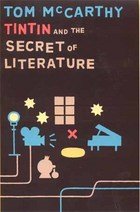
TMcC: The cover is by Jochen Gerner, a French artist. I saw a book he’d done called TNT en Amérique, in which he buried the whole of Tintin in America under black ink but left a few symbols, mainly of money, divinity and violence (i.e. dollar signs, crosses and guns, all done in cartoony style) as markers for what he’d erased — all on the correct pages, corresponding to frames in the original book. So I contacted him and asked him to do the cover, and he was really into it. We looked at the main motifs in The Castafiore Emerald — the window, the piano, the cameras and spotlights that, ultimately, occlude more than they reveal — and he applied his technique (which, after Bataille, he calls ‘déformation’) to these. And in the foreground, as on Hergé’s, the tufted figure with his finger to his lips, saying ‘Shhhh!’ — what in the book I call “the condition of the secret become visible”.

To answer the second part of your question: I didn’t want images directly from the Tintin books inside my book. I was more interested in showing how these images (which I’m assuming most people who read my book will be at least slightly familiar with) mutate into and out of other ones: eighteenth-century portraits of castrato singers, stills from Buster Keaton films and, not least, ‘detourned’ versions of the Tintin books themselves. These last images break down into political activist ones, pornographic ones and ‘art’ ones: an interesting triangle.

THE BOY HAIRDRESSER

3:AM: Given your chapter devoted to “Castafiore’s Clit” (if you ever form a band, promise me that you’ll use that name) and your comments about Tintin’s androgyny, I was surprised you didn’t devote at least a few lines to the once-ubiquitous gay Tintin haircut…

TMcC: A band called Castafiore’s Clit is a great idea. Kind of Jane’s Addiction meets The Thompson Twins. Yes, it’s funny that Tintin has lent his haircut to gay culture. I found out recently that the Rocker quiff of the Fifties was taken directly from Jean Marais’s haircut in Cocteau’s Orphée, another big presence in my book.

THE SINS OF THE FATHER

3:AM: During the Second World War, Hergé had no qualms about publishing his comic strips in Le Soir, a newspaper that was under Nazi control and had clear Nazi sympathies. Interestingly enough, as you point out, Paul de Man also wrote for Le Soir. However, I was surprised that you did not make more of this coincidence. Paul de Man’s undermining of meaning and values having been reinterpreted (and partly discredited) in the light of the posthumous discovery of his youthful far-right views, should not we also be somewhat wary of Hergé’s “retroactive wiping-out of history” (p. 41), the erosion of Rastapopoulos’s “Semitic status” (pp. 44-45) or his reinvention as a “liberal leftist” (p. 46)? After all, anti-capitalism and anti-consumerism which, in your view, testify to the author’s “right-to-left trajectory” (p. 47) are common tenets on the far right as well as the far left…

TMcC: I never went with the argument that Paul de Man’s shameful youthful secret undermines all of deconstruction (is Derrida, a Jew, a secret anti-Semite too?), not least because when I was at university one of this argument’s main advocates serially harassed his female students while simultaneously espousing feminism, which for me kind of discredited anything he had to say. Yes, the anti-consumerist thing can serve a right-wing position as much as a left-wing one, and I point out in the book that Hergé kept the same villains in place throughout his career (secret cabals, men in hoods). But I think his right-to-left trajectory was a genuine one, as was Paul de Man’s. Things are connected. Fascism is a moment that the twentieth century goes through, in the arts as much as anywhere else. Think of Yeats, Spengler, Hamsun, Pound, Céline — brilliant and hugely influential writers who were fascists. Do we discount anything that’s come after them? Of course not: you trace the fallout of the disaster, how it mutates and develops. Think of Heidegger, a one-time Nazi out of whose thought the incredibly compelling ethical vision of Levinas (another Jew) has emerged. Anyway, it would be naive and liberal to want all our artists to be nice Guardian readers. Some people are arseholes. And another thing: Paul de Man doesn’t undermine meaning and value — just certain tired and reactionary notions of both.

[Just for the record: I didn’t mean to imply that Hergé’s, Céline’s or Yeats’s works should be rejected because of their political views, although I clearly gave that impression. Like Tom, I subscribe to a resolutely politically-incorrect conception of literature. My point simply concerned anti-capitalism and anti-consumerism (which the far left certainly has no monopoly over) along with the fact that certain thinkers’ seemingly-rational ideas are so obviously linked to individual history (Maurras’s deafness or Foucault’s masochism, for instance) that one should sometimes approach them with a little caution. Another issue we could have raised here is the Arendt-Heidegger relationship, but that would probably have been one serendipitous detour — to quote McCarthy — too many!]


FOUND IN TRANSLATION

3:AM: Remainder — the best novel of 2005 which, due to its republication by Alma Books, looks set to be the novel of 2006 (ironically enough, given the theme of the book) — could be described as the best French novel ever written in English by an Englishman. With Tintin and the Secret of Literature, your approach is once again resolutely French. Almost all of your major references are French (Balzac, Baudelaire, Barthes, Derrida…), and even the vocabulary you use is Gallicized (“fictive,” for instance, which is far closer to the French “fictif” than “fictional”). Where does your familiarity with French culture and the French language come from? Was it deliberate on your part to largely avoid references to British or American literature? Wouldn’t it have been interesting to give a more English perspective on Tintin since Tintinologists have a habit of being Belgian or French?

TMcC: First of all, thanks for your kind words about Remainder, and I’ll try to persuade my French publisher, Hachette Littératures, to use your “best French novel in English” line as a blurb for their edition that’s coming out next September — I couldn’t think of better praise! Yes, most of the points of reference in Tintin and the Secret of Literature are French, although Defoe, Bunyan, Behn and other Anglo early novelists get a look in — plus there’s a big digression through Shakespeare’s Sonnets. I guess I just really like French literature. The English were going really well from the sixteenth to the nineteenth centuries, producing poets like Donne and Marvell and novels like Clarissa and Tristram Shandy, but it all went horribly wrong somewhere in the late nineteenth/early twentieth and, while the French (and Americans) embarked on the wildest adventures with thought and form — Mallarmé, Breton, Cendrars, Faulkner etc etc — we got Thomas fucking Hardy and DH fucking Lawrence. The only top-class twentieth century English writers are the ones we claim spuriously: Americans like Eliot and James, Poles like Conrad, Irishmen like Joyce and Beckett…

3:AM: At the same time, there is a sense of humour and earthiness which are very un-French, as it were. After the publication of a strange review in The Economist which presented your book as a send-up of French theory, you spoke to me of the astounding “idiocy of English empirical culture”: do you think Tintin and the Secret of Literature is going to reignite the critical Querelle des Anciens et des Modernes of the 80s and 90s?

TMcC: I think to ignite any thought at The Economist you’d need to stick a ton of semtex up their arses. That review was quite funny, though: it perfectly captured the red-faced, vein-popping fury of Little England once the values on which it bases its entire identity are ever-so-slightly “solicited”, as Derrida would say. English takes on Tintin always present Hergé as a ’satirist’ and only that: a self-sufficient, rational subject who uses words and images as tools to tell us something he knows because he’s worked it out, rationally, you see. That’s the empirical line on literature tout court: the rational expression of a self-sufficient subject — as though we weren’t constantly made and unmade within language, desire, history, symbolic networks and so on. It’s as moronic as crediting a surfer with creating the wave which carries him and allows him to ply his craft — and back into which he’s eventually going to sink.

McCARTHYISM

3:AM: You say that you were introduced to Tintin by your mother at the age of seven. That, in itself, probably says a lot about your social background — that and your early encounter with Hugo Williams (mentioned by the poet in an article he wrote in the TLS about your International Necronautical Society). In France, in the 70s, Le Journal de Tintin tended to be read in Catholic and conservative circles whereas kids from Communist families usually read a comic called Pif. What sort of social and cultural milieu were you raised in, Tom?

TMcC: I come from a liberal arts-steeped middle-class family. My mum would tell us the stories of The Odyssey and The Merchant of Venice on car journeys. My parents were left-ish but not radical. They voted Labour but I went to a private day-school from the age of twelve.

3:AM: You write that “Everybody wants to be Tintin,” but I get the feeling that that everybody applies, first and foremost, to you. You even bear a slight physical resemblance to Hergé’s hero…

TMcC: I went to a fancy dress party dressed as Tintin once…

3:AM: Susan Tomaselli rounds off her review with the claim that Tintin and the Secret of Literature made her feel like re-reading Remainder (your debut novel) rather than the Tintin books themselves. Do you see this as a success or a failure?

TMcC: Success — although she should read the Tintin books too. In a way, I used Tintin and the Secret of Literature to work through some of the themes in Remainder in a more conscious way: the relationship between trauma and repetition, for example, or the idea of inauthenticity which emerged from the de Man essay “The Rhetoric of Temporality”, which I hadn’t read when I wrote Remainder even though it could almost be describing that book. It’s great to be able to switch modes, and come at the same territory from a different angle.

WE WANTED TO BLOW UP TIME ITSELF

3:AM: Your whole oeuvre seems to be contained within this critical essay: Tintin and the Secret of Literature could thus be read as a work of internal intertextuality. First of all, there’s the importance of meridians which points to Greenwich Degree Zero, your recent artistic collaboration with Rod Dickinson…

TMcC: …when we blew up the Greenwich Observatory, or at least produced the documentation of having blown up the Observatory, completing the task of Martial Bourdin, model for Conrad’s Stevie in The Secret Agent. We wanted to blow up time itself. Funnily enough, there’s a scene in The Broken Ear where a secret agent like Stevie carries a time-bomb around and gets blown up by it because he doesn’t realise the town clocks have broken. I love the sequence in The Sound and the Fury where Quentin carries a broken clock around and rides trams in different directions in a sub-Einsteinian attempt to escape time — then dies…
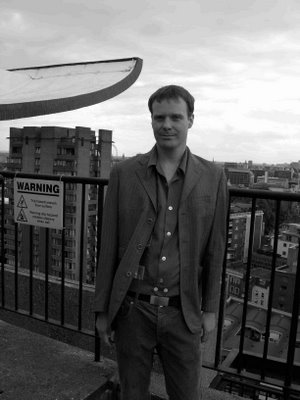
WE WANTED TO BLOW UP BRIDGES

3:AM: Then you’ve got the references to Cocteau’s Orphée and, more generally, your fascination with the “transmission-reception figure” (as you put it elsewhere): “[Tintin] will also be aware, as a radio operator, that the waves which carry his transmissions will travel outwards endlessly through space. Who knows where the signals will end up, or what they will end up meaning?” (p. 91).

TMcC: If I had to select five things to put in a space capsule to show aliens what we were capable of, Orphée would be one of them. It’s the most perfect piece of art, which lays out our existence as being in relation to death, technology, transmission-reception and desire — not to mention repetition. Death, a beautiful princess (and arts patron) falls in love with Orphée so she has another poet snatched to the underworld so he can send illicit, looping radio messages to Orphée which draw him towards her, through a mirror. Cocteau based his radio messages on the ones sent to occupied France during World War Two: these short lines of poetry. Most of them meant nothing, but one in every two hundred meant — only to those who knew — ‘blow up the bridge’. A man or woman in London reads a line of poetry into a microphone and in France a bridge blows up — or not. Poetry — real poetry — should harbour that potentiality somehow.

3:AM: You talk about Alph-Art, the eponymous avant-garde movement of Hergé’s posthumous book, which is “a cover for a giant forgery operation” (p. 158). Couldn’t this also be a fitting definition of your own “semi-fictitious” avant-garde movement, the International Necronautical Society?

TMcC: The INS had its own radio transmission network, operating out of the ICA two years ago, generating messages like Cocteau’s and actually transmitting them over the radio London-wide (and, via collaborating radio stations, world-wide). It looked like a giant factory floor, with workers running everywhere carrying lines of text — lines which, having been plucked from other media sources, were kind of second-hand if not fake. The INS is itself semi-fake, as you point out. Although the fake can hide the real.

THE UNNAMEABLE

3:AM: On page 84, you explain that, according to Freud, trauma produces “a desire for repetition mixed with a need to disguise the scene being repeated”. Could you comment on this sentence with reference to your novel Remainder?

TMcC: It’s not just Freud who says this: even his most positivist counterparts concur. Under ultra-extreme stress, the part of the mind that processes raw data into the narrative thread we call ‘memory’ simply goes on strike and refuses to process. It’s called ‘dissociation’. So the data’s present, but not dealt with, and therefore keeps bobbing up and demanding to be incorporated somehow. As it can’t form part of normal memory, it plays itself out in weird ways — ones that contain elements of the original event but are also scrambled, disguised. And it will keep repeating, albeit in modulated form, until it is accommodated properly. Well, in Remainder the hero has undergone a traumatic event which he hasn’t retained as straight memory but rather as fragments of data: the sense of being about to be hit, blue lights, railings, being held above a tray or bed and so on. These induce a propensity to repeat stuff in him. Another interesting thing about post-trauma is that (to return to a motif we touched on a moment ago) it makes people feel inauthentic, fake, because everything is of a lesser magnitude of experience than the trauma-moment itself, the only ‘real’ thing. And then the subject back-projects for himself a time when he wasn’t fake, and longs for that time. That’s what my guy is doing with his re-enactments: repeating backwards to an imagined era of authenticity — but repeating, more accurately, towards the trauma-moment itself, the true, unnameable moment, the moment of truth and unnameability itself.

THE CHINK ON THE CARPET

3:AM: The re-enactments in Remainder or in your artistic work: mimesis or simulacrum?

TMcC: Aha: very good question, bang on the money. In Remainder, he wants the authentic, so he sets up a zone of mimesis, paying architects and designers to recreate his ‘remembered’ building and re-enactors to ‘be’ the lady he remembers frying liver on the floor below him, the pianist he remembers practising Rachmaninoff and so on. He wants to accede through these re-enactments to a mode of authenticity, of simply ‘being’ rather than simulating. But of course it doesn’t work: the re-enactments tend more towards the status of simulacra, what Plato defines as ‘a copy without an original’. But then, paradoxically, the most jarring and obviously inconsistent things, the ‘extra’ bits, the ones with no originals of any type at all, are what catapult him into ultra-authenticity — which, not coincidentally, is also pure violence. It’s the little chink on the carpet of his re-enacted bank heist that flips the whole re-enactment over into all-too-real-ness, when the re-enactor trips on it, or rather on its absence, and his gun goes off…
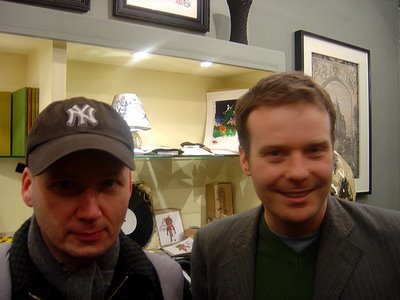

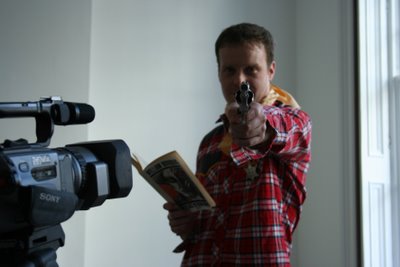
[Stewart Home and Tom McCarthy at 3:AM Magazine‘s Xmas Bash, London 2005]

THE CRACK IN THE WALL

3:AM: Barthes writes that “…the ‘realistic’ artist never places reality at the origin of his discourse, but only and always, as far back as can be traced, an already written real, a prospective code, along which we discern, as far as the eye can see, only a succession of copies” (quoted on p. 55): this is also, unwittingly, what the protagonist of Remainder does, right?

TMcC: Remainder has been read by some critics as an allegory of realism and of the realist mode of art, and this isn’t an entirely wrong reading — although if the hero had actually been an artist rather than an Everyman, some bloke, it would have been an entirely different, and inferior, book. But yes, it definitely turns around his copying, and even (as he sets about getting his re-enactors to re-enact the moments when they prepared for the previous re-enactment) his copying his moments of copying, endlessly regressive. We can try to work it out together, but ultimately I can’t give the definitive schematic meta-reading of the book any more than you — perhaps less. It was intuitive: I was looking at a crack in a wall and had a moment of dejà-vu and wished I had loads of money to re-enact this moment and there was the novel.

EVERYTHING LITERATURE SHOULD BE

3:AM: When discussing tobacco throughout the Tintin books, you explain (following Derrida) that it “goes up in smoke” but “also leaves remains, ashes, which maintain symbolic links to memory, death and inheritance. Baudelaire’s story takes off from the change left over from the two friends’ luxury expenditure: like the coin itself, it proceeds from the remainder” (p. 135). Why are remnants so important in your work?

TMcC: It’s what’s left. After the disaster, after thought, interpretation, writing itself. It’s like when Wallace Stevens says “The plum survives its poems”. Writing has to deal with this remainder, and good writing has to deal with the fact that it can never fully deal with it. Francis Ponge knows this. He writes brilliant prose poems about, for example, oranges: the texture of their cells, the way they leave goop on your hands so that even when you’ve ‘expressed’ them there’s a residue that’s not contained. If Susan Tomaselli or anyone else really want to do themselves a favour, they should re-read neither Remainder nor the Tintin books but rather Ponge’s Le Parti pris des choses (you can get it in dual text). It’s everything writing should be.

[This interview was initially posted here.]

Céline: Great Author and ‘Absolute Bastard’

This appeared in Guardian Books on 31 January 2011:

Céline: Great Author and ‘Absolute Bastard’


Special case: Louis-Ferdinand Céline. Photograph: Lipnitzki/Roger Viollet/Getty Images

Every year, the French government publishes a list of cultural events and personalities to be commemorated over the next 12 months. Compiling it is a lengthy and carefully-considered process. A High Committee of National Celebrations draws up a provisional list, which is then submitted to the Culture Ministry and, once approved, published in book form. Some 10,000 copies of the Recueil des Célébrations nationales 2011 were printed last autumn ahead of last week’s launch. Frédéric Mitterrand — the culture minister lui-même — had even penned a foreword, proving beyond a shadow of doubt that the project had received his imprimatur. However, when word got out that Louis-Ferdinand Céline was to feature alongside the likes of Blaise Cendrars, Théophile Gautier, Franz Liszt and Georges Pompidou, all hell broke loose.

Serge Klarsfeld, the country’s most famous Nazi hunter and Holocaust memorialist, expressed his indignation in the name of the Association of Sons and Daughters of Jews Deported from France. The Republic, he argued, shouldn’t celebrate “the most antisemitic” Frenchman of his day — a time, lest we forget, when antisemitism was so rife that it led to state-sanctioned Jewish persecution under the Vichy regime. Mitterrand’s decision, two days later, to remove the novelist from the list was logical in light of this backlash, but also somewhat surprising since he must have known that his inclusion would prove controversial in the first place (was he protecting Sarkozy, whose favourite author happens to be Céline?)

Far more surprising, however, was the reaction of the French intelligentsia, who were almost unanimous in their defence of the author of Journey to the End of the Night. Literary heavyweight Philippe Sollers accused the Culture Ministry of “censorship”. Frédéric Vitoux, a member of the prestigious Académie française who wrote a biography of Céline, likened this decision to the airbrushing of history under Stalin. Pop philosopher Alain Finkielkraut feared that some people would draw the conclusion that a “Jewish lobby” was dictating policy to the French government. Bernard-Henri Lévy, another celebrity philosopher, claimed that the commemoration of Céline’s death should have been an opportunity to try to understand how a “truly great author” can also be an “absolute bastard”. Even more surprising, perhaps, was the fact that Serge Klarsfeld himself felt the need to declare that he rated Céline as a “great writer” before going on to describe him as a “despicable human being”.

France is a place where authors and artists are granted a special status — a kind of poetic licence or artistic immunity. In fact, the country continues to view itself, and sometimes to be regarded as, the natural second home of all artists. It is this very liberal attitude which attracted many members of the Lost and Beat generations after the second world war, and that still attracts outsider writers such as Dennis Cooper. Some of the greatest works of contemporary fiction in English — Joyce’s Ulysses, Nabokov’s Lolita or Burroughs’s Naked Lunch — were available in France when they were banned or considered unpublishable in Britain or the US. A telling culture shock occurred on live television, in 1990, when a journalist from Quebec told Gabriel Matzneff that only in Paris would he be feted for writing — however exquisitely — about his liaisons with underage partners (of both genders). Anywhere else, she stated, he would probably end up in prison. The journalist was subsequently depicted as a philistine, unable to appreciate the subtlety of Matzneff’s feelings or the beauty of his style. Baudelaire once wrote that “literature and the arts pursue an aim independent of morality” and, for better or worse, this has clearly become France’s official artistic credo.

Trying to account for this “exception française” is no mean task, but I suspect it has something to do with the elevation of art to the status of surrogate religion during the second half of the 19th century. A similar phenomenon was taking place all over Europe, of course, but it probably had more resonance against the backdrop of the ongoing struggle between Republicanism and Catholicism. Both Flaubert and Baudelaire were prosecuted for public obscenity, but when French MPs called for the banning of Jean Genet‘s The Screens in 1966 (for political reasons, this time), the culture minister (and novelist) André Malraux immediately stepped in to defend the inviolability of artistic freedom. By then, artistic creation was largely considered as a value in itself, beyond morals and politics; even beyond good and evil.

The dominant French view on literature was probably best expressed by Oscar Wilde, who ended his life in exile in Paris: “There is no such thing as a moral or an immoral book. Books are well written, or badly written. That is all.” Not quite, though, in this case. No one is denying Céline’s talent as one of the greatest French writers of the 20th century — probably the greatest, with Proust. Is it possible, however, to distinguish the author of antisemitic tracts from the genius novelist; the man from the artist?

Spank for England

Here is my interview with novelist James Hawes, published in 3:AM Magazine in April 2005:

3:AM: When you burst onto the literary scene in 96, you already seemed to be a fully-formed, fully-fledged novelist. Tell us about your writing apprenticeship.

JH: I wanted to be an actor and playwright, but I was useless at both and thus managed to end up totally lost, broke and CV-less at 27, living among smackheads, crims and slumming-it trustafarians just as the Loadsamoney late 80s were starting. I knew I couldn’t last in that world, so I went back and did a PhD, which meant I got a grant to live on (ah, lost days) and a name-tag for my life. For the next seven years I quietly close-read Kafka, Nietzsche, Mann, Musil, Hesse and suchlike. I did it seriously and straight: by 1993 I was quite a respected Young Academic, but I was also trying to write again, this time a novel. In hindsight I suppose it looks as though I half-consciously made myself a bubble where I could be paid to dissect serious writers and see how they did it. But then we all have PhDs in Hindsight.

3:AM: A White Merc with Fins was part of that whole finger-on-the-pulse-of-the-zeitgeist post-Trainspotting chemical generation/lad lit wave. Were you influenced, or at least inspired, by Irvine Welsh or any of those writers?

JH: I didn’t know anything about them. I was still working full-time as a teacher of German lit. I knew almost nothing about Eng. Lit in general (I had never read anything by Martin Amis except Money or by Ian McEwan except his first story-collection, and still haven’t). When my younger, cooler Manchester brother heard I was trying seriously to write, he sent me Trainspotting, but by the time I read it White Merc was finished and sent off to my agent. When I read it I loved it and was jealous as hell. You could tell straight away that unlike most so-called “young gunslinger” Brit writers (see next question(s)!) Welsh was not a posh North London day-school/olde grammar-school/Eton boy slumming it.

3:AM: The consensus at the moment is that Speak for England is your first truly serious work (Alfred Hickling wrote in The Guardian that you have “filled out into a comic novelist of considerable stature”) after starting off as a hip young gunslinger in the Bret Easton Ellis/Welsh mode. I think it’s becoming increasingly clear that you’ve been sending up the zeitgeist all along à la Kingsley Amis or Evelyn Waugh (who you recently described as the “only English writer” you “read and re-read for sheer pleasure”). Is the angry young man turning into a middle-aged fogy? Are you in the process of doing a John Osborne?

JH: I don’t think my writing was ever “angry” in that way. Or “young”, come to think of it. The hero of White Merc was quite explicitly a middle-class boy knocking on 30 who really only wanted “a flat with tall windows” but had gone adrift. The book took the piss out of “alternative” IRA groupies, smackheads, hippies and suchlike. I love Waugh for the LACK of foregrounded psychology in his writing — a satirical tactic which (bizarre though it probably sounds to Anglo-Saxon ears) he shares with Kafka. As for Waugh’s snobbery, see later answers…

3:AM: As Toby Clements points out in The Telegraph, the narrator’s allegiances seem to be divided in your new book, Speak for England. To what extent were you — the author — seduced by the reactionary lost world Brian Marley encounters? I mean, even if your intent is clearly satirical, it must have been quite intoxicating — liberating, even — to write the unwriteable by envisioning the Empire literally striking back, Britain withdrawing from the EU, the public humiliation of the PM’s “Best Friend” etc.

JH: Writing satire is a way of having your cake and eating it. For example, anyone who reads Brecht can hardly miss that the supposedly Bad Guys, the wicked capitalists and chancers, get all the best lines and laughs. And the more you know about Brecht himself the more clear it is that these characters are far closer to his (concealed) heart than the Good Persons. Then again (cf Waugh, too), as Nietzsche says: “What do we care about the ORIGIN of a work? The artist is only the soil and the earth — sometimes the dung and shit — from which the WORK grows!” (fx: insane cackling).

3:AM: Your analysis of the psycho-sexual roots of power is fascinating. If we “are all forever small children”, as Carl Jung surmises in the epigraph to Chapter Three (Speak for England, 95), the past is “the only real home we shall have” (ibid 335) and, consequently, we all want to go back in order to go back home. In Speak for England, the past literally comes home. The protagonist Brian Marley — who is stranded in Papua New Guinea after taking part in a Survivor-type reality game show called Brit Pluck, Green Hell, Two Million — stumbles upon a corner of a foreign jungle that is forever England, created by the passengers of a plane crash which happened in 1958. The Colonists eventually return to Britain where they reintroduce no-nonsense Fifties values. Your academic work on Nietzsche must have had some bearing on this hankering after authority (“the ultimate perversion is repression,” 315) which drives the National Government’s counter-revolution.

JH: Yes, Nietzsche is fascinating on the psychology of power and I did a lot of work on Kafka/Nietszche in that light, so no doubt it filtered in. But even more so (and more importantly for Speak for England), he’s a master of insight about our crippling need for structures of belief and certainties — as he famously says “man would rather will nothingness than not will” — meaning that we tend to embrace (any old) system of thought that can deliver “Certainties”, at almost any price, rather than face the uncharted oceans of modernity. Today that insight is more serious than ever — it exactly explains the triumph of Muslim Fundamentalism in Iran, for example.

3:AM: You get a lot of mileage out of the past/present dichotomy. The scene in which the Prime Minister’s “Best Friend” is “seen live on TV, by about half a billion people, being caned thoroughly on his naked backside by an elderly gentleman while handsome, bronzed youths with ancient rifles and big shorts stood about and laughed at him” (254) could be innocent enough in a Boy’s Own story, but has strong S&M/homoerotic connations for us. Likewise the depiction of the PM’s Press Secretary being tossed, stark naked, in the Union Jack by sixth formers while a beautiful young lady looks on “holding her hips and shaking with laughter” (249). Could you tell us a bit about that?

JH: The bizarre thing about the 50’s was that in certain circles (i.e. ex-public school, theatrical, cinematic) people were openly gay in a way that has only become more generally possible in the last ten or fifteen years. To be honest, my conscious intentions in the above passages were simply Broad Comedy — but what do our intentions matter when it’s a question of subconcious enactments…

3:AM: If we are “all forever small children”, the childhood we long for only ever really existed in books — the kind of books which created our notion of childhood in the first place. Brian Marley (whose name advertises its own literary nature) has a Proustian moment when he rediscovers his 1965 Eagle Annual which strikes him as more real than reality itself. Speak for England often resembles one of those Disney films which mix flesh-and-blood actors with animated figures. The Colonists, for instance, seem to have stepped out of a typical Boy’s Own story: significantly, they use a toy Dan Dare radio station to make contact with the modern world. There are even two references to the Famous Five, one of which is made by a female character called George! So when people like Clemency Burton-Hill (whose name could come straight out of your book!) criticise the “dismal cliche” of the dialogue, they overlook the whole metatextual aspect, don’t they?

JH: Couldn’t out it better myself. How else would these characters talk? The whole point is that our Hero free-falls easily into that clipped, anti-emotional, impersonal, oh-so “English” mode — as a grateful escape from the pressures of Individuality.

3:AM: This childhood nostalgia can be likened to “a warm homecoming to something we have never truly known but yet missed all our lives” (28), first of all because it is fictitious, but also because the childhood depicted in most children’s books is an upper-class or at least very middle-class one. The same can be said about notions of Englishness which are also class-based. Do you think there is a link between these two notions of childhood and Englishness?

JH: Absolutely. There’s a striking difference between England and America here that goes all through cinema, especially U.S. depictions of “the golden times of youth” or whatever are always (right from Citizen Kane) small-town, close-to-the-soil, classless. Ours are Edwardian upper-middle. And in every U.S. film, the Hero has to prove his blue-collar cred (even if he’s a bigshot lawyer or the President himself) by e.g. smacking a baseball out of sight. Whereas in the UK we seem happy to accept Hugh Grant’s dithering shtick as “normal everyday Englishman”. Pinter marries into the nobility, Scruton goes hunting: to a middle-class Englishman there simply IS no other model of success than a mad sub-Austen Georgians At Home fairytale.

3:AM: Speak for England — which is partly a robinsonnade — is often reminiscent of Robinson Crusoe. Like Robinson Crusoe, the Colonists have recreated the society they came from in the middle of nowhere. Like Robinson Crusoe, Brian Marley’s problems stem from his relationship with his father (Robinson disobeys his father; fatherless Brian is in thrall to the Führer-type Headmaster, the ultimate father figure). Robinson Crusoe’s inability to accept the “middle Station of Life” is mirrored by Brian’s desire to become a “real Englishman”, ie a member of the upper-classes. The difference between the two novels is that Robinson Crusoe marks the triumph of middle-class social climbing whereas in Speak For England there is a constant distinction between becoming and being.

When Brian Marley thinks he is dying in the jungle and wishes to record a last message for his son, he cannot find his own voice. As a member of the lower middle-classes, he has no voice, no identity: being lower middle-class is a transitional state. But as you show in several of your works, the upward-mobility associated with the post-war consensus has disappeared leaving only frustration in its wake. People like Brian Marley struggle through their mediocre, ersatz lives (fake mail-order Agas!) with the nagging feeling that they are “below their imagined station” (80) and are denied “the unreflective joy of unthinking union” (222) which is shared by the working and upper classes. Tell us more about this opposition between becoming (the aspirational lower middle-classes) and being (“A caveman, that would be real”, 21).

JH: I have honestly not seen this “being” vs “belonging” business before (as an ex-academic I think I have to almost consciously repress the awareness of intellectual substructures in order to preserve any life and freedom in my writing) but you are quite right. Hmm. Yes, the salient facts of the middle-class are its very MIDDLE-ness (i.e. its lack of any “authentic” aspects) and (as Marx pointed out) its dynamism. Its relations with the Working Classes are a mixture of disdain, fear and envy, while the Upper Classes are objects of secret outrage mixed with public fawning. To my Hero’s mother’s generation the vision of “oak trees growing out of the ruins of Buckingham Palace” still implied a sort of Good Old Uncle Joe All Them Cornfields And Ballet In the Evenings left-wing project: but that Lower-Middle Radicalism is, in the saloon-bars of today, more often part of something very different: “get rid of the Posh Wasters (the Queen herself alone excepted), dismantle social security, do-gooding and multiculturalism, smash the unions, kick out the asylum seekers…”. And never underestimate the dynamism Marx spotted: we are facing what Brecht said we should dread — interesting times.

3:AM: As befits any novel about Englishness, class plays a central part. Your characters often sleepwalk through life, forgetting that “this is not a rehearsal” (Rancid Aluminium, 29), prolonging the “long vacation of extended adolescence” (A White Merc with Fins, 19), in order to maintain “the helpful fantasy that their true lives still lay in the future” (Speak for England, 80) until they make a last-ditch attempt at saving themselves by doing “something radical” (A White Merc with Fins, 22): robbing a bank, say, or taking part in an extreme reality TV show. Before reaching the end of his tether, the protagonist of Speak for England, Brian Marley, teaches English as a foreign language and flees “to some new foreign country” whenever “things get too tough or too real” (Speak for England, 41) because “moving about lets you kid yourself you are moving on” (A White Merc with Fins, 70). Countless authors of your generation have depicted the nihilistic slackerdom of the idle rich or its lumpen variety, but nobody else has dissected the “pre-emptive strike on living” of the lower middle-classes with such deadly accuracy. Would you agree that this is your great theme, and do you see it as a particularly English phenomenon?

JH: I think it’s my great theme because I’m English. Nietzsche again: “We are all just organ-grinders with only one tune, but eternity itself turns the handle”. I went to Oxford in 1978 from a rural comp like some mad innocent with a straw in his mouth, four years behind the fashion and quite literally having never met a boarding-school boy in my life. I found that the world (Oxford was then still largely a men-only-colleges place) was full of incredibly sophisticated, shamingly cool and impossibly well-connected young chaps who were used to partying in publishers’ holiday homes, skiing every Xmas vac and using mummy’s debenture at the Royal Court. They seemed two or three years older than me, never mind infinitely richer. And they (step forward in particular a certain person whom I learned ten years ago was none other than Will Self) naturally got the Posh Birds I wanted but hadn’t the faintest notion how to approach. You may detect a chip on ye olde Hawes shoulder. A sack of spuds, more like, my dear. I shudder to remember, never mind relate, the wretched idiocies I got into. And all based on class.

3:AM: You seem to imply that the linguistic class war goes far beyond the “Garridge”/”garaaj” dichotomy (256), that it is not merely a question of pronunciation.

JH: My own theory is that this can be traced right back to the Conquest. Show me a name like Percy Beaufort in the phone-book and I will call someone posh for you. I invented an Irish archaeological book from which to supposedly lift an epigraph on this subject in order to avoid forcing my views into the mouth of some hapless “character”…

3:AM: I thought the controversial end of the book (which could be described as the ultimate cliffhanger) was really effective. Did you know how it would (or would not) end right from the start, or did you come up with this — hum — aporetic non-dénouement precisely because you had no idea?

JH: No, I really didn’t know what to do with the Hero at the end, and the last thing I wanted was to manufacture a ghastly film-syle “upbeat” ending. I wish I’d ended it like A Good Man in Africa in retrospect, but I’m glad you think it worked.

3:AM: Did the Comet IV accident really happen?

JH: No, that was made up. Delighted you even have to ask.

3:AM: Many novelists of your generation like Jonathan Coe (The Rotters’ Club) or Toby Litt (Deadkidsongs) seem to be writing about their childhood. Is this a generational thing? Were you in any way inspired by these books?

JH: I haven’t read either of these. As you get older you realise that what you thought, when you were 20, was pure freedom to create your own, new, form of living is in fact tugged at by hidden (apron-)strings that go back even beyond your birth. By 40 — or maybe with parenthood? — you see that you will never know who you really are and what you could really do until you know what you actually were, and were being formed for. If anyone under 25 is reading this, my motto to them would be: “No, you don’t believe this, of course you don’t, you’re not MEANT to. But you will”.

3:AM: So what’s next?

JH: I’m putting the final touches to my first original screenplay so a Producer can take it to Cannes. It’s a screwball rom-com called Dr Kafka’s Love-Letter. I adore it and it’s had great initial come-back. I’m thinking of a novel version, but the next one will be a black-comic story about a cheated lower-middle-class man (hey, what else?) who is digging his little South London garden while wishing he’d had the guts to completely desert his ex-wife and kids by buying a bar in Valparaiso for $15,000 instead of paying £300K for this shitheap, when he comes across a long-buried, perfectly oiled and preserved AK-47…

It’s All Greek

Here is a short, unpublished review of Tom McCarthy‘s C:

It’s All Greek

How do we recombine the debris of literary history?

Inspired By: Cocteau’s Orphée in which dead poet broadcasts coded messages on living poet’s car radio, hence the author as listener-repeater; Background: Concept of the crypt (site of an encoded primal scene) linking Cocteau, Freud’s Wolf Man, invention of telephone, discovery of Tutankhamun and Nabokov’s Ada; Protagonist Modelled On: Alexander Bell, Maurice Blanchot, Howard Carter, Marinetti, Orpheus, Sergei Pankejeff, Georg Trakl; Obligatory Plot Summary: Born, fails to mourn dead teenage sister, treated for melancholia in central Europe, airborne radio operator during WWI, student in drug-fuelled 20s London, civil servant in spy-ridden Egypt, dies; Representative Sentence: “What he sees is darkness, but he sees it.”

The history of Tom McCarthy’s debut, Remainder, has almost achieved legendary status. It was first released on a tiny Parisian art press, having been spurned by all the major publishing houses in Britain, yet ended up making the cover of the New York Times, receiving the 2008 Believer Book Award and being lauded by Zadie Smith as “one of the great English novels of the past ten years”. Where do you go from there? Backwards, of course, like Dr. Learmont’s face that seems to multiply “down a telescoping corridor of memories” [77] or the archaeologists in Egypt — not to mention Serge with his predilection for coitus a tergo. McCarthy’s second novel, Men in Space, was mostly written before his first. His third — which is being touted as his big breakthrough — stems from Calling All Agents (2003), a fascinating essay that already contained all the keys to his book to come. Imagine a Bible concordance predating The Bible itself. In fact, C is CAA re-encrypted: a space in which the event that is true literature can take place.

With his first period piece, McCarthy goes back to the future (and Futurism) in order to rescue fiction from its current impasse. The timeline of this Bildungsroman is highly significant. It begins in 1898 — when Serge Carrefax is born to the “mechanical buzz” [10] of his father’s wireless radio experiments — and ends in 1922 — the year of The Waste Land and Ulysses — when he dies. The association between modern communications technology and modernism provides the backdrop to a redefinition of literature as transmission rather than self-expression.

Unsurprisingly for a novel revolving around incest — both literal and metaphorical — C contains numerous mises en abyme. There’s the tapestry of a staircase hanging above a staircase, or the school pageant (a nod to The Mousetrap in Hamlet) that dramatizes the Orphic theme underlying the entire work. The most apposite is Sophie’s “strange associative web” [71] that proliferates like a tumor and seems to harbor some dark secret within its intricate ramifications. McCarthy’s text also keeps generating new meanings, sometimes of its own volition, as words and ideas cross-fertilize in incestuous ways. Language, says Heidegger, speaks. Thus Sophie mutters beautiful schizophrenic gibberish as though she had “turned herself into a receiver” [75]. The Morse code clicks sometimes seem to be “speaking on their own” [67]. The deaf children are spoken through, their voices “ventriloquised” as if “piped in from somewhere else;” [4] their utterances resembling “a mispronounced version of something else, other sentences that are trying to worm their way up to the surface, make themselves heard” [79]. The headlong rush into modernity, away from the parodic pastoral setting, is paralleled by a return to the primitive magic of the oral tradition. The idea that something may even be lurking behind mere hearing is often hinted at. “[M]uffled signals” [83] are half-heard through wireless static (itself likened to “the sound of thought” [64]). Serge is haunted by “vague impressions of bodies hovering just beyond the threshold of the visible” [68] when riding “the dial’s far end” [83].

The protagonist teeters on the brink of some revelation that eludes him until he receives the ultimate, hallucinatory “call”. The reader can also break the code: incest is the encrypted primal scene of literature — the scene of our failed mourning for the works of the past. It’s all Greek, in the end.

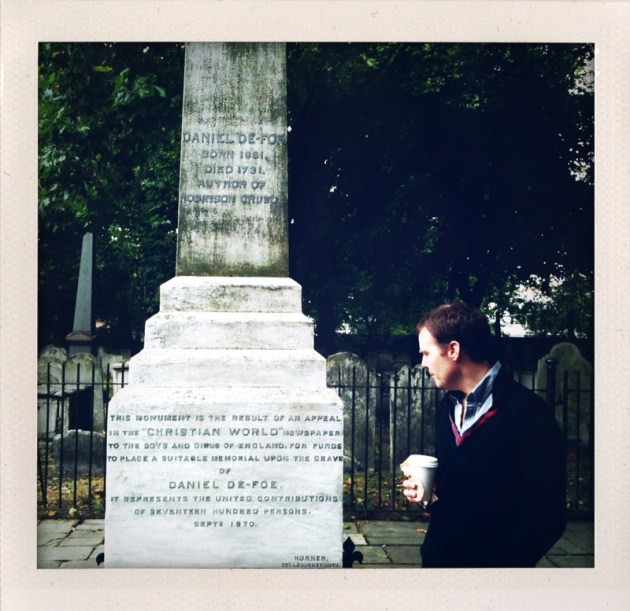
[Picture: Tom McCarthy and Daniel Defoe, Bunhill Fields, London, August 2010. By Andrew Gallix.]

C By Tom McCarthy

This appeared in the September 2010 issue of Dazed & Confused (vol. 2, issue 89, p. 196):

C by Tom McCarthy

Incest, spies and coke-fuelled adventures

Let’s not beat about the bush: Tom McCarthy’s third novel, C, is a masterpiece: a sprawling associative web that keeps generating new meanings as though of its own volition. “That’s the beautiful thing about what literature does to language,” says McCarthy. “You stick these slippery terms in and they start cross-fertilising in ways you never anticipated — incestuous ways.” C takes us from a fairytale English silk farm to spy-ridden Egypt by way of a central European spa town, aerial warfare and a coke-fuelled London filled with bright young Amazons. It is a comedy of errors, a gothic mystery, a boy’s own story; a traditional 19th-century novel seemingly rewritten by Burroughs or Ballard. You’ll find geometry, technology and trauma. Loops, repetitions and mutations. Incest, insects and radio bugs. And phantom words emanating from subterranean worlds half-glimpsed “at the dial’s far end”. Tune in…

DAZED & CONFUSED: C could be seen as a futurist novel. Serge, the protagonist, even seems to be partly modelled on Marinetti himself…
TOM MCCARTHY: I love Marinetti, and, yes, he’s part of Serge’s make-up, particularly in the war section. But Serge is equally a mixture of Freud’s Wolf Man, the beautifully fucked-up melancholic eternally grieving for his dead sister; and Alexander Bell, inventor of the phone (who also lost two siblings); and Howard Carter, the Egyptologist who disinterred the ur-family tomb; and a bunch of other people. I’m interested in the places where technology and mourning intersect.

There’s also a strong retro-futurist — even steampunk — element to C. Did you feel the need to revisit the early 20th century in order to reinvent the future of the novel?
Yes. Walter Benjamin says that the angel of history faces backwards. I think it’s the same for literature: you’ve got to look back in order to move forwards. It’s not just the foundations of contemporary technology that are being laid in the early 20th century (the code radio bugs used exactly anticipated text speak, just as lots of their output anticipated Twitter), but also literature’s period of high modernism that’s coming to a head. Not for nothing does the novel end in 1922: it’s the year that Ulysses and The Waste Land came out. The task for the contemporary writer (sadly, one which many writers of today are shirking) is to work through that period’s legacy — dynamically and radically, but attentively too.

All the major themes in C — from wireless technology to the discovery of Tutankhamun — come from your early experiments with the International Necronautical Society (INS), don’t they?
I had the idea for C while I was working on the INS project at the ICA. There, we had a radio station modelled on the illicit one in Jean Cocteau’s film Orphée (where the person transmitting is already dead), sending out all these coded poetic messages. I was looking at writing around encryption, and the concept of the ‘crypt’ that you get in psychoanalysis and philosophy.

Incest lies at the heart of C: this, for you, is the source code of western literature, right?
Yes. You go back from Nabokov through Faulkner through Racine right back to Sophocles, and incest is the central theme that keeps recurring. For Freud, the incest prohibition is what makes us civilised, socialised, even human, so that’s the taboo all tragic heroes, who are fundamentally doomed rebels, are most drawn towards transgressing.

Why do you think that all new means of telecommunication are linked to death, mourning and melancholia?
I don’t know if I can explain it. It’s just a pattern that keeps recurring. For every comm-tech invention, there seems to be a dead sibling somewhere. Bell even made a pact with his brother that, if one of them died like their other brother had, the surviving one would invent a device capable of receiving messages from the dead. Then the second brother dies, and Bell invents the telephone. He remained a rationalist, a sceptic — basically because his brothers never called. But the desire, the fantasy, is there in the technology: a ghost in the machine. It’s the same with radio. Seances in the 20s weren’t about spirit and ectoplasm any more: they were about “tuning in” to voices resonating on high frequencies, like radio waves. With the internet, it seems to be more about a presence than an absence: everything’s there, every click and keystroke ever made eternally retrievable, a giant archive. That’s a kind of haunting too, though.

Text and Photography
ANDREW GALLIX

The Young Parisians

This appeared in the summer 2010 issue of Nude Magazine (issue 16, pp. 40-43):

The Young Parisians

Why don’t you come to Paris with me?
And see the young Parisians’
– “Young Parisians” by Adam and the Ants

‘There’s something very un-British about electronic music,’ says Daniel Miller — founder of Mute Records — in BBC Four’s excellent Synth Britannia documentary. By ‘very un-British’ he means très European — German, of course, but also French. Lest we forget, musique concrète composers like Pierre Schaeffer began their sonic experiments before Stockhausen. Most Continentals in the late 70s were first introduced to synthesizers via Jean-Michel Jarre not Kraftwerk. Métal Urbain — France’s answer to the Sex Pistols — produced their scuzzy rabble-rousing pogobeat on custom-made imitation Moogs at a time when electronic instruments were still usually associated with prog rock dinosaurs. The strong French presence on Angular Records’ recent Cold Waves and Minimal Electronics compilation was generally met with dismay by British music journalists who were blissfully unaware of the existence of a thriving post-punk scene across the Channel (Indochine, a synthpop outfit in the Depeche mode, even became France’s biggest band at one point). Whereas Gallic guitar combos have always been viewed — rightly or wrongly — as derivative vis-à-vis their Anglo-American counterparts, the synth-driven ‘French Touch’ sound was successfully exported ‘around the world’ at the turn of the century. The missing link between the early 80s and late 90s was Denis Quillard, better known as Jacno, who died in November last year at the age of 52 having cemented his country’s love affair with electronic minimalism.

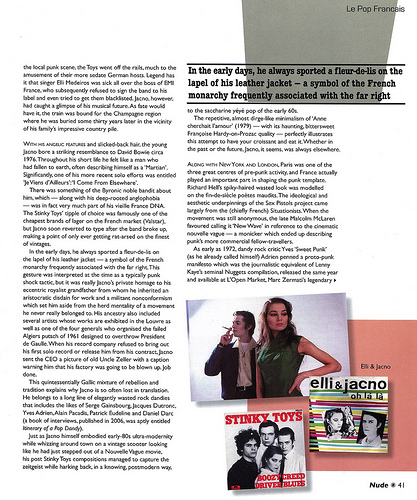
There are times when the past, present and future seem to collide, and one such occasion occurred on 9 February 1977 when Jacno’s band, the Stinky Toys, were invited to a music press junket aboard the eponymous Trans Europe Express coinciding with the release of Kraftwerk’s album. Having a reputation to maintain as the enfants terribles of the local punk scene, the Toys went off the rails, much to the amusement of their more sedate German hosts. Legend has it that singer Elli Medeiros was sick all over the boss of EMI France, who subsequently refused to sign the band to his label and even tried to get them blacklisted. Jacno, however, had caught a glimpse of his musical future. As fate would have it, the train was bound for the Champagne region where he was buried some thirty years later in the vicinity of his family’s impressive country pile.

With his angelic features and slicked-back hair, the young Jacno bore a striking resemblance to David Bowie circa 1976. Throughout his short life he felt like a man who had fallen to earth, often describing himself as a ‘Martian’. Significantly, one of his more recent solo efforts was entitled ‘Je viens d’ailleurs’: ‘I Come From Elsewhere’. There was something of the Byronic noble bandit about him, which — along with a deep-rooted anglophobia — was in fact very much part of his vieille France DNA. The Stinky Toys’ tipple of choice was famously one of the cheapest brands of lager on the French market (Valstar), but Jacno soon reverted to type after the band broke up, making a point of only ever getting rat-arsed on the finest of vintages. In the early days, he always sported a fleur-de-lis on the lapel of his leather jacket — a symbol of the French monarchy frequently associated with the far right. This gesture was interpreted at the time as a typically punk shock tactic, but it was really Jacno’s private homage to his eccentric royalist grandfather from whom he inherited an aristocratic disdain for work and a militant nonconformism which set him aside from the herd mentality of a movement he never really belonged to. His ancestry also included several artists whose works are exhibited in the Louvre as well as one of the four generals who organised the failed Algiers putsch of 1961 designed to overthrow President de Gaulle. When his record company refused to bring out his first solo record or release him from his contract, Jacno sent the CEO a picture of old Uncle Zeller with a caption warning him that his factory was going to be blown up. Job done.

This quintessentially Gallic mixture of rebellion and tradition explains why Jacno is so often lost in translation. He belongs to a long line of elegantly wasted rock dandies that includes the likes of Serge Gainsbourg, Jacques Dutronc, Yves Adrien, Alain Pacadis, Patrick Eudeline and Daniel Darc (a book of interviews, published in 2006, was aptly entitled Itinerary of a Pop Dandy). Just as Jacno himself embodied early-80s ultra-modernity while whizzing around town on a vintage scooter looking like he had just stepped out of a Nouvelle Vague movie, his post-Stinky Toys compositions managed to capture the zeitgeist while harking back, in a knowing, postmodern way, to the saccharine yéyé pop of the early 60s. The repetitive, almost dirge-like minimalism of ‘Anne cherchait l’amour’ (1979) — with its haunting, bittersweet Françoise Hardy-on-Prozac quality — perfectly illustrates this attempt to have your croissant and eat it. Whether in the past or the future, Jacno, it seems, was always elsewhere.

Along with New York and London, Paris was one of the three great centres of pre-punk activity, and France played an important part in shaping the punk template. Richard Hell’s spiky-haired wasted look was modelled on the fin-de-siècle poètes maudits. The ideological and aesthetic underpinnings of the Sex Pistols project came largely from the (chiefly French) Situationists. When the movement was still anonymous, the late Malcolm McLaren favoured calling it ‘New Wave’ in reference to the cinematic Nouvelle Vague — a monicker which ended up describing punk’s more commercial fellow-travellers. As early as 1972, dandy rock critic Yves ‘Sweet Punk’ Adrien (as he already called himself) penned a proto-punk manifesto which was the journalistic equivalent of Lenny Kaye’s seminal Nuggets compilation, released the same year and available at L’Open Market, Marc Zermati’s legendary record shop where Jacno and all the future Parisian punks used to hang out. Zermati would go on to launch the very first punk label (Skydog Records) and festival (Mont-de-Marsan, 1976). Future Ze Records supremo Michel Esteban and his then partner Lizzy Mercier Descloux (who would also play a pivotal role in New York’s No Wave scene) launched a rival emporium (Harry Cover) within gobbing distance of L’Open Market, thus sealing Les Halles’ reputation as the epicentre of Parisian punk activity. It was there that Malcolm McLaren bumped into the Stinky Toys, was impressed by Elli’s creative use of safety pins, and invited the band to take part in the 100 Club punk festival where their presence gave an international dimension to the nascent movement.

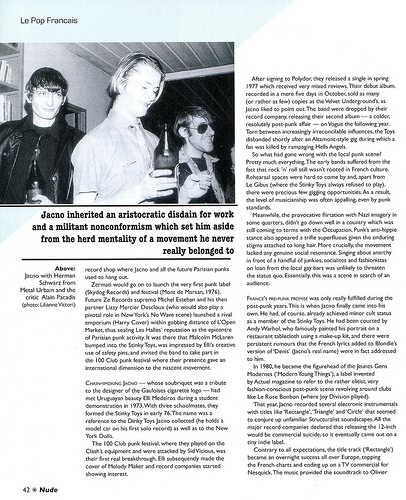
Chain-smoking Jacno — whose soubriquet was a tribute to the designer of the Gauloises cigarettes logo — had met Uruguayan beauty Elli Medeiros during a student demonstration in 1973. With three schoolmates, they formed the Stinky Toys in early 76. The name was a reference to the Dinky Toys Jacno collected (he holds a model car on his first solo record) as well as to the New York Dolls. The 100 Club punk festival, where they played on the Clash’s equipment and were attacked by Sid Vicious, was their first real breakthrough. Elli subsequently made the cover of Melody Maker and record companies started showing interest. After signing to Polydor, they released a single in spring 1977 which received very mixed reviews. Their debut album, recorded in a mere five days in October, sold as many (or rather as few) copies as the Velvet Underground’s, as Jacno liked to point out. The band were dropped by their record company, releasing their second album — a colder, resolutely post-punk affair — on Vogue the following year. Torn between increasingly irreconcilable influences, the Toys disbanded shortly after an Altamont-style gig during which a fan was killed by rampaging Hell’s Angels.

So what had gone wrong with the local punk scene? Pretty much everything. The early bands suffered from the fact that rock’n’roll still wasn’t rooted in French culture. Rehearsal spaces were hard to come by and, apart from Le Gibus (where the Stinky Toys always refused to play), there were precious few gigging opportunities. As a result, the level of musicianship was often appalling, even by punk standards. Meanwhile, the provocative flirtation with Nazi imagery in some quarters didn’t go down well in a country which was still coming to terms with the Occupation. Punk’s anti-hippie stance also appeared a trifle superfluous given the enduring stigma attached to long hair. More crucially, the movement lacked any genuine social resonance. Singing about anarchy in front of a handful of junkies, socialites and fashionistas on loan from the local gay bars was unlikely to threaten the status quo. Essentially, this was a scene in search of an audience.

France’s pre-punk promise was only really fulfilled during the post-punk years. This is when Jacno finally came into his own. He had, of course, already achieved minor cult status as a member of the Stinky Toys. He had been courted by Andy Warhol, who famously painted his portrait on a restaurant tablecloth using a make-up kit, and there were persistent rumours that the French lyrics added to Blondie’s version of ‘Denis’ (Jacno’s real name) were in fact addressed to him. In 1980, he became the figurehead of the Jeunes Gens Modernes (‘Modern Young Things’), a label invented by Actuel magazine to refer to the rather elitist, very fashion-conscious post-punk scene revolving around clubs like Le Rose Bonbon (where Joy Division played). That year, Jacno recorded several electronic instrumentals with titles like ‘Rectangle,’ ‘Triangle’ and ‘Circle’ that seemed to conjure up unfamiliar Structuralist soundscapes. All the major record companies declared that releasing the 12-inch would be commercial suicide, so it eventually came out on a tiny indie label. Contrary to all expectations, the title track (‘Rectangle’) became an overnight success all over Europe, topping the French charts and ending up on a TV commercial for Nesquick. The music provided the soundtrack to Olivier Assayas’s first short film (Copyright) in which Elli Medeiros made her debut performance as an actress. Assayas also shot a video for ‘Rectangle’ which shows Jacno playing against the suitably angular, brutalist background of the La Défense area of Paris. The only track on the record that wasn’t an instrumental — the aforementioned ‘Anne cherchait l’amour’ — was sung by Elli. It marked the beginning of Elli & Jacno who provided a blueprint for countless other synth-based duos like Soft Cell and Yazoo, and sold millions of records until they split up in 1984 having written the soundtrack to Eric Rohmer’s Les Nuits de la pleine lune.

Elli would go on to have a couple of massive solo hits in 86-87 before concentrating on her acting career and family life. She made a musical comeback in 2006. Jacno, meanwhile, released six solo albums and produced work by some of France’s greatest stars like Jacques Higelin or Etienne Daho, an early fan of the Stinky Toys. He will always be remembered, however, as the New Wave Erik Satie whose elegant electronic minuets (as Rohmer once described them) seemed to capture the essence of our adolescence. ‘True life,’ as Rimbaud once put it, ‘is elsewhere.’ That is, as ever, where Jacno is to be found.

****

Ten of the best first wave punk bands from over the Channel

Métal Urbain
Think Sex Pistols crossed with Suicide or Throbbing Gristle — or both. Hardcore political lyrics. Their second single was Rough Trade’s first release. Best track: ‘Panik’.

Asphalt Jungle
Fronted by dandy rock critic-cum-novelist Patrick Eudeline. Talked the talk but seldom walked the walk except on their third single, ‘Polly Magoo,’ which sounds like a gang of inebriated football hooligans rutting with Phil Spector. In a good way.

Starshooter
They hailed from Lyon, played a mean live set, had a sense of humour and were solidly working class unlike most of their bourgeois contemporaries. Good mates with the Damned. Listen to: ‘Macho’.

Marie et les Garçons
Also from Lyon. Heavily influenced by the NYC scene at first, then experimented with a disco crossover thang. Second single produced by John Cale. They had a female drummer (the eponymous Marie) who died in the 90s. Top track: ‘Re-Bop’.

Guilty Razors
Famous for singing in pigeon English (‘Provocate,’ ‘I Don’t Wanna Be a Rich’!). Two of their members were of Spanish origin. They were very close to the Slits. Check out: ‘I Don’t Wanna Be a Rich’.

Gazoline
Having been a failed teenybop heartthrob in the 60s, a failed glam rock star in the early 70s and a successful gay cabaret artist, Alain Kan reinvented himself as a punk rocker. His band was named after a group of militant drag queens from the early gay liberation days. Kan disappeared in 1990; no one has seen or heard from him since. Gazoline’s second single is arguably one of the most convincing punk records to ever come out of France. Best track: ‘Radio flic’.

Les Olivensteins
Started later than most of the others and paved the way for the hardcore of the early 80s (Oberkampf, Bérurier Noir et al.). One of their most provocative lyrics described the Vichy regime as the good old days. Their name came from a psychiatrist famous for his anti-drugs crusade. Like Sham 69, they ended up attracting the wrong element and split up. Top track: ‘Fier de ne rien faire’.

1984
On paper, a kind of dystopian Clash but never fulfilled their promise. Listen to: ‘Salted City’.

Les Lou’s
All-girl band managed at one stage by Bernie Rhodes. Highlight: ‘Back on the Street’.

Electric Callas
A flamboyant Bowie/Iggy fanatic from Lyon backed by a dizzying array of line-up changes. Check out: ‘Kill Me Two Times’.

In Theory: Towards a New Novel

This appeared in Guardian Books on 13 May 2010:

In Theory: Towards a New Novel

Alain Robbe-Grillet’s provocative essays on creating new literature outside the ‘dead rules’ of the past resonate now

Alain Robbe-Grillet

A novel ‘expresses nothing but itself’ … Alain Robbe-Grillet. Photograph: Daniel Janin/AFP/Getty Images

David Shields recently dismissed most contemporary novels as “antediluvian texts” that “could have been written by Flaubert 150 years ago”. “In no way,” claimed the author of Reality Hunger, “do they convey what it feels like to live in the 21st century.”

He has a point — albeit one that Alain Robbe-Grillet had already made in 1965 when he deplored the fact that young French novelists were praised for writing “like Stendhal” but castigated as soon as they refused to abide by the “dead rules” of a bygone age. Along with Michel Butor, Nathalie Sarraute and Claude Simon — the main proponents of the new novel (nouveau roman) — Robbe-Grillet stood resolutely in the second camp. In his essays, he returns time and again to the notion that the novel, from Stendhal to Joyce, has constantly evolved — hence the absurdity of using “the norms of the past” to judge the fiction of today. Far from representing a rejection of the past, the quest for a new novel was thus very much in keeping with the history of a genre which, by definition, must always be renewed.

Feeling that his work was too often misrepresented by the critical establishment (with a few notable exceptions including Barthes, Blanchot and Nabokov), Robbe-Grillet published a series of articles to set the record straight. In 1963 they were collected in Towards a New Novel — for my money, one of the most important works of postwar literary criticism. However, these “critical reflections” were never meant to constitute a manifesto. Every novel, according to Robbe-Grillet, is a self-sufficient work of art which cannot be reduced to some external meaning or truth that is “known in advance”. “The New Novel,” as he put it, “is not a theory, it is an exploration.” Why bother writing a book that illustrates a rule when “the statement of the rule would suffice”?

Quoting Heidegger at the beginning of an essay on Waiting For Godot, Robbe-Grillet writes that the human condition is “to be there”. In another essay, he states that it is “chiefly in its presence that the world’s reality resides”. So there you have it. Man is here, the world is there and the distance between the two lies at the heart of the new novel project. We endow the world with meaning (or meaninglessness) in order to control it. From this point of view, the writer’s traditional role was to excavate nature in order to unearth the “hidden soul of things”. Robbe-Grillet calls for the creation of a new form of fiction that reflects the “more modest, less anthropomorphic world” we live in today — one which is “neither significant nor absurd,” but simply is.

This seemingly anodyne observation has serious literary ramifications. Gone is the traditional hero of yore who believed the world was there to be conquered and whose hour of glory coincided with the triumph of individualism. Gone is the humanist “communion” between people and things: “Things are things, and man is only man”. Gone is the notion of tragedy, which Robbe-Grillet sees as a twisted ploy to reaffirm this solidarity: “I call out. No one answers. Instead of concluding that there is no one there (…) I decide to act as if someone were there, but someone who, for some reason or other, will not answer”. In the new novel, “Man looks at the world” but “the world does not look back,” which precludes any symbolism or transcendence. The novelist’s task now is to describe the material world, not to appropriate it or project himself onto it; to record the distance between human beings and things without interpreting this distance as a painful division. All this implies that the “entire literary language” be reformed. Similes and metaphors, which are often used gratuitously to confer literary status upon a text, are seldom innocent since they tend to anthropomorphise the world.

The new novel is routinely attacked for being inhuman and coldly descriptive. Robbe-Grillet responds that his work is in fact far less objective than the godlike, omniscient narrator who presides over so many traditional novels. Description here is purely subjective and takes centre stage, whereas in Balzac, for instance, it simply sets the scene by lending the plot an air of authenticity. Instead of referring to an external, pre-existing reality, Robbe-Grillet’s descriptions seem to create their own objects, their own hallucinatory reality. “Nothing,” he explains, “is more fantastic, ultimately, than precision.”

The reality of any work of art is its form, and to separate style from substance is to “remove the novel from the realm of art”. Art, Robbe-Grillet reminds us, is not just a pretty way of presenting a message: it is the message. Like the world out there, a novel is self-sufficient and “expresses nothing but itself”. Its “necessity” has nothing to do with its “utility”. Whenever an author envisages a future book, “it is always a way of writing which first of all occupies his mind,” which leads Robbe-Grillet to state — provocatively — that “the genuine writer has nothing to say. He has only a way of speaking”. Creative writing classes should always start and end on that note.

****

Here is a slightly longer version of the same piece:

David Shields recently dismissed most contemporary novels as “antediluvian texts” that “could have been written by Flaubert 150 years ago”. “In no way,” claimed the author of Reality Hunger, “do they convey what it feels like to live in the 21st century.” He has a point — one that Alain Robbe-Grillet had already made, back in 1965, when he deplored the fact that young French novelists were praised for writing “like Stendhal” but castigated as soon as they refused to abide by the “dead rules” of a bygone age. Along with Michel Butor, Nathalie Sarraute and Claude Simon — the main proponents of the so-called New Novel (Nouveau Roman) — Robbe-Grillet stood resolutely in the second camp. Throughout his essays, he returns time and again to the notion that the novel, from Stendhal to Joyce, has constantly evolved, hence the absurdity of using “the norms of the past” (and specifically those of the 19th century) to judge the fiction of today. He defends the nouveaux romanciers from accusations of formalism by arguing that the true “formalists” are in fact those who write formulaically, as if “the ‘true novel'” had been cast “once and for all” in the Balzacian mould: “But we, on the contrary, who are accused of being theoreticians, we do not know what a novel, a true novel, should be; we know only that the novel today will be what we make it, today, and that it is not our job to cultivate a resemblance to what it was yesterday, but to go forward”. Far from representing a rejection of the past, the quest for a new novel was thus very much in keeping with the history of a genre which, by definition, must always be renewed. “Flaubert wrote the new novel of 1860, Proust the new novel of 1910”: it was up to the nouveaux romanciers to bring the novel kicking and screaming into the 1950s.

Feeling that his work was too often misrepresented by the critical establishment (with a few notable exceptions like Barthes, Blanchot or Nabokov) and misunderstood by large sections of the reading public, Robbe-Grillet started publishing a series of articles in order to set the record straight. In 1963, they were collected in Towards a New Novel (For a New Novel in the American version; Pour un nouveau roman in the original) which, for my money, remains one of the most important works of post-war criticism. Not surprisingly, these essays cover the period during which Robbe-Grillet was also producing some of his greatest works of fiction: The Voyeur (1955), Jealousy (1957) and the screenplay for Last Year at Marienbad (1961).

In retrospect, some of the author’s predictions may seem wide of the mark: the New Novel did not, for instance, bring about “a revolution more complete” than “romanticism or naturalism”. Robbe-Grillet’s Pascalian “wager” that “man, some day, will free himself” of the concept of tragedy, strikes me as impossibly naive. The claim that calling upon the reader to play an active part in the creation of the world of a novel will also enable him “to learn to invent his own life” probably sounds a tad too ambitious — or even pretentious — for us today. But all this is just nitpicking when set against the radical renewal of fiction that is heralded within these pages. Whereas Finnegans Wake feels like a one-off or a dead end, Towards a New Novel still reads like a blueprint for a truly novel novel.

Robbe-Grillet’s forays into criticism were frowned upon by those who clung to the old cliché of the great writer in the throes of creation as “a kind of unconscious monster” emitting “‘messages’ which only the reader may decipher”. Not only did the author claim that there was no “antinomy between creation and consciousness,” but he was also convinced that literature had entered an age of self-conscious creation in which “critical preoccupations” would prove a “driving force”. However, his “critical reflections” were in no way intended to constitute “a theory, a pre-existing mould into which to pour the books of the future”. Every novel, according to Robbe-Grillet, is a self-sufficient work of art which cannot be reduced to some external meaning or truth that is “known in advance”: “The New Novel is not a theory, it is an exploration”. Why bother writing a book that illustrates a rule when “the statement of the rule would suffice”?

Towards a New Novel is neither a theory of the novel nor the manifesto of a new literary movement. Robbe-Grillet speaks of “a possible novel of the future,” “this literature still in progress” and the search for “a realistic style of an unknown genre beyond Flaubert and Kafka”. It is all very modest and tentative. There are few references to the “New Novel” as such — a term coined by a journalist in 1957 — and none to “L’Ecole du regard” (literally the School of Sight) or “L’Ecole de Minuit” (many of the nouveaux romanciers were published by Les Editions de Minuit where Robbe-Grillet was a literary advisor for 30 years). The New Novel, we are told, is simply a “convenient label for writers seeking new forms to express new relations between Man and the world”. This is as close to a programme that we get.

Quoting Heidegger at the beginning of an essay on Waiting For Godot, Robbe-Grillet writes that the human condition is “to be there”. In another essay, he states that it is “chiefly in its presence that the world’s reality resides”. So there you have it. Man is here, the world is there and the distance between the two lies at the heart of the New Novel project. We endow the world with meaning (or meaninglessness) in order to control it. From this point of view, the writer’s traditional role was to excavate nature in order to unearth the “hidden soul of things”. Words were traps “in which the writer captured the universe” before handing it over to society. Robbe-Grillet calls for the creation of a new form of fiction that reflects the “more modest, less anthropomorphic world” we live in today — one which is “neither significant nor absurd,” but simply is. This seemingly anodyne observation has huge literary ramifications.

Gone is the traditional hero of yore who considered the world was only there to be conquered and whose hour of glory coincided with the triumph of individualism. Gone is the humanist “communion” or “solidarity” between people and things: “Things are things, and man is only man”. Gone is the notion of tragedy, which Robbe-Grillet sees as a twisted ploy to reaffirm this “solidarity”: “I call out. No one answers. Instead of concluding that there is no one there (…) I decide to act as if someone were there, but someone who, for some reason or other, will not answer”. In the New Novel, “Man looks at the world” but “the world does not look back,” which precludes any symbolism or transcendence. The novelist’s task now is to describe the material world (not to appropriate it or project himself onto it); to record the distance between human beings and things (without interpreting this distance as a painful division). All this implies that the “entire literary language” be reformed. Similes and metaphors, which are often used gratuitously to confer literary status upon a text, are seldom innocent since they tend to anthropomorphize the world.

The New Novel is routinely attacked for being inhuman and coldly descriptive. Robbe-Grillet responds that his work is in fact far less objective than the godlike omniscient narrator who presides over so many traditional novels. Description here is purely subjective and takes centre stage whereas in Balzac, for instance, it simply sets the scene by lending the plot an air of authenticity. Instead of referring to an external, pre-existing reality, Robbe-Grillet’s descriptions seem to create their own objects, their own hallucinatory reality. “Nothing,” he explains, “is more fantastic, ultimately, than precision.”

The reality of any work of art is its form, and to separate style from substance is to “remove the novel from the realm of art”. Art, Robbe-Grillet reminds us, is not just a pretty way of presenting a message: it is the message. Like the world out there, a novel is self-sufficient and “expresses nothing but itself”. Its “necessity” has nothing to do with its “utility”. Whenever an author envisages a future book, “it is always a way of writing which first of all occupies his mind,” which leads Robbe-Grillet to state — somewhat provocatively — that “The genuine writer has nothing to say. He has only a way of speaking”. Creative writing classes should always start and end on that note.

Colossal Youth

This appeared in the autumn 2009 issue of Flux magazine (issue 70, pp. 54-57):

Colossal Youth

Arthur Cravan — artist, poet, boxer

You may never have heard of him, but Arthur Cravan was one of the most influential writers of the 20th century. The fact that he wrote precious little — and certainly nothing of any lasting literary value — should not be held against him. Quite the contrary, in fact. The world’s shortest-haired poet, as he often described himself, put all his genius into his life, turning it into a magnum opus full of sound and fury, high farce and convulsive beauty. In so doing, he influenced every single major avant-garde movement from Dada onwards. Cravan was the original Sid Vicious, the blueprint for all the subsequent outrages committed in the name of art. “Let me state once and for all: I do not wish to be civilised,” he wrote — and he meant it, man. Next to him, the YBAs in their shark-pickling heyday were about as controversial as a mug of Horlicks. David Lalé put it in a nutshell: “His was a life dedicated to wanton destruction, to the extent that he elevated scandal and humiliation into an art form” (Last Stop Salina Cruz).

Arthur Cravan (or Fabian Lloyd, to call him by his real name) was born in Switzerland in 1887. His first brush with authority occurred early on when he was expelled from an English military academy for spanking a teacher. Having relocated to bohemian Paris — where he partied hard with the likes of Blaise Cendrars and Kees van Dongen — Cravan planned to fake his own death so that he could publish his first book “posthumously,” in a blaze of publicity. For some reason this stunt was shelved, but he pulled off the more remarkable feat of becoming France’s Heavyweight Champion in 1910 without throwing a single punch. One of his opponents got the jitters and called it quits before the match had even started. A couple of others were directed to the wrong venue thus failing to show up. The last one sprained his ankle as he jumped a trifle too eagerly into the ring.

A big bruiser of a man, Cravan certainly looked the part — Mina Loy, his future wife, would write a book about him entitled Colossus — but his boxing was on a par with his poetry: spirited, at best. Comically enough, he was caught up by his reputation in Barcelona where he was unable to wriggle out of a rumble with former World Champion Jack Jones, an episode which left him reeling, punch-drunk. The fact that he was drink-drunk to start with probably did not help.

None of this prevented Arthur Cravan from flogging his “poet and boxer” image for all it was worth. Although he was a fraud, he inspired a long line of literary pugilists, and even came to be seen by some as the ultimate adventurer-scribe: literature made flesh. Paradoxically, for one whose existence exerts such fascination, he was a self-publicist who had no self to publicise. “I am all things, all men and animals!” he wrote in one of his better-known poems (“Hie!”), before wondering if he would ever manage to “leave behind” his “fatal plurality”. Reflecting on his hyper-protean nature — his dizzying array of disguises, pseudonyms and personae — Mina Loy claimed that Cravan “worked to maintain his reality by presenting an unreality to the world — to occupy itself with — while he made his spiritual getaway”. His whole life, at least from the time he first set foot in Paris, was indeed one long, convoluted disappearing act.

Cravan first gained the notoriety he so craved through Maintenant (“Now”), the literary journal in which he wrote everything under various noms de plume. It was partly a vanity outlet for his poems and essays, but primarily a means of courting controversy. Sourced from a butcher’s shop, the very paper it was printed on highlighted his utter contempt for belles-lettres. In the first issue, he ran a fake interview with Oscar Wilde — his late uncle — claiming that he was still alive. Cravan’s Bill Grundy moment occurred when he devoted an entire issue to gratuitous insults aimed at almost all the painters taking part in the 1914 Independents Exhibition. He opined, for instance, that only a good seeing-to would enable Marie Laurencin to fully grasp the true meaning of Art. As a result, her lover — the poet Guillaume Apollinaire — challenged Cravan to a duel which he narrowly avoided by apologising half-heartedly. He was also taken to court and almost lynched by a posse of avant-garde painters while selling copies of his journal from a wheelbarrow outside the exhibition room.

Maintenant proved that writing, for Cravan, was essentially boxing by another means, as did the infamous series of conferences he gave in Paris. During these happenings, he would take swigs from a bottle of absinthe (in lieu of the habitual bottle of water), shout abuse at the spectators and even fire gunshots over their heads. On one occasion, he wore nothing but a butcher’s apron and concluded proceedings by mooning the audience instead of bowing in the traditional fashion. On another, he sold rotten fruit and vegetables at the entrance so that people could pelt him during the performance should they feel so inclined (which they did). His final Parisian gig descended into pandemonium when he failed to commit suicide as advertised — a riot that forestalled his drunken inauguration of the 1917 Exhibition of the Society of Independent Artists in New York. Francis Picabia and Marcel Duchamp (whose legendary urinal was part of the show) had plied him with gallons of booze beforehand in the hope that his antics would put Dada on the map in the United States. Cravan rose to the occasion: he stumbled on stage looking the worse for wear and started to strip — knocking over a painting in the process — only to be pounced upon and carted away by security. Job done.

Arthur Cravan took Romantic hysteria to its logical conclusion: he was by turns histrionic, attention-seeking, uncontrollable, excessive, hilarious and, most importantly, the author of himself (hustera is Greek for womb). He was also a con artist with a cause. “The world has always exploited the Artist,” he once declared, “it is time for the Artist to exploit the world!” It was his fake-painting trafficking, rather than the First World War, that initially forced him to go on the run. He roamed the Continent, using several fake IDs, looking for “that something the poet always seems to have mislaid,” as Mina Loy elegantly put it. In Barcelona he became something of a living legend among Dadaists. When the war seemed about to catch up with him again, he relocated to New York (travelling aboard the same ship as Trotsky) and fled once more as soon as the Americans entered the conflict. Cravan stole the passport of an artist friend (who had conveniently conked out following a night on the razz) before crossing the Mexican border dressed — paradoxically enough — as a soldier. He was last seen in 1918, sailing away on a drunken boat of his own making (probably bound for neutral Argentina), leaving behind his “fatal plurality” for ever. “Whatever is said and done or even thought,” he had declared, “we are prisoners of this senseless world”. Perhaps he was trying to prove himself wrong.

Cravan was always larger than life and, in many ways, he was just too bad to be true. He was a self-unmade man whose biggest conjuring trick was to spirit himself away by taking elusiveness to the point of illusiveness. “You must dream your life with great care,” wrote this outrageous six-footer who managed to cross frontiers as if he were the Invisible Man. In the years following his disappearance, he would be sighted all over the world in a variety of guises. Several people, for instance, were convinced that he was the shadowy Dorian Hope who passed himself off as André Gide’s personal secretary and sold forged Wilde manuscripts to English and Irish booksellers from his Paris base. There is even a theory according to which he was none other than B. Traven, the mysterious author of The Treasure of the Sierra Madre. He inspired Gide’s Lafcadio, the infamous character who kills a man for no other reason but to exercise his free will, and became a symbol of ultimate transgression for the likes of Guy Debord. Dead or alive, Arthur Cravan is still at large.

In Theory: Mimetic Desire

This appeared in Guardian Books on 8 February 2010:

In Theory: Mimetic Desire

Nearly 50 years on, René Girard’s theory remains a powerfully illuminating insight into both literature and the world


Mediated desire … Amanda Drew as Emma and Simon Thorp as Rodolphe in Oxford Playhouse’s 2003 production of Madame Bovary. Photograph: PR

Many thanks for your insightful comments on “The Death of the Author” and interesting suggestions concerning future discussion topics — please keep them coming. All this feedback confirms the utility of a debate on the purpose of literary theory at a time when critics have all too often retreated into academia or become appendages of publishers’ marketing departments. Talented critics can do so much more than just test-drive the latest products for consumers. They can shape the zeitgeist, renew our perception of great literary works and even help authors make sense of their own worlds — a hat-trick René Girard pulled off with Deceit, Desire and the Novel.

Discovering Deceit, Desire and the Novel is like putting on a pair of glasses and seeing the world come into focus. At its heart is an idea so simple, and yet so fundamental, that it seems incredible that no one had articulated it before. Girard’s premise is the Romantic myth of “divine autonomy”, according to which our desires are freely chosen expressions of our individuality. Don Quixote, for instance, aspires to a chivalric lifestyle. Nothing seems more straightforward but, besides the subject (Don Quixote) and object (chivalry), Girard highlights the vital presence of a model he calls the mediator (Amadis of Gaul in this instance). Don Quixote wants to lead the life of a knight errant because he has read the romances of Amadis of Gaul: far from being spontaneous, his desire stems from, and is mediated through, a third party. Metaphysical desire — as opposed to simple needs or appetites — is triangular, not linear. You can always trust a Frenchman to view the world as a ménage à trois.

Mediation is said to be external when the distance between subject and mediator is so great that never the twain shall meet. This is the case of Don Quixote and Amadis, or Emma Bovary and the fashionable Parisian circles she dreams of. Here, the derivative nature of desire is clearly acknowledged. The hero of external mediation “worships his model openly and declares himself his disciple”. When mediation is internal, however, the distance between subject and mediator is small enough to give rise to rivalry between the two. The mediator, who aroused desire for the object in the first place, comes to be seen as an obstacle to the fulfilment of this very desire: “the model shows his disciple the gate of paradise and forbids him to enter with one and the same gesture”. Although now ostensibly a figure of hatred, the mediator continues to be idolised subterraneously or even subconsciously. In Proust‘s In Search of Lost Time, for instance, the Guermantes remain Mme Verdurin’s sworn enemies until the day when she marries into this family she had in fact secretly admired and envied all along.

Girard’s contention is that the need for transcendence has survived the decline of Christianity, resulting in the ersatz “inverted transcendence” of mimetic desire. The spread of this highly-contagious “ontological disease” gathers momentum in the works of Stendhal before reaching pandemic proportions in Proust and Dostoyevsky. Whereas Don Quixote is an “upside-down hero in a right-side-up world,” Julien Sorel (The Red and the Black) is a “right-side-up hero” in a topsy-turvy world. By the time we reach Dostoyevsky (Notes From the Underground, The Possessed), everything has gone awry. All these novels illustrate how internal mediation “triumphs in a universe where the differences between men are gradually erased”. The more egalitarian a society, the closer the mediator and the greater the rivalry.

In Stendhal’s worldview, there once was a golden age when the nobility’s social status was correlated with its nobility of spirit. Passion and spontaneity, which used to be the hallmarks of the true nobleman, have all but disappeared from The Red and the Black, giving way to abject vanity. After the French Revolution, it is no longer possible for the nobility to simply be: it must now justify its privileges in the eyes of “the Other”. In so doing, it becomes ignoble. The aristocrat mimics the bourgeois who mimics the aristocrat. At the level of individuals, this double mediation is a delicate balancing act in which the loser is the one who can no longer conceal his desire for the other, from the other. This revelation acts as an instant passion killer, since it shatters the illusion of “divine autonomy” that had proved so compelling. Open rejection, in turn, makes the heart of the spurned lover grow ever fonder.

Masochism — which features so prominently in both Proust and Dostoyevsky — is a by-product of the increasing proximity of the mediator; a means of enhancing his supposed divinity. The greater the obstacle he represents, the greater his divinity. Girard explains that we become masochists as soon as “we no longer choose our mediator because of the admiration which he inspires in us but because of the disgust we seem to inspire in him”. As the “ontological sickness” progresses, the desired object is increasingly forgotten — it virtually disappears in Dostoyevsky — to be replaced by the mediator. The masochist desires the obstacle which signals the divine presence of the mediator. In the same way, the Proustian snob puts up purely abstract barriers between himself and an object that is so ineffable it barely exists at all. This disappearance of the object is of no real consequence since it “loses its value in the very act of being possessed” anyway.

Writers themselves are not immune to mimetic desire. The release of a book is an “appeal to the public” which is frequently experienced as an affront to authorial pride. Aristocratic writers used to keep up appearances by claiming that they never intended their works to be printed. La Rochefoucauld even went as far as to claim that his manuscript had been stolen by a servant. The modern writer has no servants, so he makes “an anti-appeal to the public in the shape of anti-poetry, anti-novel, or anti-play. The main thing is to make the Other taste the rare, ineffable, and fresh quality of one’s scorn for him”. Sound familiar?

With Deceit, Desire and the Novel, René Girard wanted to demonstrate that the truly “great novelists reveal the imitative nature of desire” in their works. In the process, he reinterpreted some of the most important novels ever written, launched a devastating broadside against the inheritors of Romantic individualism and spawned a whole new sub-genre — mimetic theory — which has been applied to almost everything, from psychology to economics. Were it not for this brilliant debut, published in France back in 1961, incidentally, Facebook may have remained the plaything of a handful of Harvard geeks.

Peter Thiel — a venture capitalist whose mentor at Stanford was none other than Girard lui-même — soon spotted the commercial potential of a social networking site based on mimetic desire. In fact, the whole concept of viral, word-of-mouth marketing follows Girard’s principle according to which the strongest desires are those influenced by an admired third party. The gods haven’t withdrawn: they have gone online and their name is Legion. What the venerable Académicien makes of this exploitation of an “ontological disease” he has been denouncing for half a century is anyone’s guess.

One Thousand Cranes Can’t Be Wrong

This appeared in the winter 2009 issue of Flux magazine (issue 71, p. 14):

One Thousand Cranes Can’t Be Wrong

An introduction to Matthew Coleman’s “action painting of the heart”

Matthew Coleman had always been an artist — even when he saw himself as a writer or a filmmaker — but it took the mother of all depressions to open up his eyes. “The intensity, the violence of what I went through completely changed me,” he explains. Coleman’s work is the product of “heightened states of feelings”: the canvas is a “battleground” on which the artist squares up to his demons, wielding the palette knife like “a sword”.

The (noble) savage beauty of the Hand Bursts series — which culminates in a bloody mess that could incarnadine the multitudinous seas — conjures up the fleeting patterns Coleman creates on sundry beaches and then captures on camera. The Lines You Should Not Cross are vicious red pencil renditions of the artist’s bouts of self-harming, but they are also reminiscent of those lines literally drawn in the sand that will be, as it were, littorally washed away. The vibrancy of Coleman’s works often comes from this tension between the compulsion to freeze moments in time and the desire to dissolve into an eternal here and now.

The Cry of a Thousand Cranes — red, blue and yellow origami birds hanging in the Saatchi Gallery or from a tree in the artist’s back garden — was inspired by the old Japanese legend according to which whoever folds 1,000 paper cranes will be granted a wish. When I ask him if he believes in this legend, Matthew Coleman just smiles. Then he says, “I want yellows and blues and reds, I want to see them everywhere I walk, all exploding like fireworks”. We both stare in silence at the cranes gently swaying in the breeze.