Quotes

MG: Talking of our generation — I mean ours (we’re exactly the same age) — a real symptom of it, as this conversation is so aptly demonstrating, is that we keep referencing theory when we talk about our work. More than that: theory informs the making of it.
TMCC: But that’s always the case, even for people who claim not to ‘have’ theory. ‘Not’ having theory just means having crap theory, i.e. adhering to a humanism that has erased all traces of its own constructedness.”
Tom McCarthy and Margarita Gluzberg, “Circuits and Loops,” BOMBlog 4 May 2012

The Sound of Thinking

MG: …And in your latest novel, C, you talk a lot about static: you call it ‘the sound of thinking’.
TMC: Yes. That’s where Serge, the hero, is listening to the radio. But there’s another bit in that book where he’s playing a record and he lets it run on after it’s finished to listen to the static at the end, and he hears a huge amount of information in all that silence.
Tom McCarthy and Margarita Gluzberg, “Circuits and Loops,” BOMBlog 4 May 2012

Review of Dogma

This appeared in Bookslut on 5 March 2012 (issue 118):

Dogma by Lars Iyer

For Scheherazade, storytelling cannot end; for Lars Iyer, it cannot begin. Two novels in, and some reviewers are wondering where his trilogy is going, if anywhere. According to Alfred Hickling, in The Guardian, this “lack of direction becomes self-defeating”. He has a point. It is, in fact, the point.

Spurious, last year’s debut, precedes Dogma, its nominal sequel, but it would make little difference if one were to read them in reverse order, simultaneously, or even back to front. Both volumes can be dipped into at random, safe in the knowledge that the very same obsessions and characters will recur, like some trauma-induced repetition compulsion. Readers of Spurious will rediscover Lars and W. — the self-styled “landfill thinkers” — modeled on the author himself and his colleague William Large, two English philosophy lecturers who have both published books on the works of Maurice Blanchot. Their relationship revolves around the cruel but hilarious abuse that W. constantly heaps on Lars, a modus operandi that baffles their North American hosts: “Don’t they understand that it’s the only way we can express affection? It’s a British working class thing, W. told them, but they only looked at us blankly”. Lars is mocked for everything from his lack of style (“No woman would have permitted your vest phase“) to his non-thinking (“‘It’s like Zen,’ says W. ‘Pure absence'”). On the very first page, W. likens the roaring of the sea to his friend’s alleged stupidity: “It’s the sound of unlearning, he says. It’s the sound of Lars, of the chaos that undoes every idea”. They go off on a sparsely-attended lecture tour of the Deep South (“Six bored people, looking at their watches. Did we come all the way for this?”) during which they pontificate over pints of Big Ass Beer, buy souvenir togas in Athens, and are immortalized on the banks of the Mississippi for W.’s Facebook page: “He rides me like a horse. I ride him like a horse. Sal rides both of us, like two horses, with the camera set on automatic”. W. and Lars also attend music festivals, where they neck Plymouth Gin from water bottles, discussing Jandek’s “non-music” (“the ‘non-‘ is not privative”) and Josh T. Pearson’s integrity (“He speaks from inside the burning bush”). They look for religion in the everyday (“‘Are you going religious?’ says Sal. ‘I hate it when you go religious'”) and attempt to step into life like Rosenzweig (“This is where philosophy must begin anew, right here in the pub!”). Most significantly perhaps, they launch their own intellectual movement, the eponymous Dogma: “Dogma was greater than us. Dogma was broader, more generous. Weren’t we only swallows in the updraft? Weren’t we leaves swept up in an autumn storm?”

On the final page, W. asks his companion to be his Boswell, thus providing the trilogy with its creative primal scene. Lars, Dogma‘s narrator, plays the part of “the Delphic Pythia, speaking for the Oracle”: he carries out his duties to the letter, almost completely erasing his own voice from the book. Most of the time, it is W. we hear speaking through Lars. He speaks of Lars, but also for Lars — in his place — as though he were a ventriloquist, but the ventriloquist is himself ventriloquized since Lars is reporting all of this. W. even begins to wonder if Lars has not conjured him up “from a sense of his own failure,” and some reviewers have speculated that he may indeed be a figment of the narrator’s imagination. Lars’s very self-effacement provides a kind of passive (possibly passive-aggressive) resistance to W., simply by letting him express himself fully. One is reminded of that medieval depiction of Socrates taking dictation from Plato, in which Derrida makes out “Plato getting an erection in Socrates’s back” (The Post Card: From Socrates to Freud and Beyond). Moving on from Lars’s hypothetical erection, there are two explicit references to ventriloquism in Dogma. The second one is clearly attributed to W., and provides a nice instance of dramatic irony: “Our eternal puppet show, says W. Our endless ventriloquy. Who’s speaking through us? Who’s using our voices?” The first reference, however, remains anonymous. W’s external monologue seems to have been completely absorbed, here, by a narrative voice whose origin is no longer clearly Lars: “We were ventriloquised; we spoke, but not with our voices”.

Like its predecessor, Dogma is composed of individual fragments that originated as blog posts on the author’s website. In spite of this episodic pattern, the novel is expertly crafted throughout. A few throwaway remarks about the “famous Poles of Plymouth” in the opening pages segue seamlessly into an evocation of Stroszek; itself forestalling the American lecture tour during which W. and Lars identify with the protagonists of Herzog’s film: “They’d come to escape the past! And what did Bruno find? The dancing chicken, W. says”.

Some of these fragments are arranged in sequences, while others could be shuffled around like the loose pages in Marc Saporta’s book-in-a-box. Structurally, as well as thematically, each stand-alone vignette embodies the hope — ever dashed, but eternally springing — of a radical new departure: “We need a realitätpunkt, W. says. A point of absolute certainty, from which everything could begin. But the only thing of which he can be certain is the eternal crumbling of our foundations, the eternal stop sign of our idiocy”.

The very possibility of starting afresh — of turning over a new leaf, and then another — seems to have vanished, hence the lack of direction; of narrative drive. Spurious never really begins: it opens in medias res. Dogma never really ends, as the final Beckettian sentence testifies: “It’s time to die, says W. But death does not come”. The novel stops and starts; it repeats on itself as though it had binged on Plymouth Gin: “Every day, the same failure”. Lars and W. mooch about in the dead time of stasis, a disjointed time, which is not so much dead, as endlessly dying. “But that’s just it: death doesn’t want us, W. says,” in an earlier passage, “It isn’t our time, and it will never be our time.” Things are forever coming to an end, but the end itself never comes: “The conditions for the end are here, W. says, but not the end itself, not yet…” The two characters are suspended in this liminal state, stupefied by the non-stop inertia of late capitalism, “pushing [their] shopping cart full of Plymouth Gin through the gathering darkness,” biding their time: “The apocalypse is imminent, things are coming to an end, but in the meantime…? It’s always the meantime in the pub, W. says”. And again: “Only the disaster is real, W. says. There is no future. And isn’t that a relief: that there is no future? And meanwhile, his long fall. Meanwhile our long fall through the clouds…” And yet again: “Perhaps this is a great waiting room; this, the time before a dentist’s appointment, when nothing very important happens: we leaf through a magazine, we gaze out of the window … But they’ve forgotten to call our names, haven’t they? They’ve forgotten we are here, in the eternal waiting room”.

And what exactly is this mean limbo time? Even the seemingly gormless narrator has an answer, albeit a second-hand one: “The infinite wearing away, I said, quoting Blanchot. Eternullity, I said, quoting Lefebvre”. “We’re dead men,” W. later concurs, “the walking dead.”

Messianism — that desperate hope, or hopeful despair — lies at the very heart of Dogma. “You need a volume of Rosenzweig with you at all times,” W. explains, producing The Star of Redemption from his trusty man bag aboard a Greyhound bus bound for Memphis (of all places). Back in Britain, he boasts that he is “still reading Rosenzweig, very slowly, in German, every morning” despite failing to “understand a word” of it. He describes himself as “a man of the end who yearns for the beginning,” but beginning and end are but interchangeable opt-outs from the “endless end,” symbolized by the “eternal scratching of the rats” under Lars’s floorboards, or the “endless, remorseless teaching” that is the “wreck of the humanities“. The Mersey Estuary at sunset is likened to “the end of the world” or “the beginning,” as though both times were indeed identical. The desire to be born again is just that: a desire to be born again, to be borne back. W.’s longing for the Apocalypse is thus mirrored by his nostalgia for an idyllic childhood (“Ah, his Canadian years!”), his vision of Lars and himself as “idiot Whitmans” in “blousy shirts” roaming a prelapsarian America, and even his matutinal work routine:

    Four AM; five AM — he’s ready for work; he opens his books, he takes notes as the sky brightens over Stonehouse roofs. He’s there at the inception, at the beginning of everything, even before the pigeons start cooing like maniacs on his window-ledge. He’s up before anyone else, he knows that, but there’s still no chance of thinking. Not a thought has come to him in recent months; not one. He’s stalled, W. says. […] But when wasn’t he stalled? […] No matter how early he gets up, he misses his appointment with thought; no matter how he tries to surprise it by being there before everyone else.

It is never early enough for W. (who believes things started going downhill in the mid-Neolithic); but neither is it ever late enough. Just as the end keeps on ending endlessly, the novel itself keeps on beginning inexorably. In the paradoxical incipit of Grammars of Creation, George Steiner declares that “We have no more beginnings”: here, we have nothing but beginnings, but it comes to the same thing really. One is reminded of W., “looking for the America hidden by America”: “a perpetually new America stretching its limbs in the sun”. Dogma is also constantly in the process of becoming, which is why — for all the talk of exhaustion and Armageddon — it feels so vital and remarkably angst-free. We learn that Lars had once travelled to Patmos, where the Book of Revelation was written, but ended up by accident on Paros, “the party island.” Short of a revelation, the novel turns into a comic celebration.

Each new fragment harbors the potential to disrupt the continuum represented by the (theoretically infinite) succession of paragraphs. This promise of a revolutionary revelation — the achievement of artistic closure — is never fulfilled, and it produces a daisy chain of failed fragments: a compulsion to retread the same ground. W. claims that our reading is “only the shadow of reading, the search for the world-historical importance that reading once had”. Likewise, Dogma is only the shadow of a novel, the search for the world-historical importance that novels once had. It gestures towards the kind of book it could be if novels still mattered; if only it could take itself seriously enough to really get going. At times, this phantom book shines through the pages “like a watermark”.

Roland Barthes famously argued that “to be modern is to know that which is not possible any more”. By this token, Dogma is resolutely modern. Lars and W.’s saving grace is their acute awareness of their limitations; an awareness that can be extended to the book itself: “We know we fall short, desperately short. We know our task is too great for us, but at least we have a sense of it, its greatness”. In a recent interview at Ready Steady Book, Iyer explained that “Kafka’s work transmits a sense of the importance of notions of God, of belief, even as it deprives us of them”. This is precisely what Dogma does for literature. The book’s apparent lack of direction is part of a strategy to sabotage its literariness; to ensure that it does not become another bogus piece of literary fiction.

For the Romantics, the early German Romantics, in particular, a fragment was a synecdoche standing for a larger, ideal work left to the reader’s imagination. What is missing here is not a bigger, better book that could have been, or indeed could still be, written, but one that is no longer possible at all. In Dogma, W. is nagged by the fear that he may already have had his great idea without knowing it. When he finally loses his university job, he is caught unawares, although it is something he had been predicting right from the start: “He had been waiting for the end, W. says, and still the end surprised him”. Gradually, almost imperceptibly, we move from a sense of impending doom to a feeling that the disaster is already behind us; haunting us: “It’s time, W. says. No, it’s after time. It’s too late. We’re living a posthumous life”. In the final pages, Lars is also described as living each day “as though it were the day after the last”.

According to Iyer, who recently wrote an anti-manifesto on the subject, ours is a “literature which comes after literature”. If John Barth (“The Literature of Exhaustion,” 1967) and the High Postmodernists wrote literature’s conclusion, we are now writing its epilogue. Whereas Harold Bloom’s Romantic poets felt “belated” vis-à-vis their illustrious predecessors, we feel belated with regards to literature itself. For us, literature can no longer be “the Thing itself”; it can only be “about the vanished Thing”. From this point of view, Lars Iyer’s work ranks alongside the hauntological novels of Tom McCarthy and Lee Rourke, which excavate the lost futures of literary modernity.

Letting Speak

Tom McCarthy, “Tom McCarthy: My Desktop,” Guardian Books 24 November 2011

The best definition of writing I could give would be “letting speak” — if that word “let” is understood in all its double and triple senses: to allow (something or someone else) to speak; to interrupt (hinder) the flow of speech, break language up, allowing for what’s unspoken to infiltrate its frequency; to underwrite or lease out speech. The one thing writing’s not is straight-up speaking.

The Death of Literature

This appeared in Guardian Books on 10 January 2012:

The Death of Literature
The fact that people have been proclaiming its passing for centuries only makes the sense of its ending more acute

[The end: headstone in Lund Cemetery, Nevada. Photograph: Deon Reynolds/Getty]

“We come too late to say anything which has not been said already,” lamented La Bruyère at the end of the 17th century. The fact that he came too late even to say this (Terence having pipped him to the post back in the 2nd century BC) merely proved his point — a point which Macedonio Fernández took one step backwards when he sketched out a prequel to Genesis. God is just about to create everything. Suddenly a voice in the wilderness pipes up, interrupting the eternal silence of infinite space that so terrified Pascal: “Everything has been written, everything has been said, everything has been done.” Rolling His eyes, the Almighty retorts (doing his best Morrissey impression) that he has heard this one before — many a time. He then presses ahead with the creation of the heavens and the earth and all the creepy-crawlies that creepeth and crawleth upon it. In the beginning was the word — and, word is, before that too.

In his most influential book, The Anxiety of Influence (1973), Harold Bloom argued that the greatest Romantic poets misread their illustrious predecessors “so as to clear imaginative space for themselves”. The literary father figure was killed, figuratively speaking, through a process of “poetic misprision”. TS Eliot had already expressed a similar idea in 1920, when he claimed that “Immature poets imitate; mature poets steal; bad poets deface what they take, and good poets make it into something better, or at least something different”. Borges (a disciple of Fernández, whom Bloom references) was on the same wavelength (but at the other end of the dial) when he claimed that “each writer creates his precursors”.

According to Bloom, this feeling of “secondariness” is not specifically a Romantic phenomenon, but rather the very engine of literary history. Down the centuries, literature has always been a two-way dialogue between past and present — the former living on in the latter; the latter casting new light upon the former. George Steiner thus contends that the highest form of literary criticism is to be found within literature itself: “In the poet’s criticism of the poet from within the poem, hermeneutics reads the living text which Hermes, the messenger, has brought from the undying dead” (Real Presences, 1989). This implies that writing is not, primarily, about self-expression, but about reception and transmission; as Winnie the Pooh once put it, with uncharacteristic menace, “Poetry and Hums aren’t things which you get, they’re things which get you”. What is striking here is that Steiner — steeped in the Judaeo-Christian tradition; scourge of Gallic theory — should be in total agreement, on this point, with novelist Tom McCarthy, who comes, as it were, from the other side of the barricades. For the author of C — a novel which is all about fiction as reception and transmission — “the writer is a receiver and the content is already out there. The task of the writer is to filter it, to sample it and remix it — not in some random way, but conscientiously and attentively”. Turning chronology on its head, he sees Finnegans Wake as the source code of anglophone literature — a new beginning — rather than a dead end or a full stop. The novel, says McCarthy, has been “living out its own death” ever since Don Quixote; the “experience of failure” being integral to its DNA. If it weren’t dying, the novel would not be alive.

According to Steiner, the rise of the novel was contemporaneous with a growing linguistic crisis. After the 17th century — after Milton — “the sphere of language” ceased to encompass most of “experience and reality” (“The Retreat from the Word“, 1961). Mathematics became increasingly untranslatable into words, post-Impressionist painting likewise escaped verbalisation; linguistics and philosophy highlighted the fact that words refer to other words … The final proposition in Wittgenstein‘s Tractatus (1921) bears witness to this encroachment of the unspeakable: “Whereof one cannot speak, thereof one must be silent”. Four years earlier, Kafka had conjectured that it may have been possible to escape the sirens’ singing, but not their silence.

Harold Bloom is right: belatedness is not merely an “historical condition”. After all, it was already one of the major themes in Don Quixote. Yet, as Gabriel Josipovici points out, “this sense of somehow having arrived too late, of having lost for ever something that was once a common possession, is a, if not the, key Romantic concern” (What Ever Happened to Modernism?, 2010). Against the backdrop of declining confidence in the powers of language — just as Schiller‘s “disenchantment of the world” was becoming ever more apparent, and the writer’s legitimacy, in a “destitute time” (Hölderlin) of absent gods and silent sirens, seemed increasingly arbitrary — literature came to be considered as an “absolute“. Walter Benjamin famously described the “birthplace of the novel” as “the solitary individual”: an individual cut off from tradition, who could no longer claim to be the mouthpiece of society. As soon as this “solitary individual” was elevated to the status of an alter deus, the essential belatedness of human creativity became glaringly obvious. “No art form,” says Steiner, “comes out of nothing. Always, it comes after,” and the “human maker rages at [this] coming after, at being, forever, second to the original and originating mystery of the forming of form”.

As early as 1758, Samuel Richardson had wondered if the novel were not just a fad, whose time had already run out. By the 20th century, the picture looked far bleaker. Theodor Adorno felt that there could be no poetry after Auschwitz. In 1959, Brion Gysin complained that fiction was lagging 50 years behind painting. In the early 60s, Alain Robbe-Grillet attacked the mummification of the novel in its 19th-century incarnation. In 1967, John Barth published “The Literature of Exhaustion” in which he spoke of “the used-upness of certain forms or exhaustion of certain possibilities”. The same year, Gore Vidal diagnosed that the novel was already in its death throes: “we shall go on for quite a long time talking of books and writing books, pretending all the while not to notice that the church is empty and the parishioners have gone elsewhere to attend other gods”. The death of literature, and the world as we know it, became a fashionable topic among US academics in the early 90s (see, for instance, Alvin Kernan’s aptly-titled The Death of Literature, 1992). Their argument was usually that English departments had been hijacked by cultural studies, Continental theory or political correctness gone mad (Bloom’s “School of Resentment”).

Since then, two things have happened. The novel — which was meant to fuse poetry and philosophy, to subsume all other genres and even the entire universe (following Mallarmé‘s conception of The Book or Borges’s dream of a “Total Library”) — has been reduced to “literary fiction”: a genre that approaches writing as if the 20th century had never happened. At the same time, the digital age has taken information overload to a whole new level. As a result, David Shields believes that the novel is no longer equipped to reflect the vitality and complexity of modern life (Reality Hunger, 2010). Kenneth Goldsmith — the poet to whom we owe the wonder that is UbuWeb — urges us to stop writing altogether in order to focus on recombining the texts we’ve accumulated over the centuries (Uncreative Writing, 2011). We may all be “remixologists” now, but what if (as Lewis Carroll wondered) word combinations were limited, and we had used them all up?

According to Steiner, we are “terminalists”, “latecomers”: “we have no more beginnings“. For us, language “is worn by long usage” and the “sense of discovery, of exuberant acquisition” exhibited by writers during the Tudor, Elizabethan and Jacobean periods “has never been fully recaptured”. On the eve of the unspeakable horrors of the second world war, Adorno already felt that “the carcass of words, phantom words” was all we had left. Language had been corrupted; irredeemably soiled by “the usage of the tribe” (Mallarmé). Perhaps is it no longer possible for us to follow Ezra Pound‘s injunction to “make it new”.

“Even originality itself no longer has the ability to surprise us,” writes Lars Iyer in a remarkable essay recently published by The White Review. According to the author of Spurious (shortlisted for the Guardian‘s Not the Booker Prize), we live in “an unprecedented age of words”, but one in which Important Novelists have given way to “a legion of keystroke labourers”. Literature only survives as literary-fiction kitsch: a “parody of past forms”; a “pantomime of itself”. In “The Literature of Exhaustion”, Barth had envisaged how the “felt ultimacies of our time” (ie the end of the novel as “major art form”) could become the material of future works. Iyer cranks this up a notch. We are no longer writing literature’s conclusion but its “epilogue”: ours is a “literature which comes after literature”. Where Bloom’s Romantic poets felt “belated” vis-à-vis their predecessors, Iyer feels that we have come too late for literature, full stop. Literature today is thus no longer “the Thing itself, but about the vanished Thing”. The writer’s task is “to conjure the ghost” of a tradition that has given it up. By this token, the novels of Tom McCarthy, Lee Rourke and Iyer himself are not so much evidence of a nouveau roman revival as instances of a new type of hauntological fiction which explores the lost futures of Modernism.

Given that Iyer has published two books on the work of Maurice Blanchot, one cannot but think of the French author’s answer to the question ‘Where is literature going?’: “literature is going toward itself, toward its essence, which is disappearance”. Perhaps the “Thing itself” was about “the vanished Thing” all along – but stop me, oh-oh-oh, stop me, stop me if you think that you’ve heard this one before.

To Write the Thing That is to be Written

An extract from Astri von Arbin Ahlander‘s interview with Tom McCarthy in The Days Of Yore 2011:

…So after college, in Prague, there was always the project: To write the thing that is to be written. …There was a project. I couldn’t name it, I didn’t know what it was, but it was to write. So, all of this was somehow part of the project. Even partying was somehow part of the project. …It was a very good place for being a painter, writer or filmmaker without painting, writing or making films, necessarily. It was conducive to taking the scenic route. But, I mean, look at Baudelaire. He sits in his bed in Paris smoking hashish for weeks on end and then that becomes “the thing.”

…Read. Read, read, read. That would be the thing. Because, ultimately, it’s not about having something to say. It’s what Kafka said, “I write in order to affirm and re-affirm that I have nothing to say.” Writing is not about having something to say. It’s about an intense relationship with the symbolic. Which means being completely immersed in literature, which means in other literature, but also in the world and all its mediations. So, maybe that would be the advice: Go and get immersed.

…People who proclaim the end of the book just haven’t read their literary history. I mean, the first novel, Don Quixote, is about the end of the book. That is the premise of literature.

I think this is a unique thing about literature: It’s a medium that only works because it doesn’t work. Right? It’s always about the experience of failure. The people who have best theorized about what literature essentially is — like Blanchot, Derrida — they keep coming back to this: It’s a system failure, like a computer crash, like Macs used to be before Steve Jobs came back. They would crash every few minutes — that is what literature is. And so it has always been living out its own death.

The problem would not be if literature was doomed, the problem would be if it wasn’t. Then we would have something to worry about. That is the state the middlebrow novel is in; it is genuinely doomed.

…I think any writing that confronts its own impossibility, its embedding within media, mediation, the interruptedness and so on that this involves, is, because of its very impossibility, actually destined to paradoxically survive the same way that fish grow lungs when the seas dry up, or something. It’ll find its biological form.

We Are All Bartlebys

An extract from Tom McCarthy‘s “David Foster Wallace: The Last Audit,” The New York Times Sunday 14 May 2011:

…Which brings me to the second way of understanding the whole document: as a much rawer and more fragmented reflection on the act of writing itself, the excruciating difficulty of carrying the practice forward — properly and rigorously forward — in an age of data saturation. The Jesuit presents “the world and reality as already essentially penetrated and formed, the real world’s constituent info generated . . . now a meaningful choice lay in herding, corralling and organizing that torrential flow of info.” He could just as well be describing the task of the novelist, who, of course, is also “called to account.” It’s hard not to see in the poor pencil-pushers huddled at their desks an image of the writer — nor, given Wallace’s untimely end, to shudder when they contemplate suicide.

Lost childhood pools, by this reading, would constitute a kind of pastoral mode cached (or trashed) within the postmodern “systems” novel — which, in turn, is what the systems-within-systems I.R.S. really stands for. The issues of emotion and agency remain central, but are incorporated into a larger argument about the possibility or otherwise of these things within contemporary fiction. The data-psychic character Sylvanshine can glean trivia about anyone simply by looking at him, but is “weak or defective in the area of will.” Nor, due to endless digressions, can he complete anything. No one can; in “The Pale King,” nothing ever fully happens. That this is to a large extent a metaphor (for the novel in general, or this novel in particular) becomes glaringly obvious when we hear one unnamed character describe the play he’s writing, in which a character sits at a desk, doing nothing; after the audience has left, he will do something — what that “something” is, though, the play’s author hasn’t worked out yet. […]

…Wallace’s writing is haunted by modernism’s (very plural) legacy. One of the nicknames for the David Wallace character in “The Pale King” is “the young man carbuncular,” a moniker straight from Eliot’s “Waste Land.” Kafka’s “Castle” is explicitly invoked; and so, implicitly by the unfinished clerk-at-desk play, is the entirety of Beckett’s drama.

But there’s an older ghost haunting “The Pale King” even more, I think, one whose spectral presence combines both the political and metafictional ways of reading the book: Melville’s Bartleby, the meek and lowly copyist who cannot will himself to complete the act of copying — or, to put it another way, the writer who cannot will himself to complete the act of writing. In effect, all the I.R.S.’s clerical serfs are Bartlebys; through them, and through this book, he emerges as the melancholy impasse out of which the American novel has yet to work its way. America’s greatest writer, the author of “Moby-Dick,” spent his final 19 years as a customs officer — that is, a tax inspector. To research “The Pale King,” Wallace trained in accounting. We’re moving beyond haunting to possession here. Bartleby, of course, ends up dead, leaving a stack of undeliverable papers. This is the inheritance that Wallace earnestly, and perhaps fatally, grappled with. The outcome was as brilliant as it was sad — and the battle is the right one to engage in.

Illicit Frequencies, or All Literature is Pirated

Here is my interview with Tom McCarthy that appeared in 3:AM Magazine on 13 July 2006.
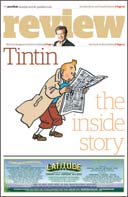
3:AM: It’s very rare, these days, to see a work of literary criticism being given such prominence. Do you agree that this is probably largely due to the fact that the main subject is not Balzac or Baudelaire — two key references here — but a comic-strip hero?

TMcC: First of all, I’m not sure I’d describe Tintin and the Secret of Literature as ‘criticism’. More as an essay. I like the idea of the essay as a primary literary form. You can trace it from David Foster Wallace through Blanchot all the way back to people like Hazlitt. But yes, the fact that it revolves around Tintin and not just Balzac and Baudelaire has certainly helped it get attention — although it wasn’t strategic to do this. I genuinely rate Hergé’s work, and wanted to read it alongside Balzac, Baudelaire, Bergson, Bachelard and all the rest, hopping from one to the other in a set of playful, serendipitous detours — which is exactly what the essay format allows.

3:AM: Your book is very much in the tradition of Barthes‘s Mythologies (an anthology which you fail to mention). I can’t remember if Barthes actually mentions Tintin anywhere, but he certainly could have done. In a way, the two figures go curiously well together: Tintin’s heyday corresponds roughly to that of Barthes and both, today, appear a little quaint. Was it Barthes who inspired this book? After all, your Tintin is primarily a semiologist who “can navigate [a key word in the McCarthy canon] the world of signs” (Tintin and the Secret of Literature p. 22), a deciphering cipher who embodies (along with Snowy?) the presence of absence — the Melvillian “whiteness of the whale” (p. 161) — but also, of course, Barthes’s “écriture blanche”.

TMcC: I do kind of mention Mythologies when I refer to wrestling and tomato tins early on in the book. I love Barthes: he’s a beautiful, generous writer. He never mentions Tintin directly as far as I know, although Derrida, another big presence (or present absence or whatever) in my book, does, glancingly, in The Post Card. Hergé read Barthes; you can see his influence very directly in the final book, Tintin and Alph-Art, in which language becomes a set of physical signs, giant letters which are held up and scrutinised by his characters.

ODETTE’S BITS

3:AM: Are you the first to draw a parallel between Sarrasine and the Tintin corpus? I haven’t read Balzac’s novel, but, from what you write, La Zambinella seems to bear a resemblance to Proust’s Odette de Crécy. Am I mistaken?

TMcC: As far as I know I am the first to draw a parallel between Tintin and Sarrasine. I re-read Barthes’s S/Z, which turns around that particular novella, initially because I wanted to write about Hergé’s total mastery of plot: the way he misdirects, doubles, occludes, jams and so on, all these devices Barthes describes so well in his take on Balzac. But as I did I realised that there were loads of points of correspondence between Sarrasine and the Tintin books. Balzac’s eponymous artist becomes obsessed by the opera singer la Zambinella, like Captain Haddock does with Bianca Castafiore; he copies her, like the sculptor Balthazar does the fetish in The Broken Ear; he’s murdered, as is Balthazar; the copy is copied and these copies are themselves copied, in both. Fundamentally, it’s about entering the realm of denatured simulation that is art. La Zambinella’s voice draws Sarrasine backstage, into a world of artifice, just as la Castafiore’s voice draws Haddock backstage and on into a world of inauthenticity. And these worlds prove fatal: the castrato la Zambinella effectively kills Sarrasine, and ultimately the not-really-pubescent Tintin effectively kills Hergé.

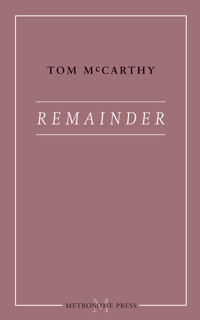
With Proust, I’ve got to admit I’ve never got as far as the Odette bits in the Remembrance. There are passages I find completely compelling, like the bit about how you can construct a composite memory of a house from various other houses you’ve known or read about or seen in pictures (which is more or less what my hero does in Remainder, but other bits lose me, and I put it down again for two years, then re-read as far as the house bit, then same again: a kind of incomplete repetition loop. Perhaps that’s what Old Marcel would have wanted.

ILLICIT FREQUENCIES

3:AM: Given that the literary status of the Tintin books is uncertain/debatable, isn’t it a little perverse to analyse them in order to uncover the “secret of literature”?

TMcC: Yes — and that’s why I wanted to do it. It would be easy to identify literary motifs in Faulkner or Dickens or someone. But what does it tell us when a corpus that makes no claims to being ‘literature’ displays a symbolic register as developed as Faulkner’s and characters as deep and rich as Dickens’s, not to mention themes and plots more or less identical to Sophocles’s and Shakespeare’s: the fall of the noble house, family secrets coming out into the open, the relation between host and guest gone disastrously wrong and so on? So much of the very best literature opens up illicit frequencies so that meaning can travel along channels other than the obvious or rational. The Tintin books are full of these frequencies, these channels; they even dramatise their setting up, hunting down, rumbling and relocating. And then it struck me that literature as a whole might hide its most intimate secrets in the most illicit of all zones, one tucked away ‘off-stage’, ‘aside’, below the radar of literature proper, which is of course the kind of zone that cartoons lurk in.
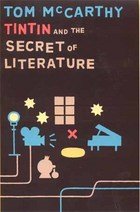
3:AM: Could you tell us about the cover of the book and Tintin’s absence from the illustrations inside?

TMcC: The cover is by Jochen Gerner, a French artist. I saw a book he’d done called TNT en Amérique, in which he buried the whole of Tintin in America under black ink but left a few symbols, mainly of money, divinity and violence (i.e. dollar signs, crosses and guns, all done in cartoony style) as markers for what he’d erased — all on the correct pages, corresponding to frames in the original book. So I contacted him and asked him to do the cover, and he was really into it. We looked at the main motifs in The Castafiore Emerald — the window, the piano, the cameras and spotlights that, ultimately, occlude more than they reveal — and he applied his technique (which, after Bataille, he calls ‘déformation’) to these. And in the foreground, as on Hergé’s, the tufted figure with his finger to his lips, saying ‘Shhhh!’ — what in the book I call “the condition of the secret become visible”.

To answer the second part of your question: I didn’t want images directly from the Tintin books inside my book. I was more interested in showing how these images (which I’m assuming most people who read my book will be at least slightly familiar with) mutate into and out of other ones: eighteenth-century portraits of castrato singers, stills from Buster Keaton films and, not least, ‘detourned’ versions of the Tintin books themselves. These last images break down into political activist ones, pornographic ones and ‘art’ ones: an interesting triangle.

THE BOY HAIRDRESSER

3:AM: Given your chapter devoted to “Castafiore’s Clit” (if you ever form a band, promise me that you’ll use that name) and your comments about Tintin’s androgyny, I was surprised you didn’t devote at least a few lines to the once-ubiquitous gay Tintin haircut…

TMcC: A band called Castafiore’s Clit is a great idea. Kind of Jane’s Addiction meets The Thompson Twins. Yes, it’s funny that Tintin has lent his haircut to gay culture. I found out recently that the Rocker quiff of the Fifties was taken directly from Jean Marais’s haircut in Cocteau’s Orphée, another big presence in my book.

THE SINS OF THE FATHER

3:AM: During the Second World War, Hergé had no qualms about publishing his comic strips in Le Soir, a newspaper that was under Nazi control and had clear Nazi sympathies. Interestingly enough, as you point out, Paul de Man also wrote for Le Soir. However, I was surprised that you did not make more of this coincidence. Paul de Man’s undermining of meaning and values having been reinterpreted (and partly discredited) in the light of the posthumous discovery of his youthful far-right views, should not we also be somewhat wary of Hergé’s “retroactive wiping-out of history” (p. 41), the erosion of Rastapopoulos’s “Semitic status” (pp. 44-45) or his reinvention as a “liberal leftist” (p. 46)? After all, anti-capitalism and anti-consumerism which, in your view, testify to the author’s “right-to-left trajectory” (p. 47) are common tenets on the far right as well as the far left…

TMcC: I never went with the argument that Paul de Man’s shameful youthful secret undermines all of deconstruction (is Derrida, a Jew, a secret anti-Semite too?), not least because when I was at university one of this argument’s main advocates serially harassed his female students while simultaneously espousing feminism, which for me kind of discredited anything he had to say. Yes, the anti-consumerist thing can serve a right-wing position as much as a left-wing one, and I point out in the book that Hergé kept the same villains in place throughout his career (secret cabals, men in hoods). But I think his right-to-left trajectory was a genuine one, as was Paul de Man’s. Things are connected. Fascism is a moment that the twentieth century goes through, in the arts as much as anywhere else. Think of Yeats, Spengler, Hamsun, Pound, Céline — brilliant and hugely influential writers who were fascists. Do we discount anything that’s come after them? Of course not: you trace the fallout of the disaster, how it mutates and develops. Think of Heidegger, a one-time Nazi out of whose thought the incredibly compelling ethical vision of Levinas (another Jew) has emerged. Anyway, it would be naive and liberal to want all our artists to be nice Guardian readers. Some people are arseholes. And another thing: Paul de Man doesn’t undermine meaning and value — just certain tired and reactionary notions of both.

[Just for the record: I didn’t mean to imply that Hergé’s, Céline’s or Yeats’s works should be rejected because of their political views, although I clearly gave that impression. Like Tom, I subscribe to a resolutely politically-incorrect conception of literature. My point simply concerned anti-capitalism and anti-consumerism (which the far left certainly has no monopoly over) along with the fact that certain thinkers’ seemingly-rational ideas are so obviously linked to individual history (Maurras’s deafness or Foucault’s masochism, for instance) that one should sometimes approach them with a little caution. Another issue we could have raised here is the Arendt-Heidegger relationship, but that would probably have been one serendipitous detour — to quote McCarthy — too many!]


FOUND IN TRANSLATION

3:AM: Remainder — the best novel of 2005 which, due to its republication by Alma Books, looks set to be the novel of 2006 (ironically enough, given the theme of the book) — could be described as the best French novel ever written in English by an Englishman. With Tintin and the Secret of Literature, your approach is once again resolutely French. Almost all of your major references are French (Balzac, Baudelaire, Barthes, Derrida…), and even the vocabulary you use is Gallicized (“fictive,” for instance, which is far closer to the French “fictif” than “fictional”). Where does your familiarity with French culture and the French language come from? Was it deliberate on your part to largely avoid references to British or American literature? Wouldn’t it have been interesting to give a more English perspective on Tintin since Tintinologists have a habit of being Belgian or French?

TMcC: First of all, thanks for your kind words about Remainder, and I’ll try to persuade my French publisher, Hachette Littératures, to use your “best French novel in English” line as a blurb for their edition that’s coming out next September — I couldn’t think of better praise! Yes, most of the points of reference in Tintin and the Secret of Literature are French, although Defoe, Bunyan, Behn and other Anglo early novelists get a look in — plus there’s a big digression through Shakespeare’s Sonnets. I guess I just really like French literature. The English were going really well from the sixteenth to the nineteenth centuries, producing poets like Donne and Marvell and novels like Clarissa and Tristram Shandy, but it all went horribly wrong somewhere in the late nineteenth/early twentieth and, while the French (and Americans) embarked on the wildest adventures with thought and form — Mallarmé, Breton, Cendrars, Faulkner etc etc — we got Thomas fucking Hardy and DH fucking Lawrence. The only top-class twentieth century English writers are the ones we claim spuriously: Americans like Eliot and James, Poles like Conrad, Irishmen like Joyce and Beckett…

3:AM: At the same time, there is a sense of humour and earthiness which are very un-French, as it were. After the publication of a strange review in The Economist which presented your book as a send-up of French theory, you spoke to me of the astounding “idiocy of English empirical culture”: do you think Tintin and the Secret of Literature is going to reignite the critical Querelle des Anciens et des Modernes of the 80s and 90s?

TMcC: I think to ignite any thought at The Economist you’d need to stick a ton of semtex up their arses. That review was quite funny, though: it perfectly captured the red-faced, vein-popping fury of Little England once the values on which it bases its entire identity are ever-so-slightly “solicited”, as Derrida would say. English takes on Tintin always present Hergé as a ’satirist’ and only that: a self-sufficient, rational subject who uses words and images as tools to tell us something he knows because he’s worked it out, rationally, you see. That’s the empirical line on literature tout court: the rational expression of a self-sufficient subject — as though we weren’t constantly made and unmade within language, desire, history, symbolic networks and so on. It’s as moronic as crediting a surfer with creating the wave which carries him and allows him to ply his craft — and back into which he’s eventually going to sink.

McCARTHYISM

3:AM: You say that you were introduced to Tintin by your mother at the age of seven. That, in itself, probably says a lot about your social background — that and your early encounter with Hugo Williams (mentioned by the poet in an article he wrote in the TLS about your International Necronautical Society). In France, in the 70s, Le Journal de Tintin tended to be read in Catholic and conservative circles whereas kids from Communist families usually read a comic called Pif. What sort of social and cultural milieu were you raised in, Tom?

TMcC: I come from a liberal arts-steeped middle-class family. My mum would tell us the stories of The Odyssey and The Merchant of Venice on car journeys. My parents were left-ish but not radical. They voted Labour but I went to a private day-school from the age of twelve.

3:AM: You write that “Everybody wants to be Tintin,” but I get the feeling that that everybody applies, first and foremost, to you. You even bear a slight physical resemblance to Hergé’s hero…

TMcC: I went to a fancy dress party dressed as Tintin once…

3:AM: Susan Tomaselli rounds off her review with the claim that Tintin and the Secret of Literature made her feel like re-reading Remainder (your debut novel) rather than the Tintin books themselves. Do you see this as a success or a failure?

TMcC: Success — although she should read the Tintin books too. In a way, I used Tintin and the Secret of Literature to work through some of the themes in Remainder in a more conscious way: the relationship between trauma and repetition, for example, or the idea of inauthenticity which emerged from the de Man essay “The Rhetoric of Temporality”, which I hadn’t read when I wrote Remainder even though it could almost be describing that book. It’s great to be able to switch modes, and come at the same territory from a different angle.

WE WANTED TO BLOW UP TIME ITSELF

3:AM: Your whole oeuvre seems to be contained within this critical essay: Tintin and the Secret of Literature could thus be read as a work of internal intertextuality. First of all, there’s the importance of meridians which points to Greenwich Degree Zero, your recent artistic collaboration with Rod Dickinson…

TMcC: …when we blew up the Greenwich Observatory, or at least produced the documentation of having blown up the Observatory, completing the task of Martial Bourdin, model for Conrad’s Stevie in The Secret Agent. We wanted to blow up time itself. Funnily enough, there’s a scene in The Broken Ear where a secret agent like Stevie carries a time-bomb around and gets blown up by it because he doesn’t realise the town clocks have broken. I love the sequence in The Sound and the Fury where Quentin carries a broken clock around and rides trams in different directions in a sub-Einsteinian attempt to escape time — then dies…
WE WANTED TO BLOW UP BRIDGES

3:AM: Then you’ve got the references to Cocteau’s Orphée and, more generally, your fascination with the “transmission-reception figure” (as you put it elsewhere): “[Tintin] will also be aware, as a radio operator, that the waves which carry his transmissions will travel outwards endlessly through space. Who knows where the signals will end up, or what they will end up meaning?” (p. 91).

TMcC: If I had to select five things to put in a space capsule to show aliens what we were capable of, Orphée would be one of them. It’s the most perfect piece of art, which lays out our existence as being in relation to death, technology, transmission-reception and desire — not to mention repetition. Death, a beautiful princess (and arts patron) falls in love with Orphée so she has another poet snatched to the underworld so he can send illicit, looping radio messages to Orphée which draw him towards her, through a mirror. Cocteau based his radio messages on the ones sent to occupied France during World War Two: these short lines of poetry. Most of them meant nothing, but one in every two hundred meant — only to those who knew — ‘blow up the bridge’. A man or woman in London reads a line of poetry into a microphone and in France a bridge blows up — or not. Poetry — real poetry — should harbour that potentiality somehow.

3:AM: You talk about Alph-Art, the eponymous avant-garde movement of Hergé’s posthumous book, which is “a cover for a giant forgery operation” (p. 158). Couldn’t this also be a fitting definition of your own “semi-fictitious” avant-garde movement, the International Necronautical Society?

TMcC: The INS had its own radio transmission network, operating out of the ICA two years ago, generating messages like Cocteau’s and actually transmitting them over the radio London-wide (and, via collaborating radio stations, world-wide). It looked like a giant factory floor, with workers running everywhere carrying lines of text — lines which, having been plucked from other media sources, were kind of second-hand if not fake. The INS is itself semi-fake, as you point out. Although the fake can hide the real.

THE UNNAMEABLE

3:AM: On page 84, you explain that, according to Freud, trauma produces “a desire for repetition mixed with a need to disguise the scene being repeated”. Could you comment on this sentence with reference to your novel Remainder?

TMcC: It’s not just Freud who says this: even his most positivist counterparts concur. Under ultra-extreme stress, the part of the mind that processes raw data into the narrative thread we call ‘memory’ simply goes on strike and refuses to process. It’s called ‘dissociation’. So the data’s present, but not dealt with, and therefore keeps bobbing up and demanding to be incorporated somehow. As it can’t form part of normal memory, it plays itself out in weird ways — ones that contain elements of the original event but are also scrambled, disguised. And it will keep repeating, albeit in modulated form, until it is accommodated properly. Well, in Remainder the hero has undergone a traumatic event which he hasn’t retained as straight memory but rather as fragments of data: the sense of being about to be hit, blue lights, railings, being held above a tray or bed and so on. These induce a propensity to repeat stuff in him. Another interesting thing about post-trauma is that (to return to a motif we touched on a moment ago) it makes people feel inauthentic, fake, because everything is of a lesser magnitude of experience than the trauma-moment itself, the only ‘real’ thing. And then the subject back-projects for himself a time when he wasn’t fake, and longs for that time. That’s what my guy is doing with his re-enactments: repeating backwards to an imagined era of authenticity — but repeating, more accurately, towards the trauma-moment itself, the true, unnameable moment, the moment of truth and unnameability itself.

THE CHINK ON THE CARPET

3:AM: The re-enactments in Remainder or in your artistic work: mimesis or simulacrum?

TMcC: Aha: very good question, bang on the money. In Remainder, he wants the authentic, so he sets up a zone of mimesis, paying architects and designers to recreate his ‘remembered’ building and re-enactors to ‘be’ the lady he remembers frying liver on the floor below him, the pianist he remembers practising Rachmaninoff and so on. He wants to accede through these re-enactments to a mode of authenticity, of simply ‘being’ rather than simulating. But of course it doesn’t work: the re-enactments tend more towards the status of simulacra, what Plato defines as ‘a copy without an original’. But then, paradoxically, the most jarring and obviously inconsistent things, the ‘extra’ bits, the ones with no originals of any type at all, are what catapult him into ultra-authenticity — which, not coincidentally, is also pure violence. It’s the little chink on the carpet of his re-enacted bank heist that flips the whole re-enactment over into all-too-real-ness, when the re-enactor trips on it, or rather on its absence, and his gun goes off…
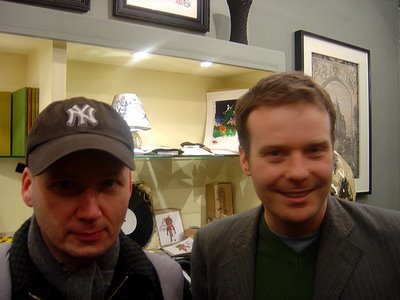

[Stewart Home and Tom McCarthy at 3:AM Magazine‘s Xmas Bash, London 2005]

THE CRACK IN THE WALL

3:AM: Barthes writes that “…the ‘realistic’ artist never places reality at the origin of his discourse, but only and always, as far back as can be traced, an already written real, a prospective code, along which we discern, as far as the eye can see, only a succession of copies” (quoted on p. 55): this is also, unwittingly, what the protagonist of Remainder does, right?

TMcC: Remainder has been read by some critics as an allegory of realism and of the realist mode of art, and this isn’t an entirely wrong reading — although if the hero had actually been an artist rather than an Everyman, some bloke, it would have been an entirely different, and inferior, book. But yes, it definitely turns around his copying, and even (as he sets about getting his re-enactors to re-enact the moments when they prepared for the previous re-enactment) his copying his moments of copying, endlessly regressive. We can try to work it out together, but ultimately I can’t give the definitive schematic meta-reading of the book any more than you — perhaps less. It was intuitive: I was looking at a crack in a wall and had a moment of dejà-vu and wished I had loads of money to re-enact this moment and there was the novel.

EVERYTHING LITERATURE SHOULD BE

3:AM: When discussing tobacco throughout the Tintin books, you explain (following Derrida) that it “goes up in smoke” but “also leaves remains, ashes, which maintain symbolic links to memory, death and inheritance. Baudelaire’s story takes off from the change left over from the two friends’ luxury expenditure: like the coin itself, it proceeds from the remainder” (p. 135). Why are remnants so important in your work?

TMcC: It’s what’s left. After the disaster, after thought, interpretation, writing itself. It’s like when Wallace Stevens says “The plum survives its poems”. Writing has to deal with this remainder, and good writing has to deal with the fact that it can never fully deal with it. Francis Ponge knows this. He writes brilliant prose poems about, for example, oranges: the texture of their cells, the way they leave goop on your hands so that even when you’ve ‘expressed’ them there’s a residue that’s not contained. If Susan Tomaselli or anyone else really want to do themselves a favour, they should re-read neither Remainder nor the Tintin books but rather Ponge’s Le Parti pris des choses (you can get it in dual text). It’s everything writing should be.

[This interview was initially posted here.]

The Not-Oyster Bit

Tom McCarthy interviewed about Tristram Shandy in Henry HitchingsBirth of the British Novel broadcast on BBC Four, 7 February 2011:

HH: What is a novel?

(Tom McCarthy laughs.)

TMC: A novel is something that contains its own negation, right? So a novel is not a novel without an anti-novel lodged in it. It’s like an oyster: it isn’t interesting unless it has got a bit of grit in it as well — that not-oyster bit that kind of produces the pearl. In Tristram Shandy, this is precisely what produces the drama: the central drama of that book is its own undermining. And I think, in a way, this is what every book should be, in one way or another.