
This article, translated by Iris Bernal, appeared in Función Lenguaje 2 (summer 2012)
La influencia de la ansiedad
“Llegamos demasiado tarde para decir algo que no se haya dicho ya” se lamentaba La Bruyère a finales del siglo XVII. El hecho de que el propio La Bruyère llegara tarde al afirmar esto (el Eclesiasta y Terencio ya se habían adelantado a él en los siglos III y II AC) venía a demostrar su aserto. Según la precuela de Macedonio Fernández, anterior al Génesis, siempre hemos llegado demasiado tarde. Este autor imagina lo que bien podría haber sucedido cuando Dios estaba a punto de crear el universo. De pronto, una voz clama en el desierto, interrumpiendo el eterno silencio del espacio infinito, la misma que aterra a Pascal: “Todo ha sido escrito, todo ha sido dicho, todo ha sido hecho”, se lamenta. El Todopoderoso, que ya ha escuchado esto con anterioridad, sigue adelante sin darle importancia, dando sentido a la famosa ocurrencia de André Gide: “Todo está ya dicho, pero como nadie escucha, hay que volverlo a decir” (Le Traité du Narcisse, 1891). En el principio fue el verbo, y el verbo es anterior al principio mismo.
En su obra más influyente, The Anxiety of Influence (1973), Harold Bloom argumentaba que los grandes poetas románticos malinterpretaron a sus ilustres predecesores “con el fin de liberar un espacio imaginativo para sí mismos”. La figura del padre literario se asesinaba, metafóricamente hablando, a través de un proceso de “transgresión poética”. T.S. Eliot ya había expresado una idea similar a propósito de la de Philip Massinger: “Los poetas inmaduros imitan; los poetas maduros roban; los malos poetas desfiguran lo que toman, y los buenos poetas lo convierten en algo mejor, o al menos en algo diferente” (1920). Borges, discípulo de Macedonio, al cual Bloom hace referencia, compartía la misma longitud de onda (aunque en el extremo opuesto del dial) cuando exclamaba que “cada escritor crea sus propios precursores” (1951).
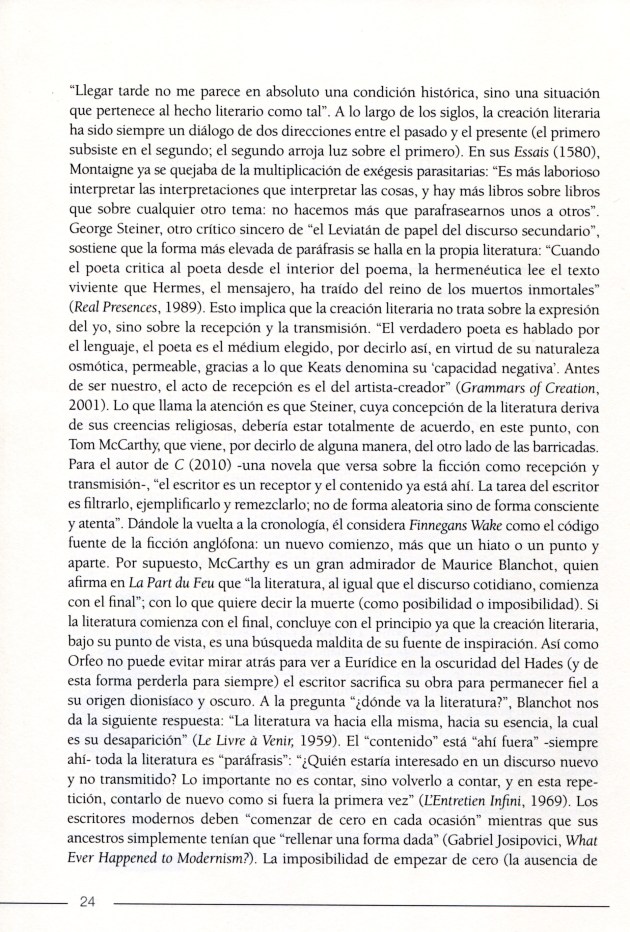
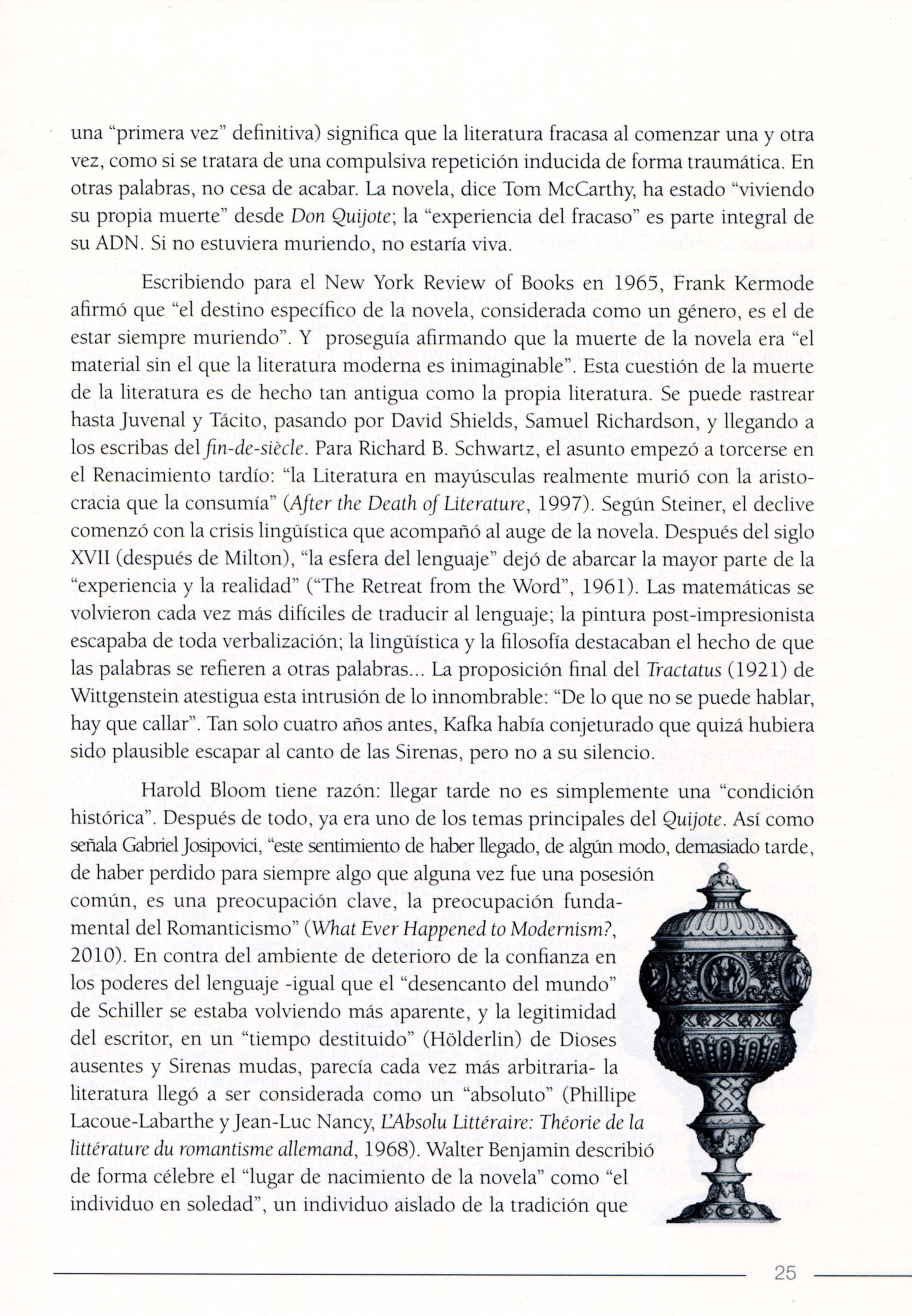
Según Bloom, este sentimiento de inferioridad es, más que un fenómeno característico del Renacimiento, el motor principal de la historia de la literatura: “Llegar tarde no me parece en absoluto una condición histórica, sino una situación que pertenece al hecho literario como tal”. A lo largo de los siglos, la creación literaria ha sido siempre un diálogo de dos direcciones entre el pasado y el presente (el primero subsiste en el segundo; el segundo arroja luz sobre el primero). En sus Essais (1580), Montaigne ya se quejaba de la multiplicación de exégesis parasitarias: “Es más laborioso interpretar las interpretaciones que interpretar las cosas, y hay más libros sobre libros que sobre cualquier otro tema: no hacemos más que parafrasearnos unos a otros”. George Steiner, otro crítico sincero de “el Leviatán de papel del discurso secundario”, sostiene que la forma más elevada de paráfrasis se halla en la propia literatura: “Cuando el poeta critica al poeta desde el interior del poema, la hermenéutica lee el texto viviente que Hermes, el mensajero, ha traído del reino de los muertos inmortales” (Real Presences, 1989). Esto implica que la creación literaria no trata sobre la expresión del yo, sino sobre la recepción y la transmisión. “El verdadero poeta es hablado por el lenguaje, el poeta es el médium elegido, por decirlo así, en virtud de su naturaleza osmótica, permeable, gracias a lo que Keats denomina su ‘capacidad negativa’. Antes de ser nuestro, el acto de recepción es el del artista-creador” (Grammars of Creation, 2001). Lo que llama la atención es que Steiner, cuya concepción de la literatura deriva de sus creencias religiosas, debería estar totalmente de acuerdo, en este punto, con Tom McCarthy, que viene, por decirlo de alguna manera, del otro lado de las barricadas. Para el autor de C (2010) -una novela que versa sobre la ficción como recepción y transmisión-, “el escritor es un receptor y el contenido ya está ahí. La tarea del escritor es filtrarlo, ejemplificarlo y remezclarlo; no de forma aleatoria sino de forma consciente y atenta”. Dándole la vuelta a la cronología, él considera Finnegans Wake como el código fuente de la ficción anglófona: un nuevo comienzo, más que un hiato o un punto y aparte. Por supuesto, McCarthy es un gran admirador de Maurice Blanchot, quien afirma en La Part du Feu que “la literatura, al igual que el discurso cotidiano, comienza con el final”; con lo que quiere decir la muerte (como posibilidad o imposibilidad). Si la literatura comienza con el final, concluye con el principio ya que la creación literaria, bajo su punto de vista, es una búsqueda maldita de su fuente de inspiración. Así como Orfeo no puede evitar mirar atrás para ver a Eurídice en la oscuridad del Hades (y de esta forma perderla para siempre) el escritor sacrifica su obra para permanecer fiel a su origen dionisíaco y oscuro. A la pregunta “¿dónde va la literatura?”, Blanchot nos da la siguiente respuesta: “La literatura va hacia ella misma, hacia su esencia, la cual es su desaparición” (Le Livre à Venir, 1959). El “contenido” está “ahí fuera” -siempre ahí- toda la literatura es “paráfrasis”: “¿Quién estaría interesado en un discurso nuevo y no transmitido? Lo importante no es contar, sino volverlo a contar, y en esta repetición, contarlo de nuevo como si fuera la primera vez” (L’Entretien Infini, 1969). Los escritores modernos deben “comenzar de cero en cada ocasión” mientras que sus ancestros simplemente tenían que “rellenar una forma dada” (Gabriel Josipovici, What Ever Happened to Modernism?). La imposibilidad de empezar de cero (la ausencia de una “primera vez” definitiva) significa que la literatura fracasa al comenzar una y otra vez, como si se tratara de una compulsiva repetición inducida de forma traumática. En otras palabras, no cesa de acabar. La novela, dice Tom McCarthy, ha estado “viviendo su propia muerte” desde Don Quijote; la “experiencia del fracaso” es parte integral de su ADN. Si no estuviera muriendo, no estaría viva.
Escribiendo para el New York Review of Books en 1965, Frank Kermode afirmó que “el destino específico de la novela, considerada como un género, es el de estar siempre muriendo”. Y proseguía afirmando que la muerte de la novela era “el material sin el que la literatura moderna es inimaginable”. Esta cuestión de la muerte de la literatura es de hecho tan antigua como la propia literatura. Se puede rastrear hasta Juvenal y Tácito, pasando por David Shields, Samuel Richardson, y llegando a los escribas del fin-de-siècle. Para Richard B. Schwartz, el asunto empezó a torcerse en el Renacimiento tardío: “la Literatura en mayúsculas realmente murió con la aristocracia que la consumía” (After the Death of Literature, 1997). Según Steiner, el declive comenzó con la crisis lingüística que acompañó al auge de la novela. Después del siglo XVII (después de Milton), “la esfera del lenguaje” dejó de abarcar la mayor parte de la “experiencia y la realidad” (“The Retreat from the Word”, 1961). Las matemáticas se volvieron cada vez más difíciles de traducir al lenguaje; la pintura post-impresionista escapaba de toda verbalización; la lingüística y la filosofía destacaban el hecho de que las palabras se refieren a otras palabras… La proposición final del Tractatus (1921) de Wittgenstein atestigua esta intrusión de lo innombrable: “De lo que no se puede hablar, hay que callar”. Tan solo cuatro años antes, Kafka había conjeturado que quizá hubiera sido plausible escapar al canto de las Sirenas, pero no a su silencio.
Harold Bloom tiene razón: llegar tarde no es simplemente una “condición histórica”. Después de todo, ya era uno de los temas principales del Quijote. Así como señala Gabriel Josipovici, “este sentimiento de haber llegado, de algún modo, demasiado tarde, de haber perdido para siempre algo que alguna vez fue una posesión común, es una preocupación clave, la preocupación fundamental del Romanticismo” (What Ever Happened to Modernism?, 2010). En contra del ambiente de deterioro de la confianza en los poderes del lenguaje -igual que el “desencanto del mundo” de Schiller se estaba volviendo más aparente, y la legitimidad del escritor, en un “tiempo destituido” (Hölderlin) de Dioses ausentes y Sirenas mudas, parecía cada vez más arbitraria- la literatura llegó a ser considerada como un “absoluto” (Phillipe Lacoue-Labarthe y Jean-Luc Nancy, L’Absolu Littéraire : Théorie de la littérature du romantisme allemand, 1968). Walter Benjamin describió de forma célebre el “lugar de nacimiento de la novela” como “el individuo en soledad”, un individuo aislado de la tradición que no puede reclamar ser el portavoz de la religión o la sociedad. Tan pronto como este “individuo en soledad” se elevaba al estatus de un alter deus, la tardanza esencial a toda la creatividad humana resultaba obvia. “Ninguna forma artística”, dice Steiner en Grammars of Creation (2001), “nace de la nada. Siempre viene después” y el “creador humano se enfurece ante [este] venir después, al ser, para siempre, segundo con respecto al misterio original y originador de la formación de la forma” (Real Presences, 1990). William Marx ha analizado con gran maestría cómo en Francia las desmedidas reivindicaciones para la literatura condujeron a esta decadencia prolongada. Esta evolución, de lo sublime a lo ridículo, tuvo lugar en tres etapas. A finales del siglo XVIII, la literatura se transformó en un sucedáneo de la religión. En una segunda etapa, marcada por la arrogancia, los escritores intentaron aislarse del resto de la sociedad (el arte por el arte) desencadenando de este modo un proceso de marginalización. En una última fase, la devaluación de la literatura (a los ojos del público en general) fue interiorizada por los propios escritores e incorporada a sus obras (L’Adieu à la Littérature. Histoire d’une dévalorisation XVIIIe-XXe siècles, 2005).
En sus Vorlesungen über die Ästhetik (compiladas en 1835), Hegel declaró, de manera brillante, que el arte se había transformado en “algo del pasado”. No quería decir con esto, como a menudo se ha creído, que el arte y la literatura estuviesen muertos, o incluso en decadencia, sino que no podían seguir transmitiendo de forma adecuada las más elevadas aspiraciones espirituales de la humanidad. En otras palabras, no podían seguir siendo el instrumento para expresar lo Absoluto. Influido por Hegel, Blanchot se pregunta: “¿Está el arte alcanzando su final? ¿Está pereciendo la poesía por haberse visto reflejada en sí misma, igual que aquel que muere después de contemplar a Dios?” (Le Livre à Venir). Si, como él propone en otro sitio, “la literatura surge en el momento en el que la literatura se convierte en una pregunta”, entonces la respuesta es no (La Part du Feu, 1949). Sin embargo, al transformarse en una pregunta, la literatura se transforma a su vez en su propia respuesta, por lo que ya no es capaz de sincronizarse consigo misma. Uno podría alegar que la literatura es entonces la distancia que la separa de sí misma. “Aquellos viejos tiempos”, anteriores al Génesis según Witold Gombrowicz, “cuando Rabelais escribía cómo un niño hacía pis contra el tronco de un árbol” habían acabado. “Retroceder al universo de los géneros literarios no es una opción”, ratifica Gabriel Josipovici, “como tampoco lo es un retorno al mundo del ancien régime” (What Ever Happened to Modernism?). Esta crisis de identidad se agravaba por una conciencia cada vez mayor de las limitaciones de la creación literaria. La literatura ya no sabía exactamente lo que era, pero sí sabía lo que no era, lo que ya no era capaz de hacer. “Ser moderno”, como declaró Roland Barthes, “es conocer lo que ya no es posible”. Es también anhelar esa imposibilidad, en la forma en la que Borges lo hacía en “el otro tigre, el que no está en el verso”. Tom McCarthy afirma que una novela es “algo que contiene su propia negación”, que clama contra sus propias limitaciones. Según este autor, la literatura es “un medio que sólo marcha cuando no funciona”: es “un fallo en el sistema, igual que un fallo en el ordenador”. “Fracasa otra vez. Fracasa mejor”, como decía Beckett en Worstward Ho (1983). Para Blanchot, es precisamente esta imposibilidad esencial de la literatura (su incapacidad para convertirse en una instancia del Absoluto hegeliano) lo que la preserva como posibilidad. La obra está siempre por venir.
La potencialidad, el angustioso vértigo de la libertad, es fundamental para la modernidad literaria. Pierre Menard responde a la arbitrariedad de la ficción (puesta de relieve por la libertad creativa) reescribiendo palabra por palabra Don Quijote y, de este modo, convierte la contingencia en necesidad (“Pierre Menard, autor de El Quijote”, 1939). Otra respuesta a esta cuestión es la de Henry James, que permite al lector sentir “la narración como podría haber sido” tras “la obra construida y limitada a la que él da vida” (Le Livre à Venir). Una creciente reticencia a dar vida a cualquier obra, por muy limitada que sea, se hizo sentir desde el siglo XVIII en adelante. En Sygdommen til Døden (1849), Kierkegaard observó cómo “se hace cada vez más plausible porque nada se vuelve real”. Llevando esta lógica hasta el extremo, Rousseau afirma que “No hay nada más bello que lo que no existe”, mientras que Keats resaltaba la belleza innombrable de las melodías “no escuchadas” (“Ode on a Grecian Urn”, 1819). Una figura emblemática, como señala Dominique Rabaté (Vers une Littérature de l’épuisement, 1991) es el “demonio de la posibilidad” lui-même: Monsieur Teste de Valéry, que se niega a reducir el campo de posibilidades convirtiendo cualquiera de ellas en realidad. Es un claro precursor del Ulrich de Musil -el epónimo Der Mann ohne Eigenschaften (1930-42)- al cual Blanchot describe como alguien que “no dice que no a la vida sino que aún no, quien finalmente actúa como si el mundo no pudiera nunca empezar excepto al día siguiente”. Otra figura representativa es Lord Chandos, de Hofmannstahl, el cual, habiendo renunciado a la literatura porque el lenguaje no puede “penetrar en el núcleo más íntimo de las cosas”, llegó a personificar un motín mudo instigado (en la vida real) por Rimbaud (Ein Brief “Lord Chandos”, 1902). Estos escritores cada vez más reticentes, los cuales, como el Bartleby de Melville, “preferirían no hacerlo” (“Bartleby, the Scrivener”, 1853), son los que Jean-Yves Jouannais denominó “artistas sin obra” (Artistes sans oeuvres, 1997); los partidarios de lo que Enrique Vila-Matas denomina la “literatura del no” (Bartleby y compañia, 2000).
La literatura ha ido muriendo inexorablemente a lo largo del siglo XX. En 1925, José Ortega y Gasset escribió sobre el “declive” de la novela. En 1930, Walter Benjamin afirmaba que estaba en “crisis”. Theodor W. Adorno creía que no podía haber poesía después de Auschwitz. En 1959, Brion Gysin (el de los “cut-ups”) se quejaba de que la ficción llevaba un retraso de cincuenta años con respecto a la pintura. A principios de los ‘60, Alain Robbe-Grillet criticó la momificación de la novela en su encarnación del siglo XIX. En 1967, John Barth publicó “The Literature of Exhaustion”, texto en el que hablaba de “la extenuación de determinadas formas o el agotamiento de determinadas posibilidades”. Ese mismo año, Gore Vidal diagnosticó que la novela estaba exhalando su último aliento. “Debemos continuar durante mucho tiempo hablando de obras y escribiéndolas, haciendo como que no nos damos cuenta de que la iglesia está vacía y que los feligreses se han ido a otra parte, a ocuparse de otros dioses”. En 1969, Ronald Sukenick publicó una colección de relatos breves titulada The Death of the Novel. A comienzos de los ‘70, el Nuevo Periodismo de Tom Wolfe fue considerado por algunos como el futuro de la escritura creativa. La muerte de la literatura y el mundo tal y como lo conocemos hoy en día, se convirtió en un tema de actualidad entre los académicos estadounidenses a principios de los ‘90 (ver, por ejemplo, la obra de Alvin Kernan titulada con gran acierto The Death of Literature, 1992). Habitualmente, argumentaban que los Departamentos de Inglés habían sido secuestrados por los estudios culturales, la Filosofía Continental y la corrección política enloquecida (a la que Bloom ha denominado “Escuela del Resentimiento”).
Desde entonces, han ocurrido dos cosas. La novela -que fue creada con el propósito de fusionar la poesía y la filosofía (según los primeros Románticos alemanes), de contener los demás géneros e incluso, el universo entero (siguiendo la concepción de Mallarmé acerca de El Libro o el sueño de Borges de una “Biblioteca Total”)- ha sido relegada a la “ficción”, un género que aborda la creación literaria como si el siglo XX nunca hubiera existido. Al mismo tiempo, la era digital ha llevado el exceso de información (del cual ya se quejaba en su momento el Eclesiasta) a un nivel completamente nuevo. Como consecuencia de esto, David Shields cree que la novela ya no está capacitada para reflejar la compleja vitalidad de la vida moderna: él prescribe nuevas formas híbridas de escritura (Reality Hunger, 2010). El poeta estadounidense (y fundador de UbuWeb) Kenneth Goldsmith nos pide encarecidamente que dejemos de escribir del todo para centrarnos en recombinar los textos que hemos ido acumulando a lo largo de los siglos (Uncreative Writing, 2011). Trasladando el retrato que James Joyce hizo de sí mismo como “el hombre del corta y pega” a la era digital, Mark Amerika afirma que hoy en día todos somos “remezcladores”. Sin embargo, ¿qué ocurriría si, tal como se preguntaba Lewis Carroll, las combinaciones de palabras fueran limitadas y ya las hubiéramos utilizado todas?
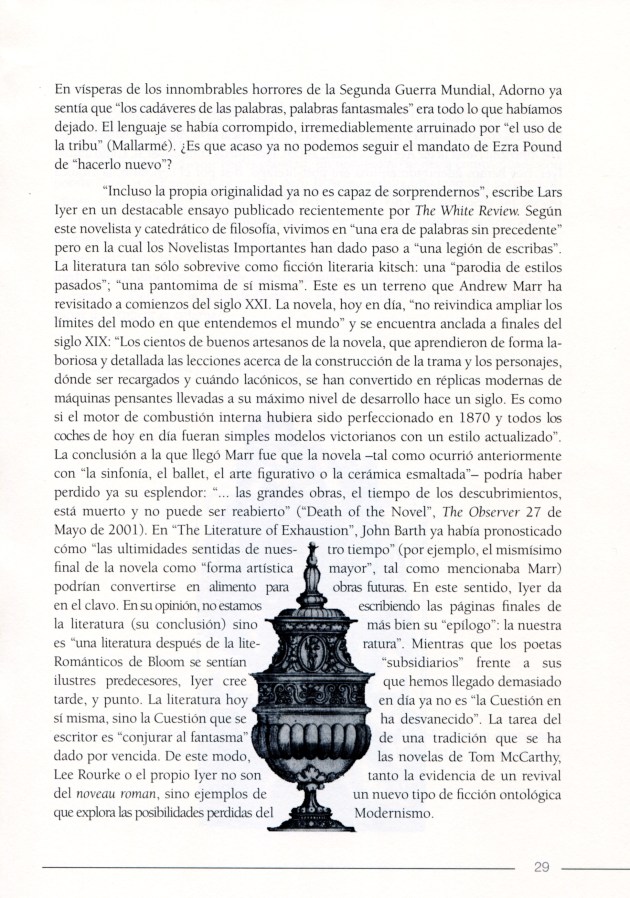
Según Steiner, somos “agonistas”, “vamos rezagados”: “No tenemos más comienzos” (Grammars of Creation). Para nosotros, el lenguaje “está desgastado por el uso” y el “sentido de revelación, de profuso conocimiento” exhibido por los escritores del periodo Tudor, Isabelino y Jacobeo “nunca ha vuelto a ser plenamente recuperado”. En vísperas de los innombrables horrores de la Segunda Guerra Mundial, Adorno ya sentía que “los cadáveres de las palabras, palabras fantasmales” era todo lo que habíamos dejado. El lenguaje se había corrompido, irremediablemente arruinado por “el uso de la tribu” (Mallarmé). ¿Es que acaso ya no podemos seguir el mandato de Ezra Pound de “hacerlo nuevo”?
“Incluso la propia originalidad ya no es capaz de sorprendernos”, escribe Lars Iyer en un destacable ensayo publicado recientemente por The White Review. Según este novelista y catedrático de filosofía, vivimos en “una era de palabras sin precedente” pero en la cual los Novelistas Importantes han dado paso a “una legión de escribas”. La literatura tan sólo sobrevive como ficción literaria kitsch: una “parodia de estilos pasados”; “una pantomima de sí misma”. Este es un terreno que Andrew Marr ha revisitado a comienzos del siglo XXI. La novela, hoy en día, “no reivindica ampliar los límites del modo en que entendemos el mundo” y se encuentra anclada a finales del siglo XIX: “Los cientos de buenos artesanos de la novela, que aprendieron de forma laboriosa y detallada las lecciones acerca de la construcción de la trama y los personajes, dónde ser recargados y cuándo lacónicos, se han convertido en réplicas modernas de máquinas pensantes llevadas a su máximo nivel de desarrollo hace un siglo. Es como si el motor de combustión interna hubiera sido perfeccionado en 1870 y todos los coches de hoy en día fueran simples modelos victorianos con un estilo actualizado”. La conclusión a la que llegó Marr fue que la novela –tal como ocurrió anteriormente con “la sinfonía, el ballet, el arte figurativo o la cerámica esmaltada”– podría haber perdido ya su esplendor: “… las grandes obras, el tiempo de los descubrimientos, está muerto y no puede ser reabierto” (“Death of the Novel”, The Observer 27 de Mayo de 2001). En “The Literature of Exhaustion”, John Barth ya había pronosticado cómo “las ultimidades sentidas de nues- tro tiempo” (por ejemplo, el mismísimo final de la novela como “forma artística mayor”, tal como mencionaba Marr) podrían convertirse en alimento para obras futuras. En este sentido, Iyer da en el clavo. En su opinión, no estamos escribiendo las páginas finales de la literatura (su conclusión) sino más bien su “epílogo”: la nuestra es “una literatura después de la literatura”. Mientras que los poetas Románticos de Bloom se sentían “subsidiarios” frente a sus ilustres predecesores, Iyer cree que hemos llegado demasiado tarde, y punto. La literatura hoy en día ya no es “la Cuestión en sí misma, sino la Cuestión que se ha desvanecido”. La tarea del escritor es “conjurar al fantasma” de una tradición que se ha dado por vencida. De este modo, las novelas de Tom McCarthy, Lee Rourke o el propio Iyer no son tanto la evidencia de un revival del nouveau roman, sino ejemplos de un nuevo tipo de ficción ontológica que explora las posibilidades perdidas del Modernismo.
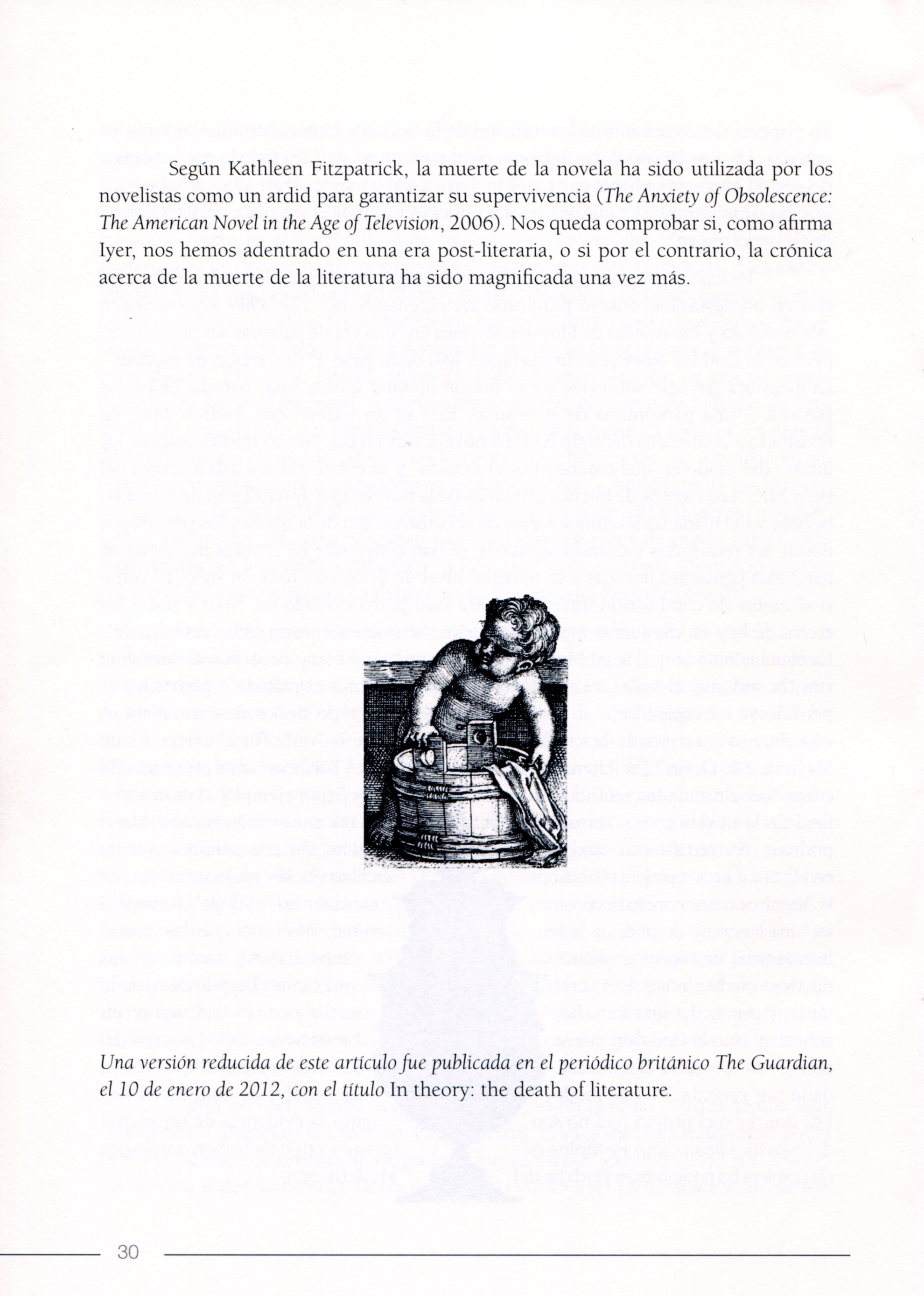
Según Kathleen Fitzpatrick, la muerte de la novela ha sido utilizada por los novelistas como un ardid para garantizar su supervivencia (The Anxiety of Obsolescence: The American Novel in the Age of Television, 2006). Nos queda comprobar si, como afirma Iyer, nos hemos adentrado en una era post-literaria, o si por el contrario, la crónica acerca de la muerte de la literatura ha sido magnificada una vez más.
Una versión reducida de este artículo fue publicada en el periódico británico The Guardian, el 10 de enero de 2012, con el título “In Theory: the Death of Literature”.




Larger versions of these scans are available here:
Page 23 / Page 24 / Page 25 / Page 26 / Page 27 / Page 28 / Page 29 / Page 30 / Page 22


 ANDREW GALLIX