Full Stop

Full Stop magazine interviewed me as part of their “Pathos” series, examining “the consequences of pursuing writing as a vocation”.

andrewgallix

“Pathos: Andrew Gallix,” Full Stop 16 January 2013

Last winter, Full Stop introduced “The Situation in American Writing,” a questionnaire adapted from The Partisan Review that asked questions about literature’s responsibility to address seismic changes in culture, the publishing industry, and the political and geopolitical landscape. That questionnaire, which featured responses from Marilynne Robinson, George Saunders, Victor LaValle, T.C. Boyle, Dana Spiotta, and dozens of other writers was illustrative of the concerns and preoccupations that writers carry with them when practicing their craft.

This year we are interested in the situation of writers, rather than writing, in the subjective experience of writing fiction (or in this case, memoir), rather than fiction’s responsibilities to respond to a rapidly changing world. To this end we are interested in examining the trying intellectual, creative, and emotional labor that is often unacknowledged or effaced in the public presentation of writing. What we’re interested in, to put it another way, is pathos.

This year, we’ve crafted a questionnaire asking writers about the effect writing has had on their physical, emotional, and economic health; on the idea of poverty being a precondition for writing well; on what makes writing truthful to one’s self and to readers. Ultimately, we are interested in the consequences of pursuing writing as a vocation.

Andrew Gallix is the Editor-in-Chief of the consistently great 3:AM Magazine which features a motto that is the envy of Full Stop: ”Whatever it is, we’re against it.” He also teaches at the Sorbonne, writes for The Guardian, and is currently working on a novel, as well as a collection of reviews of impossible books in collaboration with David Winters.

How has your decision to write affected your health? Has it had negative effects on your personal life?

The great Polish writer Witold Gombrowicz said, “One cannot be nothingness all week and then suddenly expect to exist on Sunday.” It’s equally difficult to have a day job and be “nothingness” in the evening — especially if you’re trying to juggle a family life at the same time. Things must be much easier when you can write for a living. I’m pretty sure writing contributed to my divorce, for instance!

There is long tradition that links the craft of writing with poverty. Do you think that’s appropriate? Does poverty feel like the most appropriate condition for your practice as a writer?

No. The authors I know who insist upon writing for a living, although their work is resolutely uncommercial, end up, paradoxically, being obsessed with financial matters. Every single word they write must be counted, and accounted for; turned into money to pay the bills. Don’t get me wrong: writers should be paid, but you can’t force people to buy books, let alone read them. Those lucky, or cunning enough, to find a wide audience don’t usually stop writing, all of a sudden, because they’re raking it in. Some of the most interesting writers today come from very privileged backgrounds. Others don’t, and if their books fail to sell in sufficient quantities, they usually have to supplement their incomes through grants, teaching, journalism, or jobs in publishing. The creative writing industry is, in part, a means of subsidising writers’ careers.

The question of the cost of letters (to refer to the title of a book on this subject published by Waterstone’s in 1998) is an important one, because it reflects the evolution of literature itself. When literature was essentially an aristocratic pursuit — for people who had both time and money — this question was immaterial. It only really arises with the spread of literacy and the emergence of writers who didn’t hail from the ranks of the idle rich. The Waterstone’s book I mentioned — How Much Do You Think a Writer Needs to Live on?: The Cost of Letters (edited by Andrew Holgate and Honor Wilson-Fletcher) — was inspired by a survey of literary living standards carried out by Cyril Connolly fifty years earlier. When it was published by Horizon, in 1948, British society was being radically transformed through mass education and the Welfare State. Connolly’s survey contained the following questions:

How much do you think a writer needs to live on?
Do you think a serious writer can earn this sum by his writing and if so, how?
If not, what do you think is a suitable second occupation for him?
Do you think literature suffers from the diversion of a writer’s energy into other employments or is enriched by it?
Do you think the state or any other institution should do more for writers?
Are you satisfied with your own solution of the problem and have you any specific advice to give young people who wish to earn their living by writing?

The main question (which wasn’t addressed because it went without saying at the time) is, of course, that of the definition of a “serious writer” — one who may be worthy of being subsidised in the absence of commercial success. Who decides who is a “serious writer” in the first place? Is it the writer him/herself? His/her peers? Academia? The media? The reading public? The state? I’ve always been a little dubious about the romantic image of the impoverished, tortured genius scribbling away in his, or indeed her, dingy garret, but it does reflect a very real process of privatisation of the writing profession.

Walter Benjamin famously described the “birthplace of the novel” — and hence that of modern literature — as “the solitary individual”: an individual cut off from tradition, who, unlike the writers of antiquity, could no longer claim to be the mouthpiece of religion or society. The writer’s legitimacy, in a “destitute time” (Hölderlin) of absent gods and silent sirens (Kafka) — a disenchanted world (Schiller) which is still ours — becomes highly arbitrary.

Personally, financial difficulties have always diverted me away from my writing. Having said that, the necessity to write often stems (at least in part) from a feeling of dissatisfaction — a sense that something is missing — so, from that point of view, not being rich and contented is probably an asset.

In a rare 1983 interview the enigmatic and often dour Romanian writer Emil Cioran speaks about only reading Nietzsche’s letters because he became concerned with how untruthful Nietzsche’s published works seemed when read against the miserable condition of his day to day existence (isolated, weak, sickly, certainly not characterized by any sense of vigor). Is there any sense in which the truth of one’s condition should be related to the truth of one’s writing, even if in an oblique sense?

In an oblique sense, yes; otherwise, not necessarily. As I was saying, literature is often a compensatory activity; an elaborate form of wish-fulfilment. I am absolutely fascinated by the impact that someone’s physical and psychological life can have on his/her thinking and writing — how apparently rational choices are due, for instance, to a tiny todger, short stature, child abuse, or the absence of a parent. Sartre claimed that he began writing to make up for his ugliness and impress women. We all want to be loved, and writing is always a love letter of sorts. As Richard Brautigan put it, “Just because people love your mind, doesn’t mean they have to have your body” — but one lives in hope, of course.

Perhaps Cioran’s remark makes more sense in the context of philosophy, but literature is the space of contradiction and ambiguity, and that’s what interests me.

Incidentally, I once lived in the same street as Cioran, in Paris.

Are you envious of other people’s success? If so, are you more envious of people’s success in your field or outside of it? Why?

I am, especially if I think they don’t deserve it. I’m more envious of people in my own field, of course, because I feel closer to them. It’s a phenomenon that René Girard skillfully analyses in Deceit, Desire & the Novel.

Give one example in which you had high hopes for success (artistic, commercial, or otherwise) but had those hopes dashed.

When I was really young, and still a student, I got a contract with an American publisher for a short work of criticism. I’d sent them the manuscript, on the off-chance, and it turns out that they wanted to publish it as it was. I was really proud: I didn’t know anyone my age who had published a book — but, of course, I wasn’t satisfied. The manuscript, in my eyes, wasn’t good enough. I asked the publisher to give me a little time to work on it. They granted me a one-year deadline, on the understanding that I’d send in the revised manuscript after six months. Six months, that’s all you need, they said, six months. Almost five years later, I was still working away on the manuscript, wracked by guilt, and I had to draw the conclusion, eventually, that the project I’d embarked upon was unfinishable. As Blanchot said of Joubert, I preferred failure to “the compromise of success” — or at least, that’s my excuse.

Do you feel like the world owes you a chance to make a living as a writer?

Absolutely not, but I hate the world for it!

What is the strongest emotional reaction you have ever elicited from a reader, either in your written work or during a reading? What is the strongest emotional reaction you have ever elicited from yourself during the writing process?

When people I respect have told me that they wished they’d written a story of mine.

When I’ve managed to write something so painful that I thought I’d never see it through.

When, on the rare occasion and in the distant past, women have wanted my body, just because they loved my mind.

When are you at your most truthful as a writer?

When I’m not writing.

Whatever Happened to 3:AM Magazine?

This appeared in Guardian Books on 10 July 2012:

Whatever Happened to 3:AM Magazine?

When the 3:AM website suddenly vanished last week, the might of social media helped track down the person who could switch the server back on. But what are the implications for online magazines?

[Turn it on again … server outages were undeniably on the rise, but this time there was no website to check. Photograph: Thomas Northcut/Getty Images]

I concluded my last contribution to this site with a quotation from Maurice Blanchot: “Literature is going toward itself, toward its essence, which is disappearance”. Little did I know that 3:AM Magazine — the literary webzine I had edited with a group of friends for more than a decade — would shortly after vanish suddenly into cyberspace. Whether it was going toward its essence is a moot point, which falls outside of our present remit.

When I am not running late, I often check the website, along with my email, before setting off for work. The last time I performed this routine, I sat, for what seemed like ages, staring, bleary-eyed, at an empty page that obstinately refused to load. Blogger’s block, as I like to call it, is a less heroic, technological version of l’angoisse de la page blanche: the agony experienced by writers in front of a blank page. The only sign of activity came from the little dotted line going round and round in vicious circles like Sisyphus‘s boulder or — rather fittingly in this instance — nobody’s business. With hindsight, I realise it should have put me in mind of the proverbial dotted line on which dodgy contracts are carelessly signed. At this juncture, however, I wasn’t unduly worried — or at least I wasn’t yet aware that my relative (and frankly uncharacteristic) nonchalance may have been (was) inappropriate. After all, this sort of thing had been happening — not happening — on and off for several months, and each time normal service had resumed of its own accord, as if by magic.

Although rare, server outages were undeniably on the rise, and downtime had gone from a couple of hours to a couple of days. This, of course, should have prompted a reassessment of my non-interventionist attitude, but there was little I could do, short of moving the entire website to a new company and server, which is precisely the kind of drastic measure I was eager to postpone for as long as possible. Attempting to make contact with our host — whether by phone, email, carrier pigeon or Ouija board — was a fruitless exercise I had long given up in favour of more fulfilling pursuits such as staring at empty web pages failing to load. Besides, these outages afforded me a few guilty pleasures, not least a little breathing space from the frenzy of online activity: they reminded me of the carnivalesque atmosphere brought about, in my childhood household, by the power cuts of the 1970s. And there was the frisson of flirting with disaster without going all the way — until that fated morning when I tried to check the website only to discover that there was no website to check. There was still no website when I came home from work that evening, nor the following day, nor the day after that. When the expected resurrection had failed, Godot-like, to materialise for almost a week, we were forced to contemplate the nightmare scenario of having lost 12 years’ worth of archives.

The web is a Library of Babel that could go the way of the Library of Alexandria. It is the last word in the quest for a book in which everything would be said — a tradition that extends from epic poetry to Joyce’s Ulysses through the Bible, the Summa Theologica, Coleridge‘s omnium-gatherum and the great encyclopedias, as well as Mallarmé‘s “Grand Oeuvre”. It is the ultimate Gesamtkunstwerk — “the catalog of catalogs”, the “total” library conjured up by Borges — but it also marks the triumph of the ephemeral.

In order to mimic the instant gratification provided by the web, Argentinian publisher Eterna Cadencia recently published an anthology of short stories using disappearing ink. Once you open the volume, the ink begins to fade in contact with light and air, vanishing completely within two months. In recent years, I have received a growing number of requests from early contributors to 3:AM Magazine, asking me to delete a poem or story of theirs. These people are usually applying for a new job, and find themselves haunted online by youthful incarnations of themselves that may jeopardise their futures. Yet it only took an instant for someone to switch off 3:AM‘s server and solve this problem. The past does not pass on the web; it lingers or resurfaces — unless, of course, it is wiped away. In our case, most of the material was retrievable via the Internet Archive, but as Sam Jordison pointed out in a recent email, how can we be sure that this site, or a similar one, will always be around? At least, in the old days of dead trees, you could safeguard copies of your journal in libraries or universities. When 3:AM was launched, I used to print out every new article we posted, but stopped when the site started running to thousands of pages. I had never imagined that the company I was paying to host, and indeed back up, our webzine would vanish without a word of warning, like disappearing ink.

3:AM‘s servers (located in Dallas, Texas) were owned by a company (based in Saint Joseph, Missouri) whose website was down. Emails bounced back and the phone had been disconnected. We naturally assumed that the owner — whose main claim to fame was his contribution to the penis-enlargement business — had done a runner. But as soon as the word was out, we were inundated with heart-warming messages of support and offers of help via social media, and within a few hours, Twitter had located the owner’s whereabouts. 3:AM readers informed us that he was now the landlord of — or an employee in (there were conflicting reports) — a tattoo parlour. Someone even kindly mailed me an overexposed picture of the aforementioned establishment.

American novelist Steve Himmer spotted that he and the alleged fugitive had a friend in common on Facebook, who was able to send a direct message. London-based author Susana Medina friended him and striked up a conversation. His mobile phone number and personal email addresses were soon unearthed and passed on by amateur sleuths. Blogger Edward Champion conducted a phone interview with the errant entrepreneur in which the latter claimed that he had wound up his web hosting business in 2008 and had no idea that he was still hosting us. He mentioned a “server admin in Bucharest” — name of Florin — who had been handling the company’s “lingering details”. If this is all true, and it could well be, 3:AM had been running on some unattended phantom server. I also wonder whom I have been paying all these years.

Thanks to our readers’ support, and to Champion’s fine detective work, the server has been switched back on (possibly by Florin) … until we migrate elsewhere.

La influencia de la ansiedad

This article, translated by Iris Bernal, appeared in Función Lenguaje 2 (summer 2012)

La influencia de la ansiedad

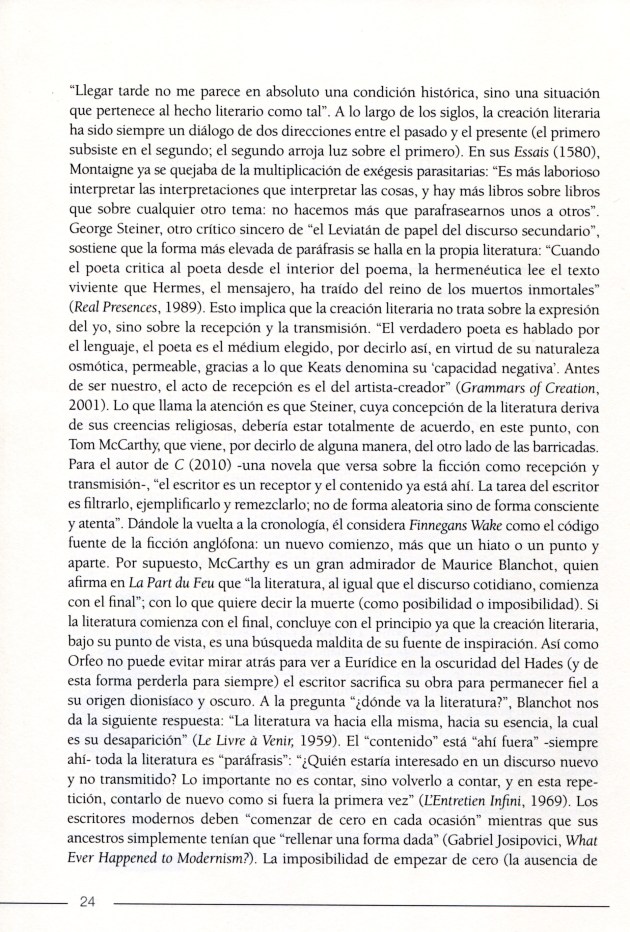
“Llegamos demasiado tarde para decir algo que no se haya dicho ya” se lamentaba La Bruyère a finales del siglo XVII. El hecho de que el propio La Bruyère llegara tarde al afirmar esto (el Eclesiasta y Terencio ya se habían adelantado a él en los siglos III y II AC) venía a demostrar su aserto. Según la precuela de Macedonio Fernández, anterior al Génesis, siempre hemos llegado demasiado tarde. Este autor imagina lo que bien podría haber sucedido cuando Dios estaba a punto de crear el universo. De pronto, una voz clama en el desierto, interrumpiendo el eterno silencio del espacio infinito, la misma que aterra a Pascal: “Todo ha sido escrito, todo ha sido dicho, todo ha sido hecho”, se lamenta. El Todopoderoso, que ya ha escuchado esto con anterioridad, sigue adelante sin darle importancia, dando sentido a la famosa ocurrencia de André Gide: “Todo está ya dicho, pero como nadie escucha, hay que volverlo a decir” (Le Traité du Narcisse, 1891). En el principio fue el verbo, y el verbo es anterior al principio mismo.

En su obra más influyente, The Anxiety of Influence (1973), Harold Bloom argumentaba que los grandes poetas románticos malinterpretaron a sus ilustres predecesores “con el fin de liberar un espacio imaginativo para sí mismos”. La figura del padre literario se asesinaba, metafóricamente hablando, a través de un proceso de “transgresión poética”. T.S. Eliot ya había expresado una idea similar a propósito de la de Philip Massinger: “Los poetas inmaduros imitan; los poetas maduros roban; los malos poetas desfiguran lo que toman, y los buenos poetas lo convierten en algo mejor, o al menos en algo diferente” (1920). Borges, discípulo de Macedonio, al cual Bloom hace referencia, compartía la misma longitud de onda (aunque en el extremo opuesto del dial) cuando exclamaba que “cada escritor crea sus propios precursores” (1951).

Según Bloom, este sentimiento de inferioridad es, más que un fenómeno característico del Renacimiento, el motor principal de la historia de la literatura: “Llegar tarde no me parece en absoluto una condición histórica, sino una situación que pertenece al hecho literario como tal”. A lo largo de los siglos, la creación literaria ha sido siempre un diálogo de dos direcciones entre el pasado y el presente (el primero subsiste en el segundo; el segundo arroja luz sobre el primero). En sus Essais (1580), Montaigne ya se quejaba de la multiplicación de exégesis parasitarias: “Es más laborioso interpretar las interpretaciones que interpretar las cosas, y hay más libros sobre libros que sobre cualquier otro tema: no hacemos más que parafrasearnos unos a otros”. George Steiner, otro crítico sincero de “el Leviatán de papel del discurso secundario”, sostiene que la forma más elevada de paráfrasis se halla en la propia literatura: “Cuando el poeta critica al poeta desde el interior del poema, la hermenéutica lee el texto viviente que Hermes, el mensajero, ha traído del reino de los muertos inmortales” (Real Presences, 1989). Esto implica que la creación literaria no trata sobre la expresión del yo, sino sobre la recepción y la transmisión. “El verdadero poeta es hablado por el lenguaje, el poeta es el médium elegido, por decirlo así, en virtud de su naturaleza osmótica, permeable, gracias a lo que Keats denomina su ‘capacidad negativa’. Antes de ser nuestro, el acto de recepción es el del artista-creador” (Grammars of Creation, 2001). Lo que llama la atención es que Steiner, cuya concepción de la literatura deriva de sus creencias religiosas, debería estar totalmente de acuerdo, en este punto, con Tom McCarthy, que viene, por decirlo de alguna manera, del otro lado de las barricadas. Para el autor de C (2010) -una novela que versa sobre la ficción como recepción y transmisión-, “el escritor es un receptor y el contenido ya está ahí. La tarea del escritor es filtrarlo, ejemplificarlo y remezclarlo; no de forma aleatoria sino de forma consciente y atenta”. Dándole la vuelta a la cronología, él considera Finnegans Wake como el código fuente de la ficción anglófona: un nuevo comienzo, más que un hiato o un punto y aparte. Por supuesto, McCarthy es un gran admirador de Maurice Blanchot, quien afirma en La Part du Feu que “la literatura, al igual que el discurso cotidiano, comienza con el final”; con lo que quiere decir la muerte (como posibilidad o imposibilidad). Si la literatura comienza con el final, concluye con el principio ya que la creación literaria, bajo su punto de vista, es una búsqueda maldita de su fuente de inspiración. Así como Orfeo no puede evitar mirar atrás para ver a Eurídice en la oscuridad del Hades (y de esta forma perderla para siempre) el escritor sacrifica su obra para permanecer fiel a su origen dionisíaco y oscuro. A la pregunta “¿dónde va la literatura?”, Blanchot nos da la siguiente respuesta: “La literatura va hacia ella misma, hacia su esencia, la cual es su desaparición” (Le Livre à Venir, 1959). El “contenido” está “ahí fuera” -siempre ahí- toda la literatura es “paráfrasis”: “¿Quién estaría interesado en un discurso nuevo y no transmitido? Lo importante no es contar, sino volverlo a contar, y en esta repetición, contarlo de nuevo como si fuera la primera vez” (L’Entretien Infini, 1969). Los escritores modernos deben “comenzar de cero en cada ocasión” mientras que sus ancestros simplemente tenían que “rellenar una forma dada” (Gabriel Josipovici, What Ever Happened to Modernism?). La imposibilidad de empezar de cero (la ausencia de una “primera vez” definitiva) significa que la literatura fracasa al comenzar una y otra vez, como si se tratara de una compulsiva repetición inducida de forma traumática. En otras palabras, no cesa de acabar. La novela, dice Tom McCarthy, ha estado “viviendo su propia muerte” desde Don Quijote; la “experiencia del fracaso” es parte integral de su ADN. Si no estuviera muriendo, no estaría viva.

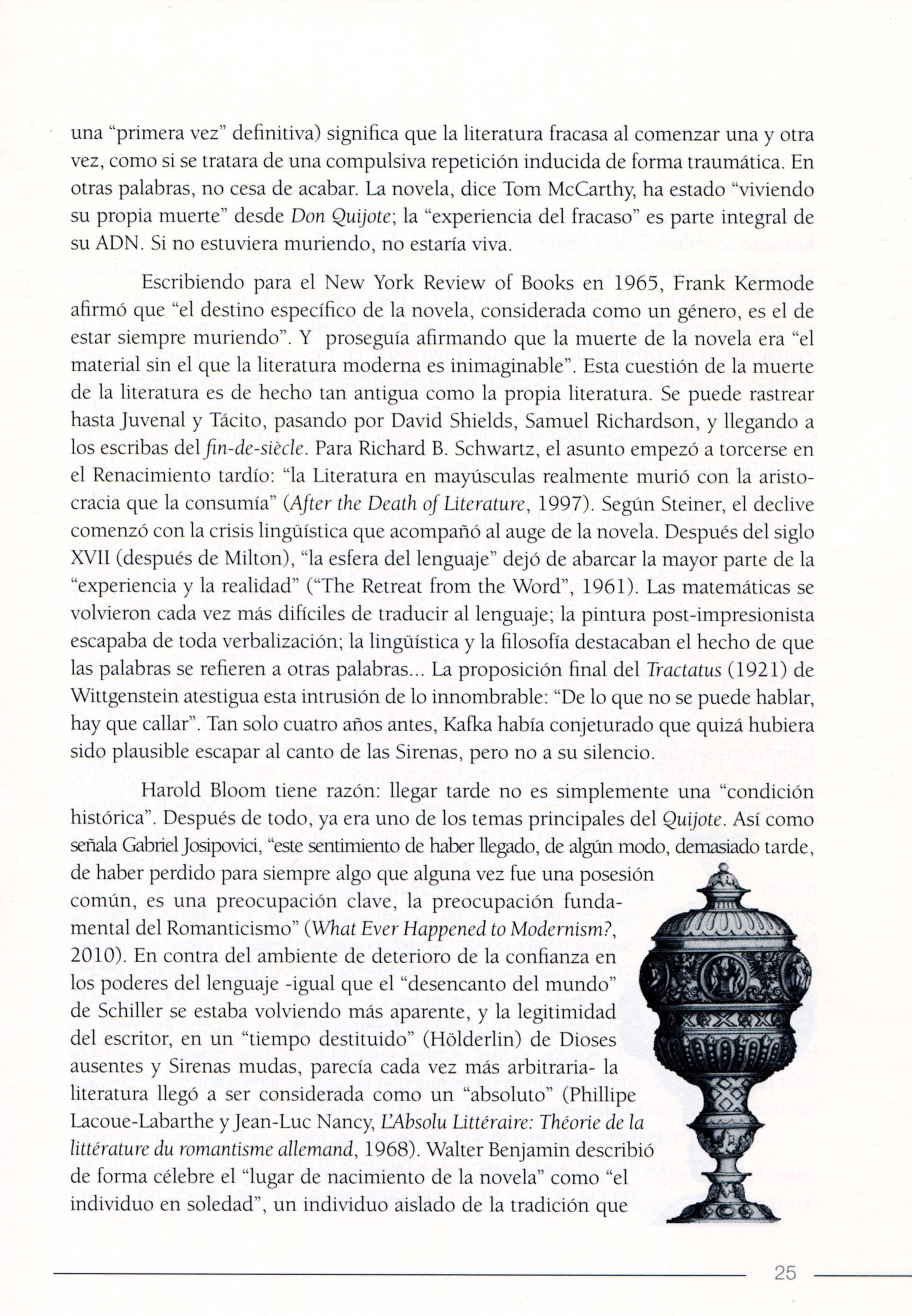
Escribiendo para el New York Review of Books en 1965, Frank Kermode afirmó que “el destino específico de la novela, considerada como un género, es el de estar siempre muriendo”. Y proseguía afirmando que la muerte de la novela era “el material sin el que la literatura moderna es inimaginable”. Esta cuestión de la muerte de la literatura es de hecho tan antigua como la propia literatura. Se puede rastrear hasta Juvenal y Tácito, pasando por David Shields, Samuel Richardson, y llegando a los escribas del fin-de-siècle. Para Richard B. Schwartz, el asunto empezó a torcerse en el Renacimiento tardío: “la Literatura en mayúsculas realmente murió con la aristocracia que la consumía” (After the Death of Literature, 1997). Según Steiner, el declive comenzó con la crisis lingüística que acompañó al auge de la novela. Después del siglo XVII (después de Milton), “la esfera del lenguaje” dejó de abarcar la mayor parte de la “experiencia y la realidad” (“The Retreat from the Word”, 1961). Las matemáticas se volvieron cada vez más difíciles de traducir al lenguaje; la pintura post-impresionista escapaba de toda verbalización; la lingüística y la filosofía destacaban el hecho de que las palabras se refieren a otras palabras… La proposición final del Tractatus (1921) de Wittgenstein atestigua esta intrusión de lo innombrable: “De lo que no se puede hablar, hay que callar”. Tan solo cuatro años antes, Kafka había conjeturado que quizá hubiera sido plausible escapar al canto de las Sirenas, pero no a su silencio.

Harold Bloom tiene razón: llegar tarde no es simplemente una “condición histórica”. Después de todo, ya era uno de los temas principales del Quijote. Así como señala Gabriel Josipovici, “este sentimiento de haber llegado, de algún modo, demasiado tarde, de haber perdido para siempre algo que alguna vez fue una posesión común, es una preocupación clave, la preocupación fundamental del Romanticismo” (What Ever Happened to Modernism?, 2010). En contra del ambiente de deterioro de la confianza en los poderes del lenguaje -igual que el “desencanto del mundo” de Schiller se estaba volviendo más aparente, y la legitimidad del escritor, en un “tiempo destituido” (Hölderlin) de Dioses ausentes y Sirenas mudas, parecía cada vez más arbitraria- la literatura llegó a ser considerada como un “absoluto” (Phillipe Lacoue-Labarthe y Jean-Luc Nancy, L’Absolu Littéraire : Théorie de la littérature du romantisme allemand, 1968). Walter Benjamin describió de forma célebre el “lugar de nacimiento de la novela” como “el individuo en soledad”, un individuo aislado de la tradición que no puede reclamar ser el portavoz de la religión o la sociedad. Tan pronto como este “individuo en soledad” se elevaba al estatus de un alter deus, la tardanza esencial a toda la creatividad humana resultaba obvia. “Ninguna forma artística”, dice Steiner en Grammars of Creation (2001), “nace de la nada. Siempre viene después” y el “creador humano se enfurece ante [este] venir después, al ser, para siempre, segundo con respecto al misterio original y originador de la formación de la forma” (Real Presences, 1990). William Marx ha analizado con gran maestría cómo en Francia las desmedidas reivindicaciones para la literatura condujeron a esta decadencia prolongada. Esta evolución, de lo sublime a lo ridículo, tuvo lugar en tres etapas. A finales del siglo XVIII, la literatura se transformó en un sucedáneo de la religión. En una segunda etapa, marcada por la arrogancia, los escritores intentaron aislarse del resto de la sociedad (el arte por el arte) desencadenando de este modo un proceso de marginalización. En una última fase, la devaluación de la literatura (a los ojos del público en general) fue interiorizada por los propios escritores e incorporada a sus obras (L’Adieu à la Littérature. Histoire d’une dévalorisation XVIIIe-XXe siècles, 2005).

En sus Vorlesungen über die Ästhetik (compiladas en 1835), Hegel declaró, de manera brillante, que el arte se había transformado en “algo del pasado”. No quería decir con esto, como a menudo se ha creído, que el arte y la literatura estuviesen muertos, o incluso en decadencia, sino que no podían seguir transmitiendo de forma adecuada las más elevadas aspiraciones espirituales de la humanidad. En otras palabras, no podían seguir siendo el instrumento para expresar lo Absoluto. Influido por Hegel, Blanchot se pregunta: “¿Está el arte alcanzando su final? ¿Está pereciendo la poesía por haberse visto reflejada en sí misma, igual que aquel que muere después de contemplar a Dios?” (Le Livre à Venir). Si, como él propone en otro sitio, “la literatura surge en el momento en el que la literatura se convierte en una pregunta”, entonces la respuesta es no (La Part du Feu, 1949). Sin embargo, al transformarse en una pregunta, la literatura se transforma a su vez en su propia respuesta, por lo que ya no es capaz de sincronizarse consigo misma. Uno podría alegar que la literatura es entonces la distancia que la separa de sí misma. “Aquellos viejos tiempos”, anteriores al Génesis según Witold Gombrowicz, “cuando Rabelais escribía cómo un niño hacía pis contra el tronco de un árbol” habían acabado. “Retroceder al universo de los géneros literarios no es una opción”, ratifica Gabriel Josipovici, “como tampoco lo es un retorno al mundo del ancien régime” (What Ever Happened to Modernism?). Esta crisis de identidad se agravaba por una conciencia cada vez mayor de las limitaciones de la creación literaria. La literatura ya no sabía exactamente lo que era, pero sí sabía lo que no era, lo que ya no era capaz de hacer. “Ser moderno”, como declaró Roland Barthes, “es conocer lo que ya no es posible”. Es también anhelar esa imposibilidad, en la forma en la que Borges lo hacía en “el otro tigre, el que no está en el verso”. Tom McCarthy afirma que una novela es “algo que contiene su propia negación”, que clama contra sus propias limitaciones. Según este autor, la literatura es “un medio que sólo marcha cuando no funciona”: es “un fallo en el sistema, igual que un fallo en el ordenador”. “Fracasa otra vez. Fracasa mejor”, como decía Beckett en Worstward Ho (1983). Para Blanchot, es precisamente esta imposibilidad esencial de la literatura (su incapacidad para convertirse en una instancia del Absoluto hegeliano) lo que la preserva como posibilidad. La obra está siempre por venir.

La potencialidad, el angustioso vértigo de la libertad, es fundamental para la modernidad literaria. Pierre Menard responde a la arbitrariedad de la ficción (puesta de relieve por la libertad creativa) reescribiendo palabra por palabra Don Quijote y, de este modo, convierte la contingencia en necesidad (“Pierre Menard, autor de El Quijote”, 1939). Otra respuesta a esta cuestión es la de Henry James, que permite al lector sentir “la narración como podría haber sido” tras “la obra construida y limitada a la que él da vida” (Le Livre à Venir). Una creciente reticencia a dar vida a cualquier obra, por muy limitada que sea, se hizo sentir desde el siglo XVIII en adelante. En Sygdommen til Døden (1849), Kierkegaard observó cómo “se hace cada vez más plausible porque nada se vuelve real”. Llevando esta lógica hasta el extremo, Rousseau afirma que “No hay nada más bello que lo que no existe”, mientras que Keats resaltaba la belleza innombrable de las melodías “no escuchadas” (“Ode on a Grecian Urn”, 1819). Una figura emblemática, como señala Dominique Rabaté (Vers une Littérature de l’épuisement, 1991) es el “demonio de la posibilidad” lui-même: Monsieur Teste de Valéry, que se niega a reducir el campo de posibilidades convirtiendo cualquiera de ellas en realidad. Es un claro precursor del Ulrich de Musil -el epónimo Der Mann ohne Eigenschaften (1930-42)- al cual Blanchot describe como alguien que “no dice que no a la vida sino que aún no, quien finalmente actúa como si el mundo no pudiera nunca empezar excepto al día siguiente”. Otra figura representativa es Lord Chandos, de Hofmannstahl, el cual, habiendo renunciado a la literatura porque el lenguaje no puede “penetrar en el núcleo más íntimo de las cosas”, llegó a personificar un motín mudo instigado (en la vida real) por Rimbaud (Ein Brief “Lord Chandos”, 1902). Estos escritores cada vez más reticentes, los cuales, como el Bartleby de Melville, “preferirían no hacerlo” (“Bartleby, the Scrivener”, 1853), son los que Jean-Yves Jouannais denominó “artistas sin obra” (Artistes sans oeuvres, 1997); los partidarios de lo que Enrique Vila-Matas denomina la “literatura del no” (Bartleby y compañia, 2000).

La literatura ha ido muriendo inexorablemente a lo largo del siglo XX. En 1925, José Ortega y Gasset escribió sobre el “declive” de la novela. En 1930, Walter Benjamin afirmaba que estaba en “crisis”. Theodor W. Adorno creía que no podía haber poesía después de Auschwitz. En 1959, Brion Gysin (el de los “cut-ups”) se quejaba de que la ficción llevaba un retraso de cincuenta años con respecto a la pintura. A principios de los ‘60, Alain Robbe-Grillet criticó la momificación de la novela en su encarnación del siglo XIX. En 1967, John Barth publicó “The Literature of Exhaustion”, texto en el que hablaba de “la extenuación de determinadas formas o el agotamiento de determinadas posibilidades”. Ese mismo año, Gore Vidal diagnosticó que la novela estaba exhalando su último aliento. “Debemos continuar durante mucho tiempo hablando de obras y escribiéndolas, haciendo como que no nos damos cuenta de que la iglesia está vacía y que los feligreses se han ido a otra parte, a ocuparse de otros dioses”. En 1969, Ronald Sukenick publicó una colección de relatos breves titulada The Death of the Novel. A comienzos de los ‘70, el Nuevo Periodismo de Tom Wolfe fue considerado por algunos como el futuro de la escritura creativa. La muerte de la literatura y el mundo tal y como lo conocemos hoy en día, se convirtió en un tema de actualidad entre los académicos estadounidenses a principios de los ‘90 (ver, por ejemplo, la obra de Alvin Kernan titulada con gran acierto The Death of Literature, 1992). Habitualmente, argumentaban que los Departamentos de Inglés habían sido secuestrados por los estudios culturales, la Filosofía Continental y la corrección política enloquecida (a la que Bloom ha denominado “Escuela del Resentimiento”).

Desde entonces, han ocurrido dos cosas. La novela -que fue creada con el propósito de fusionar la poesía y la filosofía (según los primeros Románticos alemanes), de contener los demás géneros e incluso, el universo entero (siguiendo la concepción de Mallarmé acerca de El Libro o el sueño de Borges de una “Biblioteca Total”)- ha sido relegada a la “ficción”, un género que aborda la creación literaria como si el siglo XX nunca hubiera existido. Al mismo tiempo, la era digital ha llevado el exceso de información (del cual ya se quejaba en su momento el Eclesiasta) a un nivel completamente nuevo. Como consecuencia de esto, David Shields cree que la novela ya no está capacitada para reflejar la compleja vitalidad de la vida moderna: él prescribe nuevas formas híbridas de escritura (Reality Hunger, 2010). El poeta estadounidense (y fundador de UbuWeb) Kenneth Goldsmith nos pide encarecidamente que dejemos de escribir del todo para centrarnos en recombinar los textos que hemos ido acumulando a lo largo de los siglos (Uncreative Writing, 2011). Trasladando el retrato que James Joyce hizo de sí mismo como “el hombre del corta y pega” a la era digital, Mark Amerika afirma que hoy en día todos somos “remezcladores”. Sin embargo, ¿qué ocurriría si, tal como se preguntaba Lewis Carroll, las combinaciones de palabras fueran limitadas y ya las hubiéramos utilizado todas?

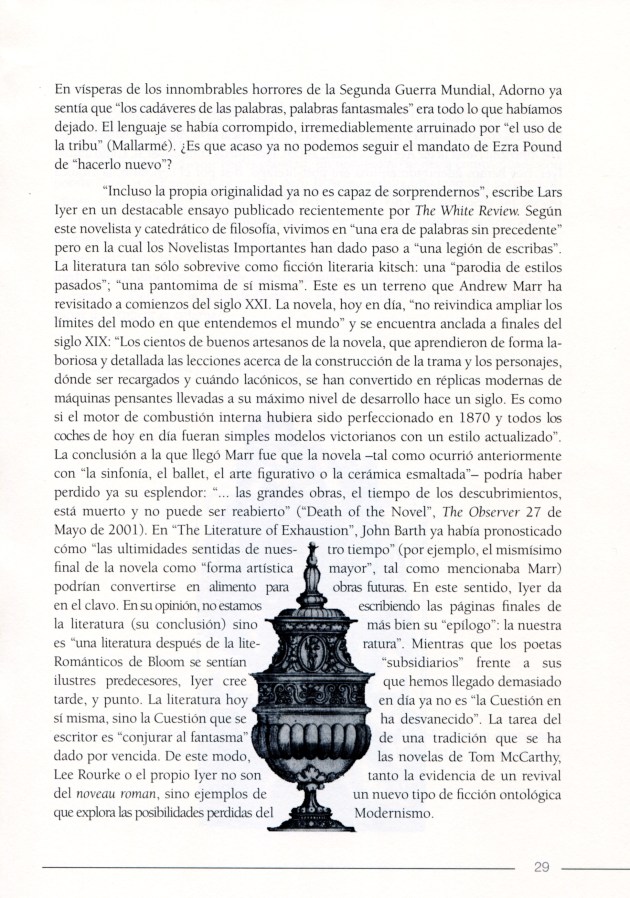
Según Steiner, somos “agonistas”, “vamos rezagados”: “No tenemos más comienzos” (Grammars of Creation). Para nosotros, el lenguaje “está desgastado por el uso” y el “sentido de revelación, de profuso conocimiento” exhibido por los escritores del periodo Tudor, Isabelino y Jacobeo “nunca ha vuelto a ser plenamente recuperado”. En vísperas de los innombrables horrores de la Segunda Guerra Mundial, Adorno ya sentía que “los cadáveres de las palabras, palabras fantasmales” era todo lo que habíamos dejado. El lenguaje se había corrompido, irremediablemente arruinado por “el uso de la tribu” (Mallarmé). ¿Es que acaso ya no podemos seguir el mandato de Ezra Pound de “hacerlo nuevo”?

“Incluso la propia originalidad ya no es capaz de sorprendernos”, escribe Lars Iyer en un destacable ensayo publicado recientemente por The White Review. Según este novelista y catedrático de filosofía, vivimos en “una era de palabras sin precedente” pero en la cual los Novelistas Importantes han dado paso a “una legión de escribas”. La literatura tan sólo sobrevive como ficción literaria kitsch: una “parodia de estilos pasados”; “una pantomima de sí misma”. Este es un terreno que Andrew Marr ha revisitado a comienzos del siglo XXI. La novela, hoy en día, “no reivindica ampliar los límites del modo en que entendemos el mundo” y se encuentra anclada a finales del siglo XIX: “Los cientos de buenos artesanos de la novela, que aprendieron de forma laboriosa y detallada las lecciones acerca de la construcción de la trama y los personajes, dónde ser recargados y cuándo lacónicos, se han convertido en réplicas modernas de máquinas pensantes llevadas a su máximo nivel de desarrollo hace un siglo. Es como si el motor de combustión interna hubiera sido perfeccionado en 1870 y todos los coches de hoy en día fueran simples modelos victorianos con un estilo actualizado”. La conclusión a la que llegó Marr fue que la novela –tal como ocurrió anteriormente con “la sinfonía, el ballet, el arte figurativo o la cerámica esmaltada”– podría haber perdido ya su esplendor: “… las grandes obras, el tiempo de los descubrimientos, está muerto y no puede ser reabierto” (“Death of the Novel”, The Observer 27 de Mayo de 2001). En “The Literature of Exhaustion”, John Barth ya había pronosticado cómo “las ultimidades sentidas de nues- tro tiempo” (por ejemplo, el mismísimo final de la novela como “forma artística mayor”, tal como mencionaba Marr) podrían convertirse en alimento para obras futuras. En este sentido, Iyer da en el clavo. En su opinión, no estamos escribiendo las páginas finales de la literatura (su conclusión) sino más bien su “epílogo”: la nuestra es “una literatura después de la literatura”. Mientras que los poetas Románticos de Bloom se sentían “subsidiarios” frente a sus ilustres predecesores, Iyer cree que hemos llegado demasiado tarde, y punto. La literatura hoy en día ya no es “la Cuestión en sí misma, sino la Cuestión que se ha desvanecido”. La tarea del escritor es “conjurar al fantasma” de una tradición que se ha dado por vencida. De este modo, las novelas de Tom McCarthy, Lee Rourke o el propio Iyer no son tanto la evidencia de un revival del nouveau roman, sino ejemplos de un nuevo tipo de ficción ontológica que explora las posibilidades perdidas del Modernismo.

Según Kathleen Fitzpatrick, la muerte de la novela ha sido utilizada por los novelistas como un ardid para garantizar su supervivencia (The Anxiety of Obsolescence: The American Novel in the Age of Television, 2006). Nos queda comprobar si, como afirma Iyer, nos hemos adentrado en una era post-literaria, o si por el contrario, la crónica acerca de la muerte de la literatura ha sido magnificada una vez más.

Una versión reducida de este artículo fue publicada en el periódico británico The Guardian, el 10 de enero de 2012, con el título “In Theory: the Death of Literature”.


Larger versions of these scans are available here:
Page 23 / Page 24 / Page 25 / Page 26 / Page 27 / Page 28 / Page 29 / Page 30 / Page 22

The Nothingness Lying Behind It

David Winters, “Transparency by Marek Bieńczyk,” The Quarterly Conversation 28 (4 June 2012)

[…] Bieńczyk’s concern is with “the connections between transparency and the expressible.” The time he covers spans from Aristotle (for whom, as he quotes, “there is only transparency,” as an underlying reality) to the present, where science has superseded such notions, yet where they’re nevertheless necessary, “since the heart of man changes more slowly than the world.” An archetypally heartfelt expression comes from Jean-Jacques Rousseau, in whose Confessions Bieńczyk discerns a desire for transparent speech; for a clear voice which would make the soul perfectly present to itself:

Rousseau believed that the heart of man could speak . . . he saw how language could become a transparent medium for the will of speech, for everything that wishes to be expressed . . . with no secrets and no depths to be fathomed or understood.

[…] But Bieńczyk’s literary history touches on another tradition, which unites an assortment of writers under the sign of

the shared striving for pure light in their texts, their striving for emptiness, for silence . . . their abandoning of the real, the concrete, the perceptible, the living, in favour of the motionless, the fading, the falling silent.

Such striving can be both formal and thematic — as in Beckett, for instance (whom Bieńczyk doesn’t discuss) or Barthes or Blanchot (whom he does). As a theme, it’s best represented by the Polish novelist Andrzej Stasiuk, whose books describe “landscapes with minimal human activity.” Stasiuk focuses on a world where “life has either not gotten going, or has already been extinguished.” Here transparency is, as in Aristotle, “the idea organizing the cosmos” — it sits in the background, the field on which existence occurs. But beyond this, Bieńczyk reminds us, there are writers who treat transparency in terms of textual form. This brings to mind Beckett’s letter to Axel Kaun, which likens language to “a veil one has to tear apart in order to get to . . . the nothingness lying behind it.” Bieńczyk’s lineage links several figures whose language “flirts with silence,” from Chateaubriand to Joubert. In each, he highlights an impulse he calls “negative idealism.” Yet this phrase doesn’t denote mere nihilism. Like the melancholic upward gaze, transparency here reaches beyond a quiet acceptance of the real. After all, as Bieńczyk avers, “if life has its own utopia, perhaps nothingness does too.” […]

The Importance of Retelling

Maurice Blanchot, The Infinite Conversation, 1969:

In the first place, no one dreams that works and songs could be created out of nothing. They are always given in advance, in memory’s immobile present. Who would be interested in a new and non-transmitted speech? What is important is not to tell, but to tell once again and, in this retelling, to tell again each time a first time.

Review of Dogma

This appeared in Bookslut on 5 March 2012 (issue 118):

Dogma by Lars Iyer

For Scheherazade, storytelling cannot end; for Lars Iyer, it cannot begin. Two novels in, and some reviewers are wondering where his trilogy is going, if anywhere. According to Alfred Hickling, in The Guardian, this “lack of direction becomes self-defeating”. He has a point. It is, in fact, the point.

Spurious, last year’s debut, precedes Dogma, its nominal sequel, but it would make little difference if one were to read them in reverse order, simultaneously, or even back to front. Both volumes can be dipped into at random, safe in the knowledge that the very same obsessions and characters will recur, like some trauma-induced repetition compulsion. Readers of Spurious will rediscover Lars and W. — the self-styled “landfill thinkers” — modeled on the author himself and his colleague William Large, two English philosophy lecturers who have both published books on the works of Maurice Blanchot. Their relationship revolves around the cruel but hilarious abuse that W. constantly heaps on Lars, a modus operandi that baffles their North American hosts: “Don’t they understand that it’s the only way we can express affection? It’s a British working class thing, W. told them, but they only looked at us blankly”. Lars is mocked for everything from his lack of style (“No woman would have permitted your vest phase“) to his non-thinking (“‘It’s like Zen,’ says W. ‘Pure absence'”). On the very first page, W. likens the roaring of the sea to his friend’s alleged stupidity: “It’s the sound of unlearning, he says. It’s the sound of Lars, of the chaos that undoes every idea”. They go off on a sparsely-attended lecture tour of the Deep South (“Six bored people, looking at their watches. Did we come all the way for this?”) during which they pontificate over pints of Big Ass Beer, buy souvenir togas in Athens, and are immortalized on the banks of the Mississippi for W.’s Facebook page: “He rides me like a horse. I ride him like a horse. Sal rides both of us, like two horses, with the camera set on automatic”. W. and Lars also attend music festivals, where they neck Plymouth Gin from water bottles, discussing Jandek’s “non-music” (“the ‘non-‘ is not privative”) and Josh T. Pearson’s integrity (“He speaks from inside the burning bush”). They look for religion in the everyday (“‘Are you going religious?’ says Sal. ‘I hate it when you go religious'”) and attempt to step into life like Rosenzweig (“This is where philosophy must begin anew, right here in the pub!”). Most significantly perhaps, they launch their own intellectual movement, the eponymous Dogma: “Dogma was greater than us. Dogma was broader, more generous. Weren’t we only swallows in the updraft? Weren’t we leaves swept up in an autumn storm?”

On the final page, W. asks his companion to be his Boswell, thus providing the trilogy with its creative primal scene. Lars, Dogma‘s narrator, plays the part of “the Delphic Pythia, speaking for the Oracle”: he carries out his duties to the letter, almost completely erasing his own voice from the book. Most of the time, it is W. we hear speaking through Lars. He speaks of Lars, but also for Lars — in his place — as though he were a ventriloquist, but the ventriloquist is himself ventriloquized since Lars is reporting all of this. W. even begins to wonder if Lars has not conjured him up “from a sense of his own failure,” and some reviewers have speculated that he may indeed be a figment of the narrator’s imagination. Lars’s very self-effacement provides a kind of passive (possibly passive-aggressive) resistance to W., simply by letting him express himself fully. One is reminded of that medieval depiction of Socrates taking dictation from Plato, in which Derrida makes out “Plato getting an erection in Socrates’s back” (The Post Card: From Socrates to Freud and Beyond). Moving on from Lars’s hypothetical erection, there are two explicit references to ventriloquism in Dogma. The second one is clearly attributed to W., and provides a nice instance of dramatic irony: “Our eternal puppet show, says W. Our endless ventriloquy. Who’s speaking through us? Who’s using our voices?” The first reference, however, remains anonymous. W’s external monologue seems to have been completely absorbed, here, by a narrative voice whose origin is no longer clearly Lars: “We were ventriloquised; we spoke, but not with our voices”.

Like its predecessor, Dogma is composed of individual fragments that originated as blog posts on the author’s website. In spite of this episodic pattern, the novel is expertly crafted throughout. A few throwaway remarks about the “famous Poles of Plymouth” in the opening pages segue seamlessly into an evocation of Stroszek; itself forestalling the American lecture tour during which W. and Lars identify with the protagonists of Herzog’s film: “They’d come to escape the past! And what did Bruno find? The dancing chicken, W. says”.

Some of these fragments are arranged in sequences, while others could be shuffled around like the loose pages in Marc Saporta’s book-in-a-box. Structurally, as well as thematically, each stand-alone vignette embodies the hope — ever dashed, but eternally springing — of a radical new departure: “We need a realitätpunkt, W. says. A point of absolute certainty, from which everything could begin. But the only thing of which he can be certain is the eternal crumbling of our foundations, the eternal stop sign of our idiocy”.

The very possibility of starting afresh — of turning over a new leaf, and then another — seems to have vanished, hence the lack of direction; of narrative drive. Spurious never really begins: it opens in medias res. Dogma never really ends, as the final Beckettian sentence testifies: “It’s time to die, says W. But death does not come”. The novel stops and starts; it repeats on itself as though it had binged on Plymouth Gin: “Every day, the same failure”. Lars and W. mooch about in the dead time of stasis, a disjointed time, which is not so much dead, as endlessly dying. “But that’s just it: death doesn’t want us, W. says,” in an earlier passage, “It isn’t our time, and it will never be our time.” Things are forever coming to an end, but the end itself never comes: “The conditions for the end are here, W. says, but not the end itself, not yet…” The two characters are suspended in this liminal state, stupefied by the non-stop inertia of late capitalism, “pushing [their] shopping cart full of Plymouth Gin through the gathering darkness,” biding their time: “The apocalypse is imminent, things are coming to an end, but in the meantime…? It’s always the meantime in the pub, W. says”. And again: “Only the disaster is real, W. says. There is no future. And isn’t that a relief: that there is no future? And meanwhile, his long fall. Meanwhile our long fall through the clouds…” And yet again: “Perhaps this is a great waiting room; this, the time before a dentist’s appointment, when nothing very important happens: we leaf through a magazine, we gaze out of the window … But they’ve forgotten to call our names, haven’t they? They’ve forgotten we are here, in the eternal waiting room”.

And what exactly is this mean limbo time? Even the seemingly gormless narrator has an answer, albeit a second-hand one: “The infinite wearing away, I said, quoting Blanchot. Eternullity, I said, quoting Lefebvre”. “We’re dead men,” W. later concurs, “the walking dead.”

Messianism — that desperate hope, or hopeful despair — lies at the very heart of Dogma. “You need a volume of Rosenzweig with you at all times,” W. explains, producing The Star of Redemption from his trusty man bag aboard a Greyhound bus bound for Memphis (of all places). Back in Britain, he boasts that he is “still reading Rosenzweig, very slowly, in German, every morning” despite failing to “understand a word” of it. He describes himself as “a man of the end who yearns for the beginning,” but beginning and end are but interchangeable opt-outs from the “endless end,” symbolized by the “eternal scratching of the rats” under Lars’s floorboards, or the “endless, remorseless teaching” that is the “wreck of the humanities“. The Mersey Estuary at sunset is likened to “the end of the world” or “the beginning,” as though both times were indeed identical. The desire to be born again is just that: a desire to be born again, to be borne back. W.’s longing for the Apocalypse is thus mirrored by his nostalgia for an idyllic childhood (“Ah, his Canadian years!”), his vision of Lars and himself as “idiot Whitmans” in “blousy shirts” roaming a prelapsarian America, and even his matutinal work routine:

    Four AM; five AM — he’s ready for work; he opens his books, he takes notes as the sky brightens over Stonehouse roofs. He’s there at the inception, at the beginning of everything, even before the pigeons start cooing like maniacs on his window-ledge. He’s up before anyone else, he knows that, but there’s still no chance of thinking. Not a thought has come to him in recent months; not one. He’s stalled, W. says. […] But when wasn’t he stalled? […] No matter how early he gets up, he misses his appointment with thought; no matter how he tries to surprise it by being there before everyone else.

It is never early enough for W. (who believes things started going downhill in the mid-Neolithic); but neither is it ever late enough. Just as the end keeps on ending endlessly, the novel itself keeps on beginning inexorably. In the paradoxical incipit of Grammars of Creation, George Steiner declares that “We have no more beginnings”: here, we have nothing but beginnings, but it comes to the same thing really. One is reminded of W., “looking for the America hidden by America”: “a perpetually new America stretching its limbs in the sun”. Dogma is also constantly in the process of becoming, which is why — for all the talk of exhaustion and Armageddon — it feels so vital and remarkably angst-free. We learn that Lars had once travelled to Patmos, where the Book of Revelation was written, but ended up by accident on Paros, “the party island.” Short of a revelation, the novel turns into a comic celebration.

Each new fragment harbors the potential to disrupt the continuum represented by the (theoretically infinite) succession of paragraphs. This promise of a revolutionary revelation — the achievement of artistic closure — is never fulfilled, and it produces a daisy chain of failed fragments: a compulsion to retread the same ground. W. claims that our reading is “only the shadow of reading, the search for the world-historical importance that reading once had”. Likewise, Dogma is only the shadow of a novel, the search for the world-historical importance that novels once had. It gestures towards the kind of book it could be if novels still mattered; if only it could take itself seriously enough to really get going. At times, this phantom book shines through the pages “like a watermark”.

Roland Barthes famously argued that “to be modern is to know that which is not possible any more”. By this token, Dogma is resolutely modern. Lars and W.’s saving grace is their acute awareness of their limitations; an awareness that can be extended to the book itself: “We know we fall short, desperately short. We know our task is too great for us, but at least we have a sense of it, its greatness”. In a recent interview at Ready Steady Book, Iyer explained that “Kafka’s work transmits a sense of the importance of notions of God, of belief, even as it deprives us of them”. This is precisely what Dogma does for literature. The book’s apparent lack of direction is part of a strategy to sabotage its literariness; to ensure that it does not become another bogus piece of literary fiction.

For the Romantics, the early German Romantics, in particular, a fragment was a synecdoche standing for a larger, ideal work left to the reader’s imagination. What is missing here is not a bigger, better book that could have been, or indeed could still be, written, but one that is no longer possible at all. In Dogma, W. is nagged by the fear that he may already have had his great idea without knowing it. When he finally loses his university job, he is caught unawares, although it is something he had been predicting right from the start: “He had been waiting for the end, W. says, and still the end surprised him”. Gradually, almost imperceptibly, we move from a sense of impending doom to a feeling that the disaster is already behind us; haunting us: “It’s time, W. says. No, it’s after time. It’s too late. We’re living a posthumous life”. In the final pages, Lars is also described as living each day “as though it were the day after the last”.

According to Iyer, who recently wrote an anti-manifesto on the subject, ours is a “literature which comes after literature”. If John Barth (“The Literature of Exhaustion,” 1967) and the High Postmodernists wrote literature’s conclusion, we are now writing its epilogue. Whereas Harold Bloom’s Romantic poets felt “belated” vis-à-vis their illustrious predecessors, we feel belated with regards to literature itself. For us, literature can no longer be “the Thing itself”; it can only be “about the vanished Thing”. From this point of view, Lars Iyer’s work ranks alongside the hauntological novels of Tom McCarthy and Lee Rourke, which excavate the lost futures of literary modernity.

The Death of Literature

This appeared in Guardian Books on 10 January 2012:

The Death of Literature
The fact that people have been proclaiming its passing for centuries only makes the sense of its ending more acute

[The end: headstone in Lund Cemetery, Nevada. Photograph: Deon Reynolds/Getty]

“We come too late to say anything which has not been said already,” lamented La Bruyère at the end of the 17th century. The fact that he came too late even to say this (Terence having pipped him to the post back in the 2nd century BC) merely proved his point — a point which Macedonio Fernández took one step backwards when he sketched out a prequel to Genesis. God is just about to create everything. Suddenly a voice in the wilderness pipes up, interrupting the eternal silence of infinite space that so terrified Pascal: “Everything has been written, everything has been said, everything has been done.” Rolling His eyes, the Almighty retorts (doing his best Morrissey impression) that he has heard this one before — many a time. He then presses ahead with the creation of the heavens and the earth and all the creepy-crawlies that creepeth and crawleth upon it. In the beginning was the word — and, word is, before that too.

In his most influential book, The Anxiety of Influence (1973), Harold Bloom argued that the greatest Romantic poets misread their illustrious predecessors “so as to clear imaginative space for themselves”. The literary father figure was killed, figuratively speaking, through a process of “poetic misprision”. TS Eliot had already expressed a similar idea in 1920, when he claimed that “Immature poets imitate; mature poets steal; bad poets deface what they take, and good poets make it into something better, or at least something different”. Borges (a disciple of Fernández, whom Bloom references) was on the same wavelength (but at the other end of the dial) when he claimed that “each writer creates his precursors”.

According to Bloom, this feeling of “secondariness” is not specifically a Romantic phenomenon, but rather the very engine of literary history. Down the centuries, literature has always been a two-way dialogue between past and present — the former living on in the latter; the latter casting new light upon the former. George Steiner thus contends that the highest form of literary criticism is to be found within literature itself: “In the poet’s criticism of the poet from within the poem, hermeneutics reads the living text which Hermes, the messenger, has brought from the undying dead” (Real Presences, 1989). This implies that writing is not, primarily, about self-expression, but about reception and transmission; as Winnie the Pooh once put it, with uncharacteristic menace, “Poetry and Hums aren’t things which you get, they’re things which get you”. What is striking here is that Steiner — steeped in the Judaeo-Christian tradition; scourge of Gallic theory — should be in total agreement, on this point, with novelist Tom McCarthy, who comes, as it were, from the other side of the barricades. For the author of C — a novel which is all about fiction as reception and transmission — “the writer is a receiver and the content is already out there. The task of the writer is to filter it, to sample it and remix it — not in some random way, but conscientiously and attentively”. Turning chronology on its head, he sees Finnegans Wake as the source code of anglophone literature — a new beginning — rather than a dead end or a full stop. The novel, says McCarthy, has been “living out its own death” ever since Don Quixote; the “experience of failure” being integral to its DNA. If it weren’t dying, the novel would not be alive.

According to Steiner, the rise of the novel was contemporaneous with a growing linguistic crisis. After the 17th century — after Milton — “the sphere of language” ceased to encompass most of “experience and reality” (“The Retreat from the Word“, 1961). Mathematics became increasingly untranslatable into words, post-Impressionist painting likewise escaped verbalisation; linguistics and philosophy highlighted the fact that words refer to other words … The final proposition in Wittgenstein‘s Tractatus (1921) bears witness to this encroachment of the unspeakable: “Whereof one cannot speak, thereof one must be silent”. Four years earlier, Kafka had conjectured that it may have been possible to escape the sirens’ singing, but not their silence.

Harold Bloom is right: belatedness is not merely an “historical condition”. After all, it was already one of the major themes in Don Quixote. Yet, as Gabriel Josipovici points out, “this sense of somehow having arrived too late, of having lost for ever something that was once a common possession, is a, if not the, key Romantic concern” (What Ever Happened to Modernism?, 2010). Against the backdrop of declining confidence in the powers of language — just as Schiller‘s “disenchantment of the world” was becoming ever more apparent, and the writer’s legitimacy, in a “destitute time” (Hölderlin) of absent gods and silent sirens, seemed increasingly arbitrary — literature came to be considered as an “absolute“. Walter Benjamin famously described the “birthplace of the novel” as “the solitary individual”: an individual cut off from tradition, who could no longer claim to be the mouthpiece of society. As soon as this “solitary individual” was elevated to the status of an alter deus, the essential belatedness of human creativity became glaringly obvious. “No art form,” says Steiner, “comes out of nothing. Always, it comes after,” and the “human maker rages at [this] coming after, at being, forever, second to the original and originating mystery of the forming of form”.

As early as 1758, Samuel Richardson had wondered if the novel were not just a fad, whose time had already run out. By the 20th century, the picture looked far bleaker. Theodor Adorno felt that there could be no poetry after Auschwitz. In 1959, Brion Gysin complained that fiction was lagging 50 years behind painting. In the early 60s, Alain Robbe-Grillet attacked the mummification of the novel in its 19th-century incarnation. In 1967, John Barth published “The Literature of Exhaustion” in which he spoke of “the used-upness of certain forms or exhaustion of certain possibilities”. The same year, Gore Vidal diagnosed that the novel was already in its death throes: “we shall go on for quite a long time talking of books and writing books, pretending all the while not to notice that the church is empty and the parishioners have gone elsewhere to attend other gods”. The death of literature, and the world as we know it, became a fashionable topic among US academics in the early 90s (see, for instance, Alvin Kernan’s aptly-titled The Death of Literature, 1992). Their argument was usually that English departments had been hijacked by cultural studies, Continental theory or political correctness gone mad (Bloom’s “School of Resentment”).

Since then, two things have happened. The novel — which was meant to fuse poetry and philosophy, to subsume all other genres and even the entire universe (following Mallarmé‘s conception of The Book or Borges’s dream of a “Total Library”) — has been reduced to “literary fiction”: a genre that approaches writing as if the 20th century had never happened. At the same time, the digital age has taken information overload to a whole new level. As a result, David Shields believes that the novel is no longer equipped to reflect the vitality and complexity of modern life (Reality Hunger, 2010). Kenneth Goldsmith — the poet to whom we owe the wonder that is UbuWeb — urges us to stop writing altogether in order to focus on recombining the texts we’ve accumulated over the centuries (Uncreative Writing, 2011). We may all be “remixologists” now, but what if (as Lewis Carroll wondered) word combinations were limited, and we had used them all up?

According to Steiner, we are “terminalists”, “latecomers”: “we have no more beginnings“. For us, language “is worn by long usage” and the “sense of discovery, of exuberant acquisition” exhibited by writers during the Tudor, Elizabethan and Jacobean periods “has never been fully recaptured”. On the eve of the unspeakable horrors of the second world war, Adorno already felt that “the carcass of words, phantom words” was all we had left. Language had been corrupted; irredeemably soiled by “the usage of the tribe” (Mallarmé). Perhaps is it no longer possible for us to follow Ezra Pound‘s injunction to “make it new”.

“Even originality itself no longer has the ability to surprise us,” writes Lars Iyer in a remarkable essay recently published by The White Review. According to the author of Spurious (shortlisted for the Guardian‘s Not the Booker Prize), we live in “an unprecedented age of words”, but one in which Important Novelists have given way to “a legion of keystroke labourers”. Literature only survives as literary-fiction kitsch: a “parody of past forms”; a “pantomime of itself”. In “The Literature of Exhaustion”, Barth had envisaged how the “felt ultimacies of our time” (ie the end of the novel as “major art form”) could become the material of future works. Iyer cranks this up a notch. We are no longer writing literature’s conclusion but its “epilogue”: ours is a “literature which comes after literature”. Where Bloom’s Romantic poets felt “belated” vis-à-vis their predecessors, Iyer feels that we have come too late for literature, full stop. Literature today is thus no longer “the Thing itself, but about the vanished Thing”. The writer’s task is “to conjure the ghost” of a tradition that has given it up. By this token, the novels of Tom McCarthy, Lee Rourke and Iyer himself are not so much evidence of a nouveau roman revival as instances of a new type of hauntological fiction which explores the lost futures of Modernism.

Given that Iyer has published two books on the work of Maurice Blanchot, one cannot but think of the French author’s answer to the question ‘Where is literature going?’: “literature is going toward itself, toward its essence, which is disappearance”. Perhaps the “Thing itself” was about “the vanished Thing” all along – but stop me, oh-oh-oh, stop me, stop me if you think that you’ve heard this one before.

Hauntology

This appeared in Guardian Books on 17 June 2011:

Hauntology: A Not-So-New Critical Manifestation
The new vogue in literary theory is shot through with earlier ideas

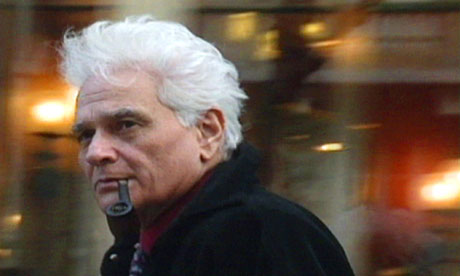
[Haunting presence … Jacques Derrida, who coined the term hauntology, in a still from the documentary Derrida]

Hauntology is probably the first major trend in critical theory to have flourished online. In October 2006, Mark Fisher — aka k-punk — described it as “the closest thing we have to a movement, a zeitgeist”. A mere three years later, Adam Harper prefaced a piece on the subject with the following caveat: “I’m all too aware that it’s no longer 2006, the year to blog about hauntology”. Two months ago, James Bridle predicted that the concept was “about six months away from becoming the title of a column in a Sunday supplement magazine”. Only four months to go, then. My hunch is that hauntology is already haunting itself. The revival starts here.

Like its close relative psychogeography, hauntology originated in France but struck a chord on this side of the Channel. In Spectres of Marx (1993), where it first appeared, Jacques Derrida argued that Marxism would haunt Western society from beyond the grave. In the original French, “hauntology” sounds almost identical to “ontology”, a concept it haunts by replacing — in the words of Colin Davis — “the priority of being and presence with the figure of the ghost as that which is neither present, nor absent, neither dead nor alive”.

Today, hauntology inspires many fields of investigation, from the visual arts to philosophy through electronic music, politics, fiction and literary criticism. At its most basic level, it ties in with the popularity of faux-vintage photography, abandoned spaces and TV series like Life on Mars. Mark Fisher — whose forthcoming Ghosts of My Life (Zer0 Books) focuses primarily on hauntology as the manifestation of a specific “cultural moment” — acknowledges that “There’s a hauntological dimension to many different aspects of culture; in fact, in Moses and Monotheism, Freud practically argues that society as such is founded on a hauntological basis: the voice of the dead father”. When you come to think of it, all forms of representation are ghostly. Works of art are haunted, not only by the ideal forms of which they are imperfect instantiations, but also by what escapes representation. See, for instance, Borges‘s longing to capture in verse the “other tiger, that which is not in verse”. Or Maurice Blanchot, who outlines what could be described as a hauntological take on literature as “the eternal torment of our language, when its longing turns back toward what it always misses“. Julian Wolfreys argues in Victorian Hauntings (2002) that “to tell a story is always to invoke ghosts, to open a space through which something other returns” so that “all stories are, more or less, ghost stories” and all fiction is, more or less, hauntological. The best novels, according to Gabriel Josipovici, share a “sense of density of other worlds suggested but lying beyond words“. For the reader or critic, the mystery of literature is the opacity — the irreducible remainder — at the heart of writing that can never be completely interpreted away. The whole western literary tradition itself is founded on the notion of posterity, which Paul Eluard described as the “harsh desire to endure” through one’s works. And then, of course, there’s the death of the author… All this, as you can see, could go on for quite a while, so perhaps we should wonder if the concept does not just mean all things to all (wo)men. Steen Christiansen, who is writing a book on the subject, explains that “hauntology bleeds into the fields of postmodernism, metafiction and retro-futurism and that there is no clear distinction — that would go against the tension which hauntology aims at”.

As a reflection of the zeitgeist, hauntology is, above all, the product of a time which is seriously “out of joint” (Hamlet is one of Derrida’s crucial points of reference in Spectres of Marx). There is a prevailing sense among hauntologists that culture has lost its momentum and that we are all stuck at the “end of history“. Meanwhile, new technologies are dislocating more traditional notions of time and place. Smartphones, for instance, encourage us never to fully commit to the here and now, fostering a ghostly presence-absence. Internet time (which is increasingly replacing clock time) results in a kind of “non-time” that goes hand in hand with Marc Augé’s non-places. Perhaps even more crucially, the web has brought about a “crisis of overavailability” that, in effect, signifies the “loss of loss itself”: nothing dies any more, everything “comes back on YouTube or as a box set retrospective” like the looping, repetitive time of trauma (Fisher). This is why “retromania” has reached fever pitch in recent years, as Simon Reynolds demonstrates in his new book — a methodical dissection of “pop culture’s addiction to its own past”.

Hauntology is not just a symptom of the times, though: it is itself haunted by a nostalgia for all our lost futures. “So what would it mean, then, to look for the future’s remnants?” asks Owen Hatherley at the beginning of Militant Modernism, “Can we, should we, try and excavate utopia?” It might just be worth a shot.

Illicit Frequencies, or All Literature is Pirated

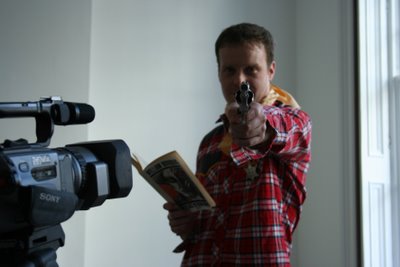
Here is my interview with Tom McCarthy that appeared in 3:AM Magazine on 13 July 2006.
3:AM: It’s very rare, these days, to see a work of literary criticism being given such prominence. Do you agree that this is probably largely due to the fact that the main subject is not Balzac or Baudelaire — two key references here — but a comic-strip hero?

TMcC: First of all, I’m not sure I’d describe Tintin and the Secret of Literature as ‘criticism’. More as an essay. I like the idea of the essay as a primary literary form. You can trace it from David Foster Wallace through Blanchot all the way back to people like Hazlitt. But yes, the fact that it revolves around Tintin and not just Balzac and Baudelaire has certainly helped it get attention — although it wasn’t strategic to do this. I genuinely rate Hergé’s work, and wanted to read it alongside Balzac, Baudelaire, Bergson, Bachelard and all the rest, hopping from one to the other in a set of playful, serendipitous detours — which is exactly what the essay format allows.

3:AM: Your book is very much in the tradition of Barthes‘s Mythologies (an anthology which you fail to mention). I can’t remember if Barthes actually mentions Tintin anywhere, but he certainly could have done. In a way, the two figures go curiously well together: Tintin’s heyday corresponds roughly to that of Barthes and both, today, appear a little quaint. Was it Barthes who inspired this book? After all, your Tintin is primarily a semiologist who “can navigate [a key word in the McCarthy canon] the world of signs” (Tintin and the Secret of Literature p. 22), a deciphering cipher who embodies (along with Snowy?) the presence of absence — the Melvillian “whiteness of the whale” (p. 161) — but also, of course, Barthes’s “écriture blanche”.

TMcC: I do kind of mention Mythologies when I refer to wrestling and tomato tins early on in the book. I love Barthes: he’s a beautiful, generous writer. He never mentions Tintin directly as far as I know, although Derrida, another big presence (or present absence or whatever) in my book, does, glancingly, in The Post Card. Hergé read Barthes; you can see his influence very directly in the final book, Tintin and Alph-Art, in which language becomes a set of physical signs, giant letters which are held up and scrutinised by his characters.

ODETTE’S BITS

3:AM: Are you the first to draw a parallel between Sarrasine and the Tintin corpus? I haven’t read Balzac’s novel, but, from what you write, La Zambinella seems to bear a resemblance to Proust’s Odette de Crécy. Am I mistaken?

TMcC: As far as I know I am the first to draw a parallel between Tintin and Sarrasine. I re-read Barthes’s S/Z, which turns around that particular novella, initially because I wanted to write about Hergé’s total mastery of plot: the way he misdirects, doubles, occludes, jams and so on, all these devices Barthes describes so well in his take on Balzac. But as I did I realised that there were loads of points of correspondence between Sarrasine and the Tintin books. Balzac’s eponymous artist becomes obsessed by the opera singer la Zambinella, like Captain Haddock does with Bianca Castafiore; he copies her, like the sculptor Balthazar does the fetish in The Broken Ear; he’s murdered, as is Balthazar; the copy is copied and these copies are themselves copied, in both. Fundamentally, it’s about entering the realm of denatured simulation that is art. La Zambinella’s voice draws Sarrasine backstage, into a world of artifice, just as la Castafiore’s voice draws Haddock backstage and on into a world of inauthenticity. And these worlds prove fatal: the castrato la Zambinella effectively kills Sarrasine, and ultimately the not-really-pubescent Tintin effectively kills Hergé.

With Proust, I’ve got to admit I’ve never got as far as the Odette bits in the Remembrance. There are passages I find completely compelling, like the bit about how you can construct a composite memory of a house from various other houses you’ve known or read about or seen in pictures (which is more or less what my hero does in Remainder, but other bits lose me, and I put it down again for two years, then re-read as far as the house bit, then same again: a kind of incomplete repetition loop. Perhaps that’s what Old Marcel would have wanted.

ILLICIT FREQUENCIES

3:AM: Given that the literary status of the Tintin books is uncertain/debatable, isn’t it a little perverse to analyse them in order to uncover the “secret of literature”?

TMcC: Yes — and that’s why I wanted to do it. It would be easy to identify literary motifs in Faulkner or Dickens or someone. But what does it tell us when a corpus that makes no claims to being ‘literature’ displays a symbolic register as developed as Faulkner’s and characters as deep and rich as Dickens’s, not to mention themes and plots more or less identical to Sophocles’s and Shakespeare’s: the fall of the noble house, family secrets coming out into the open, the relation between host and guest gone disastrously wrong and so on? So much of the very best literature opens up illicit frequencies so that meaning can travel along channels other than the obvious or rational. The Tintin books are full of these frequencies, these channels; they even dramatise their setting up, hunting down, rumbling and relocating. And then it struck me that literature as a whole might hide its most intimate secrets in the most illicit of all zones, one tucked away ‘off-stage’, ‘aside’, below the radar of literature proper, which is of course the kind of zone that cartoons lurk in.
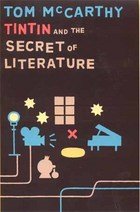
3:AM: Could you tell us about the cover of the book and Tintin’s absence from the illustrations inside?

TMcC: The cover is by Jochen Gerner, a French artist. I saw a book he’d done called TNT en Amérique, in which he buried the whole of Tintin in America under black ink but left a few symbols, mainly of money, divinity and violence (i.e. dollar signs, crosses and guns, all done in cartoony style) as markers for what he’d erased — all on the correct pages, corresponding to frames in the original book. So I contacted him and asked him to do the cover, and he was really into it. We looked at the main motifs in The Castafiore Emerald — the window, the piano, the cameras and spotlights that, ultimately, occlude more than they reveal — and he applied his technique (which, after Bataille, he calls ‘déformation’) to these. And in the foreground, as on Hergé’s, the tufted figure with his finger to his lips, saying ‘Shhhh!’ — what in the book I call “the condition of the secret become visible”.

To answer the second part of your question: I didn’t want images directly from the Tintin books inside my book. I was more interested in showing how these images (which I’m assuming most people who read my book will be at least slightly familiar with) mutate into and out of other ones: eighteenth-century portraits of castrato singers, stills from Buster Keaton films and, not least, ‘detourned’ versions of the Tintin books themselves. These last images break down into political activist ones, pornographic ones and ‘art’ ones: an interesting triangle.

THE BOY HAIRDRESSER

3:AM: Given your chapter devoted to “Castafiore’s Clit” (if you ever form a band, promise me that you’ll use that name) and your comments about Tintin’s androgyny, I was surprised you didn’t devote at least a few lines to the once-ubiquitous gay Tintin haircut…

TMcC: A band called Castafiore’s Clit is a great idea. Kind of Jane’s Addiction meets The Thompson Twins. Yes, it’s funny that Tintin has lent his haircut to gay culture. I found out recently that the Rocker quiff of the Fifties was taken directly from Jean Marais’s haircut in Cocteau’s Orphée, another big presence in my book.

THE SINS OF THE FATHER

3:AM: During the Second World War, Hergé had no qualms about publishing his comic strips in Le Soir, a newspaper that was under Nazi control and had clear Nazi sympathies. Interestingly enough, as you point out, Paul de Man also wrote for Le Soir. However, I was surprised that you did not make more of this coincidence. Paul de Man’s undermining of meaning and values having been reinterpreted (and partly discredited) in the light of the posthumous discovery of his youthful far-right views, should not we also be somewhat wary of Hergé’s “retroactive wiping-out of history” (p. 41), the erosion of Rastapopoulos’s “Semitic status” (pp. 44-45) or his reinvention as a “liberal leftist” (p. 46)? After all, anti-capitalism and anti-consumerism which, in your view, testify to the author’s “right-to-left trajectory” (p. 47) are common tenets on the far right as well as the far left…

TMcC: I never went with the argument that Paul de Man’s shameful youthful secret undermines all of deconstruction (is Derrida, a Jew, a secret anti-Semite too?), not least because when I was at university one of this argument’s main advocates serially harassed his female students while simultaneously espousing feminism, which for me kind of discredited anything he had to say. Yes, the anti-consumerist thing can serve a right-wing position as much as a left-wing one, and I point out in the book that Hergé kept the same villains in place throughout his career (secret cabals, men in hoods). But I think his right-to-left trajectory was a genuine one, as was Paul de Man’s. Things are connected. Fascism is a moment that the twentieth century goes through, in the arts as much as anywhere else. Think of Yeats, Spengler, Hamsun, Pound, Céline — brilliant and hugely influential writers who were fascists. Do we discount anything that’s come after them? Of course not: you trace the fallout of the disaster, how it mutates and develops. Think of Heidegger, a one-time Nazi out of whose thought the incredibly compelling ethical vision of Levinas (another Jew) has emerged. Anyway, it would be naive and liberal to want all our artists to be nice Guardian readers. Some people are arseholes. And another thing: Paul de Man doesn’t undermine meaning and value — just certain tired and reactionary notions of both.

[Just for the record: I didn’t mean to imply that Hergé’s, Céline’s or Yeats’s works should be rejected because of their political views, although I clearly gave that impression. Like Tom, I subscribe to a resolutely politically-incorrect conception of literature. My point simply concerned anti-capitalism and anti-consumerism (which the far left certainly has no monopoly over) along with the fact that certain thinkers’ seemingly-rational ideas are so obviously linked to individual history (Maurras’s deafness or Foucault’s masochism, for instance) that one should sometimes approach them with a little caution. Another issue we could have raised here is the Arendt-Heidegger relationship, but that would probably have been one serendipitous detour — to quote McCarthy — too many!]


FOUND IN TRANSLATION

3:AM: Remainder — the best novel of 2005 which, due to its republication by Alma Books, looks set to be the novel of 2006 (ironically enough, given the theme of the book) — could be described as the best French novel ever written in English by an Englishman. With Tintin and the Secret of Literature, your approach is once again resolutely French. Almost all of your major references are French (Balzac, Baudelaire, Barthes, Derrida…), and even the vocabulary you use is Gallicized (“fictive,” for instance, which is far closer to the French “fictif” than “fictional”). Where does your familiarity with French culture and the French language come from? Was it deliberate on your part to largely avoid references to British or American literature? Wouldn’t it have been interesting to give a more English perspective on Tintin since Tintinologists have a habit of being Belgian or French?

TMcC: First of all, thanks for your kind words about Remainder, and I’ll try to persuade my French publisher, Hachette Littératures, to use your “best French novel in English” line as a blurb for their edition that’s coming out next September — I couldn’t think of better praise! Yes, most of the points of reference in Tintin and the Secret of Literature are French, although Defoe, Bunyan, Behn and other Anglo early novelists get a look in — plus there’s a big digression through Shakespeare’s Sonnets. I guess I just really like French literature. The English were going really well from the sixteenth to the nineteenth centuries, producing poets like Donne and Marvell and novels like Clarissa and Tristram Shandy, but it all went horribly wrong somewhere in the late nineteenth/early twentieth and, while the French (and Americans) embarked on the wildest adventures with thought and form — Mallarmé, Breton, Cendrars, Faulkner etc etc — we got Thomas fucking Hardy and DH fucking Lawrence. The only top-class twentieth century English writers are the ones we claim spuriously: Americans like Eliot and James, Poles like Conrad, Irishmen like Joyce and Beckett…

3:AM: At the same time, there is a sense of humour and earthiness which are very un-French, as it were. After the publication of a strange review in The Economist which presented your book as a send-up of French theory, you spoke to me of the astounding “idiocy of English empirical culture”: do you think Tintin and the Secret of Literature is going to reignite the critical Querelle des Anciens et des Modernes of the 80s and 90s?

TMcC: I think to ignite any thought at The Economist you’d need to stick a ton of semtex up their arses. That review was quite funny, though: it perfectly captured the red-faced, vein-popping fury of Little England once the values on which it bases its entire identity are ever-so-slightly “solicited”, as Derrida would say. English takes on Tintin always present Hergé as a ’satirist’ and only that: a self-sufficient, rational subject who uses words and images as tools to tell us something he knows because he’s worked it out, rationally, you see. That’s the empirical line on literature tout court: the rational expression of a self-sufficient subject — as though we weren’t constantly made and unmade within language, desire, history, symbolic networks and so on. It’s as moronic as crediting a surfer with creating the wave which carries him and allows him to ply his craft — and back into which he’s eventually going to sink.

McCARTHYISM

3:AM: You say that you were introduced to Tintin by your mother at the age of seven. That, in itself, probably says a lot about your social background — that and your early encounter with Hugo Williams (mentioned by the poet in an article he wrote in the TLS about your International Necronautical Society). In France, in the 70s, Le Journal de Tintin tended to be read in Catholic and conservative circles whereas kids from Communist families usually read a comic called Pif. What sort of social and cultural milieu were you raised in, Tom?

TMcC: I come from a liberal arts-steeped middle-class family. My mum would tell us the stories of The Odyssey and The Merchant of Venice on car journeys. My parents were left-ish but not radical. They voted Labour but I went to a private day-school from the age of twelve.

3:AM: You write that “Everybody wants to be Tintin,” but I get the feeling that that everybody applies, first and foremost, to you. You even bear a slight physical resemblance to Hergé’s hero…

TMcC: I went to a fancy dress party dressed as Tintin once…

3:AM: Susan Tomaselli rounds off her review with the claim that Tintin and the Secret of Literature made her feel like re-reading Remainder (your debut novel) rather than the Tintin books themselves. Do you see this as a success or a failure?

TMcC: Success — although she should read the Tintin books too. In a way, I used Tintin and the Secret of Literature to work through some of the themes in Remainder in a more conscious way: the relationship between trauma and repetition, for example, or the idea of inauthenticity which emerged from the de Man essay “The Rhetoric of Temporality”, which I hadn’t read when I wrote Remainder even though it could almost be describing that book. It’s great to be able to switch modes, and come at the same territory from a different angle.

WE WANTED TO BLOW UP TIME ITSELF

3:AM: Your whole oeuvre seems to be contained within this critical essay: Tintin and the Secret of Literature could thus be read as a work of internal intertextuality. First of all, there’s the importance of meridians which points to Greenwich Degree Zero, your recent artistic collaboration with Rod Dickinson…

TMcC: …when we blew up the Greenwich Observatory, or at least produced the documentation of having blown up the Observatory, completing the task of Martial Bourdin, model for Conrad’s Stevie in The Secret Agent. We wanted to blow up time itself. Funnily enough, there’s a scene in The Broken Ear where a secret agent like Stevie carries a time-bomb around and gets blown up by it because he doesn’t realise the town clocks have broken. I love the sequence in The Sound and the Fury where Quentin carries a broken clock around and rides trams in different directions in a sub-Einsteinian attempt to escape time — then dies…
WE WANTED TO BLOW UP BRIDGES

3:AM: Then you’ve got the references to Cocteau’s Orphée and, more generally, your fascination with the “transmission-reception figure” (as you put it elsewhere): “[Tintin] will also be aware, as a radio operator, that the waves which carry his transmissions will travel outwards endlessly through space. Who knows where the signals will end up, or what they will end up meaning?” (p. 91).

TMcC: If I had to select five things to put in a space capsule to show aliens what we were capable of, Orphée would be one of them. It’s the most perfect piece of art, which lays out our existence as being in relation to death, technology, transmission-reception and desire — not to mention repetition. Death, a beautiful princess (and arts patron) falls in love with Orphée so she has another poet snatched to the underworld so he can send illicit, looping radio messages to Orphée which draw him towards her, through a mirror. Cocteau based his radio messages on the ones sent to occupied France during World War Two: these short lines of poetry. Most of them meant nothing, but one in every two hundred meant — only to those who knew — ‘blow up the bridge’. A man or woman in London reads a line of poetry into a microphone and in France a bridge blows up — or not. Poetry — real poetry — should harbour that potentiality somehow.

3:AM: You talk about Alph-Art, the eponymous avant-garde movement of Hergé’s posthumous book, which is “a cover for a giant forgery operation” (p. 158). Couldn’t this also be a fitting definition of your own “semi-fictitious” avant-garde movement, the International Necronautical Society?

TMcC: The INS had its own radio transmission network, operating out of the ICA two years ago, generating messages like Cocteau’s and actually transmitting them over the radio London-wide (and, via collaborating radio stations, world-wide). It looked like a giant factory floor, with workers running everywhere carrying lines of text — lines which, having been plucked from other media sources, were kind of second-hand if not fake. The INS is itself semi-fake, as you point out. Although the fake can hide the real.

THE UNNAMEABLE

3:AM: On page 84, you explain that, according to Freud, trauma produces “a desire for repetition mixed with a need to disguise the scene being repeated”. Could you comment on this sentence with reference to your novel Remainder?

TMcC: It’s not just Freud who says this: even his most positivist counterparts concur. Under ultra-extreme stress, the part of the mind that processes raw data into the narrative thread we call ‘memory’ simply goes on strike and refuses to process. It’s called ‘dissociation’. So the data’s present, but not dealt with, and therefore keeps bobbing up and demanding to be incorporated somehow. As it can’t form part of normal memory, it plays itself out in weird ways — ones that contain elements of the original event but are also scrambled, disguised. And it will keep repeating, albeit in modulated form, until it is accommodated properly. Well, in Remainder the hero has undergone a traumatic event which he hasn’t retained as straight memory but rather as fragments of data: the sense of being about to be hit, blue lights, railings, being held above a tray or bed and so on. These induce a propensity to repeat stuff in him. Another interesting thing about post-trauma is that (to return to a motif we touched on a moment ago) it makes people feel inauthentic, fake, because everything is of a lesser magnitude of experience than the trauma-moment itself, the only ‘real’ thing. And then the subject back-projects for himself a time when he wasn’t fake, and longs for that time. That’s what my guy is doing with his re-enactments: repeating backwards to an imagined era of authenticity — but repeating, more accurately, towards the trauma-moment itself, the true, unnameable moment, the moment of truth and unnameability itself.

THE CHINK ON THE CARPET

3:AM: The re-enactments in Remainder or in your artistic work: mimesis or simulacrum?

TMcC: Aha: very good question, bang on the money. In Remainder, he wants the authentic, so he sets up a zone of mimesis, paying architects and designers to recreate his ‘remembered’ building and re-enactors to ‘be’ the lady he remembers frying liver on the floor below him, the pianist he remembers practising Rachmaninoff and so on. He wants to accede through these re-enactments to a mode of authenticity, of simply ‘being’ rather than simulating. But of course it doesn’t work: the re-enactments tend more towards the status of simulacra, what Plato defines as ‘a copy without an original’. But then, paradoxically, the most jarring and obviously inconsistent things, the ‘extra’ bits, the ones with no originals of any type at all, are what catapult him into ultra-authenticity — which, not coincidentally, is also pure violence. It’s the little chink on the carpet of his re-enacted bank heist that flips the whole re-enactment over into all-too-real-ness, when the re-enactor trips on it, or rather on its absence, and his gun goes off…

[Stewart Home and Tom McCarthy at 3:AM Magazine‘s Xmas Bash, London 2005]

THE CRACK IN THE WALL

3:AM: Barthes writes that “…the ‘realistic’ artist never places reality at the origin of his discourse, but only and always, as far back as can be traced, an already written real, a prospective code, along which we discern, as far as the eye can see, only a succession of copies” (quoted on p. 55): this is also, unwittingly, what the protagonist of Remainder does, right?

TMcC: Remainder has been read by some critics as an allegory of realism and of the realist mode of art, and this isn’t an entirely wrong reading — although if the hero had actually been an artist rather than an Everyman, some bloke, it would have been an entirely different, and inferior, book. But yes, it definitely turns around his copying, and even (as he sets about getting his re-enactors to re-enact the moments when they prepared for the previous re-enactment) his copying his moments of copying, endlessly regressive. We can try to work it out together, but ultimately I can’t give the definitive schematic meta-reading of the book any more than you — perhaps less. It was intuitive: I was looking at a crack in a wall and had a moment of dejà-vu and wished I had loads of money to re-enact this moment and there was the novel.

EVERYTHING LITERATURE SHOULD BE

3:AM: When discussing tobacco throughout the Tintin books, you explain (following Derrida) that it “goes up in smoke” but “also leaves remains, ashes, which maintain symbolic links to memory, death and inheritance. Baudelaire’s story takes off from the change left over from the two friends’ luxury expenditure: like the coin itself, it proceeds from the remainder” (p. 135). Why are remnants so important in your work?

TMcC: It’s what’s left. After the disaster, after thought, interpretation, writing itself. It’s like when Wallace Stevens says “The plum survives its poems”. Writing has to deal with this remainder, and good writing has to deal with the fact that it can never fully deal with it. Francis Ponge knows this. He writes brilliant prose poems about, for example, oranges: the texture of their cells, the way they leave goop on your hands so that even when you’ve ‘expressed’ them there’s a residue that’s not contained. If Susan Tomaselli or anyone else really want to do themselves a favour, they should re-read neither Remainder nor the Tintin books but rather Ponge’s Le Parti pris des choses (you can get it in dual text). It’s everything writing should be.

[This interview was initially posted here.]
In Theory: Towards a New Novel

This appeared in Guardian Books on 13 May 2010:

In Theory: Towards a New Novel

Alain Robbe-Grillet’s provocative essays on creating new literature outside the ‘dead rules’ of the past resonate now

Alain Robbe-Grillet

A novel ‘expresses nothing but itself’ … Alain Robbe-Grillet. Photograph: Daniel Janin/AFP/Getty Images

David Shields recently dismissed most contemporary novels as “antediluvian texts” that “could have been written by Flaubert 150 years ago”. “In no way,” claimed the author of Reality Hunger, “do they convey what it feels like to live in the 21st century.”

He has a point — albeit one that Alain Robbe-Grillet had already made in 1965 when he deplored the fact that young French novelists were praised for writing “like Stendhal” but castigated as soon as they refused to abide by the “dead rules” of a bygone age. Along with Michel Butor, Nathalie Sarraute and Claude Simon — the main proponents of the new novel (nouveau roman) — Robbe-Grillet stood resolutely in the second camp. In his essays, he returns time and again to the notion that the novel, from Stendhal to Joyce, has constantly evolved — hence the absurdity of using “the norms of the past” to judge the fiction of today. Far from representing a rejection of the past, the quest for a new novel was thus very much in keeping with the history of a genre which, by definition, must always be renewed.

Feeling that his work was too often misrepresented by the critical establishment (with a few notable exceptions including Barthes, Blanchot and Nabokov), Robbe-Grillet published a series of articles to set the record straight. In 1963 they were collected in Towards a New Novel — for my money, one of the most important works of postwar literary criticism. However, these “critical reflections” were never meant to constitute a manifesto. Every novel, according to Robbe-Grillet, is a self-sufficient work of art which cannot be reduced to some external meaning or truth that is “known in advance”. “The New Novel,” as he put it, “is not a theory, it is an exploration.” Why bother writing a book that illustrates a rule when “the statement of the rule would suffice”?

Quoting Heidegger at the beginning of an essay on Waiting For Godot, Robbe-Grillet writes that the human condition is “to be there”. In another essay, he states that it is “chiefly in its presence that the world’s reality resides”. So there you have it. Man is here, the world is there and the distance between the two lies at the heart of the new novel project. We endow the world with meaning (or meaninglessness) in order to control it. From this point of view, the writer’s traditional role was to excavate nature in order to unearth the “hidden soul of things”. Robbe-Grillet calls for the creation of a new form of fiction that reflects the “more modest, less anthropomorphic world” we live in today — one which is “neither significant nor absurd,” but simply is.

This seemingly anodyne observation has serious literary ramifications. Gone is the traditional hero of yore who believed the world was there to be conquered and whose hour of glory coincided with the triumph of individualism. Gone is the humanist “communion” between people and things: “Things are things, and man is only man”. Gone is the notion of tragedy, which Robbe-Grillet sees as a twisted ploy to reaffirm this solidarity: “I call out. No one answers. Instead of concluding that there is no one there (…) I decide to act as if someone were there, but someone who, for some reason or other, will not answer”. In the new novel, “Man looks at the world” but “the world does not look back,” which precludes any symbolism or transcendence. The novelist’s task now is to describe the material world, not to appropriate it or project himself onto it; to record the distance between human beings and things without interpreting this distance as a painful division. All this implies that the “entire literary language” be reformed. Similes and metaphors, which are often used gratuitously to confer literary status upon a text, are seldom innocent since they tend to anthropomorphise the world.

The new novel is routinely attacked for being inhuman and coldly descriptive. Robbe-Grillet responds that his work is in fact far less objective than the godlike, omniscient narrator who presides over so many traditional novels. Description here is purely subjective and takes centre stage, whereas in Balzac, for instance, it simply sets the scene by lending the plot an air of authenticity. Instead of referring to an external, pre-existing reality, Robbe-Grillet’s descriptions seem to create their own objects, their own hallucinatory reality. “Nothing,” he explains, “is more fantastic, ultimately, than precision.”

The reality of any work of art is its form, and to separate style from substance is to “remove the novel from the realm of art”. Art, Robbe-Grillet reminds us, is not just a pretty way of presenting a message: it is the message. Like the world out there, a novel is self-sufficient and “expresses nothing but itself”. Its “necessity” has nothing to do with its “utility”. Whenever an author envisages a future book, “it is always a way of writing which first of all occupies his mind,” which leads Robbe-Grillet to state — provocatively — that “the genuine writer has nothing to say. He has only a way of speaking”. Creative writing classes should always start and end on that note.

****

Here is a slightly longer version of the same piece:

David Shields recently dismissed most contemporary novels as “antediluvian texts” that “could have been written by Flaubert 150 years ago”. “In no way,” claimed the author of Reality Hunger, “do they convey what it feels like to live in the 21st century.” He has a point — one that Alain Robbe-Grillet had already made, back in 1965, when he deplored the fact that young French novelists were praised for writing “like Stendhal” but castigated as soon as they refused to abide by the “dead rules” of a bygone age. Along with Michel Butor, Nathalie Sarraute and Claude Simon — the main proponents of the so-called New Novel (Nouveau Roman) — Robbe-Grillet stood resolutely in the second camp. Throughout his essays, he returns time and again to the notion that the novel, from Stendhal to Joyce, has constantly evolved, hence the absurdity of using “the norms of the past” (and specifically those of the 19th century) to judge the fiction of today. He defends the nouveaux romanciers from accusations of formalism by arguing that the true “formalists” are in fact those who write formulaically, as if “the ‘true novel'” had been cast “once and for all” in the Balzacian mould: “But we, on the contrary, who are accused of being theoreticians, we do not know what a novel, a true novel, should be; we know only that the novel today will be what we make it, today, and that it is not our job to cultivate a resemblance to what it was yesterday, but to go forward”. Far from representing a rejection of the past, the quest for a new novel was thus very much in keeping with the history of a genre which, by definition, must always be renewed. “Flaubert wrote the new novel of 1860, Proust the new novel of 1910”: it was up to the nouveaux romanciers to bring the novel kicking and screaming into the 1950s.

Feeling that his work was too often misrepresented by the critical establishment (with a few notable exceptions like Barthes, Blanchot or Nabokov) and misunderstood by large sections of the reading public, Robbe-Grillet started publishing a series of articles in order to set the record straight. In 1963, they were collected in Towards a New Novel (For a New Novel in the American version; Pour un nouveau roman in the original) which, for my money, remains one of the most important works of post-war criticism. Not surprisingly, these essays cover the period during which Robbe-Grillet was also producing some of his greatest works of fiction: The Voyeur (1955), Jealousy (1957) and the screenplay for Last Year at Marienbad (1961).

In retrospect, some of the author’s predictions may seem wide of the mark: the New Novel did not, for instance, bring about “a revolution more complete” than “romanticism or naturalism”. Robbe-Grillet’s Pascalian “wager” that “man, some day, will free himself” of the concept of tragedy, strikes me as impossibly naive. The claim that calling upon the reader to play an active part in the creation of the world of a novel will also enable him “to learn to invent his own life” probably sounds a tad too ambitious — or even pretentious — for us today. But all this is just nitpicking when set against the radical renewal of fiction that is heralded within these pages. Whereas Finnegans Wake feels like a one-off or a dead end, Towards a New Novel still reads like a blueprint for a truly novel novel.

Robbe-Grillet’s forays into criticism were frowned upon by those who clung to the old cliché of the great writer in the throes of creation as “a kind of unconscious monster” emitting “‘messages’ which only the reader may decipher”. Not only did the author claim that there was no “antinomy between creation and consciousness,” but he was also convinced that literature had entered an age of self-conscious creation in which “critical preoccupations” would prove a “driving force”. However, his “critical reflections” were in no way intended to constitute “a theory, a pre-existing mould into which to pour the books of the future”. Every novel, according to Robbe-Grillet, is a self-sufficient work of art which cannot be reduced to some external meaning or truth that is “known in advance”: “The New Novel is not a theory, it is an exploration”. Why bother writing a book that illustrates a rule when “the statement of the rule would suffice”?

Towards a New Novel is neither a theory of the novel nor the manifesto of a new literary movement. Robbe-Grillet speaks of “a possible novel of the future,” “this literature still in progress” and the search for “a realistic style of an unknown genre beyond Flaubert and Kafka”. It is all very modest and tentative. There are few references to the “New Novel” as such — a term coined by a journalist in 1957 — and none to “L’Ecole du regard” (literally the School of Sight) or “L’Ecole de Minuit” (many of the nouveaux romanciers were published by Les Editions de Minuit where Robbe-Grillet was a literary advisor for 30 years). The New Novel, we are told, is simply a “convenient label for writers seeking new forms to express new relations between Man and the world”. This is as close to a programme that we get.

Quoting Heidegger at the beginning of an essay on Waiting For Godot, Robbe-Grillet writes that the human condition is “to be there”. In another essay, he states that it is “chiefly in its presence that the world’s reality resides”. So there you have it. Man is here, the world is there and the distance between the two lies at the heart of the New Novel project. We endow the world with meaning (or meaninglessness) in order to control it. From this point of view, the writer’s traditional role was to excavate nature in order to unearth the “hidden soul of things”. Words were traps “in which the writer captured the universe” before handing it over to society. Robbe-Grillet calls for the creation of a new form of fiction that reflects the “more modest, less anthropomorphic world” we live in today — one which is “neither significant nor absurd,” but simply is. This seemingly anodyne observation has huge literary ramifications.

Gone is the traditional hero of yore who considered the world was only there to be conquered and whose hour of glory coincided with the triumph of individualism. Gone is the humanist “communion” or “solidarity” between people and things: “Things are things, and man is only man”. Gone is the notion of tragedy, which Robbe-Grillet sees as a twisted ploy to reaffirm this “solidarity”: “I call out. No one answers. Instead of concluding that there is no one there (…) I decide to act as if someone were there, but someone who, for some reason or other, will not answer”. In the New Novel, “Man looks at the world” but “the world does not look back,” which precludes any symbolism or transcendence. The novelist’s task now is to describe the material world (not to appropriate it or project himself onto it); to record the distance between human beings and things (without interpreting this distance as a painful division). All this implies that the “entire literary language” be reformed. Similes and metaphors, which are often used gratuitously to confer literary status upon a text, are seldom innocent since they tend to anthropomorphize the world.

The New Novel is routinely attacked for being inhuman and coldly descriptive. Robbe-Grillet responds that his work is in fact far less objective than the godlike omniscient narrator who presides over so many traditional novels. Description here is purely subjective and takes centre stage whereas in Balzac, for instance, it simply sets the scene by lending the plot an air of authenticity. Instead of referring to an external, pre-existing reality, Robbe-Grillet’s descriptions seem to create their own objects, their own hallucinatory reality. “Nothing,” he explains, “is more fantastic, ultimately, than precision.”

The reality of any work of art is its form, and to separate style from substance is to “remove the novel from the realm of art”. Art, Robbe-Grillet reminds us, is not just a pretty way of presenting a message: it is the message. Like the world out there, a novel is self-sufficient and “expresses nothing but itself”. Its “necessity” has nothing to do with its “utility”. Whenever an author envisages a future book, “it is always a way of writing which first of all occupies his mind,” which leads Robbe-Grillet to state — somewhat provocatively — that “The genuine writer has nothing to say. He has only a way of speaking”. Creative writing classes should always start and end on that note.